Introduction
Political ambition is often seen as a powerful driver of political behaviour. Politicians are goal-seeking actors who strategically adapt their behaviour to maximize their chances of realizing whatever goal they wish to achieve (Strøm, Reference Strøm, Müller and Saalfeld1997). Although such goals may also be policy-related, a crucial part of politicians’ motivations is career-related (e.g. Mayhew, Reference Mayhew1974; Fenno, Reference Fenno1978; Searing, Reference Searing1994; Strøm, Reference Strøm, Müller and Saalfeld1997). Politicians’ career goals can be static, when they primordially want to maintain their current position in the near future, or progressive, when they aspire to attain an office higher or more prestigious than the one (s)he is currently holding (Schlesinger, Reference Schlesinger1966).Footnote 1 In any case, to achieve such ambitions, politicians must adhere to the desires of those who may act as career gatekeepers, which in party-centred, European systems typically to a large extent are political parties and their leaders.
Although often theoretically assumed, empirical research on the link between political behaviour and the fulfilment of static and progressive career ambitions is relatively limited. Many studies have examined the consequences of legislators’ behaviour for their re-(s)election in one way or another (Bowler, Reference Bowler2010; Martin, Reference Martin2010; Bräuninger et al., Reference Bräuninger, Brunner and Däubler2012; François and Navarro, Reference François and Navarro2019; Yildirim et al., Reference Yildirim, Kocapınar and Ecevit2019; Louwerse and Van Vonno, Reference Louwerse and Van Vonno2021). But studies on the consequences for promotion to higher office – let alone studies that examine both the achievement of static and progressive ambitions – are more scarce (see however: Martin, Reference Martin2014; Dockendorff, Reference Dockendorff2019; Treib and Schlipphak, Reference Treib and Schlipphak2019). Such research is crucial, first, because it provides insights into the accountability of political representatives: are legislators rewarded for their efforts? Second, while parliaments’ institutional strength may be weakened due to high levels of legislative turnover (Gouglas et al., Reference Gouglas, Maddens and Brans2018), a further outflow of qualified personnel can be reduced when re-election chances depend on incumbents’ past performance (Ferejohn, Reference Ferejohn1986) or when leadership positions are allocated on a meritocratic basis (Shepsle, Reference Shepsle1988).
This paper empirically investigates the link between MPs’ past performance in parliament and the short-term fulfilment of their parliamentary career ambitions. It makes two contributions to the existing literature: first, it combines an analysis of both MPs’ achievement of static and progressive career ambitions. This allows us to investigate whether the re-election and promotion of MPs – the former being a formal prerequisite to the latter – are conditional upon different aspects of parliamentary behaviour. Second, while most studies focus on the effect of either party loyalty, quantitative parliamentary activity or – to a lesser extent – the quality of MPs’ work, our research design takes into account all of these aspects of incumbents’ past behaviour.
Using a unique combination of behavioural and MP peer assessment data on 325 members of three Belgian parliaments (the federal Chamber of Representatives and the regional parliaments of Flanders and Wallonia) between 2014 and 2019 and their career advancements in the subsequent term (2019–2024), our multivariate analyses reveal that particularly incumbents’ party loyalty and activity level matter for their future careers – but not the quality of their parliamentary work. As such, this study provides important new insights into how legislators may get rewarded (or not) for their parliamentary performance and which factors increase MPs’ chances for re-election and promotion to higher political office.
Parliamentary behaviour and the achievement of career ambitions
Influential rational-choice perspectives on legislative behaviour dictate that in order to understand the actions of politicians, one must understand their individual goals and ambitions. Although legislators may be driven by a strong desire to shape public policies or exert legislative influence (Cox and McCubbins, Reference Cox and McCubbins1993; Searing, Reference Searing1994), it is widely acknowledged that their individual career goals matter. In his seminal work, Mayhew (Reference Mayhew1974) drew attention to incumbents’ particular desire to renew their current position: legislators are ‘single-minded seekers of re-election’ (p. 5) and their behaviour should primarily be understood in that sense. Although re-election is generally a strict necessity before being able to pursue any other office in the legislature, others have argued that also progressive career ambitions should be taken into account (e.g. Schlesinger, Reference Schlesinger1966; Hibbing, Reference Hibbing1986; Herrick and Moore, Reference Herrick and Moore1993). Strøm (Reference Strøm, Müller and Saalfeld1997) distinguishes between four hierarchically-ordered career goals. (1) Reselection and (2) re-election refer to legislators’ static ambitions and can be highly intertwined in party-centred, closed-list PR electoral systems where parties decide on list positions and thus also on incumbents’ electoral chances. (3) Party office and (4) legislative office relate to MPs’ progressive career goals. The former are positions that are entirely under the control of the party itself such as who is to be the parliamentary group leader or whip. The latter are positions such as the Speaker or the committee chair that typically require the consent of a broader coalition of parties.Footnote 2 Such leadership positions or ‘mega seats’ are particularly attractive to legislators because they typically come with prestige, political influence, higher remuneration and other spoils (e.g. extra staff or office space) (Carroll et al., Reference Carroll, Cox and Pachón2006; Martin, Reference Martin2014).
Legislators will try to align their behaviour in parliament with the specific career ambitions they pursue. Strategic parliamentary behaviour takes shape in legislators’ instrumental employment of the scarce resources they possess, such as their voting power, time, staff, and parliamentary prerogatives (e.g. the right to initiate, sponsor or amend bills, plenary speaking time), in order to raise the attention and benevolence of those principals who control access to the positions they desire most (Strøm, Reference Strøm, Müller and Saalfeld1997; Müller, Reference Müller2000). For the static ambition of re-election, these principals are voters and parties, albeit with varying degrees of influence due to candidate selection and electoral rules. For the progressive ambition of acquiring higher office, these typically are political parties (Strøm, Reference Strøm, Müller and Saalfeld1997; Müller, Reference Müller2000; Saalfeld and Strøm, Reference Saalfeld, Strøm, Martin, Saalfeld and Strøm2014).
Empirical research on the link between legislators’ behaviour and the fulfilment of their career ambitions has so far focussed on the effect of three aspects of parliamentary performance: MPs’ (1) party loyalty, (2) their (quantitative) parliamentary effort and less often also (3) the quality of their parliamentary work. In what follows, we present a combined empirical test of the theoretical arguments that underpin these operationalizations and their hypothesized effects on the attainment of MPs’ static (i.e. re-election) and progressive ambitions (i.e. higher parliamentary office).
Party loyalty and career ambitions
First, MPs’ political fortunes may be affected by their loyalty to the party. Party unity is an important asset that political parties use to enhance their policy-making influence, increase decisional efficiency and send out a clear collective message to the electorate (Cox and McCubbins, Reference Cox and McCubbins1993; Laver and Shepsle, Reference Laver, Shepsle, Bowler, Farrell and Katz1999; Müller, Reference Müller2000). It has, therefore, traditionally been argued that parties use their career gatekeeping powers as an ex-ante control instrument through which they make sure that their office-holders’ policy positions align with that of the party, and as an ex-post disciplining tool through which they ensure that MPs contribute to the common party goals (Carey, Reference Carey2007; Bailer, Reference Bailer2017). Particularly for the fulfilment of MPs’ static ambitions, the electoral system is crucial because it vests in career gatekeeping powers either in the hands of voters or in those of the party and its leadership (Strøm, Reference Strøm, Müller and Saalfeld1997). Thus far, an abundant literature has shown how some systems, most notably closed-list systems with centralized candidate selection processes, tend to induce more party loyalty, while others, such as open-list systems where voters’ preference votes may alter parties’ ordering of candidates on the ballot, generate incentives to ‘cultivate a personal vote’ (e.g. Carey and Shugart, Reference Carey and Shugart1995). Indeed, although parties are incentivized to reward loyal MPs, we know that voters may electorally reward ‘mavericks’ who dissent from the party with preference votes (Vivyan and Wagner, Reference Vivyan and Wagner2012; Crisp et al., Reference Crisp, Olivella, Malecki and Sher2013) and that MPs with a strong personal electoral reputation may be less inclined to toe the party line (Tavits, Reference Tavits2009; Sieberer, Reference Sieberer2010).
Still, even in open or flexible list PR systems, parties typically severely weigh on (centralized) candidate selection processes. They consequently may reward loyal MPs by giving them a visible (and thus advantageous) position on the electoral ballot. Hence, we expect that incumbents’ party loyalty is positively correlated with their chances of re-election (H1a).
Whereas voters may co-impact the fulfilment of static ambitions to some extent, parties typically possess a monopoly over the allocation of positions that may satisfy MPs’ progressive ambitions. We may hence expect to find a positive effect of MPs’ loyalty on their advancement to higher positions (H1b) that is perhaps even more substantial than the effect on MPs’ re-election prospects, where also voters’ judgements matter and parties may be incentivized to take advantage of the personal reputations of electorally-strong candidates (Crisp et al., Reference Crisp, Olivella, Malecki and Sher2013; André et al., Reference André, Depauw, Shugart and Chytilek2017). At least in theory, party leaders may use office spoils (beyond re-selection) as discipline-inducing ‘carrots and sticks’ (Bailer, Reference Bailer2017). Empirical research indeed suggests not only that dissenting MPs more often desire to take up a position that is external to the legislature in which they currently serve (Meserve et al., Reference Meserve, Pemstein and Bernhard2009) but also that those who occupy a parliamentary leadership position are less likely to defect (Becher and Sieberer, Reference Becher and Sieberer2008) and that party loyalty may be rewarded with leadership positions in parliament, such as, whip or committee chair positions in more candidate-centred electoral systems (Martin, Reference Martin2014). In sum, we expect that:
H1a: Loyal MPs are more likely to satisfy their static ambitions by gaining re-election.
H1b: Loyal MPs are more likely to satisfy their progressive ambitions by acquiring a higher parliamentary office.
Parliamentary effort and career ambitions
Loyalty is, however, probably not all that matters. MPs’ level of activity, sometimes labelled as their parliamentary effort, is generally regarded as an indirect but observable proxy of their political ambition (Hermansen, Reference Hermansen2016; Høyland et al., Reference Høyland, Hobolt and Hix2019; Treib and Schlipphak, Reference Treib and Schlipphak2019). We know that MPs’ parliamentary activity is correlated with contextual factors at the party-level, such as parties’ government status, party family or size. Particularly MPs from opposition parties and smaller party groups are generally expected to more actively make use of the wide variety of parliamentary tools they have at their disposal (e.g. Jenny and Müller, Reference Jenny, Müller, Blomgren and Rozenberg2012). Parties, in other words, ‘constrain MPs’ actions, but also offer the context in which their behaviour will be evaluated’ (Louwerse and Otjes, Reference Louwerse and Otjes2016: 791). By productively engaging in many parliamentary activities instead of portraying ‘slacking behaviour’ (Frech et al., Reference Frech, Goet and Hug2020), legislators show to party leaders their eagerness and willingness to contribute to the party’s policy goals by actively developing and defending detailed bill proposals and scrutinizing governmental policies within their designated area of issue specialization (Louwerse and Van Vonno, Reference Louwerse and Van Vonno2021). Furthermore, parliamentary tools may not only serve policy-seeking goals but can also be used following a personal vote-seeking strategy by legislators who wish to increase their visibility and name recognition among the public (Bräuninger et al., Reference Bräuninger, Brunner and Däubler2012; Däubler et al., Reference Däubler, Bräuninger and Brunner2016). Activity might directly result in increased voter support according to this logic (see e.g. Bowler, Reference Bowler2010; François and Navarro, Reference François and Navarro2019), but since parties may reward politicians with a strong personal electoral reputation, party leaders might also valorise efforts by individual MPs to gain public prominence through their activity by satisfying their career ambitions (Yildirim et al., Reference Yildirim, Kocapınar and Ecevit2019). Empirical research has indeed established links between MPs’ parliamentary efforts and their re-selection chances (Däubler et al., Reference Däubler, Christensen and Linek2018; Papp, Reference Papp2019; Yildirim et al., Reference Yildirim, Kocapınar and Ecevit2019; Louwerse and Van Vonno, Reference Louwerse and Van Vonno2021). Evidence from Chili (Dockendorff, Reference Dockendorff2019) and the European Parliament (Treib and Schlipphak, Reference Treib and Schlipphak2019) furthermore shows that increased activity might also lead to promotion to higher parliamentary office. We hence expect that MPs who are more active in parliament are more likely to satisfy their static (H2a) and progressive ambitions (H2b).
H2a: MPs who are more active in parliament are more likely to satisfy their static ambitions by gaining re-election.
H2b: MPs who are more active are more likely to satisfy their progressive ambitions by attaining higher parliamentary office.
Parliamentary quality and career ambitions
Lastly, a disadvantage of a narrow focus on observable parliamentary behaviour is that one potentially misses out on crucial information about the quality of legislators’ work or about their activities behind the scenes. Some legislators might not necessarily stand out because of their high levels of parliamentary activity but do strike as legislators that may selectively, but very effectively, use parliamentary tools to influence policy-making because of their higher expertise, experience and larger personal networks (Miquel and Snyder Jr, Reference Miquel and Snyder2006; Volden and Wiseman, Reference Volden and Wiseman2009). Although qualitative aspects of parliamentary work may not always be publicly visible, the media or opinion leaders may play an important role in fostering additional voter support for incumbents (Bouteca et al., Reference Bouteca, Smulders, Maddens, Devos and Wauters2019). Also, party selectors may reward qualitative parliamentary work since inductive research suggests that ‘quality [of parliamentary work] may trump quantity for representatives that want to make a name for themselves inside the party’ (Borghetto and Lisi, Reference Borghetto and Lisi2018: 16; see also: Mondak, Reference Mondak1995; Stone et al., Reference Stone, Maisel and Maestas2004). Empirical research about the link between the quality of MPs’ parliamentary work and their career prospects is, however, very scarce. Nevertheless, findings from the relation between legislative effectiveness and the allocation of parliamentary leadership positions among members of the North Carolina Congress indicate that incumbents’ previous qualitative parliamentary performance is an important predictor for career advancement (Miquel and Snyder Jr, Reference Miquel and Snyder2006). Also we hypothesize – besides a positive effect of the quantity of MPs’ parliamentary work and their party loyalty – that MPs who pay more attention to qualitative aspects of their parliamentary work (as assessed by their peers, see below) are more likely to fulfil both their static (re-election) and progressive career ambitions (higher office).
H3a: MPs whose work is assessed as more qualitative are more likely to satisfy their static ambitions by gaining re-election.
H3b: MPs whose work is assessed as more qualitative are more likely to satisfy their progressive ambitions by attaining higher parliamentary office.
Research design
Case selection
We test our hypotheses using data on 325 membersFootnote 3 of three Belgian parliaments between 2014 and 2019: the federal Chamber of Representatives, the Flemish Parliament and the Parliament of Wallonia.Footnote 4 Belgium is a suitable case to study the potential impact of parliamentary performance on incumbents’ parliamentary careers for a number of reasons. Like in many systems, Belgian MPs face diverging incentives from different principals, due to the country’s flexible list PR electoral system. On the one hand, MPs – both from the federal and regional parliaments – are directly accountable to voters who may cast a preference vote on their preferred candidate(s). On the other hand, parties have a strong impact on incumbents’ political careers, not only through their monopoly on the allocation of leadership positions but also due to the relative importance of candidates’ list positions (which are assigned by party selectorates) compared to the more limited impact of preference votes on parliamentary seat allocation (De Winter, Reference De Winter, Gallagher and Mitchell2005). Many voters cast list votes and when they do cast a preference vote, it is often for a top-list candidate who would have been elected (based on the redistribution of list votes) anyway (Wauters et al., Reference Wauters, Thijssen, Van Aelst and Pilet2016). Although party selectors do take candidates’ personal electoral reputations into account (André et al., Reference André, Depauw, Shugart and Chytilek2017), these may be less important for the attribution of realistic list positions (Put et al., Reference Put, Smulders and Maddens2021). The fact that legislators in Belgium – like in many other countries – display high levels of party loyalty (Depauw and Martin, Reference Depauw, Martin, Giannetti and Benoit2008), has often been an argument to disregard MPs’ voting behaviour in those contexts. However, it could also mean that (rare) defections have particularly severe consequences (see below). Furthermore, although there may be little variation in party loyalty, MPs can still differentiate themselves from their colleagues by diligently and effectively using the wide array of parliamentary tools they have at their disposal to introduce bills, resolutions or ask parliamentary questions (Bräuninger et al., Reference Bräuninger, Brunner and Däubler2012). Consequently, we regard Belgium as a rather typical case for party-centred, list PR electoral systems as often found in Western Europe. Especially for the allocation of leadership positions in parliament, parties decide quite autonomously and are not bound by many formal rules or informal constraints. Unlike for electoral candidates,Footnote 5 formal gender quota do not apply and unlike for highly visible positions such as cabinet ministers (Dumont et al., Reference Dumont, Fiers, Dandoy, Dowding and Dumont2008) an equal territorial representation of all electoral districts is less important.
Dependent variables
We measure the achievement of static and progressive career ambitions by respectively focusing on whether incumbent MPs (i.e. those who served in the 2014–2019 term) got re-elected and obtained a parliamentary leadership position in the subsequent legislative term (2019–2024). For the former, we coded MPs’ re-election as ‘one’ if they renewed their mandate as an MP in either of the three parliaments within 12 months after the 2019 general elections (during which both the federal and regional parliaments were elected) or ‘zero’ otherwise. With this approach, we take into account those MPs who were able to directly secure their seat as well as those who would soon enter parliament as a successor of another MP (e.g. someone who took an oath as a minister) within a reasonable amount of time.Footnote 6
Our second dependent variable indicates whether an incumbent MP obtained a leadership position in the subsequent term. We only consider positions that were acquired during the first year of the 2019–2024 term to exclude any confounding effect of MPs’ behaviour within the new term. Following Strøm (Reference Strøm, Müller and Saalfeld1997), we take into account both (parliamentary) party offices and legislative offices acquired in one of the three parliaments under study. Legislative offices include those of Speaker, Vice-Speaker, member of the parliamentary bureau,Footnote 7 or committee chair. Parliamentary party leaders, who both act as managers and spearheads of their parliamentary parties (de Vet, Reference de Vet2019) are counted as holding a party office.Footnote 8 Our binary dependent variable parliamentary leadership position is coded as one if incumbent MPs acquired any party or legislative office, and zero if they did not. It is important to note that MPs’ achievement of acquiring a leadership position can only be observed for those that got re-elected. Consequently, our total sample of 325 Belgian MPs is reduced to 158 re-elected MPs for the analysis of this dependent variable. Our statistical models explicitly take this potential selection bias into account (see below).
Independent variables
Our independent variables measure three aspects of the parliamentary performance of MPs in the 2014–2019 legislative term using a unique combination of behavioural and elite survey data.
First, MPs’ party loyalty is measured based on their plenary voting record (see e.g. Crisp et al., Reference Crisp, Olivella, Malecki and Sher2013). Even though Belgian parties are characterized by high levels of party unity (Depauw and Martin, Reference Depauw, Martin, Giannetti and Benoit2008) and we may thus expect little variation, this does also imply that even a low amount of voting defections from the parliamentary party may be highly consequential. We expect diminishing (negative) returns of voting against the party line: negative consequences will decrease for an increasing amount of voting defections. Each MPs’ party loyalty is therefore measured with a negatively loading indicator of his/her voting defection by taking the natural logarithm of the percent of votes an MP did not vote with the majority of his/her parliamentary party.
Second, we measure the parliamentary activity (quantitative parliamentary performance) of incumbent MPs based on their use of various parliamentary tools. We take into account plenary speech frequency, plenary speech length, the number of oral parliamentary questions (both in plenary and committee sessions), written parliamentary questions, private members’ bills and resolutions. Rather than determining arbitrary weights to aggregate the indicators, the data is summarized based on its empirically underlying structure with the help of exploratory and confirmatory factor analyses (for more details see Schobess, Reference Schobess2021). This approach reveals three primary dimensions: representation activity, legislative activity, and control/oversight activity that cluster around the overarching concept of MPs’ overall parliamentary activity.
Third, in order to take into account more qualitative (and less publicly visible) aspects of MPs’ parliamentary work, we innovatively make use of (rater bias corrected) peer assessment scores. Using a unique survey design, MPs were asked to evaluate six qualitative aspects of the parliamentary work for 12 randomly sampled peers that are active in the same parliamentary committees or parliamentary party group. These six aspects are the perceived ‘quality’ and ‘effectiveness’ of MPs’ three main parliamentary functions: representation, legislation and oversight (for the theoretical argumentation see: Schobess, Reference Schobess2021). The peer assessment survey had a response rate of 28.3 percent and resulted in a total of 6576 evaluations covering 93.1 percent of our population of Belgian MPs. The raw peer assessment scores have been controlled for various forms of individual rater bias with a Bayesian ordered probit varying-intercepts, varying-slopes model. Exploratory and confirmatory factor analyses revealed that the indicators of MPs’ qualitative parliamentary performance cluster around two dimensions that compose the latent variable of MPs’ quality of parliamentary work, the content of MPs’ parliamentary work, and their policy-making effectiveness (for more details see Schobess, Reference Schobess2021). While ‘policy-making effectiveness’ is primarily related to individual MPs’ capability to influence public policy outcomes, ‘content of parliamentary work’ mainly captures MPs’ loyalty towards voters, and the focus on important topics during parliamentary questions.
Control variables
Since the achievement of career ambitions is unlikely to solely depend on parliamentary performance, we need to control for other factors as well. Because MPs’ chances to get re-elected and to rise to higher office might be partially shaped by similar factors and we need to control for a potential selection bias (see below), a number of control variables are included in our analyses of both dependent variables. Obviously, MPs who already held a leadership position before the elections may have good reason to re-claim their position. Moreover, already holding a visible leadership position can signal expertise for the future exercise of a (higher) parliamentary function. We therefore include lagged control variables for incumbent committee chairs, (vice-)Speakers, Bureau members and parliamentary party group leaders. Because similar arguments also hold for MPs’ general political experience, we also control whether an MP has previously been a minister at the Belgian national or regional levels and account for MPs’ (logged) parliamentary seniority.Footnote 9 MPs’ gender is also included in the models, as social psychological studies indicate that the behaviour of female politicians might be judged more critically than that of men (e.g. Cucchi and Cavazza, Reference Cucchi and Cavazza2021). Finally, we include two party characteristics that might potentially affect incumbents’ chances to ascend to higher office: whether or not MPs’ parties belonged to the majority or opposition as well as the raw seat change of MPs’ parliamentary parties (PPG size change) after the election as parliamentary positions are distributed proportionally.
In order to estimate the potential selection bias for MPs’ appointments to higher office we include a number of additional controls for the analyses of incumbents’ re-election chances. We include two variables that relate to incumbents’ previous electoral performance: their electoral vulnerability Footnote 10 in the previous election and whether (s)he ran on the main electoral list or got the mandate as a substitute replacing another MP. Secondly, we control for three additional factors that are likely to be associated with both our independent variables and incumbents’ chances to get re-elected: MPs’ media coverage during the electoral campaign,Footnote 11 their increased public visibility as a mayor, and the relative share of the previous term (s)he actually exercised the mandate (incumbency time). Finally, we also include dummy variables to control for potential differences between the parliaments.
Statistical model
Since our analysis of incumbents’ rise to higher parliamentary office is per definition limited to those MPs who effectively got re-elected, we make use of an integrated empirical approach that controls for a potential selection bias (see e.g. Heckman, Reference Heckman1974; Heckman, Reference Heckman1979; Timpone, Reference Timpone1998). This approach allows us to relax the implicit assumption that re-elected MPs do not differ from those who did not get re-elected with regard to their previous parliamentary performance. Due to the nature of both dependent variables, we employ a sample selection model for binary outcome variables (see Dubin and Rivers, Reference Dubin and Rivers1989). More precisely, our statistical model has the following specification:
 $${s_i} = \left\{ {\matrix{ 1 \cr 0 \cr } } \right.\matrix{ {\;\;\;if\;s_i^* \gt 0} \hfill \cr {\;\;\;otherwise} \hfill \cr }$$
 $${y_i} = \left\{ {\matrix{ 1 \cr 0 \cr {missing} \cr } } \right.\matrix{ {{\rm}\,\,\,\,\,\,\,\,if{\rm{\;}}y_i^{\rm{*}} \gt 0{\rm{\;}}} \&\ \ {s_i^{\rm{*}} \gt 0} \cr {\,\,\,\,\,\,if{\rm{\;}}y_i^{\rm{*}} \le 0} \ \&\ \ {s_i^{\rm{*}} \gt 0} \cr {{\rm}\!\!\!\!\!\!\!\!\!\!\!\!\!\!\!\!\!\!\!\!\!\!if{\rm{\;}}s_i^{\rm{*}} \le 0} {} {} \cr }$$
 $$\left( {\matrix{ {s_i^*} \cr {y_i^*} \cr } } \right)\;\widetilde{\phantom{a}}\;MVN\left( {\left( {\matrix{ {{\mu _{is}}} \cr {{\mu _{iy}}} \cr } } \right),\Sigma } \right)$$
 $${\mu _{is}} = \;{Z_i}\gamma $$
 $${\mu _{iy}} = \;{X_i}\beta $$
 $$\Sigma = \left( {\matrix{ 1\ \ \rho \cr \rho \ \ 1 \cr } } \right)$$
where
 ${s_i}$
represents a dichotomous variable specifying whether an incumbent MP got re-elected or not and
 ${y_i}$
the achievement of a parliamentary leadership position (only observed for re-elected MPs). The two dependent variables are assumed to have an underlying latent variable
 $s_i^*$
and
 $y_i^*$
respectively indicating the propensity to get re-elected and nominated to a higher parliamentary position that both stem from a multivariate normal distribution with mean
 ${\mu _{is}}$
,
 ${\mu _{iy}}$
and a (co-)variance structure
 $\Sigma $
. We estimate
 ${\mu _{is}}$
and
 ${\mu _{iy}}$
with two vectors of linear predictors
 $\gamma $
and
 $\beta $
(including a constant term) for two sets of explanatory variables
 ${Z_i}$
and
 ${X_i}$
respectively and follow the convention to set the standard deviation of the residuals to one (to allow model identification). Finally,
 $\rho $
indicates the estimated covariance of the residuals for both regressions where a value of zero indicates the absence of any sample selection bias, whereas estimates closer to +1 (−1) indicate a positive (negative) correlation between both equations, that is the strength of a potential selection bias. Inferences are obtained in a Bayesian framework with Markov Chain Monte Carlo (MCMC) simulation choosing
 $N\left( {0,1000} \right)$
as prior distribution for all
 $\;\gamma $
and
 $\beta $
as well as
 $Uniform\left( { - 1,1} \right)$
for
 $\rho $
. We ran three Markov chains of 80.000 iterations each thinned by a factor of 80 after 8.000 burn-in in JAGS (Plummer, Reference Plummer2003).Footnote
12
Results
Descriptive results
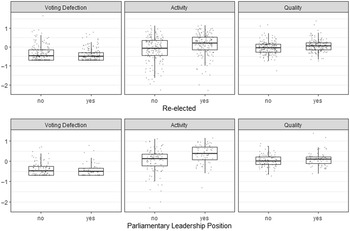
The descriptive results in Figure 1 already provide some tentative support for our theoretical expectations. The distributions of the independent variables across the different groups of MPs show that incumbent MPs who defect more often from the party get slightly less often re-elected or selected for higher parliamentary office. In contrast, MPs with higher levels of parliamentary activity got re-elected and promoted more often than less active MPs. Similarly, MPs that got re-elected or obtained a higher parliamentary office tend to be characterized by a more qualitative parliamentary performance. Independent t-tests, however, show that the distributional differences between these groups of MPs are rather small and only significant for parliamentary activity (both dependent variables, P < 0.001) and for the relation between the quality of parliamentary work and re-election (P < 0.01).
Bivariate relations between voting defection, parliamentary activity, and quality of parliamentary work with MPs’ re-election and promotion to higher parliamentary office.

Multivariate results
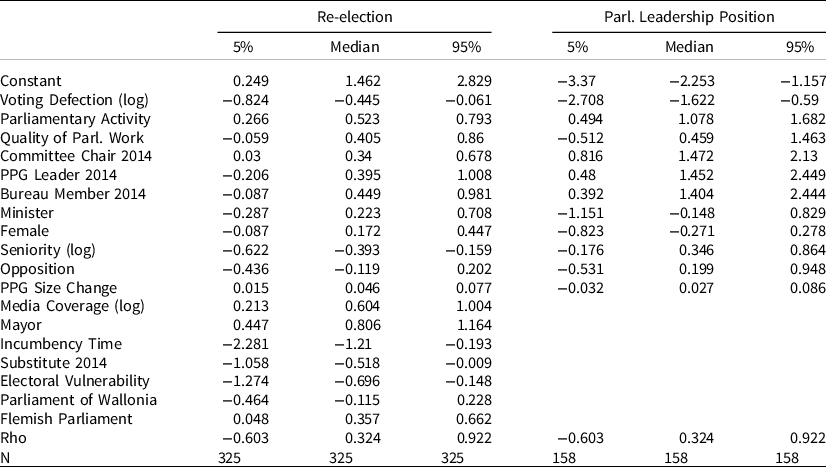
Before discussing the multivariate results, it should be noted that our empirical approach fits the data rather well. Our statistical model enables us to increase the amount of correctly predicted electoral outcomes from 51.4 percent based on chance (taking only the distribution of the dependent variable into account) to 68.9 percent. Similarly, the model can correctly predict whether incumbent MPs obtain a higher parliamentary office for 90.5 percent of our population compared to 62 percent based on chance.Footnote 13 Secondly, the median estimate of the sample selection bias ρ = 0.32 indicates a weak positive correlation between MPs’ propensity to get re-elected and their probability to rise to higher parliamentary office (see Table 1).Footnote 14 Although the large credible interval does not allow us to conclude that our sample is characterized by a selection bias, the potential existence of a positive correlation between both equations stresses the importance to control for a potential selection bias when analysing incumbent MPs’ subsequent career trajectories.Footnote 15
Parliamentary performance and re-election/promotion to higher parliamentary office (Bayesian sample selection model with binary outcome variable)

Note: Posterior medians and credible intervals shown. Identical signs of all three values of a coefficient indicate a 95 percent probability that the coefficient is either positive or negative.
Static career prospects
Turning to the multivariate analysis of MPs’ chances to get re-elected, we first examine the sign of the Bayesian model coefficients and the respective probability that the coefficient is positive/negative (as expected by our hypotheses). The left part of Table 1 shows that the coefficients of all three independent variables point in the theoretically expected direction. While parliamentary activity and quality of parliamentary work are most likely to be positively related with re-election (posterior median >0), MPs’ voting defection is negatively associated with the chances to get re-elected. In fact, our model estimates that the relation between MPs’ voting defection and their re-election has a 97.3 percent (posterior) probability of being negative, providing strong evidence in support of H1a. Similarly, parliamentary activity has a probability above 99.9 percent to be positively related with re-election according to our model. This provides very strong support for our theoretical expectation that more active MPs are more likely to get re-elected (H2a). Since the credible interval for the coefficient of quality of parliamentary work (slightly) overlaps zero, hypothesis H3a is rejected.Footnote 16
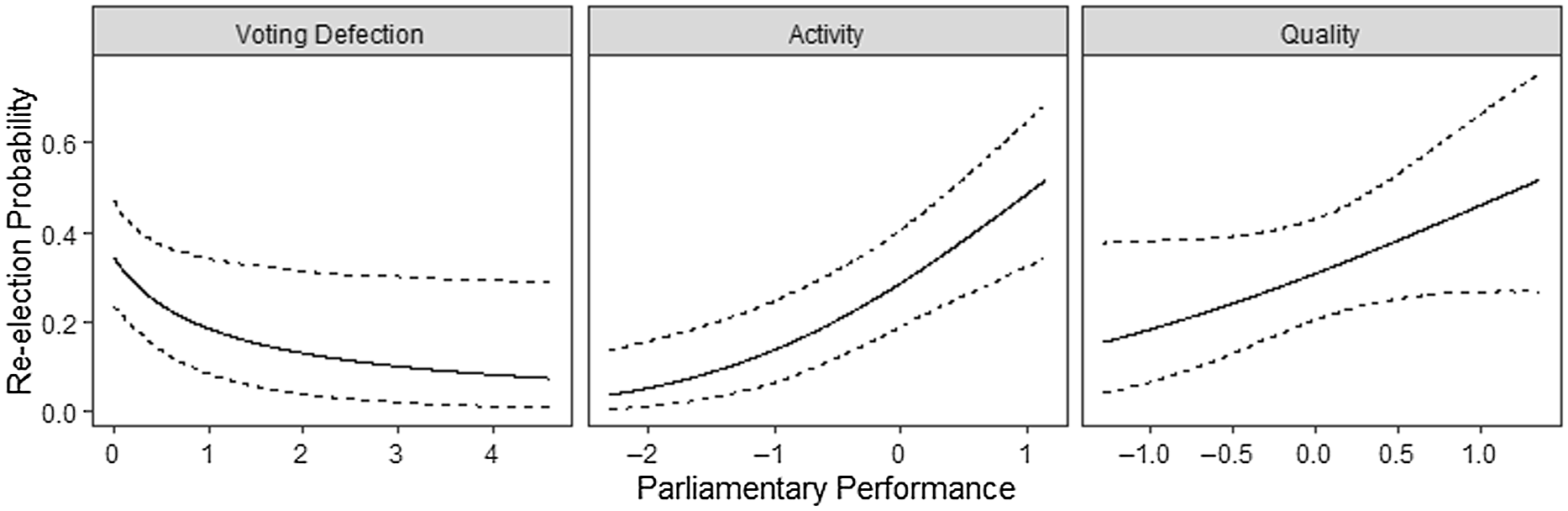
To get a better picture of the substantial effects, we calculate the predicted probability of an MP to get re-elected for 1000 values of our three independent variables (covering their empirical range) while holding all other explanatory factors constant at their median (see Figure 2). The results reveal that an average MP that votes 99.5 percent of the times with his/her parliamentary party can improve his/her chances to get re-elected from around 24 percent to 34 percent by consistently voting all the time with the majority of his/her parliamentary party. Although some would consider a 34 percent probability to get re-elected as low, the analysis shows that even a few defections from one’s party can come at a substantial cost. The effect of party loyalty is even more astonishing given the limited variance in our independent variable (generally very high levels of voting unity). Small behavioural changes may have big electoral consequences.
Additionally, a typical MP with a median level of parliamentary activity can improve his/her average chances to get re-elected from around 29 percent to more than 51 percent by becoming one of the most active MPs in parliament. Finally, while the quality of MPs’ parliamentary work could also go along with better chances to secure one’s re-election, Figure 2 suggests a higher uncertainty about the relation, due to both a smaller effect size and larger credible intervals of the coefficient as compared to MPs’ parliamentary activity.
Predicted probabilities for MPs’ chances to get re-elected due to changes in (1) voting defection (original scale), (2) parliamentary activity (factor score with mean = 0 and SD = 0.6) and (3) quality of parliamentary work (factor score with mean = 0 and SD = 0.3).

Progressive career prospects
Next, we turn to MPs’ chances to obtain a parliamentary leadership position. In line with our theoretical expectations, Table 1 (right part) demonstrates that MPs’ voting defection is negatively related with their chances for parliamentary promotion, while their previous activity and quality of parliamentary work are positively associated with the probability to get selected for a higher parliamentary office. However, the level of uncertainty for these relations differs for the three coefficients. A posterior probability each above 99.9 percent provides very strong support for hypotheses H1b and H2b, suggesting that MPs that were less loyal or less active are less likely to get selected for a parliamentary leadership position. The empirical results, however, force us to reject H3b since the probability for a positive relation between MPs’ quality of parliamentary work and incumbents’ promotion to higher office is below conventional standards. Apparently, qualitative aspects of MPs’ previous parliamentary performance matter little for incumbent MPs’ chances to get selected for higher parliamentary office.Footnote 17
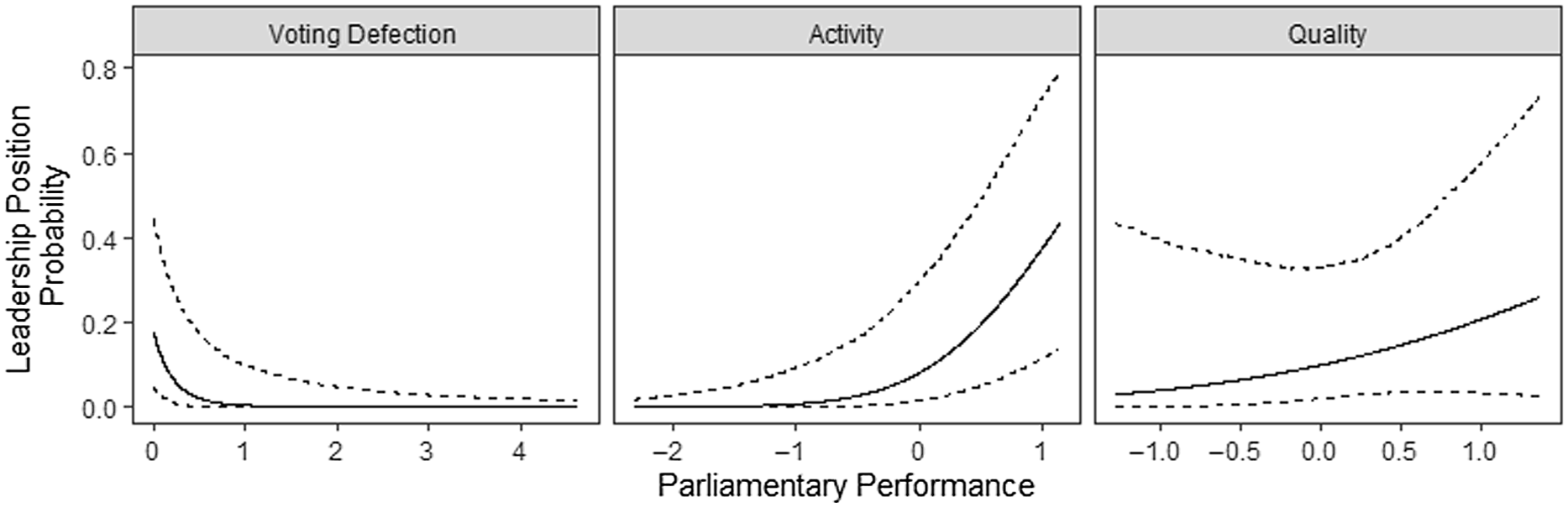
Figure 3 again provides more insights about the practical relevance of these findings based on the calculation of the predicted probabilities. It shows that the impact of MPs’ previous voting defection and their activity level can be very substantial. A typical MP that is loyal to his/her party 99.5 percent of the time has an average probability below 2 percent to obtain a parliamentary leadership position, while that would be approximately 17 percent if (s)he had never defected from his/her parliamentary party.
Predicted probabilities for MPs’ chances to obtain a parliamentary leadership position due to changes in (1) voting defection (original scale), (2) parliamentary activity (factor score with mean = 0 and SD = 0.6) and quality of parliamentary work (factor score with mean = 0 and SD = 0.3).

In a similar vein, a typical MP with a median parliamentary activity can be expected to increase his/her average probability to rise to higher parliamentary office from around 8 percent to above 42 percent. Even though high levels of parliamentary activity and low levels of voting defection are not sufficient conditions for average MPs to receive a higher parliamentary office, it is important to keep in mind that a typical MP can multiply his/her average probability to obtain a parliamentary leadership position by a factor of more than 5 (parliamentary activity) or even 9 (voting defection) in the previously described scenarios.
Finally, the steeper curve for the expected impact of MPs’ previous voting defection on their probability to receive a parliamentary leadership position (left pane, Figure 3) as compared to their chances to get re-elected (left pane, Figure 2) seems to suggest that party loyalty is more important for higher parliamentary office than for incumbents’ re-election.
The robustness of these findings was assessed in several ways. First we employed separate models assuming the absence of any sample selection bias. Second, we controlled for additional explanatory factors regarding Belgium’s party system, linguistic divide, and MPs’ previous committee experience. Third, we also ran analyses without those MPs who got elected in another parliament or became ministers (alternative career goals). Fourth, we tested for potential differences between parliaments by also running the analysis for members of the Belgian federal Chamber of Representatives only (despite the limited sample size). All robustness checks lead to very similar results (see online Appendix).
However, two further robustness checks result in more unexpected findings at first sight. On the one hand, less loyal MPs might be more likely to get re-elected in another, arguably less competitive parliament such as the Belgian Senate, the European Parliament or within the linguistic communities (see online Appendix). This finding may point to the more complex relation between MPs and their political party in a context where many parliaments allow for ‘level-hopping’ of MPs. That means party leaders could more easily ‘degrade’ less loyal (but eventually electorally valuable) incumbents to an electoral list for a parliament that offers fewer career opportunities in the future. Alternatively, the multi-level setting could allow less loyal MPs to ‘save’ their political career by deliberately choosing to stand for re-election in a less competitive parliament (e.g. at the end of the parliamentary career). Since this only concerns eight MPs in our sample, the eventually valuable underlying mechanisms should be analysed in more detail by future studies that analyse a larger sample of MPs trying to get elected in potential second-order parliaments. On the other hand, we also employed two alternative operationalizations of MPs’ qualitative parliamentary performance to get a deeper understanding of the underlying mechanisms. While a measure based on qualitative evaluations of Dutch-speaking MPs’ parliamentary work by journalists confirms our null-findings with regard to incumbents’ re-election, they point to a positive relation with MPs’ rise to higher parliamentary office (see online Appendix). Additionally we further separated our measure of MPs’ quality of parliamentary work into its underlying dimensions (see above). The analysis indicates that the null-findings for qualitative parliamentary performance are due to conflicting relations between its constitutive dimensions (policy-making effectiveness and content of parliamentary work). In fact, it appears that only MPs’ policy-making effectiveness (but not its content) is positively related with both re-election and higher parliamentary office (see online Appendix). These findings may point to the importance of the prior accessibility of qualitative evaluations and the prevalence of evaluation criteria focussing on MPs’ effectiveness. We believe that both findings (i.e. level-hopping and the study of the underlying dimensions of qualitative parliamentary performance) provide particularly promising avenues for future research on the relation between MPs’ parliamentary performance and their subsequent re-election/achievement of higher office.
Conclusion
Although the behaviour of politicians is usually expected to be driven by personal career objectives, empirical research on the relationship between MPs’ behaviour and their chances to realize static and progressive career ambitions is scarce. This article investigated this relationship by employing a holistic approach. First of all, we examined both MPs’ re-election and parliamentary promotion prospects, which allowed us to take a potential selection bias into account. Second, we compared the influence of three aspects of MPs’ previous parliamentary performance that have typically been examined separately, being MPs’ loyalty to the party, their (quantitative) parliamentary activity and the quality of their parliamentary work.
Overall, our results support the general expectation that incumbent MPs’ previous parliamentary performance matters for their subsequent career trajectories. However, this is only the case for those aspects of parliamentary performance that are most publicly visible to voters and political party leaders. On the one hand, we find that parliamentary activity and party loyalty are both substantial predictors for MPs’ chances to get re-elected and promoted to higher parliamentary office. On the other hand, however, our analyses do not provide sufficient empirical evidence for a positive relation between MPs’ qualitative parliamentary performance (largely behind the scenes) and their achievement of static or progressive career ambitions. Note that hard-working MPs may also choose to progress to professions outside of politics (e.g. in private companies) which are not accounted for in this study.
The finding that representative institutions in Belgium recruit their members at least partially on a meritocratic basis is particularly relevant since it has been argued that the outflow of qualified personnel can be reduced when MPs’ career prospects depend on their past performance (Ferejohn, Reference Ferejohn1986; Shepsle, Reference Shepsle1988). A few side notes are, however, in place here. First, while Belgian parliaments may be particularly likely to reward those MPs who have been highly active, this is less true for MPs who focus more on qualitative aspects of their parliamentary work. In other words: MPs who aspire to maintain their position or climb the parliamentary career ladder seem to benefit most from being highly active and loyal, and not from investing a lot of time and resources (often behind the screens) in parliamentary work that is effective or qualitative. Note also, that these findings contrast with earlier findings about voters’ rewards for MPs’ quality of parliamentary work (see Bouteca et al., Reference Bouteca, Smulders, Maddens, Devos and Wauters2019) suggesting that voters’ preferences for the parliamentary work of individual MPs may be insufficiently taken into account with regard to MPs’ parliamentary career prospects. This in itself offers a rather bleak picture of the role of elected representatives in democratic policy-making and the degree to which MPs are rewarded for making meaningful contributions. Moreover, the fact that turnover rates and parliamentary career stagnation are likely to be higher among MPs that are less loyal to the party (while overall party loyalty is very high) may result in further reinforcing the power of political parties in an already heavily party-dominated environment (De Winter and Dumont, Reference De Winter and Dumont2006). Taken together, career-related incentives could shift the balance towards visible but more symbolic activities (instead of quality and effectiveness) and even further reinforce parliamentary party unity during plenary votes. Although we should refrain from making claims about evolutions throughout time, these findings in themselves are relevant for debates on an alleged ‘decline of parliaments’ (see Martin et al. (Reference Martin, Saalfeld, Strøm, Martin, Saalfeld and Strøm2014)).
Our study has a number of implications for future research. Since our analysis shows that parliamentary activity and party loyalty are relevant predictors for their career prospects, research should avoid an exclusive focus on only one of these aspects of MPs’ behaviour. The findings for the Belgian case furthermore indicate that voting defection may be relevant for MPs’ parliamentary careers even when levels of party unity are very high. We argued that Belgium is a rather typical example of a party-centred list PR system and that we would expect our findings quite likely to hold in many other (similar) European contexts. Still, however, further research is needed to allow generalizations over different contexts and other periods of time. This may also include alternative measures of qualitative aspects of MPs’ parliamentary performance that pay particular attention to potential differences between the impact of their underlying dimensions such as the content of MPs’ parliamentary work as compared to their legislative effectiveness.
Supplementary material
To view supplementary material for this article, please visit https://doi.org/10.1017/S1755773922000340.
Financial support
This work was supported by Ghent university – Special Research Fund [grant number BOF.STA.2017.0017.01]
Conflicts of interest
None.
Appendix A
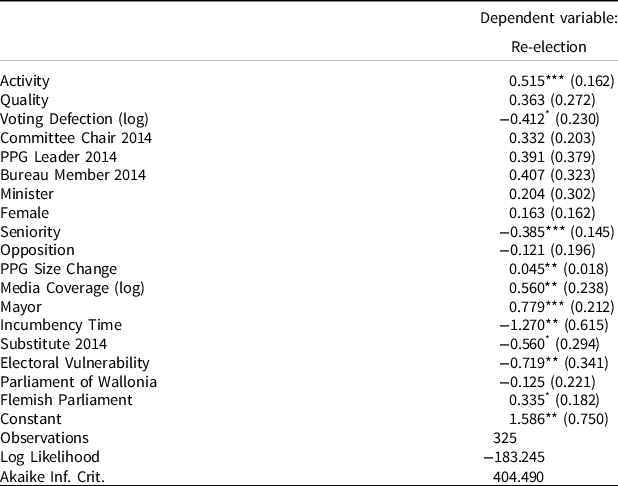
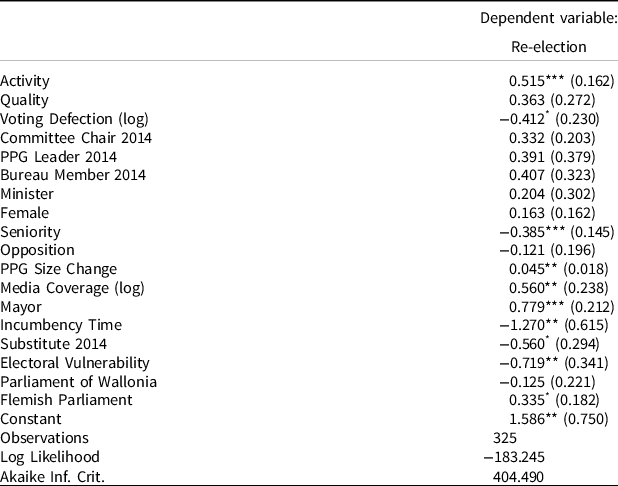
Parliamentary performance and incumbents’ re-election. Probit model coefficients with standard errors in parentheses
Note:
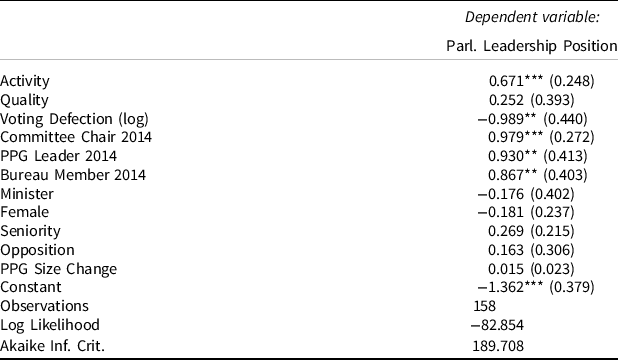
Parliamentary performance and incumbents’ rise to higher parliamentary office. Probit model coefficients with standard errors in parentheses

Note:*P < 0.1.