Some researchers have argued that childhood bilingual acquisition does not impose a cognitive load on children (e.g., Genesee, Reference Genesee2001). Cognitive load would be manifested in significant delays in bilinguals’ language acquisition or greater processing difficulty by bilinguals relative to monolinguals. The evidence for early bilingualism not posing a cognitive load is that bilingual children can use their two languages like monolinguals of the same age in terms of phonology and syntax (see review in Genesee and Nicoladis, Reference Genesee and Nicoladis2007). Furthermore, bilingual children may show some advantages relative to monolingual children in terms of pragmatic use of language (e.g., Comeau, Genesee and Mendelson, Reference Comeau, Genesee and Mendelson2007), theory of mind (e.g., Goetz, Reference Goetz2003; Berguno and Bowler, Reference Berguno and Bowler2004), some metalinguistic abilities (e.g., Galambos and Goldin-Meadow, Reference Galambos and Goldin-Meadow1990), and controlling attention to the relevant variables of a problem (e.g., Bialystok, Reference Bialystok1988, Reference Bialystok2001; Bialystok and Martin, Reference Bialystok and Martin2004).
One apparent exception to the contention that bilingualism is not more difficult for children than monolingualism is in terms of vocabulary size. Preschool bilingual children (i.e., children between about 18 months and four years of age) often score below monolingual children of the same age on receptive vocabulary within a language (Doyle, Champagne and Segalowitz, Reference Doyle, Champagne, Segalowitz and Paradis1978; Rosenblum and Pinker, Reference Rosenblum and Pinker1983; Pearson, Fernández and Oller, Reference Pearson, Fernández and Oller1993; Nicoladis and Genesee, Reference Nicoladis and Genesee1996; Pearson, Reference Pearson1998; Nicoladis, Reference Nicoladis2003, Reference Nicoladis2006). The same holds true of expressive vocabulary (Junker and Stockman, Reference Junker and Stockman2002). Bilingual children rarely learn their two languages in similar contexts (de Houwer, Reference De Houwer1990), are exposed (on average) to each language for less time than monolinguals (Pearson, Fernández, Lewedeg and Oller, Reference Pearson, Fernández, Lewedeg and Oller1997) and so their vocabulary items may be distributed across their two languages (Pearson, Reference Pearson1998). Some researchers have counted bilinguals’ Total Conceptual Vocabulary, or the number of concepts for which bilinguals have a label, regardless of language (Pearson, Reference Pearson1998). Results for preschool bilingual children have generally shown that the Total Conceptual Vocabulary is the same or greater than that of monolingual children, in both comprehension and production (Pearson, Reference Pearson1998; Junker and Stockman, Reference Junker and Stockman2002). This result suggests that bilinguals’ vocabulary is distributed across their two languages. In other words, bilinguals know many words in one language that they do not know in the other.
For children five years old or older, studies have reported a wider variety of results with regard to bilingual children's receptive vocabularies. Some studies have shown that bilingual children score below the norm in both languages (e.g., Uchikoshi, Reference Uchikoshi2006). Other studies have shown that bilingual children score below the norm in one language and at the norm in the other language (e.g., Umbel, Pearson, Fernández and Oller, Reference Umbel, Pearson, Fernández and Oller1992; Umbel and Oller, Reference Umbel and Oller1994). Still other studies have shown no differences between monolinguals and bilinguals (e.g., Cromdal, Reference Cromdal1999).
Part of the reason that the results of studies become more variable around the time that children start school is that children's source of new vocabulary items may change. In the early school years, oral receptive vocabulary scores are strongly related to literacy experiences, such as the frequency of hearing stories read out loud (see Sénéchal, LeFevre, Thomas and Daley, Reference Sénéchal, LeFevre, Thomas and Daley1998). In contrast, the primary source of preschool children's receptive vocabulary is undoubtedly participation in oral interactions (Umbel et al., Reference Umbel, Pearson, Fernández and Oller1992; Pearson et al., Reference Pearson, Fernández, Lewedeg and Oller1997; Bloom, Reference Bloom2000).
While there is some variability across studies in school-aged children's receptive vocabulary scores, bilingual children continue to show signs of smaller expressive vocabularies than monolinguals. Oller, Pearson and Cobo-Lewis (Reference Oller, Pearson and Cobo-Lewis2007) reported that Spanish–English bilinguals in Florida had significant gaps between their receptive and productive vocabularies in Spanish but by grade 5 no such gap in English.
Why might there be a gap between receptive vocabulary and productive vocabulary? Researchers have commonly assumed that language learners generally understand words first and then learn to produce them (e.g., Clark and Hecht, Reference Clark and Hecht1983; see discussion in Harris, Yeeles, Chasin and Oakley, Reference Harris, Yeeles, Chasin and Oakley1995). Furthermore, researchers have often assumed that receptive and expressive vocabularies share a common semantic store but differ in that expressive vocabulary also requires motoric representations of words (e.g., Fromkin, Reference Fromkin1987). In other words, producing words is harder (i.e., requires more practice) than understanding them. If so, then bilingual school-aged children's gap between expressive and receptive vocabulary may be due to difficulties in lexical access for the purposes of production. Bilingual children may have, on average, less experience with the motoric representations of words than monolinguals since, on average, they would spend less time speaking any one language relative to monolinguals (see Pearson et al., Reference Pearson, Fernández, Lewedeg and Oller1997; see also Gathercole and Hoff, Reference Gathercole and Hoff2007; Gollan, Montoya, Cera and Sandoval, Reference Gollan, Montoya, Cera and Sandoval2008). Hearing a language less often than monolinguals, bilinguals might also have smaller comprehension vocabulary than monolinguals, but the less frequent exposure/practice might affect production more than comprehension.
Lexical access difficulties in production have been reported in bilingual adults, usually in the context of inducing a tip-of-the-tongue (TOT) state. Tip-of-the-tongue states (TOTs) are word retrieval failures characterized by a feeling of imminent recall and a greater than chance probability of accurately reporting partial information of the sought-after word. Bilingual adults have more TOTs than monolinguals (Gollan and Acenas, Reference Gollan and Acenas2004). The exceptions to this finding occur when proper names or cognates are used, or when low-frequency words are elicited (Gollan, Bonanni and Montoya, Reference Gollan, Montoya and Bonanni2005; Gollan and Brown, Reference Gollan and Brown2006). Proper names and cognates might receive activation from both languages and so are easy to access. Very difficult words are outside the TOT-prone range of bilinguals whereas monolinguals have more of a chance of partially retrieving them.
One common explanation of TOT states is through partial activation at the lemma level (Burke, Mackay, Worthley and Wade, Reference Burke, MacKay, Worthley and Wade1991; Gollan and Brown, Reference Gollan and Brown2006; see also Jones and Langford, Reference Jones and Langford1987; Jones, Reference Jones1989). According to this explanation, language production proceeds in a roughly linear process, with access to the meaning or the message as the initial step (or Step 1 in Gollan and Brown, Reference Gollan and Brown2006; see Ferreira and Dell, Reference Ferreira and Dell2000). At this step, speakers conceptualize the message that they wish to convey and may activate the semantic representations associated with words. Gollan and Brown (Reference Gollan and Brown2006) found that bilingual adults had more difficulty in Step 1 than monolinguals (as measured by words which they could not access for a production task but claimed to know), but only with medium-frequency words rather than high- or low-frequency words. They did not interpret this finding and the significant difference could be spurious. According to their reasoning, there is no basis to suspect that bilinguals differ from monolinguals in their ability to access lexical–semantic representations for the message that they wish to convey.
TOTs occur at the next step in the process of production (Step 2 in Gollan and Brown, Reference Gollan and Brown2006), as the speaker tries to access a particular word-form associated with the meaning or message he/she wishes to convey. TOT states represent incomplete activation of a target word that has failed to surpass a retrieval threshold. Retrieval deficits occur in the linkage between phonological word system and semantic word systems. Infrequent usage could lead to relatively weaker connections between phonological and semantic word systems. As a result, bilinguals have more TOTs than monolinguals.
The present study
The purpose of this study was to compare school-aged bilingual children's lexical access to that of monolinguals. We predicted that, even if there were differences in receptive vocabulary between the language groups, these differences would not explain the greater difficulty with lexical access for bilinguals. To assess the children's ease of lexical access, we tried to induce a TOT state.
TOT states have been documented in children's spontaneous speech as young as two years of age (Elbers, Reference Elbers1985). However, the youngest age at which an experimental TOT paradigm has been used with children is 7–9 years (Faust, Dimitrovsky and Davidi, Reference Faust, Dimitrovsky and Davidi1997). The researchers showed children pictures associated with labels they deemed would be difficult for the children to retrieve in Hebrew. In this study, we used the same picture-naming task to see if bilinguals would have more TOTs than monolinguals.
We addressed three specific research questions about French–English bilingual children between the ages of 7 and 10 years:
First, do bilingual children have smaller receptive vocabularies than monolingual children? Results of previous studies of school-aged bilingual children have been varied (e.g., Cromdal, Reference Cromdal1999; Oller et al., Reference Oller, Pearson and Cobo-Lewis2007). The children we tested were being educated primarily in the minority language (French) and lived in a region in which English was the majority language, so we expected that the bilingual children's vocabulary scores might be close to monolinguals’, even if they were lower. We also measured children's understanding of the labels of the pictures that appeared on our picture-naming task. This measure allows us to explore converging evidence for bilingual children's receptive vocabulary. Bilingual children might know fewer of those labels than monolingual children.
Second, do bilingual children have a harder time accessing their words for production than monolingual children? Given the reported gap between receptive vocabulary and expressive vocabulary in school-aged children (Oller et al., Reference Oller, Pearson and Cobo-Lewis2007) and bilingual adults’ higher rate of TOTs than monolinguals’ (Gollan and Acenas, Reference Gollan and Acenas2004), we expected to find evidence for greater difficulty accessing words for production in bilingual children. We expected that the bilingual children would produce the correct target word on our picture-naming task less often than monolingual children. We also expected the bilinguals to experience more TOT states than monolinguals. As Gollan and Brown (Reference Gollan and Brown2006) argued that there is no reason to suspect Step 1 differences between bilinguals and monolinguals, we predicted that there would be no difference between the two groups on the number of words that they could identify correctly even if they had not produced the target. Also, it was also possible that the bilinguals might know as many target words as monolinguals, only dispersed across their two languages.
Third and finally, assuming we find evidence for greater difficulty accessing words for production, can these differences be attributed to bilinguals having fewer words in their receptive vocabularies? If it is correct to think of people having a single vocabulary store that is accessed by either comprehension or production (e.g., Fromkin, Reference Fromkin1987), then the gap between expressive and receptive vocabularies is not due (only) to knowing fewer words but having difficulty accessing them for production. In this case, the differences between bilinguals and monolinguals on the picture-naming task should remain, even when receptive vocabulary scores are covaried.
Note that the research questions are framed in terms of comparisons between bilingual and monolingual children. This study took place thousands of kilometers from the nearest community of monolingual French speakers. For that reason, the statistical comparisons are between English monolingual children and the English of the bilingual children. We present the French results and compare them to the English results of the same bilingual children for the sake of interest and return to the issue of appropriate control groups in the discussion.
Methods
Participants
Twenty French–English bilingual children between 7;0 (years; months) and 10;1 participated in this study. They were recruited through French schools in Edmonton, Alberta, Canada. Edmonton is located in a predominantly English-speaking part of Canada and has a small and active French-speaking community. In the French schools, teaching is carried out entirely in French, except for one English language arts class starting in grade 3. All of the bilingual children had minimally heard English in the general community and French from at least one parent since birth. Many of the children also had one English-speaking parent.Footnote 1 All of the children were educated primarily in French. We compared the children's performance on the vocabulary tests (normed scores) to determine language dominance: ten children scored higher in English than in French, seven children higher in French than in English. The remaining three children scored within three points on the normed version of the two vocabulary tests and so were considered to be balanced.
Twenty-five monolingual English-speaking children aged between 7;6 and 10;1 participated in this study. These children were recruited through after-school programs. The children's parents reported that these children did not speak more than a few words of any language other than English. The twenty children who matched the bilingual children the closest in age were included in the analyses.
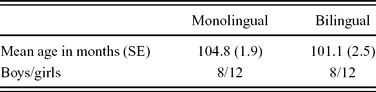
Background characteristics of both groups of children are summarized in Table 1. Having matched the two groups as closely as possible on age, it is not surprising that there was no significant difference between the two groups on age, t(38) = 1.20, p = .24.
Background characteristics of the two language groups.

The bilingual children were tested in their homes or in a university library room while the monolinguals were tested in their after-school programs. The bilinguals were tested in two sessions (one in English by a native English speaker, and one in French by a native French speaker). Due to scheduling conflicts, all the bilingual children were tested in French first and English second. The two sessions were usually about a week apart.
Materials
Standardized vocabulary tests were administered according to the instruction manual. In English, we used the Peabody Picture Vocabulary Test III (PPVT; Dunn and Dunn, Reference Dunn and Dunn1997). In French, we used the Échelle de vocabulaire en images Peabody (EVIP; Dunn, Thériault and Dunn, Reference Dunn, Thériault and Dunn1993). These vocabulary tests are normed by age. We used the raw scores in our primary analyses rather than the standard or normed scores because we were interested in how the children's performance was related to their relative vocabulary size.
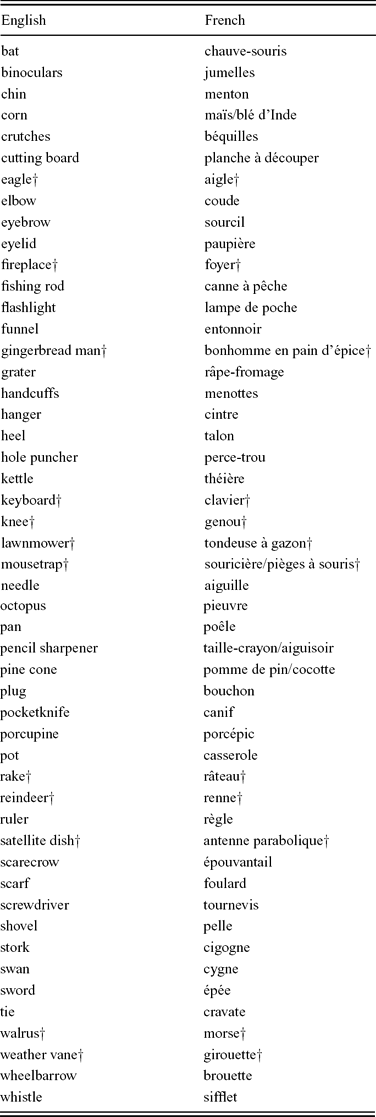
The picture-naming task consisted of 50 pictures that were presented to the children on a computer screen. Most of the pictures were of objects included in a previous study of TOTs in early school-aged children (Faust et al., Reference Faust, Dimitrovsky and Davidi1997), except those that were cognates in English and French because cognates are less likely to induce TOTs in bilingual adults (Gollan and Acenas, Reference Gollan and Acenas2004). These words were replaced by labels we deemed to be at about the same level of difficulty for children of this age range (see Appendix A). The list of 50 target words appears in Appendix A. These target words were a mixture of both simple and compound words. The pictures were all approximately the same size. The order of the 50 items was random.
A comprehension post-test was given to the children after they performed the picture-naming task in order to verify whether the children could recognize the referent of the target words out of an array of four pictures. The 50 target items were presented one at a time along with three distractor pictures. One of the three distractors was a picture that they had seen during the picture-naming task, while the second was semantically related to the target word, and the third was a picture of an object that had not appeared on the picture-naming task. The word was printed below each picture for the experimenter to read to the child. For example, for the target word screwdriver in Figure 1, the distractor that they had seen in the study previously was a funnel, the semantically related picture was a hammer, and the final distractor was a stapler. For each item, the pictures were always in the same quadrant, with the target answer roughly evenly distributed among the four quadrants across the items. The order of the items was randomized for each child.
Comprehension post-test picture for target screwdriver.

Procedure
The children were tested by a native speaker of the relevant language. The experimenter spoke only one language throughout the testing session, so that the bilingual children would be in as monolingual mode as possible (Grosjean, Reference Grosjean and Nicol2001). Within each language, the order of the three tests was constant, with the vocabulary test administered first.
Next, the children were introduced to the picture-naming task. This portion of the study was videotaped. The tester was seated next to the child so that the computer screen was visible to both the child and the tester. The video camera was positioned so that both the child and the computer screen could be recorded.
The TOT task was introduced with the following words:
I'm going to show you some pictures on the computer screen, and I want to know if you know the names of these pictures. Don't worry if you don't know all the words: some of them may be too hard for you. Just try your best.
We demonstrated how the children were to respond by going through the first three pictures (the practice trials) together, clearly explaining the different responses that they could make after being presented with a picture. The first trial picture was of an apple: the children were expected to know the word, so their response would be “apple”. The second trial picture was one of a sundial, a more difficult word, so the children were expected not to know it, and their response would be “I don't know”. The third trial picture was of an accordion, also a difficult word, but we thought that the children might be familiar with it and thus would respond with “I know it” if they were in a TOT state and then attempt to retrieve the word. As soon as the picture appeared on the screen, we asked the child if he thought he knew what that object was. From this point, three response types were requested. Firstly, if he knew it, he would say the name of the object out loud right away. Then the next picture was presented. The second option that could occur was if the child expressed that he did not know it. He would be advised to say, “I don't know it”, and then the next picture would be shown. The third option that could occur would be if the child expressed that he did know it, but he could not say what the word was right away. This child would be in a TOT state and would be advised to say, “I know it”, and then attempt to retrieve that word. The pictures were kept on the screen for three seconds, and then were removed so that the child was left with a blank screen. If the child had not retrieved the name of the object by the end of 60 seconds, then the next picture was shown (following Frick-Horbury and Guttentag, Reference Frick-Horbury and Guttentag1998). Constant reassurance was given so that the children did not feel badly or become too frustrated if they did not know the words. Previous studies have shown that demand characteristics may play a role in TOT reports (Widner, Smith and Graziano, Reference Widner, Smith and Graziano1996).
The final task was the comprehension post-test. It was explained to the children as follows:
Now you're going to see four pictures on the screen along with a word on the bottom. I want you to point to the picture that matches up with the word that I say.
The experimenter then read each target word to the child (unless the child read the word out loud faster than she did). The comprehension post-test pictures did not disappear after three seconds (like the TOT pictures) and remained on the screen until the child had answered and the next picture was shown.
Scoring
Participants were given three options to say after being presented with the pictures. If the children declared the answer right away, the response was scored as K (know). They were scored correct if they produced the exact target word for the picture (see Appendix A). The target words were straightforward in English. In French, however, we included as target words both the dictionary translations of the English words and the words that the French-speaking experimenter told us people typically said. For example, the dictionary translation of a pencil sharpener is taille-crayon in French, lit. “carve-pencil”, but French speakers often say aiguisoir, lit. “sharpener”. If the children said that they did not know the answer, the response was scored as “DK” (don't know). If the children claimed that they knew the answer but could not think of it immediately, responses were scored as a TOT.
Sometimes the children did not answer with any of the response types as they sat and stared at the computer screen without saying anything or indicating nonverbally that they might know the answer. Some of the children employed different strategies as they attempted to retrieve the words: responses included repeating the first letter or syllable, concentrating by looking up or down, covering the mouth or eyes, rocking back and forth, rising up, tapping their fingers and knuckles, shaking their bodies and heads, and giving definitions (e.g., “something that you use to catch mice” for mousetrap) and elaborations (e.g., “my dad has one of those” for ruler). The children's responses were scored as TOTs when the children partially produced the word, or when they defined the word as the first part of their lexical search. If the children sat in silence and looked off into space, the researcher asked if they knew it or if they wanted to move onto the next picture. If they requested to wait, their responses were recorded as TOTs. If they requested to move on, the responses were recorded as DKs.
We also scored one other operationalization of difficulty of lexical access: the number of items the children denied knowing in the picture-naming task (DK) but identified correctly in the comprehension post-test (correctly identified later, or CIL). The CILs could be considered Step 1 difficulty (Gollan and Brown, Reference Gollan and Brown2006) because the children had a semantic representation associated with the word but demonstrated no evidence of having accessed enough of the word-form to be in a tip-of-the-tongue state.
The rate of the TOTs was calculated for each child as the number of TOTs divided by the sum of TOTs and the number of correctly produced (following Gollan and Brown, Reference Gollan and Brown2006). This rate assumes that the TOTs are a result of Step 2 or at least partial access to the lemma representation. In other words, the rate of TOTs means: out of the items for which there was some evidence of activation of the lemma representation, how often did the children report partial activation of the word-form?
The rate of CILs was calculated for each child as the number of CILs divided by the sum of CILs and the number of DKs which were not correctly identified later.Footnote 2 This rate is based on the assumption that CILs are due to Step 1 difficulty (Gollan and Brown, Reference Gollan and Brown2006). In other words, the rate of CILs means: out of the items for which the children had no activation of the word-form representation, how often did the children have a semantic representation of the word?
Results
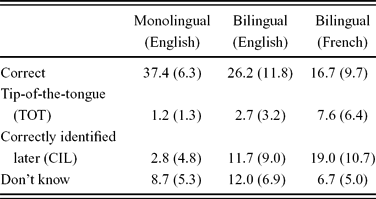
Table 2 summarizes the average number of children's responses by each coding category.
Average number (SD) of response types by language group.

Comprehension
The monolingual children's average PPVT vocabulary scores were 137.0 (MSE = 4.2) and the bilingual children's average PPVT vocabulary scores were 125.2 (MSE = 4.7). The difference between the groups did not reach significance, F(1, 38) = 3.48, p = .07. The average vocabulary scores in French on the EVIP were 92.3 (MSE = 4.7) for the bilingual children (note that the raw scores of the English and French vocabulary tests are not on the same scale).Footnote 3
Because the vocabulary tests are standardized by age, we expected the monolingual children's age to be correlated with their vocabulary scores although this correlation might not necessarily hold for bilingual children. Vocabulary scores are often correlated with exposure time to a particular language and exposure time to a particular language for bilingual children can vary according to travel or changes in the family or care-giving situation (see Genesee and Nicoladis, Reference Genesee and Nicoladis2007). In fact, the children's age was positively and significantly correlated with their vocabulary scores in English for both the monolingual children, r(18) = .488, p < .05, and the bilingual children, r(18) = .454, p < .05. The correlation between age and vocabulary scores did not reach significance for the bilingual children in French, r(18) = .253, n.s.
The average number of items not known on the comprehension test was 0.7 (MSE = 0.2) for the monolingual children, 2.6 (MSE = 0.8) for the bilingual children in English, and 6.6 (MSE = 1.4) for the bilingual children in French. The difference between the monolinguals and bilinguals in English was significant, F(1, 38) = 5.25, p = .03, ηp2 = .121. The difference between the bilinguals’ English and French was also significant on a paired-samples t-test, t(19) = 2.75, p = .013.Footnote 4
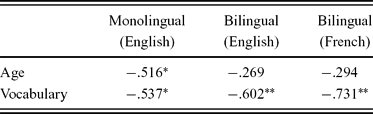
Assuming that we had converging measures of children's receptive vocabulary, we expected the children's vocabulary scores to correlate highly and negatively with the number of items not known on the comprehension test. The relevant correlations are summarized in Table 3. As expected, there are significant negative correlations in all the groups between vocabulary scores and the number of items not known on the comprehension test. This result suggests that vocabulary scores and the number not known on the comprehension test were both measures of receptive vocabulary. Age was correlated significantly only for the monolingual children.
Correlation coefficients between number of items not known on comprehension test and age/vocabulary.

*p < .05, **p < .01.
Production (picture naming)
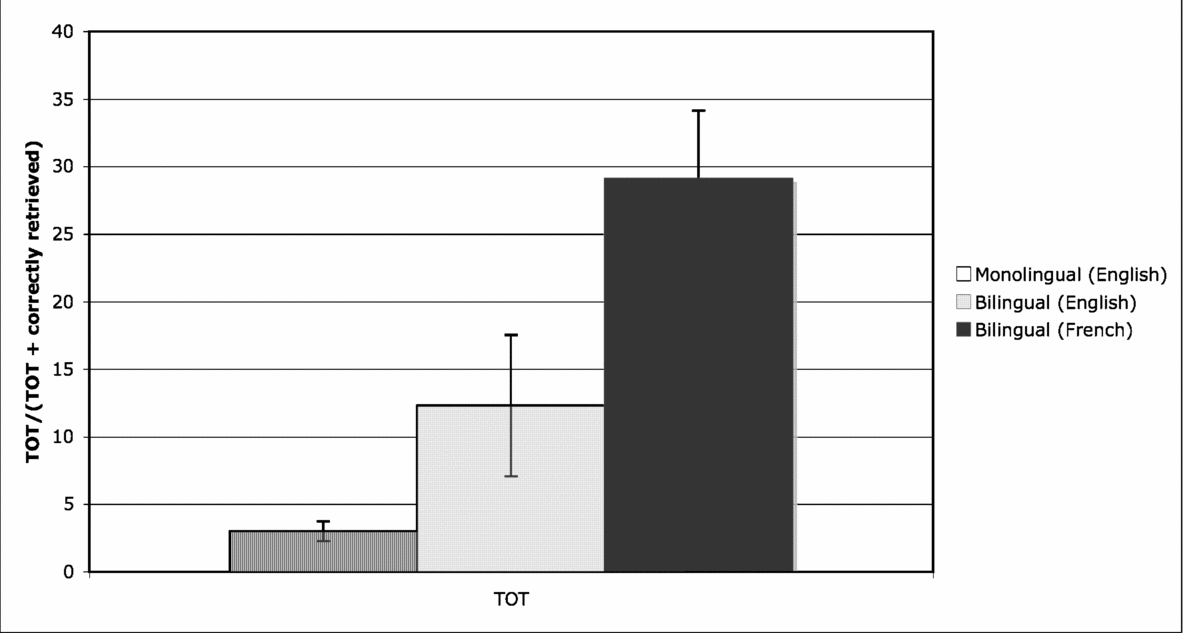
The monolingual children produced significantly more target names for the pictures (M = 37.4, MSE = 1.4) than the bilingual children in English (M = 26.2, MSE = 2.6), F(1, 38) = 14.09, p < .01, ηp2 = .270. The same result was obtained on an item analysis, with the average number of monolingual children producing the correct response per item being significantly higher (M = 15.0, MSE = 0.7) than the number of bilingual children in English (M = 10.5, MSE = 0.7), F(1, 98) = 20.72, p < .01, ηp2 = .175. The bilingual children produced more target names for the pictures in English than in French (M = 16.7, MSE = 2.2), t(19) = 2.90, p < .01. The same held true of an item analysis on a repeated-measures ANOVA (French by item, M = 6.7, MSE = 0.7), F(1, 49) = 50.26, p < .01, ηp2 = .506. The participants’ average rates of TOTs are summarized in Figure 2. For the reported TOTs, the difference between bilinguals and monolinguals in English was significant, F(1, 38) = 5.09, p = .03, ηp2 = .118. The difference between the bilinguals’ English and French was significant, t(19) = 2.85, p = .01. While most of the bilingual children had a noticeably higher rate of TOTs in French (N = 13), four children had a higher rate in English and three children had approximately equivalent ratings. The higher rate of TOTs did not correspond neatly to the children's dominance; for example, some French dominant children had a higher rate of TOTs in French than in English (see Appendix B).
Average rate of tip-of-the-tongue states (TOTs) in the production task for each language group.

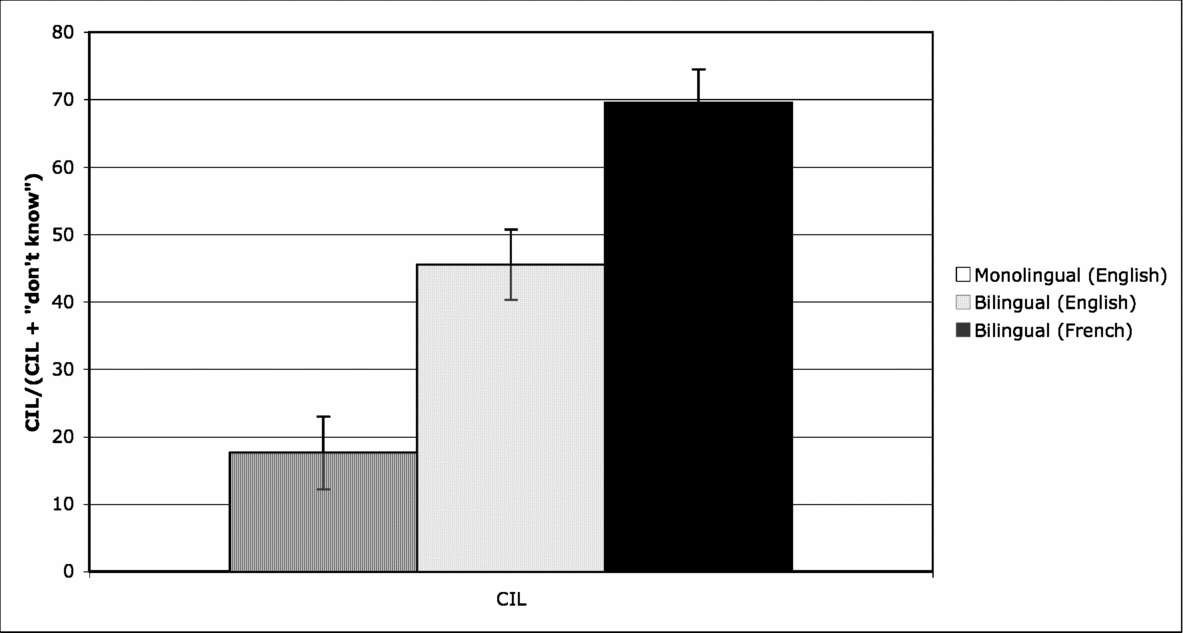
Figure 3 summarizes the rate of CILs by each group. For the rate of CILs, the difference between the bilinguals and monolinguals in English was significant, F(1, 38) = 13.80, p < .01, ηp2 = .266. The difference between the bilinguals’ English and French was significantly different, t(19) = 3.85, p < .01. Here again, most children had a higher rate of CILs in French than in English (N = 13), but one child had a higher rate in English than in French and six children had approximately equivalent rates. As with the TOTs, the relative rates did not correspond neatly to the children's dominant language (see Appendix B).
Average rate of items in the production task correctly identified later (CIL) on a comprehension test for each language group.

The bilingual children scored significantly below the monolingual children in producing the correct response in the picture-naming task. If the bilinguals’ conceptual vocabulary was equivalent to that of monolinguals but dispersed across their two languages, then they might have been able to label as many of the pictures in either one language or the other. We compared the number of items for which the monolinguals did not correctly produce a label (M = 12.6, MSE = 1.8) with the number of items for which the bilinguals did not correctly produce a label in either English or French (M = 17.7, MSE = 1.8). The result just missed significance, F(1, 38) = 3.88, p = .056. This result means that there was a trend for the bilinguals to know the target label less often in either language than the monolinguals in English.
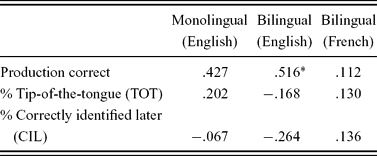
The range in age of participants is fairly wide for a developmental study so it is important to check for possible effects of age. Table 4 summarizes the correlations between age and the production measures. The only correlation that reached significance was the number correct in English on the picture-naming task for the bilingual children.
Correlation coefficients between age and production measures.

*p < .05.
Relationship between comprehension and production
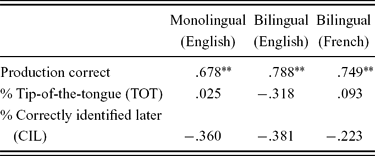
The correlations between the vocabulary scores and the production measures are summarized in Table 5. The number of items correctly produced was highly and positively correlated with comprehension vocabulary scores for all the groups. The rate of reported TOTs and the rate of CILs were not significantly correlated with receptive vocabulary scores for any group.
Correlation coefficients between receptive vocabulary scores and production measures.

**p < .01.
To see if the observed differences between bilinguals and monolinguals could be attributed to the marginal difference in vocabulary scores, we repeated the relevant analyses with the vocabulary scores as a covariate and checked for group differences. For the number not known on the comprehension test, there was no longer a significant difference once vocabulary scores were covaried, F(1, 37) = 2.13, p = .153. The same held true of the percentage of reported TOTs, F(1, 37) = 3.15, p = .08. In contrast, the group differences for the number correct on the production task, F(1, 37) = 10.92, p < .01, ηp2 = .228, and the percentage of correctly identified later (%CIL), F(1, 37) = 9.46, p < .01, ηp2 = .204, remained even with vocabulary scores covaried.
Discussion
The first purpose of this study was to compare bilingual and monolingual school-aged children's receptive vocabulary scores. The results revealed small differences in receptive vocabulary between the bilingual and monolingual children. The bilinguals recognized significantly fewer pictures in English corresponding to the words in our task. The difference in receptive vocabulary in English did not reach significance in this sample (p = .07). These results are consistent with other studies of school-aged bilinguals, showing that it is possible for bilinguals’ vocabulary size to be close to that of monolinguals (e.g., Cromdal, Reference Cromdal1999).
The second purpose of this study was to compare bilingual and monolingual school-aged children's lexical access for production. In contrast to the small differences in lexical comprehension measures, there were greater differences (as measured by effect sizes) between the bilinguals and the monolinguals in our picture-naming task. The bilinguals produced significantly fewer target labels for our pictures than the monolinguals. They also experienced more TOTs than monolinguals in English (as has been found for adults; Gollan and Acenas, Reference Gollan and Acenas2004). The bilinguals also had a higher rate of words in English that they said they did not know and then correctly identified later (CIL) on the comprehension post-test, relative to the monolinguals. We considered CIL a measure of Step 1 (i.e., access of semantic representation associated with a word-form; Gollan and Brown, Reference Gollan and Brown2006) difficulty for production. These results are consistent with the gap between receptive and expressive vocabularies reported elsewhere for bilingual school-aged children (e.g., Oller et al., Reference Oller, Pearson and Cobo-Lewis2007).
The third purpose of this study was to test if the differences between bilinguals and monolinguals on lexical access could be attributed to the differences in vocabulary scores. The receptive vocabulary scores correlated highly with the number incorrect on the comprehension post-test for the words in our picture-naming task, the number correctly produced in all language groups, and the percentage of CILs. However, the differences between language groups on the number correctly produced on the production task and the rate of CILs remained, even after receptive vocabulary scores were covaried. In contrast, the difference between the groups on the number incorrect in comprehension disappeared once receptive vocabulary scores were covaried. These results suggest that the children's receptive vocabulary scores cannot explain the group differences on the measures of language access for speaking. In other words, the bilingual children seemed to have difficulty accessing words relative to monolingual children over and above their receptive vocabulary scores. The differences between bilingual and monolingual children on expressive vocabulary measures (e.g., Oller et al., Reference Oller, Pearson and Cobo-Lewis2007) are probably not due only to bilinguals knowing fewer words than monolinguals. As such, these results are consistent with those from bilingual adults, showing greater difficulties accessing words relative to monolinguals (e.g., Gollan and Acenas, Reference Gollan and Acenas2004; Gollan et al., Reference Gollan, Montoya and Bonanni2005).
One apparent difference between this study and previous studies with bilingual adults is that the bilingual children in this study had difficulty accessing any lemma representation at all for some words that they knew in the comprehension test (i.e., CIL). In contrast, Gollan and Brown (Reference Gollan and Brown2006) argued that there is little difference between bilingual and monolingual adults in Step 1 access. It is possible that the difference between these two studies points to a developmental change. That is, in the early school years, bilingual children have less partial activation of words that they know and by adulthood, bilinguals are able to at least partially activate most words that they know for the purposes of production. The present study did not use the same operationalization of Step 1 access as Gollan and Brown (Reference Gollan and Brown2006). Before reaching the conclusion that there are genuine developmental changes in lexical access, it would be important that a study use the same dependent measures for both adults and children. If such developmental changes were found, it is possible that increased practice in producing the language leads to an increased ability to access at least part of the lemma representation for particular target words for production.
While the bilingual children scored relatively equivalently on the French and English versions of the receptive vocabulary test (see footnote 3 above), there were more items for which they did not produce the correct label in the French version of the TOT test than the English version. Furthermore, the bilingual children reported more TOTs in French than in English and had more CILs. We suspect that these differences are due to a non-equivalence of the two languages with regard to the test items, because of language contact. In the context in which the bilingual children are growing up, French is a minority language and has been in contact with English for centuries. As a result, almost all the French speakers the children encounter also speak English. There is more variation in the labels used to refer to objects in French than in English. Language contact is known to have a big impact on vocabulary items, particularly through bilinguals’ borrowing words or phrasings from their other language (e.g., Sankoff, Reference Sankoff, Trudgill, Chambers and Schilling-Estes2001).Footnote 5 In other words, by showing a difference between these bilingual children's French and English in producing a specific target word, we have replicated previous results showing lexical effects in bilinguals in language contact situations. If our reasoning is correct, then the bilinguals’ poorer performance on the picture-naming task in French compared to English was due not only to bilingualism but also to the fact of being bilingual in a part of Canada where the majority of language was English. To test this reasoning, it would be necessary to have not only a French monolingual control group but also a bilingual control group living in a region in which French was the majority language.
Previous studies of bilingual children have suggested that when bilinguals have smaller vocabularies than monolinguals, their vocabulary might be dispersed across their two languages (e.g., Pearson, Reference Pearson1998; Oller et al., Reference Oller, Pearson and Cobo-Lewis2007). In apparent contradiction to that suggestion, our results showed a trend for bilinguals to produce fewer target labels in both languages combined than monolinguals in English. This finding should be seen as weak counterevidence for the dispersion suggestion at best, for at least three reasons. First, the difference did not reach significance in this sample (p = .056). Second, for the reasons just discussed, the methodology of requiring an exact target label for bilinguals in a language contact situation underestimates their abilities in the minority language (French, in this case). Third, as noted earlier, the bilinguals scored just slightly above the norm in both their languages on receptive vocabulary so, on average, they had age-appropriate vocabulary levels relative to monolinguals in both languages.Footnote 6
We did not systematically analyze what the children did when they did not produce the target response.Footnote 7 However, the most striking alternative among both bilingual and monolingual children was to use a more general word (e.g., eye for the target eyelid or, in French, oiseau” “bird” for the target cygne “swan”) or a word from the same semantic domain (e.g., pliers for the target hole puncher or, in French, phoque “seal” for the target morse “walrus”). In many other instances, the bilingual children coined names that described the object. For example for the target lawnmower, some of the names that the bilingual children used were grass cutter, lawn cutter, lawnding machine, and mow-lawn. One bilingual child called the crutches walking sticks.
Some of the bilingual children's responses suggested that both languages were activated, even in the monolingual contexts we tried to create for testing. First, the bilingual children sometimes gave the correct answer but not in the target language (cf. Grosjean, Reference Grosjean and Nicol2001). There was also some evidence of the influence of the other language in more subtle ways. For example, one child called the target blé d'Inde “corn” cornes, the French word for horns of an animal. Another child called the target pinecone (NB pomme de pin in French, literally “apple of pine + tree”) apple pine, and another one called it pine apple. There were also some examples of blends. For example, one child used a phonological blend, calling the target shovel “shell” (pelle in French). Another child used a morphological blend, calling the target fishing rod “fishing can” (in French canne à pêche).
This study was not designed to test how exactly lexical selection takes place. Researchers are not in agreement as to whether bilingual adults activate both their languages in production tasks or not (see Lee and Williams, Reference Lee and Williams2001; Costa, Reference Costa, Bhatia and Ritchie2004; Finkbeiner et al., Reference Finkbeiner, Gollan and Caramazza2006; Gollan et al., Reference Gollan, Montoya, Cera and Sandoval2008; see also Mahon, Costa, Peterson, Vargas and Caramazza, Reference Mahon, Costa, Peterson, Vargas and Caramazza2007). In the present study, the bilingual children sometimes produced responses that were influenced by the name of the object in the other language even though they were in as monolingual a mode as possible. It is possible that the degree of competition between languages is related to the frequency of the words (see Gollan et al., Reference Gollan, Montoya, Cera and Sandoval2008, for discussion). Future studies designed to address questions about how lexical selection takes place could include bilingual children, as children may experience more between-language interference than adults (see Nicoladis, Reference Nicoladis2006).
The results of the present study showing greater lexical access difficulties for bilingual children contradict the argument that bilingualism does not have a cognitive load for children (cf. Genesee, Reference Genesee2001). That said, we should point out that the effect sizes in this study are very small so that the differences, while reliable, may not matter much on a day-to-day basis. Also, other studies have suggested that there is little obvious difference between the fluency of bilingual and monolingual children in everyday discourse (e.g., Nicoladis, Pika and Marentette, in press). Furthermore, finding the exact word to refer to an object may rarely be necessary in the context of everyday discourse, particularly since the children were clever at filling the gaps with adequate paraphrases. Hence, our results show that there do exist lexical access differences between French–English bilinguals and English monolinguals of the same age range, but it is not clear that these differences would have a major impact on everyday discourse.
List of 50 target words

†These items did not appear in Faust et al. (Reference Faust, Dimitrovsky and Davidi1997); all other items did.
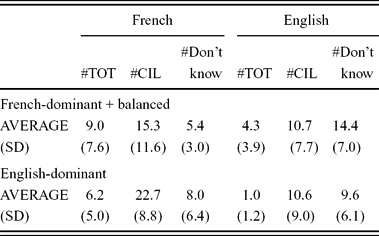
Average scores of bilingual participants according to dominance

The symbol # refers to the raw numbers.