The Indian subcontinent is among the world’s most disaster prone areas, with floods being the most common natural disaster. In recent years, due to climate change and ill-planned development practices, floods have also occurred in areas that are normally not flood prone such as the state of Jammu and Kashmir.Reference Milly, Wetherald, Dunne and Delworth 1 , 2 Rapid need assessments (RNAs) are used by public health officials to collect information about an affected population, particularly as a first line of public health response to guide response efforts to emergencies and disasters. Community Assessment for Public Health Emergency Response (CASPER) toolkit for RNAs was developed by the Centers for Disease Control and Prevention (CDC) in 2009 to help provide timely, inexpensive, and reliable status of current household-based public health needs, which can be conducted anytime on communities affected by natural or man-made disasters. 3
During September 2-6, 2014, the state of Jammu and Kashmir experienced torrential rainfall causing flooding of the Jhelum River. Floods in Kashmir Valley caused damage to houses, roads, communications, and health care infrastructure. Among a population of 12.5 million ~250 deaths were reported due to the floods and about 200,000 were evacuated. 4 More than 350 villages across the state and the capital, Srinagar, were severely affected with many parts inundated. The Integrated Disease Surveillance Programme reporting units in Srinagar were affected due to floods and limited post-flood health data were available.
We conducted a RNA of Srinagar city using CASPER tool for the first time in India after 3 weeks of floods once the water started receding. Our objectives were to determine the health impact due to flooding, assess the immediate safety needs of the flood-affected population, and assess the public health response during the post-disaster time period.
METHODS
Srinagar city consists of about 1.1 million people and 180,000 households (2010 census). Based on the CASPER tool created by the CDC, Atlanta, we conducted a cross-sectional study in Srinagar city from September 27 to October 1, 2014. CASPER uses a validated 30×7 cluster sampling methodology with a design effect of 2 to collect information at the household level on the health status and basic needs of a community affected by a disaster.
As described in CASPER, we used a two-stage sampling method to select a representative sample of 210 households to be interviewed across the city. In the first stage, we selected 30 clusters by probability proportional to size in reference to the number of housing units within the 2011 census blocks. In the second stage, interview teams traveled to the centre of the selected cluster, spun a pen, and followed the direction of the pen to interview every 10th household until 7 households agreed to participate in the study.
The questionnaire captured information regarding demographics, functional needs, post-flood damage, supply needs, emergency preparedness, concerns about injuries and illnesses, and communication usage. We pre-tested the questionnaire in the Lasjan area of Srinagar city, which was not part of the selected 30 clusters. We divided the field interviewers into 3 groups (2 persons in each group) covering 30 clusters in 5 days with a goal of 210 total interviews. We interviewed the head/representative (>18 years of age) of the household.
We calculated the contact rate by dividing the completed interviews by the total number of households where contact was attempted, and the completion rate by dividing the number of completed interviews by the number of interviews conducted. We used Epi-Info software version-7 for data entry and analysis. We used households as the unit of analysis and calculated weighted proportions and estimated projections. Data analyses included a mathematical weight for probability of selection for each interviewed household
 $$\eqalignno{{\rm Weight{\,\equals\,}&} &{{{ {\displaystyle \rm Total\,\,\, number\,\,\, of\,\,\, housing\, \atop \displaystyle \rm units\,\,\, in\,\,\, sampling\,\,\, frame}}} \over {\left( {{{\displaystyle \rm Number\,\,\, of\,\,\, housing\,\,\, units\,\,\, \atop \displaystyle \rm interviewed\,\,\, within\,\,\, clusters}}} \right){\rm }{\times}{\bigg({\displaystyle \rm Number\,\,\, of\,\,\, \atop \displaystyle \rm clusters\,\,\, selected}\bigg)}}}.$$
We calculated all projections and confidence intervals taking into account within the clusters and between the clusters differences using Epi-Info software. Since this evaluation was part of post-disaster emergency public health response, it was exempted from ethical review. We obtained verbal consent from the head/representative (>18 years of age) of the household after explaining the objectives of the study and did not collect any personal identifiers.
RESULTS
The survey was completed in 5 days, and on the seventh day the preliminary report was submitted to the state authorities. We interviewed 210 households with 100% completion rate and 96% (210/217) contact rate. There were no deaths reported in the 210 households during or post floods.
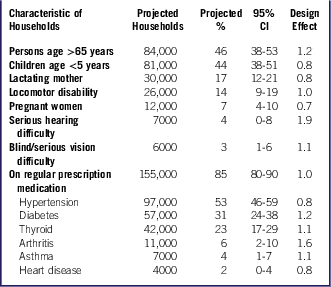
RNA findings of self-reported and non-flood-related demographic and functional needs of households (Table 1) show that 66% (121,000) of households had either elderly with age more than 65 years (46%) or children <5 years (44%). 14% of the households had at least one person with locomotor disability, 4% with serious difficulty in hearing, and 3% with blindness or serious difficulty in vision. Regarding health status (Table 1), 85% (155,000) households had a household member on prescription medicines, particularly for non-communicable diseases (NCDs). Overall, 53% were on prescription medicines for hypertension, 31% for diabetes mellitus, and 22% for thyroid disease.
Self-Reported and Non-Flood-Related Demographic, Functional Needs and Health Status of Households (At Least 1 Member) in Srinagar City, Rapid Need Assessment, September 2014Footnote a

a Assessment done 3 weeks after floods.
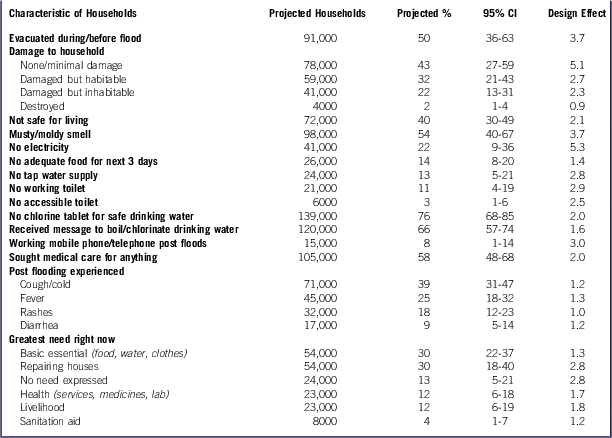
RNA findings on self-reported and flood-related damage, safety and needs of households (Table 2), show that 50% households were evacuated to alternate shelters during or after the floods. Evacuation was done either by government agencies or with local help due to damaged or submerged houses. During the study, 9% of the household members were not residing in their homes. Approximately 57% (104,000) of houses had significant damage and 40% of households felt that their houses were not safe to live in.
Self-Reported and Flood-Related Damage, Safety, Health and Needs of Households (At Least 1 Member) in Srinagar City, Rapid Needs Assessment, September 2014Footnote a

a Assessment done 3 weeks after floods.
All households reported drinking boiled water, which was the prevailing practice in the region. Approximately 44% (81,000) of households lacked basic services like electricity, tap water supply, working toilets, and sanitation. All households reported having a working toilet at home before the floods, but post flood 11% of the households did not have a working toilet and 3% did not have access to a toilet. During the flood response the state health department distributed chlorine tablets and recommended boiling/chlorination of water in all households. At the time of interview 76% of the households did not have chlorine tablets for water treatment. Also 14% (26,000) of the households did not have access to adequate food supply for the next 3 days. Self-reported findings on emergency preparedness showed the presence of an emergency supply kit in 16% and a first aid kit in 14% of the households before the flood. Warning messages before flooding were received by 35% of households.
RNA findings on self-reported and flood-related status on health and needs by households (Table 2) show that 58% (105,000) of households sought medical care for a household member. Approximately 55% of households had 1 or more residents with cough/cold, fever, rash, or with diarrhea (>3 loose stools in 24 hours). Among these 38% sought care from the government health facility, 36% from the medical relief camps, and 24% from private health facilities. In an estimated 16% (29,000) of households, at least one household member sustained a flood-related injury. In all, 68% (124,000) of households had at least one household member who experienced agitation, anxiety, depression, or nightmares since the flooding. Among the household members on prescription medicines, 40% did not have a 1 week supply of medicines with them at the time of interview. Of the evacuated households, 68% had one household member who sought medical care for any acute medical condition (fever, rash, diarrhea, injuries, etc.) compared with 47% of those that were not evacuated (odds ratio [OR]: 2.4; CI: 1.1-5.1). Among evacuated households, 79% had one household member who experienced stress and anxiety compared with 57% in households that were not evacuated (OR: 2.7; CI: 1.4-5.4).
Overall, 30% expressed greatest immediate need for support in getting the following basic essentials: food, water, and clothes; 30% for support in repair of house; 12% for support in restoring livelihood; 12% in getting health services; 4% in getting sanitation services; and 13% of households did not express any immediate need. Of evacuated households, 97% had an immediate need for help compared with 75% of households that were not evacuated (OR: 12; CI: 2.4-55). Among evacuated households 82% needed assistance to repair the house compared with 29% of evacuated households (OR: 11; CI: 4.6-25).
DISCUSSION
The public health response to this large-scale flood in Jammu and Kashmir was the first to use CASPER methodology for a rapid needs assessment during a disaster response in India, a country at high risk for large-scale public health emergencies. After this massive Srinagar flood, our survey was completed and presented within a week and found that more than half of the households were damaged and almost half required evacuations. Our survey helped identify and quantify the immediate needs of the community including basic essentials like food, water, clothes, mental health care, and prescription medications for NCDs.
In our study, two-thirds of the households reported a household member with a mental health issue such as agitation, anxiety, depression, or nightmares since flooding. High prevalence of post-disaster mental health issues has also been documented in post-disaster RNA studies in other countries.Reference Norris, Speier and Henderson 5 - Reference Rodriguez, Tocco, Mallonee, Smithee, Cathey and Bradley 7 During post-tsunami in south India, 64% of individuals screened positive for common post-disaster mental health issues.Reference George, Kanakamma, John, Sunny, Cohen and De Silva 8 In post-disaster situations, systematic case identification and mental health interventions can be integrated into the public health response such as implemented by Médecins Sans Frontières in China, Colombia, Gaza, and the West Bank. Such interventions resulted in symptomatic improvement in a majority of people.Reference North and Pfefferbaum 9 , Reference Coldiron, Llosa, Roederer, Casas and Moro 10
A large proportion of households without a week’s supply of their required prescription medicines for NCDs was an important finding in our RNA which needed immediate attention from the health authorities. Health authorities in Jammu and Kashmir state responded by giving priority to NCD medicine procurement along with other medical supplies. Over the past quarter century there has been an increase in the frequency and severity of disasters globally, while there has also been an increase in the burden of NCDs.Reference Demaio, Jamieson and Horn 11 The RNAs in other disasters have also provided insight into medication needs, especially the shortage of chronic disease medications in a post-disaster response.Reference Norris, Speier and Henderson 5 - Reference Rodriguez, Tocco, Mallonee, Smithee, Cathey and Bradley 7 This problem is recognized globally by the United Nations in the Sendai Framework for Disaster Risk Reduction 2015-2030. 12 In future disaster responses, India will need to ensure that NCD medication needs and conditions are appropriately captured and addressed.
The CASPER tool rapidly obtains objective and timely data in a relatively inexpensive manner through robust and efficient methodology for data collection, precise analysis, rapid interpretation, and dissemination of results. This RNA, though done after 3 weeks of flooding due to difficulty in reaching inundated areas and logistic issues, gathered valuable information for the disaster response. This demonstrates the importance of rapidly collected field data using CASPER tool to guide a public health response. CASPAR can contribute to more rapid detection, response to, and even control of, a public health emergency, and can serve as a potential important tool in India and other countries for efforts to enhance global health security.
Our study did have limitations. First, the answers to the questionnaire were self-reported and could not be verified. Second, the sampling and analysis were household-based and cannot be interpreted at the individual level.
These findings using CASPER methodology helped the state health authorities to ensure availability of prescription medicines in the health facilities, to prioritize assistance to people with psychological symptoms post disaster, improve plans for immediate supply of basic essentials, and to address the needs for immediate assistance in repairing unsafe houses. We recommend that similar rapid needs assessment studies using CASPER methodology should be facilitated in immediate post-disaster situations for future disaster preparedness, recovery and planning in India.
Acknowledgments
The authors thank the people of Srinagar, who patiently responded to the questionnaire in a post-disaster situation. The authors thank the staff of State Surveillance Unit (Kashmir Epidemiology Division), Dr Rehana Kausar (State Surveillance Officer), Dr Saleem Ur Rehman (Director Health Services, Jammu and Kashmir State), Dr Shazia Wafai (Regional Director, H&FW, Government of India), Dr S. Muhammad Salim Khan (HOD, SPM), postgraduate students, and staff of Government Medical College, Srinagar, for their contributions to this assessment. The authors also thank Dr Renu Garg (WHO) for insightful comments in the preparation of this manuscript and Dr Alden Henderson (CDC) for teaching us CASPER methodology.
Conflicts of Interest
The authors declare that there are no conflicts of interest.