INTRODUCTION
Difficulties in studying household economy and diet are related to a number of reasons. Firstly, bones and food crusts on ceramics are not always preserved in the cultural layers of settlement sites. Secondly, it is difficult to attribute animal bones from multilayer sites to a particular ceramic type. Numerous bones of wild and domestic animals were found in the Eneolithic layer (Morgunova Reference Morgunova1995), but as this cultural layer contained ceramics of different types, it was difficult to associate the animal bones with the cultural horizons. One of the most difficult questions is the origin of domestic animals on the Middle Volga region. The latest materials show the connection between the Middle Volga, Lower Volga, and North Caspian (Shishlina et al. Reference Shishlina, Zazovskaya, van der Plicht and Sevastyanov2012). The aim of this paper is to present the results obtained through comprehensive studies of diet and economy in the Eneolithic based on the materials from Lebyazhinka III and Lebyazhinka VI settlement sites (Figure 1).
Location map of Lebyazhinka III and Lebyazhinka VI settlements in the Middle Volga region.

Materials of the settlement sites Lebyazhinka III and Lebyazhinka VI are unique for studying the problems of diet. The Lebyazhinka VI settlement has an exclusive place among the sites of forest-steppe zones of Volga region because Eneolithic artifacts prevail at this site. The ceramic collection includes the pottery from early to later stages of the Eneolithic. For the first time, for this region the connection between Eneolithic layers and the domestic animal bones was established. Excavations of the Lebyazhinka VI settlement have been carried out since 2013. A house pit investigated at the site contained hearths, ceramic vessels, stone and bone tools, as well as animal, turtle, bird, and fish bones. Concentrations of Unio shells were discovered at bottom levels of the house pit, and apparently precede the construction of the dwelling. The cultural layer has good preservation of organics, including small fish bones. In the fill of the dwelling, at its floor level vessels of one cultural type are encountered—so-called collar ceramics. Thus, a connection between the dwelling and the ceramics of the described type is firmly established. The attribution of the site to the Eneolithic is supported by a small oxidized copper object found there. Several house pits were found on the Lebyazhinka VI and Lebyazhinka III sites. This fact is evidence of the presence of long-lived Eneolithic settlements in this region. To obtain reliable results, it is equally important to determine the cultural affiliation of the studied complexes as a whole, and to define the details of individual finds. The study of diet and economy of palaeo-populations rises to a new level, if it is possible to find indications of the appearance of productive livelihoods. The settlement site Lebyazhinka VI meets these criteria. The ceramic type found at the floor level in the fill of House pit 1, and similar ceramics found outside the dwelling at Lebyazhinka VI had been studied. It is noteworthy that fragments of many ceramic vessels have food crusts on them.
The materials of Lebyazhinka III site have been attributed to Samara culture (Ovchinnikova Reference Ovchinnikova1995). The settlement Lebyazhinka III is a single-layer site, where a dwelling with a long use period, large hearths, and “collar” type pottery was studied. Findings included numerous flint and quartz tools on flakes, bone artifacts, and archaeozoological materials.
METHODS AND MATERIALS
Animal bones from these settlements were studied by the archaezoological method. Archaeozoological remains have been identified both in the cultural layer of the settlement and in the fill of the dwelling, 2409 fragments of animal bones altogether. Of these, 1527 bones and bone fragments were suitable for the species definition. The preservation of bones is satisfactory (3 points out of 5). The analysis of animal bones enables discussion of yet another important topic: definition of the main economic activity of the ancient population. Data on a gathering economy is sporadic and controversial: only charred acorns can be connected to this, in addition to stone tools, which can be interpreted as tools used in mashing and grinding plant food. Processing of archaeozoological materials was done according to techniques developed in the Laboratory of Natural-Scientific Methods of the Institute of Archaeology of the Russian Academy of Sciences (Antipina Reference Boessneck, Müller and Teichert2004). Bone remains were divided into categories, each with their own reasons for deposition into the cultural layer: kitchen waste, waste from bone-cutting activities, and bone artifacts. For this purpose, taphonomic condition and archaeological context of the finds and traces of artificial impact on the bones (crushing, processing, effects of fire, traces of bite marks made by dogs and rodents) were examined in detail. Natural preservation of bones was assessed by 5-point scale, where the best preservation corresponds to 5 points. Only one of the above-mentioned categories, kitchen waste, is considered in this article. Species definition was carried out using comparative anatomical collections stored in the Laboratory Archaeology of Samara State University of Social Sciences and Education (Samara, Russia) and the Zoological Museum of Moscow State University (Moscow, Russia). Separation of the remains of sheep (Ovis aries) and/or goats (Capra hircus) was based on the characteristics identified and published previously (Boessneck et al. Reference Boessneck, Müller and Teichert1964). The high fragmentation rate of the bones did not often allow determination to the species, and therefore the vast majority of these two species are discussed collectively as sheep or goats. Horse bones are few in number, and attributing them reliably to wild or domestic species is not possible.
Species composition of the fish was determined by comparing fish bones with samples of modern and sub-fossil species of fish from the osteological standard collection of E.Y. Yanish at the I.I. Schmalhausen Institute of Zoology of the National Academy of Sciences of Ukraine (Kiev, Ukraine). The difficulty of determining bones on the species level derives from the fact that most fish bones were fragmented. In order to calculate the size of sub-fossil fish, the bones were measured with a caliper with an accuracy of 0.1 mm, after which their length and weight were determined according to the methodology of Lebedev (Reference Lebedev1960). The age of the fish was determined on their vertebrae when possible. In analyzing the results of determinations, one fish bone was assumed to correspond to one specimen. Systematics and Latin species names of fish are given according to the guide by Movchan (Reference Movchan2011).
Food remains consist of animal bones and crusts found on the inner surfaces of ceramic vessels. In order to research such materials, we used the measurement of lipids by gas chromatography. Good preservation and clear archaeological contexts of materials, including localisation of areas where food was prepared are particularly important. Qualitative and quantitative analysis of the residues of fatty acids adsorbed on the walls of ceramic vessels used for cooking is one of the methods that make judging diet possible. For example, based on the obtained results, one can draw conclusions about the prevalence of food of animal or vegetable origin in the diet (Eerkens Reference Eerkens2005). Also known is the method of analysis of stable isotopes (carbon and nitrogen) composition in human bone collagen (Craig et al. Reference Craig, Allen, Thompson, Stevens, Steele and Heron2012; Colonese et al. Reference Colonese, Lucquina, Guedes, Thomas, Best, Fothergill, Sykes, Foster, Miller, Maltby, Tersch and Craig2017).
Residues of fatty acids on the surfaces and in the pores of ceramic sherds were analyzed by gas chromatography at the Department of Chemistry of Samara National Research University (Samara, Russia). The deposit (m=5 mg) from the surface of ceramic samples was peeled off and placed in glass cells, where for 8 hr and at 60°C organic compounds were derivatized with a 2% solution of sulphuric acid in absolute methanol. The mixture was centrifuged for 10 min and 500 μL of the mixture from each sample was taken. Then the extraction of fatty acid methyl esters adsorbed in archaeological ceramics was carried out with n-hexane (500 μL). 400 μL of extract was taken from the upper hexane layer and placed in vial. The extracts were analyzed using a gas chromatograph FK Agilent 7890A with a mass-selective detector 5975C, a gas chromatography column MP_5-M8 (length 30 m, inner diameter 0.25 mm), temperature programming from 40°C (5 min) to 100°C with a heating rate of 5°C/min, from 100°C (40 min) to 280°C with a heating rate of 10°C/min. In order to identify food crust on the vessels we used lipid analysis by gas chromatography.
For 14C dating of bones, collagen extraction was carried out according to the standard procedures of Arslanov and Svezhentsev (Reference Boessneck, Müller and Teichert1993). For liquid scintillation counting (LSC), benzene cocktails were measured on a Quantulus 1220 liquid scintillation counting system. The 14C calibration program OxCal 4.3 was used for calibration of 14C dates (Bronk Ramsey et al. Reference Bronk Ramsey, Scott and van der Plicht2013).
RESULTS AND DISCUSSION
Archaeozoological Analysis
When studying economy and diet, faunal remains found in the central part of the dwelling have been given special importance. Altogether 1298 animal bones were found here in 2013 and 2015 (Korolev et al. Reference Korolev and Roslyakova2014). They are mainly fragments, of which 822 bones are determined to the species level, amounting to 63.3% of the entire collection. Remains of domestic and wild mammal species, birds, fish, pond turtles and mollusks are found both in the dwelling and the cultural layer. Single horse bones (Equus caballus) found at the settlement cannot be reliably attributed either to the domestic or wild species on the basis of morphological features (Anthony Reference Anthony2007).
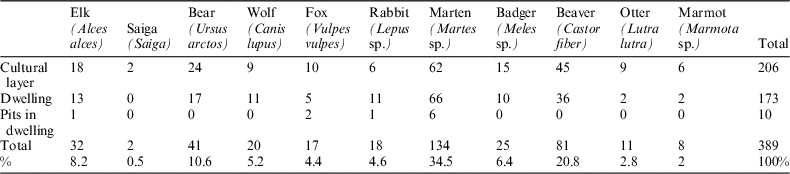
The study of archaeozoological materials from the Lebyazhinka VI settlement showed that the meat diet at the site included both wild and domestic species in approximately equal quantities. These figures were calculated acknowledging the weight differences of carcasses of different animal species. The basis of the meat diet was formed by cattle, elk, bear, and sheep or goat. Bones of the wild species constitute 64% of the mammal bones, including bones of elk (Alces alces), bear (Ursus arctos), wolf (Canis lupus), fox (Vulpes vulpes), rabbit (Lepus sp.), marten (Martes sp.), badger (Meles sp.), beaver (Castor fiber), otter (Lutra lutra), and marmot (Marmota sp.). Marten and beaver bones are the most numerous (Table 1). The predominance of marten bones evidences the developed hunting of fur animals. The large role of hunting for providing subsistence is also confirmed by the large number of arrow and spear heads, many of which had been broken during use.
Lebyazhinka VI: ratio of wild animals in the dwelling and in the cultural layer (excavations of 2013, 2015) (Korolev et al. Reference Korolev and Shalapinin2017).

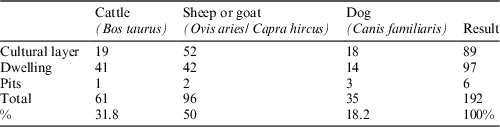
Altogether, 36% of all mammal bones are of the domestic species. They are represented by cattle (Bos taurus) and sheep or goat (Ovisaries/Capra hircus), and also bones of dog (Canis familiaris) are discovered (Table 2; Figure 2).
Archaeozoological materials from the settlement Lebyazhinka III (after Ovchinnikova Reference Ovchinnikova1995): number of bones per species.

The settlement Lebyazhinka VI: ratio of bones of domestic species in the dwelling and in cultural layer (excavations of 2013, 2015).

Numerous traces of cutting, chopping, and breaking of bones resulting from cutting up and using of carcasses have been recorded. Marks of dog bites and traces of fire are present as well. This indicates that the majority of animal bones from the Lebyazhinka VI settlement site are kitchen waste.
Fish were also included in the diet. This article presents the results of the analysis of materials from excavations in 2013–2014 (materials from 2015–2016 are still under analysis). In total, 202 fish bones were analyzed, of which 87 fragments were indeterminate. Preservation of bones—4 points out of 5. In analyzing the results, one fish bone is considered equal to one specimen. The study of species composition shows that there are 9 species belonging to 5 orders: Acipenseriformes order—Russian sturgeon (Acipenser gueldenstaedtii), stellate sturgeon (Acipenser stellatus), sterlet (Acipenser ruthenus); Cypriniformes order—carp (Cyprinus carpio), roach (Rutilus rutilus); Perciformes order—zander (Stizostedion lucioperca), perch (Perca fluviatilis); Esociformes order—pike (Esox lucius); Siluriformes order—catfish (Silurus glanis). Pike prevails by the number of bones (49.6%), catfish is in the second place (25.2%), carp, zander, and perch are present in approximately equal quantities, whereas other species, including sturgeon, are represented by single specimens. Fish of medium and large size were preferred, the most individuals being 8–10 yr old (45.9%). All fish bones belong to the category of kitchen waste, which is indirectly also supported by the charred fragments with black color and presence of bones among pottery fragments in concentrations and pits. There are bones of both cranial and postcranial skeleton in the ratio of 1:2.6. The presence of bones from both the cranial and the postcranial skeleton shows that fish were caught not far from the settlement and were cut just before eating. The great importance of the fish diet is also confirmed by the finds of bone harpoons, hooks, and sinkers. Harpoons and hooks were usually broken in the ancient times.
Bones of birds (in the number of 125 pieces) were also found at the settlement, which indicates a certain role of poultry meat in the diet—however, the study of this source material has not been completed. As a result we identified bones of various ducks: mallard (Anas platyrhynchos) (constitute 28% bones of birds) up to the species, 5 bones of netta (Anas crecca) or pochard (Anas querquedula) up to the genus. Thus, 32.0% of all the bones of birds belong to waterfowl of the genus ducks (Anas). Traces of fire are found in only three cases. The color of the burned bone makes it possible to know the temperature at which the bone was burned (Bradley et al. Reference Bradley2005). In this case, all burnt bones are black. This color is obtained by the bone of temperature of about 400°C, which is typical for open fire.
Lipid Analysis
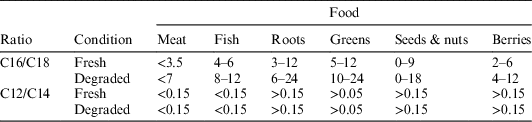
There are several criteria for interpreting the results of fatty acid composition, of which the ratios of fatty acids C16/C18 and C12/C14 are one of the most common (Table 3).
Criteria for interpreting fatty acid analysis results.

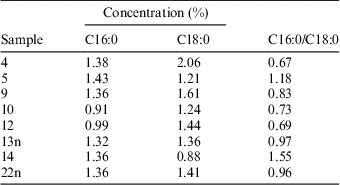
Gas chromatographic analysis (GC-MS) of the deposits on the surface of 33 ceramic samples was carried out. The ratio of fatty acids C16:0 / C18:0 for some samples are given in Table 4.
The settlement Lebyazhinka VI: analysis of residues of fatty acids on samples of ceramics.

It should be noted that fatty acid C18:3 (linolenic) and long-chain fatty acids (C20, C22, etc.) prevail in all the samples. This indicates the use of vegetable fats in the cooking process. Small amounts of short-chain fatty acid residues are found in samples 3, 4, 5, 7, 8, 9, 10–12, 13n, 14, 17–20, 22, 22n, 28, 29. The presence of these acids is characteristic for dairy products of animal origin (Evershed et al. Reference Evershed, Dudd, Copley, Berstan, Stott, Mottram, Buckley and Crossman2002). However, in order to confirm such assumptions, it is necessary to carry out additional studies of the deposits from the surface of these samples, an isotopic analysis of the content of acids C16:0 and C18:0 in particular (Dudd et al. Reference Dudd and Evershed1998). Fatty acids were not detected in samples 6, 15, 23, 30.
Radiocarbon Analysis
Dating of the Lebyazhinka III settlement was done from samples of charcoal, shell, and fragments of ceramics, and the chronology of site is determined within the interval 5200–4600 BC (for 68.2% confidence range; Morgunova et al. Reference Morgunova, Vybornov, Kovalyukh and Skripkin2010). In order to confirm the dates obtained mainly on ceramics, a bear mandibula was dated. The received date (SPb-2288, 5758±100 BP, 68,2% range 4716 (68.2%) 4496 cal ВС, 95.4% range 4832 (91.4%) 4438 cal ВС, 4426 (4.0%) 4370 cal ВС, is slightly younger than the dates obtained earlier. It cannot be excluded that the date on ceramics would not have been affected by “reservoir effect,” and perhaps, the new date on jaw bone allows correcting the chronology of this settlement.
Radiocarbon dating on cattle bone found in the fill of the dwelling of Lebyazhinka VI site was obtained: SPb-2290 –5122 ± 70 BP, 68.2% confidence range 3986 (33.6%) 3906 cal ВС, 3880 (34.6%) 3801 cal ВС, 95.4% probability 4051–3712 cal BC.
Main results of the archaeozoological analysis—determinations of species, age and size of the animals—provide the necessary data for studying the diet. Food crusts preserved on the walls of ceramic vessels, are another important source for studying the topic. According to the crust analyses, meat and vegetables, fish and vegetables, only vegetables, and possibly, dairy products were prepared in the vessels. Apparently the vessels were cleaned after cooking. We also obtained two dates of bear at Lebyazhinka III and cattle at Lebyazhinka VI. Lebyazhinka burial ground is situated near the settlement Lebyazhinka III. Now there is no evidence that they belong to the same population. The dates obtained on human bones from the burial are early. The new dating by the marmot tooth of the burial showed that the dates of settlement and burial almost coincided (Shishlina et al. Reference Shishlina, van der Plicht and Turetsky2018). Hunting equipment, such as stone arrow and spear heads, as well as fishing tools like bone harpoons and hooks are central, as their identification indicates that activities like hunting and fishing provided subsistence. It is more difficult to identify special tools used for processing and preparing products of plant origin. These include stone slabs and stones of round and elongated shape with traces of rubbing on their surface. In any case, ascertaining their use in cooking activities requires a special study. Archaeological research presented here is based on typological method and comparative analysis.
CONCLUSION
The presented results of a comprehensive study of economy, diet, and chronology are of fundamental importance for the study of the Eneolithic in the Middle Volga region. Materials from the Lebyazhinka III settlement site evidence of the preservation of a traditional hunting and fishing-based economy—these activities also determine the diet of settlers of the site. The early chronology of this settlement, the first quarter of the IV millennium BC, was confirmed by 14C date obtained on bear bone. Materials from the Lebyazhinka VI settlement site tell about the appearance of animal husbandry, while the predominant role of hunting and fishing is still preserved. This kind of combination of foraging and productive economies is characteristic for the initial stage of spread of cattle breeding. In contrast to southern Europe and the Caucasus, where a complex economy based on cultivation and animal husbandry was developing, in the Volga region innovations in economy were made in the form of animal husbandry and the use of metal. Studies on diet evidence a combination of productive economy and hunting and fishing. Dogs were apparently helping humans in keeping the domestic animals. Resolving several questions placed for this study has simultaneously raised new ones. Among these are the questions of determining the origin of animal husbandry, defining the composition of plant components in the diet, the problem of using dairy products, and refining the chronology of these processes.
ACKNOWLEDGMENTS
This research was supported by the State assignment of the Ministry of Education and Science of the Russian Federation, Project No. 33.1907.2017/PCh.