Introduction
A growing body of research has showcased the importance of leader humility, an interpersonal trait that signifies a willingness to gain an accurate view of oneself, an appreciation of others’ contributions and strengths, and teachability (Owens, Johnson, & Mitchell, Reference Owens, Johnson and Mitchell2013; Rego et al., Reference Rego, Owens, Yam, Bluhm, Cunha, Silard and Liu2019), in the business ethics domain (Frostenson, Reference Frostenson2016; Lin, Chen, Herman, Wei, & Ma, Reference Lin, Chen, Herman, Wei and Ma2019; Rego & Simpson, Reference Rego and Simpson2018). Compared with leadership behaviors, leadership traits are believed to be more powerful and they have a greater effect on employees than organizations (Yukl & Gardner, Reference Yukl and Gardner2020). To date, leader humility has been found to effectively promote the followers’ ethical behaviors or reduce their unethical behaviors in the workplace (e.g., Bharanitharan, Chen, Bahmannia, & Lowe, Reference Bharanitharan, Chen, Bahmannia and Lowe2019; Owens & Hekman, Reference Owens and Hekman2012; Owens, Yam, Bednar, Mao, & Hart, Reference Owens, Yam, Bednar, Mao and Hart2019). However, these studies have primarily focused on unethical behaviors that serve the follower’s self-interest and depart from the organization’s interests. In fact, employees are sometimes involved in unethical behaviors with an intention to benefit their organization (e.g., misrepresenting the truth to maintain the integrity of the organization; exaggerating the effects of the products to the public; Umphress & Bingham, Reference Umphress and Bingham2011). These unethical behaviors are referred to as unethical pro-organizational behavior (UPB). From a long-term vision, UPB may damage the reputation of a company or make the company face a flurry of lawsuits, and accordingly UPB is a noteworthy phenomenon for the company (Lee, Schwarz, Newman, & Legood, Reference Lee, Schwarz, Newman and Legood2019). Due to the paradoxical nature of UPB, the effect of leader humility on UPB should be more complex than its effect on general unethical behaviors. Unfortunately, we know little about how leader humility influences follower UPB.
Therefore, the purpose of our research is to uncover the question of how leader humility impacts follower UPB. Recent work on ethic-oriented leadership has indicated that there may not be always linear relationships between ethic-oriented leadership and follower (un)ethical behaviors (Miao, Newman, Yu, & Xu, Reference Miao, Newman, Yu and Xu2013; Stouten, van Dijke, Mayer, De Cremer, & Euwema, Reference Stouten, van Dijke, Mayer, De Cremer and Euwema2012). As a trait that enables a leader to adopt ethic-oriented leadership (Lin et al., Reference Lin, Chen, Herman, Wei and Ma2019; Oc, Bashshur, Daniels, Greguras, & Diefendorff, Reference Oc, Bashshur, Daniels, Greguras and Diefendorff2015), leader humility is thus supposed to have an inverted U-shaped relationship with follower UPB. Specifically, a humble leader provides an ethical model for the follower to observe and learn by exhibiting ethical behaviors (Oc et al., Reference Oc, Bashshur, Daniels, Greguras and Diefendorff2015; Owens & Hekman, Reference Owens and Hekman2012) and this social learning process thus reduces the likelihood of the follower’s engagement in unethical behaviors (Liu, Liao, & Loi, Reference Liu, Liao and Loi2012). However, leader humility may also trigger the social exchange process by treating followers with fairness and trust, and appreciating followers for their work (Davis et al., Reference Davis, Worthington, Hook, Emmons, Hill, Bollinger and Van Tongeren2013; Owens, Johnson, & Mitchell, Reference Owens, Johnson and Mitchell2013). In this case, leader humility is proposed to promote the follower’s motivation to reciprocate by engaging in behaviors that benefit the leader and the employing organization (Cropanzano & Mitchell, Reference Cropanzano and Mitchell2005; Miao et al., Reference Miao, Newman, Yu and Xu2013). We expect that the most engagement in UPB will occur at the point where the social learning effects of leader humility on follower UPB balance its social exchange effects. Using the contrasting perspectives of social exchange and social learning, we propose a nonlinear association between leader humility and follower UPB.
Furthermore, we expect the relationship between leader humility and UPB to be moderated by followers’ organizational identification. Previous research on UPB has empirically confirmed the powerful role of organizational identification in triggering UPB (Chen, Chen, & Sheldon, Reference Chen, Chen and Sheldon2016). The follower who holds strong organizational identification will treat the success or failure of the employing organization as his/her gains or losses (Mael & Ashforth, Reference Mael and Ashforth1992), thus such follower will regard UPB as dutiful behaviors that serve the organization (Ashforth & Anand, Reference Ashforth and Anand2003; Umphress & Bingham, Reference Umphress and Bingham2011). Furthermore, the extant literature of UPB has proposed a joint effect of organizational identification and social exchange relationship on individual willingness to conduct UPB (Umphress & Bingham, Reference Umphress and Bingham2011). Therefore, we propose that the increase in follower UPB associated with leader humility predicted by social exchange theory is moderated by the follower’s organizational identification. That is, the strength of the association between leader humility and follower UPB may differ with followers with high or low levels of organizational identification.
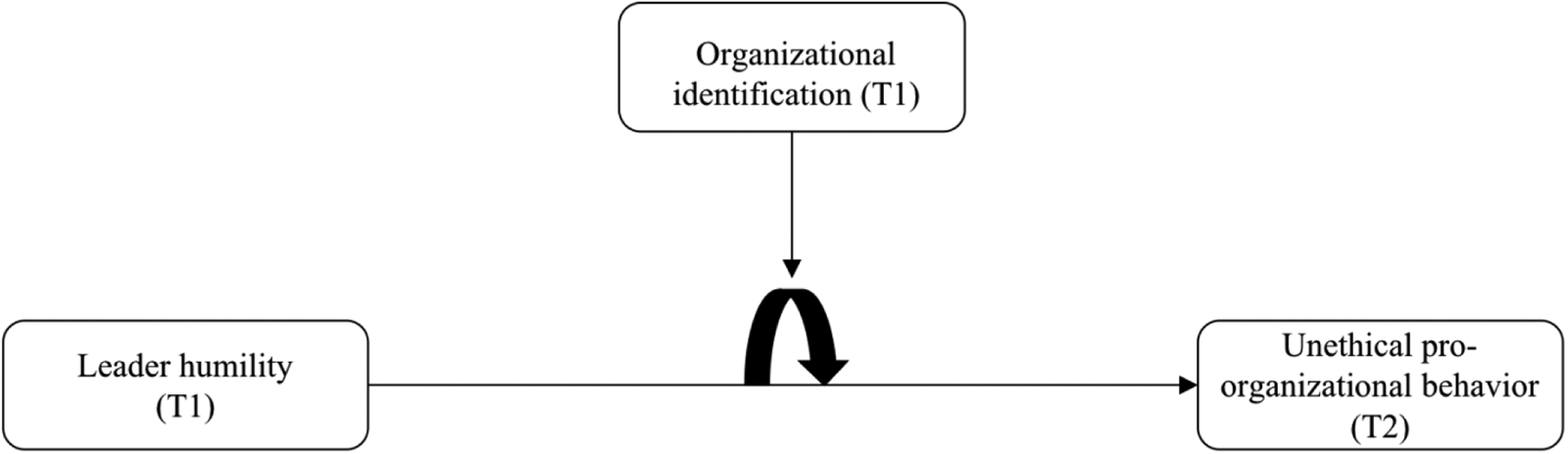
Our research contributes to the extant literature on humility and business ethics in four ways. First, by testing the potential nonlinearity in the linkage between leader humility and follower UPB, our research contributes to the leader humility literature by shifting our attention from its positive side (e.g., Wang, Liu, & Zhu, Reference Wang, Liu and Zhu2018; Yuan, Zhang, & Tu, Reference Yuan, Zhang and Tu2018; Zhou & Wu, Reference Zhou and Wu2018) to its dark side. Second, our research enriches the extant knowledge about the consequences of leader humility in the business ethics domain by introducing a specific unethical behavior, in this case, UPB as the outcome of leader humility, while further providing a broader vision of leader humility’s role. Third, by identifying a specific leader trait – leader humility, as the predictor of follower UPB, our research also broadens the existing UPB literature, which has exclusively identified leadership (e.g., Cheng, Wei, & Lin, Reference Cheng, Wei and Lin2019; Effelsberg & Solga, Reference Effelsberg and Solga2015; Graham, Ziegert, & Capitano, Reference Graham, Ziegert and Capitano2015) as predictors of UPB, and answers Pierce and Aguinis’s (Reference Pierce and Aguinis2015) call for a comprehensive understanding of the triggers of UPB. Fourth, by testing whether this nonlinear association is moderated by the follower’s organizational identification, our research develops a boundary condition for the association linking leader humility to follower UPB from the identification perspective. We also provide a more comprehensive understanding of organizational identification’s role in the literature of unethical pro-social behavior, which has primarily focused on the main effect of organizational identification (e.g., Chen, Chen, & Sheldon, Reference Chen, Chen and Sheldon2016; Johnson & Umphress, Reference Johnson and Umphress2019; Umphress, Bingham, & Mitchell, Reference Umphress, Bingham and Mitchell2010). The conceptual model in this study is presented in Figure 1.
Conceptual model.

Literature review and hypotheses development
Leader humility
Leader humility refers to a self-based and interpersonal trait that enables the leader to perform better in social situations by manifesting a willingness to gain an accurate view of oneself, appreciating others’ contributions and strengths, and modeling teachability (Owens, Johnson, & Mitchell, Reference Owens, Johnson and Mitchell2013). Due to its interpersonal nature, leader humility can be observed and recognized by followers via a pattern of behaviors that occur in the interpersonal interactions (Mao, Chiu, Owens, Brown, & Liao, Reference Mao, Chiu, Owens, Brown and Liao2019). There are several behavioral tendencies behind the leaders’ humble behaviors (Argandona, Reference Argandona2015). First of all, humility enables the leader to evaluate oneself from an objective, non-defensive, and accurate view (Jeung & Yoon, Reference Jeung and Yoon2018; Tangney, Reference Tangney2000). Second, leaders who score high on humility are inclined to appreciate their followers’ contributions and advantages, without feeling threatened (Exline, Campbell, Baumeister, Joiner, Krueger, & Kachorek, Reference Exline, Campbell, Baumeister, Joiner, Krueger, Kachorek, Peterson and Seligman2004; Morris, Brotheridge, & Urbanski, Reference Morris, Brotheridge and Urbanski2005). Finally, humble leaders are interested in learning from others, while willing to embrace advice, ideas, and information from others (Li, Zhang, Xia, & Liu, Reference Li, Zhang, Xia and Liu2019; Tangney, Reference Tangney2000).
Leader humility has important moral implications (Silard, Miao, & Owens, Reference Silard, Miao and Owens2021) because it enables leaders to adopt ethic-oriented leadership (Oc et al., Reference Oc, Bashshur, Daniels, Greguras and Diefendorff2015). For example, humble leaders emphasize fairness and trust (Lin et al., Reference Lin, Chen, Herman, Wei and Ma2019) and these ethical characteristics guide humble leaders to adopt a leadership approach that is less self-interested (Owens & Hekman, Reference Owens and Hekman2012). Accompanied by these ethical characteristics, humble leaders are willing to share success and achievement with others (e.g., their followers) (Frostenson, Reference Frostenson2016), and are unwilling to place personal benefits above their followers’ interests (Owens & Hekman, Reference Owens and Hekman2012). Adopting an accurate view of oneself is another characteristic of leader humility (Frostenson, Reference Frostenson2016; Morris, Brotheridge, & Urbanski, Reference Morris, Brotheridge and Urbanski2005). This characteristic fosters individuals to recognize oneself accurately, and further promotes their moral reasoning capability (Grenberg, Reference Grenberg2005).
Given the ethics-oriented nature behind the leaders’ humble behaviors, humble leaders provide ethical behavioral role models for their followers by behaving in an ethical approach (Lin et al., Reference Lin, Chen, Herman, Wei and Ma2019). According to social learning theory (Bandura, Reference Bandura1977, Reference Bandura1986), followers adopt the same behavior pattern by observing and learning from such ethical behavioral role models provided by humble leaders. Several studies have proposed that leader humility contributes to fostering their followers’ ethical conducts (e.g., Carnevale, Huang, & Paterson, Reference Carnevale, Huang and Paterson2019; Owens et al., Reference Owens, Yam, Bednar, Mao and Hart2019; Owens & Hekman, Reference Owens and Hekman2016). Yet, few studies have empirically unpacked the effect of leader humility on ethics-related outcomes (e.g., UPB) (Silard, Miao, & Owens, Reference Silard, Miao and Owens2021).
UPB
UPB consists of a pattern of a series of unethical behaviors that are conducted with an intention to help their organization (Umphress, Bingham, & Mitchell, Reference Umphress, Bingham and Mitchell2010). Such a type of unethical behavior contains dual kernel components. On the one hand, as a specific unethical behavior, UPB has an unethical nature. That is, such behavior violates generally accepted ethical norms (Donaldson & Dunfee, Reference Donaldson and Dunfee1994; Umphress & Bingham, Reference Umphress and Bingham2011) via commission (e.g., exaggerating or misrepresenting the truth about the company) or omission (e.g., concealing negative information about the company or its products) (Lee et al., Reference Lee, Schwarz, Newman and Legood2019). On the other hand, different from unethical actions motivated by self-interest, UPB is accompanied by an intention to support the organization (Umphress & Bingham, Reference Umphress and Bingham2011; Vadera & Pratt, Reference Vadera and Pratt2013).
Once UPB occurs, the organization’s reputation will be ruined and the organization is likely to be threatened by lawsuits (Lee et al., Reference Lee, Schwarz, Newman and Legood2019). Given these serious consequences, to identify the factors that may trigger UPB is particularly important. No doubt that the leader is a key element in shaping an employee’s unethical act (Graham, Ziegert, & Capitano, Reference Graham, Ziegert and Capitano2015) and there is a prominent role played by leaders in the definition of UPB (Umphress & Bingham, Reference Umphress and Bingham2011). Thus, a growing body of research (e.g., Cheng, Wei, & Lin, Reference Cheng, Wei and Lin2019; Effelsberg, Solga, & Gurt, Reference Effelsberg, Solga and Gurt2014; Miao et al., Reference Miao, Newman, Yu and Xu2013) has tried to explore how leader factors influence follower UPB. However, such studies have largely investigated how leadership such as transformational leadership and ethical leadership affects one’s decision on UPB while ignoring the role of leader characteristics or traits in predicting UPB. To cover this shortage in the existing UPB research, this study focuses on a specific leader trait – leader humility, which has grown in importance in the business ethics domain (Rego & Simpson, Reference Rego and Simpson2018), and investigates its role in predicting follower UPB.
The relationship between leader humility and follower UPB
Integrating social learning and social exchange perspectives, in combination with the dual natures (i.e., unethical and pro-organizational) of UPB, we state that the impact of leader humility on follower UPB follows an inverted U-curve pattern. That is, compared with those experiencing low or high levels of leader humility, followers who are guided by intermediate levels of leader humility tend to engage more in UPB.
Specifically, follower UPB is supposed to grow with the increase in leader humility from low to moderate levels, as increased leader humility contributes to his/her follower’s reciprocating motivation toward the employing organization by fostering the social exchange process between a leader and his/her follower. Social exchange theory states that followers’ behaviors and attitudes depend largely on how they are treated by their leader (Blau, Reference Blau1964; Cropanzano & Mitchell, Reference Cropanzano and Mitchell2005). Followers supervised by a humble leader may have a feeling of being respected (Lin et al., Reference Lin, Chen, Herman, Wei and Ma2019) and trusted by their leader (Carnevale, Huang, & Paterson, Reference Carnevale, Huang and Paterson2019), as such a leader tends to appreciate followers’ contributions and strengths (Morris, Brotheridge, & Urbanski, Reference Morris, Brotheridge and Urbanski2005; Tangney, Reference Tangney2000). Moreover, humble leaders care about their followers’ interests and treat them in a fair way (Morris, Brotheridge, & Urbanski, Reference Morris, Brotheridge and Urbanski2005). Thus, compared with those supervised by leaders with low humility, followers experiencing moderate levels of leader humility will feel more trust and fairness in the organization. Drawn from social exchange theory, the enhanced trust and fairness contribute to fostering the favorable relationships between follower and leader (Cropanzano & Mitchell, Reference Cropanzano and Mitchell2005). Therefore, humble leaders who treat their followers with fairness and trust, as well as appreciate their followers’ contributions and strengths (Owens, Johnson, & Mitchell, Reference Owens, Johnson and Mitchell2013) are likely to develop favorable interpersonal interactions with their followers (Davis et al., Reference Davis, Worthington, Hook, Emmons, Hill, Bollinger and Van Tongeren2013; Miao et al., Reference Miao, Newman, Yu and Xu2013; Rego & Simpson, Reference Rego and Simpson2018). As the relationship with their leader improves, followers are inclined to reciprocate by taking actions that benefit the leader and the employing organization (Cheng, Lu, Chang, & Johnstone, Reference Cheng, Lu, Chang and Johnstone2013; Song, Gu, Wu, & Xu, Reference Song, Gu, Wu and Xu2019). The existing UPB literature has proposed that favorable relationships with leaders will trigger followers to take pro-organizational actions (e.g., UPB) (Umphress, Bingham, & Mitchell, Reference Umphress, Bingham and Mitchell2010; Wang, Long, Zhang, & He, Reference Wang, Long, Zhang and He2019). Thus, followers experiencing moderate levels of leader humility are more likely to reciprocate their leader and the employing organization by protecting their interests (Nahrgang, Morgeson, & Ilies, Reference Nahrgang, Morgeson and Ilies2009), even when it has an unethical nature, such as UPB (Miao et al., Reference Miao, Newman, Yu and Xu2013). Relative to those under moderate levels of leader humility, followers experiencing low levels of leader humility may develop a poor quality of exchange relationship with their leader and thus be unlikely to work for the leader and the employing organization. Accordingly, followers experiencing intermediate levels of leader humility are expected to be more involved in UPB than those experiencing low levels of leader humility.
However, to uncover the relationship between leader humility and follower UPB further, taking moral implications of leader humility into consideration is necessary, because Owens et al. (Reference Owens, Yam, Bednar, Mao and Hart2019) proposed that leader humility fosters followers’ social learning process concerning morality and thus reduces the possibility that followers take unethical actions. Social learning theory holds that individuals can learn how to behave via observation and emulation of the behaviors expressed by important social contacts (Bandura, Reference Bandura1986). Given the significant role of leaders in allocating key organizational resources, evaluating the followers’ performance and deciding whether their followers receive promotions or pay raises, as well as training opportunities (Liu, Liao, & Loi, Reference Liu, Liao and Loi2012), followers tend to pay close attention to the behaviors exhibited by their leaders and hereby adopt similar patterns of behavior (Mayer, Kuenzi, Greenbaum, Bardes, & Salvador, Reference Mayer, Kuenzi, Greenbaum, Bardes and Salvador2009; Wang, Liu, & Zhu, Reference Wang, Liu and Zhu2018). As such, the follower’s inclination to behave unethically is supposed to decrease with the increase in leader humility from intermediate to high levels, as high levels of humility enable leaders to behave more ethically than moderate levels of humility (Oc et al., Reference Oc, Bashshur, Daniels, Greguras and Diefendorff2015). First, leaders who score high on humility are more willing to view themselves accurately by paying attention to their weaknesses as well as strengths (Frostenson, Reference Frostenson2016; Morris, Brotheridge, & Urbanski, Reference Morris, Brotheridge and Urbanski2005). Such an accurate self-awareness helps humble leaders to reduce the likelihood of unethical behaviors (Grenberg, Reference Grenberg2005; Owens et al., Reference Owens, Yam, Bednar, Mao and Hart2019). Second, such leaders are more inclined to recognize their followers’ contributions (Exline et al., Reference Exline, Campbell, Baumeister, Joiner, Krueger, Kachorek, Peterson and Seligman2004) and share success and achievement with others (e.g., their followers) (Frostenson, Reference Frostenson2016). That is, high levels of humility enable leaders to follow a less self-interested behavioral pattern (Owens & Hekman, Reference Owens and Hekman2012). By demonstrating humility in these ways, leaders with over humility will provide a clearer ethical role model for followers to observe and learn. This social learning process removes followers’ doubts about how to weigh ethical standards against organizational interests, stimulates followers to employ high ethical standards, and reduces the likelihood of conducing unethical behavior, even if it is essentially pro-organizational. As a result, followers experiencing high levels of leader humility manifest a stronger willingness to serve the interests of organizations in an ethical manner, rather than in an unethical manner (e.g., UPB). That is, in situations where leader humility is at a high level, the social learning effect on followers’ ethical behaviors outweighs the effect of social exchange on followers’ pro-organizational behaviors, consequently leading to a decrease in follower UPB.
Low and high levels of leader humility may destroy followers’ reciprocating motivation toward the employing organization and remove the unethical behavioral component, respectively. We thus propose that moderate levels of leader humility will motivate followers to take more UPB than low or high levels of leader humility, as followers have strong motivation to work for organizational interests and limited ethical message from moderate levels of leader humility. Specifically, compared with those who hold high levels of humility, there are relatively fewer ethical components expressed by behaviors of leaders with moderate levels of humility. Moreover, in the case of a moderate level of humility, there may be some other things more worthy of concern in the leader’s mind, such as maximizing the organizational interest. These two points bring great confusion to followers in conditions where a conflict exists between the interests of organization and ethical rules (Miao et al., Reference Miao, Newman, Yu and Xu2013). Owning to such confusion, the process of neutralization is likely to be facilitated, allowing followers to pursue the organizational interests in an unethical way (Sykes & Matza, Reference Sykes and Matza1957; Umphress & Bingham, Reference Umphress and Bingham2011). That is, in situations where leader humility is at a moderate level, there is a balance between the effects of social learning on followers’ ethical behaviors and the effects of social exchange on followers’ pro-organizational behaviors, leading to a peak of follower UPB. Recent work conducted by Miao et al. (Reference Miao, Newman, Yu and Xu2013) supports our proposition. Their work uncovered an inverted U-shaped association between ethical leadership, which is positively predicted by leader humility (De Vries, Reference De Vries2012), and follower UPB.
To sum up, we propose that the association linking leader humility to follower UPB follows a curvilinear path. That is, leader humility will have a positive relationship with UPB up to a point, after which an increased leader humility can result in reduced follower UPB; the most engagement in UPB will occur at moderated levels of leader humility.
Hypothesis 1: There is an inverted U-shaped relationship between leader humility and follower UPSB.
The moderating role of organizational identification
Deriving from social identity theory (Tajfel, Reference Tajfel1982; Tajfel & Turner, Reference Tajfel, Turner, Worchel and Austin1986), organizational identification is conceptualized as the extent of an individual’s perception of belonging or oneness with the employing organization, and the degree to which an individual regards the success or failure of the employing organization as his/her gains or losses (Ashforth & Mael, Reference Ashforth and Mael1989). Organizational identification reflects the strength of a person’s psychological attachment to the employing organization (Decoster, Camps, Stouten, Vandevyvere, & Tripp, Reference Decoster, Camps, Stouten, Vandevyvere and Tripp2013). Thus, individuals who identify more with their organization are more proud of their organizational membership (Loi, Chan, & Lam, Reference Loi, Chan and Lam2014), are more likely to internalize the goals of their employing organization as their own to a greater degree (Van Knippenberg, Reference Van Knippenberg2000), and are more willing to help the working organization by engaging in ethical and unethical behaviors (Chen, Chen, & Sheldon, Reference Chen, Chen and Sheldon2016; Decoster et al., Reference Decoster, Camps, Stouten, Vandevyvere and Tripp2013). That is, individuals with stronger organizational identification will make greater contributions to the organization (Van Knippenberg, Van Knippenberg, De Cremer, & Hogg, Reference Van Knippenberg, Van Knippenberg, De Cremer and Hogg2004).
Supporting these arguments, the extant research has showcased that individuals with strong organizational identification are willing to help the organization in good as well as bad times (Van Dick, Ullrich, & Tissington, Reference Van Dick, Ullrich and Tissington2006; Van Knippenberg, Van Dick, & Tavares, Reference Van Knippenberg, Van Dick and Tavares2007). For example, in a transitional organization, organizational identification contributes to reducing employees’ turnover intention, decreasing their negative feelings, improving satisfaction, as well as increasing citizenship behaviors (Van Dick, Ullrich, & Tissington, Reference Van Dick, Ullrich and Tissington2006). Moreover, Van Knippenberg, Van Dick, and Tavares (Reference Van Knippenberg, Van Dick and Tavares2007) revealed that the negative association between low organizational support and individuals’ absenteeism and turnover intention is buffered by their organizational identification. Furthermore, the effect of abusive supervision on facilitating followers’ propensity to gossip is confirmed to be weakened by organizational identification (Decoster et al., Reference Decoster, Camps, Stouten, Vandevyvere and Tripp2013). Recent studies determined that individuals with high organizational identification are more likely to touch the ethical bottom line, abandon the ethical principles, and conduct unethical behaviors for favoring their organization (Ashforth & Anand, Reference Ashforth and Anand2003; Chen, Chen, & Sheldon, Reference Chen, Chen and Sheldon2016; Umphress & Bingham, Reference Umphress and Bingham2011). Umphress, Bingham, and Mitchell (Reference Umphress, Bingham and Mitchell2010) discovered that organizational identification, in combination with positive reciprocity, significantly predicts follower UPB. Building upon these findings, organizational identification is used as a moderator to offer insight into the nonmonotonic association between leader humility and follower UPB in this study.
We suppose that the proposed nonmonotonic association between leader humility and follower UPB will be stronger for followers who score high on organizational identification. Specifically, followers experiencing high levels of organizational identification tend more to internalize the goals of the employing organization as their own (Van Knippenberg et al., Reference Van Knippenberg, Van Knippenberg, De Cremer and Hogg2004). Consequently, such a follower tends to place the organization’s interests in a more important place and thus holds a stronger motivation toward the goals and interests of their organization. Due to the enhancing effect of high organizational identification on the follower’s pro-organizational motivation, the effect of leader humility on follower UPB via motivating followers to reciprocate their organization is likely to be catalyzed. Therefore, compared with those who hold low organizational identification, followers with high organizational identification are expected to reach a higher level of UPB when they are guided by moderate levels of leader humility.
Hypothesis 2: Organizational identification moderates the curvilinear relationship between leader humility and follower UPB, such that the inverted U-curve relationship between leader humility and follower UPB will be stronger for followers with high organizational identification than for those with low organizational identification.
Method
Participants and procedures
For testing our theoretical model, two-wave data were collected from full-time employees in eastern China, who worked in various industries, including architecture, finance, government agencies, IT, manufacturing, and retail. We identified participants by using a snowball sampling method (Loi, Kuhn, Sahaym, Butterfield, & Tripp, Reference Loi, Kuhn, Sahaym, Butterfield and Tripp2020) through MBA students enrolled in an organizational behavior course at a national key university located in eastern China. For extra course credit, 46 MBA students were asked to randomly invite at least two full-time employees who had daily interaction with their leaders and were willing to participate in our research and to provide contact information on those invited employees. We then sent our surveys to the participants directly via Qualtrics (a widely-used data collection platform). The whole survey process was anonymous and information provided by participants was only used for research. Data were collected at two time points and doing so can help reduce the threats of common method variance (Podsakoff, MacKenzie, Lee, & Podsakoff, Reference Podsakoff, MacKenzie, Lee and Podsakoff2003) and respondent fatigue (Miao et al., Reference Miao, Newman, Yu and Xu2013).
At Time 1, questionnaires were distributed to 219 participants for collecting data on demographic variables (gender, age, and education), organizational identification, and perceptions of leader humility. There were 202 participants who completed questionnaires (response rate: 92.2%). At Time 2, 3 weeks later, questionnaires were distributed to the initial 219 participants for collecting data on one’s willingness to conduct UPB. There were 203 participants who completed questionnaires (response rate: 92.7%). MBA students were regarded as contacts to remind their coworkers to complete questionnaires on time, which can improve the response rate.
After matching participants’ responses at Time 1 with those at Time 2 and removing cases with missing data, the final sample consisted of 193 employees from 46 teams. Among 193 participants, 46.1% were male, 69.9% were 30 years and under, and 81.3% held a bachelor’s degree or above. The mean of organizational tenure was 4.45 years.
Measures
Following Brislin’s (Reference Brislin, Lonner and Berry1986) translation and back-translation procedures, we translated all scales adopted in this research into Mandarin Chinese, because scales for leader humility, UPB, and organizational identification were developed in English. All items were rated on a 7-point Likert Scale with a range from 1 (strongly disagree) to 7 (strongly agree).
Leader humility (Time 1)
In line with previous research on leader humility (e.g., Lin et al., Reference Lin, Chen, Herman, Wei and Ma2019), we evaluated employees’ perceptions of leader humility using the nine-item scale developed by Owens and Hekman (Reference Owens and Hekman2016). Respondents were required to rate how much they agreed or disagreed with six statements, such as ‘My leader takes notice of others’ strengths’ and ‘My leader is willing to learn from others’ (α = .96).
Organizational identification (Time 1)
We measured followers’ identification with the organization by adopting the six-item scale from Mael and Ashforth (Reference Mael and Ashforth1992). Respondents were required to rate how much they agreed or disagreed with six statements, such as ‘My organization’s successes are my successes’ and ‘I’m very interested in what others think about my organization’ (α = .88).
UPB (Time 2)
We adopted the six-item scale developed by Umphress, Bingham, and Mitchell (Reference Umphress, Bingham and Mitchell2010) to measure one’s willingness to conduct UPB. Respondents were required to rate how much they agreed or disagreed with six statements, such as ‘If it would help my organization, I would misrepresent the truth to make my organization look good’ and ‘If needed, I would conceal information from the public that would be damaging to my organization’ (α = .94).
Controls
Prior research has shown that unethical behavior decision (e.g., UPB) may be influenced by an individual’s demographics, including age and organizational tenure (Kish-Gephart, Harrison, & Treviño, Reference Kish-Gephart, Harrison and Treviño2010; Thau, Derfler-Rozin, Pitesa, Mitchell, & Pillutla, Reference Thau, Derfler-Rozin, Pitesa, Mitchell and Pillutla2015), thus these demographics were controlled in our model.
Analytical strategy
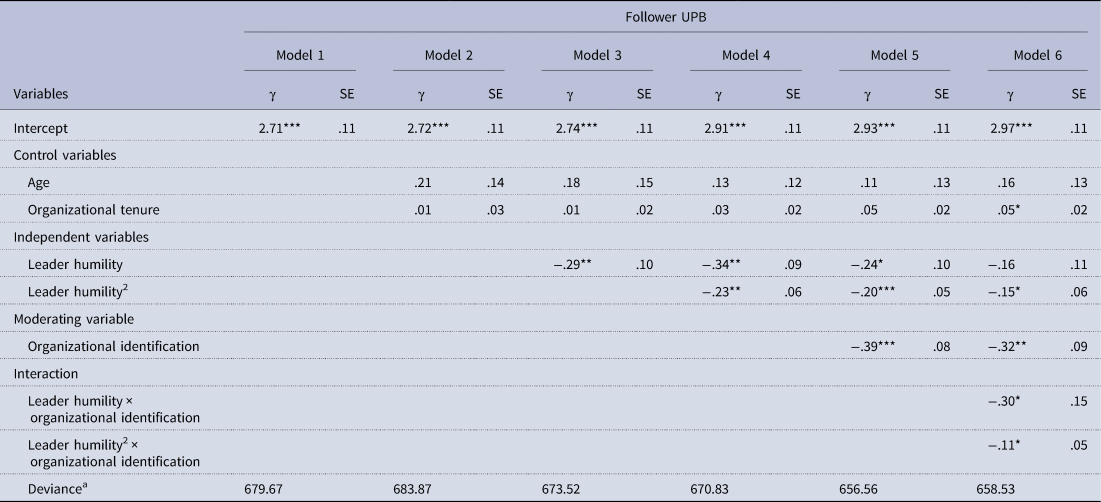
All of the constructs (i.e., leader humility, organizational identification, and UPB) were collected at the follower level; however, on account of the fact that data in this study had a nested structure (i.e., at least two followers share a team leader), hierarchical regression analyses were conducted for hypothesis testing using Hierarchical Linear Model (HLM) in the software HLM 6.08. By running one null model where UPB worked as the dependent variable (Model 1, Table 3), we can make a judgement on whether it is appropriate to test our theoretical model using HLM2. Results showed significant between-team variances in UPB (χ2(45) = 63.00, p < .05), indicating that HLM2 is reasonable and appropriate in this study. After examining the null model, controls, leader humility, and a quadratic leader humility term were added to the model in sequence for investigating the nonlinear effect of leader humility on UPB (Hypothesis 1). To further evaluate the influence of organizational identification on this curvilinear relationship (Hypothesis 2), organizational identification, its interaction with leader humility, and its interaction with the leader humility quadratic were included on the basis of previous model. We then followed Aiken and West’s (Reference Aiken and West1991) approach to test the significance of slopes for the proposed moderation effect. The predictor (i.e., leader humility) and the moderator (i.e., organizational identification) were centered to reduce the threats from multicollinearity (Aiken & West, Reference Aiken and West1991; Rapp, Bachrach, & Rapp, Reference Rapp, Bachrach and Rapp2013).
Results
Descriptive statistics
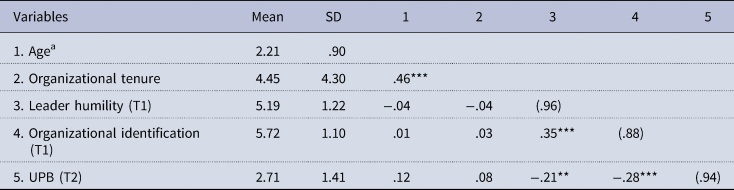
The descriptive statistics – means and standard deviations (SD), of all of the measured variables (i.e., leader humility, organizational identification, and UPB), and their correlations were provided by Table 1. Values of Cronbach’s α ranging from .88 to .96 were higher than the .70 acceptable level (Nunnally, Reference Nunnally1978), indicating a satisfactory reliability.
Correlations of measured variables

N = 193. *p < .05; **p < .01; ***p < .001. Values of α are shown in brackets along the diagonal line.
a 1 = 25 years and under, 2 = 26–30 years, 3 = 31–35 years, 4 = 36–40 years, 5 = 41 years and above.
Measurement model
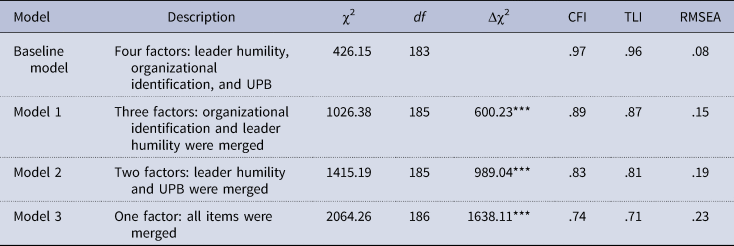
Confirmatory factor analyses were conducted to examine the discriminant validity of all of the study constructs using LISERL 8.8. There were three latent variables (i.e., leader humility, organizational identification, and UPB) with 21 indicators (i.e., six items for UPB, six items for organizational identification, and nine items for leader humility) in our measurement model. Results in Table 2 suggested that the baseline model fitted the data well (χ2(183) = 426.15, p < .001, CFI = .97, TLI = .96, RMSEA = .08). This baseline model was also demonstrated to provide a better fit than other models via a series of χ2 difference tests (see Table 2). Summing up the above, these results supported the discriminant validity of all of the study variables.
Comparisons of measurement model

CFI, comparative fit index; TLI, Tucker–Lewis index; RMSEA, root mean-square error of approximation.
*** p < .001.
Hypotheses testing
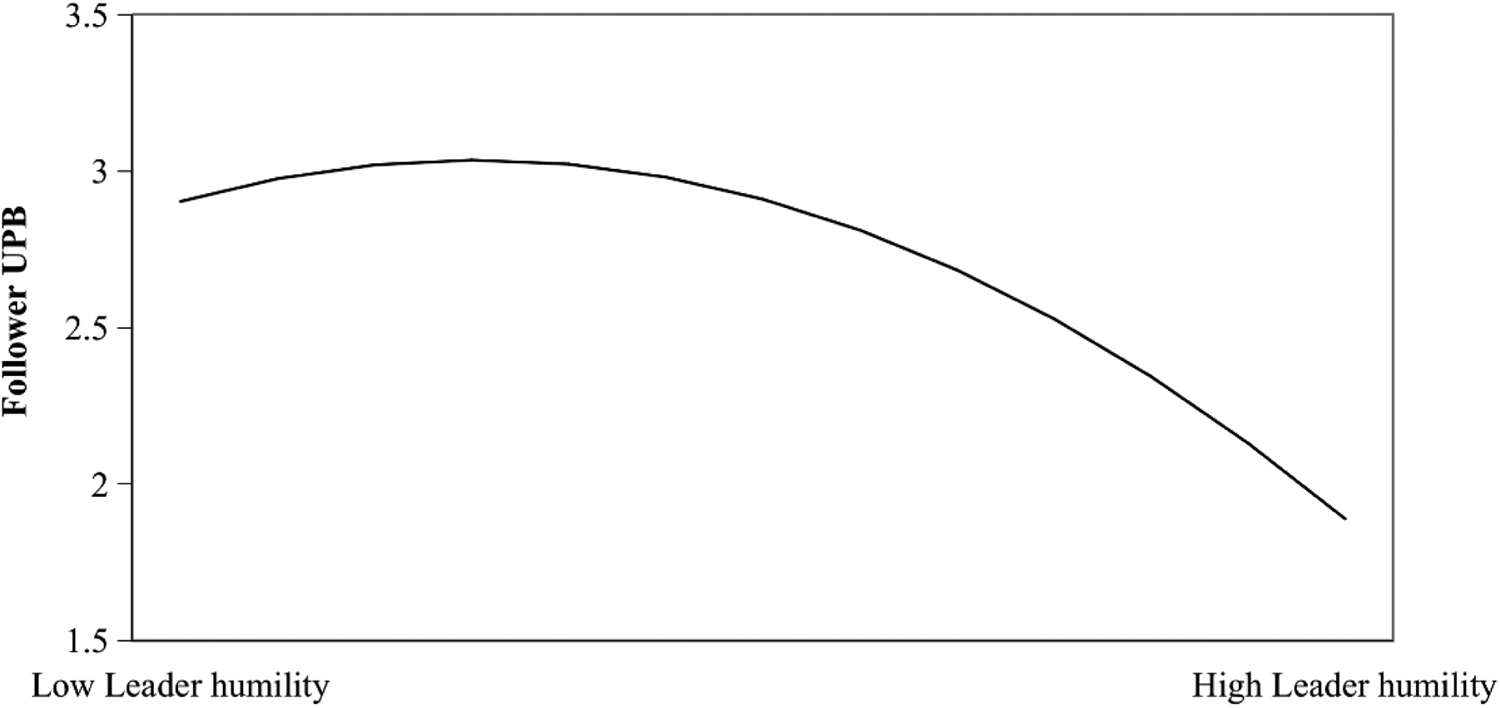
Results for Hypotheses 1 and 2 were shown in Table 3. Control variables (i.e., age and organization tenure) were first added into the regression (Model 2), following by the independent variable – leader humility (Model 3). Results indicated that leader humility had a significant effect on follower UPB (γ = −.29, SE = .10, p < .01). The quadratic term – leader humility × leader humility, was then entered into the regression (Model 4) and was found to have a significant effect on follower UPB (γ = −.23, SE = .06, p < .01), indicating that leader humility had an inverted U-shaped relationship with follower UPB. Following the Dawson and Richter’s (Reference Dawson and Richter2006) procedure, we plotted the quadratic fit of leader humility in predicting follower UPB. As shown in Figure 2, UPB does not increase too much when leader humility increases from low to moderate level, and decreases significantly from moderate to high level. Overall, findings mentioned above support Hypothesis 1.
Relationship between leader humility and follower UPB.

Hierarchical linear modeling regression results

N = 193.
a Deviance is a measure of model fit; it equals −2* the log-likelihood of the maximum-likelihood estimate. The smaller the model deviance is, the better the fit will be.
*p < .05; **p < .01; ***p < .001.
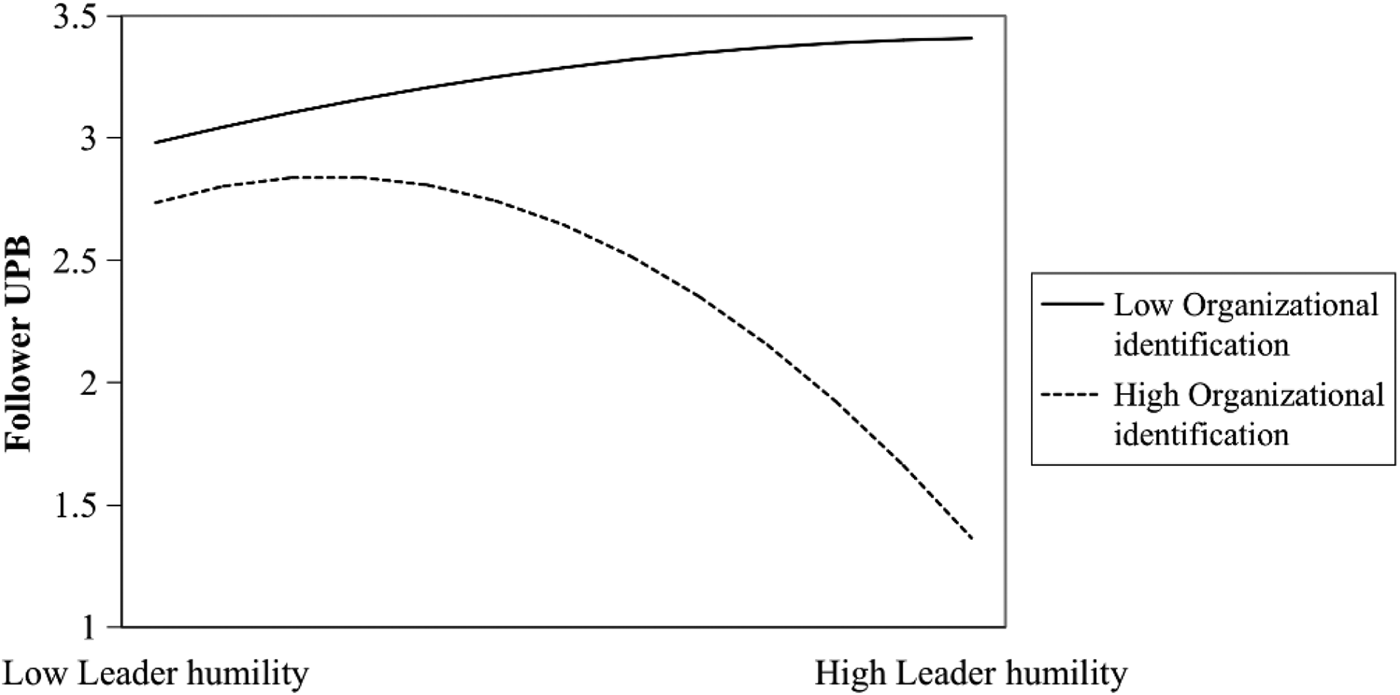
To test Hypothesis 2, which proposed that the inverted U-shaped relationship between leader humility and follower UPB was moderated by organizational identification, two interaction terms (i.e., leader humility × organizational identification and leader humility2 × organizational identification) were added into the regression (Model 5). This approach has been adopted by previous research (e.g., Farh, Lee, & Farh, Reference Farh, Lee and Farh2010; Tangirala & Ramanujam, Reference Tangirala and Ramanujam2008). As shown in Table 3, the term of leader humility2 × organizational identification was significant (γ = −.11, SE = .05, p < .05). To further probe these results, we estimated the curves between leader humility and follower UPB for followers with high (+1 SD) and low (-1 SD) organizational identification and plotted the relationship in Figure 3. As shown in Figure 3, in the condition of high organizational identification, leader humility had a significant and negative quadratic effect on follower UPB (γ = −.16, SE = .04, p < .001), whereas in the condition of low organizational identification, leader humility had no significant linear (γ = .05, SE = .20, ns) or quadratic effect (γ = −.03, SE = .05, ns) on follower UPB. Overall, results mentioned above provide support for Hypothesis 2 associated with the moderating role of organizational identification.
The moderating effect of organizational identification in the relationship between leader humility and follower UPB.

Discussion
We examined the likelihood of the curvilinear relationship between leader humility and follower UPB, and whether this relationship was moderated by the follower’s organizational identification. Findings revealed an inverted U-curve association between leader humility and follower UPB. That is, too little or too much leader humility context hampers the follower’s willingness to favor the organization’s interests in an unethical manner (i.e., UPB), whereas the most UPB emerges when the leader exhibits a moderate level of humility. Furthermore, we found that this curvilinear relationship exists when the follower holds a high level of organizational identification, but leader humility was unrelated to follower UPB when this follower holds a low level of organizational identification. Therefore, these findings provide theoretical and managerial implications for the extant literature.
Theoretical implications
Our research makes four contributions to the literature on humility and business ethics. First, we contribute to the growing literature on leader humility by demonstrating its implications for follower UPB. The extant literature has exclusively highlighted the ethical nature of leader humility and believed that leader humility can stop an individual’s unethical conduct (e.g., Lin et al., Reference Lin, Chen, Herman, Wei and Ma2019; Oc et al., Reference Oc, Bashshur, Daniels, Greguras and Diefendorff2015; Owens & Hekman, Reference Owens and Hekman2012), while overlooking its potential dark side. Our study moves beyond this generally accepted view by proposing and confirming an inverted U-shaped relationship between leader humility and follower UPB. By considering two social processes (i.e., learning and exchange) simultaneously, we find that in situations where leader humility is at a moderate level, the effects of social learning on followers’ ethical behaviors balance the effects of social exchange on followers’ pro-organizational behaviors, leading to a peak of follower UPB. Unlike the extant literature on leader humility that has largely focused on its positive effects (e.g., Wang, Liu, & Zhu, Reference Wang, Liu and Zhu2018; Yuan, Zhang, & Tu, Reference Yuan, Zhang and Tu2018; Zhou & Wu, Reference Zhou and Wu2018), our findings indicate that leader humility might cause negative consequences to some degree. This finding also indicates that compared with general unethical behaviors, the relationship between leader humility and follower UPB is more complex, due to the dual (i.e., pro-organizational and unethical) nature of UPB (Umphress, Bingham, & Mitchell, Reference Umphress, Bingham and Mitchell2010). Furthermore, findings regarding the curvilinear effect of leader humility on follower UPB complement and extend the previous work by Miao et al. (Reference Miao, Newman, Yu and Xu2013) that confirmed an inverted U-shaped relationship between ethical leadership and follower UPB, given that leader humility is positively related to ethical leadership (De Vries, Reference De Vries2012) and humility has been considered as the core of ethical leadership (Yuan, Zhang, & Tu, Reference Yuan, Zhang and Tu2018).
Second, by identifying UPB as the outcome of leader humility, our research extends and complements the burgeoning research that considers leader humility as an antecedent of other important behavioral outcomes, such as creativity or innovation (e.g., Wang, Liu, & Zhu, Reference Wang, Liu and Zhu2018; Yuan, Zhang, & Tu, Reference Yuan, Zhang and Tu2018; Zhou & Wu, Reference Zhou and Wu2018) and voice behavior (Bharanitharan et al., Reference Bharanitharan, Chen, Bahmannia and Lowe2019; Jeung & Yoon, Reference Jeung and Yoon2018). Although leader humility has become increasingly important in the business ethics area (Argandona, Reference Argandona2015; Rego & Simpson, Reference Rego and Simpson2018), little empirical attention has been paid to the role of leader humility in followers’ ethical or unethical behaviors (Silard, Miao, & Owens, Reference Silard, Miao and Owens2021). By identifying one specific unethical behavior (i.e., UPB) as the consequence of leader humility, our study therefore fills this gap and enriches the existing knowledge about the outcomes of leader humility.
Third, we contribute to the existing research on UPB by verifying leader humility as the predictor of UPB. An increasing number of scholars have explored the triggers of UPB, especially from the leadership perspective (e.g., Cheng, Wei, & Lin, Reference Cheng, Wei and Lin2019; Effelsberg & Solga, Reference Effelsberg and Solga2015; Effelsberg, Solga, & Gurt, Reference Effelsberg, Solga and Gurt2014; Graham, Ziegert, & Capitano, Reference Graham, Ziegert and Capitano2015), while ignoring the potential effects of leader trait. A recent work conducted by Mesdaghinia, Rawat, and Nadavulakere (Reference Mesdaghinia, Rawat and Nadavulakere2019) has provided empirical evidence for the crucial role played by leader traits (i.e., leader bottom-line mentality) in the follower’s unethical pro-social behavior. By identifying leader humility, a typical leader trait (Owens, Johnson, & Mitchell, Reference Owens, Johnson and Mitchell2013), as the antecedent of a follower’s UPB, our work thus fills up the deficiency in the extant UPB research and responds to the recent call (Mesdaghinia, Rawat, & Nadavulakere, Reference Mesdaghinia, Rawat and Nadavulakere2019) for examining the effects of leader trait on unethical pro-social behavior.
Fourth, our research contributes to the organizational identification literature by verifying organizational identification as a moderator in the curvilinear relationship between leader humility and follower UPB. We find that the inverted U-shaped relationship between leader humility and follower UPB is stronger among followers with high organizational identification. This finding supports previous work that highlights the importance of organizational identification in changing the effect of leader factors on followers’ behaviors. For example, Decoster et al. (Reference Decoster, Camps, Stouten, Vandevyvere and Tripp2013) showcased that organizational identification buffers the effect of abusive supervision on followers’ perceived cohesion and tendency to gossip. We also extend the extant knowledge of organizational identification’s role in unethical pro-social behavior literature, which has primarily considered organizational identification as an antecedent of one’s willingness to engage in unethical behaviors with an intention of benefiting other entities, such as the leader and the organization (e.g., Chen, Chen, & Sheldon, Reference Chen, Chen and Sheldon2016; Johnson & Umphress, Reference Johnson and Umphress2019; Umphress, Bingham, & Mitchell, Reference Umphress, Bingham and Mitchell2010).
Managerial implications
UPBs are unethical behaviors with a pro-organizational mask (Umphress, Bingham, & Mitchell, Reference Umphress, Bingham and Mitchell2010). Due to this mask, such unethical behaviors can be easily ignored by managers and organizations. If these things continue, the organization would be seriously damaged (Umphress & Bingham, Reference Umphress and Bingham2011). Our research demonstrates an inverted U-shaped relationship between leader humility and follower UPB, which reminds managers to use leader humility with caution. As discussed before, leader humility triggers the social learning and exchange processes simultaneously, which may decrease followers’ unethical behaviors and increase their motivation to reciprocate the organization respectively. Thus, there is a point (i.e., a moderate level of leader humility) where the effects of social learning balance the effects of social exchange, and UPB reaches the peak. Therefore, followers should be guided to reciprocate their organization in an ethical way, rather than unethical way, by incorporating ethics into staff training systems. Doing so can strengthen the follower’s moral consciousness and transmit an organizational culture with an emphasis on ethics to their followers. Alternatively, managers should clearly add prohibition on unethical behaviors into the organization’s rules and regulations, as well as including unethical behavior as a clear indicator into the rewards and punishment system. It must be stressed that unethical behavior in the name of organizations is also forbidden.
Our result also showcases that moderate levels of leader humility lead to more UPB for the follower with high organizational identification, because such a follower is more willing to help the organization (Chen, Chen, & Sheldon, Reference Chen, Chen and Sheldon2016; Umphress & Bingham, Reference Umphress and Bingham2011). Thus, the follower’s moral virtues are of importance to decide whether or not to conduct pro-organizational behaviors in an unethical way. To provide a training program is necessary (Miao et al., Reference Miao, Newman, Yu and Xu2013). Besides teaching theoretical knowledge regarding morality, this training program should improve followers’ capability in dealing with ethical issues in practice via a case study. In addition, the repeated practice of ethical behaviors can guarantee that followers are truly virtuous (Melé, Reference Melé2005). These training courses would strengthen followers’ ethical beliefs, thereby reducing the likelihood of conducing ethical behaviors.
Limitations and directions for future research
Despite these theoretical and practical implications, there are several limitations that offer future research directions. First, our research was conducted within the Chinese context. Given that leader’s effectiveness varies under various cultural contexts (Arun, Şen, & Okun, Reference Arun, Şen and Okun2020), future research is encouraged to ascertain our findings’ generalizability outside the Chinese context. Second, we proposed two social processes (i.e., exchange and learning) to explain the curvilinear relationship between leader humility and follower UPB. However, these two processes were unincorporated in our research framework and were not directly measured. Therefore, future research is suggested to explore whether social learning and social exchange mechanisms can account for this curvilinear relationship. Third, organizational identification is identified as the moderator of the associations between leader humility and follower UPB. Recently, the relational self, which is referring to one’s identification with other persons (e.g., leader; Sluss & Ashforth, Reference Sluss and Ashforth2007, Reference Sluss and Ashforth2008), has been shown to influence the effect of leadership on follower outcomes (e.g., Miao et al., Reference Miao, Newman, Yu and Xu2013; Wang & Rode, Reference Wang and Rode2010). Therefore, future studies are recommended to investigate whether identification with leader may moderate the association between leader humility and follower UPB. Another limitation in this study is the method of measuring UPB. The present study only assessed one’s willingness to conduct UPB, instead of the actual UPB. Although it has been widely accepted in the behavioral ethics domain that unethical intentions can substitute for actual unethical actions (Effelsberg et al., Reference Effelsberg, Solga and Gurt2014; O’Fallon and Butterfield, Reference O’Fallon and Butterfield2005), future research is recommended to collect data on one’s actual UPB for more valid conclusions.
Conclusion
Numerous pieces of evidence indicated that leader humility can effectively reduce followers’ unethical behaviors that serve the follower’s self-interest and depart from the organization’s interests. Drawing on social exchange and social learning theories, we aim to advance this line of research by examining why and when leader humility affects follower UPB among followers with various levels of organizational identification. Unlike previous studies that exclusively highlight the moral implications of leader humility, we demonstrated an inverted U-curve relationship between leader humility and follower UPB and that this curvilinear relationship was found to be moderated by the follower’s organizational identification. We hope our findings stimulate further research on the flip side of leader humility.
Financial support
Fundamental Research Funds for the Central Universities (Grant No. NS2020060); National Natural Science Foundation of China (Grant No. 72001100); Ministry of Education Project of Humanities and Social Science (Grant No. 20YJC880026; 20YJC630122).
Conflict of interest
None.
Jun Song is an Associate Professor of Human Resource Management at the School of Business Administration, Nanjing University of Finance & Economics, China. Her research interests include unethical behavior in organizations, dark-side leadership, and cultural values. Her research has been published in journals such as Asia Pacific Journal of Management, Journal of Managerial Psychology, Current Psychology, and Journal of Psychology.
Kuai Wang is a postgraduate student of Human Resource Management at the School of Business Administration, Nanjing University of Finance & Economics, China. His research interests include unethical behavior in organizations, dark-side leadership, and cultural values.
Changqing He is an Assistant Professor of Management at the College of Economics and Management, Nanjing University of Aeronautics and Astronautics, China. His research interests include dark-side leadership, innovation management, human resource management, and cultural values. His research has been published in journals such as Asia Pacific Journal of Human Resource, Current Psychology, International Journal of Environmental Research and Public Health, Chinese Management Studies, and Creativity and Innovation Management.