Introduction
To be alive, you've got to feel a generous flow,
and under a competitive system, that is impossible, really.
The world is waiting for a great movement of generosity, or for a great wave of death.
We must change the system, and make living free to all men
Or we must see men die, and then die ourselves.
(From Being Alive by D. H. Lawrence)Contemporary political enthusiasm for the involvement of third sector organisations (TSOs) in public service provision can be traced to the late 1980s,Footnote 1 when many Western governments turned to the third – or voluntary – sector as a solution to the perceived failings of the welfare state. Since that time, some common policy themes have emerged and across many European countries, as well as Canada and New Zealand, arrangements for the provision of publicly funded services by TSOs have become more prevalent, increasingly contractual and progressively more competitive and market-orientated (Bode, Reference Bode2006; Cloutier-Fisher and Skinner, Reference Cloutier-Fisher and Skinner2006; Fear and Barnett, Reference Fear and Barnett2003; Kendall, Reference Kendall2003; Larner and Butler, Reference Larner and Butler2005; Milbourne, Reference Milbourne2009). Some thirty years on, in the context of widespread economic downturn, politicians continue to look to the third sector as a more cost-efficient and, as they frequently argue, more effective means of meeting social needs than direct state provision.
However, TSOs’ ability to meet such expectations on a sustainable basis within the current economic, social and political environment is questionable. In the UK for instance, increased TSO involvement in public service provision during the first decade of the twenty-first century was made possible by simultaneous increases in government funding and infrastructural support to the third sector (Alcock and Scott, Reference Alcock, Scott and Powell2007; Ramesh, Reference Ramesh2011). By contrast, the early 2010s have seen the reduction or withdrawal of much of this financial and infrastructural support – particularly in areas such as housing and social care – and the increasing use of large-scale ‘prime contractors’ in fields such as welfare-to-work (Stewart, Reference Stewart2011). Such changes, it has been suggested, reflect a ‘fundamental misunderstanding of how the contracting process played out for the voluntary sector’ (Duncan Shrubsole,Footnote 2 quoted in Stewart, Reference Stewart2011). Studies of TSOs in Canada (Cloutier-Fisher and Skinner, Reference Cloutier-Fisher and Skinner2006) and the US (Lake and Newman, Reference Lake and Newman2002), for example, have called into question the assumption that TSOs can compensate for shortfalls in government funding by drawing on voluntary support, showing instead that severe budget cuts posed a major problem for these organisations and their ability to provide services. Thus, whilst the UK's pre-existing contractual arrangements were by no means ideal (see for example Buckingham, Reference Buckingham2009; Milbourne, Reference Milbourne2009), the recent changes raise serious concerns about the continuity – let alone quality and capacity – of many of the much-needed services provided by TSOs (Butler, Reference Butler2011).
The diversity of the organisations that comprise the third sector – and their consequently divergent responses to policy and funding changes – means that in spite of the growing volume of research in this field, it is often difficult to draw strong and coherent conclusions about the impacts of policy measures on TSOs and their services. Understanding TSOs’ heterogeneity is crucial to the development of appropriate policy towards the third sector, and it is important that the strengths, weaknesses and particular capacities or niche roles of different organisations are identified and understood, not only by policy-makers and commissioners, but also by the third sector practitioners who will be required to re-negotiate their organisations’ roles and relationships as the policy and funding environment is further re-worked. What is needed, it seems, is a means of capturing something of the diversity of TSOs’ characteristics and responses to change, without ‘getting lost’ in the complexity and detail of individual cases.
This paper represents an attempt to tackle this problem in the context of a particular case study: TSOs working with single homeless peopleFootnote 3 in two local authorities in South East England. Interview and documentary evidence from twenty TSOs were combined with insights from the academic literature to develop a typology which assigns these organisations to one of four ‘ideal types’. The characteristics and responses exhibited by the organisations within each of these ‘types’ are described in a generalised way, making for an account that is more robust than one based on a single organisation, but which acknowledges and reflects the variation that exists amongst the organisations studied.
Whilst the typology is the product of an empirical study of a particular location and field of service provision, it resonates strongly with the findings of other third sector studies (both in the UK and internationally), and given the international policy similarities alluded to above, it may serve as a useful tool for reflection or further conceptual development in other contexts. The paper begins by reviewing some of the literature that informed the research, and then the subsequent two sections set the empirical study in context, justifying its service area and geographical foci respectively. The typology of responses to contracting is then introduced and explained, and the four types – Comfortable Contractors, Compliant Contractors, Cautious Contractors and Community-Based Non-Contractors – are described. In closing, the conceptual and policy implications of the typology and the findings it represents are discussed.
Conceptualising and classifying TSO responses: a literature review
Changing state-third sector relations have stimulated much discussion about the potential erosion of TSOs’ autonomy, distinctiveness and ability to engage with local communities (e.g. Fyfe and Milligan, Reference Fyfe and Milligan2003; Osborne and McLaughlin, Reference Osborne and McLaughlin2004). Debates about the impacts of contracting on TSOs have been summarised elsewhere (e.g. Milligan, Reference Milligan2007; Buckingham, Reference Buckingham2009), although more recent research has provided further evidence, suggesting for instance that tendering can lead to worsening pay and conditions for TSO staff, and can adversely affect service quality (Cunningham and Nickson, Reference Cunningham and Nickson2009). However, the current paper is primarily concerned with capturing variation in TSO responses to contracting. This review therefore focuses on literature that has conceptualised or drawn attention to divergence or diversity amongst TSOs in regard to their relationships with the state and involvement in contracting.
In the early 1990s, Knight (Reference Knight1993) suggested that the third (or voluntary) sector was bifurcating into two groups: one including organisations which were involved in government contracts and therefore relatively well-resourced and professionalised, and the other (which he deemed to be ‘true’ voluntary organisations) consisting of organisations that were independent of the state and reliant on volunteers and donations. Although Knight saw this bifurcation as a necessary means of preserving the sector's autonomy and voluntarism, it also raises concerns about the marginalisation of non-contracted providers and their beneficiaries, and about the potential curtailment of volunteering opportunities and reduced engagement with local communities in organisations that become ‘corporatist’ in nature (Fyfe and Milligan, Reference Fyfe and Milligan2003; Milligan and Fyfe, Reference Milligan and Fyfe2004). Studies that point to the difficulties experienced by smaller providers in competing for government contracts (e.g. Morris, Reference Morris2000; Milbourne, Reference Milbourne2009) seem in some respects to resonate with Knight's predictions; however, the fact that smaller providers were (at least in some cases) engaged in tendering suggests that these situations were more complex than the ‘bifurcation’ hypothesis would suggest. Amongst the homelessness TSOs in the current study, there were certainly significant differences between the characteristics of organisations that were involved in contracts and those that were not. However, some characteristics (such as volunteer involvement) were evident in both groups, and there was considerable variation in experiences of and responses to contracting amongst the contracted providers. The binary distinction made by Knight (Reference Knight1993) did not therefore capture the complexity of TSOs’ actual responses to the changing funding and policy environment.
Elsewhere, researchers have conceptualised TSOs’ apparently divergent responses to contracting in more equivocal terms. A study of third sector social service providers in Christchurch, New Zealand, identified two ‘organisational trajectories’, differentiating between a small proportion of providers that had become more professionalised and dependent on state contracting, and a larger proportion that had remained highly dependent on volunteers and had a variety of income sources (Conradson, Reference Conradson2002). These trajectories correspond with the two groups identified by Knight (Reference Knight1993), but Conradson (Reference Conradson2002) observed that organisations following both trajectories exhibited a combination of compliance and resistance in response to policy and funding changes. Milligan and Fyfe (Reference Milligan and Fyfe2005) examined the differences between so-called ‘grass-roots’ and ‘corporatist’ welfare TSOs in Glasgow (see also Fyfe and Milligan, Reference Fyfe and Milligan2003) and concluded that this distinction, although in some respects useful, was an oversimplification of a far more complex reality. For example, grass-roots organisations are typically associated with community empowerment and active citizenship, but some national TSOs were found to be engaging communities in similar ways to local ones (Milligan and Fyfe, Reference Milligan and Fyfe2005). Federal organisations, where a local TSO was affiliated to a larger national organisation, also posed a problem within this binary classification, because they were able to draw on the resources of the national organisations but otherwise exhibited attributes more akin to the ‘grassroots’ providers (Milligan and Fyfe, Reference Milligan and Fyfe2004, Reference Milligan and Fyfe2005). These issues were evident amongst the TSOs studied in Southampton and Hampshire, and demonstrate that in order to classify TSOs in a theoretically meaningful way, it is necessary to take into account qualitative information about organisations and their experiences, as well as their more readily categorised characteristics, such as income and area of operation.
More generic, conceptual classifications of state–third sector relationships also offer insights into how the impacts of contracting might vary amongst TSOs, depending on the nature of their relationship with the state. Young (Reference Young2000), for example, developed a three-fold typology categorising state–third sector relationships as: supplementary, whereby TSOs meet needs that are unmet by the state; complementary, whereby TSOs partner with the state to deliver services that are largely state funded; or adversarial, whereby TSOs seek to influence government policy. In the current study, the non-contracted TSOs corresponded with the supplementary model, but the majority of TSOs had complementary relations with the state by dint of their involvement in government contracts. However, this classification does not enable us to distinguish between different organisational responses to contracting within the complementary category, and as such is less useful for exploring the impacts of contracting.
Najam (Reference Najam2000) draws on Young's work but proposes a different model of government–third sector relations, based on the level of correspondence between the goals and strategies of each party. He identifies four types of relationship: co-operation, where the state and TSO have similar aims and preferred strategies for achieving them; co-optation, where the preferred strategies are similar, but the state's objectives differ from those of the TSO; complementarity, where the two parties share similar aims but use different strategies to achieve them; and confrontation, where the state and TSO have different aims and different strategies (Najam, Reference Najam2000). This framework corresponds with some of the experiences of the TSOs in this study, but again, the interview data suggested that the relationships between providers and local government were more complex than this classification allows for. The term ‘co-optation’, for instance, does not acknowledge TSOs’ own agency in deciding whether to accept government funding. Furthermore, TSOs often had multiple goals or strategies, some of which corresponded with the government's and others of which did not.
The homelessness literature also draws attention to differing TSO responses to policy and funding changes: in particular, Johnsen et al. (Reference Johnsen, Cloke and May2005: 791) identified three ‘developmental trajectories’ based on their study of day centre services. These trajectories differentiated between services that were heavily dependent on voluntary labour and funding, those which had become professionalised and retained their original religious ethos and those which had become professionalised and abandoned their religious ethos. Johnsen et al. (Reference Johnsen, Cloke and May2005) also identified a further group of services that were secular and highly professionalised from their outset. These trajectories relate to day centres specifically and were based on the values and level of professionalisation of services, rather than the impacts of contracting, but similar distinctions were apparent amongst the TSOs in Southampton and Hampshire. The typology presented later in this paper focuses more specifically on responses to contracting and relates to a broader range of homelessness services, but it corresponds closely with Johnsen et al.'s (Reference Johnsen, Cloke and May2005) trajectories and as such serves to corroborate and build upon the existing evidence base.
Homelessness and the policy context
In the UK, TSOs provide a diverse range of homelessness services from supported accommodation and hostels through to day centres, soup runs and drop-in cafes, and are also engaged in research and campaigning activities (Cloke et al., Reference Cloke, Johnsen and May2005; May et al., Reference May, Cloke and Johnsen2005). Consequently, the characteristics of homelessness TSOs vary widely and they are often involved in a complex mixture of policy and funding arrangements. This makes homelessness an insightful field in which to study the impacts of contracting on TSOs of different types. Furthermore, the policy and funding changes that have influenced the UK homelessness sector over the past fifteen years epitomise the themes that recur throughout the third sector literature, such as: increasingly contractual relations between third sector providers and government funders, more competitive markets for contracts and greater requirements for the monitoring and reporting of outcomes. Indeed, the implementation of Directive 2004/18/EC (European Parliament, 2004) means that a degree of commonality in the procurement practices affecting TSOs is to be expected amongst EU member states. Studying the impacts of government contracting on UK homelessness TSOs can therefore yield insights that are relevant to broader debates about the third sector and its changing relationship with the state.
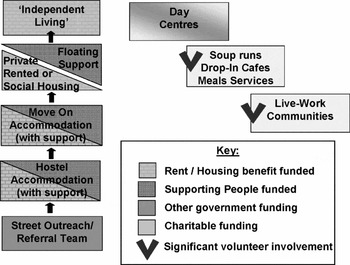
Nevertheless, in order to understand TSOs’ responses to tendering it is necessary to know something about the specific context in which they operate. Reviews of UK housing and homelessness policy (May et al., Reference May, Cloke and Johnsen2005; Mullins and Murie, Reference Mullins and Murie2006) and third sector policy (Alcock and Scott, Reference Alcock, Scott and Powell2007: 91–4; Haugh and Kitson, Reference Haugh and Kitson2007) can be found elsewhere, but this study focussed in particular on the impacts of the Supporting People programme. This was introduced in 2003 as a means of structuring, funding and monitoring the provision of housing-related supportFootnote 4 for single homeless people (amongst other vulnerable client groups) (see Riseborough, Reference Riseborough, Mullins and Murie2006). The programme encouraged local authorities to commission a range of services, so that clients could progress from more intensive services (e.g. hostels) to less intensive ones (e.g. community-based floating support). The schematic diagram (Figure 1) simplifies a much more complex reality, but it shows how the services funded by the Supporting People programme typically operated alongside those funded by voluntary income or other government funding streams, and demonstrates how important this programme had become as an income source for homelessness services. As such, changes to this programme have had – and will continue to have – a major impact on many homelessness TSOs and their service users.
A schematic diagram showing how Supporting People-funded services fit within a ‘typical’ homelessness services landscape (Based on research in Southampton and Hampshire).

However, the impacts have not been geographically uniform; factors such as differing local needs, pre-existing service landscapes and differing interpretations of the UK Procurement Regulations (through which Directive 2004/18/EC was enacted) gave rise to considerable variation between local authorities, not only in the configuration and capacity of the homelessness services commissioned, but also in the nature of the specific commissioning processes employed.
Case study: homelessness TSOs in Southampton and Hampshire
A combination of qualitative and quantitative methods were used to explore the impacts of contracting – and tendering and monitoring processes in particular – on TSOs providing homelessness services in Southampton and Hampshire, two local authorities in South East England.Footnote 5
Methods
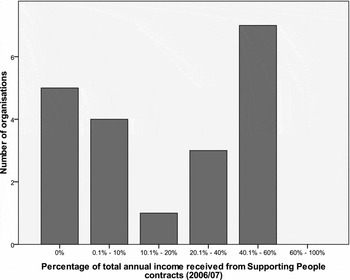
The qualitative research comprised twenty-six semi-structured interviews. These were conducted in 2007/08, and included representatives (typically managers, directors or leaders) of twenty TSOs that provided single homelessness services, as well as the manager of a local infrastructure TSO and two local government representatives who were involved in commissioning homelessness services. Although volunteers, staff and service users were not interviewed for this project, the research was informed by insights gained through the author's own involvement as a soup kitchen volunteer from 2006 to 2009. Quantitative data from annual reports and other documentary sources were used to categorise the TSOs according to characteristics such as annual income, income sources and volunteer involvement. These data revealed something of the diversity of the TSOs studied: the organisations’ annual incomes ranged from less than £20,000 to over £100,000,000, for instance, and there was considerable variation in the extent to which the organisations relied on contractual income from Supporting People (Figure 2).
Histogram showing TSOs' receipt of income from Supporting People contracts.

The interview data were analysed using a coding scheme comprised of a mixture of ‘emic’ and ‘etic’ codes: the former arising from the language and concepts used by interviewees, the latter reflecting themes from the academic and policy literature and original ideas (Crang, Reference Crang, Flowerdew and Martin2005). The coded interview transcripts were linked to the categorical data derived from the documentary evidence (using NVivo software); however, because different organisations had different combinations of attributes, a more sophisticated means of interpreting and presenting the data was required, and to this end the typology (described below) was developed.
There have of course been some changes since the data were collected: the removal of the ‘ring fence’ around Supporting People funding (meaning that local authorities now decide how much funding to allocate to these services), coupled with significant cuts in local authority budgets imposed by central government, has led to severe reductions in the resources made available for the provision of accommodation-related support services across the UK (Stewart, Reference Stewart2011). Nevertheless, the findings presented here remain relevant, not only because they depict the organisational landscape on to which contemporary policies are being projected, but also because competition and market-based principles continue to dominate approaches to commissioning public services from the third sector in many European countries and other Western economies.
The local homelessness service landscape
The Supporting People programme had played a significant part in shaping the local homelessness landscape, and fifteen of the twenty TSOs studied were involved in contracts with the local government as part of this programme. Not all the TSOs were directly affected by the programme however, and some provided services that were outside of its remit, such as soup runs or drop-in meals services.
The accommodation services offered by the TSOs studied included night-shelters, hostels and assessment centres, as well as move-on accommodation for those leaving more intensive services, or who were considered to have lower level needs. Although Supporting People did not fund the accommodation component of these services, it paid for the support provided to residents and therefore represented an important source of both income and clients. The accommodation itself was typically funded by rental income: this was usually covered by housing benefits, but sometimes clients had to contribute themselves. Several TSOs provided floating support, which was funded entirely by Supporting People and delivered by paid staff.
All the hostel and move-on accommodation services had paid staff and very little, if any, volunteer involvement. The night shelter had a small number of paid staff, but was heavily dependent on volunteers. This service also had a greater proportion of voluntary income and, unlike the other accommodation services, it did not charge rent. One TSO was developing a new accommodation-based service independently of Supporting People funding; in its initial stages this project was funded primarily by trusts and corporate donations but in the longer term was intended to become a self-financing social enterprise.
Three day centres were represented in the study. These were used by rough sleepers and people living in hostel, move-on or temporary accommodation. The day centres’ funding included a mixture of government contracts (not Supporting People), voluntary donations and grant funding from local authorities. All the centres relied on a core of paid staff but the level, nature and purpose of volunteer involvement varied. Volunteers were sometimes involved in providing education, training or other activities, and in one centre some former service users helped out with housekeeping tasks.
Another TSO did outreach work with rough sleepers and co-coordinated referrals into accommodation services; these services relied on paid staff and government funding. The more informal services included a soup kitchen, a food and clothing bank and several volunteer-run projects which served meals on a weekly basis in local church halls. These initiatives did not involve any formal support work or monitoring and relied heavily on voluntary income, in-kind donations and volunteer labour.
Commissioning in practice at the local level
In both local authorities, the number of homelessness services and providers contracted by local government was being rationalised significantly at the time of the study (Southampton Supporting People, 2005; Hampshire Supporting People, 2006). This was motivated partly by the need to reduce costs, as larger contracts were deemed to be more cost effective, but also by the need to better co-ordinate provision in order to make the previously complex network of services easier for homeless people to navigate and to reduce the likelihood of repeat homelessness.
In Southampton, the entire network of single homelessness services was restructured (Buckingham, Reference Buckingham2009); new contract specifications were drawn up for each of the proposed services, and competitive tendering was used to allocate all of these contracts. Hampshire's approach involved a more gradual adaptation and reworking of the existing service landscape. This meant that some contracts could be negotiated with existing providers, while others (for instance where a new service was being commissioned) were tendered for. In both local authorities, tenders were judged on the basis of quality and cost.
Once contracted by the local authority, providers were required to submit quarterly returns which included measures such as number of residents (utilisation), move-ons and evictions, and to participate in the Quality Assessment Framework (QAF) standards scheme. Providers’ past performance in the QAF was used in assessing tenders; this meant that there was considerable pressure on providers to achieve the specified outcomes and to evidence this effectively. However, TSOs experienced and responded to these pressures in different ways, and the following typology allows a more nuanced narrative about the impacts of contracting to be articulated.
A typology of TSO responses to contracting
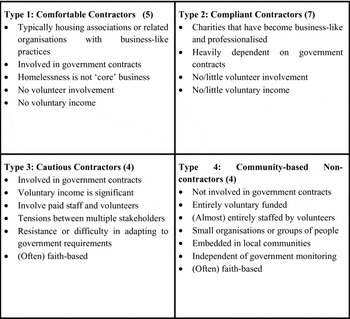
The organisations in the study were classified into four types according to their characteristics and responses to the contracting processes described above: Comfortable Contractors, Compliant Contractors, Cautious Contractors and Community-Based Non-Contractors. The key attributes of each type are summarised in Figure 3 and are described further below. As Ling (Reference Ling, Clarke, Gerwirtz and McLaughlin2000: 83) points out: ‘Typologies are always in danger of forcing a complex and unwilling world into arbitrary categories. At best, however, they open up a field of inquiry to systematic and ordered study so that we understand complexity, rather than are overwhelmed by it.’ The typology presented below is therefore an abstraction of a more complex reality, and some of the organisations departed from the characteristics associated with their ‘types’ in certain respects. Such simplification, however, is necessary in order to make sense of and communicate about the degree of diversity that one is confronted with when studying even a small segment of the third sector.
A typology of TSO responses to contracting. Note: The numbers in brackets indicate how many of the organisations in the study were classed as this type.

Developing the typology
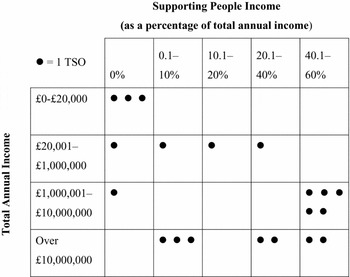
The TSOs not only exhibited differing responses to contracting but were also diverse in terms of their size, income sources, service types and levels of volunteer involvement. To take account of these multiple variables, the typology was developed using both the interview and quantitative data. By categorising the quantitative data, it was possible to identify clusters of organisations with similar characteristics. For instance, the organisations that were most dependent on Supporting People funding tended to be those with annual incomes between £1,000,000 and £10,000,000 (Figure 4). Four of the largest providers with incomes over £10,000,000 also received over 20 per cent of their income from Supporting People, although a further three such providers received less than 10 per cent of their income from this source. Given the relatively small number of cases, inferences based on the quantitative data alone are of limited value; however, commonalities between organisations’ experiences of contracting were apparent from the interview data, and four basic responses to contracting could be discerned. These corresponded with some of the trajectories and types identified in the literature reviewed above, as the subsequent descriptions show. Linking the thematically coded interview transcripts with the categorical data enabled the coded fragments to be analysed according to different organisational characteristics, which was particularly useful in developing the typology. In many cases, TSOs with similar characteristics exhibited similar responses to contracting, but where there was a discrepancy between them, an organisation's response to contracting took precedence in determining its type. These discrepancies were themselves interesting, but are difficult to discuss without revealing the TSOs’ identities. However, the two TSOs whose characteristics differed significantly from those typically associated with their response type were organisations with relatively large incomes and geographical coverage, but whose strongly articulated values and desire to maintain their autonomy meant that they had either resisted involvement in contracting altogether, or that they drew significantly on non-governmental funding to help them pursue their mission whilst remaining involved in contracts.
Matrix showing relationship between total annual income and income from Supporting People contracts.

The typology is to some extent ‘grounded’ in the sense that it was derived from analysis of the empirical data, but iteration between the empirical data and existing literature helped ensure that the typology was informed by the theoretical concerns of the study and offered a further ‘test’ of the validity of the emerging typology. Once the typology had been consolidated, the interview data were further analysed, enabling the different impacts on different types of TSO to be identified, evidenced and discussed.
Type 1: Comfortable Contractors
This group consisted of providers that were either housing associations or had de-merged from housing associations in order to specialise in support services for vulnerable client groups. For the housing associations, homelessness services were typically a small part of their business, which was mainly general needs social housing. The specialised support organisations typically catered for a range of client groups (e.g. people with disabilities, elderly people) in addition to homeless people, and were more dependent on government contracts than the housing associations for whom rent was the main income source. Comfortable Contractors were the largest TSOs in terms of their income, geographical scope and number of staff. They operated at a regional to national scale and did not involve volunteers or have any voluntary income.
These TSOs placed a strong emphasis on promoting independent living, and as such their aims matched closely with those endorsed by local government. In some cases, specialised support departments had been set up (or had expanded their activities) in direct response to the increased availability of government funding at the start of the Supporting People programme. Comfortable Contractors were the most business-like in terms of their values and practices: for instance one manager commented:
There's nothing charitable about being in the charity sector. There is absolutely no love in the business. It is very much running a business. It's a charitable business in that the objects . . . are charitable in nature, and . . . in the sense that we aren't in the business for profit . . . but in every other sense it is a business. (Comfortable Contractor)
Being competitive, innovative, cost-efficient and entrepreneurial were key values for Comfortable Contractors, and establishing a good reputation and brand image were cited as very important by providers of this type. These values (and the practices that ensued from them) corresponded closely with local governments’ need to reduce costs and minimise value for money and meant that these organisations were relatively well prepared for competitive tendering and the monitoring requirements associated with contracts. As one manager explained:
I think because we are part of this big group, we had the resources to tender well from the beginning. And I think that's an important thing. So [Group Name] as a housing organisation had skills in tendering for other types of business, so we could learn from that. But also, I think what we're seeing . . . is that people who have won initial tenders, learn how to tender well and keep on getting better at it. (Comfortable Contractor)
Of all the types, the Comfortable Contractors experienced the least friction or difficulty in participating in competitive tendering and complying with contractual obligations.
Type 2: Compliant Contractors
The Compliant Contractors had typically originated as local homelessness charities. Most had significantly expanded since their origin and provided a variety of services to homeless (and sometimes other) clients. They were mainly regional level providers, and all were heavily dependent on income from government contracts. They relied almost entirely on paid staff and had become increasingly professionalised in response to the standards required by government contracts. Volunteer involvement was usually very limited, although most of these organisations had involved more volunteers in the past.
Managers of these TSOs identified some tensions between their organisation's values and goals and the requirements of their contracts, but, because of financial dependency, felt they had little choice but to comply with government demands:
[W]e only operate, almost only operate in [city]. If we fall out with [the] Council, that's our main source of income. We are vulnerable to upsetting the Council. So strategically we have had to roll over and go with the flow. (Compliant Contractor)
It seemed that, as Chew and Osborne (Reference Chew and Osborne2009) also observed in their work on strategic positioning, these organisations’ traditional values and practices had been eroded in their pursuit of economic survival. In order to compete for and comply with government contracts, the Compliant Contractors had moved towards the more formal quality measurement practices and market-oriented values that characterised the Comfortable Contractors. They had embraced the emphasis on ‘move-on’ and independence promoted by the Supporting People programme, perceiving it to be more progressive than simply supporting homeless people's survival:
I don't mean this to sound pejorative . . . but the be all and end all shouldn't just be about giving people free food and . . . then not expecting them to change their lifestyle . . . if we don't have expectations that people can and will change their lives . . . we're just consigning a percentage of the population to the dump, and that's just wrong, fundamentally. (Compliant Contractor).
However, other managers expressed greater reluctance about the emphasis on measurable outcomes, and this was best expressed (in fact by a Comfortable Contractor manager) in the following words:
rather than meeting client needs, you're looking at ‘what are Supporting People needs?’ and what they're measuring, and they may not always be the same as what clients want support with, help with, or care with.
Thus, some mangers felt that a more holistic approach would enable clients to make more sustainable progress but, being reliant on contractual funding, were obliged to focus on achieving the outcomes defined by government funders.
Type 3: Cautious Contractors
The ‘Cautious Contractors’ were involved in state contracts but also received a significant proportion of voluntary income. Reconciling the demands of multiple stakeholders was therefore a key challenge for Cautious Contractor managers. All involved volunteers in some way, although they relied mainly on paid staff for direct service provision. Some were quite professionalised in their operation, but, for others, meeting the standards required by government funders had been much more difficult. This was particularly the case for smaller, localised providers with few paid staff, in which managers found it difficult to balance the necessary administrative and monitoring tasks with their operational and practical duties.
These organisations tended to attach greater importance to maintaining and enacting their ethos or values, which in most cases were based on the Christian faith. The way in which these values were interpreted varied between and within organisations. Cautious Contractor managers said that to some extent their organisations’ values could be expressed within the conditions of government contracts, and that voluntary resources gave them some scope to provide additional services which more closely reflected their values. However, there were occasions when these organisations’ values brought them into conflict with commissioners, for example:
[The local government] were very clear that they wouldn't allow us to operate with seventeen beds in nine bedrooms, and they really want . . . one guest per bedroom. . . that's a huge reduction . . . our contention is that if guys are out on the street . . . is that not better to have them in a bed off the street, in that environment, than to say we can't have you because we're not allowed to have any more than one bed in each room? (Cautious Contractor)
There were also concerns that the focus on measurable outcomes was compromising organisations’ ability to meet the needs of individuals who were unlikely to achieve these, as another manager explained:
people [funders] want to see successes. So we have to play on ‘we're going to get so many people into work’ . . . and really actually what we want to do is make sure that the person that's on the street can come in, and wherever they're at now, which is probably, you know, quite low – employment, housing, are a little bit too far off − they can just come in and be looked after for a while, you know, while we're open. That isn't necessarily what people want to hear. People want to hear that people are moving on. And lots of people do, lots of people do. And there are lots of people who don't, and might not ever, but we still want to work with them, and make sure they've had a meal today. (Cautious Contractor)
In contrast to the Compliant Contractors, the values-based tensions that arose in these organisations were more likely to prompt efforts to uphold the organisations’ original ethos. The ability of these organisations to secure voluntary resources, particularly through faith communities, played a key part in enabling them to retain some autonomy and continue to pursue their own values (see also Harris et al., Reference Harris, Halfpenny and Rochester2003). However, several providers that would have been classified as Cautious Contractors (no longer operating at the time of the study) had been taken over by Comfortable and Compliant Contractors in recent years because they lacked the resources to meet the standards required by government contracts, suggesting that such efforts were not always successful. Cautious Contractor organisations seemed to experience the greatest tensions of all the types because they had to meet the requirements of government funders, whilst trying to remain faithful to their (often faith-based) organisational values and maintain the support of volunteers and donors (see also Cloke et al., Reference Cloke, Johnsen and May2007; Ebaugh et al., Reference Ebaugh, Chafetz and Pipes2005).
Type 4: Community-based Non-contractors
These organisations differed significantly from the other types in that they were not involved in government contracts at all. With one exception, the services they offered would not in any case have been eligible for contractual funding: they included providing cooked meals in a church hall on a weekly basis, and redistributing donated food and clothing. These organisations were resourced entirely by voluntary donations and were staffed mainly by volunteers (some employed a few paid staff).
All but one of these Community-based Non-contractors were faith-based and had strong links with local churches. The providers placed a strong emphasis on offering acceptance to service users and building relationships with them. For instance, one volunteer leader commented that:
to me the primary role, aim, is the community, it's the relationship, it's building relationships with these people. And I think that's what we've been really touched by, really impacted by . . . getting to know these guys. They've really changed us [the volunteers]. (Community-based Non-contractor)
Informal conversations with service users suggested that these services provided important sites of sociability or even solidarity for their users. Interviewees also reported that existing service users often brought new people along, suggesting that they themselves found the services beneficial.
Being independent from government performance monitoring and the need to compete for contracts, these organisations were in many ways free to pursue their own aims and values. However, these services generally operated for very limited time periods each week; some volunteers met up with service users outside of the project hours, but providers acknowledged that there were limits to what could be achieved with the available resources and expertise. As such, although these organisations were not restricted by contractual obligations and were arguably the most embedded within local communities, time and resource constraints meant that they could not provide as much help to as many people as they would have liked to.
Concluding discussion
The typology presented above highlights the diversity of TSO responses to contracting, demonstrating that there were significant differences between the experiences of organisations that were involved in contracts, as well as between contracted and non-contracted TSOs. Whilst studying different local authorities or service types may have yielded different results, the insights derived from this research may be relevant to TSOs operating in other contexts. The typology can also serve as a conceptual tool for theoretical and policy-related reflection, and this concluding section identifies broader academic debates to which the material presented here is of relevance.
Much has been written about TSOs’ potential ‘multi-functionality’ (Kendall, Reference Kendall2003; Evers, Reference Evers1995), and their hybridity – or ability to combine the characteristics associated with other sectors – has recently become a concept of great interest to third sector scholars (e.g. Billis, Reference Billis and Billis2010; Evers, Reference Evers2005). In this context, state contracting was contributing to the hybridisation of TSOs that were involved in contracts by requiring them to adopt practices and values associated with the market and state sectors. However, the hybridisation resulting from contractual requirements was also exacerbating the ‘division of labour’ between the contracted and non-contracted TSOs (see Buckingham, Reference Buckingham2011): some had become highly proficient at winning and delivering government contracts; whilst others were focusing their attentions on meeting relational needs, for example. Notably, the Comfortable Contractors displayed little of the ‘voluntarism’ (e.g. volunteer labour or donated resources) which arguably underpins many of the comparative advantages (such as community cohesion and cost effectiveness) upon which governmental support for third sector service provision is typically premised.
The findings presented here attest to the state's preference for partnering with TSOs that have the capacity and will to embrace modernisation and to report accurately on their work (McLaughlin, Reference McLaughlin2004), and show how TSOs characteristics were changing in response to this. However, not only were TSOs gradually changing type as they conformed to contractual requirements, but it had also become increasingly common for Cautious and even Compliant Contractors to be subsumed by Comfortable Contractors through mergers or acquisitions, thereby increasing the dominance of the latter. These changes within individual TSOs, and in the composition of the homelessness third sector, add to existing concerns about the potential loss of the distinctive capabilities and strengths that these (particularly medium-sized) organisations bring to service provision.
Policy implications
It is clear that the availability of government funding and the quality assessment systems associated with this are key factors in driving and facilitating the emergence and in some cases transformation of TSOs that can meet the standards required by government funders. Since this research was carried out, reductions in local authority budgets have led to significant cuts in Supporting People funding in many areas (Stewart, Reference Stewart2011), and the evidence presented here adds weight to concerns raised elsewhere (e.g. Butler, Reference Butler2011; Ramesh, Reference Ramesh2011) about the way in which the withdrawal or reduction of government support and intervention will affect the quality, coverage and continuity of TSOs’ services. The Compliant Contractors are heavily dependent on government funding, and so would be very vulnerable to such cuts. The Comfortable Contractors are perhaps less vulnerable because government contracts do not usually constitute their core business; however, cuts in housing benefit payments will have a significant impact on their core income and they may opt out of providing homelessness support services if these ceased to be financially viable.
In the context of falling public sector funding, the Community-based Non-contractors – and to some extent the Cautious Contractors – may be the most robust, with their greater reliance on voluntary donations and labour. In most cases, however, these organisations lack the capacity, resources and expertise to provide the much-needed accommodation and support services on a sufficient scale. These limitations are arguably surmountable if an organisation is able to articulate and successfully communicate a clear vision that is aligned with the values of a willing and sufficiently well-resourced public, but the co-occurrence of such conditions is by no means ubiquitous. Nevertheless, increasing demand for homelessness services coupled with reduced government funding for them suggests that the needs of people previously supported by government-funded services will increasingly have to be met through voluntarily resourced provision. Whilst such provision makes a vital and distinctive contribution to homelessness and many other social services, in a society where individualism and personal consumption are so highly prized, and in which rich and poor frequently live very separate lives, entrusting the welfare of the most deprived groups entirely or primarily to the willingness of individuals to give voluntarily of their time and money would appear to be a risky strategy.Footnote 6
The typology presented in this paper underlines the need for policy-makers to take into account the varied characteristics of TSOs: this might involve developing different funding arrangements for different sizes of TSO; introducing (non-coercive) policies that promote collaborative working between organisations of different types that operate in similar fields and geographical areas; or developing mechanisms to ensure that service provision contracts allocated to individual TSOs (directly or as sub-contractors) are commensurate with the organisation's capacity to deliver them. However, while the different and distinctive capacities of different types of TSO warrant careful consideration when developing policy interventions, directing resources and assigning responsibilities to TSOs, decision-makers also need to bear in mind that such interventions have the potential to erode the third sector's diversity, and that TSOs’ capacities to meet social needs depend to a great extent on the resources and support made available to them.
Acknowledgments
The author would like to thank John Mohan and Silke Roth (University of Southampton) for their supervision of the doctoral research upon which this paper is based. My thanks also go to the interviewees who shared their time and experiences for the purposes of this research and to David Mullins and two anonymous referees for their constructive feedback. A preliminary version of this paper was presented at the Welfare and Values in Europe Conference (Uppsala, Sweden) in March 2009.