Introduction
Tea, Camellia sinensis (L.) O. Kuntze is most widely used as a non-alcoholic beverage all over the world. In India, indigenous tea was used as a medicinal plant from early times, but its commercial cultivation did not begin until the 19th century. Tea is one of the most imperative agro-industrial crops, and sustains the economy of a large number of people in North East India (Saha, Reference Saha2014). It is a perennial monoculture crop providing a congenial microclimate, as well as continuous supply of food to a large number of arthropods. Every part of the tea plant, i.e. leaf, stem, root, flower and seed, are subject to attack from at least one arthropod pest species (Saha, Reference Saha2014). These pests may cause an 11−55% yield loss on average, if left uncontrolled (Hazarika et al., Reference Hazarika, Bhuyan and Hazarika2009). Among arthropods, insect and mite pests are the most damaging (Muraleedharan, Reference Muraleedharan and Pimentel2007), causing on average a 5−55% yield loss (Muraleedharan, Reference Muraleedharan, Wilson and Clifford1992; Rattan, Reference Rattan, Wilson and Clifford1992; Sivapalan, Reference Sivapalan and Jain1999). According to recent estimates, globally, approximately 1034 arthropod species and 82 species of nematodes are associated with tea plantations (Saha and Mukhopadhyay, Reference Saha and Mukhopadhyay2013; Saha, Reference Saha2014). Among the insect pests, Lepidoptera is the largest order, containing 32% of the pest species, followed by Hemiptera with 27% (Muraleedharan, Reference Muraleedharan and Pimentel2007).
In India, only 300 species of arthropods are recorded from tea ecosystems and about 167 species are from Northeast India (Das, Reference Das1965). Around 27 to 28 insect and mite species attack tea in plantations of three regions of the Northern West Bengal, i.e. Terai, the Dooars and Darjeeling hill slopes (Saha, Reference Saha2014). The dynamic adaptations of insects have enabled them to attack every part of the tea plant, but most pests attack the foliage. The most important insect pests that suck the sap from the most profitable part of the tea plant processed in the tea industry for making tea, i.e. the young tender leaves, buds and stems, are mainly the tea mosquito bug (Helopeltis theivora), tea jassid (Empoasca flavescens) and Assam tea thrips (Scirtothrips dorsalis). These sucking pests cause substantial losses in yield to the tea industry (Saha, Reference Saha2014).
Scirtothrips dorsalis Hood (Thripidae: Thysanoptera) is the most common thrips species found in the lower elevation of Darjeeling hill and adjoining plains. The yellow tea thrips, Scirtothrips dorsalis is a well-known pest of tea and chillies in India, and is referred to as the ‘chillies thrips’ or the ‘Assam thrips’. Scirtothrips dorsalis was first noted on castor shoots and chillies in Coimbatore (India) in 1916, and was described as a new species by Hood (Reference Hood1919). It has been found to infest about 20 hosts in India, including important crops such as tea, cotton, castor and mango (Kumaresan et al., Reference Kumaresan, Regupathy and Baskaran1988; Ananthakrishnan, Reference Ananthakrishnan1993). Scirtothrips dorsalis is a major pest of tea in almost all tea plantations in the plains of North East India and often causes severe damage to tea in Terai and the Dooars. The occurrence of S. dorsalis coincides with the new flush in the tea plantations. Larvae and adults feed on buds, tender shoots, leaves and flowers of the tea plants, causing damage. During feeding on the youngest open leaves they make small slits by inserting the stylets and sucking the sap oozing through the wound. The sucking marks are made one after the other, forming thin pale lines on the underside of the leaves parallel to the mid vein, which are often described as ‘silvered’ or ‘sand papery lines’. Damaged leaves become thicker and harder than the non-damaged ones, have a duller darker green colour and are often puckered or deformed (Das, Reference Das1965). Scirtothrips dorsalis is capable of producing several generations per year, but typically has 4−8 generations (Venette and Davis, Reference Venette and Davis2004). Adults typically mate 2−3 days after their pupal moult, and the females oviposit 3−5 days after emergence. Females tend to lay eggs continuously with the total number of eggs ranging from 40 to 68 (Venette and Davis, Reference Venette and Davis2004).
Understanding the diversity of insect responses to chemical pressures (plant allelochemicals and insecticides) in their local ecological context represents a key challenge in developing sustainable pest control strategies. Plants and insects have co-existed for a long time (Saha, Reference Saha2014). Farmers suppressed insects either by other insects or toxins or by plant defence mechanisms, to create a balance between the insect pest population and host. As each plant species has a unique set of defence traits (ranging from morphological to phytochemical parameters) that have behavioural and physiological ramifications for a potential herbivore consumer (Wink and Waterman, Reference Wink and Waterman1999; Wink, Reference Wink2003), the resistance mechanisms evolved by insects to deal with the chemical defences of plants are similar to those mechanisms that have evolved to resist synthetic insecticides. The chemical structure of some synthetic insecticides is comparable to that of some plant produced compounds (e.g. pyrethroids and nicotinoids).
Host plants have significant effects on the development, survival and reproduction on herbivorous insects (Murphy and Briscoe, Reference Murphy and Briscoe1999; Farazmand et al., Reference Farazmand, Rassoulian and Bayat-Assadi2000; Ju et al., Reference Ju, Wang, Wan and Li2011). Host plant chemistry may also influence the energy budget of herbivorous insects and life history traits (Giles et al., Reference Giles, Madden, Stockland, Payton and Dillwith2002; Castañeda et al., Reference Castañeda, Figueroa and Nespolo2010). A female insect encountering a poor-quality host plant may modify her oviposition behaviour, either by reducing the number of eggs she lays on each plant or, in some cases, adjusting the size or nutritional content of the eggs (Leather and Burnand, Reference Leather and Burnand1987). In extreme cases, where the quality of the host plant is too low to support adult survival, female insects may reabsorb eggs or embryos and use the nutrients gained to increase their longevity, and thus their potential to find better-quality host plants for their offspring (Brough and Dixon, Reference Brough and Dixon1990; Ward and Dixon, Reference Ward and Dixon1982). Plant quality may also affect sex ratios in some insect orders as well as the importance of the male insect's contribution to reproduction, via the quality of nuptial gifts.
Induction of insect detoxifying enzyme activities by plant allelochemicals is a clear manifestation of biochemical phenotypic plasticity and has been documented in several instances. Many of the theories and some of the experiments implicitly or explicitly deal with the insect's ability to metabolize plant secondary metabolites by P450 and other enzymes. In the case of detoxification, however, the landmark paper of Krieger et al. (Reference Krieger, Feeny and Wilkinson1971) can be seen as echoing the Fraenkel (Reference Fraenkel1959) paper, by exposing the role of P450 enzymes. They stated that: ‘. . . higher activities of midgut microsomal oxidase enzymes in polyphagous species than in monophagous species indicates that the natural function of these enzymes is to detoxify natural insecticides present in the larval food plants.’ In Krieger's study, aldrin epoxidation was measured in gut homogenates of last instar larvae from 35 species of Lepidoptera. Polyphagous species had on average a 15-times higher activity than monophagous species. This trend was seen in sucking insects as well. A 20-fold lower aldrin epoxidase activity was found in the oleander aphid Aphis nerii when compared to the potato aphid Myzus euphorbiae or to the green peach aphid Myzus persicae (Mullin, Reference Mullin, Brattsten and Ahmad1986). The former is a specialist feeder on two plant families, Asclepiadaceae and Apocyanaceae, whereas the latter two are generalists found on 30–72 plant families. The concept is extended to other detoxification enzymes, for example in mites, which have a five times lower aldrin epoxidase activity than their herbivorous prey (Mullin et al., Reference Mullin, Croft, Strickler, Matsumura and Miller1982). The toxicity of the natural phototoxin α-terthienyl is inversely proportional to the level of its metabolism in Lepidoptera, and is related to diet breadth. Metabolism is highest in Ostenia nubilalis (which feeds on numerous phototoxic Asteraceae), lower in Helicoverpa virescens (which has a broad diet, including some Asteraceae that are non-phototoxic), and lowest in Manduca sexta (a specialist of Solanaceae) (Iyengar et al., Reference Iyengar, Arnason, Philogene, Werstiuk and Morand1990).
The conceptual framework of Krieger and colleagues has been challenged (Gould, Reference Gould1984) and defended (Ahmad, Reference Ahmad1986). An alternative view (Berenbaum et al., Reference Berenbaum, Cohen and Schuler1992) proposes that aldrin epoxidation represents ‘P450s with broad substrate specificity (that) is most abundant in insects that encounter a wide range of host plant metabolites.’ The ability to induce P450 enzymes and deal with a wide range of toxic chemicals in the diet has been thought to present a ‘metabolic load’ for polyphagous species, with specialists restricting their ‘detoxification energy’ to one or a few harmful substrates (Whittaker and Feeny, Reference Whittaker and Feeny1971). However, careful studies in both oligophagous and polyphagous species have refuted the concept of induction as imposing a metabolic load (Neal, Reference Neal1987; Appel and Martin, Reference Appel and Martin1992). Global approaches to the comparison of generalist and specialist herbivores feeding on plants with higher or lower levels of chemical defences are now available, as shown by the elegant studies of Govind et al. (Reference Govind, Mittapalli, Griebel, Allmann, Böcker and Baldwin2010) where the transcriptional responses of neonates of the specialist M. sexta and generalist H. zea fed for 24 h on Nicotiana attenuata plants (wild type or progressively suppressed in their jasmonate response), were compared by microarrays. The metabolism of plant toxins by insects has been reviewed extensively (Brattsten, Reference Brattsten1979a; Ahmad, Reference Ahmad1986; Ahmad et al., Reference Ahmad, Brattsten, Mullin, Yu, Brattsten and Ahmad1986; Mullin, Reference Mullin, Brattsten and Ahmad1986; Yu, Reference Yu1986; Li et al., Reference Li, Schuler and Berenbaum2007). Many P450 inducers are known in insects (Agosin, Reference Agosin, Gilbert and Kerkut1985; Hodgson, Reference Hodgson, Kerkut and Gilbert1985; Scott et al., Reference Scott, Liu and Wen1998) and it appears that several of these inducers alter the expression of different P450s (Scott et al., Reference Scott, Liu and Wen1998).
Insect resistance to plant allelochemicals interferes with their resistance to synthetic insecticides (Yu and Ing, Reference Yu and Ing1984). From the evolutionary perspective, despite the key role of the chemical ‘arms race’ in driving the co-evolution of plants and insects, much research has focused so far on describing the diversity of plant chemicals and their effects on herbivores. Therefore, the understanding of the insecticide resistance mechanisms (as well as taking into account other ecological parameters) is important in predicting the spread of insecticide resistance in natural pest populations, and in choosing the optimum strategy for managing insect pest populations. Less is known about the multiple mechanisms evolved by insects to overcome these chemical defences. These mechanisms include contact and ingestion avoidance, excretion, sequestration and degradation of the toxin and target site mutation. Biotransformation of plant toxins is one of the major weapons that insects have evolved in their co-evolutionary arms race with plants (Mitter, Reference Mitter, Farrell and Futuyma1991; Berenbaum, Reference Berenbaum2002). Metabolic resistance often results from overproduction of ‘detoxification enzymes’ that can metabolize plant xenobiotics (allelochemicals). This mechanism is often associated with phenotypic plasticity, as the production of detoxification enzymes is usually induced by the presence of plant xenobiotics in the diet of the insect (Saha et al., Reference Saha, Mukhopadhyay and Bahadur2012a,d ; Saha et al., Reference Saha and Mukhopadhyay2013).
The knowledge of population growth parameters of any pest would facilitate the designing of a comprehensive pest management programme for its host plants. Hence, an understanding of the biology and life history traits of a pest on alternative hosts is essential for the planning and development of effective management strategies. In addition, how chemical cues affect host choice and how insects deal with the plant allelochemicals need to be investigated and understood along with their adaptation to host chemical compounds in constraining or expanding their ability to cope with other compounds (Dethier, Reference Dethier1954; Berenbaum et al., Reference Berenbaum, Zangerl and Nitao1986; Lindroth et al., Reference Lindroth, Scriber and Hsia1988). The term host plant quality describes the components of the host plant, e.g. the levels of nitrogen, carbon, trace elements and defensive compounds that positively or negatively affect the performance of herbivorous insects. The host plant quality is a key determinant of the fecundity of herbivorous insects at both the individual and the population scales (Awmack and Leather, Reference Awmack and Leather2002). Low plant quality can act as a defence mechanism against herbivorous pests and cause a decline in their fecundity and an increase in developmental time (Legrand and Barbosa, Reference Legrand and Barbosa2000).
Materials and methods
Collection and laboratory rearing
A laboratory culture of S. dorsalis was set up (at 25±2°C and 70−80% RH) on tea, collected from organically maintained plantations on the Mokaibari Tea Estate of the Darjeeling foothills, and maintained in the laboratory for twenty generations to be used as a control (insecticide unexposed). Adult male and female S. dorsalis were collected from tea plantations via mouth aspirator and kept in a plastic container (10 cm × 10 cm × 30 cm). After mating, females laid eggs on tender leaves mainly on the lower side in crevices of veins, and tender shoots. Leaves and tender shoots with eggs were kept upright by passing through a perforation made manually on a Thermacol sheet fitted in a Petri dish containing water. Fresh tender shoots, having few tender leaves, were kept separately in such a way that their shoots touched the water present in the Petri dish below the thermacol. The Petri dishes were kept under a glass chimney and the open mouth covered with fine nylon mesh. Nymphs were reared to adult stage by replacing old with fresh tea shoots daily. The emerging adults were allowed to mate and oviposit on fresh tea shoots. Rearing was done using the same stock through 10 generations. Scirtothrips dorsalis was also reared on two alternative hosts, chilli (Capsicum annuum) and castor (Ricinus communis L.) beside tea (C. sinensis) for ten generations following the process already described above. The host-specific males and females of the 10th generation were used for enzyme assays.
Data on the pre-oviposition period, oviposition period, fecundity, hatchability percent, total nymphal duration and total developmental time and adult longevity on each host plant (tea, chilli and castor) were recorded.
Enzyme extraction
A pool of ten adults of S. dorsalis was homogenized in 200 µl ice cold 0.1 m sodium phosphate buffer (pH 7.0) and centrifuged at 12,000 g for 20 min at 4°C in high speed refrigerated centrifuge (SIGMA 3K30) (Saha et al., Reference Saha, Roy and Mukhopadhyay2012c). Forty microlites of the resultant post mitochondrial supernatant were aliquoted into 0.2 ml centrifuge tubes and stored at −80°C, and served as the enzyme source.
Detoxifying enzyme activity assay
General esterase activity (α-Esterase). General esterase activity was measured using α-naphthyl acetate (α-NA) as substrate according to the method described by Van Asperen (Reference Van Asperen1962) with minor modifications for use in a microplate reader. Twenty microliters of supernatant was taken in each well of the microplate reader (Opsys MR, DYNEX Technologies, USA) in duplicate. Two hundred microliters of freshly prepared 30 mm α-NA was added into each well for reaction to occur. The reaction was stopped after 15 min by adding 50 µl of staining solution prepared fresh by mixing two parts 0.1% Fast Blue BB salt with five parts of 5% sodium dodecyl sulphate (SDS). The plate was left for 5 min to equilibrate and absorbance was read at 590 nm in a microplate reader (Opsys MR). The change in absorbance was converted to end product (α-naphthol) using the standard curve of α-naphthol (0.05−1.00 µm). Blanks were set at the same time using a reaction mixture without protein extracts (enzyme).
Glutathione S-transferase (GST) activity
Using the protocol described by Kao et al. (Reference Kao, Hung and Sun1989) we estimated GST activity with minor modifications. Fifty microliters of 50 mm 1-chloro-2,4-dinitrobenzene (CDNB) and 150 µl of 50mM reduced glutathione (GSH) were added to 2.78 ml of sodium phosphate buffer (100 mm, pH 6.5). Twenty microliters of enzyme stock were then added. The contents were shaken gently, incubated for 2−3 min at 20°C and then transferred into the sample cuvette of UV-Visual Spectrophotometer (Rayleigh UV-2601; Beijing Beifen-Ruili Analytical Instrument (Group) Co. Ltd, Republic of China). The reaction was carried out in duplicate. Three millilitres of the reaction mixture without enzyme was placed in the reference slot for blanking. Absorbance at 340 nm was recorded for 10−12 min employing the kinetics (time scan) menu.
A unit of enzyme activity is defined as the amount of enzyme that catalyses the formation of 1 µm of 2,4-dinitrophenylglutathione per minute at 30°C using 1 mm concentrations of GSH and CDNB. Specific activity is defined as units per mg of protein. The difference in the millimolar extinction co-efficient between CDNB–GSH conjugate and CDNB is 9.6. Changes in absorbance per minute were converted into µm CDNB conjugated/min/mg protein using the formula,
 $$\begin{eqnarray*}
&&{\rm{CDNB-GSH\; conjugates}}\left( {{\rm{\mu mol/min/mg\; protein}}} \right)\!\!\!\\
&&\quad= \frac{{{\rm{Abs.}}{\rm{\; increase }}\;\left( {{\rm{in\; }}5\;{\rm{ min}}} \right){\rm{ }} \times {\rm{ }}3{\rm{ }} \times {\rm{ }}1000}}{{9.6^*{\rm{ }} \times {\rm{ }}5{\rm{ }} \times {\rm{ protein}}\;{\rm{in}}\;{\rm{mg}}}}
\end{eqnarray*}$$
(*9.6 mm/cm is the extinction coefficient for CDNB–GSH conjugate at 340 nm) (Habig et al., Reference Habig, Pabst and Jakoby1974; Nehare et al., Reference Nehare, Moharil, Ghodki, Lande, Bisane, Thakare and Barkhade2010).)
Cytochrome P450 monooxygenase activity
Most of the classic methods to evaluate oxidase activity with chromogenic substrates require the purification of microsomal fractions, but we are unable to use these methods to estimate the differences in oxidase activity in single small insects (Martin et al., Reference Martin, Chandre, Ochou, Vaissayre and Fournier2002). The alternative method is to measure the level of haem-containing enzymes, which includes the cytochrome oxidase enzymes (Brogdon et al., Reference Brogdon, McAllister and Vulule1997). Peroxidation of tetra-methyl benzidine (TMBZ) is catalysed by microsomal proteins with hydrogen peroxide as co-substrate. The amount of oxidase enzymes is correlated with the peroxidase activity of the haem groups. Such a technique would be helpful for estimating large-scale differences in oxidase activity characteristic of insecticide resistance and oxidase induction (Martin et al., Reference Martin, Chandre, Ochou, Vaissayre and Fournier2002).
Cytochrome P450 activity was estimated by measuring haem peroxidase activity (Penilla et al., Reference Penilla, Rodriguez, Hemingway, Trejo, López and Rodriguez2007; Tiwari et al., Reference Tiwari, Pelz-Stelinski, Mann and Stelinski2011). As haem constitutes the majority of cytochrome P450 of non-blood-fed (herbivorous) insects, quantification of haem activity can be expressed as cytochrome P450 (Brogdon et al., Reference Brogdon, McAllister and Vulule1997). For cytochrome P450 activity, 20 µl supernatant of the enzyme extract was taken in the well of a microplate containing 200 µl of 6.3 mm TMBZ solution [10 mg TMBZ dissolved in 5 ml absolute methanol mixed with 15 ml of 0.25M sodium acetate buffer (NaC2H3O2), pH 5.0, prepared fresh daily]. Into each well, 80 μl of 0.0625 m potassium phosphate buffer (KH2PO4) pH 7.2 and 25 μl of 3% hydrogen peroxide (H2O2) was added. Two controls per plate were prepared each with 20 μl of homogenizing buffer and with all the ingredients except the enzyme source. Absorbance was recorded at 630 nm after 30 min of incubation in a microplate reader (Opsys MR, DYNEX Technologies) against blanks at 25 °C. A standard curve for haem peroxidise activity was prepared using different concentrations of cytochrome C (0.0025 nm −0.02 nm) from horse heart type VI (Sigma Aldrich). Total cytochrome P450 activity was expressed as nm of cytochrome P450 equivalent units (EUs) mg protein/min.
Electrophoretic analysis of general esterases
Electrophoresis of different sucking pest populations, i.e. field-collected populations from conventional and organic tea plantations of Terai, the Dooars and Darjeeling hill slopes, as well as from laboratory-reared control populations were carried out in 8% polyacrylamide gels using equal amounts of protein in tris-glycine (pH 8.3) at 125V for 6−7 h at 4°C. The gels were stained for esterase isozymes according to the Georghiou and Pasteur protocol (Georghiou and Pasteur, Reference Georghiou and Pasteur1978) with slight modifications. Esterase isozymes were designated as EST I, II, III, IV, V etc., based on mobility from anode to cathode. The relative mobility (Rm) values of esterase isozyme bands were determined according to the standard method. Densitometric analysis of the isozyme bands was performed using Image Aide Analysis software. The increase in esterase isozymes (EST I, II, III, IV, V etc.) was quantified as the relative pixel density of the bands for the specimens collected from field (organic and insecticide managed, i.e. conventional) tea plantations along with laboratory-reared control specimens.
Protein quantification
Enzyme activities were corrected for protein concentration. The total protein content of the homogenate was determined by Folin–Lowry method (Lowry et al., Reference Lowry, Rosebrough, Farr and Randall1951) using bovine serum albumin as the standard.
Statistical analysis
Comparisons of data on enzyme activities among different S. dorsalis populations was done by one way analysis of variance (ANOVA) using GraphPadInstat, GraphPad Software Inc., USA and SPSS 16.0, SPSS Inc., Chicago, USA for Windows.
Results
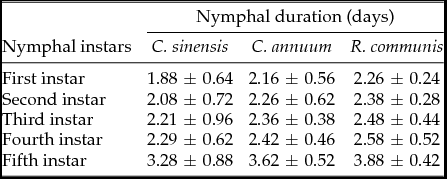
The biology of S. dorsalis was studied on three alternative hosts, i.e. tea (C. sinensis), chilli (C. annuum) and castor (R. communis). Six developmental stages were recorded in S. dorsalis: the egg, two larval instars (first and second), two pupal (prepupa and pupa) stages and the adult stage. The duration of different life stages of S. dorsalis on three host plants was recorded (Table 1). Scirtothrips dorsalis preferred to oviposit in sites with tender leaves. The eggs were kidney-shaped and glossy white in colour. The insects laid 2−3 eggs per day. Fecundity varied on the three hosts. A higher fecundity was observed on C. sinensis (11.4±0.36 eggs) than on C. annuum (9.7±0.24 eggs) and R. communis (8.6±0.32 eggs). The egg incubation period also varied on the three alternative hosts. In C. sinensis, the egg incubation period was 6.2±0.23 days which was significantly lower than the other two hosts, C. annuum (7.1±0.34) and R. communis (7.5±0.52) days. Total developmental period (TDP) was significantly shorter in C. sinensis (13.6±0.52 days) than the other two alternative hosts, C. annuum (15.5±0.36) and R. communis (16.7±0.14) days. The larval developmental period (LDP) also varied significantly on the three alternative hosts (4.3±0.64 days on C. sinensis, 4.9±0.46 days on C. annuum and 5.6±0.36 days on R. communis). The pupal development period (PDP) (in days) showed significant variation on three alternative hosts. On C. sinensis it was 3.1±0.42 days, which is significantly lower than on other two non-tea hosts, C. annuum (3.5±0.34 days) and R. communis (3.6±0.22 days) (Table 2).
Duration of different nymphal instars of Scirtothrips dorsalis reared on Camellia sinensis, Capsicum annuum and Ricinus communis

Life history traits of Scirtothrips dorsalis on Camellia sinensis, Capsicum annuum and Ricinus communis

1 ARM, Age at reproductive maturity (days); OP, oviposition period (days); PoOP, post oviposition period (days); FD, fecundity (no. of eggs laid/female); IP, incubation (egg) period (days); HC, hatchability (% of eggs hatched); LDP, larval developmental period (days); PDP, pupal developmental period (days); TDP, total developmental period (days); AL, average longevity (days).
2 (Means±SE), figures in parenthesis represent the range.
Within columns, means followed by the same letter do not differ significantly (P<0.05) in Tukey's HSD (honestly significant difference test).
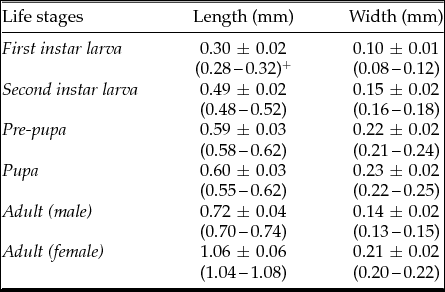
The oviposition period and hatchability were significantly higher on C. sinensis (Table 2). The age at reproductive maturity and egg incubation periods were lower on C. sinensis than the other two host plants (Table 2). The morphometrics of different life stages and body parts of S. dorsalis studied on C. sinensis are presented in Table 3. The body length of the female S. dorsalis is 1.06±0.06 mm and was larger than the male, which measured 0.72±0.04 mm. The length of the different instars progressively increased (Table 3).
Morphometrics (lengths in mm) of different life stages Scirtothrips dorsalis on Camellia sinensis. Mean±SD of ten observations

+ Figures in parenthesis represent the range.
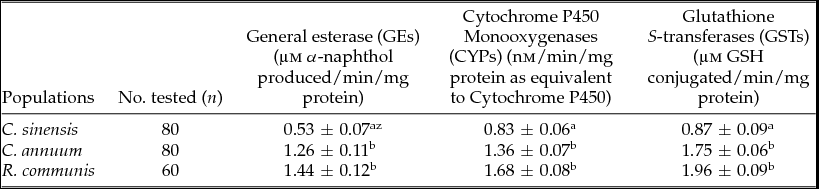
In S. dorsalis, GEs showed 2.7-fold enhancements in activity when reared on R. communis compared to C. sinensis-reared specimens (Table 4). Similarly, an enhancement in activity of GEs was also noticed in C. annuum-reared specimens (2.4-fold). Cytochrome P 450 monooxygenase also showed 1.6- and 2.0-fold higher activity when reared on C. annuum and R. communis in comparison to C. sinensis reared S. dorsalis. GST showed 2.0- and 2.3-fold higher activity when reared on C. annuum and R. communis in comparison to C. sinensis-reared S. dosalis (Table 4).
General esterases (GEs), cytochrome P450 monooxygenases (CYPs) and glutathione S-transferases (GSTs) activity (Values are means±SE) in Scirtothrips dorsalis reared on three different host plants

Within columns, means followed by the same letter do not differ significantly (P=0.05) in Tukey's HSD (honestly significant difference) test.
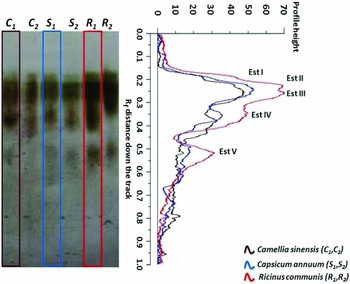
Densitometric analysis of GEs showed five isozyme bands of esterase, i.e. EST I–V with Rf values 0.17, 0.22, 0.27, 0.35 and 0.52, respectively. The pixel density and accordingly the profile height varied in different host-reared (specific) S. dorsalis specimens. EST I–III showed distinct profile height for the specimen reared on three different hosts (Fig. 1).
Densitometric analysis of electro-phoregram of general esterase of Scirtothrips dorsalis reared on Camellia sinensis (C 1 , C 2), Capsicum annuum (S 1, S 2) and Ricinus communis (R 1 , R 2).

Discussion
Over the four hundred million years of co-evolution with plants, phytophagous insects have developed diverse resistance mechanisms to cope with plant chemical defences (Bernays, Reference Bernays1998). Because insects face a geographical mosaic of chemical environments, from non-toxic to highly toxic plants, the costs associated with resistance traits vary with the probability of encountering a toxin. Moreover, other selection pressures, such as the presence or absence of competitors and predators, can also influence the costs and selection of particular resistance traits. Thus, the complexity of the local community composition is a key factor in maintaining the diversity of adaptive mechanisms to plant xenobiotics. These mechanisms are more plastic and complex compared with those involved in resistance to insecticides, perhaps because environments in which insecticides are heavily used also tend to have communities of low diversity and complexity. However, because some detoxification enzymes are involved in plant toxins and insecticide metabolism, cross-resistance mechanisms can be observed under specific environmental conditions. Deciphering the impact of allelochemicals in cross-resistance mechanisms with insecticides at a local scale, and comparing the molecular and evolutionary mechanisms of resistance to phytotoxins and synthetic insecticides represents promising areas of research for developing long-term sustainable insect control strategies for the effective management of pests of concern.
Awang et al. (Reference Awang, Muhamad and Chong1988), Ju et al. (Reference Ju, Wang, Wan and Li2011) and Saeed et al. (Reference Saeed, Sayyed, Shad and Zaka2010) found that the quality of the food source affects the duration of nymphal development. Significantly shorter nymphal duration (days) of S. dorsalis on C. sinensis than on the other two alternative host plants indicates its preference (acceptability), better adaptation and utilisation of C. sinensis, which is further supported by higher fecundity, hatchability and longer oviposition periods on C. sinensis than on the two other hosts. An ovipositing female can also use physical properties of the plant such as leaf pubescence (Foster et al., Reference Foster, Woodcock, Williamson, Devonshire, Denholm and Thompson1999), smoothness (Kanno and Harris, Reference Kanno and Harris2000), toughness and the presence of trichomes (Pffannenstiel and Yeargan, Reference Pffannenstiel and Yeargan1998), and shape and colour (Alonso-Pimentel et al., Reference Alonso-Pimentel, Korer, Nufio and Papaj1998), to assess host plant quality. On a poor-quality host plant a female insect may either lay a few good-quality eggs or a large number of poor-quality eggs (Reference RossiterRossiter, 1991a ,Reference Rossiter b ; Rossiter et al., Reference Rossiter, Cox-Foster and Briggs1993). The reduced fecundity and hatchability on C. annum and R. communis may be due to the high titre of phenol and the low ratio of protein to phenol in these host leaves (Banerjee and Hoque, Reference Banerjee and Hoque1985), in addition to differences in structure of egg-laying surface, as was evident in alternative hosts (presence of trichomes in R. communis). The differences in these fitness traits are due to the nutritional quality of these hosts and incorporation of greater amount of phenolics into the ovary and insect system from C. annum and R. communis hosts (Banerjee and Hoque, Reference Banerjee and Hoque1985; Awmack and Leather, Reference Awmack and Leather2002).
The GEs showed a significant increase in activity in C. annuum and R. communis-reared specimens than that of C. sinensis-reared S. dorsalis. However, the activity of the enzyme in the insects was not significantly different when fed on the two alternative hosts. Esterase is involved in allelochemicals metabolism (Li et al., Reference Li, Schuler and Berenbaum2007). The metabolic enzyme may be present in multiple forms and is inducible by plant allelochemicals causing change in insect's susceptibility to insecticides (Yang et al., Reference Yang, Margolies, Zhu and Buschman2001; Riley and Tan, Reference Riley and Tan2003). The enhanced activity of esterases in S. dorsalis may be due to induction by the allelochemicals present in both the non-tea host plants. GST is a broad-spectrum detoxifying enzyme, and has detoxifying effects on many plant allelochemicals (Yu, Reference Yu2008). The activity of GST is also inhibited by a number of allelochemicals (Lee, Reference Lee1991; Yu and Abo-Elghar, Reference Yu and Abo-Elghar2000). Saha et al. (Reference Saha, Mukhopadhyay and Bahadur2012b ) reported a higher level of detoxifying enzymes activity in H. theivora when reared on two alternative hosts, i.e. Mikania micrantha (Asteraceae) and Psidium guajava (Myrtaceae), than on tea.
Scirtothrips dorsalis is polyphagous (Saha and Mukhopadhyay, Reference Saha and Mukhopadhyay2013). In this regard, this pest is exposed to a wide variety of plant allelochemicals of diverse groups having potential to induce the activity of this resistance-related enzyme. In addition to insecticides, insect hydrolases (carboxylesterases) also metabolize allelochemical glycosides. β-glucosidase is active toward a variety of glucosides in fall armyworms, corn earworms, cabbage loopers and velvetbean caterpillars. Yu (Reference Yu1989) found that the p-nitrophenyl β-d-glucoside, 4-methyl umbelliferyl β-d-glucoside, d (+)-cellobiose, d-amygdalin and helicon were preferred substrates whereas sinigrin, phloridzin, α-solanine, tomatine and linamarin were poor substrates. There was no correlation between degree of herbivore polyphagy and β-glucosidase activity among these species. Beta-glycosidases have been shown to play important roles in the survival of certain phytophagous insects. The ability of the peach tree borer, Synanthe donexitiosa larvae to survive well on prunasin-containing peach tree is because they can metabolize cyanogenic glycosides through β-glucosidase and detoxify the released cyanide by β-cyanoalanine synthase, thereby allowing them to utilize peach trees (Reilly et al., Reference Reilly, Gentry and McVay1987). Another example is the larvae of the Tiger Swallowtail, Papilio glaucus, which feed on quaking aspen that contains various phenolic glycosides (e.g. salicortin). These larvae hydrolyse the glycosides by β-glucosidase and detoxify the released phenolic aglycones by a highly active esterase, thereby allowing them to survive on aspen (Lindroth et al., Reference Lindroth, Scriber and Hsia1988; Lindroth, Reference Lindroth1989).
GSTs are also involved in the metabolism of toxic allelochemicals including α, β-unsaturated carbonyl compounds (e.g. trans-cinnamaldehyde, trans-2-hexanal), isothio-cyanates (such as allylisothiocyanate, benzyl isothiocyanate), and organothiocyanates (e.g. benzyl thiocyanate) in lepidopteran insects. These transferase activities in the specialist velvet bean caterpillar are lower than in the generalist fall armyworm, as the activity towards the isothiocyanates in the crucifer-adapted cabbage looper is 2- to 6-fold higher than that in the fall armyworm. The results suggest that GSTs play an important role in allelochemical resistance in phytophagous Lepidoptera (Wadleigh and Yu, Reference Wadleigh and Yu1987, Reference Wadleigh and Yu1988). Many allelochemicals are found to be potent inhibitors of GSTs in insects (Yu and Abo-Elghar, Reference Yu and Abo-Elghar2000). Many flavonoids, other phenols and α, β-unsaturated carbonyl compounds are also found to be potent inhibitors of the enzymes.
In the present study, esterases, GSTs, and cytochrome P450 monooxygenases of S. dorsalis appear to play significant roles in detoxification of allelochemicals. Monooxygenase showed more enhanced activity in S. dorsalis on two alternative hosts than on C. sinensis, but the difference in activity in the two former host plants was minimal, indicating a similar influence of the latter hosts on the defence enzyme (CYP) of the tea thrips. Monooxygenase enzymes are more versatile and have wide acceptance of a variety of chemicals (Terriere, Reference Terriere1984), including a wide range of plant allelochemicals (Li et al., Reference Li, Schuler and Berenbaum2007). These enzyme systems can be induced by plant allelochemicals (Krieger et al., Reference Krieger, Feeny and Wilkinson1971; Terriere, Reference Terriere1984; Schuler, Reference Schuler1996; Zeng et al., Reference Zeng, Zhimou, Goudong, Schular and Berenbaum2007) and maintain an elevated level of activity (Brattsten et al., Reference Brattsten, Wilkinson and Eisner1977; Brattsten, Reference Brattsten and Hedin1983; Yu et al., Reference Yu, Berry and Terriere1979; Yu, Reference Yu1983). The induction of the enzyme systems depends on the frequency with which a host plant is fed upon (Li et al., Reference Li, Zangerl, Schuler and Berenbaum2000, Reference Li, Berenbaum and Schuler2002, Reference Li, Schuler and Berenbaum2003; Zeng et al., Reference Zeng, Zhimou, Goudong, Schular and Berenbaum2007).
The versatility in the adaptation of an insect to its environment depends on the phenomenon of induction (Terriere, Reference Terriere1984) through a rapid process (Brattsten, Reference Brattsten1979a ,Reference Brattsten, Rosenthal and Janzen b ) in which a chemical stimulus of a host enhances the activity of the detoxification system leading to the production of additional enzymes. Polyphagous insects can selectively express a broad range of enzymes that assist in the detoxification of numerous xenobiotics, including secondary plant metabolites (Brattsten et al., Reference Brattsten, Evans, Bonetti and Zalkow1984). The enhancement in detoxifying enzymes in different host plants studied for S. dorsalis may be an ideal example. The denser and heavier bands in PAGE for the specimens reared on two alternative hosts (other than tea) corroborates with the enhanced quantity of the GEs. Adaptations to plant allelochemicals through induction of detoxifying enzymes confer an adaptive plasticity to insects that enable them to optimize their fitness in the presence of varying levels of toxins (Després et al., Reference Després, David and Gallet2007). Furthermore, a mutation leading to an increased enzymatic affinity is retained by selection if it occurs in an inducible gene that overproduces the enzyme rather than in a constitutive gene, because it confers higher resistance to its bearer in the presence of the toxin (Le, Reference Le2006). Therefore, induction of detoxifying genes by plant allelochemicals is considered as the first step toward further specialization (Després et al., Reference Després, David and Gallet2007).
The capacity of insects to metabolize plant allelochemicals also cross protects them against synthetic insecticides (Kennedy, Reference Kennedy1984; Li et al., Reference Li, Zangerl, Schuler and Berenbaum2000); and therefore, significantly enhances insect tolerance to insecticides (Zeng et al., Reference Zeng, Zhimou, Goudong, Schular and Berenbaum2007), causing difficulty in its insecticidal control and management. The present findings give a clue that induction of defence enzymes due to feeding on alternative hosts is possibly rendering S. dorsalis more tolerant to xenobiotics, thus posing a pest management problem in Eastern Himalayan tea plantations.
Acknowledgements
The author expresses his sincere thanks to the authority of University of North Bengal for approving the work as a research proposal for financial support under ‘Research Grant’ for Teachers in Science (Sanction No. 2786/R-2013 dt. 31.05.2013). The author also expresses sincere thanks to the Head, Department of Zoology, University of North Bengal, for providing laboratory facilities and funds from the departmental budget allocation. The author appreciates sincerely the guidance of PhD supervisors Professor A. Mukhopadhyay and Dr M. Bahadur in formulating the work. The author also expresses sincere appreciation to those scientists and authors upon whose concepts, hypotheses and scientific contributions the present work has been discussed. The authors also express thanks to the University of North Bengal for providing uninterrupted LAN (Local Area Network) that has immensely helped in searching and collecting information.