INTRODUCTION
The Ziphiidae (beaked whales) are one of the most diverse and wide-ranging families of the order Cetacea, with a number of species inhabiting the sub-tropical and sub-Antarctic zones of the southern hemisphere. However, of the 21 beaked whale species recognized, knowledge of individual species ranges varies greatly, with some species still known from <20 records (e.g. Dalebout et al., Reference Dalebout, Baker, Mead, Cockfort and Yamada2004; MacLeod et al., Reference MacLeod, Perrin, Pitman, Barlow, Balance, D'Amico, Gerrodette, Joyce, Mullin, Palka and Waring2006). These toothed whales are generally found only in deeper waters beyond the edge of the continental shelf, and are superb divers that, like sperm whales (Physeter macrocephalus Linnaeus, 1758), are able to descend to over 1000 m and remain submerged for up to an hour (e.g. Hooker & Baird, Reference Hooker and Baird1999; Madsen et al., Reference Madsen, Johnson, de Soto, Zimmer and Tyack2005). In recent decades, concern about anthropogenic impacts on these little-known cetaceans has escalated (e.g. Cox et al., Reference Cox, Ragen, Read, Vos, Baird, Balcomb, Barlow, Caldwell, Cranford, Crum, D'Amico, D'Spain, Ferandez, Finneran, Gentry, Gerth, Gulland, Hildebrand, Houser, Hullar, Jepson, Ketten, MacLeod, Miller, Moore, Mountain, Palka, Ponganis, Rommel, Rowles, Taylor, Tyack, Wartzok, Gisiner, Mead and Benner2006) due to their apparent extreme sensitivity to loud sounds (such as naval sonar and seismic surveys) which has resulted in an ever-growing number of atypical mass strandings (Simmonds & Lopez-Jurado, Reference Simmonds and Lopez-Jurado1991; Frantzis, Reference Frantzis1998; Evans et al., Reference Evans, England, Lautenbacher, Livingstone, Hogarth and Johnson2001; Jepson et al., Reference Jepson, Arbelo, Deaville, Patterson, Castro, Baker, Degollada, Ross, Herraez, Pocknell, Rodriguez, Howie, Espinosa, Reid, Jaber, Martin, Cunningham and Fernandez2003).
To understand how beaked whales may be impacted by these threats, we urgently need better knowledge of where they occur. Despite few at sea sightings and stranding records for some species and limited survey effort in many areas, MacLeod & Mitchell (Reference MacLeod and Mitchell2006) were able to identify 23 key areas worldwide for beaked whales, including the zone around the Falkland Islands and Tierra del Fuego, the southern province of Argentina. However, although recognized as a key area, relatively little data regarding beaked whales has been published for the Falkland Islands. MacLeod & Mitchell (Reference MacLeod and Mitchell2006) cited only a single study as support for their key area designation—that of White et al. (Reference White, Gillon, Black and Reid2002), who collected marine mammal and seabird sightings for this area between 1998 and 2001. In an attempt to redress this lack, we here present records of beaked whale strandings from the Falkland Islands and nearby South Georgia dating from 1866 to 2008.
The Falkland Islands (52°30′S 60°00′W) are situated in the South Atlantic Ocean, approximately 460 km east of the coast of South America, on a projection of the Patagonian continental shelf. This shelf (with a water depth of up to 200 m) extends some 200 km beyond the Falklands coast to the north, about 50 km to the south-west, and about 50–100 km offshore on the eastern side (Otley et al., Reference Otley, Munro, Clausen and Ingham2008). To the south, a deep east–west trough (the Falklands Trough) divides the continental shelf from the Burdwood Bank—an elevated block bound by submarine ridges and troughs.
The archipelago consists of two main islands (East Falkland Island and West Falkland Island) and several hundred lesser islands. Around the main islands and chain of smaller north-westerly islands, water depths are typically 20–40 m. These islands are a self-governing Territory of the United Kingdom, with a population of approximately 3000 people. The vast majority of the people live on East Falkland Island, predominantly in the capital city, Stanley. The population of West Falkland Island is approximately 130 people, while fewer than 50 people live on all the other islands combined.
South Georgia (54° 00′S 36°30′W), and the associated islands in the South Sandwich Islands group, sits on the Scotia Ridge, the continental shelf which extends from the southern tip of Tierra del Fuego. South Georgia is situated approximately 800 nautical miles to the east–south-east of the Falkland Islands. It is surrounded by a narrow continental shelf, which is highly irregular with the ingression of deep channels caused by glacial erosion. To the north, east and south of South Georgia, the seabed slopes steeply to reach depths of 3000 m or more, and to the west, along the Scotia Ridge, the water depth is less than 1000 m (Black, Reference Black2005). South Georgia and the associated South Sandwich Islands are an overseas territory of the United Kingdom with no permanent inhabitants except British government officers, scientists, and support staff from the British Antarctic Survey. As South Georgia and the Falkland Islands form part of the same oceanographic island zone, beaked whale stranding details for both are presented here.
This diversity of bathymetry and oceanographic features around these island archipelagos provide an abundance of habitat suitable for the beaked whale species that occupy the sub-temperate and sub-Antarctic zones. Eleven stranding records involving six species have been published previously for the Falkland Islands (Turner, Reference Turner1880; Fraser, Reference Fraser1950; Hamilton, Reference Hamilton1952; Strange, Reference Strange1972; Lichter, Reference Lichter1986; Baker, Reference Baker2001). As far as we are aware, there has been no previous publication of beaked whale strandings from South Georgia. Three years of at-sea surveys around the waters of the Falkland Islands yielded seven sightings of beaked whales (White et al., Reference White, Gillon, Black and Reid2002), while two years of at-sea surveys around the waters of South Georgia, including the waters on route from the Falkland Islands, yielded 53 sightings (Black, Reference Black2005).
Investigation of material collected from dead stranded beaked whales and held in museums and personal collections in the Falkland Islands indicated that this group is more abundant than previously published records suggest. This study collated the published and other records known locally in the Falkland Islands and South Georgia.
MATERIALS AND METHODS
Data collection
Records of beaked whales stranded in the Falkland Islands between 1866 and 2008 were collated from a variety of sources. For each specimen, the following information was collected: stranding location, date, degree of decomposition when found, age, sex, total length (rostrum tip to the median notch of the caudal fin), material recovered and storage location. These data were obtained from scientific publications, the curator of the institute or landowner of the property where the specimen is held, from news articles published in the local media (e.g. Penguin News and Falklands Conservation Newsletters), and through direct examination by J.S. and H.O. Copies of photographs made of the animals at the time of stranding, and subsequently, were obtained where possible for archival purposes. All material held in the Falkland Islands was also photographed by H.O. The specimen held at South Georgia was photographed by South Georgia Museum staff.
Species identification and sex
Specimens were identified to species based on verbal and written reports, photographs taken in situ at the time of stranding or discovery of the specimen, examination of archived material, and by genetic analysis of bone or tissue samples. The key details used for identification were external morphological features and osteological features combined with confirmation of the genetic analysis.
Where cranial and mandibular material was available, several features were used to determine or confirm the sex of the animal:
(A) tooth morphology—the majority of ziphiids have only a single pair of teeth which develop and emerge from the gum tissue only in adult males. The size, shape, and position of the teeth are also a primary diagnostic feature for species identification (Mead, Reference Mead, Ridgway and Harrison1989a);
(B) vomer development on the rostrum (Mesoplodon and Ziphius)—in adult males, the mesorostral canal is usually filled in through proliferation of the vomer (Mead, Reference Mead, Ridgway and Harrison1989a; Heyning, Reference Heyning1984);
(C) prenarial basin (Ziphius cavirostris)—secondary resorption of the bone anterior to the external bony nares occurs with advancing age in males of this species (Heyning, Reference Heyning1984);
(D) maxillary crests (Hyperoodon planifrons)—develop to greater extent in adult males (Mead, Reference Mead, Ridgway and Harrison1989b).
Age-class was determined based on the total length of the specimen, the size and degree of ossification of the skull and jaw, the size and shape of the teeth, and, for freshly stranded calves, on the presence/absence of fetal folds.
Genetic analysis
Bone and/or tissue samples were taken from all specimens where material was stored in the Falkland Islands and South Georgia in order to determine or confirm species identity through phylogenetic comparison to a reference database of mitochondrial (mt) DNA sequences (Dalebout et al., Reference Dalebout, Baker, Mead, Cockfort and Yamada2004, Reference Dalebout, Baker, Steel, Robertson, Chivers, Perrin, Mead, Grace and Schofield2007), and to conduct preliminary assessments of broad-scale population structure for each species.
DNA was extracted from small amounts (approximately 0.05–0.1 gm) of bone powder or degraded soft tissue using the silica-based method (e.g. Rohland & Hofreiter, Reference Rohland and Hofreiter2007). Short fragments (300 to 600 base pairs (bp)) of the mtDNA control region and cytochrome b genes were amplified using the polymerase chain reaction (PCR) and sequenced. Further details on DNA extraction, PCR conditions, sequencing methodology, and phylogenetic comparisons are available from M.L.D.
RESULTS
Stranding records overview
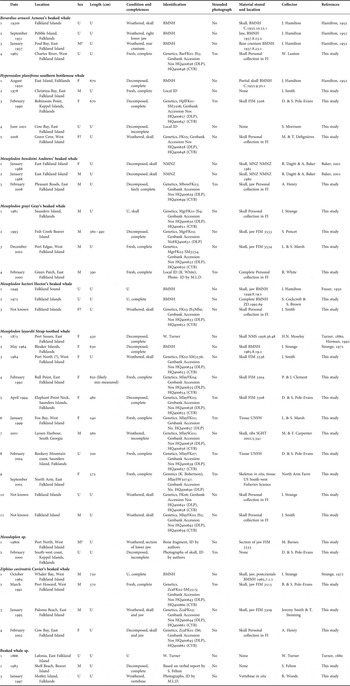
A total of 38 records of beaked whales stranded in the Falkland Islands and one record for South Georgia were obtained for the period 1866 to 2008 (total, N = 39; Table 1). These include 11 previously published records (Turner, Reference Turner1880; Fraser, Reference Fraser1950; Hamilton, Reference Hamilton1952; Strange, Reference Strange1972; Lichter, Reference Lichter1986; Baker, Reference Baker2001), and 28 new records (Table 1). All stranding records are of single individuals, with one possible exception (see below).
Records of beaked whales stranded on the Falkland Islands and South Georgia between 1866 and 2008.

U, not known. ID, identification: BMNH, British Museum of Natural History; UE, University of Edinburgh; NMNZ, National Museum of New Zealand Te Papa Tongarewa; NMS, National Museums of Scotland; UNSW, University of New South Wales. Genbank Accession numbers: DLP, control region; CYB, cytochrome b. Sex: M, male; F, female. Material stored and location: FI, Falkland Islands.
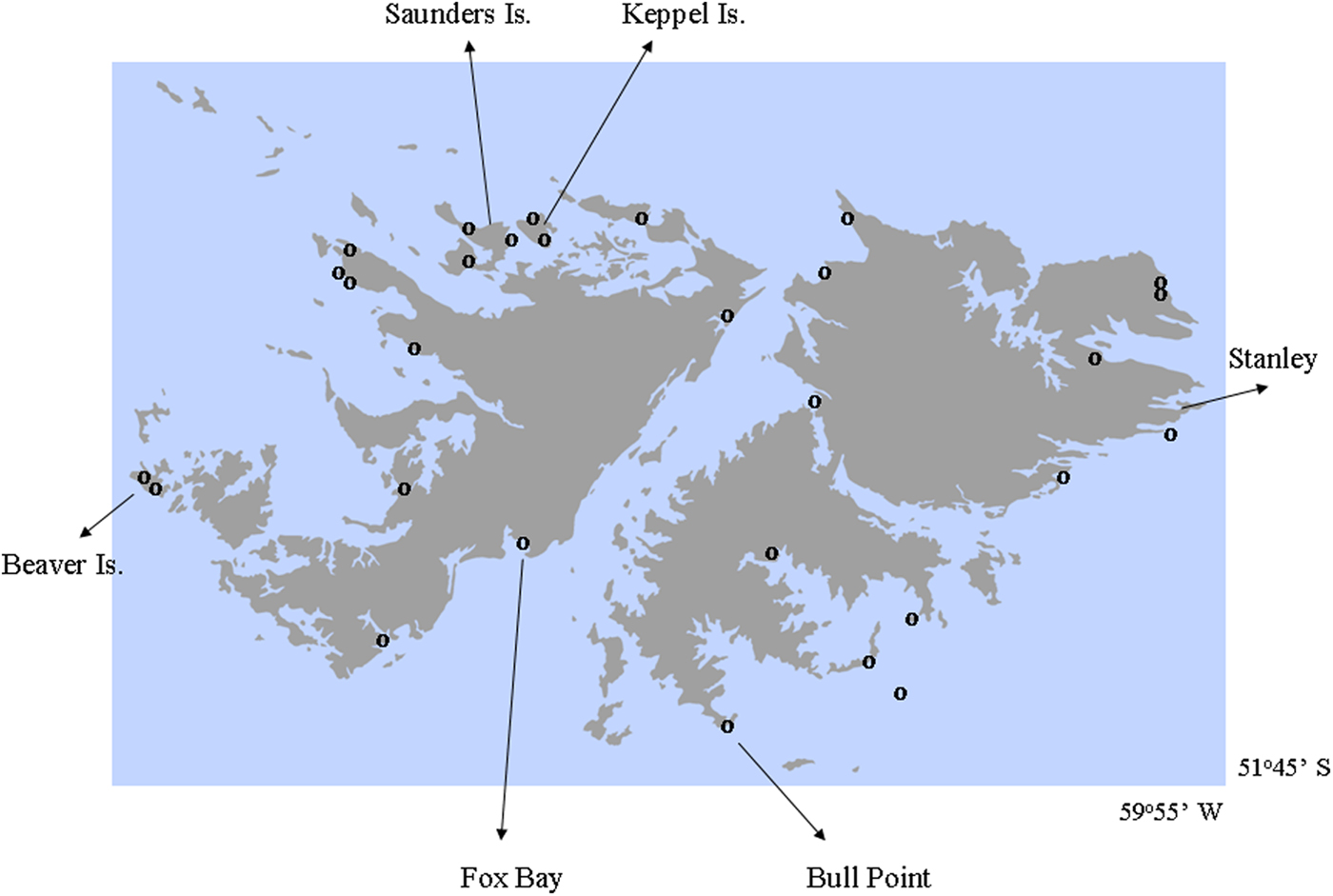
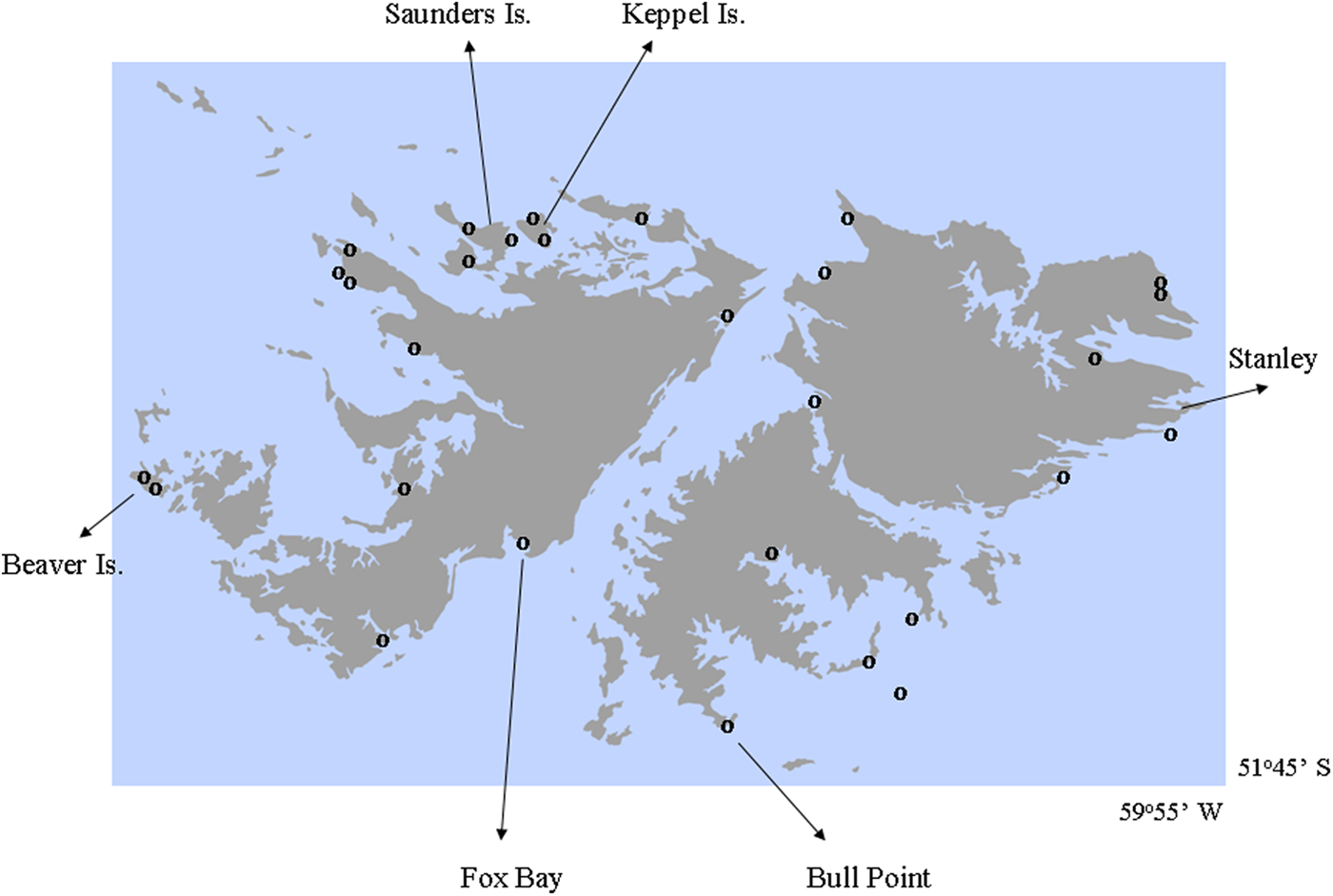
Taking into account the highly clustered distribution of the human population, and therefore the likelihood that a stranded whale will be discovered and reported, beaked whales appear to strand throughout the archipelago of the Falkland Islands; no area showed a particularly high incidence of records (Figure 1). The single record from South Georgia comes from Larsen Harbour at the south-west tip of the island.
Location of beaked whale strandings in the Falkland Islands (N = 30 records where location was known). Some locations are indicated exactly, some are identified to the recorded island, area or farm.
Species identification
Of the 39 records, the skull and lower jaw (and for some specimens, additional other bones) of 20 specimens have been collected and stored in the Falkland Islands Museum (FIM), South Georgia Museum (SGM), at museums in the United Kingdom and New Zealand, and nine are in the personal collections of three people in the Falkland Islands (Table 1). Two specimens remain in situ on the beach where they were discovered. Two other specimens had samples of tissue preserved but no bones were stored. Photographs of the specimen at the time of stranding were available for 10 specimens (Table 1).
Five specimens could not be identified to species level due to the lack of sufficient diagnostic material. Two specimens, one consisting only of a section of the lower jaw, and the other of a partial weathered skull (photograph only, material not available for physical examination), were identified by the authors as belonging to the genus Mesoplodon. Similarly, three specimens were identified only as beaked whales (Ziphiidae sp.). These consisted of: (i) a photograph of a vertebra; (ii) a verbal report by a local of finding a stranded whale with clearly protruding teeth (the specimen was subsequently washed away); and (iii) a verbal report by a local documented by Turner (Reference Turner1880).
Of the 34 specimens identified to species level, species identification was confirmed by genetic analysis for 20 specimens (59%) (Table 1). With the exception of one specimen, the species identity determined from DNA analysis was in agreement with that determined from morphology. Where the DNA results differed from those of the initial morphological assessment, subsequent re-evaluation of the specimen's morphology confirmed that it had indeed been misidentified, and that the species identity as determined through DNA was correct (specimen FK03-JS3Mhe, weathered skull = M. hectori, but initially misidentified as M. layardii from morphology). All DNA sequences generated for this study have been submitted to Genbank (Accession Nos HQ400626–HQ400662).
Species identity was determined from morphology for the remaining specimens. Of these, eight specimens were identified by the Natural History Museum, London (BMNH), two specimens were identified by the National Museum of New Zealand Te Papa Tongarewa (NMNZ) (Baker, Reference Baker2001), and one specimen was identified by Turner (Reference Turner1880). Other specimens were identified by J.S., the former curator of the Stanley Museum, Falkland Islands, and A. Henry and S. Morrison, skilled local naturalists. One specimen was initially identified by a local, and confirmed by M.L.D. from photographs (Gray's beaked whale 4; no genetic sample available).
Overall, seven species in four genera were represented; Arnoux's beaked whale Berardius arnuxii (N = 4), southern bottlenose whale Hyperoodon planifrons (N = 5), Cuvier's beaked whale Ziphius cavirostris (N = 4), Andrews' beaked whale Mesoplodon bowdoini (N = 3), Gray's beaked whale M. grayi (N = 4), Hector's beaked whale M. hectori (N = 3) and strap-toothed whale M. layardii (N = 11).
All animals were dead on discovery with the exception of one Gray's beaked whale which was first seen alive in a coastal embayment, but beached about one hour after being first sighted. Strange (Reference Strange1992) also documented one report of one unidentified beaked whale species which was returned to the sea after being found live stranded.
For the other specimens, it is not known whether the animals were alive at the time of stranding, or died at sea and were later washed up (beachcast). However, nine specimens were relatively fresh at the time of discovery; intact and without significant damage from scavenging birds. None of these specimens, showed any signs of potentially terminal physical trauma—e.g. ship strike wounds such as propeller cuts, or large shark bites (photographs; personal communications of discoverers).
Of the 39 specimens discussed here, nine were discovered ‘fresh’ (23%), 13 were fairly decomposed (33%), and 12 consisted of a skull and/or other osteological material which was already old and weathered when found (31%). For five records, the state of the specimen when originally discovered is not known.
An accurate date (i.e. month and year) of stranding was available for only 17 specimens (Table 1). Twelve specimens were very weathered skulls and these were assumed to have stranded ten years or more before being discovered as stranded beaked whales in the Falkland Islands and Tierra del Fuego are not scavenged as rapidly as other cetacean species (personal obsservation; N. Goodall, personal communication). No date of discovery could be assigned for three of the nine specimens held in personal collections. For the other specimens, only the decade in which discovery was made could be assigned.
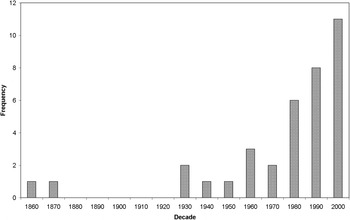
The majority of the specimens (N = 25) were discovered between 1980 and 2008 (Figure 2). Earlier records mostly coincide with two key historical periods of concentrated marine research in the Falkland Islands and South Georgia: the voyage of HMS ‘Challenger' in the 1870s and the ‘Discovery' research programme which ran between 1910 and 1950.
Frequency of beaked whale strandings in the Falkland Islands and South Georgia between 1860 and 2000 by decade (N = 36 dated records).

Nine beaked whales stranded during the southern summer months (December–February), with three records during March–May, two records during June–August, and two records in September (Table 1). Of six strap-toothed whales for which the month of stranding is known, five were recorded between January and May, and one in September.
Sex was able to be determined with certainty for 23 of the 39 specimens. For six of the seven species the animals stranded included or appear to include both males and females, and a range of age-classes. All four Gray's beaked whales were males.
Species accounts
ARNOUX'S BEAKED WHALE BERARDIUS ARNUXII
Arnoux's beaked whale has been recorded from throughout the colder waters of the southern hemisphere, mostly below 40°S, although strandings are known from southern Brazil (MacLeod et al., Reference MacLeod, Perrin, Pitman, Barlow, Balance, D'Amico, Gerrodette, Joyce, Mullin, Palka and Waring2006). This study added another record to the three animals reported previously from the Falkland Islands, bringing the total from this area to four (Table 1). Three of the records are from the 1930s (Hamilton, Reference Hamilton1952) and one is from 1965 (this study), suggesting that this species is likely only an occasional visitor to this region.
Genetic analysis 1 specimen (BarFK01-JS5)
Control region: the Falklands animal shares the same haplotype (i.e. belong to the same maternal lineage) as one Arnoux's from New Zealand, one from South Australia, and one from South Africa. This appears to be a common haplotype among Arnoux's beaked whales, representing four of eight animals analysed to date for this gene (M. Dalebout, unpublished data). The other three haplotypes known from this species differ from the most common haplotype by a single bp (i.e. one nucleotide substitution).
Cytochrome b: sequence data are held for only two other Arnoux's beaked whales, both from New Zealand. The Falklands animal shares the same haplotype as one of these, and differs from the other by a single bp.
SOUTHERN BOTTLENOSE WHALE HYPEROODON PLANIFRONS
The southern bottlenose whale has a circumpolar distribution throughout the southern hemisphere, with strandings as far north as 30°S (MacLeod et al., Reference MacLeod, Perrin, Pitman, Barlow, Balance, D'Amico, Gerrodette, Joyce, Mullin, Palka and Waring2006). This study added a further four records to the single stranding recorded previously for the Falkland Islands (Hamilton, Reference Hamilton1952), bringing the total to five (Table 1). Both of the confirmed females (specimens 1 and 3) were sexually-mature adults based on their length of 670 cm (maximum female length reported by Reeves et al., Reference Reeves, Stewart, Clapham and Powell2002 is 750 cm).
Genetic analysis—two specimens (HplFK01-SM3506 and FK05)
Control region: there is a high level of intra-specific diversity at this gene among southern bottlenose whales (Dalebout, Reference Dalebout2002). Of the animals sampled to date (N = 20, including specimens from New Zealand, Australia, and South Africa), the only shared haplotypes observed have been among mother–calf pairs. All other animals sampled possess unique haplotypes that differ from one another by up to 20 bp and cluster into two distinct clades that do not appear to be region-specific (Dalebout, Reference Dalebout2002). The haplotypes represented by the two Falkland Islands animals form part of the same haplotype clade, but differ from one another by >10 bp. In comparisons across a 300 bp fragment, HplFK01-SM3506 has a unique haplotype, and is most closely related to an animal from New Zealand (1 bp difference). All other haplotypes differ by >5 bp from these two haplotypes. Over a slightly different but similar sized fragment, FK05 differs by >5 bp from all other haplotypes sampled to date.
Cytochrome b: the two distinct haplotype clades observed at the control region also appear to occur at the cytochrome b. Again, the two Falkland Islands specimens form part of the same clade. They differ from each other by 1 bp, and each haplotype differs by at least 1 bp from the other southern bottlenose whales sampled to date for this gene.
ANDREWS' BEAKED WHALE MESOPLODON BOWDOINI
Andrews' beaked whale is known from 37 published records, and from these, the species appears to have a circumpolar distribution north of the Antarctic Convergence to 32°S (Baker, Reference Baker2001; Laporta et al., Reference Laporta, Praderi, Little and Le Bas2005; MacLeod et al., 2006). This study adds a further record to the two known records for the Falkland Islands. This species was not recorded here prior to the 1980s.
Two of the three specimens for this species were collected by a visitor to East Falkland Island in January 1988. These specimens are currently held in the Museum of New Zealand Te Papa Tongarewa (Baker, Reference Baker2001). The skulls, identified as belonging to a male and a female, were in a similar state of weathering when found at the same location and may have stranded together (A. Baker, personal communication).
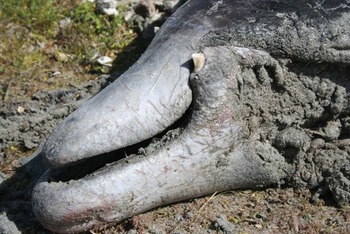
The adult male stranded in 2008 showed clear signs of tooth rake marks on the beak and lower jaw, presumably as a result of fighting with other males with similarly well-developed teeth (Heyning, Reference Heyning1984; Baker, Reference Baker2001), as well as sucker marks from small squid taken as prey (Figure 3).
The beak and lower jaw of adult male Andrews' beaked whale found in 2008 (MbowFK03) showing the scars from tooth rakes inflicted by other adult males in combat and suckers of squid (prey). (Photograph: A. Henry.)

Genetic analysis—1 specimen (MbowFK03)
Control region: the Falklands Islands Andrews' beaked whale represents the same maternal lineage (haplotype) as six M. bowdoini from New Zealand, two from Australia (Tasmania and Western Australia) and one from Tristan da Cunha. This is the most common haplotype among Andrew's beaked whales sampled to date (48%; 10 of 21 animals from throughout the species' range; M. Dalebout, in preparation). The second most common haplotype differs from this by 4 bp and is shared by 7 animals (33%) with a similarly wide distribution, including one animal from Uruguay (HM367089; Laporta et al., Reference Laporta, Praderi, Little and Le Bas2005). The other two haplotypes known are intermediates between the two common haplotypes.
Cytochrome b: only a very short cytochrome b fragment was obtained for the Falklands specimen, and could not be compared to other animals sampled.
GRAY'S BEAKED WHALE MESOPLODON GRAYI
Gray's beaked whale has a wide distribution in cold temperate and polar waters of the southern hemisphere (MacLeod et al., Reference MacLeod, Perrin, Pitman, Barlow, Balance, D'Amico, Gerrodette, Joyce, Mullin, Palka and Waring2006). It has been reported previously from the eastern coast of South America between 31°S and 53°S (Goodall, Reference Goodall1978; Pinedo et al., Reference Pinedo, Barreto and Lammardo2001). This study provides the first records for the Falkland Islands, and all were collected since 1980. All four specimens were males. The two specimens which total length information was available for appear to be subadults, measuring between 360 and 490 cm, well below the maximum male length of 570 cm (Reeves et al., Reference Reeves, Stewart, Clapham and Powell2002).
Genetic analysis—3 samples (MgrFK01-JS4, MgrFK02 and MgrFK03-SM3534)
Control region: of the 106 Gray's beaked whales analysed to date, 91 are from New Zealand, nine are from Australia (seven from Western Australia, one from Tasmania, and one from New South Wales), two are from South Africa, and one is from Argentina (M. Dalebout, in preparation), in addition to the three specimens from the Falkland Islands.
MgrFK02 shares the same haplotype as 23 animals from New Zealand, two animals from Australia (Tasmania and Western Australia) and one from South Africa. This is the most common haplotype observed to date, represented by 25% (27 of 106) of animals sampled. MgrFK01-JS4 shares the same haplotype as 10 animals from New Zealand and one from Western Australia. This is the second most common haplotype observed to date, represented by 11% of animals sampled. MgrFK03-SM3534 represents a unique haplotype that differs by 1 bp from the 17 other control region haplotypes observed to date in this species. Preliminary analyses have not revealed any strong genetic structuring in this species based on geography.
Cytochrome b: this gene has been analysed for only a small number of Gray's beaked whales to date (N = 8 total, counting two of the Falklands animals; M. Dalebout, in preparation). At this locus, MgrFK03-SM3534 shares the same haplotype as two animals from New Zealand and one from New South Wales. This is the most common cytochrome b haplotype overall (50% of animals sampled). MgrFK01-JS4 has a unique haploytpe that differs by 2 bp from another unique haplotype possessed by an animal from New Zealand. Attempts to obtain cytochrome b sequences from MgrFK02 were unsuccessful.
HECTOR'S BEAKED WHALE MESOPLODON HECTORI
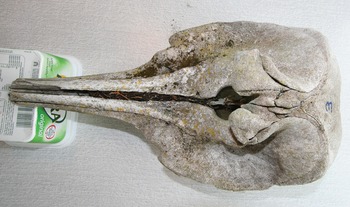
Hector's beaked whale is known from only 25 published records from between 32 and 55°S in the southern hemisphere, primarily from New Zealand (Mead & Baker, Reference Mead and Baker1987) and the south-east coast of South America (MacLeod et al., Reference MacLeod, Perrin, Pitman, Barlow, Balance, D'Amico, Gerrodette, Joyce, Mullin, Palka and Waring2006). Records attributed to this species from California (Mead, Reference Mead1981; Mead & Baker, Reference Mead and Baker1987) are now recognized as a different species, Perrin's beaked whale M. perrini (Dalebout et al., 2002), which while morphologically similar, is not closely related to Hector's beaked whale (Dalebout et al., Reference Dalebout, Steel and Baker2008). This study brings to three the number of records of Hector's beaked whales from the Falkland Islands. Due to the rarity of this species, a dorsal view of the skull held on the Falkland Islands is presented here (Figure 4).
Dorsal view of Hector's beaked whale (FK03-JS3Mhe). The skull is 49 cm in length and 27 cm in width. (Photograph: H.O.)

Genetic analysis—1 specimen (FK03-JS3Mhe)
Control region: comparisons were made to 12 other Hector's beaked whales from strandings in Argentina (Cappozzo et al., Reference Cappozzo, Negri, Mahler, Lia, Martinez, Gianggiobe and Saubidet2005), South Australia, Tasmania, and Western Australia (Gales et al., Reference Gales, Dalebout and Bannister2002), New Zealand, and South Africa (M. Dalebout, in preparation). The Falklands animal shares the same haplotype as three animals from New Zealand and one from South Africa; N = 5 total (45%), over 400 bp. Most of the six other control region haplotypes differed from this, the most common haplotype, by 1–2 bp.
Cytochrome b: comparisons were made to eight other Hector's beaked whales from strandings in Argentina, Australia and New Zealand (M. Dalebout, in preparation). Over 350 bp, the Falklands animal has a unique haplotype which differs by 1–3 bp from the six other cytochrome b haplotypes sampled to date.
STRAP-TOOTHED WHALE MESOPLODON LAYARDII
The strap-toothed whale has a circumpolar distribution, ranging from temperate to polar southern hemisphere waters, including Ille Kerguelen and Heard Island (MacLeod et al., Reference MacLeod, Perrin, Pitman, Barlow, Balance, D'Amico, Gerrodette, Joyce, Mullin, Palka and Waring2006). This study adds a further eight records to the two records published previously for the Falkland Islands, and the first record for South Georgia.
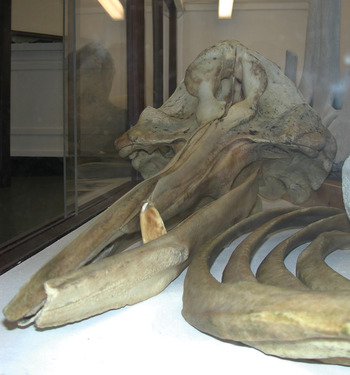
Stranded animals ranged in age from young neonate calves to fully grown adults. The maximum recorded length for adult females of this, the largest of the Mesoplodon species, is 620 cm (Reeves et al., Reference Reeves, Stewart, Clapham and Powell2002). As such, it is likely that the adult female reported to be 850 cm in length (strap-toothed whale 4) was mis-measured. The male specimen found at South Georgia was identified as sexually mature based on the presence of erupted teeth (Figure 5). The majority of males known for this species either have un-erupted, undeveloped teeth (subadults) or long, fully-developed strap-like teeth (sexually-mature adults). As such, the presence of partially-developed teeth in the South Georgia specimen is unique. It appears that the teeth of this species erupt and develop very rapidly during the accelerated growth phase that accompanies the onset of sexual maturity (A. Baker, personal communication in Cappozzo et al., Reference Cappozzo, Negri, Mahler, Lia, Martinez, Gianggiobe and Saubidet2005).
The adult male strap-toothed beaked whale from South Georgia (MlaySG01) with partially developed teeth (note: the right mandible has been placed at the left side of the skull.). (Photograph: South Georgia Museum.)

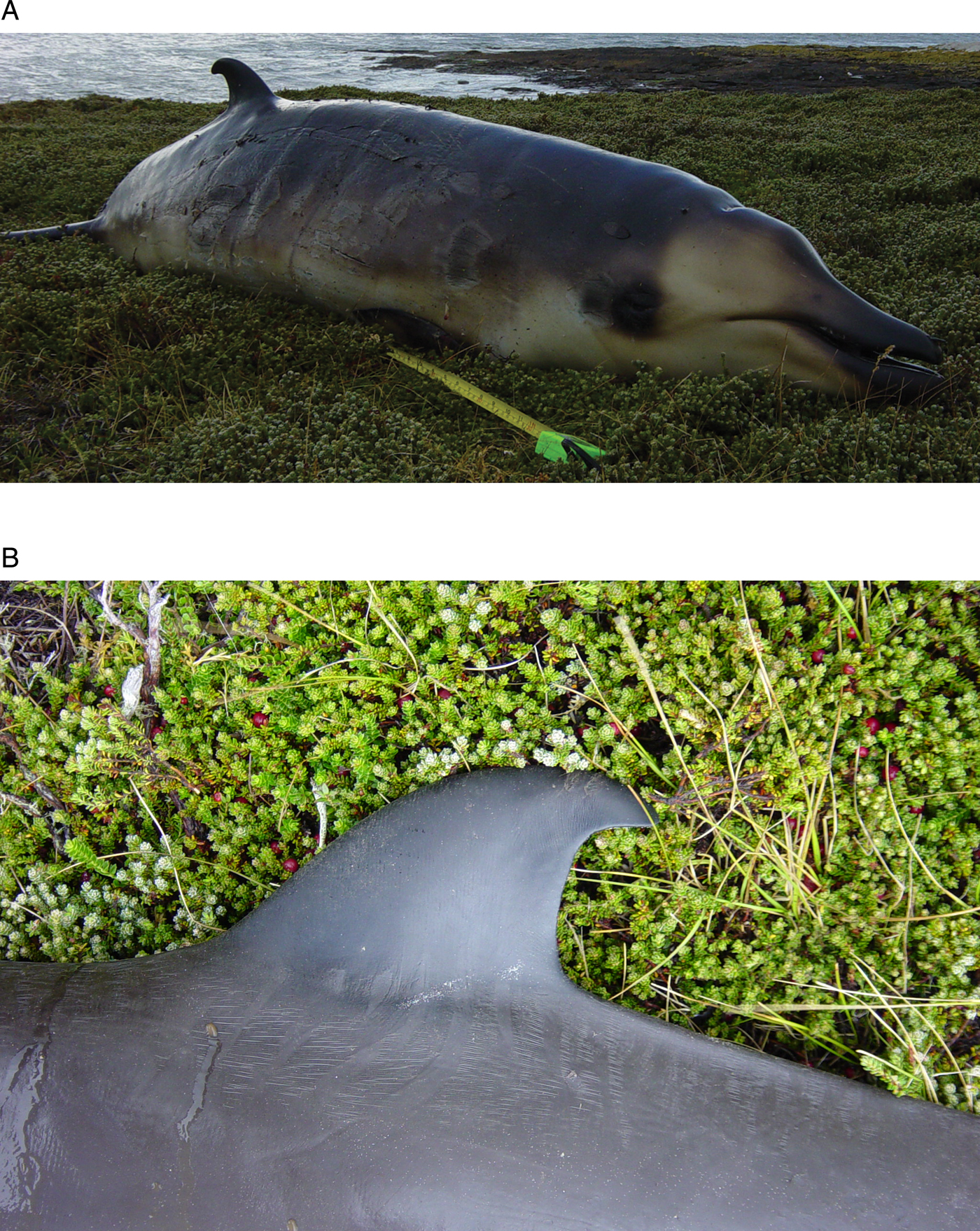
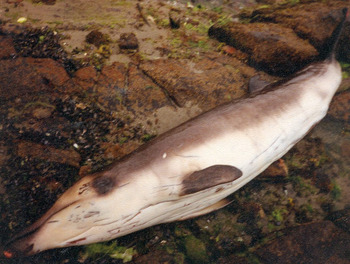
Little is known about the social behaviour and reproduction of the strap-toothed whale. Two calves were found in January and February. The 200 cm-long animal found at Saunders Island was likely to be a neonate, between a week to few weeks old, based on its length (reported birth length is 220–240 cm: Reeves et al., Reference Reeves, Stewart, Clapham and Powell2002), the lack of solid food in its stomach and an umbilical cord and presence of fetal folds (Figure 6A). The 240 cm-long animal found at Fox Bay was also likely to be a neonate a few weeks of age based on its length, the lack of an umbilical cord and the presence of fetal folds (Figure 7). In cetaceans, the foetus folds in half laterally in utero to conserve space (Reidenberg & Laitman, Reference Reidenberg, Laitman, Perrin, Würsig and Thewissen2009). Based on observations of wild bottlenose dolphins, the marks from this folding are clearly visible in the first month after birth, may sometimes be visible after a month two, and are barely or not visible in month three (Mann & Smuts, Reference Mann and Smuts1999).
Juvenile strap-toothed whale from Saunders Island, Falkland Islands in 2004 (MlayFK07), total length 200 cm. (Photographs: A. Tuson.)

Juvenile strap-toothed whale from Fox Bay, Falkland Islands in 1999, total length 240 cm. (Photograph: L. & S. Marsh.)

Both neonate strap-toothed whales found in the Falkland Islands had very strongly hooked dorsal fins (Figures 6B & 7). Dorsal fin morphology and its potential as a diagnostic feature for species or regional populations has yet to be investigated in beaked whales.
Genetic analysis—nine specimens (see Table 1)
Control region: in comparisons among the animals sampled from the Falkland Islands–South Georgia region, four share the same haplotype over approximately 360 bp. The other five animals represent three haplotypes that differ by 1–3 bp from the most common one (Figure 8).
Mitochondrial DNA control region haplotype network for the nine strap-toothed whales for which genetic information was obtained. Boxes represent haplotypes (maternal lineages). Lines connecting boxes represent nucleotide substitutions, length being proportional to number of base pair changes (i.e. 1 or 2).

In comparisons to other regions (New Zealand, South Australia and South Africa), the most common haplotype among the Falklands–South Georgia animals is also the most common haplotype overall; shared by 40% (18 out of 44) of all strap-toothed whales sampled to date (M. Dalebout, in preparation). The other haplotypes differ from the most common lineage by 1–5 bp, and are represented by 1–3 animals each. Overall, relationships among strap-toothed whale haplotypes appear to form a star-like network, without strong geographical structure (Dalebout, Reference Dalebout2002). Of the four other Falklands–South Georgia haplotypes, two are shared by animals from South Australia, and two are unique.
Cytochrome b: in comparisons to the six other strap-toothed whales that have been analysed for this gene (M. Dalebout, in preparation), three from the Falkland Islands (MlayFK02-JS2, MlayFK05 and MlayFK06) share the same haplotype, which they also share with one animal from South Africa. The South Georgia animal possesses a different haplotype, which it shares with two animals from New Zealand, and differs from the most common one by a single bp. The remaining three Falkland Islands animals represent unique haplotypes that differ from the others sampled to date by 1–2 bp. No cytochrome b sequence is held for MlayFK01.
CUVIER'S BEAKED WHALE ZIPHIUS CAVIROSTRIS
Cuvier's beaked whale has the widest distribution of all beaked whales, ranging from polar to tropical waters in all the world's oceans with the exception of high latitude Arctic and Antarctic regions (MacLeod et al., 2006). This study added a further three records to the single previous stranding record for the Falkland Islands, being an adult male 750 cm in length (Strange, Reference Strange1972). This measurement may not be accurate as the maximum length is given by Reeves et al. (Reference Reeves, Stewart, Clapham and Powell2002) for this species is about 700 cm.
Genetic analysis—3 specimens (ZcaFK01, ZcaFK02SM3515, ZcaFK03)
Control region: all three Falkland Islands animals represent different haplotypes (maternal lineages), all of which appear to be part of the ‘AG' haplotype clade that is found predominantly in the southern hemisphere (see figure 1 in Dalebout et al., Reference Dalebout, Robertson, Frantzis, Engelhaupt, Mignucci-Giannoni, Rosario-Delestre and Baker2005): ZcaFK02SM3515 likely represents HapA (50 bp of the sequence was missing), while ZcaFK01 differs from ZcaFK02SM3515 by at least 1 bp, and from other known haplotypes by at least 3 bp. ZcaFK03 also differs from ZcaFK01 and all other known haplotypes by at least 3 bp. As such, two of the Falklands animals represent lineages that have not been found elsewhere to date. A more comprehensive assessment of control region variation in Cuvier's beaked whales worldwide is in progress (Dalebout et al., in preparation).
Cytochrome b: a comprehensive assessment of variation at this gene for Cuvier's beaked whales is also currently in progress (Dalebout et al., in preparation). All three Falkland Islands animals represent different cytochrome b haplotypes. Preliminary comparisons to animals from other areas indicate that ZcaFK01 represents a common southern hemisphere haplotype, also represented by at least six animals from South Africa and two from New Zealand. The other two Falklands animals represent different and potentially unique haplotypes (i.e. not observed in other animals analysed to date), which differ by 1–2 bp from the common southern hemisphere type.
DISCUSSION
This study has tripled the number of beaked whales known to have stranded in the Falkland Islands–South Georgia region, and provided four records for a species (Gray's beaked whale) not previously recorded in this region. For South Georgia, only the southern bottlenose whale was recorded previously; small numbers were killed here during whaling operations by Soviet and Russian whalers (Mead, Reference Mead, Ridgway and Harrison1989b). Here we document the stranding of a young sexually mature male strap-toothed whale.
Due to the importance of the south-west South Atlantic Ocean for beaked whales, their distribution and abundance should be regularly monitored. Dedicated at-sea surveys are high in cost and effort, and often yield only a few sightings. In contrast, detailed information can be gained at little cost from investigating stranded beaked whales. As such, great support should be given to the network of local naturalists and landowners who report stranded cetaceans. This is reflected as a priority one action task in the Falkland Islands Species Action Plan for Cetaceans 2008–2018 (Falkland Islands Government, 2008).
The anatomy and behaviour of the beaked whale makes them very sensitive to anthropogenic noises such as sonar and airgun arrays, which can lead to strandings (Barlow & Gisiner, Reference Barlow and Gisiner2006). The Falkland Islands and South Georgia have been regularly patrolled by fisheries patrol vessels and military vessels that may use sonar for detection and navigation purposes. Concern about sonar relates primarily to the use of mid-frequency active sonar (1–10 kHz), as used particularly in military exercises (Dolman et al., in press). The use of mid-frequency sonar by military vessels in the waters of the Falkland Islands and South Georgia and the use of marine mammal mitigation is unknown. There have also been two rounds of intense oil exploration activities, including seismic surveys and drilling, in the Falkland Islands. Both activities are conducted under legislation that minimizes impacts and risks to marine mammals.
The live sightings (White et al., Reference White, Gillon, Black and Reid2002; Black, Reference Black2005) and stranding records (this study) indicate that the seven species regularly or occasionally frequent the waters of the Falkland Islands. All the species recorded here are known to occur elsewhere in the south-west sector of the South Atlantic Ocean based on live sightings and/or stranded specimens (Goodall, Reference Goodall1978; Rossi-Santos et al., Reference Rossi-Santos, Baracho, Cipolotti and Marcovaldi2007; Goodall et al., Reference Goodall, Dellabianca, Boy, Benegas, Pimper and Ricciadelli2008). The similarity of the stranding records for Tierra del Fuego and the Falkland Islands is in spite of the considerable differences in search effort, with specimens found primarily ad hoc in the Falkland Islands, whereas the 33 year long Tierra del Fuego records are based on specific annual beaches surveys and as well as ad hoc findings.
In Tierra del Fuego and southern Patagonia, the most frequently recorded beaked whale species found stranded were (in order) Cuvier's beaked whale, Gray's beaked whale, and strap-tooth whale (Goodall et al., Reference Goodall, Dellabianca, Boy, Benegas, Pimper and Ricciadelli2008), whereas strap-tooth whale was the most frequently recorded species in the Falkland Islands.
All four specimens of Gray's beaked whale recorded from the Falkland Islands were males, whereas of the seven specimens of known sex from Tierra del Fuego, the only male was a foetus. Based on skull morphology, several other animals from Tierra del Fuego also appear to be female (Goodall et al., Reference Goodall, Dellabianca, Boy, Benegas, Pimper and Ricciadelli2008).
Whilst the waters around Tierra del Fuego appear to be a calving ground for several beaked whale species (Hector's, Gray's, strap-toothed and Cuvier's; Goodall et al., Reference Goodall, Dellabianca, Boy, Benegas, Pimper and Ricciadelli2008), the only neonates found to date on the Falklands are strap-toothed whales.
The only other beaked whale species known to be found in the south-western sector of the South Atlantic Ocean but not yet reported from the Falkland Islands is Shepherd's beaked whale (Tasmacetus shepherdi Oliver, Reference Oliver1937). This rare species, first described from New Zealand by Oliver (Reference Oliver1937), has stranded eight times in Patagonia (Goodall et al., Reference Goodall, Dellabianca, Boy, Benegas, Pimper and Ricciadelli2008), and there is one possible live sighting in waters north-west of South Georgia (Laughlin, 1996 as summarized by Pitman et al., Reference Pitman, Van Helden, Best and Pym2006).
Confusion between the strap-toothed whale and the recently resurrected spade-toothed whale (M. traversii Gray, 1874) may be an issue at sea, but the skull morphology of these species is distinct (van Helden et al., Reference van Helden, Baker, Dalebout, Reyes, Van and Baker2002). Here, morphological identification was further confirmed by genetic analysis for nine of the 11 specimens. It is possible, however, that spade-toothed whales occur in the Falkland Islands region. To date, this species is known from only three partial skulls; two from New Zealand and one from the Juan Fernandez Archipelago off the coast of Chile (van Helden et al., Reference van Helden, Baker, Dalebout, Reyes, Van and Baker2002).
This study adds further support to the designation of the Falkland Islands and Tierra del Fuego as a key area for beaked whales (MacLeod & Mitchell, Reference MacLeod and Mitchell2006). In this designation, this area qualified under two of four criteria: (i) areas where one or more beaked whale species have been regularly recorded at sea; and (ii) areas of high diversity of beaked whales, where ‘high’ means records of more than 25% of all beaked whale species, and at least 50% of all beaked whale genera (i.e. at least five species from at least three genera). Of the 23 beaked whale key areas recognized worldwide, the Falkland Islands is the only United Kingdom Overseas Territory (in mainland UK, the Scottish coast between the southern Outer Hebrides to Shetland is also a key area).
Whilst live sightings in waters of the Falkland Islands were made only between July and November, and at South Georgia predominantly during March to October (White et al., Reference White, Gillon, Black and Reid2002; Black, Reference Black2005), strandings were more frequent during December to February. Five strap-toothed whale strandings in the Falkland Islands occurred during summer and autumn, and only one occurred during spring. A similar trend has been reported for the species in southern Argentina (Di Tullio et al., Reference Di Tullio, Goodall, Secchi, Siciliano and Santos2005). Although strandings were reported more often in the summer, due likely to more people being on the coast, strandings were reported in other months too, suggesting that this species is present year round.
Generally, we have too little data to make any real generalizations about stranding patterns and species distributions around the Falklands. However, several points are worth noting. Strap-toothed whales have stranded on the Falkland Islands throughout the period 1875 to 2005. In comparison, Arnoux's beaked whale has stranded only four times between 1931 and 1965, Gray's beaked whale was not recorded until 1981, and Andrews' beaked whale was not recorded until 1987. These latter species may simply not be particularly common in this area, but recent changes in water temperature and/or prey availability may also be influencing their distributions.
In north-west Scotland, where water temperatures have been rising since 1981, there has been an increase in sightings and strandings of warmer water cetacean species and a decrease in the frequency of stranding of cooler water species (MacLeod et al., Reference MacLeod, Bannon, Pierce, Schweder, Learmonth, Herman and Reid2005). Data analysed by the UK Climatic Research Unit of the University of East Anglia (Rayner et al., Reference Rayner, Parker, Norton, Folland, Alexander, Rowell, Kent and Kaplan2003; Parker et al., Reference Parker, Alexander and Kennedy2004; http://www.cru.uea.ac.uk/cru/data/temperature/) show a steady increase in the number of records of warmer than normal sea conditions in the Falkland Islands since the 1960s. Such conditions could result in the exclusion of predominantly cold-water species such as Arnoux's beaked whales, while attracting cool-temperate species such as Andrews' and Gray's beaked whales.
Reconstruction of seasonal use patterns from at-sea sightings and stranding records should be undertaken with care. Beaked whales seen in the waters of both the Falkland Islands and South Georgia were sighted far from shore (White et al., Reference White, Gillon, Black and Reid2002), and whales that die at sea may be carried long distances on surface currents or by prevailing winds, which can vary seasonally (MacLeod et al., 2004). However, the freshness of most of the stranded animals reported here implies that they were already present in the area when they sickened and died. Combined, the live sightings previously published (White et al., Reference White, Gillon, Black and Reid2002) and our stranding records suggest that up to seven species of beaked whale may be present in the waters around the Falkland Islands year round.
ACKNOWLEDGEMENTS
We thank all the discoverers and investigators of the beaked whale specimens in the Falkland Islands and South Georgia for their enthusiasm and dedication to recording the natural history of the islands. The assistance of the staff of the Falkland Islands Museum and South Georgia Museum in providing information, photographs and access to specimens for sampling was greatly appreciated. Particular appreciation for the skilled efforts of Steve Massam of the Falkland Islands Museum for successfully drilling the skulls of beaked whales (for powdered bone for DNA studies) stored in the Falkland Islands and South Georgia. We also thank K.M. Robertson of United States NMFS South-west Fisheries Science Center for DNA sequence data and confirmation of species identity of the strap-toothed whale (MlaySW50747). The genetic analysis was funded jointly by the Falkland Islands Government's Environmental Studies Budget and Falklands Conservation's Conservation Grants Scheme. Thanks also to R.N.P. Goodall and one anonymous referee who provided helpful comments and additional information.