I
This article describes how the British monetary authorities tried to manage long-term interest rates through government debt management operations between 1962 and 1964, adding some detail to the account given by Capie (Reference Capie2010, pp. 282–6), and providing an interpretation. The period was one in which politicians were preoccupied with the United Kingdom's rate of economic growth, which had been low in the 1950s relative to that of other industrial countries, though not relative to the UK's own history.Footnote 1 In 1962, the Chancellor of the Exchequer, Selwyn Lloyd, set up the National Economic Development Council to identify obstacles to growth and ‘to seek agreement upon ways of improving economic performance, competitive power and efficiency, in other words to increase the rate of sound growth’,Footnote 2 and announced a target of 4 per cent for economic growth. In practice, particularly after Lloyd had been succeeded by Reginald Maudling, macro-economic policy was to expand demand, especially investment, and to try to eliminate any adverse consequences for inflation and the balance of payments by means of a voluntary incomes policy. Indeed, Maudling described the purpose of his 1963 Budget as ‘to do the Government's part in achieving the rate of growth broadly described as the 4 per cent target, which we have already accepted in the National Economic Development Council’.Footnote 3
Some institutional background on government debt management is necessary. Government debt existed in three main types – gilt-edged securities (gilts), which were coupon-bearing bonds issued with maturities of several years and at least one year; National Savings instruments issued to individual savers; and Treasury bills, normally issued with a three-month maturity. Gilts and Treasury bills were marketable, but National Savings instruments were not. Treasury bills provided residual financing for the government if other forms proved insufficient, but they counted as liquid assets for the commercial banks, which were required to maintain a minimum ratio of defined liquid assets to deposits; over-reliance on them was regarded as potentially inflationary, both for that reason and because their short maturity meant that they were a close substitute for money.
Gilts were traded in the Stock Exchange, where the market in them was made by jobbers. Until 1969, jobbing firms had to be partnerships, and the partners had, in principle, unlimited liability.Footnote 4 It was hard for partnerships to accumulate capital, partly because of high rates of income taxation (Morgan and Thomas Reference Morgan and Thomas1962, p. 237; Michie Reference Michie1998, pp. 391–3 and 437). During the Second World War, the supply of gilts had been massively enlarged: in 1946, the net government debt/GDP ratio had been 237 per cent; by 1962 it had fallen to 100 per cent. Roughly two-thirds of the debt was in the form of gilts. Moreover, with the rise of pension funds and other institutional investors, gilt holdings became more concentrated and individual transactions became larger. For these reasons, the Stock Exchange jobbers were unable to make markets in gilts that the Bank of England considered sufficiently liquid. The Bank regarded market liquidity as one of the main attractions of gilts and was concerned that a deterioration in liquidity would lead to a rise in yields. Accordingly, though not apparently as the result of any conscious decision, the Bank came to act as a jobber itself – a largely unrecognised example of a central bank acting as ‘market-maker of last resort’.Footnote 5 The development of the Bank of England's role as a gilt-edged market maker will be described in a forthcoming separate paper.Footnote 6
For present purposes, the important facts are that in the early–mid 1960s, the Bank of England combined the roles of issuing house, underwriter and leading market maker in gilts, and that there was no predetermined schedule of new issues. When a new issue was made, only a small amount was normally sold at the public tender. The remainder was acquired by the Issue Department of the Bank of England, which thus acted as underwriter, and was made available for gradual sale as a ‘tap stock’ in the secondary market.Footnote 7, Footnote 8 It was also standard practice for the Bank to buy, and hold in the Issue Department, gilts approaching maturity, so as to spread through time the impact of the redemption on the money market. In this article, ‘forthcoming maturities’ is taken to mean maturities due in the next nine months.
After the cheap money policy pursued by Chancellor of the Exchequer Hugh Dalton in the post-war Labour administration had tried, and failed, to establish long-term gilt yields at 2½ per cent, there had been no generally accepted objectives of debt management, except to refinance the heavy flow of maturities somehow (Howson Reference Howson1993). Decisions were mainly ad hoc (Allen Reference Allen2014). The Radcliffe report had, however, recommended that the monetary authorities ‘must have and must consciously exercise a positive policy about interest rates, long as well as short, and about the relationship between them’ (Radcliffe Report 1959, para. 982). The long-rate policy that began in 1962 can be regarded as an attempt to follow Radcliffe's recommendation. It was also influenced by the Prime Minister, Harold Macmillan, who wanted lower long-term interest rates as a means of promoting economic growth.
The policy bore an obvious resemblance to Operation Twist, which had been initiated in the United States in 1961. I have found no references to Twist in the archives, but it is barely conceivable that it did not influence UK policy. Swanson (Reference Swanson2011, p. 155) summarises the objectives of Twist succinctly: ‘If longer-term Treasury yields could be lowered without affecting short-term Treasury yields, the reasoning went, then investment could be stimulated without worsening the balance of payments and gold outflows.’
The article is structured as follows. Sections ii and iii describe what the policy was and how it was implemented in two different phases, characterised by falling yields until September 1963 and rising yields since October of the same year. Section iv briefly discusses the role played by the maturity structure of government debt and the yield curve, and the transparency of the Bank of England's action. Section v concludes.
II
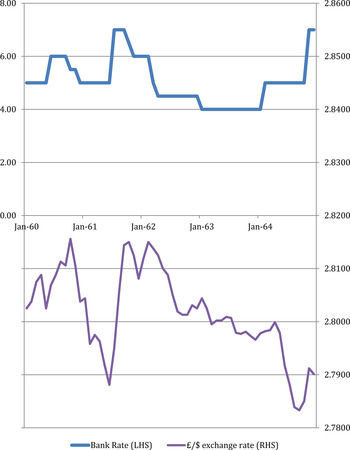
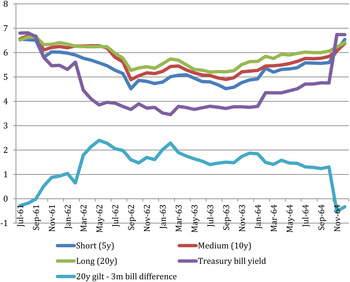
Short-term interest rates were a very important influence on long-term rates, and they were determined largely by the need to maintain the Bretton Woods parity of £1 = $2.80. They fell steadily as the exchange rate strengthened after the troubles of 1961, which in turn had been caused by excessive demand expansion in 1959 and the revaluation of the Deutsche Mark in March 1961 (Figure 1).Footnote 9 The latter had been widely thought to be inadequate, so that a further revaluation was expected. Bank rate was unchanged at 4 per cent from January 1963 until it was increased in February 1964 in response to the drying up of gilt sales and growing external deficits. Long and medium gilt yields were initially slow to respond to falling short rates, but then followed the same down-up cycle as short rates, with a smaller amplitude (Figure 2).
Bank rate and the exchange rate 1960–4 (%) Source: Bank of England Statistical Abstract, 1970.

Gilt and Treasury bill yields 1961–4 Source: Bank of England Statistical Abstract, 1970; author's calculations.

Official discussion of a long-term interest rate policy appears to have begun in the Treasury in late 1961. Robert Armstrong, a Treasury official who had been secretary to the Radcliffe committee,Footnote 10 circulated a note on the subject, which began with three assumptions:
1. We should not try to lead [bond] prices against a trend, nor seek to force prices to move faster or further in a given direction than they would do if we did not intervene;
2. We should regards ourselves as entitled to control, but not ultimately to try and resist, a downward trend;
3. We should regard ourselves as free to control, and even to try and prevent (or stop) an upward trend.Footnote 11
The first assumption acknowledged the supremacy of markets in setting bond prices, while the asymmetry between the second and third assumptions possibly reflected the experience of the post-war ultra-cheap money, when gilt yields became unsustainably low.
Armstrong's analysis was based on his view of the likely demand for capital equipment, which he expected to decrease in 1962 and 1963 following the investment boom of 1960–1. He noted that fears of inflation had affected gilt yields, but thought that such fears would become less influential in the future. And he assumed no change in fiscal policy. He concluded that:
there is a good case for letting the current strength of the gilt-edged market be reflected in some rise in prices, even if that means somewhat lower net sales (it will not necessarily do so, since we have generally found a rising market propitious for selling). I am not suggesting anything dramatic; nor should we want to go too fast, so that, if the outlook changes and our assumptions are proved wrong, we can call a halt before we have gone too far. But, if we aimed at 5½ to 5¾ per cent. by March (current yields about 6¼ per cent.), I do not think that a reduction of this kind achieved gradually over the next four or five months, would be inconsistent with the general economic policy or outlook, or with prospects for the gilt-edged market.Footnote 12
I have found in the archives no sign of further discussion of Armstrong's note in the few months after it was written; however, the Bank of England Quarterly Bulletin noted that in February 1962 ‘official policy…was not to oppose some slow rise in prices’.Footnote 13 On 15 March, Jasper Hollom (Bank of England) told the Treasury that the supplies of long-dated gilts in the Issue Department were running low and that the Bank therefore had no control over the longer end of the gilt market. The portfolio would need at some point to be replenished. In discussing the choice of stock to be issued, Hollom remarked:
In general, it would seem that our policy at the long end of the market should be to keep any tendency for prices to move upwards under restraint, so that the pace of the movement remains modest, but not to prevent a gradual progress to a rather lower long-term yield. One of the factors to be borne in mind is that, if we join the Common Market, it will be important that our long-term rates should be in an appropriate relationship to those of other countries.Footnote 14
Hollom advised issuing an additional £500 million of 5 per cent Treasury 1986/89, though he considered 5½ per cent Treasury 2008/12 a reasonable alternative. The question was extensively debated in the Treasury, and the joint Permanent Secretary, Sir Frank Lee, recommended the 2008/12 stock to the Chancellor, Selwyn Lloyd.Footnote 15 Lloyd's decision, however, announced on 4 May, was for a smaller amount of the shorter stock: £300 million of the 1986/89; he thus chose to do less to restrain the fall in long-term interest rates than his advisers had recommended. It was priced at 84½, above the market price at the time when the pricing decision was made (84 3/16) ‘in order to lead the market in the direction in which we would wish it to go’.Footnote 16
On 14 June, Macmillan, who was chronically mistrustful of what he regarded as the hidebound orthodoxy of the Treasury and the Bank of England, wrote to Lloyd. He began: ‘You know how keen I am to get the long term interest rate down’, went on to express concern about falling industrial investment and concluded: ‘I hope you will most seriously consider the necessary technical steps to achieve a lower long term interest rate, even if it is not possible yet to make any further reduction in the bank rate.’Footnote 17
An internal paper produced at about the same time in the Treasury, in response to an earlier inquiry from Macmillan, commented that:
the objectives of interest rate policy can be regarded as long-term and short-term. In the long-term the policy must doubtless be, as the Radcliffe Committee said, ‘to take a view as to what the long-term economic situation demands’. It is difficult to define what this means in practice, but the experience of the post-war years suggests very strongly that the ‘equilibrium’ rate of interest in the circumstances of today must be much higher than the 2½% which Mr Dalton aimed at, and must be much more in the region of 5% to 6%. The way in which the rate has behaved in the last three or four years, the better shape that the gilt-edged market is in, and the better control we have secured over the monetary system all suggest that we may have found something like the ‘equilibrium’ rate between these two figures. From a long-term point of view, therefore, unless there is any very great change in circumstances, it would seem that we ought not to take any action which would cause the rate to depart too much either above or below this ‘equilibrium’ range.
From the short-term point of view the proper role of interest rate policy would seem to be that it should influence rates upwards when the pressure of demand is becoming excessive and the economy is getting into a boom, and downwards when the reverse is happening. Ideally these rises and falls should be about the long-term ‘equilibrium’ level and should not be violent. The present situation, with a certain degree of slack in the economy, is one in which some fall in interest rates has been appropriate for some time and has in fact been going on; but if, as we believe, activity and the pressure of demand are likely to rise towards the end of the year, then it would be appropriate for the fall in interest rates to be arrested and perhaps even reversed. From this point of view, therefore, there would not seem to be any great scope in the immediate future for bringing about a marked or rapid fall in interest rates.Footnote 18
The paper also warned that ‘the Government cannot control interest rates but only influence them, and that the other influences which are at work all the time, could easily frustrate the Government's policy, or, if it were pursued relentlessly, require the pumping out of more and more Treasury Bills’.
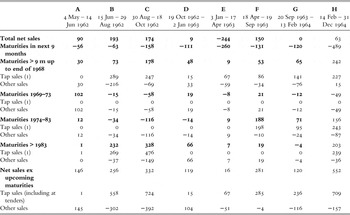
A short-dated issue (£400 million of 5 per cent Exchequer 1967) was made in June, designed to absorb funds from the banks following the release of Special Deposits, of which £151 million was sold at the tender and the remainder by the end of September (Table 1).Footnote 19
Official gilt operations, May 1962 – December 1964 (£ million, nominal)a

a including at tenders Source: BOE C11/21-26; author's calculations.
Discussion of how to reply to Macmillan revealed a misunderstanding between the Treasury, which was ultimately responsible for formulating the policy, and the Bank of England, which was responsible for advising on it and implementing it. A draft by William Armstrong (Treasury) sent to the Bank for comment said that ‘We are doing nothing to interfere with the decline in long-term interest rates’ and ‘We are no longer engaging in active funding – that is selling long-term securities in order to redeem short-term debt and thus lengthen the debt as a whole.’Footnote 20 Yet Hollom pointed out that neither statement was true: ‘We have recently been siseable sellers of stock. For example during the three calendar months ended the 30th June we were net sellers to the extent of £221 million.’ He provided a table showing that during those three months here had been net sales of £369 million of over-five-year gilts, partly offset by £148 million of purchases of one- to five-year gilts.Footnote 21 The only possible explanation of this misunderstanding is that Armstrong made a mistake. Hollom went on to say that ‘For all practical purposes, short of making a major public move, we cannot do more than choose between allowing an upward market movement to be reflected primarily in the rate or primarily in more funding. At present we are leaning towards movements in rate, while continuing to fund in slow time and at rising prices.’ The BEQB explained that the fall in yields in April–July 1962 ‘was not opposed by the authorities. On the other hand to have encouraged a faster fall in yields than in fact occurred seemed inappropriate. Uncertainties remained both at home and abroad, and too rapid a fall, which could not be sustained and might indeed have been reversed, would have damaged the market.’Footnote 22
On 11 July 1962, the Treasury sent Macmillan the final version of the paper,Footnote 23 modified in the light of the Bank's comments.Footnote 24 In considering why rates had not fallen further from the peak of nearly 7 per cent reached in August 1961, it put some of the blame on local authorities, whose borrowing techniques ‘are resulting in their paying somewhat higher rates than they need’, but reassured Macmillan that work was in hand to address that problem. The paper identified
clear arguments for allowing the tendency towards lower rates to continue. Internally, a lower long-term rate would benefit the Exchequer, the local authorities and the nationalised industries: it would reduce the cost of investment by private industry, and of house purchase by individuals. On the external side, there are perhaps conflicting considerations. On the one hand, it could be argued that the position of, and the outlook for, the current account is still not good enough to allow us to make London markedly less attractive for the deposit of foreign funds, or markedly less expensive as a source of funds for foreign borrowers: on the other hand, it could be argued that lower long-term rates would fit in with the need for international co-operation on exchange matters, and would help to secure the benefits which would follow if London became the chief capital market of the European Economic Community.
The paper went on to express some caution:
It is essential, however, that the fall in rates should not exceed that which can be sustained. A series of reversals of direction in this field would be calculated to destroy the new-found interest, both at home and abroad, in gilt-edged securities and so make the task of monetary policy needlessly more difficult.
It noted the dangers of balance of payments problems, rising inflation and the continuing growth of demand for capital equipment; though it did not mention that the balance of payments problems would be aggravated if the UK, having become ‘the chief capital market of the European Economic Community’, had the lowest long-term interest rates in the EEC. It concluded that
for some time it will be natural for long-term interest rates to remain relatively high (say, between 5% and 6%), and that if we want the present downward trend to continue, our best course is:
(a) so far as official operations are concerned, to continue to allow the increasing demand for gilt-edged to be reflected primarily in rising prices rather than in sales by ourselves; and
(b) more generally, to maintain firmly our anti-inflationary policies.
This was not much of a policy statement. It failed to explain how the balance between selling gilts and allowing prices to rise and yields to fall was to be measured, and in what sense the demand for gilts was currently being allowed to be reflected ‘primarily’ in rising prices. Moreover it failed to say what was to happen if the demand for gilts weakened and yields began to rise; but that was not to happen until autumn 1963 (Figure 2).
On 13 July, Macmillan dismissed Lloyd and replaced him with Reginald Maudling, in what was called the ‘night of the long knives’.Footnote 25 ‘With his eye to the forthcoming General Election Macmillan was determined to boost Conservative popularity by raising living standards rapidly though reflation. In his new Chancellor, Reginald Maudling, Macmillan had a man without Lloyd's scruples about putting the economy at risk and one who was ready, in conjunction with Macmillan, to seek ways of ensuring expansion without producing runaway inflation which were unorthodox and contrary to Treasury thinking’ (Lamb Reference Lamb1995, p. 450). Macmillan himself criticised Lloyd for his slowness in producing the incomes policy that he believed would be sufficient to contain inflation (Macmillan Reference Macmillan1973, p. 91). Maudling knew that the Prime Minister wanted faster economic growth quickly; moreover Tim Bligh, Macmillan's private secretary, told Macmillan on 16 July that he would find a way of ensuring that the new Chancellor ‘should be aware of these papers [including the one about long-term interest rates] and should be in a position to discuss them with you in the near future’.Footnote 26
In August, Cromer and Maudling discussed long-term interest rates. Hollom had briefed Cromer to stress the importance of lower budget deficits and to point out that local authority borrowing, unlike that of the central government, was not decreasing. As regards long-term interest rates, Hollom said ‘the long-term rate has now fallen from its peak twelve months ago of about 6¾% to something only a little above 6%; that this rate of fall seems quite fast enough; and that we would propose to handle our market operations in such a way as to do no more funding than is necessary to keep the movement as orderly and as continuous as possible’.Footnote 27
Secondary market sales of the new tranche of 5 per cent Treasury 1986/89 had not got under way until the end of June, but it was sold out in August.Footnote 28 Between 15 June and 29 August, sales of the 1986/89s were £269 million and of the short 1967 tap a further £289 million, but there were offsetting purchases of £279 million of stocks maturing up to 1968 and £86 million of later maturities, so that total net sales were just £193 million (Table 1, column B).Footnote 29 The Bank wanted to issue a new long tap, and proposed a new tranche of 5½ per cent Treasury 2008/12, to be priced slightly above market levels, and the Treasury agreed. The argument was strengthened by the decision to finance more local authority borrowing centrally, which implied that more gilt sales would be needed. Mynors, the Deputy Governor of the Bank, did ‘not much like issuing a 5½ at 93 for nearly 40 years when everybody, ourselves included, thinks that this may look like expensive borrowing in a few months’ time’.Footnote 30 The issue, of £500 million priced at 95, nevertheless went ahead on 30 August. The market price at the time the pricing decision was made was 94 9/16, and the difference of 7/16 between that and the issue price was equivalent to a yield difference of three basis points.Footnote 31 Not surprisingly, very little was sold at the tender.
Yields continued to fall, and Treasury officials became concerned. Radice suggested that ‘we should consider with some urgency whether the Bank's control of the medium-term maturities in the market is adequate at the moment’ and ‘whether the gilt edged yields as a whole are rising [presumably he meant falling] faster than they ought to in the context of long-term interest policy’.Footnote 32 His colleagues Goldman, Padmore and William Armstrong agreed.Footnote 33 They met the Bank on 18 October, as the tranche of 5½ per cent Treasury 2008/12 issued at the end of August approached exhaustion. In a letter written the previous day, Alan Whittome (Hollom's deputy) had told the Treasury that, apart from the remaining holdings of the 2008/12s,
we hold £300 million of stocks maturing in 1980 or after. In addition we hold some £75 million in the 1970/80 bracket. With a portfolio of this size, spread as it is over a number of stocks, we are in a position to restrain a fall in interest rates.
Turning to policy objectives, he suggested, rather casuistically, that:
If we have to expect balance of payments troubles around the end of 1965 we must expect long-term rates to begin to rise about or rather before that time and it makes no sense to encourage a fall in yields which could itself exacerbate our balance of payments difficulties. But this is far from asserting that there should be no further fall in rates, particularly at a time when so many of the earlier arguments in favour of lower rates, for instance the expected level of investment by industry, remain. In general terms we think that we should be content if long-term rates were to fall to around 5% by early 1965; on the other hand we should take no steps to encourage them to fall and should be content if the market settled at a rate anywhere between 5 ½% and 5%.Footnote 34
The minutes of the meeting, which discussed what to do when the 2008/12 tap was exhausted, reveal more about how the policy was implemented:
On the technical level, the fall in yields had been helped by the way in which purchases of the tap stock had been made easier by a liberal switching policy. Up to the end of last week the Bank had been taking in at prices well up to market prices other gilt-edged stocks offered by would-be purchasers of the tap stock. In this way the existence of the tap stock had positively encouraged a favourable sentiment in the market. The main ground for adopting the policy of helping switching in this way was because the Bank was not anxious to fund aggressively in a period in which the credit squeeze was being steadily relaxed.Footnote 35
Later, the BEQB attributed the general strength of the gilt market between June and October partly ‘to official indications that a fall in yields would not be opposed’.Footnote 36
The 2008/12 tap stock, whose ‘price was allowed to rise only slowly’Footnote 37 was indeed exhausted on 19 October.Footnote 38 These sales were supplemented by the remaining £75 million of the 1967 short tap and sales of £119 million of a new short issue, 4 per cent Treasury 1965. Nevertheless, total net sales of all stocks were only £174 million (Table 1, column C), the difference representing gilts bought in exchange for tap sales, including £227 million of maturities up to 1968 and £322 million of longer maturities. However, although net sales had been modest, the average maturity of the debt had been lengthened. Looking ahead:
It was pointed out that, while net sales of securities by the Bank over the last six months (£394 million) had been large, they had been much smaller than the gross sales of tap stocks, and it was to be expected that the net appetite for stocks of all maturities in the immediate future would be big enough to exhaust the Issue Department portfolio at the same speed as the tap had been exhausted. The Bank also intended to continue the policy adopted this week of discouraging switching by offering comparatively unfavourable prices to purchasers of stocks in the portfolio who wished the Bank to take in other stocks.Footnote 39
This is an example of the way in which the Bank's multiple roles, as government debt manager, underwriter, and market maker in gilts, were mutually entangled. When it was particularly anxious to sell a tap stock or to facilitate falling yields, the Bank offered attractive terms for switches out of other stocks, and not just forthcoming maturities, but not otherwise.Footnote 40
The meeting concluded that:
It should be possible to know within a week or so whether the Issue Department's portfolio would be sufficient to hold the position, the general objective being to prevent interest rates falling faster than would bring rates to 5%, or slightly above, by early next year.Footnote 41
The market was set back by the Cuban missile crisis in late October 1962, and in the week beginning 19 October, the Bank supported it by buying £49 million of gilts, excluding forthcoming maturities.Footnote 42 Thereafter, downward pressure on long-term interest rates eased, and then went into reverse for a period (Figure 2). The Bank sold hardly any gilts (net) from its residual portfolio in the remainder of 1962 (Table 1, column D), and there were no further new issues until April 1963. The BEQB (1963, Q1, p 5) commented that:
After the rapid fall in yields during the third quarter, a quieter time was only to be expected, but a continuing downward drift in yields seemed likely and official policy was designed to allow this to happen.
Early in 1963, yields increased, however (Figure 2), and the Bank bought £244 million of gilts net between 3 January and 18 April; these purchases consisted entirely of forthcoming maturities; leaving those aside, there were small net sales (Table 1, column E). Rising yields posed an obvious problem for a policy which was predicated on falling yields, but the Bank of England was unwilling to abandon the cause. The June BEQB said that after yields had begun to rise in February 1963, ‘Official policy at this time did not favour a sharp rise in yields, which might have hampered an expansion of the economy.’Footnote 43 It sent the Treasury a paper, the brainchild of John Fforde, which boldly concluded that:
An appreciable and early fall in long-term interest rates is desirable. The decisively favourable argument rests upon the judgment that the earlier conditions of capital shortage, world-wide and not confined to the UK, have changed. There is not yet a glut of capital, but there is no longer great scarcity. If, therefore, we are to encourage lower rates, there remain the important questions of timing and method.
No action by the authorities which causes it to be believed that gilt-edged prices have become in large part a matter settled by official intervention in the market can be good for the long-term health of gilt-edged. Unless a rise in gilt-edged prices could be brought about now by official ‘encouragement’, as distinct from ‘coercion’, it is an enterprise which had better not be attempted.
One way of giving ‘encouragement’ would be to reduce short-term rates; but the external situation and the approach of the Budget preclude this for the time being. An alternative is to operate in medium and long-dated stocks so that as long as market selling pressure is never sustained rates will fall. In effect this would mean being prepared on days when the market is weak to take all the stock offered to us at prices only a little below current levels and on days when the market is firm to move our selling prices upward rather more rapidly than is usual. At the same time we should be prepared on occasions to buy longer-dated stocks against sales of those of shorter dates, when this could be done unobtrusively…
If we were seen to be operating in a way designed to reduce rates then we would risk losing all that we were trying to achieve. For if lower rates were thought not to be sustainable even in the short run the atmosphere created would be most unlikely to encourage private investment and there could also be heavy sales of gilt-edged by those prepared to back their own judgments.
If we were to remain unseen we should not set ourselves targets and we should also be prepared in some circumstances to see prices fall, for we should be conspicuous if we attempted to steady a weak market that persisted over several days.Footnote 44
Treasury officials were sceptical. Cairncross thought the argument misguided, on the grounds that past and planned future fiscal measures would support investment, and that the balance of payments risks of the policy were underestimated.Footnote 45 The Bank and the Treasury discussed the paper on 4 March. Hollom recorded laconically that:
The Treasury representatives tended to argue that the question of whether lower long-term interest rates were desirable was largely academic at the present juncture and also that the paper made insufficient allowance for the external position and for the fact that rates in other countries were tending to move upwards. They also suggested that, from the balance of payments angle, the interest rate was the most costly form of stimulus to industry that could be used and that it would be less effective than fiscal action.
Despite all this they agreed at the end that to the extent that the long-term rate could be unobtrusively nudged downwards over the period ahead, this would be welcome; they were also inclined to think that, so far as short-term rates were concerned, an upward tendency would be beneficial.Footnote 46
Yields began to fall again in March, and the question of a new issue came back onto the agenda. There were substantial forthcoming maturities (£590 million due by May 1964). The Issue Department portfolio was concentrated at the short end, but the Bank was concerned to maintain bank liquidity, and sales of shorts, which were likely to appeal to the banks, would aggravate the concern.Footnote 47 Hence Hollom argued, and won, the case for a longer issue.
It is, of course, the case that we would like to see a rather lower level of yields at the longer end and that there is, therefore, no pressing need to be in a position of being able to restrain an upward movement in prices should it develop. It is, however, arguable that we are better able to take advantage of suitable opportunities of nudging the market upwards if we are there as dealers than if we are not; and also that to restock our portfolio as part of the process of dealing with a maturing stock is likely to have less of a depressing impact on the market than would restocking it as a separate operation at a later stage when an upward movement in prices had begun to show itself.
Hollom added the qualification that ‘it would be desirable not to go too long, both for variety and because of the possibility of somewhat lower long-term rates’.Footnote 48 The issue, announced on 17 April, was of £400 million of 5 per cent Exchequer 1976/78, a new stock. It was priced aggressively at 96, and thus represented a further ‘encouragement’ of lower long-term interest rates.Footnote 49 Nevertheless, public applications were as much as £20 million.Footnote 50 The June BEQB reaffirmed that in April, official policy ‘was not to oppose the decline in yields.’Footnote 51
On 19 April, Cairncross had written in an internal Treasury note, with which Goldman had agreed, that ‘I assume that it would still be our position that we did not want to see [long-term] rates fall below 5½% without further discussion with the Bank.’Footnote 52 Yields continued to fall until the summer of 1963 (Figure 2). From 19 April to 20 September sales of the 1976/78 stock (including those made at the tender) were £198 million (Table 1, column F), and a further £86 million of the 1965 tap stock was sold. However, there were large purchases of forthcoming maturities (£131 million) and of other stocks and total net sales were just £150 million.
In June and July the debate between the Treasury and the Bank of England became more pointed. Goldman sent to the Bank a paper by Radice, to which he made it clear that the Treasury was not committed, to be discussed at a joint meeting chaired by Sir Denis Rickett (Treasury). Radice's paper concluded that ‘any further fall in [long-term] rates from the present level would be acceptable only if it came as a result of a strong gilt-edged market. It should not be brought about by active encouragement by the authorities’ (rates were then around 5¼ per cent), and that active resistance to falling long-term rates should begin when they reached 5 per cent or below.Footnote 53 Maurice Allen, an adviser to Cromer, commenting on Radice's ‘references to 5% as a point where “active discouragement to the market would be advisable”’, noted that ‘5% is a round figure, but I do not see what other merit it has’.Footnote 54
At the meeting, Rickett disowned the paper, and asked for it to be rewritten. He and the other Treasury representatives (Cairncross, Goldman, Douglas Allen and Macpherson) wanted to resist any further fall in long-term rates at all. A misunderstanding came to light: the Treasury thought that a target of 5½ per cent for long-term rates had been agreed in March, while the Bank did not. I have found in the archives no official Treasury record of the March meeting which might have prevented the misunderstanding.
The Treasury thought that neither ‘external nor home situations warranted the conclusion that any further fall in rates should be tolerated’. Specifically, the forecast balance of payments deficits were being revised upwards, and any reduction of medium- and long-term interest rates, at a time when such rates were rising abroad, would make things worse. Domestically, ‘there was little likelihood of any private investment boom starting up this year and … lower interest rates would not change that prospect’. Finally, ‘Cairncross suggested that there may have been a sizeable speculative element in the recent fall in rates. If the market now wanted to take rates lower it should be protected against itself – the authorities could see dangers ahead which the market did not recognise; in particular, a rise in Bank Rate, likely enough before the year was over, would cause a severe setback in gilt-edged.’ The Bank rejected this last point in particular, and commented that the ‘predominating influence on the market was likely to be political uncertainty’.Footnote 55
Another important misunderstanding, within the Treasury, seems to have been decisive. In a note on banking liquidity of 30 May, Radice had ‘referred to the “present agreed policy of sustaining the long term rate round about its present level.” The Chancellor [Maudling] asked by whom the policy had been agreed.’ Radice's answer referred to Selwyn Lloyd's report to Macmillan of the previous July, but added that that there had been a misunderstanding between the Treasury and the Bank about what had been agreed in March.Footnote 56
Treasury officials, presumably instructed by Maudling, now had second thoughts about long-term interest rates. When William Armstrong wrote to Cromer on 18 July, suggesting a further meeting, the revised paper which he enclosed was very similar to Radice's original paper, which Rickett had disowned at the meeting on 13 June.Footnote 57 The July version concluded as follows:
There is certainly a difference between not resisting a continuation of the present downward trend of rates and actively encouraging a reduction. The net effect of the Bank's current operations in the market is to discourage too rapid a decline in rates and it seems right that this tactic should continue. Any further fall in rates from the present level would be acceptable only if it came as a result of a strong gilt-edged market. It should not be brought about by the authorities. But there may come a point, if the gilt-edged market continues strong as it may well do for some time still, when a decision will have to be taken whether to continue with the tactic of passive resistance or whether more active discouragement to the market would be advisable. This point would perhaps come if rates were tending to fall below 5 per cent. A continuation of the fall at that point might carry with it the risk of a reaction with the increase of investment in 1964 which could have damaging effects on the confidence in gilt-edged, quite apart from balance of payments considerations. It might further be concluded that, in spite of the need to increase bank liquidity if possible by open-market operations, the Bank should not purchase stock on such a scale as might appear to the market to be designed to promote lower long term rates. If prevention of a fall in rates below 5 per cent becomes incompatible with maintenance of sufficient bank liquidity it may be necessary to allow a further fall in the liquidity ratio.Footnote 58
Cromer sought a further concession from the Treasury when he replied to Armstrong on 23 July:
There is, I think, no important difference between us as regards policy. In our view too some further fall in the long-term rate is likely, and we agree with you that it should be allowed to occur but should not be deliberately promoted. We also agree that some time over the next 18 months the rate can be expected to move upwards…
I would not, however, accept that if rates fell below 5% a change of policy would necessarily be called for. There is no particular significance in any figure and 5% does not emerge from the analysis. In our view, what matters is why and how a certain level of rates is reached and what at that time are the position and prospects at home and abroad. By all means let us agree to look at the question again, but I suggest that we should not tie ourselves to any particular bench mark.
… in our view, the paper seriously over-emphasises the part that market tactics have played in bringing about a lower rate over the past months. Tactics have certainly been a contributory factor but the underlying causes were much the more important and the tactics would not have succeeded had these not been favourable…
… Subject to these two points, I should be content for the Chancellor to be informed that the Bank were in general agreement with the paper.’Footnote 59
After this, the meeting itself seems to have been something of a formality. Whittome's record of it says simply that:
At a meeting between the Chancellor and the Governor this afternoon it was agreed that no immediate action was called for on the Treasury's memorandum on the long term rate of interest but that the position should be looked at again after the holidays.Footnote 60
III
Yields began to rise in October (Figure 2).Footnote 61 Official sales of gilts stopped and went into reverse. There was a short dated issue (£500 million of 4 per cent Exchequer 1968) on 20 September, but between then and mid February 1964 net gilt sales were zero (Table 1, column G), partly reflecting purchases of forthcoming maturities and partly the upturn in yields. Official policy had changed: the BEQB said that ‘Official policy did not seek to oppose the rise in yields that was then [in late October and November] developing…’Footnote 62
There was, however, some discussion about supporting the gilt market when prices were falling. On 6 December, Radice reported a conversation with Hollom about two recent occasions on which the Bank had provided support:
On the first occasion when the gilt-edged market turned weak jobbers and other professional operators who tend to be temporary holders of gilt edged ready to increase or reduce their holdings with fluctuations in the market, were holding especially large amounts of stock because of the long run of rising yields [presumably Radice meant prices]. At the first break in the market they were quick to unload: a lot of stock came on offer and the Bank took in a lot of what it was offered. On the next occasion, as only a small period had elapsed since the first break, professionals had not acquired any sizeable holdings of stock and had less to unload. The Bank did not have to take in so much. On both occasions the Bank's tactic was to take in enough stock on offer to preserve an orderly market, but their tactic was not to go out and support the market with active buying of stock not offered to them. On both occasions their price tactics were similar, namely that they allowed the market to find its own level on the principle that to do so would provide a better basis from which the market could start moving up again.Footnote 63
Treasury officials then considered whether more aggressive resistance to rising yields would be desirable in the future, and whether they were satisfied with the degree of support that the Bank had provided in October and November.Footnote 64 They do not appear to have asked the Bank to review its tactics; perhaps they were deterred by a historical paper on cheap money policies which included a negative assessment of the attempt to enforce very low gilt-edged yields in 1945-7.Footnote 65
On 20 January Hollom mused about a possible new issue. Noting that the Issue Department, though well supplied with short gilts, had very few mediums and longs, he commented internally that:
In current market circumstances it may not be essential to replace the existing ‘tap’ stock, for over a period we are perhaps unlikely to be called upon to be heavy net sellers; moreover, a government issue always has some dampening effect on the market. But we have gradually become the linchpin round which the market works. When we are out of the market, particularly in the sense of not having a long or medium stock which we are ready to sell against purchases of shorter-dated stocks, then the jobbers are without the reassuring guide to prices and turnover which our activities provide despite the fact that we may be intent on following, not leading, the market. In consequence, the market easily becomes lost and uncertain; momentum may then not readily be regained.
If we were without a ‘tap’ stock for a long period the market would in time undoubtedly adjust itself and, though it would be thinner, it would stand more on its own feet. The difficulty is that we do not believe we can afford what might be a long period of re-adjustment. Later in the year we are likely to want to be net sellers and we have a long queue of new issues; we therefore do not want ourselves to take any action which might weaken a market that may well be depressed for other reasons.Footnote 66
Mynors, however, preferred not to propose a new long issue to the Treasury right away.Footnote 67 However, on 6 February Hollom wrote to Radice that:
Although 75% of the recently issued L.C.C loan was left with the underwriters, there has been a good turnover and this stock is being steadily absorbed. We have therefore been considering the issue of a new British Government stock to replace 5% Exchequer Stock 1976/78, of which the Issue Department now holds only a very small amount.
For some weeks there has been little interest in the long end of the market and it is not likely that this situation will change in the immediate future. On the other hand, something longer than a medium-dated issue would give us a stronger and more flexible operating position.
He proposed £400 million of a 5¼ per cent stock 1978/80, to which the Treasury agreed.Footnote 68 The issue was priced at 96½, which was in line with current market yields. Only £1 million was sold at the tender, and the rest was acquired by the Bank. In the prevailing environment of rising yields, it was hard to sell; even by the end of 1964, just £242 million had been sold to the market and £87 million to the National Debt Commissioners.Footnote 69
Despite this disappointing result, the Bank, discerning demand for longer-dated gilts, proposed in April a new 1987/91 stock. By this time, yields had risen substantially since February, and they were ½ per cent or more above the levels of the previous summer, when the Bank had wanted to be able to facilitate further downward movement. At least some Bank officials still opposed the idea of pushing long-term interest rates higher: Whittome, for example, attacked the suggestion that ‘the Bank should cause the long-term interest rate to rise’.Footnote 70 But the Bank had put aside its yield objectives, and any associated scruples, in the face of a decisive market movement, and moreover advanced no elaborate arguments related to market structure in proposing the new issue. Hollom wrote to Radice: ‘Although we still hold a substantial amount of the current “Tap” stock, namely, 5¼% Funding Loan 1978/80, we now hold little in the way of long-dated stocks and if we are to be certain of remaining in a position to control that end of the market we must issue a new stock. We also need to sell stock, preferably long-dated.’Footnote 71 If ‘remaining in control’ meant preventing yields from falling too fast, Hollom need not have worried: they increased a little on balance in the six months remaining before the general election, and this issue, like its predecessor, was hard to sell: by the end of the year, £237 million of the £400 million issued had gone into to the market, and a further £68 million to the National Debt Office.Footnote 72 As to rate policy, the June BEQB reported that ‘although no attempt was made to prevent prices falling in April [1964] when the market was weak, the authorities were content in May to see the market a little firmer’.Footnote 73
This was the last issue before Labour's narrow victory in the General Election of 15 October, which changed the outlook for government debt management profoundly. In August–September, ‘the authorities were primarily concerned to limit the fluctuation of prices as the election approached’.Footnote 74 Long yields increased by about 80 basis points between the end of September 1964 and the end of June 1965.
IV
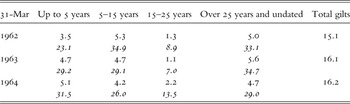
There is little sign in the archives of any systematic discussion of the maturity structure of the outstanding government debt. The main concerns were with yields and with managing flows: dealing with upcoming maturities and keeping the Issue Department's portfolio in a condition to enable it to meet anticipated demand for gilts. In fact the maturity structure of the stock of gilts appeared from summary statistics to shorten considerably in the two years 1962-4 (Table 2). The increase in the percentage of under-five-year gilts was partly the consequence of the very large 2½ per cent Savings 1964/67 and 3 per cent Funding 1966/68 (£1.3 billion in total) moving from the five– to fifteen-year bracket into the up-to-five-year bracket, but the shortening of these and other issues with the passage of time was not offset by longer new issues.
Gilt-edged securities outstanding, 1962–4 (£ billion)a

a Excluding holdings of National Debt Commissioners but including holdings of other public sector bodies. Figures in italics show percentage of total gilts in each maturity bracket.
Source: Pember and Boyle (1976).
The shortening of the maturity structure of the debt might be expected to have caused the yield curve to flatten (that had been the purpose of Operation Twist). In fact, the yield curve did flatten gradually from May 1962 to September 1964, by 116 basis points (Figure 2). Other factors, some of them unmeasured, also affected the yield curve, however, and it is not possible to say how much of the flattening can be attributed to the long-term interest rate policy.
In discussing the monetary authorities’ behavior during this episode, Capie (Reference Capie2010, p. 285) comments that ‘It is not difficult to see how the markets had a problem understanding the Bank's actions.’ However, he cites no evidence of misunderstanding with the market; moreover, the Bank provided some public explanation of its objectives in its Quarterly Bulletin, which had been first published in 1960 on the recommendation of the Radcliffe committee. As the quotations above show, eight of the eleven Quarterly Bulletins published between 1962 Q2 and 1964 Q4 conveyed some information about official objectives for long-term interest rates; in the other three cases there appears to have been nothing worth saying.
This was transparency ex post, and it is hard to imagine that in real time the jobbers and other market participants would have been unable to decode the signals implicit in the details of the Bank's operations. The authorities were much more transparent about debt management in this period than they had been in the 1950s, and than they were to be in the 1970s.
V
What was the long-term interest rate policy? For the Bank of England, it was a matter of adjusting a complicated constellation of market tactics so as to nudge long rates inconspicuously down: ‘encouraging’ rather than ‘coercing’. For the Treasury, it was more about target levels, though the Treasury acknowledged that the targets might not be achieved. The gap between the two conceptions was never bridged, owing to poor communication.
What difference did the policy make? It might be supposed that if the Bank had been less generous in the terms that it offered for switches into tap stocks in the period up to October 1962, then tap sales might have been lower in that period, but total net sales might have been higher. Nevertheless the attempt to influence long rates downwards made the government's debt shorter in average maturity than it otherwise would have been, reinforcing the shortening brought about by the passage of time. In the light of the inflationary excesses that were to follow, this was regrettable from the financial standpoint of the government, though by the same token it reduced the extent to which bond holders were expropriated by later inflation. The yield curve flattened from May 1962 onwards, consistent with the aims of the policy (Figure 2), though it is not clear how much the policy contributed to the flattening.
The Bank of England displayed no particular concern about inflation in its policy advice. For example, Fforde's paper of February 1963 is much more concerned about investment than about inflation, even though it acknowledges that domestic policy might ‘produce inflation à la iveme République’.Footnote 75 The most likely explanation of the Bank's apparent insouciance about inflation is that it saw its role as being pursuit of whatever policy objectives the government determined; this is consistent with Fforde's later (Reference Fforde1983, p. 200) description of the Bank as ‘the central banking arm of a centralised macroeconomic executive’.
It is easy to criticise the long-rate policy. The Radcliffe committee had tacitly assumed that the authorities would know better than the market what the proper level of long-term interest rates was; and this was automatically also assumed in the implementation of Radcliffe's recommendation. However, there was not much reason to think that the assumption was warranted: as Maurice Allen pointed out at the time, the suggested levels towards which long rates were to be nudged or directed (according to one's conception of the policy) did not emerge from any systematic analysis, but from a fairly casual comparison with historical levels, with rough adjustments to allow for expected demand for investment funds. Treasury officials’ concerns about the balance of payments effects of the policy were too easily put aside.
The main shortcoming of the Radcliffe's committee's recommendation was that it massively underestimated the significance of inflationary expectations, and failed to distinguish between real and nominal interest rates. By the early 1960s, output had become the government's main policy objective, and incomes policies were intended to suppress the inflationary consequences of any excess demand.Footnote 76 Inflation was to become higher and more variable as successive incomes policies failed. Inflationary expectations could not be expected to remain stable, and any policy aimed at a particular level of long-term bond yields was likely to be undermined when they changed. However, inflationary expectations were not evidently volatile in 1962–3, and the long-rate policy was suspended in 1964 when they showed signs of increasing.
Despite its shortcomings, the policy was not without merit or interest. The Bank of England's triple role in the gilt market as issuing agent, underwriter and leading market maker was both unavoidable and unavoidably complicated; and the long-rate policy of 1962-4 at least acknowledged the complications and tried to manage them rationally. It was unfortunate that the formulation of the policy, like Radcliffe's recommendation, was poorly conceived.
Appendix: Cast of characters
Allen, Douglas, under-secretary, HM Treasury 1960–2, third secretary in charge of National Economy division 1962-4
Allen, Maurice, adviser to the Governor of the Bank of England 1954–4
Armstrong, Robert, HM Treasury official, had been secretary of the Radcliffe Committee
Armstrong, William, third secretary in charge of Home Finance division 1958–62, joint permanent secretary 1962-8
Bligh, Tim, private secretary to the Prime Minister
Cairncross, Alec, economic adviser to the Government, 1961–4
Cromer, Lord Rowley, Governor of the Bank of England 1961–6
Fforde, John, adviser to the Governor of the Bank of England
Goldman, Samuel, under-secretary, HM Treasury, 1960; third secretary in charge of Home Finance division and domestic and external aspects of the monetary and credit system from October 1962
Hollom, Jasper, Chief Cashier, Bank of England, 1962–66, responsible for gilt-edged operations
Lee, Sir Frank, joint permanent secretary to the Treasury 1960–2, when he retired after a heart attack
Lloyd, Selwyn, Chancellor of the Exchequer, until 13 July 1962
Macmillan, Harold, Prime Minister 1957–63
Maudling, Reginald, Chancellor of the Exchequer from 13 July 1962
Mynors, Humphrey, Deputy Governor, Bank of England, 1954–64
Padmore, Thomas, second secretary, HM Treasury, 1952–62
Radice, I. de L., Treasury official responsible for liaison with Bank of England
Rickett, Dennis, second secretary, HM Treasury, in charge of Overseas Finance division 1958–68
Whittome, Alan, Deputy Chief Cashier, Bank of England