Introduction
Maternal obesity is associated with increased risk of adverse pregnancy outcomes for both mother and fetus, including pre-eclampsia, gestational diabetes and stillbirth.Reference Guelinckx, Devlieger, Beckers and Vansant1 More recently, it has been recognized that the fetal risks associated with maternal obesity extend beyond pregnancy and include in utero ‘programming’ of early onset of obesity in childhood and adolescence.Reference Gale, Javaid and Robinson2–Reference Sewell, Huston-Presley, Super and Catalano4 Childhood obesity has been linked to the rising incidence of allergy in early childhood; asthma prevalence is associated with an increased body mass index (BMI) in childhood.Reference Rizwan, Reid and Kelly5, Reference Epstein, Wu, Paluch, Cerny and Dorn6 In the Western world, between 5% and 10% of children have asthma, making this respiratory disorder the most common chronic disease in the paediatric population.Reference Sennhauser, Braun-Fahrlander and Wildhaber7 Thus dissecting a possible link between maternal obesity and offspring respiratory health is of public health importance.
In the context of biological pathways, obesity is associated with dysregulation of the hypothalamic–pituitary–adrenal (HPA) axis, with increased cortisol secretion rates associated with HPA axis activation.Reference Pasquali, Vicennati, Cacciari and Pagotto8, Reference Strain, Zumoff, Strain, Levin and Fukushima9 Although circulating levels of cortisol may be lower or unchanged in obesity,Reference Pasquali, Vicennati, Cacciari and Pagotto8, Reference Strain, Zumoff, Strain, Levin and Fukushima9 the associated continuous low grade inflammatory state, as well as increased expression of 11β-hydroxysteriod dehydrogenase-1 (11β-HSD-1), which re-activates cortisol from inactive cortisone, leads to increased tissue levels of cortisol.Reference Staab and Maser10 The latter could underlie the altered HPA responses, with increased cortisol release upon a stressor.Reference Benson, Arck and Tan11 Dysregulation of the maternal HPA axis is likely to impact on pregnancy outcomes, as increased activity of the maternal HPA axis is one of the key mechanisms proposed to underlie the early life programming of adult disease in the offspring,Reference Seckl12, Reference De Vries, Holmes and Heijnis13, Reference Benediktsson, Lindsay, Noble, Seckl and Edwards14 Higher maternal cortisol levels during human pregnancy also predict lower birth weightReference Goedhart, Vrijkotte and Roseboom15 and low birth weight is associated with increased activity of the HPA axis in adult life in the offspring.Reference Phillips, Walker and Reynolds16 Conversely, the pattern of variation in cortisol levels in pregnancies is lower in obese pregnancies possibly causal to altered birth weight.Reference O’Reilly, Riley and Critchley17
Interesting, alterations in HPA axis activity have also been linked to development of allergies and wheezing. Atopic pre-disposition has been associated with an altered HPA axis where most recent publications show hypo-cortisolaemia in atopy,Reference Buske-Kirschbaum, von and Krieger18–Reference Priftis, Papadimitriou, Nicolaidou and Chrousos21 though a few earlier reports found the opposite, perhaps due to the stress of severe disease.Reference Buske-Kirschbaum, Fischbach, Rauh, Hanker and Hellhammer22 Taken together, it is plausible that altered cortisol levels in pregnancy could be causally linked to increased incidence of atopic pathologies in the offspring.
Schematic overview of hypothesis tested, including mediation, independent variables and confounders.

Recently, studies were published in support of the relationship between maternal overt obesity and offspring wheezingReference Haberg, Stigum, London, Nystad and Nafstad23–Reference Leermakers, Sonnenschein-van der Voort and Gaillard27 and asthmaReference Harpsoe, Basit and Bager24, Reference Patel, Rodriguez and Little26, Reference Reichman and Nepomnyaschy28–Reference Lowe, Ekeus and Braback30 but no causal mechanism has been identified. We here extended this by hypothesising that maternal BMI, also in the leaner ranges (<BMI 25), is associated with development of offspring wheezing in early life, and that this is mediated through decreased maternal HPA axis activity (see schematic diagram). In this large community-based cohort of pregnant women and their offspring we studied maternal BMI, serum cortisol and offspring wheezing in early life. As it is known that there is a genetic component in atopy,Reference Devereux, Litonjua and Turner31 and as lower birth weight and as exclusive breast feeding has been shown to impact on allergic outcomes,Reference Nagel, Buchele and Weinmayr32 we studied parental atopy, birth weight, breastfeeding and season as independent variables. We took parity, maternal smoking, ethnicity, socio-economic class and gestational hypertension into consideration as potential confounding factors, as these were identified by previous studies.Reference Haberg, Stigum, London, Nystad and Nafstad23–Reference Lowe, Ekeus and Braback30, Reference Reynolds, Walker and Phillips33
Methods and study design
General study design
The current study is part of the ‘Amsterdam Born Children and their Development’ study (ABCD), a prospective community-based cohort study examining the relationships between maternal lifestyle during pregnancy and the child’s health at birth and later life. The study cohort has been described in detail previously.Reference van Eijsden, Vrijkotte, Gemke and van der Wal34 Although the participation rates among women born outside the Netherlands (42–64%) were still lower than the participation rate among Dutch-born women (77%), the degree of selection bias resulting from this ethnic non-response was minimal,Reference Tromp, van, Ravelli and Bonsel35 indicating that the results could be generalized to the population. The study protocol was approved by the medical ethical committees of all Amsterdam hospitals and the Municipal Privacy Protection Committee of Amsterdam. All subjects gave written informed consent. Briefly, between January 2003 and March 2004, 12,381 Amsterdam women were enrolled in the ABCD study at their first antenatal visit to an obstetric care provider (general practitioner, midwife or gynaecologist). Within 2 weeks, a pregnancy questionnaire including information on socio-demographic characteristics, medical history (including weight and height), psychosocial stress and lifestyle was sent to the women at home and returned by pre-paid mail. In addition, women were invited to participate in the biomarker study, for which an additional blood sample was taken during routine blood collection at the first visit. Women who gave permission for follow-up received a baby-questionnaire 3 months after delivery, covering lifestyle, emotional problems and the babies’ health.
The pregnancy-questionnaire was filled out by 8266 women (response rate 67%). Of these, 7730 gave birth to viable singleton infant for whom information on birth weight and pregnancy duration was available and 5131 (62%) women also completed the baby-questionnaire. Pregnancy outcome, infant gender, birth weight and gestational age [based on ultrasound or, if unavailable (<10%), timing of the most recent menstrual period] were obtained from the Youth Health Care registration of Amsterdam’s Municipal Health Service. Full lung maturation occurs just before term, and thus incomplete maturation, as in pre-term birth, might increase susceptibility to childhood wheezing. In the current study we excluded women with a pre-term birth (gestational age <37.0 weeks, n=248) and women taking systemic steroids (n=23), leaving 4860 women–infant pairs for the main analysis.
Schematic overview of hypothesis tested-does pre-pregnancy BMI predict infant wheezing, and is this mediated via a change in maternal cortisol levels? Maternal and paternal atopy, exclusive breast feeding, birth weight season of birth and gender offspring were used as independent variables. Potential confounding factors which we corrected for in the statistical analysis included parity, maternal smoking, ethnicity, socio-economic class and gestational hypertension. Parity has been shown to have a potential confounding effect, as first borns are more likely to develop wheeze than babies with more siblings,Reference Just, Belfar and Wanin36 and also the opposite has been shown.Reference Jedrychowski, Perera and Maugeri37 An environment of smoking has been shown to increase early life wheeze incidence, repeatedly,Reference Jedrychowski, Perera and Maugeri37 but as we lacked precise data on how often the smoking father was present, we took maternal smoking into consideration. Non-Dutch ethnicity has been associated with a higher incidence of wheezingReference Koopman, Wijga and Smit38 as has a lower social economic status.Reference Kurukulaaratchy, Matthews and Arshad39 Gestational hypertension has been linked to a generally less healthy baby,Reference Franklin, Holmgren and Jonsson40 which could include early life wheezing.
Outcome variable
Offspring wheezing was reported by the mother from the infant questionnaire and categorized into yes/no. The translation of the question was ‘Has your baby ever had wheezing?’ Similar questions on wheezing have been previously validated in physician-diagnosed wheezing showing high sensitivity (86%), specificity (91.8%), positive predictive value (76.8%) and predictive negative value (95.4%).Reference Mallol, Garcia-Marcos, Sole and Brand41–Reference Mallol, Garcia-Marcos and Aguirre43
Independent variables
Maternal pre-pregnancy BMI was calculated by self-reported weight before pregnancy and height from the pregnancy questionnaire [pre-pregnancy BMI=maternal weight/(maternal height)Reference Gale, Javaid and Robinson2]. Self-reported BMI is reported to be reliable, even in an over-weight population, where under-estimates can be predicted.Reference Dekkers, van Wier, Hendriksen, Twisk and van44 Missing values were imputed for maternal height (3.8% missing) and pre-pregnancy weight (9.9% missing) by a random imputation procedure using linear regression analysis and other variables known to be associated with maternal height and weight, respectively.Reference Mesman, Roseboom and Bonsel45 This resulted in 12.0% missing data on maternal pre-pregnancy BMI. Repeating the analysis on the not imputed data set did not alter the results (data not shown). Pre-pregnancy BMI was used as a continuous and a categorical measure. The BMI categories were used as follows: lean BMI (BMI<18.5 kg/m2); normal BMI (BMI between 18.5 and 25 kg/m2), overweight or obese (BMI>25 kg/m2), obese (BMI>30 kg/m2), according to WHO standards. Maternal asthma, maternal allergy to dust mite and maternal allergic rhinitis were obtained from the infant questionnaire and addressed by the questions whether they ever had asthma, allergic rhinitis or were allergic to dust mite. Duration (in weeks) of exclusively breast feeding was reported by the mother. As pollen, fungi and viral exposure is different depending on the season during which a baby is born this affects wheeze incidence,Reference Harley, Macher and Lipsett46 we divided season of birth into four categories (January–March, April–June, July–September, October–December).
Confounding factors
Information on confounding factors, previously associated with infant wheezing and pre-pregnancy BMI included parity (primiparous v. multiparous), maternal smoking during pregnancy (yes v. no), socio-economic class by educational attainment (years of education after primary school: low: 0–5 years, moderate 6–10 years and high: ⩾11 years), maternal age (continuous, years), ethnicity based on self reported country of birth of the pregnant women (western v. non-western), self-reported hypertensive status during pregnancy (chronic and pregnancy-related hypertension).Reference Haberg, Stigum, London, Nystad and Nafstad23–Reference Nagel, Buchele and Weinmayr32
Cortisol sub-study
A blood sample was taken in a 9-ml Vacuette (Greiner BV, Alphen aan de Rijn, the Netherlands) at the time of the first antenatal visit. The gestational age at blood sampling was equal to the gestational age at the first antenatal visit which was based on ultrasound or, if unavailable (<10%), based on the first day of the last menstrual period. Time of day of sampling was recorded as in the morning, before noon (am), or in the afternoon (pm). All samples were sent to the Regional Laboratory Amsterdam for processing and plasma and serum aliquots stored at −80°C until analysis (mean 22; range: 13–29 months). Serum cortisol levels were measured by radio-immunoassay using only samples from women in which the time of blood sampling as well as gestational age at time of blood sampling was known (n=2227). The interassay coefficient of variation was 10.2% for low values and 4.9% for high values.Reference Goedhart, Vrijkotte and Roseboom15 The prevalence of infant wheezing and maternal asthma was similar in the group with cortisol (10.5% and 8.9%, respectively) compared with those with no cortisol measurement (10.2% and 8.0%), P>0.21. The women with cortisol measurements were more often of Western origin (87.1% in cortisol subgroup v. 81.3% in cohort as a whole) and more highly educated than the whole group (52.9% more than 10 years education v. 47.4%), whilst between 6 and 10 years of education was similar (36.6% in cortisol subgroup v. 37.3%).
Statistical analysis
Descriptive statistics (two-sample t-test for continuous and χ2 test for categorical variables) were used to assess differences with respect to offspring wheezing according to maternal and infant characteristics. Mean differences in pre-pregnancy BMI and cortisol levels between the groups with and without maternal asthma, allergy to dust mite and allergic rhinitis were tested by two sample t-test. Five separate logistic regression analysis were performed to assess the association between the maternal characteristics: pre-pregnancy BMI, maternal asthma, allergy to dust mite, allergic rhinitis, cortisol and the occurrence of offspring wheezing, independently. In addition, five multivariate logistic regression analyses were performed in which adjustments were made for potential confounding factors. Those factors that were associated with offspring wheezing were considered as confounding factors. The cortisol measurements were standardized by additional adjustments for time of the day at blood sampling and gestational age at blood sampling to correct for diurnal variation in cortisol secretion and the known increase in cortisol during gestation.Reference Goedhart, Vrijkotte and Roseboom15 In a final multivariate model, all maternal and infant predictors that were univariately associated with offspring wheezing were combined to assess their independent contributions. As the maternal atopy variables were highly correlated and our main interest concerned maternal asthma, maternal allergy to dust mite and maternal allergic rhinitis as outcome variables were not taken into account in this last analysis. To test whether maternal cortisol is a mediator in the association between maternal pre-pregnancy BMI and infant wheezing, according to Baron and KennyReference Baron and Kenny47 the following regression equations should be estimated: (1) the association between the independent variable and the mediator, (2) the association between the independent variable and the outcome variable, (3) the association between the mediator and the outcome variable, controlling for the effect of the independent variable. We also calculated correlation coefficients. No departure from linearity was found on the log odds scale between infant wheezing and pre-pregnancy BMI. This was investigated using four splines and the likelihood ratio test (P=0.49). Data were analysed using SPSS version 15.0 (SPSS Inc., Chicago, IL, USA) and and the statistical package R 2.13.1.. P<0.05 was considered significantly different.
Results
General study characteristics and offspring wheezing
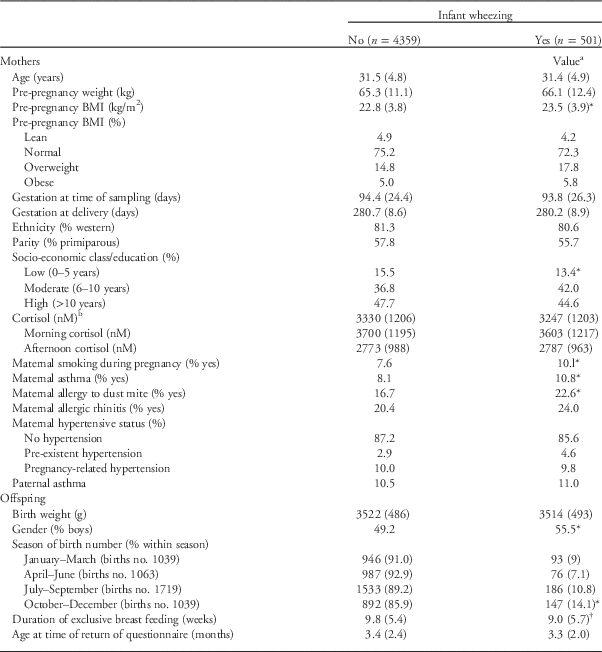
The cohort represents a healthy urban group of women (BMI 22.8±2.8 kg/m2; mean±s.d.) with offspring of normal birth weight (3423±6.8 g). Table 1 shows the baseline characteristics of all the subjects and their offspring born at term (n=4860). Of all, 10.3% (n=501) babies were reported to have wheezing in early life. Wheezing in the baby was more common in offspring of mothers who smoked, in male offspring and those children who were born in October–December (Table 1). Offspring wheezing was also related to shorter duration of breast feeding and socio-economic class. Offspring wheezing was unrelated to birth weight, maternal age, parity, ethnicity, hypertension during pregnancy or to paternal asthma.
Characteristics of women and their offspring as a function of offspring wheezing
BMI, body mass index.
*Significantly different between the groups with and without offspring wheezing.
†Significantly different between the October-December v. January-March.
a Data are mean (s.d.) or number (%).
b Cortisol measurements available in subset n=2227.
Maternal obesity and atopy as predictors of offspring wheezing
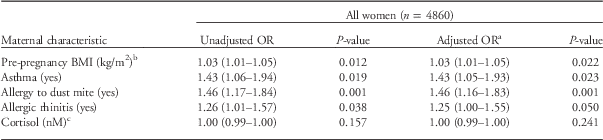
In all, 20.2% (n=984) of mothers were overweight or obese (BMI>25 kg/m2), with 5.1% (n=248) obese (BMI>30 kg/m2). Figure 1 shows that increased maternal BMI was associated with increased risk for maternal asthma, allergy to dust mite and with a trend for allergic rhinitis. In univariate analyses, maternal factors associated with wheezing in the offspring in early life included maternal asthma, allergy to dust mite, allergic rhinitis and increased maternal BMI. These associations remained after adjustment for potential confounding factors (Table 2).
Maternal BMI according to maternal atopy and offspring wheezing. Maternal pre-pregnancy BMI (mean±s.e.m.; Y-axis in kg/m2) are depicted of women who did (in open bars) or did not (in black bars) experience asthma, allergy to house dust mite or allergic rhinitis. Also, maternal BMI was depicted of mothers who did (open bar) or did not (in black) give birth to babies who suffered from wheezing. P-values are stated above each condition, *=P<0.05. Maternal BMI levels were higher in mothers who had suffered from asthma and allergy to house dust mite as compared to mothers who had not. Maternal BMI was increased when comparing mothers who had given birth to a baby suffering from wheezing in early life, to mothers whose child did not suffer from wheezing.
Relationship between offspring wheezing and maternal characteristics
BMI, body mass index.
a Results of logistic regression analysis. Covariates included in the model include offspring gender, season of birth, duration of breast feeding, education, smoking, and maternal pre-pregnancy BMI.
b BMI (kg/m2) used as a continuous variable in this model.
c Results are based on a subsample with information on cortisol (n=2227). Additional adjustment for time of the day of blood sampling and gestational age at blood sampling.
Mediation of maternal cortisol: relationship with maternal BMI, atopy and offspring wheezing
In a subset of women (n=2227) mean cortisol levels were 3361±1239 nM. Increased maternal BMI was associated with lower cortisol levels (r=−0.05, P=0.01). Figure 2 shows that mothers with a history of asthma also had lower overall circulating cortisol levels. This finding remained significant after adjustment for parity and maternal BMI. Cortisol levels did not differ in those with a history of allergy to dust mite. Morning cortisol levels tended to be lower in those with allergic rhinitis. Maternal cortisol levels were not related to offspring wheezing (Table 2, Fig. 2) indicating that the association between maternal BMI and offspring wheezing was not mediated by altered maternal cortisol levels in the first trimester.
Maternal cortisol levels according to maternal atopy and offspring wheezing. Maternal levels of cortisol (mean±s.e.m., in nM; standardized for time of day and gestational age at blood sampling) are depicted of women who did (in solid bars) or did not (in open bars) experience asthma, allergy to house dust mite or allergic rhinitis. Also, cortisol was depicted of mothers who did (solid bar) or did not (open bar) give birth to babies who suffered from wheezing. P-values are stated above each condition, *=P<0.05. Maternal cortisol levels were lower in mothers who had suffered from asthma as compared with mothers who had not.
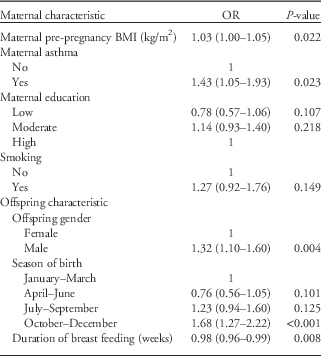
Table 3 summarizes the offspring and maternal predictors of offspring wheezing. In multivariate analyses, the independent predictors of offspring wheezing included maternal pre-pregnancy BMI, maternal asthma, offspring gender, season of birth and duration of breast-feeding.
Multivariate results of maternal and offspring predictors for infant wheezing
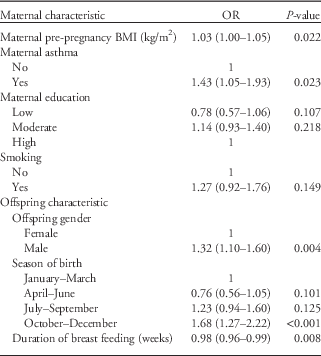
BMI, body mass index.
Discussion
In this large cohort of pregnant women we found increased maternal BMI predicted offspring wheezing. Although only some ‘wheeze’ in infants will lead to onset of asthma, our results support the findings of smaller studies with preliminary data showing that high pre-pregnancy BMI is associated with increased risks of developing asthmaReference Epstein, Wu, Paluch, Cerny and Dorn6 and eczemaReference Kusunoki, Morimoto and Nishikomori48 in the offspring, and is consistent with a recent study relating maternal obesity with a diagnosis of asthma in the offspring at age 3 years.Reference Reichman and Nepomnyaschy28 At this age wheezing is most likely due to bronchiolitis, which is seasonal in nature.Reference Carroll, Wu and Gebretsadik49 As we explicitly corrected for seasonal effects we thereby removed potential confounder effects of respiratory infection and subsequent bronchiolitis. Our findings are of particular significance as only 5% of the study population were clinically obese with a BMI>30 kg/m2. A recent study by Haberg et al.Reference Haberg, Stigum, London, Nystad and Nafstad23 also reported an increase in early life wheezing in offspring of women with an early pregnancy BMI exceeding 25–30 kg/m2. Given the increased prevalence of obesity in women of child-bearing age,Reference Yeh and Shelton50 with projected rates of obesity for 2015 among females in the United Kingdom up to 29% (https://apps.who.int/infobase/), our study, together with Haberg’s,Reference Haberg, Stigum, London, Nystad and Nafstad23 suggests that offspring wheezing will increase with increasing maternal obesity prevalence.
We found that duration of exclusive breastfeeding was associated with less early life wheezing. This is in accord with most studies,Reference Nagel, Buchele and Weinmayr32 although othersReference Duncan and Sears51 have found no association and there remains much debate regarding the optimal duration for exclusive breastfeeding.Reference Anderson, Malley and Snell52 The mechanisms underlying the beneficial effects of breastfeeding are unknown. In animals, evidence shows that introduction of allergens in the food while breastfeeding reduces the allergic response to this allergen.Reference Tooley, El-Merhibi and Cummins53 Underlying mechanisms are likely to include the induction of tolerance,Reference Polte and Hansen54 for example by increasing number of suppressive T-cells [forkhead boxP3 (Foxp3) positive T-cells].Reference Tooley, El-Merhibi and Cummins53
Obesity in pregnancy was associated with lower cortisol levels, as has previously been described in non-pregnant individuals.Reference Pasquali, Vicennati, Cacciari and Pagotto8, Reference Strain, Zumoff, Strain, Levin and Fukushima9 While circulating cortisol levels are lower in obesity or unchanged, tissue levels may be higher secondary to increased expression of 11β-HSD-1.Reference Staab and Maser10 We found that cortisol levels were also lower in pregnant mothers with asthma. This is in accord with recent studies showing that individuals with atopy including atopic dermatitis and allergic asthma have lower cortisol levels and a blunted adrenocortical response to stress.Reference Buske-Kirschbaum, von and Krieger18–Reference Priftis, Papadimitriou, Nicolaidou and Chrousos21, Reference Wamboldt, Laudenslager, Wamboldt, Kelsay and Hewitt55 We excluded those who were receiving current systemic glucocorticoid therapy as this could have impacted on the cortisol levels. As our findings are similar to previous studies,Reference Buske-Kirschbaum, von and Krieger18, Reference Buske-Kirschbaum, Jobst and Wustmans56 we conclude that the lower cortisol levels are most likely correlated to atopy and not caused by prolonged glucocorticoid treatment. Despite the findings of lower cortisol levels in mothers who were obese or had a history of asthma, we found no association between lower maternal cortisol levels and childhood wheezing. If altered maternal cortisol levels do not explain the link between maternal obesity and offspring wheezing, what are the alternative explanations? As other studies have shown a correlation between maternal obesity and childhood asthma and wheezingReference Haberg, Stigum, London, Nystad and Nafstad23–Reference Leermakers, Sonnenschein-van der Voort and Gaillard27, Reference Scholtens, Wijga and Brunekreef29, Reference Lowe, Ekeus and Braback30, Reference Reynolds, Walker and Phillips33 and as the effect we describe here of maternal BMI on offspring wheezing was independent of maternal and paternal asthma, this suggests that the in utero environment, rather than the genetic environment, is causal in alterations in offspring immune function. Two non-mutually exclusive explanations are possible. Either BMI exerts influence via hitherto unknown pathways, or a common variable underlies both BMI and wheezing. Regarding these, it has become apparent that immune responses can be affected by obesity. Obesity may ‘reset’ the immune system by establishing ‘low grade’ inflammation in fat deposits.Reference Lumeng, Bodzin and Saltiel57, Reference Lumeng, Deyoung, Bodzin and Saltiel58 In pregnancy, the chronic inflammatory state of pre-gravid obesity with increased levels of pro-inflammatory mediators in the maternal circulationReference Ramsay, Ferrell and Crawford59 as well as in the placenta,Reference Challier, Basu and Bintein60 is likely to impact on the developing offspring. A recent study showed that levels of adipokines, cytokines produced by adipose tissue, and which are increased in obesity, were correlated with risk of offspring early life wheezing.Reference Rothenbacher, Weyermann, Fantuzzi and Brenner61 Likewise cord blood cytokines, the number of IL-13 positive T-cells and IgE levels (which are indicative of an allergic response) have been shown to predict acute lower respiratory illnesses and risk of atopic disorders in infants.Reference Scirica, Gold and Ryan62, Reference Ly, Rifas-Shiman and Litonjua63 Together, these studies support the hypothesis that the in utero environment, including that induced by maternal obesity, may affect the developing immune system. Alternatively, more complex interactions between low class living conditions in an urban environment, and both maternal obesity and child wheezing are possible than were covered with our variables.
Another potential mechanism that could explain our findings is a genetic causal relationship, where pathways are shared in obesity and wheezing. However, we were unable to find proof for this hypothesis. DelgadoReference Delgado, Barranco and Quirce64 reviewed several papers and concluded that obesity affects lung function and increases incidence and prevalence of asthma but that the effects are mild. Taken together with the facts that our babies were not obese, and the effects found were similar in the leaner ranges of mothers, does make developmental programming effects more likely underlying our current findings than genetics.
In contrast to other studies, we did not find low birth weight to be a predictor of early life wheezing. However, our analysis only included babies born at term, and therefore excluded small babies due to pre-term birth. Pre-term birth has been shown to predict asthma later in life,Reference Reichman and Nepomnyaschy28 while the effect of being small for gestational age is more equivocal.Reference Rothenbacher, Weyermann, Fantuzzi and Brenner61, Reference Scirica, Gold and Ryan62 Full lung maturation occurs just before term, and thus incomplete maturation, as in pre-term birth, might increase susceptibility to childhood wheezing. Maternal allergy, which we found to be a predictor of childhood wheezing, has also been associated with low birth weight in a study including preterm babies, where birth weight was corrected for gestational age.Reference Clark, Hulme and Devendrakumar65 In contrast, we found that paternal allergy did not predict childhood wheezing, a finding in accord with a recent study showing maternal asthma increases offspring disease risk to a greater extent than paternal disease.Reference Lim, Kobzik and Dahl66
The main strength of this study is the sample size (almost 5000), and the representation of a wide array of social strata. As a result of the detailed characterization of the women in pregnancy, we were able to adjust for a larger number of potential confounding factors including level of education, smoking, parental asthma, parity, ethnic background in considerable detail and gestational hypertension. Limitations of the study include the lack of objective measures of infant bronchospasm (self-report on infant wheezing), although there is evidence that mothers do report symptoms of asthma and wheezing reliably. Our question on baby wheezing has repeatedly been shown by other researchers to give a reliable estimation of wheezing.Reference Mallol, Garcia-Marcos and Aguirre67–Reference Mallol, Garcia-Marcos, Sole and Brand69 In addition, we report comparable wheezing rates to Western societies; 10.3% prevalence of infant wheezing at 3 months v. 9.2% in the Netherlands and 10.5% in Europe.Reference Mallol, Garcia-Marcos, Sole and Brand69 Other limitations include lack of serum parameters (serum IgE/cytokines) although we cannot justify taking samples from such small babies. Also, maternal blood sampling was untimed although cortisol levels were corrected for sampling time. We also did not quantify maternal physical activity, or nutrition,Reference Devereux, Litonjua and Turner31, Reference Willers, Devereux and Craig70 which may impact on both BMI and offspring wheezing. Pre-pregnancy weight was self-reported, and self-reported BMI values tend to overestimate measured BMI values at the low end of the BMI scale (<22) and underestimate BMI values at the high end, particularly at values >28.Reference Stommel and Schoenborn71 However, if only means are used the correlations between self-reported and measured heights and weights are high.Reference Niedhammer, Bugel, Bonenfant, Goldberg and Leclerc72, Reference Engstrom, Paterson, Doherty, Trabulsi and Speer73 In particular, Dutch women and men are more accurate about reporting their weight than other populations.Reference Krul, Daanen and Choi74, Reference Dekkers, van Wier, Hendriksen, Twisk and van75 Even though there are limitations to use self-report on weight and height, these generally decrease, rather than increase hypothesized relations. We did not address the effects of gestational weight gain. Future work should examine the effects of pre-pregnancy weight management,Reference Callaway, O’Callaghan and McIntyre76 but encouragingly, if the pro-inflammatory state is indeed causal to offspring’s immune health, there is evidence, in non-pregnant individuals, that weight loss does reduce circulating cytokines.Reference Maiorino, Schisano and Di77, Reference Mai, Chen and Krewski78
In conclusion we have demonstrated that increased BMI is a predictor of early life wheezing. The study supports the hypothesis of the early life origins of disease in the aetiology of obesity and asthma. With the increasing prevalence of obesity in women of child-bearing age, this study highlights the importance of weight management in pregnancy.
Acknowledgements
The Amsterdam Born Children and their Development study was financially supported by a research grant from the Netherlands Organisation for Health Research and Development (grant number 2100.0076). The National Institute for Public Health and the Environment co-financed the cortisol analyses. The authors are grateful to all participating hospitals, obstetric clinics and general practitioners for their assistance in implementing the Amsterdam Born Children and their Development study, and thank all of the women who participated for their cooperation.
Conflicts of Interest
None.