INTRODUCTION
The order Ceriantharia Perrier, 1883 is a small, poorly known order of Anthozoa, comprising solitary and elongated polyps. Many species remain undescribed since the number of described larvae is twice the number of adult forms (den Hartog, Reference den Hartog1977). They are burrowers, covered by a filamentous tube of discharged cnidae and mucus, that can use their muscular column to penetrate into the sediment. The tube is usually deep purple and distinct enough to be used alone as an evidence of the presence of Ceriantharia. The most distinctive diagnostic features are the simple tentacles arrayed on two whorls, in contrast to other burrowing anemones that have a single one (Shepard et al., Reference Shepard, Theroux, Cooper and Uzmann1986; Daly et al., Reference Daly, Brugler, Cartwright, Collins, Dawson and Fautin2007). Cerianthids also possess an exclusive type of cnida, the ptychocyst, which is only used in tube construction (Mariscal et al., Reference Mariscal, Conklin and Bigger1977).
Little is known about the natural history or live appearance of most species, which leads to further taxonomic uncertainty. The arrangement of mesenteries and cnidome are the main diagnostic characters to identify Ceriantharia species (Molodtsova et al., Reference Molodtsova, Griffiths and Acuña2011). However, the polyps may be difficult to collect intact and mesenteries of most species are insufficiently developed or well-preserved for such determinations (Fautin, Reference Fautin, Scott and Blake1998). As in other groups, molecular characters are as useful as morphological ones for identification (Rodriguez et al., Reference Rodriguez, Marques, Stampar, Morandini, Christiansen, Genzano and Mianzan2011).
Only two species of Ceriantharia are currently known from the Brazilian coast: Cerianthus brasiliensis Mello-Leitão, Reference Mello-Leitão1919 and Ceriantheomorphe brasiliensis Carlgren, Reference Carlgren1931. Only two published records are available for Ceriantheomorphe brasiliensis in Brazilian waters, both in Ilha Bella (−23.783 −45.35), State of São Paulo (type location) (Carlgren, Reference Carlgren1931; Stampar et al., Reference Stampar, Emig, Morandini, Kodja, Balboni and Silveira2010). Three other records exist from the Gulf of Mexico (Carlgren & Hedgpeth, Reference Carlgren and Hedgpeth1952; Hedgpeth, Reference Hedgpeth1954), but they remain doubtful (Stampar et al., Reference Stampar, Emig, Morandini, Kodja, Balboni and Silveira2010). Since this species is listed as endangered along the Brazilian coast (Machado et al., Reference Machado, Drummond and Paglia2008), information on its distribution and/or biology is highly valuable (Stampar & Silveira, Reference Stampar and Silveira2006). This paper describes a newly discovered population of Ceriantheomorphe brasiliensis in the large subtropical Paranaguá Bay (southern Brazil).
MATERIALS AND METHODS
Nine specimens of Ceriantheomorphe brasiliensis were observed and filmed with an underwater camera (GoPro HD Hero) at seven different sites in the Bay of Paranaguá, Paraná, southern Brazil, in October 2011 (Table 1). One of them was collected by snorkelling under license No. 10508 SISBIO–IBAMA. Paranaguá Bay (25°30′S 48°25′W) is a semi-closed estuarine system, bordered by extensive tidal plains and colonized by mangroves and marshes (Lana et al., Reference Lana, Marone, Lopes, Machado, Seeliger and Kjerfve2001). The bay is divided into three compartments along the salinity gradient, namely inner, middle and lower sections. The lower section, where the specimens were found (Figure 1), is highly dynamic due to the constant exchange with the coastal adjacent area (Marone et al., Reference Marone, Machado, Lopes and Silva2005).
Records of Ceriantheomorphe brasiliensis in the lower euhaline section of Paranaguá Bay (black dots).

Location data of Ceriantheomorphe brasiliensis specimens in Paranaguá Bay.

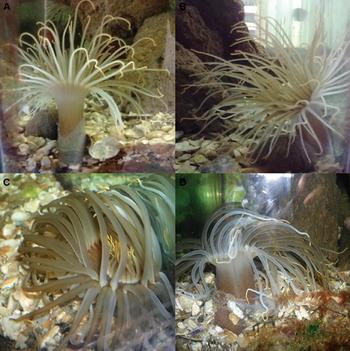
The collected animal was kept in a seawater aquarium for observations and photographing. It was later preserved in formaldehyde (4%) and dissected in a plastic tray with an ethylene-vinyl acetate bottom. An incision was made along its ventral portion using a scalpel and each lateral fold was fastened with acupuncture needles. The preserved material was used in squash preparations, with distilled water and saliva, for cnidome observations under interference contrast light microscopy. The terminology for the cnidome is that of Mariscal (Reference Mariscal, Muscatine and Lenhoff1974) and England (Reference England1991). The collected specimen was deposited in the Museu de Zoologia of Universidade de São Paulo (MZUSP), under the deposit number MZUSP 02471 (Figure 2).
Photographs of the collected specimen, taken in an aquarium. Note the yellow coloration at the end of each tentacle: (A) lateral view of the animal, with column exposed; (B) view of the expanded tentacles; (C) more detailed view of the labial tentacles (partially reflected in the aquarium's backwall); (D) lateral view showing the area of the multiplication chamber (vertical line).

RESULTS AND DISCUSSION
SYSTEMATICS
Order CERIANTHARIA Perrier, 1893
Suborder SPIRULARIA den Hartog, Reference den Hartog1977
Family CERIANTHIDAE Milne-Edwards & Haime, 1852
Genus Ceriantheomorphe Carlgren, Reference Carlgren1931
Ceriantheomorphe brasiliensis Carlgren, Reference Carlgren1931
(Figure 2)
Morphological and anatomical observations
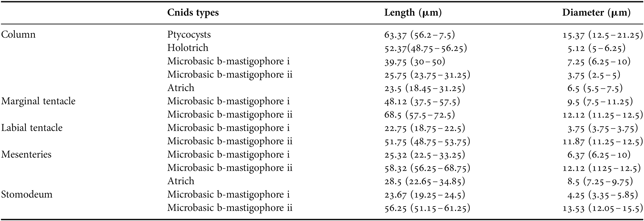
Medium sized cerianthid specimen, with about 55 long marginal tentacles and 50 short labial tentacles (some tentacles regressed, since sampling until fixation of the material). Broad oral disc, with distance between marginal and labial tentacle insertion as much as 3 cm in preserved animal. Each marginal and labial tentacle arranged into four pseudocycles. Only directives and the second pair of protomesenteries attached to the narrow siphonoglyph. Hyposulci present and hemisulci absent. Only directive mesenteries sterile; all other mesenteries fertile. Cnidome shown in Table 2. Arrangement of mesentery consistent with the description of the type material by Carlgren (Reference Carlgren1931).
Cnidome of the studied specimen of Ceriantheomorphe brasiliensis. Values are average, maximum and minimum for 30 cnidocyts of each type.

Remarks on distribution
This is the first published Brazilian record of the species outside Ilha Bella, São Paulo. The type location was described as Villa Bella, Ilha St Sebastino, São Paulo, by Calgren (1931), however no information about its environmental conditions was provided. The holotype was deposited in the US National Museum.
The specimens were found in different types of substrate, including natural subtrata (gravel, sand and mud) and artificial ones (tyres and piece of cloth) (see underwater videos as online supplementary material). The ocurrence sites are next to consolidated substrates, where there is usually enough energy to resuspend the sediment. Local salinity ranges between 25 and 33 psu (Mizerkowski et al., in press). This is unusual, since the species had previously only been recorded in higher salinity (33–35 psu) and in unconsolidated substrata.
Little is known about Ceriantheomorphe brasiliensi, and it is a target of animal traffic and illegal trading, so Machado et al. (Reference Machado, Drummond and Paglia2008) described it as an endangered species. They also stated that it occurs in several areas of each coastal state of Brazil, even in the absence of published records. There are unpublished records of Ceriantheomorphe brasiliensis in south-eastern and southern Brazil. However, there are no records in north-eastern Brazil. This is not consistent with a continuous distribution along the western Atlantic, from Mexico to Brazil, as inferred by Machado et al. (Reference Machado, Drummond and Paglia2008). More likely, the estimated area of occurrence—or area of occupancy (Gaston, Reference Gaston1991)—is disjunct, apparently restricted to latitudes higher than 20 degrees (S.N. Stampar, personal observation).
Knowledge of the species distribution is essential for conservation purposes (Tyre et al., Reference Tyre, Possingham and Lindenmayer2001; Rondini et al., Reference Rondinini, Wilson, Boitani, Grantham and Possingham2006). Based on insufficient evidence, IBAMA, the Brazilian agency that regulates and enforces environmental laws, listed Ceriantheomorphe brasiliensis as an endangered species. However, not enough studies have been made to settle that issue. The actual status of this species as an endangered one must be assessed more carefully by the scientific community and the regulatory agencies. Our record shows the need for a comprehensive review of this species along the Brazilian coast and clarification regarding the material from the Gulf of Mexico.
ACKNOWLEDGEMENTS
S.N.S. was supported by Coordenação de Aperfeiçoamento de Pessoal de Nível Superior (CAPES) through the Programa de Pós-graduação em Zoologia do Departamento de Zoologia (IBUSP, Universidade de São Paulo). We are grateful to Drs F.L. da Silveira and A.C. Morandini for providing laboratory facilities and to L. Sandrini-Neto and V. Oliveira for their valuable collaboration in the art work.