Introduction
According to the 2021 population census, China’s total fertility rate was only 1.3, far lower than the natural population replacement level of 2.1 (Basten and Jiang, Reference Basten and Jiang2015), and the willingness to bear children is low. Delayed childbearing is the main reason for the decline in fertility (Wang et al., Reference Wang, Liang and Peng2015). The delay in the onset of childbearing will have two adverse effects on fertility. First, it will cause women to miss the optimal ages for childbearing, which increases the possibility of infertility and childbearing risk (Locke and Budds, Reference Locke and Budds2013). Second, it will lead to other competitive goals in life reducing the subjective childbearing intention, which will reduce the fertility level of the whole country and the risk of national ageing and a labour force that is insufficient (Morgan and Taylor, Reference Morgan and Taylor2006). The postponement of childbearing age is an important research topic, and an analysis of the factors affecting childbearing age and their mechanisms of operation will help increase understanding, assist the formulation of population policy and guidance and, it is hoped, alleviate China’s population problem.
This article reports the results of a study investigating the impact of family orientation, the number of years spent working, and their interaction on childbearing age among women who have recently completed their childbearing. We find that a traditional family orientation and a higher number of working years contribute to delaying the childbearing age. People with a traditional family orientation delay childbearing because they want to make elaborate material preparations for raising their children. Women who have worked many years are more aware of gender inequality in the domestic sphere (having been exposed to gender equality in the workplace). This is especially the case for women with a modern family orientation. However, this does not necessarily lead people with a modern family orientation to delay childbearing. They may advance their childbearing in an effort to escape an oppressive domestic environment in their families of origin.
Factors affecting childbearing age
Childbearing age is affected by many factors, such as the economic situation and the stage of social development in a community (Balbo et al., Reference Balbo, Billari and Mills2013). However, childbearing is essentially a family-related and personal issue. With social development and the gradual improvement of social security, the impact of familial factors on individual childbearing age is slowly decreasing. At the same time, individuals can increasingly make independent decisions about their affairs, and the impact of personal factors on childbearing behaviour is increasing (Mitchell and Gray, Reference Mitchell and Gray2007). Catherine Hakim put forward a similar argument in her preference theory: ‘in prosperous modern societies, preferences become a much more important determinant, maybe even the primary determinant of woman’s behaviour’ (Hakim, Reference Hakim2003, p. 361). Some people contrast the fertility behaviour of people with a ‘traditional’ family orientation and those with a ‘modern’ family orientation. The traditional family orientation emphasises that families should be formed as soon as possible and that families with children are complete families (Freedman et al., Reference Freedman, Coombs, Chang and Sun1974), whereas the modern family orientation emphasises people’s feelings and the realisation of self-worth. On the face of it, this would seem to suggest that a traditional family orientation should advance the onset of childbearing and a modern family orientation should delay it. However, some authors argue that a modern family orientation induces people to advance their marriage and childbearing so that they can escape at a young age from an unequal family environment and so that once childbearing is over their work and life will not be interrupted by childbirth. People with a traditional family orientation may also cherish the value of children and prefer more preparation time to provide their children with the best environment, leading to delayed childbearing (Feng et al., Reference Feng, Kugler and Zak2000). Therefore there is no consensus on the impact of family orientation on the age at childbearing. In this paper we shall examine this issue.
There is also an association between the number of years spent working (which we refer to in this paper as ‘working years’ and childbearing age. Here, the findings in the literature are rather more consistent for women who have reached the end of their childbearing years: the more years worked, the later the childbearing age. However, there is no agreement on the mechanism behind this association. Work experience has a crowding-out effect on childbearing in that, the more work experience a woman has, the greater the opportunity cost of having children. This opportunity cost consists of a current opportunity cost element (the salary foregone during periods devoted to child care) and a future opportunity cost element (the future accumulation of human capital abandoned because of career interruption). Economists have long argued that human capital plays an important role in people’s decisions about the timing of childbearing (Gustafsson, Reference Gustafsson2001). Generally, they hold that the earlier the birth-related interruption to working life occurs, the greater the future opportunity cost (Cigno and Ermisch, Reference Cigno and Ermisch1989), and some studies have provided evidence of this (Amuedo-Dorantes and Kimmel, Reference Amuedo-Dorantes, Kimmel, Gustafsson and Kalwij2006; Correll et al., Reference Correll, Benard and Paik2007; Miller, Reference Miller2010).
Others have explained delayed childbearing from a gender equality perspective. The decline of fertility has been associated with increased female labour force participation accompanied in some countries by a lack of institutional factors which make combining childbearing and work easier (Brewster and Rindfuss, Reference Brewster and Rindfuss2000; Billari and Kohler, Reference Billari and Kohler2004). The decline in fertility was most pronounced in these countries with traditional familial social policies (García-Manglano et al., Reference García-Manglano, Nollenberger and Sevilla2014). McDonald (Reference McDonald2000) observed that in countries with high levels of gender inequality in individual-oriented institutions (such as education and the labour market) and family-oriented institutions, fertility is low. Fertility transition from high to low is accompanied by a conflict between personal aspirations and a woman’s expected role in the family. An important idea is that, as the overall level of gender equality in a society increases, fertility initially declines, since more women choose activities that compete with childbearing, but then increases again, as the society modifies its institutions to allow women to combine childbearing with these activities (Esping-Anderson et al., Reference Esping-Anderson and Billari2015). Therefore the relationship between the fertility rate and gender equality is U-shaped.
There are some societies, however, with considerable gender equality in the public sphere where fertility remains low because of an imbalance of gender equality between the public and the private spheres. In these societies, women are becoming equal to men in the public labour market but the degree of equality in the family is lower. The increase in fertility which accompanies gender equality at the macro-level requires gender equality to increase in both public and private spheres. Not every family accepts gender equality at the same time, so equality in the private sphere can lag behind that in the public sphere. Family support for an egalitarian lifestyle, so that a balance is achieved within the household between the financial contributions of men and women and their domestic responsibilities can play an important role in promoting fertility (Mörk et al., Reference Mörk, Sjögren and Svaleyrd2013).
In addition to opportunity costs and gender equality, other objective factors affect childbearing age. People who have difficulty conceiving or bringing pregnancies to term, for example, may have a high average age at childbearing. This paper will not consider such factors, but will focus on the associations between the number of years spent working and the age at childbearing, as mediated by the economic position within the household and opportunity costs.
To be clear, we hypothesise that, among women who are approaching, or who have reached, the end of their childbearing years, a greater number of years spent working will be associated with delayed childbearing because of increased opportunity costs and because working strengthens women’s awareness of equality issues and this raises tensions if, within the family, their position is subserviant. We have no a priori hypothesis about the direction of the association between traditional or modern family orientation and the age at childbearing, for reasons already given.
In China, changes in the age at childbearing have an important influence on fertility. In theory, the fertility rate is determined by the proportion of women who have children and the average number that they have. In China, cultural factors mean that the willingness to have at least one child is high, so the effect of the proportions of women who have children on variations in the fertility rate is muted. For both traditional and modern family oriented people, children have great significance, although the nature of that significance might be different (Balbo and Arpino, Reference Balbo and Arpino2016). Not to have children is considered unusual and those who do not have children are sometimes referred to as ‘leftover men’ and ‘leftover women’ (Wang, Reference Wang2012; Evans, Reference Evans2015). Most people, therefore, want to reproduce. At the same time, Chinese women believe that they should complete childbearing before the age of 30 years (Xing et al., Reference Xing, Meng, Lin and Qin2019), regardless of the number of births they have, because of the risk of reproduction at older ages and their children’s health. Therefore the age at which childbearing starts affects the number of children women have (the earlier you start, the more children you can have before the age of 30 years). Fertility intentions are highest at ages 26-30 years and decline markedly after age 30 (Gao, Reference Gao2000).
Data and definitions of variables
Data were obtained from the China Family Panel Study (CFPS) 2014. The various waves of the CFPS are aimed at gathering data at the individual, family and community level to reflect the changes in China’s society, economy, population, education and health and provide a basis for academic research and public policy analysis. The CFPS pays attention to both the economic and the non-economic welfare of Chinese residents. It is a national, multidisciplinary project. Its sample covers 25 provinces, cities and autonomous regions and its target sample size is 16,000 households. All family members in these households are considered as respondents. In the 2014 wave the CFPS interviewed 37,147 people and screened 12,144 people who had given birth and were in the age range 17-49 years. However in our analysis we restricted attention to 3,069 men and women aged 40-49 years in order only to consider those who were unlikely to have another child (Li and Zhang, Reference Li and Zhang2021).
The dependent variable is the childbearing age, calculated by subtracting the age of the respondent’s eldest son or daughter from his or her own age.
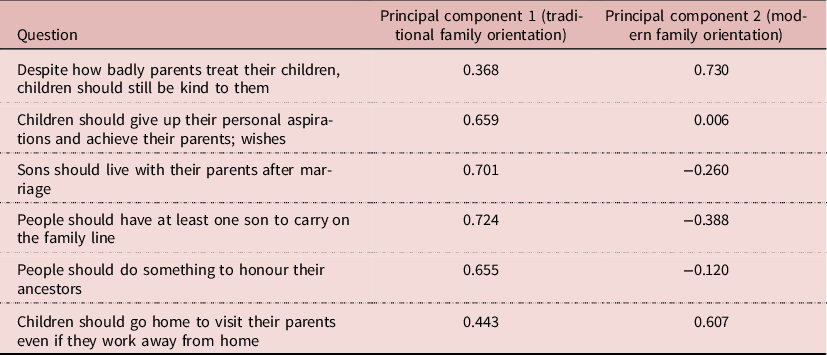
Family orientation was characterised as ‘traditional’ or ‘modern’ based on responses to a battery of six questions: (1) ‘Despite how badly parents treat their children, children should still be kind to them’; (2) ‘Children should give up their personal aspirations and achieve their parents’ wishes’; (3) ‘Sons should live with their parents after marriage’; (4) ‘People should have at least one son to carry on the family line’; (5) ‘People should do something to honour their ancestors’; and (6) ‘Children should go home to visit their parents even if they work away from home’. The scoring was on a five-point scale from ‘strongly disagree’ (1 point) to ‘strongly agree’ (5 points). The study conducted principal components analysis on the responses to extract two independent principal components, one measuring the intensity of traditional family orientation and the other modern family orientation (Table 1).
Principal component analysis of family orientation: correlations between answers to six questions and traditional and modern family orientation

Cumulative sum of squares 55.7 %.
Source: China Family Panel Study 2014.
See https://opendata.pku.edu.cn/dataverse/CFPS?language=en [accessed 31 October 2022].
The variable ‘working years’ cannot be derived directly from the CFPS questionnaire. We therefore computed it as the respondent’s age minus years of education minus 6. The rationale behind this is that compulsory education law in China requires that children begin school at the age of six years. Accordingly, the age at leaving education is equal to the years of education plus 6. Since both men and women in China generally start working straight after leaving education the current age minus the age at leaving school can be regarded as the number of years spent working. Clearly this method of computing working years means that current age, years of education and working years form a linear combination. However, the correlation between years of education and working years was low.
Drawing upon the literature, the study also controlled for other variables that may affect age at childbearing, such as gender, educational level, personal income level, family income level, region, hukou, ownership of the enterprise in which the person worked and the type of work done. The family income variable was derived by taking the logarithm of the answer to the question ‘How much money did your family earn last year?’ (Vignoli et al., Reference Vignoli, Minello, Bazzani, Matera and Rapallini2021). The personal income variable was based on the logarithm of answers to the question ‘What was your total income last year?’. The type of work was classified as ‘agricultural’ and ‘non-agricultural’, as previous studies have found that non-agricultural workers have a later childbearing age (Wang and Chi, Reference Wang and Chi2017). The ownership of the enterprise was classified as ‘public’ or ‘private’. Previous studies have found that publicly-owned enterprises follow the government’s wishes and implement policies regarding marriage and childbearing, which may affect childbearing age (Cheng et al., Reference Cheng, Ma, Qi and Xu2021). The hukou is classified as ‘urban’ or ‘rural’, as previous studies found that people with an urban hukou have a later childbearing age (Mu et al., Reference Mu, Yeh, Zhang, Wang and Lin2022). Region is divided into ‘eastern region’ (Beijing, Tianjin, Hebei, Liaoning, Shanghai, Jiangsu, Zhejiang, Fujian, Shandong, Guangdong and Hainan), ‘central region’ (Shanxi, Inner Mongolia, Jilin, Heilongjiang, Anhui, Jiangxi, Henan, Hubei, Hunan and Guangxi) and ‘western region’ (Sichuan, Guizhou, Yunnan, Tibet, Shaanxi, Gansu, Qinghai, Ningxia and Xinjiang). Previous studies have found that people in central and western China have an earlier childbearing age than people in eastern China.
According to the income standard issued by the National Bureau of Statistics in 2014, personal income is classified into four bands: ‘low’, ‘middle’, ‘relatively high’ and ‘high’. We used this categorisation in our analysis. Family income is divided into ‘low’, ‘middle’ and ‘high’, where the dividing lines are the 30 per cent and 70 per cent quantiles of the distribution. We also computed a variable denoting the ratio of personal to family income (PTF), or personal income as a proportion of family income divided into three categories: ‘less than one quarter’, ‘one quarter to half’ and ‘more than half’.
Analysis procedure
The study used the Statistical Package for the Social Sciences (SPSS) 22.0 for the principal components analysis, correlation analysis and regression analysis. The principal components analysis has already been described. Regression was used to explore the effects of family orientation, number of working years and their interaction on the age at childbearing. We took childbearing age as the dependent variable and analysed the impact of family orientation and the number of working years on childbearing age for males and females (Models 1 and 2) and both sexes together (Model 3). We also examined the interaction of these two variables (Model 4).
To examine the effect of family income on the relationship between family orientation and childbearing age we divided the sample into three groups according to family income and estimated separate regression models for each group. To examine the impact of opportunity costs we estimated additional regression models for three family income groups, and for three personal income categories. If opportunity costs are important to the explanation we would expect the impact of working years on childbearing age to be greater among richer individuals.
Finally, we looked at the effect of traditional family orientation and modern family orientation on childbearing age for different levels of the ratio of personal to family income, as a measure of the respondents’ position within their households.
Results
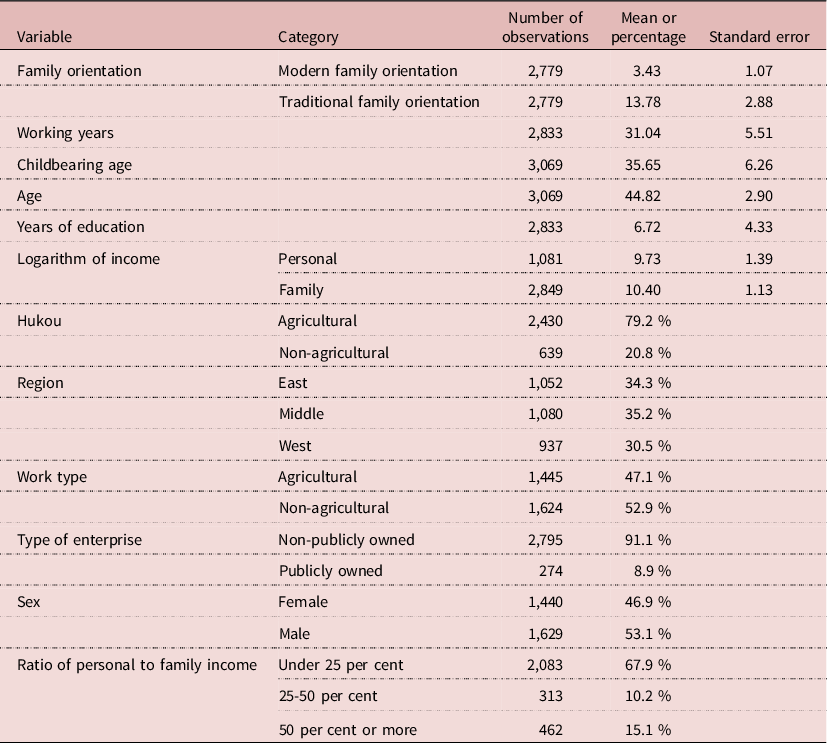
Table 2 shows the descriptive statistical results for each variable. The average score on traditional family orientation was 13.78 and that for modern family orientation was 3.43. The average number of working years was around 31 and the average age at childbearing was just over 35 years. This is higher than that observed for females in previous studies (Hou et al., Reference Hou, Zhang and Gu2020), but our sample includes men. The mean age of our respondents was just under 45 years. Nearly four fifths had an agricultural hukou, but agricultural work dominated for only about half the sample. Our sample was reasonably balanced between men and women, and across the three regions of China. The average length of education was 6.72 years, and the averages of the logarithms of personal and family income were 9.73 and 10.40 respectively (or 16,815 and 32,859 yuan).
Descriptive statistics for variables used

Source: China Family Panel Study 2014.
See https://opendata.pku.edu.cn/dataverse/CFPS?language=en [accessed 31 October 2022].
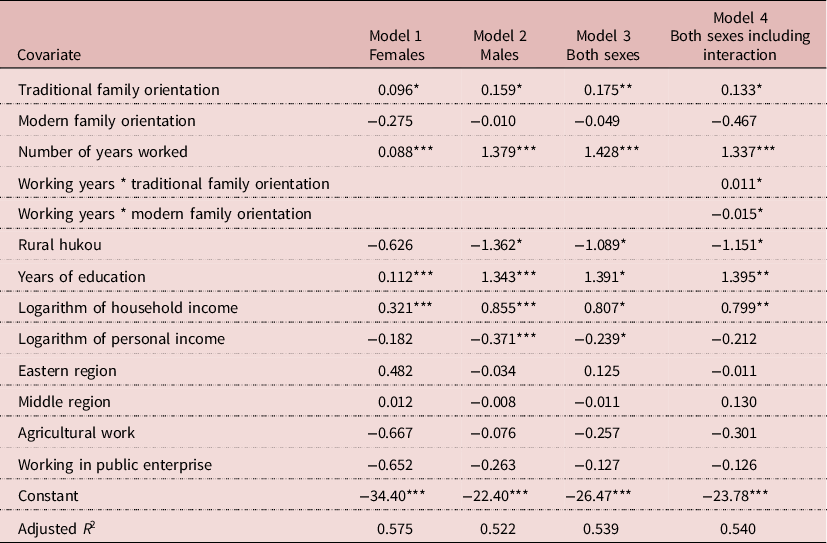
The results of the regression of childbearing age on family orientation and working years are shown in Table 3. Traditional family orientation is a consistent but fairly modest predictor of a later childbearing age. The extent to which a person has a modern family orientation, however, is not significantly associated with childbearing age. The number of years spent working has a strong and consistent association with childbearing age. Indeed among males, an additional year spent working is associated with a rise in the age at childbearing of more than one year. We estimated a model for both sexes combined which included an interaction between family orientation and working years. Although the interaction terms were statistically significant, their impact on childbearing age was very small.
Results from regression analysis of childbearing age on family orientation and number of years working

Notes. Reference categories for categorical covariates are urban hukou, western region, non-agricultural work, and working in a non-public enterprise.
* 0.05 < p < 0.01, ** 0.01 < p < 0.001, *** p < 0.001
Source: China Family Panel Study 2014.
See https://opendata.pku.edu.cn/dataverse/CFPS?language=en [accessed 31 October 2022].
We then estimated models of the impact of family orientation on childbearing age in families with different income levels. We found that the effect of traditional family orientation was greatest among middle-income families (Table 4) but that modern family orientation was not associated with the age at childbearing for any level of family income. Working years positively predicted age at childbearing at all levels of personal income, and the impact was greatest at high levels. An additional working year was associated with an increase in the age at childbearing of between 1.3 and 1.5 years among persons with a personal income in groups other than the highest, but with an increase of more than 3 years for persons in the highest personal income bracket. This suggests that the opportunity cost hypothesis has some merit (greater impact for those with higher income) but it is not the whole story (as working years are associated with delayed childbearing even among the lowest income group).
Effect of family orientation on childbearing age among persons in different family income categories

Notes. Regression models included controls for the remaining variables included in the models reported in Table 3.
* 0.05 < p < 0.01, ** 0.01 < p < 0.001, *** p < 0.001
Source: China Family Panel Study 2014.
See https://opendata.pku.edu.cn/dataverse/CFPS?language=en [accessed 31 October 2022].
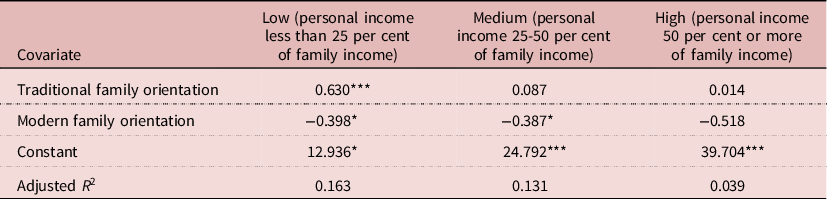
The impact of working years on childbearing age was significant at around 1.5 years for persons whose contribution to the family income was less than 50 per cent, but was not statistically significant for those whose contribution to the family income was greater than 50 per cent. The impact of family orientation on childbearing age also varied with a person’s position within the household economy (Table 5). Traditional family orientation was associated with increased childbearing age only among households with low equality, and among persons whose personal income was less than 25 per cent of the household income, and among persons whose own income exceeded this proportion there was a negative association between modern family orientation and childbearing age.
Effect of family orientation on childbearing age according to the ratio of personal to family income

Notes. Regression models included controls for the remaining variables included in the models reported in Table 3.
* 0.05 < p < 0.01, ** 0.01 < p < 0.001, *** p < 0.001
Source: China Family Panel Study 2014.
See https://opendata.pku.edu.cn/dataverse/CFPS?language=en [accessed 31 October 2022].
Discussion
The vast majority of Chinese people, irrespective of their family orientation, want to have at least one child, and those who do not have children will be regarded as ‘left over people’, a status which is associated with a loss of social identity. Childlessness also threatens the harmony of relationships in marriage, family and social life. Therefore childbearing is a task that must be completed even by those with a modern family orientation. If they accomplish childbearing at a young age, they will afterwards be free to do their own things without being constrained and restricted by family and society. Men and women with such a family orientation will, if they are placed in an environment where their economic role in the household is small, want to escape this environment earlier, and so will have their children earlier (Table 5). Where they feel more influential within their household, men and women with a modern family orientation will not feel such an urge to escape, so there is no pressing need to have children at a young age.
China’s social enterprises, especially in the private sector, prefer employees who have married and had children, because they believe that employees who have yet to have children will increase their human resource costs because of future preg nancy, maternity leave protection, absenteeism and mobility (Anker and Hein, Reference Anker and Hein1985). Therefore, those who anticipate working in such enterprises may complete childbearing early to increase their personal competitiveness.
To summarise, then, having a modern family orientation may not dispose a person to have fewer children than he or she would with a traditional family orientation and, in particular, need not be associated with a later age at childbearing (for a study reaching a similar conclusion for the United States, see Clifford and Ford, Reference Clifford and Ford1974).
Conclusion
Based on data from the China Family Panel Study of 2014, this paper has investigated the predictors of childbearing age, and especially the association between family orientation and the number of years working on the age at having children. The results indicate that having a traditional family orientation and a large number of working years are associated with a later age at childbearing. There is some support for the opportunity cost hypothesis in that people whose opportunity costs are high will seek to time their childbearing to as to minimise these. In addition, people who are in a subservient economic position in the family environment can encourage couples who find this environment stultifying to bear children early in order to escape it. Given the strong social expectation that they will bear at least one child, it may seem best to do this as soon as possible. By contrast, it seems as if people with a traditional family orientation may delay childbearing in order to prepare the optimal family situation in which to bring up children.
Because of different cultural backgrounds and social development, the principles governing reproductive behaviour in China may be different from those in western countries (Lee and Feng, Reference Lee and Feng1999). Fertility is the result of personal rational behaviour, especially in the modern world where individualism is strong. But only in an environment of gender equality can couples have children without scruples. In places and at times where gender equality does not exist, the factors that influence fertility can be different.
Acknowledgements
This research was supported by key program of the National Social Science Foundation of China (fund number: 22ASH010) and the key program of the Jiangsu Social Science Foundation (fund number: 21SHA002).