Mind–mindedness (MM) is a caregiver's tendency to view an infant or young child as an individual with an independent mind and mental states rather than as an entity with needs that must be satisfied (Meins & Fernyhough, Reference Meins and Fernyhough2010). MM reflects a caregiver's understanding of her child's cognitions, emotions, desires, and preferences. MM has recently been described as a relational construct, rather than as a cognitive–behavioral trait (Meins, Fernyhough, & Harris-Waller, Reference Mains, Fernyhough and Harris-Waller2014). The construct of MM originally emerged within an attachment framework, in part as an attempt to explain the “transmission gap” (van IJzendoorn, Reference van IJzendoorn1995) between maternal behavioral sensitivity and infant attachment security. Maternal MM bears similarities to the constructs of “maternal reflective functioning” (Fonagy, Steele, Steele, Moran, & Higgins, Reference Fonagy, Steele, Steele, Moran and Higgins1991; Slade, Grienenberger, Bernbach, Levy, & Locker, Reference Slade, Grienenberger, Bernbach, Levy and Locker2005) and “maternal insightfulness” (Oppenheim & Koren-Karie, Reference Oppenheim and Koren-Karie2002) that also involve a parent's capacity to reflect upon a child's internal world. How parents think about their infants’ and young children's cognitions, desires, and behaviors may influence parental behavior and children's development, including the development of behavioral problems (Walker, Wheatcroft, & Camic, Reference Walker, Wheatcroft and Camic2012). Yet these relations may vary according to different personal and family characteristics.
In this paper, we investigated the links between maternal MM and young children's behavior problems, and examined whether the previously observed positive associations between MM and behavioral development may be disrupted when mothers parent in an at-risk context (e.g., trauma exposure or mental illness). This question merges distinct lines of research on MM. One line of research has focused on the relation between MM and infant attachment and behavioral development. A second line of research has emphasized the links between MM and parenting behavior. Researchers have begun exploring the circumstances and characteristics that may explain the etiology of MM (e.g., mothers’ childhood experiences) and whether MM may operate differently in various populations (e.g., psychosocial risk; Demers, Bernier, Tarabulsy, & Provost, Reference Demers, Bernier, Tarabulsy and Provost2010; Lok & McMahon, Reference Lok and McMahon2006; McMahon & Meins, Reference McMahon and Meins2012; Pawlby et al., Reference Pawlby, Fernyhough, Meins, Pariante, Seneviratne and Bentall2010). Although most studies of maternal MM have utilized low-risk samples (e.g., moderate or high socioeconomic status [SES] and low trauma exposure), some investigations have examined samples at psychosocial risk (e.g., teenage mothers and mothers with mental illness). The results of these investigations demonstrate that at-risk mothers show lower or less appropriate MM, suggesting that MM may be vulnerable amid contexts of psychosocial stress or mental illness (Lok & McMahon, Reference Lok and McMahon2006; McMahon & Meins, Reference McMahon and Meins2012; Meins et al., Reference Meins, Fernyhough, Wainwright, Gupta, Fradley and Tuckey2002).
Relations Between MM and Children's Development
A mother's internal working models (her mental representations of self, child, and parenting) develop as a result of her own history of relational experiences beginning during her childhood, and affect her parenting attitudes, behavior, and provision of experiences to her child. “In order to be mind-minded, caregivers must first form a representation of the infant's internal state and then use this representation to inform their behavioral engagement with the child” (Meins et al., Reference Meins, Fernyhough, de Rosnay, Arnott, Leekam and Turner2012). A mother's representations may or may not reflect accurate assessments of her infant's internal states, however; thus, resulting maternal comments and behavior toward her child may vary in appropriateness and sensitivity. Furthermore, negative parenting, even in infancy, is associated with behavior problems in childhood (Lorber & Egeland, Reference Lorber and Egeland2011). Laranjo, Bernier, and Meins (Reference Laranjo, Bernier and Meins2008) concluded that attuned (i.e., appropriate and accurate) MM is a prerequisite to mothers’ behavioral sensitivity in interactions with their infants. Appropriate MM has been linked to aspects of positive child functioning, including attachment security (Bernier, Carlson, Deschenes, & Matte-Gagne, Reference Bernier, Carlson, Deschênes and Matte-Gagné2012; Meins, Fernyhough, Fradley, & Tucker, 2001; Meins et al., Reference Meins, Fernyhough, de Rosnay, Arnott, Leekam and Turner2012), positive peer interactions (McElwain, Booth-LaForce, & Wu, Reference McElwain, Booth-LaForce and Wu2011), and self-regulation (Bernier et al., Reference Bernier, Carlson, Deschênes and Matte-Gagné2012).
Given the documentation of associations between appropriate MM and positive child functioning, researchers have begun to investigate whether there are similar links to developmental concerns. In theory, appropriate MM fosters children's ability to self-regulate behavior and emotions by their greater understanding of mentalization (their own and others’; Sharp & Fonagy, Reference Sharp and Fonagy2008). The research evidence in support of this proposition is sparse, though suggestive. Bernier, Carlson, and Whipple (Reference Bernier, Carlson and Whipple2010) noted that maternal MM supports children's executive functioning and emergent self-regulatory abilities. In a study of mothers with borderline personality disorder (Schacht, Hammond, Marks, Wood, & Conroy, Reference Schacht, Hammond, Marks, Wood and Conroy2013) mothers with borderline personality disorder were less likely than healthy mothers to express mind-related representations of their children; similarly, their children showed diminished mental state understanding. One small study using mothers’ representational MM (Walker et al., Reference Walker, Wheatcroft and Camic2012) demonstrated that when mothers lacked MM, their preschool-aged children were at higher risk for the development of behavior problems, though this was the case only among children in the “community group” but not those referred for clinical services. In a prospective longitudinal study, appropriate maternal MM during play with their infants predicted fewer behavioral difficulties in their 3-year-old children, which then mediated later behavioral difficulties at age 5, but these relations were evident only among a low SES group; MM did not predict behavior problems among the high SES group (Meins, Centifanti, Fernyhough, & Fishburn, Reference Meins, Centifanti, Fernyhough and Fishburn2013).
The documentation of an association between behavioral MM and behavior problems only in the low SES group in the study by Meins, Centifanti, et al. (Reference Meins, Centifanti, Fernyhough and Fishburn2013), and the investigation of Walker et al. (Reference Walker, Wheatcroft and Camic2012) reporting relations between representational MM and preschoolers’ behavioral problems in the community sample, but not the children referred to clinical services for emotional/behavioral difficulties, suggests that other factors might disrupt the expected link between MM and behavior problems in high-risk contexts. High-risk circumstances and conditions such as high stress, poverty, mental health concerns, and trauma experienced by parents and children may alter the theoretically expected pattern of low MM predicting increased behavior problems. Our limited understanding of the ways in which MM may interact with other contextual factors indicates a need for further investigation of these associations in different conditions of risk.
MM in the Context of Psychosocial Risk
The goal of the current study was to examine whether the links between MM and children's behavior problems are disrupted by maternal trauma exposure and symptoms of posttraumatic stress disorder (PTSD) in a sample of adolescent mothers and their toddlers. Adolescent parenting is associated with a host of psychosocial risks (e.g., depression, low social support, maternal history of childhood maltreatment, and relational and community trauma) that may compromise sensitive parenting and children's development (Leadbeater & Way, Reference Leadbeater and Way2001; Putnam, Reference Putnam2006). Young women are more likely to bear children as teens when their contexts present substantial risk to their own developmental trajectories, for example, living in impoverished families and neighborhoods, living in violent homes, or having a family history of adolescent parenting (Meade, Kershaw, & Ickovics, Reference Meade, Kershaw and Ickovics2008). These conditions increase risk for continued exposure to both traumatic events and to mental health concerns such as depression and PTSD that may also affect parenting. In a study of adolescent and adult mothers, Demers et al. (Reference Demers, Bernier, Tarabulsy and Provost2010) found the expected links between MM, maternal sensitivity, and infant attachment only among adult mothers. They called for greater study of MM in adolescent mothers, and in other at-risk samples, in part to understand whether expected developmental processes and pathways diverge under different developmental contexts.
Risks such as mental health challenges, including experiences of trauma and PTSD, may limit MM by affecting a mother's capacity to understand her child's perspective (Goodman & Gotlib, Reference Goodman and Gotlib1999; Lok & McMahon, Reference Lok and McMahon2006; Meins et al., Reference Meins, Fernyhough, Wainwright, Gupta, Fradley and Tuckey2002), perhaps due to self-preoccupation or cognitive distortions. Demers et al. (Reference Demers, Bernier, Tarabulsy and Provost2010) documented that a mother's state of mind regarding her own history, and her parenting stress may affect her capacity for MM. Psychosocial stress may moderate associations between MM and children's behavior problems. In a study by Walker et al. (Reference Walker, Wheatcroft and Camic2012), MM was not linked to behavior problems in the clinical sample (who reported greater depression and parenting stress). In addition, other investigations (Meins, Fernyhough, Arnott, Turner, & Leekam, Reference Meins, Fernyhough, Arnott, Turner and Leekam2011; Pawlby et al., Reference Pawlby, Fernyhough, Meins, Pariante, Seneviratne and Bentall2010) indicate that associations between MM, maternal depression, and child development are complex and inconsistent (e.g., some mothers who are depressed are attuned to their infants’ internal states). In their study of mothers of 8-month-olds, Meins et al. (Reference Meins, Fernyhough, Arnott, Turner and Leekam2011) reported a lack of “strong associations” between MM and maternal depression. Similarly, Pawlby et al. concluded that “in depressed mothers, our findings provide scant support for the hypothesized lower levels of mind–mindedness in mothers with SMI [severe mental illness] and suggest that SMI does not automatically mean that mothers will be more likely to misinterpret their infants’ internal states” (2010, p. 1867).
Trauma and Posttraumatic Stress
Certain circumstances or contexts may alter the associations between MM and children's behavior. Trauma exposure, and the psychological consequences of trauma that result in symptoms of PTSD, may be an example of such circumstances. According to the American Psychiatric Association (APA, 2013) trauma involves “exposure to actual or threatened death, serious injury or sexual violation,” regardless of whether a person experiences the event directly, witnesses the event in person, or learns that it occurred to a close family member or friend, or directly experiences repeated exposure to aversive details of the event. Traumatic exposure may result in PTSD, a disorder that is characterized by intrusive thoughts, avoidance of reminders of the traumatic events, numbing of emotional responsiveness, and persistent physiological arousal following exposure to a traumatic stressor, and associated with impairment in social or occupational functioning (APA, 2013).
Traumatic events, such as childhood histories of maltreatment and exposure to intimate partner violence (IPV), have been linked to maladaptive parenting cognitions and behaviors among adult and adolescent mothers alike (DiLillo & Damashek, Reference DiLillo and Damashek2003; Lang, Gartstein, Rodgers, & Lebeck, Reference Lang, Gartstein, Rodgers and Lebeck2010; Noll, Trickett, Harris, & Putnam, Reference Noll, Trickett, Harris and Putnam2008). For example, childhood physical and emotional abuse were related to decreases in maternal responsiveness (Bert, Guner, & Lanzi, Reference Bert, Guner and Lanzi2009); trauma and depression were associated with lower maternal sense of control and with negative maternal attributions and behavior (Moehler, Biringen, & Poustka, Reference Moehler, Biringen and Poustka2007; Schechter et al., Reference Schechter, Myers, Brunelli, Coates, Zeanah, Davies and Liebowitz2006; Stevens, Ammerman, Putnam, & Van Ginkel, Reference Stevens, Ammerman, Putnam and Van Ginkel2002). Yet not all mothers who have been exposed to traumatic events develop PTSD or maladaptive parenting behavior; these issues have not been explored among at-risk adolescent mothers.
Adolescent mothers have high rates of exposure to traumatic events that may result in PTSD (De Paul & Domeniech, Reference De Paul and Domenech2000; Putnam, Reference Putnam2006), including childhood histories of maltreatment, community violence, IPV, and the traumatic loss of loved ones. The majority of adolescent mothers have experienced multiple traumatic events (Sarri & Phillips, Reference Sarri and Phillips2004). In one study, 75% of adolescent mothers were exposed to at least three types of violence, for example, childhood physical abuse, witnessing violence, and experiencing IPV (Kennedy & Bennett, Reference Kennedy and Bennett2006), documenting that they constitute a high-risk group for PTSD.
PTSD symptoms can include withdrawal and reduced responsiveness, irritability, difficulty concentrating, hypervigilance, and distorted perceptions of one's environment and of others’ intentions. Scheeringa and Zeanah (Reference Scheeringa and Zeanah2001) suggested that parents who experience avoidance and withdrawal symptoms (requirements for a PTSD diagnosis) may be unable to correctly interpret, and respond sensitively, to their children's behavioral cues. These same PTSD symptoms also may affect MM and its relation to parenting and children's behavioral development. If, for example, a mother is socially withdrawn from interaction with her child (a symptom of PTSD), she has less opportunity to understand her child's wants, emotions, and cognitions, and thus is less likely to be appropriately mind–minded when she is in interaction. Similarly, the hypervigilance to signs of threat, and distorted perceptions of the environment, including the social environment, may prevent a mother from being attuned, and responsive, to her child's developmental needs; this would be reflected in a lack of appropriate MM, and perhaps a reduced rate of minded comments and representations in general. There is a gap in our understanding of the relation between PTSD and MM, particularly among adolescent mothers, who are more likely to experience trauma and PTSD (De Paul & Domeniech, Reference Luster, Brophy-Herb, Osofsky and Fitzgerald2000; Putnam, Reference Putnam2006).
Although we know very little about the impact of PTSD on parenting among adolescent mothers, it is reasonable to expect that PTSD, similar to other indicators of psychological distress (e.g., parenting stress and depression), would place these mothers at greater risk for nonattuned or insensitive parenting (East, Matthews, & Felice, Reference East, Matthews and Felice1994; Luster, Reference Luster1998; Luster & Brophy-Herb, Reference Luster, Brophy-Herb, Osofsky and Fitzgerald2000). Understanding the links between trauma exposure, PTSD, and MM may also help explain the challenges to positive socioemotional development among children of adolescent mothers.
Research Questions of the Investigation
Our study goal was to examine the links between maternal MM and toddlers’ behavior problems and competence, and to investigate whether the positive associations between MM and child functioning found in low-risk samples were altered by maternal trauma exposure and PTSD in a sample of adolescent mothers. In other words, does trauma exposure or PTSD symptoms disrupt the maternal MM–child behavior connection? Because there are few investigations that address this issue, and the results of previous studies show inconsistent patterns of MM–behavior problems linkages in circumstances of high psychosocial risk, we did not posit a directional hypothesis regarding the nature of this association.
Method
Sample and procedures
Data were derived from a longitudinal, randomized, controlled trial of Healthy Families Massachusetts, a statewide home visiting program for young first-time parents. A total of 837 English- and/or Spanish-speaking pregnant or newly parenting first-time mothers between 16 and 21 years old were randomly assigned to either the home visiting group (62%) or the control group (38%). Mothers in the control group were exempt from receiving home visiting services, instead receiving referrals to community resources such as Women, Infants, and Children and parenting support groups, including other home visiting services. A total of 704 mothers (response rate of 84%) participated in evaluation activities, which included, at a minimum, a release of data from several state agencies or an initial (Time 1 [T1]) phone interview. Mothers also were invited to participate in an in-person semistructured research interview, written questionnaires, and videotaped observations of mother–child interactions. A total of 473 mothers (67%) completed the full protocol at T1. Data were collected at enrollment (T1), and 1 year (Time 2 [T2]) and 2 years (Time [T3]) postenrollment.
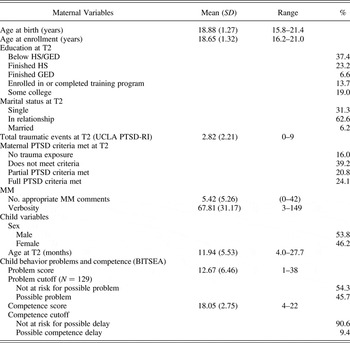
The present study (n = 212) included only participants with filmed observations of mother–child interactions at T2. Participants who were prenatal at T1 but who did not give birth to live children were excluded from participation at T2. Demographic characteristics of this subsample are presented in Table 1. Mothers ranged in age from 15.8 to 21.4 years (M = 18.88, SD = 1.27) at childbirth. Twenty-three percent of mothers had completed high school only, 7% had completed a GED, 14% had completed or were in the process of completing a post high school/GED training program, and 19% had completed some college; 37% of mothers had not completed high school. Of participation mothers 31% of mothers were single, 63% were in a relationship but not married, and 6% were married. Of the child participants, 53.8% were male, and 46.2% were female. At T2, child participants ranged in age from 4.0 to 27.7 months old (M = 11.94, SD = 5.53). The vast majority (88.7%) of child participants were between 6 and 24 months of age, with 6.1% of children below 6.0 months of age, and 5.2% 24 months or older. We compared participants in this study with those from the larger study who did not have T2 videos on maternal age at enrollment, child's age and sex, maternal race/ethnicity and preferred language, Brief Infant–Toddler Social and Emotional Assessment (BITSEA) problem and competence scores, and maternal trauma exposure and PTSD criteria. No differences between the groups were found with the exception of race/ethnicity and preferred language; mothers in this study were less likely to be Hispanic and to prefer Spanish than mothers in the larger sample.
Sample demographics and descriptive statistics for measures of maternal trauma, mind–mindedness, and child emotional competence (N = 212)

Note: T2, Time 2; HS/GED, high school/general educational development; UCLA PTSD-RI, University of California Los Angeles Posttraumatic Stress Disorder Reaction Index; MM, maternal mind–mindedness; BITSEA, Brief Infant–Toddler Social and Emotional Assessment.
Measures
Details on the methodology of the larger evaluation study are presented elsewhere (Jacobs et al., Reference Jacobs, Easterbrooks, Goldberg, Mistry, Bumgarner, Raskin and Fauth2016). Here, we briefly describe measures used in the present study.
Family demographics
Demographic characteristics (e.g., child age and sex, maternal age at childbirth, maternal education, and marital status) were collected at T2 phone interviews.
MM
At T2, mothers and children were observed in a 5-min filmed free-play interaction at home; mothers were instructed to play with their children as they usually would. Maternal utterances were coded from video and transcribed for MM (Meins & Fernyhough, Reference Meins and Fernyhough2010). The transcribed MM comments were coded to assess appropriate and nonattuned mental state (emotion, desire, and cognition) references in mothers’ speech. An example of an appropriate MM comment follows: Mother says to child “you want the ball don't you?” when the child is reaching for the ball; the same example would be coded as nonattuned if the child is busy building with blocks. All maternal utterances were coded, including utterances in which a mother referred to her child's mental states and nonmental state utterances, yielding a score for maternal verbosity that was used as a control in analyses. Five coders were trained to reliability using the Meins and Fernyhough (Reference Meins and Fernyhough2010) Mind-Mindedness Coding Manual (Version 2.0). As indicated in the manual, each comment was coded as either mind–minded or not, and then mind–minded comments were coded as either appropriate or nonattuned. Disagreements were reviewed and discussed to consensus. Approximately 25% of cases were viewed by more than one coder; Cohen κ coefficients were 0.96 for total number of comments, 0.95 for mind–minded comments, 0.81 for nonattuned comments, and 0.96 for appropriate comments. As is the case in the empirical literature, nonattuned comments were infrequent (<10% of mind–minded comments); we used appropriate mind–minded comments as the focus of our analyses.
Maternal trauma history
Maternal trauma exposure was assessed at the T2 in-person interview using the University of California at Los Angeles Posttraumatic Stress Disorder Reaction Index for DSM-IV, a screening instrument for evaluating PTSD features in adolescents (Pynoos, Rodriguez, Steinberg, Stuber, & Frederick, Reference Pynoos, Rodriguez, Steinberg, Stuber and Frederick2001). There are two parts: Part I captures lifetime trauma exposure (e.g., community violence, natural disasters, sexual abuse, and domestic violence); Part II targets the objective and subjective characteristics of the traumatic event (Pynoos et al., Reference Pynoos, Rodriguez, Steinberg, Stuber and Frederick2001). The instrument has high diagnostic validity (sensitivity of 0.93 and specificity of 0.87, using a cutoff score of 38; Steinberg, Brymer, Decker, & Pynoos, Reference Steinberg, Brymer, Decker and Pynoos2004). Alpha coefficients have demonstrated good to excellent internal consistency (Layne et al., Reference Layne, Pynoos, Saltzman, Arslanagić, Black, Savjak and Houston2001; Nygaard, Jensen, & Dyb, Reference Nygaard, Jensen and Dyb2012; Roussos et al., Reference Roussos, Goenjian, Steinberg, Sotiropoulou, Kakaki, Kabakos, Karagianni and Manouras2005).
Instrument items are aligned with DSM-IV-TR criteria, providing preliminary PTSD diagnostic information. Mothers indicated whether they had been exposed to any of 12 discrete trauma experiences (e.g., natural disasters, domestic violence, and community violence); they also could indicate exposure to another nondesignated event. Responses were summed to create an overall indicator of trauma exposure (possible range = 0–13).
If the mother endorsed at least one traumatic event, she was asked to rate the frequency of PTSD symptoms on a 5-point Likert scale (0 = none to 4 = most of the time over the past 30 days). Items assessed the three symptom clusters of PTSD symptoms as detailed in the DSM-IV-TR (APA, 2013): (a) reexperiencing (e.g., “I have upsetting thoughts, pictures, or sounds of what happened come into my mind when I do not want them to”); (b) avoidance/numbing (e.g., “I try not to talk about, think about, or have feelings about what happened”); and (c) increased arousal symptoms (e.g., “I watch out for danger or things that I am afraid of”). A categorical variable was then created, indicating whether participants met criteria for full, partial, or no PTSD diagnosis. Criteria for PTSD included (a) having experienced a traumatic event that caused an intense response (e.g., fear or helplessness) and (b) meeting criteria for a minimum of two symptom clusters (partial) or all three symptom clusters (full). For this study, mothers were categorized into the following groups: 0 = no trauma exposure, 1 = exposure, but does not meet criteria for PTSD, 2 = exposure and meets partial criteria for PTSD, and 3 = exposure and meets full criteria for PTSD.
Child behavior problems and competence
Child behavioral problems and competence were assessed at T3 using the 42-item BITSEA (Briggs-Gowan & Carter, Reference Briggs-Gowan and Carter2002). Mothers indicated how true various statements were for their child using a 3-point Likert scale (0 = not true/rarely, 1 = somewhat true/sometimes, and 2 = very true/often). A problem score was created by summing 31 items that indicated problematic behavior (e.g., “Cries or has tantrums until he or she is exhausted”); higher scores indicate greater levels of socioemotional or behavioral problems (possible range = 0–62). A competence score was created by summing 11 items that indicated positive, age-appropriate behaviors (e.g., “Shows pleasure when he or she succeeds [for example, claps for self]”); lower scores indicate a possible deficit/delay in competence (possible range = 0–22). Previous studies have demonstrated that the BITSEA has good reliability and validity (Briggs-Gowan, Carter, Irwin, Wachtel, & Cicchetti, Reference Briggs-Gowan, Carter, Irwin, Wachtel and Cicchetti2004; Karabekiroglu et al., Reference Karabekiroglu, Rodopman-Arman, Ay, Ozkesen, Akbas, Tasdemir, Boke and Peksen2009; Kruizinga et al., Reference Kruizinga, Jansen, De Haan, Van der Ende, Carter and Raat2012). Scoring takes into account the age of the child; cut scores for behavior problems and competence are provided for children of different ages.
Analytic strategy
We began by analyzing the main effect of MM on child behavior using hierarchical linear regression models with demographic and adjustment variables entered first (Step 1), and total number of appropriate mind–minded comments entered second. Hierarchical linear regression models were then tested with demographic and other adjustment variables entered first (Step 1), predictor variables (total number of appropriate mind–minded comments and trauma exposure/PTSD symptoms) entered second (Step 2), and interactions entered last (Step 3). As MM is theorized to promote positive behavioral outcomes over and above the effect of total maternal speech, we adjusted for overall maternal verbosity (total utterances) during the MM interactions. Although the dominant approach to MM analysis is to compute a proportion score (MM comments/total utterances), the MM coding manual specifies that researchers may choose to use a frequency measure instead of the proportion, so long as they adjust for verbosity, overall number of comments made (Meins & Fernyhough, Reference Meins and Fernyhough2010); in past research, Meins, Fernyhough, Arnott, Leekam, and de Rosnay (Reference Meins, Fernyhough, Arnott, Leekam and de Rosnay2013) noted a correlation of 0.88 between proportion and frequency scores for appropriate MM. We chose to use frequency because proportion scores are bounded outcomes scores, meaning there is a finite range of possible scores. These types of scores are susceptible to particular distributions that can make the use of linear regression inappropriate (Lesaffre, Rizopoulos, & Tsonaka, Reference Lesaffre, Rizopoulos and Trsonaka2007). Because of the theoretical importance of children's age to MM, we also adjusted for child age at the time of the MM interaction. Finally, because of the likelihood that maternal MM may be influenced by participation in a parenting intervention, we adjusted for whether participants were in the home visiting intervention or the control condition.
Results
Preliminary analyses
We found a high level of trauma exposure among participants, with an average of approximately three trauma experiences (M = 2.82, SD = 2.21) before age 20. Only 16% of participants reported no trauma exposure. Of the participants who reported exposure to at least one traumatic event, 51 (28.2%) met full criteria for PTSD, 44 (24.3%) met partial criteria for PTSD, and 83 (50%) did not meet full or partial criteria for PTSD or did not report experiencing PTSD symptoms. Three participants (2%) did not complete the University of California at Los Angeles PTSD Reaction Index for DSM-IV.
Over the course of their 5-min interactions, mothers made between 3 and 149 total utterances (M = 67.81, SD = 31.17). Total mind–minded comments were between 0 and 45 (M = 5.88, SD = 5.62). The vast majority (92%) of mind–minded comments were appropriate (M = 5.42, SD = 5.26). The distribution of total appropriate MM comments was positively skewed and leptokurtic, with several outliers in each direction. These outliers were retained in the analyses, as linear regression is relative robust (and conservative) in the presence of nonnormal distribution. We used Pearson product-moment correlations to test for relations between MM comments and relevant background variables, as well as between child behavior and child age. MM was not significantly correlated with child age, as measured by the total number, r (210) = –.06, p = .43, or proportion of appropriate MM comments, r (210) = –.05, p = .48. Maternal relationship status at the time of the MM interaction also was not correlated with total number, r (209) = –.02, p = .82, or proportion, r (209) = .05, p = .51, of appropriate MM comments. Maternal education status (as measured by whether or not mothers had completed high school or a GED) was not correlated with total number, r (213) = .02, p = .78, or proportion, r (213) = .05, p = .45, of appropriate MM comments. Child age was not significantly correlated with behavior problems, r (205) = –.09, p = .21, or behavior competence, r (204) = .07, p = .32.
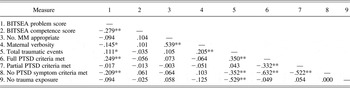
Table 2 presents correlations between MM, trauma exposure, PTSD criteria, and child BITSEA scores for behavior problems and social competence. MM was not significantly correlated with trauma exposure, r (212) = .11, p = .128, or with meeting full PTSD criteria, r (179) = .07, p = .33. For those participants with a history of trauma exposure, over a third (39.2%) reported too few symptoms to meet criteria for PTSD. Almost one quarter of participants (24.1%) met full criteria and 21% met partial criteria for PTSD, indicating that almost half of all mothers experienced some form of PTSD symptomatology a number of times a week.
Correlations among mind–mindedness, trauma exposure, PTSD diagnosis, and child behavioral scores

Note: PTSD, posttraumatic stress disorder; BITSEA, Brief Infant–Toddler Social and Emotional Assessment; MM, maternal mind–mindedness.
*p = .05 (two tailed). **p = .01 (two tailed).
MM and child behavior
Contrary to our hypothesis that MM would significantly predict child behavior, we found that among our sample of adolescent mothers, MM was not a significant predictor of later child behavioral problems (b = –0.05, SE = 0.10, p = .60). MM also was not a significant predictor of children's later behavioral competence (b = 0.05, SE = 0.04, p = .29).
Trauma exposure analysis
BITSEA behavior problem score
Although MM was not a significant predictor of behavior problems among children of at-risk young mothers, maternal trauma exposure was a significant predictor of behavior problems. Exposure to a greater number of traumatic events was associated with a higher BITSEA problem score (b = 0.52, SE = 0.21, p = .01). The interaction between MM and maternal trauma exposure was not a significant predictor of behavior problems (b = 0.03, SE = 0.03, p = .34).
BITSEA competence score
Regression analysis indicated no significant link between maternal trauma exposure and children's competence scores (b = –0.003, SE = 0.09, p = .97). The interaction between MM and maternal trauma exposure was not a significant predictor of children's competence (b = –0.01, SE = 0.02, p = .48).
PTSD analysis
Descriptive data
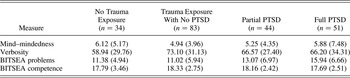
Table 3 presents mean scores for MM and BITSEA behavior problems and competence according to the four trauma/PTSD groups (no trauma exposure, no PTSD despite exposure, partial PTSD, and full PTSD).
Descriptive statistics (standard errors) for levels of PTSD, mind–mindedness, and reported child behavior competence
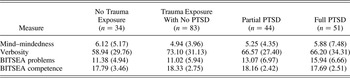
Note: PTSD, posttraumatic stress disorder; BITSEA, Brief Infant–Toddler Social and Emotional Assessment.
BITSEA behavior problem score
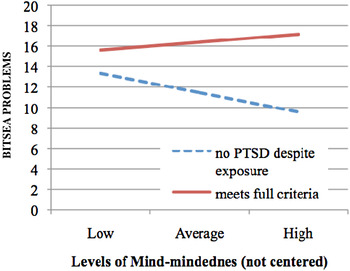
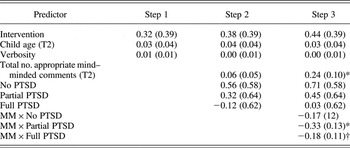
Results of regression analyses with total number of appropriate mind–minded comments and PTSD criteria predicting behavior problems are depicted in Table 4. Children of mothers who did not meet criteria for PTSD despite a history of trauma exposure had significantly fewer behavior problems compared to children of mothers who met full criteria for PTSD. The significant relation with full PTSD was qualified by significant two-way MM × Full PTSD interaction. The effect of MM on BITSEA problems differed depending on whether or not mothers met full criteria for PTSD. Tests of the conditional effect revealed that higher MM predicted fewer behavior problems among children of trauma-exposed mothers who did not meet full PTSD criteria but that MM did not significantly impact BITSEA problem scores when mothers met criteria for full PTSD. A visual representation of the interaction between MM and full versus no PTSD can be seen in Figure 1.
(Color online) Brief Infant–Toddler Social Emotional Assessment problem scores by level of mind–mindedness and posttraumatic stress disorder status among participants with exposure to trauma.

Unstandardized coefficients (standard errors) from linear regression analyses of reported child behavior problems with no PTSD despite exposure to trauma as reference category

Note: This analysis is based on a sample size of 207. PTSD, posttraumatic stress disorder; T2, Time 2; MM, maternal mind–mindedness.
†p < .10. *p < .05. ***p < 001.
BITSEA competence score
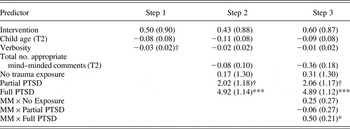
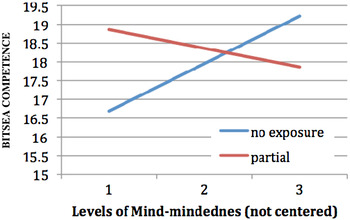
As depicted in Table 5, neither MM nor PTSD predicted child behavior competence. However, there was a significant MM × PTSD interaction among mothers who met partial PTSD criteria compared to mothers who were not exposed to any traumatic events. Children's competence decreased as MM increased among mothers who met partial criteria for PTSD, whereas among mothers with no trauma exposure, children's competence scores increased as mothers’ MM increased (see Figure 2). Analyses in which other categories of the moderator (i.e., no PTSD, partial, or full PTSD) were used as a reference did not reveal significant interaction effects.
(Color online) Brief Infant–Toddler Social Emotional Assessment competence scores by level of mind–mindedness and posttraumatic stress disorder status among participants with no exposure to trauma.

Unstandardized coefficients (standard errors) from linear regression analyses of reported child behavior competence with no exposure to trauma as reference category

Note: This analysis is based on a sample size of 206. T2, Time 2; PTSD, posttraumatic stress disorder; MM, maternal mind–mindedness.
†p < .10. *p < .05. **p < .01. ***p < 001.
Discussion
Maternal MM, the capacity of a mother to appreciate her child's autonomous cognitions, desires, and behavior, is conceptualized as a cornerstone of sensitive caregiving. As such, greater MM is expected to promote children's social and behavioral competence. The extant research exploring these issues in at-risk samples is both limited in scope and inconsistent in results, but suggests that some circumstances may moderate MM–child development associations. The expected positive associations between appropriate MM and children's adaptation may be disrupted in the context of risk (e.g., adolescent mothering, Demers et al., Reference Demers, Bernier, Tarabulsy and Provost2010; psychosocial stress or clinical concerns, Walker et al., Reference Walker, Wheatcroft and Camic2012). In this longitudinal study, we investigated the relations between appropriate MM, assessed during infancy, and children's behavior problems assessed 1 year later in a sample of adolescent mothers and their children, and examined whether maternal exposure to traumatic events and PTSD, assessed at the same time as MM, influenced relations between MM and toddlers’ functioning. The study is one of the first to examine longitudinal associations between maternal MM and children's behavior problems.
Contrary to expectations, we did not find main effects of appropriate MM on children's behavior regulation (competence and problems). However, the effect of maternal trauma exposure (direct association) and PTSD symptoms (direct, and in association with MM) was evident, consistent with the idea that PTSD symptomatology alters the expected associations between MM and children's behavior regulation. Adolescent mothers are at high risk for trauma exposure, including prior to childbirth (Putnam, Reference Putnam2006). The vast majority (84%) of the young mothers in our sample had experienced traumatic events, averaging three such events (those most common in our sample were witnessing community violence, experiencing the violent death or injury of a loved one, and witnessing physical violence at home) before age 20. As a comparison, the National Comorbidity Survey Replication (Kessler et al., Reference Kessler, Berglund, Demler, Jin, Merikangas and Walters2005) data suggest a rate of trauma across a lifetime to be around 50% among women. In our study of young women, mothers’ trauma exposure (most of which occurred before childbirth) predicted greater behavior problems when children were assessed at approximately 24 months old, but did not predict delays in children's social competence. This differential prediction may suggest that it is not simply a maternal “response set” that links traumatic exposure to mothers’ perceptions of and responses to their children as being more challenging (difficult or less competent).
Although trauma was prevalent in this sample, and maternal trauma exposure predicted children's behavior problems, not all individual mothers and children demonstrated this pattern of association between trauma exposure and problems in behavioral regulation. A simple dichotomy of whether someone has been exposed to traumatic events obscures variations in individual meanings, symptoms, and circumstances. For some individuals, traumatic experiences result in extended psychological distress and PTSD symptomatology; for others, access to resources and support may facilitate adaptive coping and resilience (Cicchetti & Curtis, Reference Cicchetti and Curtis2007). In our sample, mothers who were trauma exposed had high rates of current PTSD symptomatology (28% of the sample met criteria for full PTSD, and 24% met criteria for partial PTSD). Children of mothers whose trauma history is not reflected in extensive psychological and behavioral symptoms may experience “positive stress” or “tolerable stress” (as opposed to “toxic stress”) that is not dysregulating (Shonkoff, Boyce, & McEwen, Reference Shonkoff, Boyce and McEwen2009). For other women, or in other circumstances, trauma may result in PTSD, a disorder characterized by symptoms of hypervigilance or persistent physiological arousal, numbing of emotional responsiveness, avoidance of reminders of the traumatic event, and/or symptoms that impair social interaction, including parent–child relationships. When mothers experience PTSD symptoms, they may be less psychologically available for positive, attuned interactions with their children, and toddlers may not have the necessary support for developing appropriate behavior regulation. In contrast, previous traumatic experiences may sensitize some mothers to their infants’ minds, resulting in heightened MM that may be either appropriate or nonattuned (and potentially also heightened emotional arousal, a symptom of PTSD). We found evidence of complex associations between trauma, PTSD, MM, and children's functioning in our study.
PTSD moderated associations between MM and toddler functioning
Mothers’ PTSD moderated the relation between appropriate MM comments and toddlers’ adaptation. Among mothers who had a history of trauma exposure but did not exhibit PTSD, higher MM predicted fewer child behavior problems as expected, whereas for those mothers who exhibited full PTSD, higher MM was not associated with lower behavior problems. The finding of low child behavior problems in the context of maternal mental health among trauma-exposed mothers is consistent with theoretical expectations of the association between appropriate MM and children's behavior: that a mother's awareness of and attunement to her child's cognitive and emotional states would be associated with the child's appropriate behavior regulation and competence because that child has experienced more sensitive caregiving and mother–child synchrony.
Among mothers who are experiencing extensive PTSD symptoms (hyperarousal, hypervigilance, and numbing) the expected link between MM and behavior problems was decoupled. There likely is variability within this group that would be interesting to explore further. It may be that some, but not all, mothers who experience extensive or chronic PTSD and who are highly mind–minded are too focused on their children's minds; they may be hyperaroused and hypervigilant (both symptoms of PTSD) in ways that are dysregulating for their children. Some mothers may have inappropriate expectations of the sophistication of their infants’ minds (recall that the average child age at the time of the MM assessment was 12 months), and even when minded comments are appropriate, perhaps there is a delicate balance to be understood. A study of young children (ages 6–30 months) with their foster mothers, differing from the current study in the use of a representational measure of MM, suggested that for some mothers or for some children, too great a focus on their child's mental attributes, particularly in children younger than 30 months (the oldest in their study), reflects a lack of awareness and ability to respond appropriately to the child's actual cues (Bernier & Dozier, Reference Bernier and Dozier2003). Other mothers with PTSD may be appropriately focused and responsive to their children's cues, and for them, appropriate MM is associated with lower behavior problems, as expected. Among mothers with less extensive PTSD symptomatology (partial PTSD), a moderating effect was not observed, suggesting that extent of symptomatology may be key. Like most investigations of MM, our study did not examine the valence (positive or negative) of MM comments, and it may be that even with comments that are appropriately mind–minded, the valence matters. Walker et al. (Reference Walker, Wheatcroft and Camic2012) coded positive, negative, and neutral MM comments in mothers of preschoolers, and found a higher proportion of negative and neutral mind-related comments in their clinical sample. Another study that coded the valence of maternal comments found a positive link between positive MM comments and maternal sensitivity (Demers et al., Reference Demers, Bernier, Tarabulsy and Provost2010).
Mothers who experience PTSD as a result of traumatic experiences may be socially isolated (in part from avoiding others, a PTSD symptom, or from impaired social interactions as a result of the PTSD symptoms). Research on “mind perception” indicates that individuals who are socially isolated may make more attributions about the mental states of others (Epley & Waytz, Reference Epley, Waytz, Fiske, Gilbert and Lindzey2009); such “mind reading” is common among individuals with PTSD (Najavits, Gotthardt, Weiss, & Epstein, Reference Najavits, Gotthardt, Weiss and Epstein2004). We wonder whether some, but not all, mothers with full PTSD may ascribe mental states to their children in order to feel a greater sense of social connection. Although we were not able to examine this idea in the present study, this hypothesis may be an interesting avenue for future research.
Moderation of MM–child functioning associations by PTSD also was found in relation to children's social competence, though only when comparing mothers with no trauma exposure and traumatized mothers who met partial PTSD criteria. For mothers not exposed to trauma, higher MM was related to greater social competence, as theoretically expected. Children of mothers with partial PTSD, however, were less socially competent when their mothers showed high MM.
In theory, high appropriate MM is a positive and desirable characteristic for mothers to exhibit; research has established connections between appropriate MM and positive child functioning in social, cognitive, and behavioral domains (e.g., Bernier et al., Reference Bernier, Carlson, Deschênes and Matte-Gagné2012; Meins et al., Reference Meins, Fernyhough, Fradley and Tuckey2001). Both Arnott and Meins (Reference Arnott and Meins2008) and Demers et al. (Reference Demers, Bernier, Tarabulsy and Provost2010) noted the potential for interventions to increase maternal MM and enhance child development. In most cases, high and appropriate MM would be expected to enhance parenting, mother–child interaction, and children's functioning. However, our data suggest that this is not the case universally.
Maternal PTSD may be one such circumstance that alters the expected links. Mothers in our sample reported a high rate of trauma exposure and PTSD symptoms. In this life context, high MM complicates sensitive parenting. This may explain the relation between partial PTSD and toddlers’ lower social competence when mothers have high MM. It may be that mothers with partial PTSD are actively “working” on their traumatic experiences and are in a period of dynamic reorganization. Relational trauma is one mechanism by which a caregiver's posttraumatic distress may be reflected in the symptoms of the next generation (Leen-Feldner et al., Reference Leen-Feldner, Feldner, Knapp, Bunaciu, Blumenthal and Amstadter2013; Scheeringa & Zeanah, Reference Scheeringa and Zeanah2001); perhaps high MM, even when it is appropriate, is one vehicle by which this effect may occur. Again, examining the valence of the minded comments may be revealing. Implementing MM interventions may be differentially effective for at-risk mothers who are experiencing PTSD symptomatology that is chronic or transitional, as opposed to mothers who have limited trauma exposure or are not experiencing posttraumatic distress.
Strengths and limitations
As with all investigations, this study has both strengths and limitations based on study design, sample, and conclusions. The longitudinal design allowed a more rigorous test of prediction than would be the case with cross-sectional data. We used well-established measures of MM, trauma, and children's socioemotional functioning. Furthermore, our index of trauma and PTSD was well suited for use with adolescents who constitute our sample. In addition, we conducted a behavioral assessment (albeit brief) of MM rather than using maternal report in order to limit issues of single data source.
A limitation of the study is that, in comparison to some (but not all) other investigations, we examined appropriate MM comments rather than nonattuned comments. Our decision was related to the much greater frequency of appropriate (vs. nonattuned comments), and the fact that most of the literature is built on studies using appropriate MM comments. In future work on trauma and PTSD, it would be interesting to examine nonattuned comments and the potential for PTSD, in particular, to result in distorted perceptions of a child's mental states. As this study used a behavioral assessment of MM, and others may use a representational assessment, results that vary across studies may have a methodological component related to MM measurement.
Our data on the presence of MM in maternal speech during free-play interactions with their infants shows relatively similar proportions of MM comments to other samples, including samples of adult and adolescent mothers. In our study, the percentage of appropriate mind–minded comments (to total verbal comments) in our sample (7%) is quite similar to other studies of low-risk adult mothers (7.7%; Arnott & Meins, Reference Arnott and Meins2008), perhaps surprising given the risk nature of our sample. Comparing number of appropriate MM comments, our sample (5.42 in 5-min interaction) showed relatively more such comments than did the adolescent mothers (5.49 in a 10-min interaction; calculated on a 5-min interaction = 2.25) in the study by Demers et al. (Reference Demers, Bernier, Tarabulsy and Provost2010), and was more similar to their sample of adult mothers (8.63 in 10 min; 4.32 based on 5 min). This suggests that the young mothers in our sample do not show overall deficits in MM. However, the meaning of MM in an at-risk sample of adolescent mothers may be somewhat different from mothers in the low-risk settings that are studied typically. In addition, a 5-min observation may have limitations as an assessment of the MM construct; we do not know the extent to which different study samples may require longer periods of time for valid evaluation of the construct.
One limitation of this investigation may be the relatively limited number of toddlers with potential delays in competence that may present power issues in statistical analysis. Although more than 40% of the sample of toddlers scored above the cutoff for behavior problems, less than 10% evidenced delays in competence. Another limitation is that our results may not generalize to the wider population of mothers and toddlers, even those mothers who bear children as adolescents. The sample was composed of mothers who volunteered to participate in an evaluation of a home visiting parent support program, so our results cannot be generalized to all adolescent mothers, nor to all traumatized mothers and their children.
Implications and conclusions
The finding that MM operated differently for mothers with divergent experiences of trauma exposure and PTSD suggests that, at least among adolescent mothers and their children, MM is a more nuanced phenomenon than was previously recognized. The expected association between MM and behavior problems held for the mothers who were trauma exposed but who did not experience current PTSD, but among mothers whose trauma exposure led to full PTSD symptoms while they were parenting their infants and toddlers, being more mind–minded was not associated with behavior problems among toddlers. There are several reasons why this might be the case. The symptoms of PTSD include hypervigilance and hyperarousal. Perhaps MM exhibits a curvilinear relation to behavior problems in these cases, with some mothers “too mind–minded” and “too attuned” to their infants’ internal states in a way that is intrusive or distorted, and others who are appropriate and sensitive to their children alongside their concurrent extensive PTSD symptoms. However, the associations with children's behavioral competence (e.g., curiosity, interest in peers, and mastery motivation) were different, with high MM in the context of partial (but not full) PTSD related to deficits in competence. Although the tests did not reach standard levels of significant association in the case of full PTSD, there was a trend in the same direction. Perhaps there were other protective factors that buffer these associations in the case of extensive PTSD symptomatology (e.g., trauma treatment programs, or family members providing considerable support); these relations remain to be explored in future research. As appropriate MM had the expected protective effect against children developing behavior problems when mothers had experienced trauma, yet were not currently experiencing PTSD symptomatology, one clinical implication might point to the development of interventions that encourage appropriate MM among trauma-exposed mothers. Additional future work should address the conditions and circumstances that promote mental health and adaptive parent and child functioning in populations that are likely to experience significant trauma, and to reducing trauma exposure.