Introduction
Mild cognitive impairment (MCI) is defined by cognitive deficits that are noticeable to subjects or their families, but which do not significantly interfere with functioning (Winblad et al., Reference Winblad2004). It is common in older people, affecting between 10 and 35% aged over 65 years (Ward et al., Reference Ward, Arrighi, Michels and Cedarbaum2012). MCI is often considered an intermediate stage between normal aging and dementia, though not all patients progress in their cognitive impairment and some revert to normal. Approximately 2.5–7.5% of patients with MCI in the community (Brodaty et al., Reference Brodaty2017; Brodaty et al., Reference Brodaty2013) and 10–15% attending memory clinics (Farias et al., Reference Farias, Mungas, Reed, Harvey and DeCarli2009; Mitchell and Shiri-Feshki, Reference Mitchell and Shiri-Feshki2009) develop dementia each year. With such a high incidence of dementia, significant attention has focused on identifying risk factors for progression.
Apathy – a disorder of motivation, affect, and goal-directed behavior – may predict such progression to dementia (Mortby et al., Reference Mortby2022; Sherman et al., Reference Sherman, Liu, Herrmann and Lanctôt2018). Apathy has been associated with a two-fold increased risk of dementia in both patients seen in memory clinics (van Dalen et al., Reference van Dalen, van Wanrooij, Moll van Charante, Brayne, van Gool and Richard2018) and people in the general community (Bock et al., Reference Bock, Bahorik, Brenowitz and Yaffe2020). In patients with dementia, apathy is associated with worse clinical outcomes (Connors et al., Reference Connors, Teixeira-Pinto, Ames, Woodward and Brodaty2022a; Starkstein et al., Reference Starkstein, Jorge, Mizrahi and Robinson2006; Zhu et al., Reference Zhu, Grossman and Sano2019). Given the overlap between MCI and dementia for many patients, it might be expected that apathy would similarly predict prognosis in MCI. Mechanisms underlying apathy remain unclear, but could include degeneration of prefrontal-subcortical circuits underlying motivation and planning. Evidence for this includes neuroimaging studies that have revealed changes in the medial frontal cortex and subcortical structures across several different neurodegenerative conditions (Lanctôt et al., Reference Lanctôt2017; Le Heron et al., Reference Le Heron, Apps and Husain2018; Mortby et al., Reference Mortby2022).
Despite these findings, comparatively little research has examined the longitudinal course of apathy in MCI. Previous research has instead tended to rely on a cross-sectional assessment of apathy to predict subsequent dementia diagnosis as a dichotomous outcome (van Dalen et al., Reference van Dalen, van Wanrooij, Moll van Charante, Brayne, van Gool and Richard2018). As such, it has largely overlooked the longitudinal trajectory of apathy and more fine-grained relationships with cognition and function over time that might provide stronger evidence for continuity across the MCI-dementia spectrum. To this end, a recent study found that apathy in MCI predicted beta-amyloid deposition and frontotemporal and subcortical atrophy, both indicators of likely dementia (Johansson et al., Reference Johansson2020). This study suggested a possible association between apathy and cognition, though it was limited by its relatively small sample size (53 patients with MCI at baseline), large amounts of missing data on cognition on follow-up (>50%), and the lack of other clinical measures. Another small study found that apathy increased over time, though it did not control for incident dementia or examine longitudinal clinical correlates (Guercio et al., Reference Guercio2015). Other research focused on older people generally, rather than with MCI, has suggested that apathy increases (Brodaty et al., Reference Brodaty, Altendorf, Withall and Sachdev2010) and predicts both functional decline (Clarke et al., Reference Clarke, Ko, Lyketsos, Rebok and Eaton2010) and poorer subjective physical functioning (Henstra et al., Reference Henstra2018). The impact of apathy on caregiver burden in MCI, however, has largely been overlooked despite evidence of an association in dementia (Connors et al., Reference Connors, Seeher, Teixeira-Pinto, Woodward, Ames and Brodaty2020; Terum et al., Reference Terum, Andersen, Rongve, Aarsland, Svendsboe and Testad2017).
A further limitation of previous research on apathy is that few studies have controlled for depression (a disorder of mood). Depression itself is associated with poorer prognosis in MCI (Cooper et al., Reference Cooper, Sommerlad, Lyketsos and Livingston2015) and can sometimes be difficult to distinguish from apathy due to shared features, including anhedonia and reduced interest in activities. The two can be distinguished by other features: apathy may be characterized by an absence of emotion and indifference, whereas depression may involve dysphoria and attributions of hopelessness (Brodaty and Connors, Reference Brodaty and Connors2020). The symptoms are also likely underpinned by distinct mechanisms: whereas apathy may arise from neurodegeneration of circuits involved in motivation, depression can arise from attributions and social context alone (Brodaty and Connors, Reference Brodaty and Connors2020; Brodaty et al., Reference Brodaty, Connors, Xu, Woodward and Ames2015; Cummings, Reference Cummings2003). As such, depression represents a potential confound and it can be difficult to disentangle the two symptoms’ relative effects.
We examined apathy and depression longitudinally in a sample of patients with MCI over a 3-year period. We assessed both the trajectory of these symptoms and their clinical correlates, including cognition, function, other neuropsychiatric symptoms, and caregiver burden, after controlling for other variables. Given the association between apathy and dementia, we controlled for incident dementia diagnosed after the study’s baseline in these analyses. We used linear mixed models to analyze the data, which has the advantages of being able to both handle missing data and model longitudinal trends across participants relative to the time of their clinical diagnosis of MCI, rather than just the 3-year study period. Based on previous research, we expected that apathy would increase over time and be associated with worse clinical outcomes.
Methods
Design
Patients were drawn from the PRIME study (Brodaty et al., Reference Brodaty, Woodward, Boundy, Ames and Balshaw2011), a prospective 3-year observational study conducted in nine memory clinics in Australia. These memory clinics were located across Australian states and territories, including both regional and capital centres. All patients recruited were receiving specialist assessment and/or treatment. Nine hundred and seventy patients were recruited: 781 with dementia and 189 with MCI. Patients and a family member or friend as their informant were assessed annually by a research nurse/psychologist or their specialist clinician, with additional visits at 3 and 6 months. Ethics approvals were obtained from the institutional ethics committees for each of the individual recruitment centres (National Institute of Health clinical trials registry number: NCT00297271).
Participants
Diagnoses of MCI were made at baseline according to the Petersen criteria (Winblad et al., Reference Winblad2004) by a specialist psychogeriatrician, geriatrician, or neurologist. These criteria required that: (i) patients or an informant report concerns about cognitive deficits, (ii) patients show objective evidence of cognitive deficits, (iii) patients retain generally preserved functioning in activities of daily living, and (iv) patients not meet DSM-IV criteria for dementia. Data relating to the subtypes of MCI (Winblad et al., Reference Winblad2004) were not collected.
To be included in the study, patients needed to live in the community; be fluent in English; have an informant consent to the study; and provide written informed consent either themselves or through a legal guardian/proxy. There was no requirement for patients to take any specific medication. Patients were excluded if they had an acute or life-threatening illness that was likely to prevent them from completing the study. Four patients with MCI were excluded from analyses because they were taking medication for Alzheimer’s disease or were concurrently participating in a clinical trial of an investigational drug. This paper focused on the remaining 185 patients with MCI at baseline.
Measures and procedure
Assessments were completed by a specialist clinician, trained research nurse, or research psychologist. Demographic data were collected at baseline. All other measures were completed at each visit. Neuropsychiatric symptoms were assessed using the 12-item NPI (Cummings, Reference Cummings1997), which was completed by interviewing patients’ informants regarding the month prior to assessment. In the NPI, symptoms are rated on their frequency (1 = ‘rarely’ to ‘4’ = ‘very often’) and severity (1 = ‘mild’ to 3 = ‘severe’). The product of these two ratings gives a total score for each symptom (range 0–12). Separate items in the NPI assess apathy and depression. The 12 different symptoms can also be summed to give a total NPI score. For the purposes of comparing neuropsychiatric symptoms other than apathy and depression, the total NPI score was modified to exclude these two symptoms (range 0–120).
Function was assessed using the Functional Autonomy Measurement System (SMAF) (Hébert et al., Reference Hébert, Carrier and Bilodeau1988); higher scores indicate better function (range −87 to 0). Cognition was assessed using the Mini-Mental State Examination (MMSE) (Folstein et al., Reference Folstein, Folstein and McHugh1975); higher scores indicate better cognition (range 0–30). Caregiver burden was assessed with the Zarit Burden Interview (ZBI) (Bédard et al., Reference Bédard, Molloy, Squire, Dubois, Lever and O'Donnell2001); higher scores indicate greater burden (range 0–88). Dementia severity was assessed using the Clinical Dementia Rating scale (CDR) (Morris, Reference Morris1993) and scored using the sum of boxes method (O’Bryant et al., Reference O’Bryant2008); higher scores indicate greater severity (range 0–18).
Patients were also assessed regularly for dementia and a list of medications that patients were taking at each visit was compiled. Analyses focused on antidepressant, antipsychotic, and stimulant medications given their potential relationships to apathy and depression.
Statistical Analyses
The main analyses treated apathy and depression as continuous variables. In order to assess prevalence, dichotomous scores were calculated for each symptom based on both their presence (score ≥ 1) and clinically significant levels (score ≥ 4) (Brodaty et al., Reference Brodaty, Connors, Xu, Woodward and Ames2015). Baseline data were analyzed using logistic regressions to compare different groups while adjusting for age, sex, and time since clinical diagnosis. Patients who completed the NPI were compared to those who did not in terms of dementia severity, cognition, function, and caregiver burden. Of those with NPI data, patients who had apathy at baseline were compared to those who did not in terms of the same outcome variables. Patients who subsequently developed dementia were compared to those who did not in the same way.
Longitudinal data were analyzed using linear mixed models with normally distributed random intercepts and random effects for time. Time was measured from when patients received their clinical diagnosis. To assess the trajectory of apathy scores over time, a model examined apathy score as outcome and time since clinical diagnosis, age at baseline, sex, depression, antidepressant use, antipsychotic use, total number of medications (as a proxy for physical health), and incident dementia as predictors. A separate analysis similarly examined the trajectory of depression score.
Other longitudinal analyses examined the clinical correlates of apathy. Outcome measures were cognition (MMSE), function (SMAF), dementia severity (CDR), neuropsychiatric symptoms (NPI total score excluding apathy and depression), and caregiver burden (ZBI). For each outcome, separate models included the following predictors: apathy, depression, age, sex, antidepressant use, antipsychotic use, total number of medications, and incident dementia. For all outcomes, interactions between time and each of incident dementia, apathy, and depression were included in the model to check if the latter effects varied over time; they were retained if p < 0.10 or if they improved overall model fit. Models were selected and compared on the basis of the Akaike information criterion. Statistical significance was set at p < 0.05 for all statistical tests of main effects given the exploratory nature of the analyses.
Two sensitivity analyses were completed. First, to directly compare the longitudinal trajectories of apathy and depression, a linear mixed model examined the difference in standardized z-scores between apathy and depression over time while controlling for the same variables as the main analyses (age, sex, antidepressants, antipsychotics, number of medications, and incident dementia). Second, to assess the relationship between a cross-sectional assessment of apathy and subsequent clinical outcomes, analyses were repeated using baseline apathy and depression as predictor variables instead of the time-dependent measures used in the main analyses. All analyses were completed using SPSS v. 28 (IBM Corporation, Armonk, New York, USA).
Results
Patients’ characteristics
Of 185 patients with MCI, 164 patients (88.6%) had the NPI completed at baseline. These patients did not differ in cognition, function, or caregiver burden from participants who did not have a NPI completed.
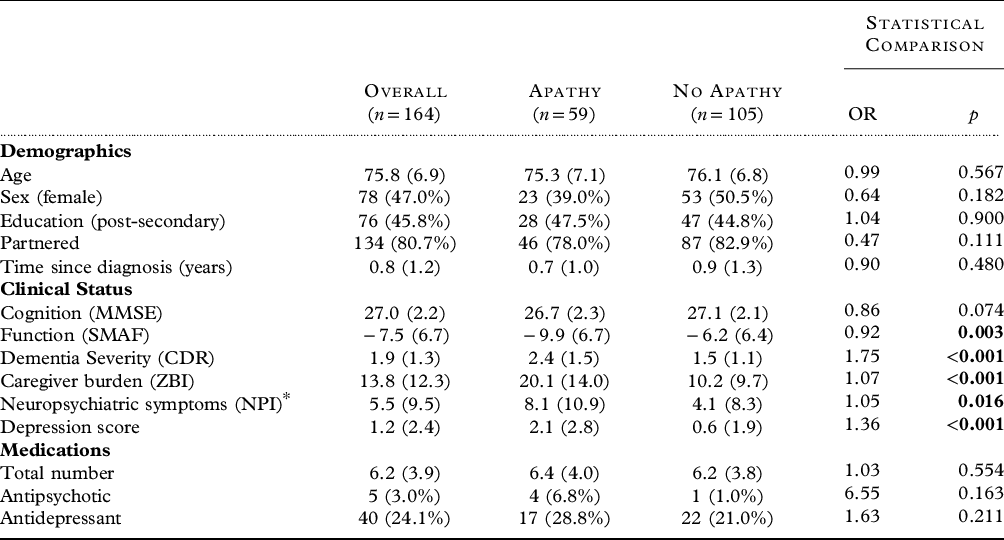
Patients’ demographic and clinical characteristics are summarized in Table 1. Patients with apathy at baseline did not differ from those without apathy in terms of age, sex, education, or time since clinical diagnosis. Patients with apathy, however, exhibited worse function, dementia severity, depression, overall neuropsychiatric symptoms, and caregiver burden than patients without apathy.
Patients’ characteristics at the study’s baseline

Note. Numbers in brackets indicate standard deviations for continuous variables and percentages for categorical variables. Statistical comparisons used logistic regression to compare patients with apathy and those without apathy, adjusting for age, sex, and time since clinical diagnosis. Numbers in bold indicate p-values <0.05. MMSE = Mini-Mental State Examination; SMAF = Functional Autonomy Measurement System; CDR = Clinical Dementia Rating scale (scored using sum of boxes). ZBI = Zarit Burden Inventory; *NPI = Neuropsychiatric Inventory (total score excluding apathy and depression). No participants took stimulant medications during the study.
The number of patients at each time point is reported in Appendix 1. Of the 164 patients, 47 (28.7%) were diagnosed with dementia over the course of the study (35 with Alzheimer’s disease, 4 with mixed dementia, 4 with frontotemporal dementia, 2 with vascular dementia, 2 with dementia with Lewy bodies). These patients had lower cognition scores at the study’s baseline visit (OR 0.77, p < 0.001) but did not otherwise differ from other patients.
Longitudinal trajectories
The prevalence of apathy gradually increased over the study. Apathy was present in 36.0% of patients at baseline, 34.0% at 3 months, 37.9% at 6 months, 38.3% at 1 year, 47.5% at 2 years, 49.5% at 3 years. Clinically significant apathy – indicated by a cut-off of 4 or more – was present in 10.4% of patients at baseline, 13.3% at 3 months, 13.1% at 6 months, 18.4% at 1 year, 26.2% at 2 years, 25.2% at 4 years. By contrast, the prevalence of depression appeared to be relatively constant, affecting 37.2%, 38.7%, 42.8%, 39.7%, 40.2%, and 43.2% at the respective visits; for clinically significant depression, 11.6%, 7.3%, 9.0%, 12.1%, 13.9%, and 11.7% were affected at the respective visits.
There was considerable overlap between symptoms; across time points, 51.9–64.4% of patients with apathy also exhibited depression. Likewise, 48.4–67.3% of patients with depression also exhibited apathy. Both symptoms showed evidence of persistence over time. For patients with data across subsequent annual visits, 68.6–77.1% of those with apathy and 63.8–67.3% of those with depression at the earlier visit still had their respective symptom 1 year later.
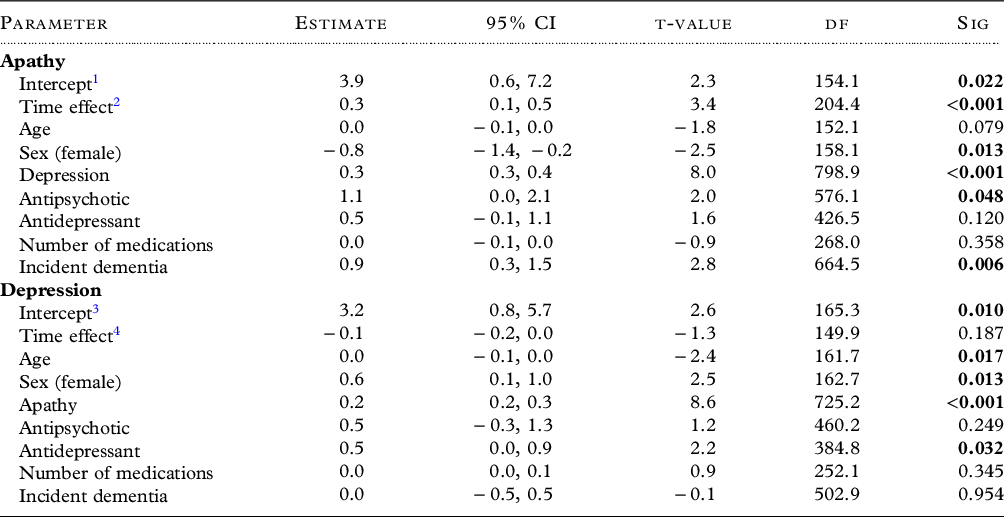
Across all patients, average apathy scores increased by 0.3 points each year after clinical diagnosis (p < 0.001) controlling for age, sex, depression, number of medications, antipsychotics, antidepressants, and incident dementia (see Table 2). Male sex, depression, antipsychotic use, and incident dementia were associated with greater apathy. By contrast, average depression scores appeared to remain relatively stable after adjusting for other variables (longitudinal slope −0.1, p = 0.187; Table 2). Younger age, female sex, apathy, and antidepressant use were associated with greater depression. No participants took stimulant medications during the study.
Linear mixed model examining the trajectory of apathy and depression over time

Note. Numbers in bold indicate p-values <0.05. Sex indicates values for females relative to males.
1 Random effect with mean 3.9 and SD 1.5
2 Random effect with mean 0.3 and SD 0.6
3 Random effect with mean 3.2 and SD 1.1
4 Random effect with mean −0.1 and SD 0.2
A separate analysis confirmed that there was a significant difference between the longitudinal trajectories of apathy and depression over time using standardized scores and controlling for other clinical variables (effect estimate = 0.1, p = 0.005; Appendix 2).
Longitudinal correlates and outcomes
Across measures, there were significant interactions between incident dementia and time. This indicates that patients who developed dementia during the study had different longitudinal trajectories on outcome measures – declining more rapidly in function, cognition, dementia severity, caregiver burden, and neuropsychiatric symptoms over time from when first diagnosed with MCI – than patients who did not develop dementia. The main effects of incident dementia – reflecting comparisons between groups at the time of patients’ MCI diagnosis, rather than the study’s baseline visit – were not statistically significant. Altogether, this indicates that the differences in the outcome measures between those who developed dementia and those who did not were not apparent at the time of their MCI diagnosis and only emerged later with the progression of dementia (Tables 3–5, Appendices 3–4). Interactions between time and both apathy and depression were also not statistically significant when included in the model, indicating that associations between these variables and outcome measures were stable over time.
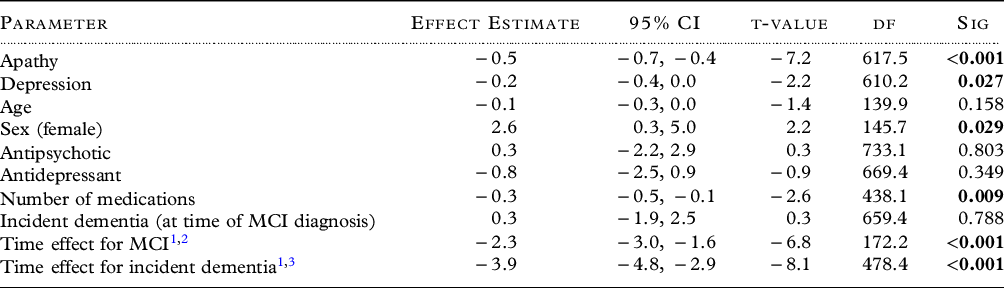
Linear mixed model examining apathy as a predictor of function over time

Note. Function was assessed using the Functional Autonomy Measurement System (SMAF). Numbers in bold indicate p-values <0.05. Sex indicates values for females relative to males.
1 The interaction between time and incident dementia had a p-value of <0.001 and was retained in the model. As such, separate time effects for the presence and absence of dementia are reported, while the intercept term is not reported.
2 Random effect with mean −2.3 and SD = 3.5
3 Random effect with mean −3.9 and SD = 3.5
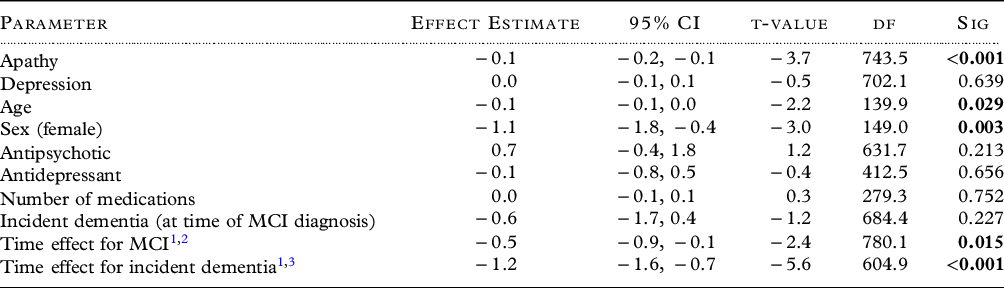
Linear mixed model examining apathy as a predictor of cognition over time

Note. Cognition was assessed using the Mini-Mental State Examination (MMSE). Numbers in bold indicate p-values <0.05. Sex indicates values for females relative to males.
1 The interaction between time and incident dementia had a p-value of 0.015 and was retained in the model. As such, separate time effects for the presence and absence of dementia are reported, while the intercept term is not reported.
2 Random effect with mean −0.5 and SD = 1.2
3 Random effect with mean −1.2 and SD = 1.2
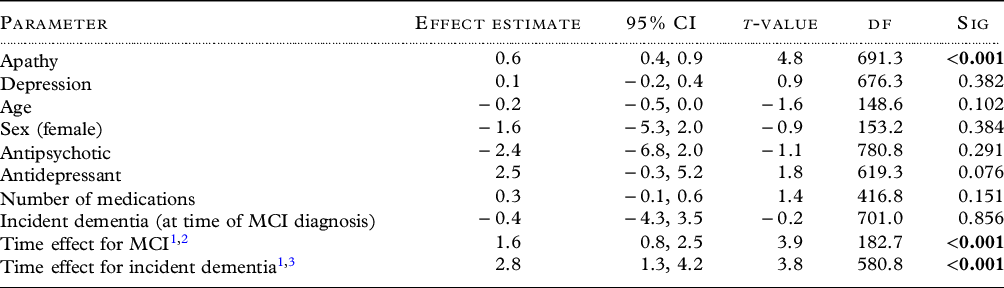
Linear mixed model examining apathy as a predictor of caregiver burden over time

Note. Caregiver burden was assessed using the Zarit Burden Inventory (ZBI). Numbers in bold indicate p-values <0.05. Sex indicates values for females relative to males.
1 The interaction between time and incident dementia had a p-value of 0.115 and significantly improved model fit, so was retained in the model. As such, separate time effects for the presence and absence of dementia are reported, while the intercept term is not reported.
2 Random effect with mean 1.6 and SD = 3.4
3 Random effect with mean 2.8 and SD = 3.4
Apathy was associated with worse function, cognition, and dementia severity over time. Each point on the apathy scale was associated with scoring 0.5 points lower on the SMAF scale (p < 0.001), 0.1 points lower on the MMSE (p < 0.001), and 0.2 points higher on the CDR (p < 0.001), after adjusting for depression and other variables. Depression was also related to worse function (0.2 points lower on the SMAF scale; p = 0.027), but not cognition (0.0 points on the MMSE; p = 0.639) or dementia severity (0.0 points on the CDR, p = 0.129), after controlling for other variables (Tables 3–4; Appendix 3).
Both apathy and depression were associated with other neuropsychiatric symptoms over time. Each point on the apathy scale was associated with scoring 1.0 points higher on the 10-item (omitting apathy and depression) NPI (p < 0.001), while each point on the depression scale was associated with 0.7 points higher score (p < 0.001) after adjusting for other variables (Appendix 4). Apathy was associated with worse caregiver burden. Each point on the apathy scale was associated with scoring 0.6 points higher on the ZBI (p < 0.001). Depression was not associated with caregiver burden (0.1 points, p = 0.382) after adjusting for other variables (Table 5).
Repeating the main analyses that focused on longitudinal clinical correlates using baseline apathy and depression scores as predictors left the overall findings unchanged, with the exception that baseline apathy was not significantly related to cognition (Appendix 5). Baseline apathy continued to predict function, dementia severity, other neuropsychiatric symptoms, and caregiver burden over the course of the study. Baseline depression predicted only other neuropsychiatric symptoms.
Discussion
Apathy affected a large proportion of patients with MCI. More than one-third had apathy at baseline, 10% of patients at clinically significant levels. The proportion affected increased over the study to around half – a quarter had clinically significant apathy – at 3 years. Overall apathy scores similarly increased, with average scores increasing around 0.3 units on the NPI per year from time of diagnosis. Apathy was also associated with worse clinical outcomes, including incident dementia and worse cognition, function, dementia severity, neuropsychiatric symptoms, and caregiver burden. The effect sizes were small for each unit of apathy, though they were likely to be clinically noticeable given the range of apathy scores in the population and the accumulation of apathy with time. These findings are in contrast to those for depression, which remained relatively stable over time, appeared unrelated to incident dementia, and was associated with a narrower range of adverse outcomes (specifically function and neuropsychiatric symptoms).
The prevalence of apathy was similar to previous studies of patients with MCI (Apostolova and Cummings, Reference Apostolova and Cummings2008). Our study extends previous research by confirming that apathy consistently increases over time, from when MCI is first diagnosed and continuing after dementia is diagnosed. Our study also shows that apathy’s associations with adverse outcomes in MCI exist longitudinally and are independent of both dementia and depression. Together, these findings reflect a continuity with dementia, where similar longitudinal trends are evident independent of depression (Connors et al., Reference Connors, Teixeira-Pinto, Ames, Woodward and Brodaty2022a, Reference Connors, Teixeira-Pinto and Loy2022b). Across both MCI and dementia, apathy increases over time and is associated with worse clinical outcomes, suggesting shared underlying mechanisms. These findings are consistent with neuroimaging research that has found associations between apathy and frontotemporal and subcortical atrophy (Johansson et al., Reference Johansson2020; Le Heron et al., Reference Le Heron, Apps and Husain2018). As such, apathy may simply represent an outward manifestation of neurodegeneration, particularly of prefrontal–subcortical circuits involved in motivation and planning.
The findings help to elucidate the relationship between apathy and depression. As in dementia, there was overlap between symptoms, with 52–64% of patients with apathy also having depression. Each symptom also predicted the other over time. Such overlap may arise from their shared phenotypic features and the high prevalence of both symptoms (Brodaty and Connors, Reference Brodaty and Connors2020). In addition, both symptoms were associated with worse function, suggesting that they both have the potential to confound the diagnosis of cognitive disorders (Brodaty and Connors, Reference Brodaty and Connors2020). There were, however, significant differences between symptoms. Whereas apathy consistently increased over time and was associated with a wide range of adverse outcomes, depression remained relatively stable and was associated with only worse function, albeit to a lesser degree than apathy, and other neuropsychiatric symptoms. There were also sex differences: whereas apathy was greater in males, depression was greater in females.
Altogether, these differences between symptoms may reflect their distinct mechanisms. As already noted, apathy may arise from neurodegeneration, hence its strong relationship with poor outcomes. Depression, by contrast, can also arise from psychological and social processes in the absence of neurodegeneration, hence its weaker relationship with clinical outcomes. Mechanisms underpinning sex differences remain unclear but could include both biological factors and socialized gender roles (Brodaty et al., Reference Brodaty, Connors, Xu, Woodward and Ames2015). Such differences have been reported previously in older people without cognition impairment (Brodaty et al., Reference Brodaty, Altendorf, Withall and Sachdev2010; Geda et al., Reference Geda2014), people with MCI (Guercio et al., Reference Guercio2015), and people with dementia (Brodaty et al., Reference Brodaty, Connors, Xu, Woodward and Ames2015; Lövheim et al., Reference Lövheim, Sandman, Karlsson and Gustafson2008), indicating their robustness and the likelihood of common mechanisms across different levels of cognitive impairment.
Our study had a number of limitations. First, recruitment involved convenience sampling from memory clinics, so it is unclear if findings generalize to other treatment settings. Second, cognition was assessed by the MMSE, a relatively crude measure of cognition, rather than a neuropsychological battery. Third, apathy and depression were assessed using the NPI, rather than symptom-specific measures. Other research, however, indicates a strong relationship between the NPI as a measure of apathy and other forms of apathy assessments (Lanctôt et al., Reference Lanctôt2021) and between the NPI as a measure of depression and depression-specific scales (Cummings et al., Reference Cummings, Mega, Gray, Rosenberg-Thompson, Carusi and Gornbein1994). Fourth, the exploratory nature of the analyses might increase the risk of Type I error. Fifth, the study did not examine medication dosages; specific subclasses of psychotropic medications; medication classes other than psychotropics; past psychiatric history; or medical comorbidities in detail. Other classes of medications (Huffman and Stern, Reference Huffman and Stern2007) and certain medical comorbidities, including vascular risk factors (Aizenstein et al., Reference Aizenstein2016), have been linked to apathy and depression. Finally, the study did not examine subtypes of MCI; collect biomarkers or neuroimaging data; or recruit a control group of patients without MCI.
Despite these limitations, our findings provide further evidence for apathy as a marker of poor clinical outcomes in older people and across different neurocognitive disorders. Our findings also indicate the need to distinguish apathy and depression given their distinct trajectories and clinical correlates. In particular, apathy’s close relationship to disease progression suggests the need to consider those with apathy to be at high risk of further decline and to plan for such contingencies. Depression, which appears less closely tied to disease course, is itself associated with functional impairment, highlighting the need for treatment. The frequent co-occurrence of symptoms, however, indicates the importance of careful assessment (Brodaty and Connors, Reference Brodaty and Connors2020). Nevertheless, treatment options for apathy remain limited (Mortby et al., Reference Mortby2022). Given apathy’s prevalence and burden, this remains an important direction for future research.
Conflicts of interest
In the last 3 years, David Ames has received royalties for edited books from Cambridge University Press and Taylor and Francis. Michael Woodward has worked on drug trials funded by pharmaceutical companies including AbbiVie, Astra Zeneca, AZ therapies, Biogen, Buck, Eisai, Janssen, Lilly, Lundbeck, Merck/MSD, Novartis, Pfizer, Roche, Servier, Takeda, Tau Rx, vTv Therapeutics, and Zinfandel. He has received honoraria for consultancy or presentations at meetings organized by CogRx, Lundbeck, Merk Sharp & Dohme, Novartis, and Nutricia. Henry Brodaty has been a consultant for Nutricia, Biogen, Roche, and Skin2Neuron. Michael Connors and Armando Teixeira-Pinto have no conflicts of interest to declare.
Funding
Data collection was funded in part by Janssen-Cilag Pty Limited. Janssen-Cilag had no input into the design, execution, analysis, interpretation, or writing of this study.
Description of authors’ roles
MC conducted the statistical analyses and drafted the manuscript. HB, DA, and MW conceptualized and designed the overall PRIME study, while MC and HB conceptualized this paper. ATP provided statistical advice. All authors read and approved the final manuscript.
Acknowledgments
Data collection was funded in part by Janssen-Cilag Pty Limited. Janssen-Cilag had no input into the design, execution, analysis, interpretation, or writing of this study. We are grateful to the staff at nine testing sites and the patients and their families who supported this study.
Supplementary material
To view supplementary material for this article, please visit https://doi.org/10.1017/S1041610222001089