Manufacturing Iranian Modernization: Industrialization in Iran, 1921–1941
Labor activism can be observed in Iran as early as the early twentieth century, though the country remained predominantly agricultural well into the twentieth century. However, many of the early labor actions, which took place from the inception of the Constitutional Revolution in 1906 to the dawn of Pahlavi modernization in early 1920s, did not occur in manufacturing sectors. Instead, telegraphers, tramway workers, and print-shop employees were among the protagonists of labor activism in Iran.Footnote 1 The already existing labor activism in Iran experienced a radicalization in the early 1920s largely due to the activities of Iranian migrant workers in former Tsarist Russia and to the impact of the Bolshevik Revolution in 1917. The Communist Party of Iran was founded in 1920. Trade unions were particularly active in Tehran, but were not limited to it and increasingly spread to different parts of the country. Consequently, the Central Council of Federated Trade Unions (CCFTU) was established in 1921, which in the following three years reached a membership of eight thousand.Footnote 2 The oil workers employed at the oils refinery in Abadan, southern Iran, and the carpet weavers in Kerman were among the immediate targets of labor activists. In Abadan particularly, there was a favorable atmosphere for labor activism due to distressing working and living conditions. Finally in May 1929, it culminated in a strike in Abadan, “the heart of Anglo-Persian Company's (APOC) empire.”Footnote 3 Having found itself between “the moral and political value of having the Iranian workers on its side” and “the potential dangers of an independent labor movement,” the Iranian establishment finally suppressed the striking worker.Footnote 4
For communists, the battle may have been lost but not the war. Two years later in May 1931, another strike broke out at Vatan Factory in Isfahan as the second major labor action of Reza Shah's period. In contemporary accounts, as well as in later studies, this strike is underscored as a turning point for the history of Iranian labor activism. This was due to the partial, yet impressive success of the strike and the consequent adoption by the Iranian Parliament (henceforth the Majles) of the anti-Communist bill, which forbade the formation of trade unions in the country. The strike stood at a transition from the period of centralization policies of the mid-1920s to the industrial leap-forward of the 1930s. Therefore, before moving to the discussion of the strike under study, it seems imperative to mention the circumstances in which it took place.
At the turn of the twentieth century, Iran's manufacturing scene was dominated by craft industries.Footnote 5 Production was mainly organized along guild lines in towns, but in rural settings peasants also spun and wove for additional income, as well as for their own use. Further, the number of cottage industries, which used rather light machinery and employed varying numbers of workers, sometimes tens of them in the same shop, was on the increase. Throughout the nineteenth century, Iranian industries, particularly textiles, had significantly suffered from European economic penetration, although some of the labor-intensive sectors, mainly carpet weaving, recorded an impressive growth due to export-oriented production. Generally speaking however, many industries were hard-hit by the inflow of ready-made imports. In the ensuing debates regarding possible solutions to the problem, two main tendencies, namely prohibitive and developmental, predominated. The prohibitionists argued that craft industries could meet domestic demand if effectively promoted and efficiently protected against imports. To this end, several lists were proposed, which contained goods to be banned from import, including luxuries such as tea, sugar, and all kinds of textile products, leather work, foodstuff, and so on. The developmentalists, on the other hand, argued for factorization and import-substitution industrialization as the only viable solution, since, they claimed, existing crafts industries were obsolete and unable to meet the demand. At all events, however, small-scale manufactures continued to predominate Iran's industrial scene well into the mid-twentieth century.
Largely restricted in its tariff policies by commercial treaties signed with foreign states, such as Russia and Britain, several attempts were made to develop home industries and to curtail imports. For instance, during the premiership of Mirza Taqi Khan Amir Kabir, the powerful yet ill-fated minister of Naser al-Din Shah between 1848 and 1851, measures were adopted for this purpose. The underlying aim of his economic policy was import substitution.Footnote 6 Also, as Polak points out, in order to check the continuous outflow of money, the Shah made repeated efforts at a European type of industrialization.Footnote 7 Yet, notwithstanding the extensive human and material capital mobilized for such projects, they usually fell far behind the expectations, and many of the established state-owned or private factories soon shut down. Thus, Lord Curzon's remark in 1890 about the absence in Iran of any European-style factories was hardly an exaggeration.Footnote 8 The same point was made by Muhammad Hasan Amin al-Zarb, prominent entrepreneur and merchant in late nineteenth-century Iran, at a meeting between the Shah and a group of merchants in 1893. During the discussions about the lack of industries in Iran and the country's dependence on foreign commodities, he remarked: “… what do we have for manufactories and industries that we can say: we don't want the European commodities?”Footnote 9 Textile crafts were particularly hard-hit especially in such craft centers as Isfahan. Bemoaning the decline of the craft industries, Mirza Hossein Tahvildar, author of a prominent source about nineteenth-century Isfahan, makes the following observation about a weavers’ guild in this city in 1870s:
For the past few years the cheap red and yellow European fabrics have been popular. Whenever their textile fabrics have had a new design, and have appeared different to the eyes the people of Iran have given up their body and soul and have pursued the colour and scent of others. In doing this they have incurred losses which they do not realize. Especially now they are crazy about inexpensive clothes which, looked at wisely, are not at all economical or lasting. On the other hand when the merchandise of the weavers’ guild lost the market, it began imitating European wares. Weavers paid more attention to appearance than to Quality. It was for the sake of elegant appearance and easy handling that they employed European yarn in weaving qadaks.Footnote 10 Their work became ugly and, as a result of mixing European and Iranian materials, it became progressively defective and tore and went to pieces while worn: it also lost its stiffness, fluff, and durability. Spinners lost their jobs and gradually perished.Footnote 11
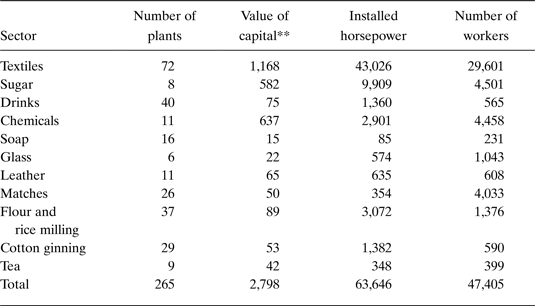
From early 1920s onward, large-scale industrialization gained unprecedented momentum.Footnote 12 With Reza Khan's rapid ascendance to supreme power following the coup d’état in 1921, which ended in his coronation as Reza Shah Pahlavi, foundations were laid for industrialization. Improvements in transportation and in other infrastructural facilities as well as the establishment of security on roads and highways contributed to the creation of a countrywide market. The state's ambitious industrialization policy was reflected in its legislation. Between 1925 and 1941, a total of 1,145 laws and decrees were passed or issued on industrial and related matters.Footnote 13 For instance, in 1925, a law was passed by the Majles that exempted industrial and agricultural machines and instruments and their component parts from import duties for ten years.Footnote 14 Several monopolies were formed between 1925 and 1931 in such goods as sugar, tea, and opium, until foreign trade was put under full state monopoly in 1931. Also, the National Bank (Bank-e Melli) was established in 1925 and soon assumed control of the monopoly right to issue banknotes from the British-owned Imperial Bank. More significantly, full tariff autonomy was attained in 1928. In short, by the early 1930s the groundwork was laid for state-controlled industrialization. The Great Depression in the early 1930s, and the implementation of the first five-year plan in the USSR, which prevented Iranian merchants from accessing Russian markets, further pushed Iran into a program of self-sufficient economic development in many of its industries. At all events and as shown in Table 1, from 1930 until Reza Shah's forced abdication in 1941, Iran made significant progress towards industrialization.
Manufacturing plants established during 1930–1940*.

Source: Extracted from Ministry of Labour, Statistical Survey of Iranian Industries 1947 (in Persian). Quoted in Massoud Karshenas, Oil, State and Industrialization (Cambridge: Cambridge University Press, 1990), 77.
* Excludes government cement factories.
** Historical cost at current prices [1990] in millions of rials.
The textile industry, especially cotton processing, experienced particular growth. Insufficient private entrepreneurship facilitated the state's grip over the economy, and in many cases the state directly opened and ran factories. But private factories also existed. Established in Isfahan by the prominent merchant and industrialist Hajj Muhammad Hosayn Kazarouni, Vatan (Homeland) Wool Spinning and Weaving Factory was an early and successful example of private investment. In its early stages, the factory was supported by the state with orders for the needs of the army.Footnote 15 It was a renewed developmentalist effort to fight foreign imports and produce national fabric. From the late nineteenth century, there had already emerged a concern about producing melli (national/Islamic) fabrics to curtail foreign imports of which textiles constituted a large sum. The Anjoman-e Islami (Islamic Society) and Anjoman-e Sharqi (the Oriental Society) were formed to this end. They gradually gave way to the Islamic Company founded in 1899, which soon went bankrupt.Footnote 16 Yet, as a prominent centre of craft industries, Isfahan maintained its importance during the industrial leap-forward of the 1930s, too.
The two decades between 1921 and 1941 were the formative years for the nascent Iranian working class, as well as a period of structural transformations in Iranian society. As a part of the centralization policies of the 1920s, several tribes were forced into settlement, and many of the tribesmen found employment in industries, mainly in the ever-growing oil industry, in the south. Rural-urban migration increasingly continued, often producing a large pool of urban destitute. Guilds gradually lost their power until the abolition of guild taxes, the raison d’être of the guilds, in 1927 finally dealt a severe blow to their basic structure.Footnote 17 Amidst the industrialization fever little, if any, attention was paid to workers and labor issues. For some, Iran was not an industrialized country and hence had no workers as such. In 1934, this point was most strikingly articulated by Mirza Seyed Baqer Khan Kazemi, the Iranian Minister of Foreign Affairs, in a correspondence with Muhammad Ali Jamazalzadeh, an employee of the International Labor Office (ILO).Footnote 18 In October 1932, Jamalzadeh sent a letter to the Iranian Foreign Ministry in which he emphasized that since Iran was rapidly industrializing, the establishment of a labor office in the country to exclusively deal with agricultural and industrial affairs from the perspective of labor emerged as a necessity.Footnote 19 He then provided examples from a number of Eastern countries, such as Egypt, Turkey, and Iraq, which had adopted significant measures on this issue. In his reply in May 1934, Kazemi made the following points: “The erection of factories is a new and ongoing process in Iran hence the introduction of a labour law and regulations about labour issue has not yet been an urgency and obligation. Therefore suggestions of ILO will be asked when time comes for the establishment of a labour office and for the introduction of a labour law and regulations.”Footnote 20
Inside Vatan Factory, Late 1920s.

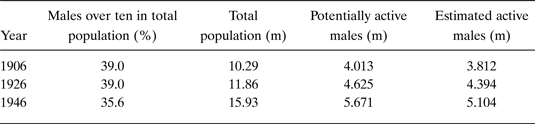
It is not easy to reach to any precise quantitative idea about the workforce during the period under study. According to Abdullayev, between the late nineteenth century and the First World War, there were 126,000 workers in Iran, seventeen-thousand of whom were employed in manufacturing with some sort of machine power, while the rest worked in craft industries and traditional economic activities.Footnote 21 Obviously the real number should have been higher than this. Abdullayev's figures seem to be based on a narrow definition of labor. As Floor argues, underage boys and girls, as well as quite a substantial number of women, were engaged in all kinds of economic activities, especially in carpet weaving.Footnote 22 Moreover, peasants, too, usually spun or wove for additional income. Table 2 provides the following statistics about the economically active male population and its proportion to the total population for the three years with twenty-year intervals.
Estimates of the economically active male population for five years.

Source: Bharier, Economic Development, 34.
As shown in Table 3, according to Bharier, between 1906 and 1946 the proportion of agricultural workers to the total labor force declined by about fifteen percent despite the rise in the actual number of agricultural workers caused by the increased population.Footnote 23
The proportion of agricultural workers in the labor force.

Source: Bharier, Economic Development, 34.
As far as the workforce employed at large industrial establishments with ten or more workers is concerned, its proportion to the total labor force rose from one percent in 1926 to two percent in 1946, although in actual number it rose from thirty thousand to ninety-four thousand, respectively.Footnote 24
Beyond the Organized vs. Un-organized Labor Dichotomy: Petitions and the Discursive Formation of the Iranian Working Class
The debates on organized vs. non-organized labor have, for a long time, haunted the scholarship on Middle-Eastern labor. For a while, attention was paid to organized labor, such as trade unions and syndicates, as well as to collective labor actions.Footnote 25 Labor history gradually extended its domain to include subjects such as everyday life, leisure, family etc., which “attempted to contextualize workers’ struggles.”Footnote 26 However, most of the studies about Middle-Eastern labor, written from either perspective, either ignored or relegated to the periphery of their concerns the discursive aspect of labor. Yet, as Chakrabarty argues, “an analytic strategy that seeks to establish a ‘working class’ as the ‘subject’ of its history must also engage in the discursive formation that makes the emergence of such a subject-category possible.”Footnote 27 Such an attempt has a double advantage. It not only enables us to see how workers perceived themselves, that is the discursive making of the working class, but also provides insights about how structural processes “are apprehended by flesh-and-blood human actors,” that is workers’ discursive engagement with other classes and with the world around them.Footnote 28
The Iranian working class was as much a result of a discursive process as of material practices.Footnote 29 The role of these material practices or structures has been great in Iran, as elsewhere, particularly from the mid-nineteenth century onward. Foreign economic domination, domestic political and economic developments, and the subsequent dislocations contributed to the emergence of the Iranian working class from “the assemble of the social relations,”Footnote 30 as well as of a “classed representation” of the Iranian workers, to borrow Lockman's phrase.Footnote 31 The Iranian working class, as indeed any other working class, emerged out of a complex set of social relations until it became a separate societal entity. Until well into the twentieth century, therefore, workers’ voices should be sought in class-crossing alliances rather than in self-interested class representations. In other words, workers’ discursive formation gradually emerged from a general subaltern discourse and, in time, gained a language of its own.
As a unique example of such sources, petitions sent by Iranian workers to the Majles during 1920s and 1930s constitute the main source of this study. Petitions remain an unexploited source material for Middle-Eastern scholarship.Footnote 32 As a unique source of information for Iranian social history in general and for labor history in particular, petitions provide invaluable insights about the discursive formation of the Iranian working class and about their living and working conditions.
Petitions can be defined as “demands for a favour or for the redressing of an injustice directed to some established authority.”Footnote 33 Petitioning, both written and verbal, has a long history in Iran, as elsewhere in the world, and it has been considered, throughout centuries, an indispensable part of a just kingship. From the mid-nineteenth century, several measures were taken for the “institutionalization of petitioning” in Iran. In 1860, Naser al-Din Shah (r.1848–1896) declared by a decree that he saved Mondays exclusively to give audience to the aggrieved and those having demands.Footnote 34 In 1874, the establishment of the more institutionalized Box of Justice in Tehran was declared in which supplicants would drop their petitions.Footnote 35 In 1882, the institutionalization of justice went further with the foundation of the Council for the Investigation of Grievances (Majles-e Tahqiq-e Mazalem) for the “administration of justice.”Footnote 36 With the Constitutional Revolution in 1906, petitioning was established as a legal right. The number of petitions pouring in from all around the country to the Majles soon reached such extents that the Commission of Petitions was established for the administration of supplications and for forwarding them to relevant ministries.
A typical petition starts with a display of respect to the authority in question, usually the Majles, often in a rather obedient and deferential language. Then the petitioner introduces himself or herself, a part, which at times, provides detailed information as to the petitioner's environments and social as well as political settings in which he or she lives. This part is followed by the statement of the request or complaint in question. In order to prove the accuracy of their claims and increase their chances of attendance to their cases, petitioners sometimes included a supporting document called Letter of Testimony (Esteshhad Nameh). This could be a letter from a prominent person, a leading merchant, governor, a clergy, etc., or a photograph, which was frequently used as a testimony to demands for financial aid due to physical disability.
In addressing higher authorities, Iranian subalterns called themselves, other than in such words as ahali and mardom (both meaning people), which separated only the ruled from the rulers, in various ways: kaminahghan (inferior subjects)Footnote 37; bicharahghan (the helpless) and badbakht (the wretched)Footnote 38; bandehghan (servants).Footnote 39 Or else they would combine a few of them such as “avam, and kolah-namadi (helpless, laity, and the felt-capped). Workers, too, whether working at factories or elsewhere, made extensive use of petitioning avenues to voice their demands and grievances. The dissemination of kargar as the standard term to refer to Iranian workers has been a slow process. In their petitions, for example, workers either referred to themselves as fa'aleh or amaleh (laborer) or ranjbar (toiler), or they used their field of expertise, such as bafandeh (weaver), risandeh (spinner), hammal (porter), etc. As Bayat argues, kargar did not emerge, for some time, as the standard term for a new social category, distinct from fa'aleh or amaleh.Footnote 40 Apparently, prior to the First World War kargar was not the common term with which working people in Iran referred to themselves.Footnote 41 Yet from the early 1920s onward, kargar increasingly came to be used to refer to the working people. This way, workers first referred to themselves with the general terms of subalternity, but gradually they developed a distinct working-class language. The emergence of kargar as a standard term used by workers, as well as by others, constituted a major turning point in the discursive formation of the Iranian working class.”
Petitioning workers mention diverse labor-related issues in a deferential language. For example, in a series of petitions in 1921, three hundred female workers from the Wool Spinning Factory in Mazandaran (northern Iran) asked for their wages for the last nine months they had worked before the factory shut down.Footnote 42 While doing this they provided invaluable details about their shopfloor experiences, as well as their living conditions. Their petitions and the responses sent from the Majles also demonstrate an original example of workers’ engagement with the state. In March 1923, shoemakers shared their opinions about the “Law for the use of national clothes” (qanun-e este'mal-e albaseh-ye vatani), which was passed in February 1923 and made it compulsory for all state employees, including the military, to wear clothes produced of native fabrics and of Iranian make.Footnote 43 After highlighting the decline of their craft, they criticized deputies for taking measures only to promote textile production and disregarding shoemakers altogether. Finally they expressed their desire for a similar law for the use of national home-made shoes, too.Footnote 44 In August 1926, public bath attendants complained in their petition about the absence of a labor law to regulate their working hours and conditions.Footnote 45 In another petition in January 1931, the phaeton riders of Gilan complained about the high taxes, the negative impact on their business of the introduction of modern technology, and the growing regulative capacity of municipal power. They complained that the decision of the Municipality that strictly forbade the passage of phaetons from the bazaars dealt yet another blow to their business. People were no longer able to reach the riders easily when they needed to. The riders asked, in the end, for the removal of the ban on the phaetons and the “restoration of order.”
The Petition and the photograph of Hosayn Abbas, a previous worker at AIOC (APOC), in which he asked for financial help for not being able to work after he lost his right arm in a work accident on July 20, 1939.

The introduction of modern technology did not only hit phaeton-riders. Other sectors, such as cigarette-making, were equally influenced. In March 1932, cigarette-making workers stated in their petition that according to what they read in the newspapers some merchants and other investors involved in cigarette selling had imported a number of cigarette-cleaning machines, with a daily product equal to that of about a hundred workers. Although these machines did not yet work in a full capacity, the workers and their families, they argued, were in a state of decline since they could not compete with machine-based production and lost their livelihoods. The cigarette-sellers then requested the Majles to show mercy to the workers and their families by saving them from this misery.Footnote 46 It is interesting to note, however, that it is not really clear what the cigarette workers, and many other workers for that matter, actually requested. They seem to be well aware of the irreversible mechanization of manufacturing, but apparently they did not request the removal of the machines. At the same time they proved unable to compete with the machines’ production capacity, as a result of which they fell into deprivation. Yet in any case they requested the protection of the state although it is not clear, either, what they wanted with this protection. Workers’ request from the state is rather clear in some cases, as in the case of the three hundred and fifty former workers of the Khosrovi Tannery in Tabriz. The workers stated, in a collective petition in June 1936, that they lost their jobs because of the financial difficulties and increased taxes that led the factory management to close its shoe-making department.Footnote 47 They stated that the department had been producing military boots and had to shut down due to the increased custom duties on the necessary chemicals. Therefore, they asked for the removal of the factory's financial difficulties in order to be able to go back to their work.Footnote 48 Consequently, the factory was saved from its financial problems by army orders.Footnote 49
Workers’ petitions almost unexceptionally employed a carefully balanced wording sophisticatedly stated to not outrage the authority in question, but at the same time make their grievances adequately clear. During the constitutional period, workers often referred to the merits of the constitutional regime and the sacrifices they made for its realization, while after Reza Shah's coronation in 1925, they used a rather patriarchal language, emphasizing the protective role of the Shah over his peoples, as well as his supremacy as their just king and father. Similar to Chalcraft's remarks about Egyptian peasants, Iranian workers too “made strategic use of the figure of the just ruler and lodged sometimes assertive appeals to the rule of law and new and old rights in a dangerous and power-laden context.”Footnote 50 For their conflicts with their managers or factory owners, or for their complaints about local authorities, they apparently knew how to draw the Shah or the Majles into their disputes, though not always successfully. The voice of workers, which was initially intermingled with such general concerns of the wider population as famine, injustice, and widespread poverty, gradually gained a distinct identity. Such an identity was in no way a peculiarity of the factory workers, and those employed at craft industries also expressed their grievances and demands. Nonetheless, with the increasing state-sponsored factory-based industrialization, workers had to face the growing penetration of the state authority, which significantly contributed to the development of the Iranian working class. It is true that from the early 1900s until the late 1920s Iranian workers were engaged in several labor actions. However, compared to the size of the working class and the number of industries, such actions remained rather limited in scope. The more continued engagement took place in the discursive realm. In this one can see the changing self-perceptions of workers and their changing attitude toward the ruling classes. In some cases, as in the case of the Vatan Factory workers, workers’ discursive strategies occasionally contradicted the growing radicalization of the working class.
The Vatan Factory Strike: One Action Different Discourses
The rapid industrialization of the late 1920s and 1930s paid little attention to the plight of workers whose working conditions were usually heartbreaking.Footnote 51 Wages, mostly on piecework basis, were low, and job security was absent, whereas vilification, bastinado, and similar punishments were commonplace. With the worldwide economic crisis of the late 1920s and 1930s and the subsequent industrialization, little attention was paid to the plight of workers. At any rate, with the progress of industrialization the number of industrial proletariat increased, too. Apart from the oil industry, which was the most developed and mechanized industry in the country, the textile industry employed the greater part of the proletariat. Villagers who migrated to larger towns and cities, former craftsmen who had lost their jobs for various reasons but mainly due to the cheaper imports, and the urban destitute constituted the main source of labor in the nascent industries. Although both female and child labor were used in factories, it was in the small-scale establishments, particularly in carpet weaving, where they were extensively employed, often in bad working conditions and for rather low wages.Footnote 52
A survey undertaken of twelve cotton-spinning and weaving plants in 1936 revealed that the number of male workers in the textile industry was declining as in other countries. Yet unlike other countries, male labor in Iran was being replaced by child labor instead of female workers.Footnote 53 A list that was prepared for the Etemadiyeh Weaving and Spinning Factory in Bushahr contains information about the workers and provides some ideas about the composition of the industrial workforce.Footnote 54 Of the 193 workers specified in the roster, 188 were males while females amounted to only five. The number of children under fourteen years was fifty-seven with an average age of 9.8 years. From the information provided in the roster, it appears that employing more than one worker from the same family was common. But the list is not conclusive, since, according to a list of factories prepared by the Ministry of Arts and Crafts, the factory employed at least five hundred workers with 3,500 spindles and 120 looms.Footnote 55 Piecework was the widespread practice in the textile industry. In 1900, the basic daily wage for unskilled labor was 1 kran (about 4.5 pence) and a skilled worker received 1.5 krans daily.Footnote 56 In the mid-1930s, an average wage in the cotton textile-industry was about 6 pence for a ten-hour day.Footnote 57 Wages usually fell far behind the costs of living.
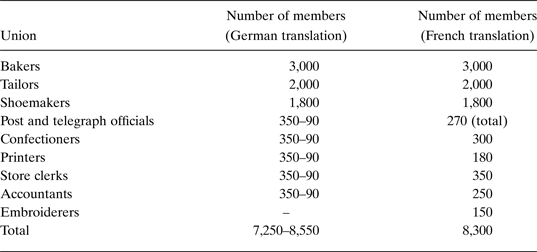
In the 1920s the growing communist and socialist organizations had already placed labor issues at the center of their programs. Thanks to the effort of the Socialist Party and the Communist Party of Iran, the Central Council of Federated Trade Unions (CCFTU) was established in 1921 and in the following three years reached a membership of eight thousand.Footnote 58 Based on a report presented by Muhammad Dehqan, the president of CCFTU, Table 4 contains further information on its membership. Trade unions were active in the oil industry, as well as amongst carpet weavers in Kerman and textile workers of Isfahan, along with other industries. With the Fifth Congress of the Comintern in 1924 and Moscow's decision to “Bolshevize” the international Communist movement, which was re-affirmed at the Sixth Congress of the Comintern in 1928, Communist groups received orders for more radical actions in their respective countries.Footnote 59
The trade unions affiliated with CCFTU.

Source: Kosroe Chaqueri, Historical Documents: Labour Movement, Social democracy, and Communism in Iran V. 6 (Florance: Mazdak, 1976), 105.
In the early 1930s, Isfahan was one of the largest cities in Iran, and the size of its working class was increasing, which made it one of the favorable centers for labor activism. Craft industries dominated the textile manufacturing in the city but large-scale industrialization was flourishing, too. A secret committee, which was affiliated with the Communist Party of Iran (CPI), was formed by Nasrallah Aslani (Kamran). Kamran was educated at the Communist University of the Toilers of the East (KUTV) and had started to work at the factory earlier in order to lay the groundwork for a strike at Vatan Factory.Footnote 60 The decision to strike on the coming May Day in 1931 coincided with an imprudent move on the part of factory management. A contract was drafted by the director Mirza Jafar Kazarouni, son of Muhammad Hosayn Kazaruni, which, according to the petitioning workers, “was entirely to their own interests and against those of the workers.”Footnote 61 The contract mentioned, among other things, that the wages of a full month would be charged to any worker who did not give one month's notice before he quit work at the factory.Footnote 62 This escalated the existing unrest among workers. On May Day 1931, some 60–70 workers gathered in a garden, near the city. On the wall a red banner was fixed on which “Proletarians of the World Unite” was written.Footnote 63 It was decided on the occasion that the strike would be launched on May 7. The factory management took several steps to thwart the action but to no avail. Even eight- or ten-year-old children participated in the strike, and the few workers who wanted to continue work were attacked by the striking workers and were induced to strike.Footnote 64 The striking workers came with a list of thirteen demands, including, but not limited to: freedom to organize a union, changing from piece-work to a monthly salary, an eight-hour working day instead of twelve-hour, for not less than 5 krans, abolition of vilifications and punishment with the stick, etc.Footnote 65 Some of the strike leaders were arrested and one, a CPI member, was taken to Tehran but succeeded in escaping.Footnote 66
Consequently, during the negotiations not only was the contract withdrawn but workers also obtained the following concessions from the factory management: The working day was reduced from twelve to nine hours; the examination system at the factory gate was abolished and vilification and money fines were reduced; a tea drinking facility was established and vessels with ice water were put in all departments; lunch time was extended from half an hour to one hour.Footnote 67 Communist newspapers celebrated these achievements and opined that the strike set an instructive example for the future activities of CPI.Footnote 68 What is more relevant for the current discussion is to see how the workers engaged and negotiated with the central authorities in order to gain their support. Also, how workers’ immediate concerns and their bread-and-butter matters were criticized by the communist publications. The partial success of the strike apparently satisfied many of the workers but they were frustrated for their striking friends who were imprisoned but not released after the strike. In order to draw the Shah's support, workers sent to him the following petition on June 11, 1931:
To the sacred threshold of the protector of Islam His Majesty Reza Shah Pahlavi may our souls be sacrificed for his sake.
We are the praying servants of His Majesty and the workers of the Haft Dast [Vatan] Factory. The director has drawn up a contract which was entirely in the interest of the employer and against those of the workers. Some of the workers who were forced to sign it, but refrained from doing so, were fired from their jobs and then other workers also stopped working. As a result, by the order of the director (Mirza Jafar Kazarouni, son of Hajj Muhammad Hosayn Kazarouni), the chief of police arrested and jailed six of them and denied access to them as if they are bloodthirsty criminals. For one and a half months they have been in prison. We made complaints to the high authorities and to the state attorney, but no one paid attention to our grievances. Since Mirza Jafar is the richest person in Isfahan, he bribes whoever necessary (tarasshuhat-e sarvat-e u behkasani keh bayad serayat bakonad mikonad). For his own benefit and by not giving wages to workers, he deprived fifty workers of their jobs and livelihood. A group of painstaking labourers who try to live on a few pennies with their families are tortured and jailed and all this can happen under the eternal rule of His Majesty the Shah, may our souls be sacrificed for His sake. What should we do? O, just King and the protector of Islam, O, protector of his subjects, O defender of the helpless and the weak! For the sake of Your Highness, for the Sake of the Leader of the Age [the twelfth imam of the Shiites] pay attention to the cry of these humble and helpless workers. We do not know why the chief of police always obeys Hajj Muhammad Hosayn Kazarouni's son and does whatever he says. We are left helpless, please help us! We are expecting His Majesty's answer and mercy.Footnote 69
An illustration of the Vatan Factory Strike.
Workers: Strike is the only weapon of workers!
Long live the union of the workers of Esfahan!
Death to punishment and vilification!
Death to ill-natured and unscrupulous managers!
Death to the 12-h-working day and long live the 8-h-working day!
Death to swearing and vilification!
The Capitalist (with kolah-e pahlavi/Pahlavi hat): What the hell is this Bolshevik play you have launched?

The Ministry of Interior Affairs informed the Government on September 5, 1931, that the imprisoned workers had been released after the necessary investigation.Footnote 70 The deferential attitude of Iranian workers towards the Shah, as also reflected in the petition, was regarded by some Communist newspapers as a mistake and lack of a clear apprehension of the situation in the country. For example, Nahzat, published in Berlin, argued a few months after the strike that “the Vatan Factory strike showed that workers did not understand the link between the present government in Iran and the capitalists.”Footnote 71 Moreover, it was also argued that workers were mistaken by going to the state attorney in order to ask for the release of their fellow colleagues and by surmising that the attorney would defend their rights. After all, argued the newspaper, not only the state attorney but also the Shah, the Majles, the government, and the judiciary were entirely on the side of the capitalists and they were the enemies of workers.Footnote 72 Many of the striking workers, however, were well aware of the balance of power and carefully made a clear distinction between Reza Shah, whom they called “the helper of the oppressed and the weak,” and the local authorities whom they regarded as corrupt. Strike leaders and workers also knew that Reza Shah was in favor of keeping order and apprehensive about any independent labor movement and, in fact, societal movements of any sort. The striking oil workers had followed in 1929 with a similar strategy by distinguishing between the “Crowned Father” and the hostile Anglo-Persian British Company, but to no avail.Footnote 73 The Communists thought, therefore, that the Vatan Factory workers had made a similar mistake.
In almost every labor movement during 1920s and 1930s this “everybody-but-the Shah” attitude was prevalent. That “all the responsibility must fall upon persons and positions of lower standing (corrupt officials), while the relationship of trust and of filial obedience with the prince is to be preserved and confirmed” was a universal strategy adopted by subalterns in various corners of the world throughout history.Footnote 74 For workers, their immediate concerns and working the system “to their minimum disadvantage,” to use Hobsbawn's phraseology, ranked first.Footnote 75 This did not mean that workers lacked any comprehension of the political setting. On the contrary, they seem to have been well-aware of the “opportunity,” which, in Tilly's formulation, refers to the relationship between a group and the world around it.Footnote 76 By assuring the Shah of their obedience and of the fact that their action did not target his legitimacy, workers had a chance to emphasize their certain and concrete grievances.
Organized labor is a curious phenomenon and it explicitly shows historians how power structures were shaped and worked at any given period and in a given society and how laboring people reacted to them and pursued their everyday concerns. Yet to focus only on trade unions, syndicates, or guilds as forms of labor activism may distract our attention from the greater part of the laboring people, in Iran as elsewhere, who were not organized and often refrained from rioting and openly confronting the authorities as much as possible. This, however, does not make them a less important subject of study. One should look closely at how workers secured or failed to secure their objectives in their negotiations with the factory management and with the political establishment. Open confrontation was apparently the last resort for many of the workers.
Generally speaking, in order to achieve more favorable living and working conditions, Iranian workers during the period under study employed a gradually ascending strategy. At the first level, they used their personal contact with their superiors at the shop floor either peacefully or through threats, intimidation, or even violence. They then gradually moved up to the factory management, the local authorities, and finally the Majles or the person of the Shah. Petitions enable us to study how they discursively, and often masterfully, engaged at each level. As Chalcraft observes for peasant petitions of late nineteenth-century Egypt, an analysis of Iranian workers’ petitions, too, reveals “not passivity, silent subversion, or outright revolution but, surprisingly, sophisticated engagement and negotiation with state practice and discourse.”Footnote 77 The case of Vatan Factory workers clearly illustrates this point. It is safe to suggest that in a context of fervent industrialization and increasing authoritarianism they could have risked their already partial achievements had they behaved otherwise.