INTRODUCTION
Salema, Sarpa salpa (Linnaeus 1758), is a benthopelagic gregarious sparid marine fish that sometimes forms sizeable schools (Russell et al., Reference Russell, Pollard, Mann, Buxton and Carpenter2014), and lives in shallow waters (up to 70 metres) inhabiting predominantly coastal waters near algae- or seagrass-covered rocks, such as Posidonia oceanica and Cymodocea nodosa, as well as sandy bottoms (Villamil et al., Reference Villamil, Lorenzo, Pajuelo, Ramos and Coca2002; Criscoli et al., Reference Criscoli, Colloca, Carpentieri, Belluscio and Ardizzone2006; Pallaoro et al., Reference Pallaoro, Dulčić, Matić-Skoko, Kraljević and Jardas2008). It is a widely distributed species, occurring along the Mediterranean (Jadot et al., Reference Jadot, Donnay, Acolas, Cornet and Bégout-Anras2006) and the Black Seas (Pashkov & Reshetnikov, Reference Pashkov and Reshetnikov2012), in the eastern Atlantic (from the Bay of Biscay to Cape of Good Hope) and in the Western Indian Ocean (from Mozambique to Cape of Good Hope) (Walt & Mann, Reference Walt and Mann1998). Initially, salema was described as a rudimentary hermaphrodite (Joubert, Reference Joubert1981) but nowadays is characterized by protandric hermaphroditism: the male gonadic tissue matures first and the female tissue develops later (Walt & Mann Reference Walt and Mann1998; Villamil et al., Reference Villamil, Lorenzo, Pajuelo, Ramos and Coca2002). More recently, Paiva et al. (Reference Paiva, Neves, Vieira, Sequeira, Vendrell, Costa, Peleteiro and Gordo2014) showed the presence of hard structures in the ovaries of salema, easily seen macroscopically and which through histological analysis suggest to be masses of hydrated oocytes; these structures appear either isolated or in groups, forming a cystic structure, and showed a higher prevalence in months preceding the spawning season suggesting a relation with the reproductive strategy of the species.
Salema is becoming important in Portuguese fishery landings (DGRM, 2015) given an increasing interest in new potential resources as a consequence of overexploitation of many marine fish stocks (FAO, 2014). Fish consumption tends to be based on locally and seasonally available products and over-exploitation allowed a diversification of consumers' feeding habits based on new available local fish species. Salema fits in this category and has reached an increasing importance among other Sparidae species representing 4% of the total landed in Portuguese waters (INE, 2014). This increasing interest justifies the acquisition of new biological information about the species, particularly regarding life history patterns, including essential population parameters such as abundance, age and growth, survival, reproduction, maturity and recruitment (Begg, Reference Begg, Cadrin, Friedland and Waldman2005). This information is important to provide baseline data on population dynamics and productivity rates needed for stock assessments (Begg, Reference Begg, Cadrin, Friedland and Waldman2005).
Until now, investigation on salema occurred mainly in the Mediterranean Sea and in the Indian Ocean, focusing on feeding habits (Gerking, Reference Gerking1984; Antolic et al., Reference Antolic, Skaramuca, Span, Musin and Sanko-Njire1994; Havelange et al., Reference Havelange, Lepoint, Dauby and Bouquegneau1997), spatial distribution (Dulčić et al., Reference Dulčić, Kraljevic, Grbec and Pallaoro1997; Ruitton et al., Reference Ruitton, Francour and Boudouresque2000; Jadot et al., Reference Jadot, Donnay, Acolas, Cornet and Bégout-Anras2006), and growth and reproductive biology (e.g. Walt & Beckley, Reference Walt and Beckley1997; Walt & Mann, Reference Walt and Mann1998; Criscoli et al., Reference Criscoli, Colloca, Carpentieri, Belluscio and Ardizzone2006; Pallaoro et al., Reference Pallaoro, Dulčić, Matić-Skoko, Kraljević and Jardas2008; El-Etreby et al., Reference El-Etreby, Ahmed, Alwany and Ali2015). The information on the species in the Atlantic Ocean is restricted to one study from the Canary Archipelago (Villamil et al., Reference Villamil, Lorenzo, Pajuelo, Ramos and Coca2002) focused on the biology, and age and growth.
The main objective of the present study was to describe age, growth and reproduction of salema captured off the coast of Portugal. These findings will be useful to improve the current fishing regulations and propose future management measures on the species exploitation.
MATERIALS AND METHODS
Sampling
Sampled individuals were obtained monthly between January 2012 and December 2012 from artisanal fisheries (namely trammel nets) in the central region of the Portuguese coast. Due to the gear selectivity individuals with total length (TL) smaller than 28 cm were poorly represented and those under 17 cm TL were not represented at all. To overcome this issue, samples were also obtained from Óbidos lagoon (the largest coastal lagoon located in the central coast of Portugal), using a beach seine net, which allowed catching individuals smaller than 10 cm TL.
For each individual the following parameters were taken: TL (to the nearest 0.1 cm), total weight (TW, to the nearest 0.01 g), gutted weight (GW, to the nearest 0.01 g), and gonad and liver weights (W gon and W liv, respectively, to the nearest 0.01 g).
Gonads were stored in a 10% buffered formaldehyde solution. Tissue samples were dehydrated in a graded ethanol series (70–96%) and embedded in methacrylate resin following standard procedures. Sections of 3 µm were stained with toluidine blue. Individuals were sexed histologically as undifferentiated, male, female and bisexual (gonads in a non-functional intersexual phase with both ovarian and testicular tissues present).
Length-weight relationship
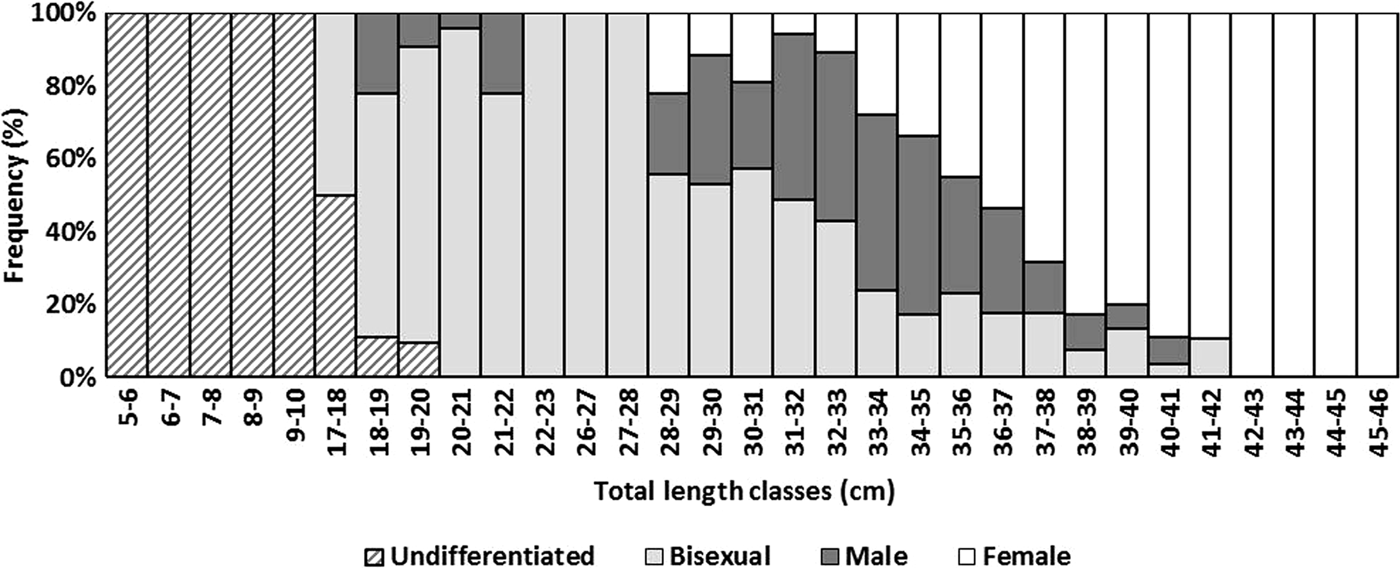
A total of 904 individuals were analysed: 853 individuals with TL ranging from 17.2 to 45.1 cm were obtained from commercial landings, and 51 individuals with TL ranging from 5.2 to 9.8 cm were caught in Óbidos lagoon (Figure 1). The Mann–Whitney test was applied to evaluate the existence of significant differences between males and females according to TL. The relationship between TL and TW was calculated using a power function (TW = aTLb) and the t-test was used to analyse differences in allometric coefficients (Zar, Reference Zar1999).
Frequency of undifferentiated, male, female and bisexual Sarpa salpa individuals.

Age and growth
The sagittal otoliths were removed, cleaned and stored dry in plastic vials. Right otoliths were immersed in a 1:1 glycerine – alcohol solution, with sulcus acusticus placed downwards, and the posterior region was observed under a stereomicroscope using reflected light, a dark background and an 18× magnification; a total of 579 otoliths were used for age determination.
To analyse the trends in growth pattern, the radius and the distances between the nucleus and the successive growth increments were measured for a total of 487 otoliths, using a micrometer eyepiece.
To analyse the consistency among readers, a subsample of 115 otoliths, covering all available length classes, was read by two of the authors to establish a reading and interpretation criteria, assuming birth date as 1 October (Matić-Skoko et al., Reference Matić-Skoko, Kraljević, Dulčić and Pallaoro2004). Reproducibility between readers was analysed using the average per cent error (APE) (Beamish & Fourier, Reference Beamish and Fourier1981), the coefficient of variation (CV) (Chang, Reference Chang1982) and the index of precision D (Chang, Reference Chang1982). A test of symmetry (Bowker, Reference Bowker1948) was used to detect systematic differences between the ages assigned by the two readers.
The marginal increment ratio analysis (MIR) (Fowler & Short, Reference Fowler and Short1998) was based on 175 otoliths and was used to test the existence of an annual growth pattern. The MIR was based on individuals ranging from 18.7 to 42.5 cm TL.
To estimate the parameters of the von Bertalanffy growth function (VBGF) (von Bertalanffy, Reference von Bertalanffy1938), two approaches were used: whole otolith readings and back-calculation. Back-calculation allowed the estimation of lengths at ages that were rarely observed (Francis, Reference Francis1990), particularly between 11 and 28 cm TL. The relationship between otolith radius (OR) and TL was established by power regression equation to back calculate the mean length-at-age (Francis, Reference Francis1990; Folkvord & Mosegaard, Reference Folkvord, Mosegaard, Panfili, Pontual, Troadec and Wright2002). According to Tuset et al. (Reference Tuset, González, Lozano and García-Días2004), the standardized residuals of the regression were used to identify which type of estimate (biological or mathematical) should be used and to determine which age class should be considered in the back-calculation analysis. The geometric mean regression was used to calculate the mean length-at-age at lower ages.
VBGF curves were fitted to length-at-age data by non-linear regression. To choose the best approach, the Akaike's information criterion (AIC) (Akaike, Reference Akaike, Petrov and Csaki1973) was used. These analyses were performed using the R routine stats software package (R-3.1.0 for Windows).
Reproduction
GONAD CHARACTERIZATION
To test the homogeneity of the oocyte distribution within and between ovaries, six spawning capable females (ranging between 35.4 and 39.2 cm TL) were analysed. Slices from the anterior, middle and posterior regions of the right ovary, and from the middle region of the left ovary were taken and oocyte size distribution was compared within and between the two ovaries using an analysis of variance (ANOVA).
Digitized images of histological sections were used to characterize each stage of spermatogenesis and oogenesis (maximum and minimum diameters were measured and the average was used). Measurements were performed on 346 male cells and on 624 oocytes with a visible nucleus using the software ImageJ (Schneider et al., Reference Schneider, Rasband and Eliceiri2012).
SEXUAL CYCLE
The sexual maturity phase of each individual was histologically assigned according to the standardized terminology proposed by Brown-Peterson et al. (Reference Brown-Peterson, Wyanski, Saborido-Rey, Macewicz and Lowerre-Barbieri2011), which divides the microscopic maturity phases into immature (1), developing (2), spawning capable (3 SC) and its actively spawning subphase (3 AS), regressing (4) and regenerating (5). Furthermore, the gonadosomatic index (GSI = (W gon/GW) × 100) of sexually mature individuals was used to identify the spawning season of salema. The hepatosomatic index (HSI = (W liv/GW) × 100) and the Fulton condition factor (K = (GW/TL3) × 100) were also estimated. Simple regression analysis was used to investigate relationships between GSI with HSI and K. The non-parametric Kruskal–Wallis test was used to investigate the significance of differences in GSI, and K between monthly samples.
LENGTH AND AGE AT FIRST MATURITY
The size at which 50% of the fish were mature was estimated for 160 males, collected during the spawning season, adjusting the following logistic function: Y = 1/(1 + exp(−1 × (a+b × TL))), where Y was the percentage of mature individuals as a function of size class (TL), and a and b are constants. Length at first maturity (L 50) was estimated as: L 50 = –(a/b). The substitution of L 50 in the von Bertalanffy growth function corresponded to the age at first maturity (A 50). Due to the lack of immature females, it was not possible to calculate their L 50 or A 50.
FECUNDITY
To investigate the fecundity type of salema, the four lines of evidence suggested by Hunter et al. (Reference Hunter, Macewicz, Lo and Kimbrel1992), Greer-Walker et al. (Reference Greer-Walker, Witthames and Bautista de los Santos1994) and Murua & Saborido-Rey (Reference Murua and Saborido-Rey2003) were examined: (i) oocyte size – frequency distribution; (ii) seasonal variation in the percentage of different oocyte classes during spawning season (i.e. previtellogenic and early vitellogenic vs advanced vitellogenic oocytes); (iii) seasonal variation in the mean diameter of the advanced vitellogenic oocytes; and (iv) incidence of atresia throughout the spawning season.
To evaluate line (i), digitized images of histological sections of 32 females in the actively spawning subphase (ranging between 30.5 and 45.1 cm TL) during the spawning season were analysed; maximum and minimum oocytes diameters were measured using the software ImageJ.
To evaluate lines (ii) and (iii), the gravimetric method (Hunter et al., Reference Hunter, Macewicz and Kimbrell1989) was applied to 41 ovaries in the actively spawning subphase sampled throughout the spawning season (ranging between 30.5 and 45.1 cm TL). From each ovary, one sample varying between 0.03–0.04 g (to the nearest 0.01 g) was taken, placed into a mesh sieve with 125 µm mesh size and sprayed with pressure water in order to separate the secondary growth oocytes (comprised between the cortical alveolar and hydrated oocytes stages) from primary growth oocytes (the mesh size of the sieve was chosen based on the mean diameter value of the cortical alveolar oocytes, estimated in histological sections. See Results section, Reproduction: Gonad characterization). Then, the oocytes were collected in a watch glass, and separated using a needle and tweezers, in order to be photographed with a digital camera coupled to a stereomicroscope. Subsequently, each image was analysed by ImageJ software with the ObjectJ plugin (available at: https://sils.fnwi.uva.nl/bcb/objectj) and the diameter threshold for each oocyte stage was defined by previous histological sections analysis. ANOVA was applied to investigate the differences between the mean number of previtellogenic and early vitellogenic oocytes, and advanced vitellogenic oocytes throughout the spawning season. The seasonal variation in the mean diameter of the advanced vitellogenic oocytes throughout the spawning season was also analysed by ANOVA.
To evaluate line (iv), the relative intensity of atresia in vitellogenic oocytes, the percentage of alpha atresia stage oocytes in the total number of oocytes present in an individual ovary (Hunter & Macewicz, Reference Hunter and Macewicz1985), was calculated using digitized images of histological sections from 15 females (varying between 30.5 and 42.9 cm TL) at the actively spawning subphase, throughout the spawning season. ANOVA was used to detect significant statistical differences in the relative intensity of atresia.
The results indicated that salema presented determinate fecundity, which implies that the standing stock of vitellogenic oocytes is fixed prior to the onset of the spawning period (Ganias et al., Reference Ganias, Murua, Claramunt, Dominguez-Petit, Gonçalves, Juanes, Keneddy, Klibansky, Korta, Kurita, Lowerre-Barbieri, Macchi, Matsuyama, Medina, Nunes, Plaza, Rideout, Somarakis, Thorsen, Uriarte, Yoneda, Domínguez-Petit, Murua, Saborido-Rey and Trippel2014) (see Results section, Reproduction: Fecundity). For species with determinate fecundity, the number of vitellogenic oocytes measured prior to the beginning of spawning is considered equivalent to the potential annual fecundity (FPa) (Hunter et al., Reference Hunter, Macewicz, Lo and Kimbrel1992; Murua et al., Reference Murua, Kraus, Saborido-Rey, Witthames, Thorsen and Junquera2003). Therefore, the gravimetric method (Hunter et al., Reference Hunter, Macewicz and Kimbrell1989) was applied to estimate FPa in 26 females at the spawning capable phase (ranging between 33.8 and 42.5 cm TL) without post ovulatory follicles (histologically confirmed). Three subsamples (varying between 0.03–0.04 g, to the nearest 0.01 g) were taken from each ovary and no significant differences were found among subsamples of the same female (χ2 test, χ2 = 66.01, df = 77, P = 0.81). The same methodology used before to analyse fecundity type lines of evidence (ii) and (iii) was followed to estimate the fecundity of salema. The realized annual fecundity (FRa) was estimated after discounted atretic losses from FPa (Murua et al., Reference Murua, Kraus, Saborido-Rey, Witthames, Thorsen and Junquera2003) and the relative annual fecundity was also calculated as the number of oocytes per gram of GW.
Before each ANOVA, the assumptions were checked. Statistical analysis was performed using Statistica software (version 12) and IBM SPSS Statistics (version 22) with a significance level of 0.05.
RESULTS
Length–weight relationship
The males ranged between 18.7–40.9 cm TL and females between 28.6–45.1 cm TL; the Mann–Whitney test revealed significant differences between sexes (U = 17123.50; P < 0.001), the females being larger than males (Figure 1).
The relationship between TL and TW was: TW = 0.06 TL2.64, R 2 = 0.85 for males, TW = 0.02TL2.91, R 2 = 0.81 for females and TW = 0.02TL2.98, R 2 = 0.85 for both sexes. Males presented a negative allometry (t = −4.24 and P < 0.05) while females and all individuals from both sexes presented an isometric growth (t = −1.14 and P > 0.5 for females; t = −0.46 and P > 0.5 for both sexes).
Age and growth
TRENDS IN GROWTH PATTERN
The analysis of the growth increments detected a false increment between 1.08 and 1.25 mm; this false increment was designated as a juvenile band since it does not correspond to a yearly growth increment because it was already present in smaller individuals (between 5.2 and 9.8 cm TL) captured in the Óbidos lagoon. The true yearly growth increments were clearly individualized being the mean and standard deviation of the first 12 increments as follows: 2.02 ± 0.03, 2.81 ± 0.02, 3.21 ± 0.03, 3.51 ± 0.03, 3.76 ± 0.44, 3.99 ± 0.32, 4.16 ± 0.40, 4.31 ± 0.61, 4.53 ± 0.54, 4.78 ± 0.04, 4.98 ± 0.03 and 5.19 ± 0.03 mm.
CONSISTENCY AMONG READERS
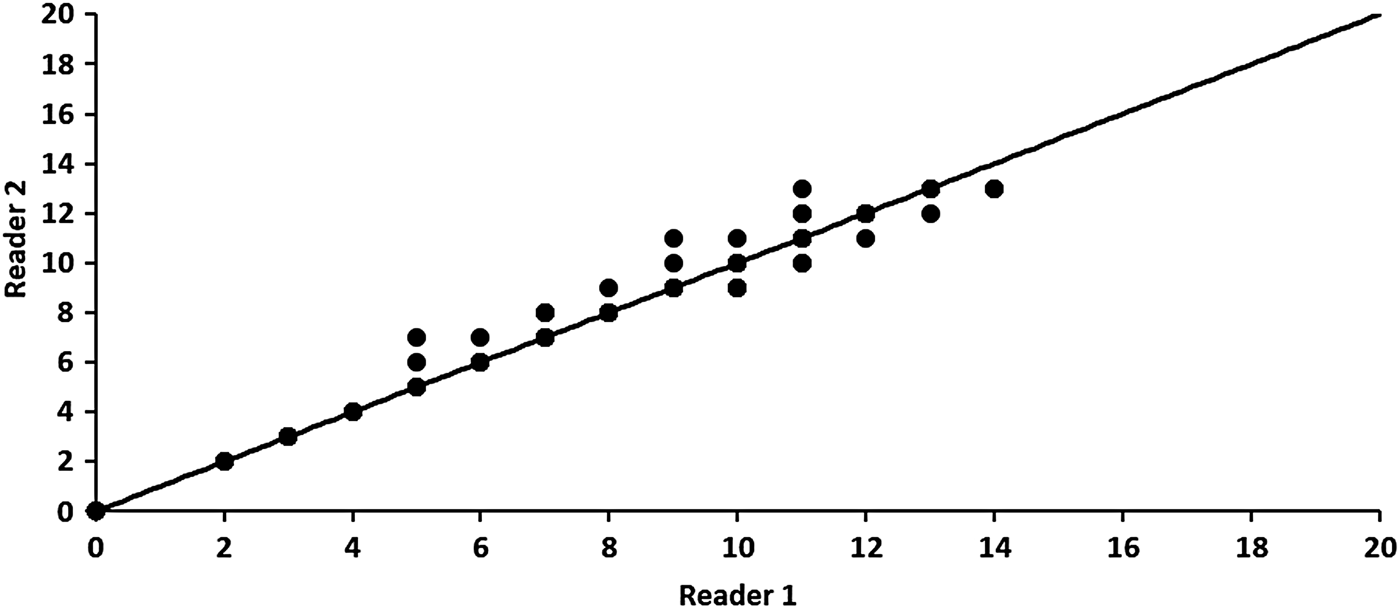
The indexes of precision between readers were 1.74, 1.37 and 1.23% for CV, APE and D, respectively. A total agreement of 79.1% and an agreement within 1 year of 97.4% were achieved. Analysing the agreement plot which compares the age assignment between readers (Figure 2), reader 2 tended to assign slightly higher ages until age 11. Nevertheless, there was no evidence of systematic disagreement between readers, as demonstrated by the test of symmetry (test of symmetry: χ2 = 12.33, df = 10, P = 0.26).
Agreement plot for comparisons between ages assigned by readers 1 and 2 in whole otoliths of Sarpa salpa.

As a good agreement between readers was achieved, the remaining otoliths were read twice by the first author, and those estimates that did not differ in more than 1 year were accepted and used to assign a modal age.
MIR, AGE DETERMINATION AND GROWTH COMPARISONS
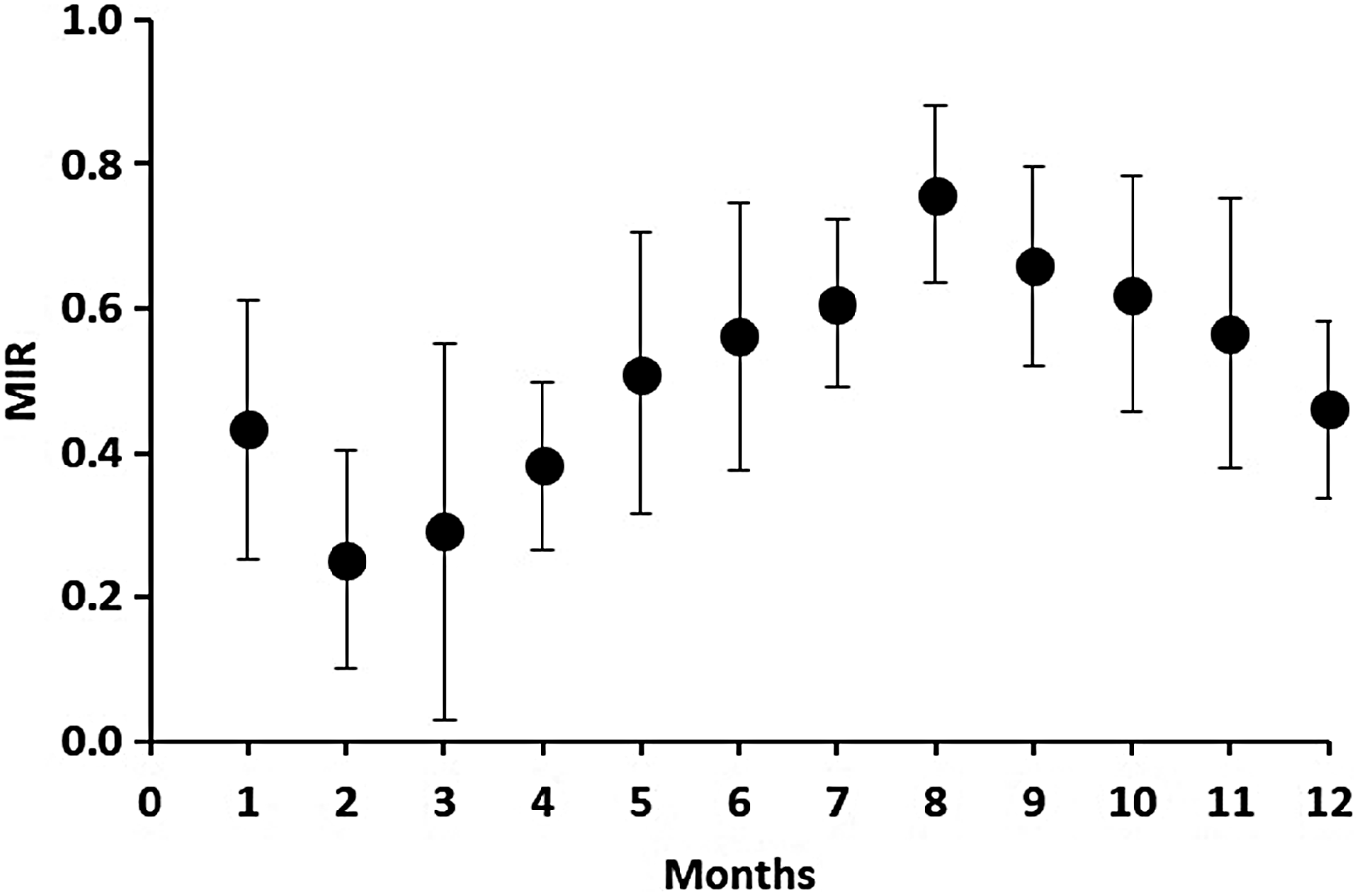
MIR showed that there is a clear annual pattern of growth increment formation, with highest values found between May and November and the lowest values between December and April, suggesting that the growth increment is formed in the latter period (Figure 3).
Monthly evolution of marginal increment ratio analysis (MIR) in whole otoliths of Sarpa salpa.

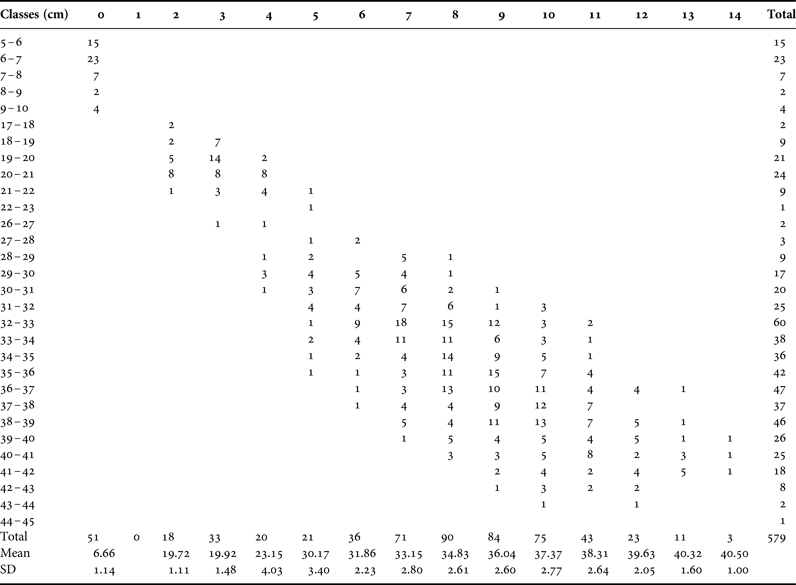
For age determination a total of 579 individuals were used, ranging between 5.2 and 44.6 cm TL. Since this species is hermaphrodite and presents sex reversal, the estimation of age by sex was not considered (Walt & Beckley, Reference Walt and Beckley1997). Table 1 presents the age-length key for all individuals; the minimum age observed was 0 years (5.2 cm TL) and the maximum age observed was 14 years (41.4 cm TL). Individuals with age 1 were not sampled.
Age-length (in cm) key obtained by direct reading of the otoliths of Sarpa salpa.

SD, standard deviation.
Regarding back-calculation approach, a good relationship between TL and OR was obtained for all individuals (TL = 99.42 OR1.22, R 2 = 0.87). The back-calculation was only applied until age class 11, since the analysis of the standardized residuals of the regression showed that otolith growth was allometric by age class 12.
Table 2 presents the VB growth parameters obtained from the two approaches used. The value of L ∞ obtained for the whole otolith readings was slightly lower than the maximum observed length, and the L ∞ value obtained from the back-calculation approach was similar to the maximum observed length. The AIC values suggested that the back-calculation approach was the best one to describe the growth of salema (Table 2).
Parameters of the von Bertalanffy growth equation calculated for Sarpa salpa in the present study and in other studies.

Comparisons between back-calculation, determined in the present study, and other studies are presented.
WOR, whole otolith reading; B, back-calculation; Standard deviation in parentheses; AIC, Akaike information criterion; N, number of individuals; df, degrees of freedom; α = 0.05 and * = P < 0.05.
Reproduction
GONADS CHARACTERIZATION
Of the 904 specimens analysed, 55 were undifferentiated, 255 were males, 346 were females and 248 were bisexuals (Figure 1). The individuals ranging between 5.2 and 9.8 cm TL were undifferentiated as well as a small percentage of individuals between 17.6 and 19.70 cm TL (0.4% of the total number of individuals). The bisexual individuals appeared between 17.2 and 41.5 cm TL, the males between 18.7 and 40.9 cm TL and the females between 28.6 and 45.1 cm TL.
In this species, the oocyte development is group-synchronous, since in the maturing ovary at least two cohorts of oocytes can be distinguished: one constituted by small oocytes to be spawned in future breeding seasons, and another formed by larger oocytes to be spawned during the current breeding season (Murua et al., Reference Murua, Kraus, Saborido-Rey, Witthames, Thorsen and Junquera2003). There were no significant differences in oocyte size distribution among and between ovaries (ANOVA, P > 0.05), so samples were collected from the middle region of the right ovary.
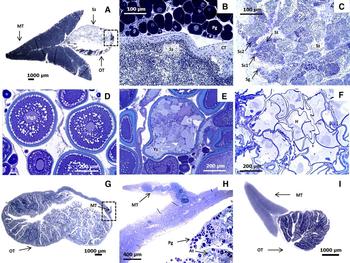
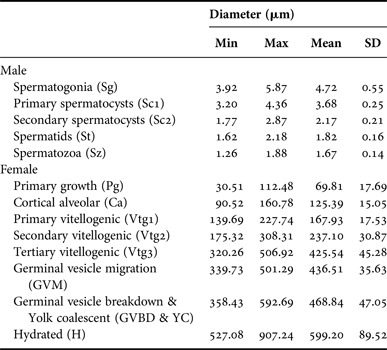
Table 3 summarizes the range size, mean and standard deviation of different sexual cells present in male and female tissues. All the analysed males presented inactive female tissue (Figure 4A, B). Different sexual cells were observed when males entered in the actively spawning subphase (Figure 4C) and the spermatic duct was full of spermatozoa (Figure 4A, B). Spawning capable females presented tertiary vitellogenic oocytes (Figure 4D) and in the actively spawning subphase yolk coalescent (Figure 4E) and hydrated oocytes (Figure 4F) were also observed. In the case of females two different types of ovaries were found: ovaries with residual male tissue (occupying a small part of the ovary) (Figure 4G, H) and ovaries with no longer visible male tissue, indicating a complete regression; in bisexual gonads both tissues were present but always in an inactive form (Figure 4I).
Cross-sections of Sarpa salpa gonads: (A) male at the actively spawning subphase; (B) detail of figure (A) assigned by a dashed square; (C) different sexual cells present in male at the actively spawning subphase; (D) tertiary vitellogenic oocyte in a female at the spawning capable phase; (E) yolk coalescence oocyte in a female at the actively spawning subphase; (F) hydrated oocytes of a female at the actively spawning subphase; (G) female at the regressing phase; (H) detail of figure G) assigned by a dashed square; (I) bisexual individual with both inactive tissues, male and female. At, atresia; CT, connective tissue; H, hydrated oocyte; MT, male tissue; OT, ovarian tissue; Pg, primary growth oocyte; Sc1, primary spermatocytes; Sc2, secondary spermatocytes; Sg, spermatogonia; St, spermatids; Sz, spermatozoa; Vtg3, tertiary vitellogenic oocyte; Yc, yolk coalescence oocyte.

Summary of the range size, mean and standard deviation (SD) of different sexual cells present in male and female tissues of Sarpa salpa.

SEXUAL CYCLE
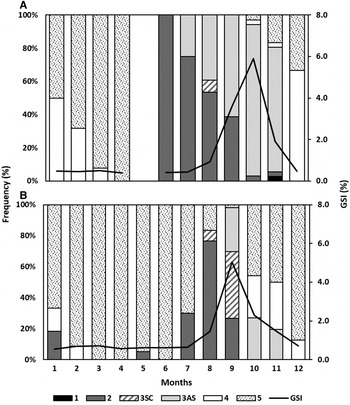
The distribution of the maturity phases of males and females throughout the year is presented in Figure 5. Immature males were rare, only being detected in January and November, and developing males occurred from June to November. Males spawning season started in September, with more than 50% being in the actively spawning subphase, and ended in November. No males were sampled in May.
Monthly variation of the maturity phases and the gonadosomatic index (GSI) for Sarpa salpa males (A) and females (B). 1, immature; 2, developing; 3 SC, spawning capable; 3 AS, actively spawning; 4, regressing; 5, regenerating.

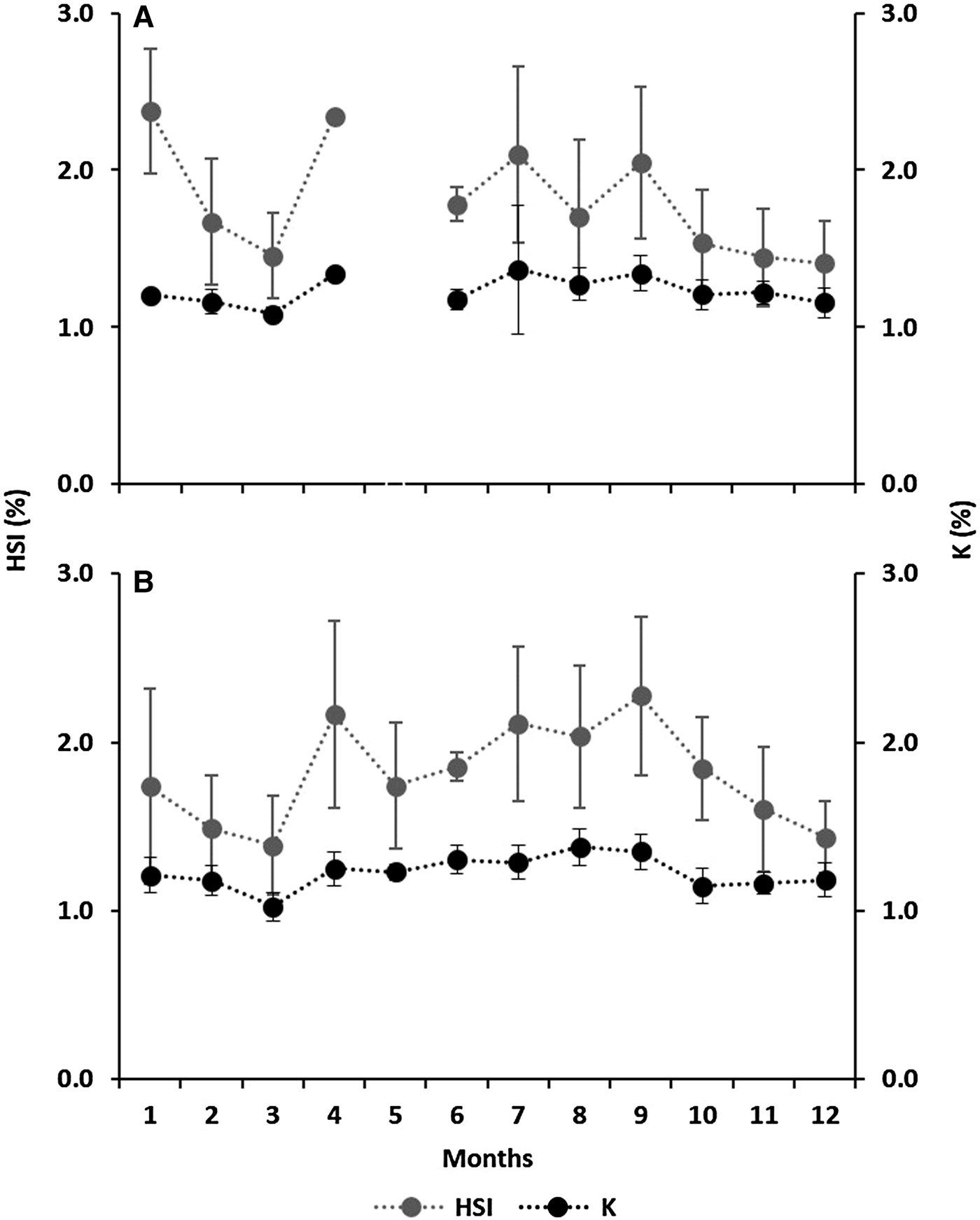
Regarding females, no immature specimens were sampled. Females spawning season coincided with males, starting in September and ending in November, and the regenerating phase was observed from December to July. Males and females GSI followed the annual sexual cycle pattern (Figure 5A, B): in males, the GSI reached its maximum value in October and in the case of females in September. The monthly evolution of the HSI and K is presented in Figure 6A for males and in Figure 6B for females. The maximum male HSI value was observed in April and the minimum value in December while in the case of females, the maximum value was observed in September and the minimum value in March. The mean K values remained relatively low (varying between 1.0–1.4%) throughout the year for both sexes, having reached their maximum value in July for males, and in August for females. Males and females GSI, HSI and K were significantly different throughout the year, as showed by Kruskal–Wallis test (H GSI = 104.11, H HSI = 65.65, H K = 98.15 for males and H GSI = 200.76, H HSI = 121.75, H K = 178.41, for females, P < 0.001). GSI and HSI for both males and females were significantly related (males: R = 0.16 and P = 0.01; females: R = 0.27 and P < 0.001). The relationship between GSI and K was significantly correlated for females (R = 0.25 and P < 0.001) but not significantly for males (R = 0.06 and P = 0.32).
Monthly variation of the mean and standard error of hepatosomatic index (HSI) and Fulton's condition factor (K) for Sarpa salpa males (A) and females (B).

LENGTH AND AGE AT FIRST MATURITY
The following logistic function Y = 1/(1 + exp(−1 × (173.63 + 7.09 × TL))) was adjusted to 160 males collected during the spawning season. The estimated L 50 was 24.5 cm TL and, based on the previous age determination, the length at first maturity corresponded to age 2. All females sampled were sexually mature and the smallest had 28.6 cm TL.
FECUNDITY
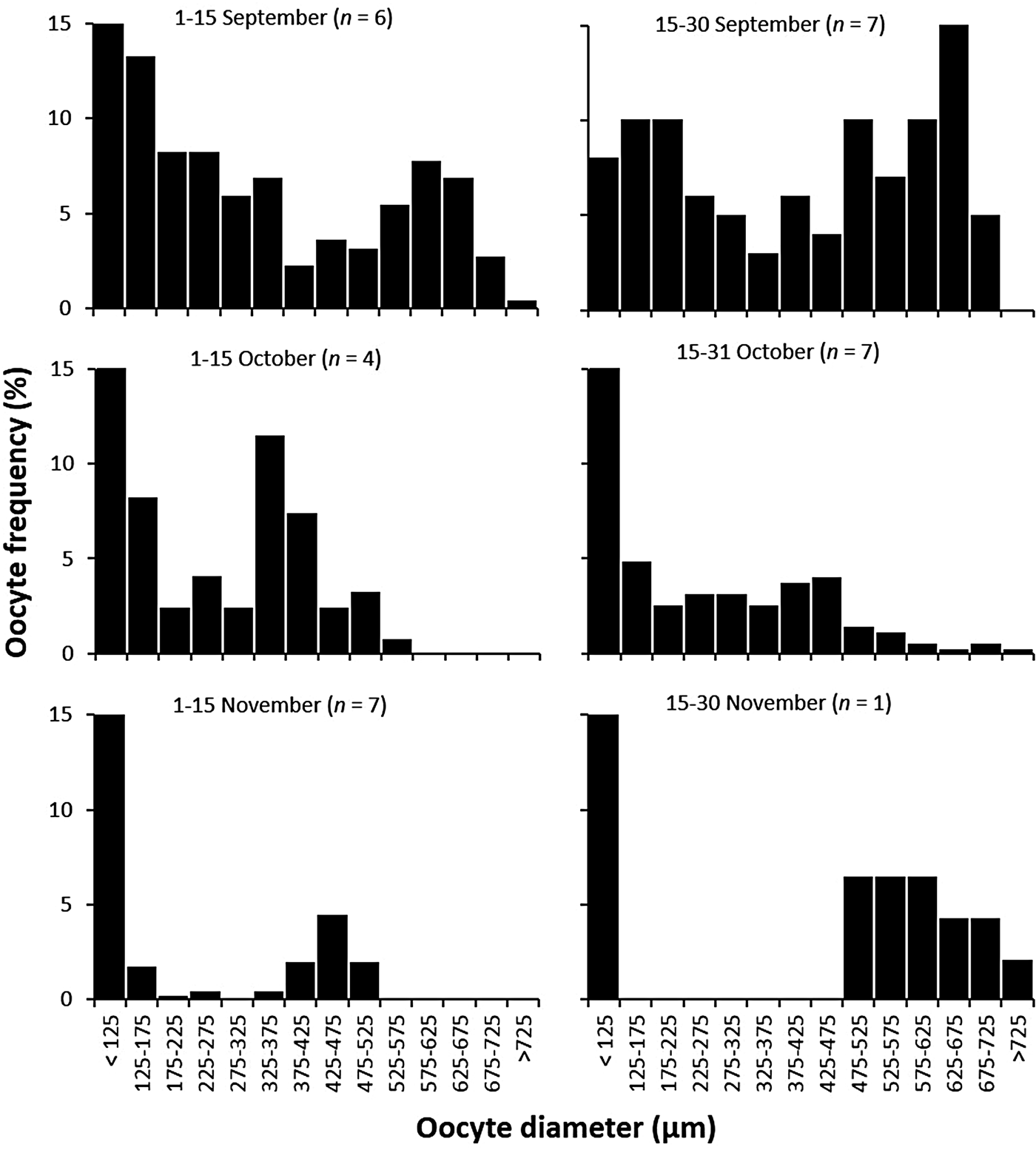
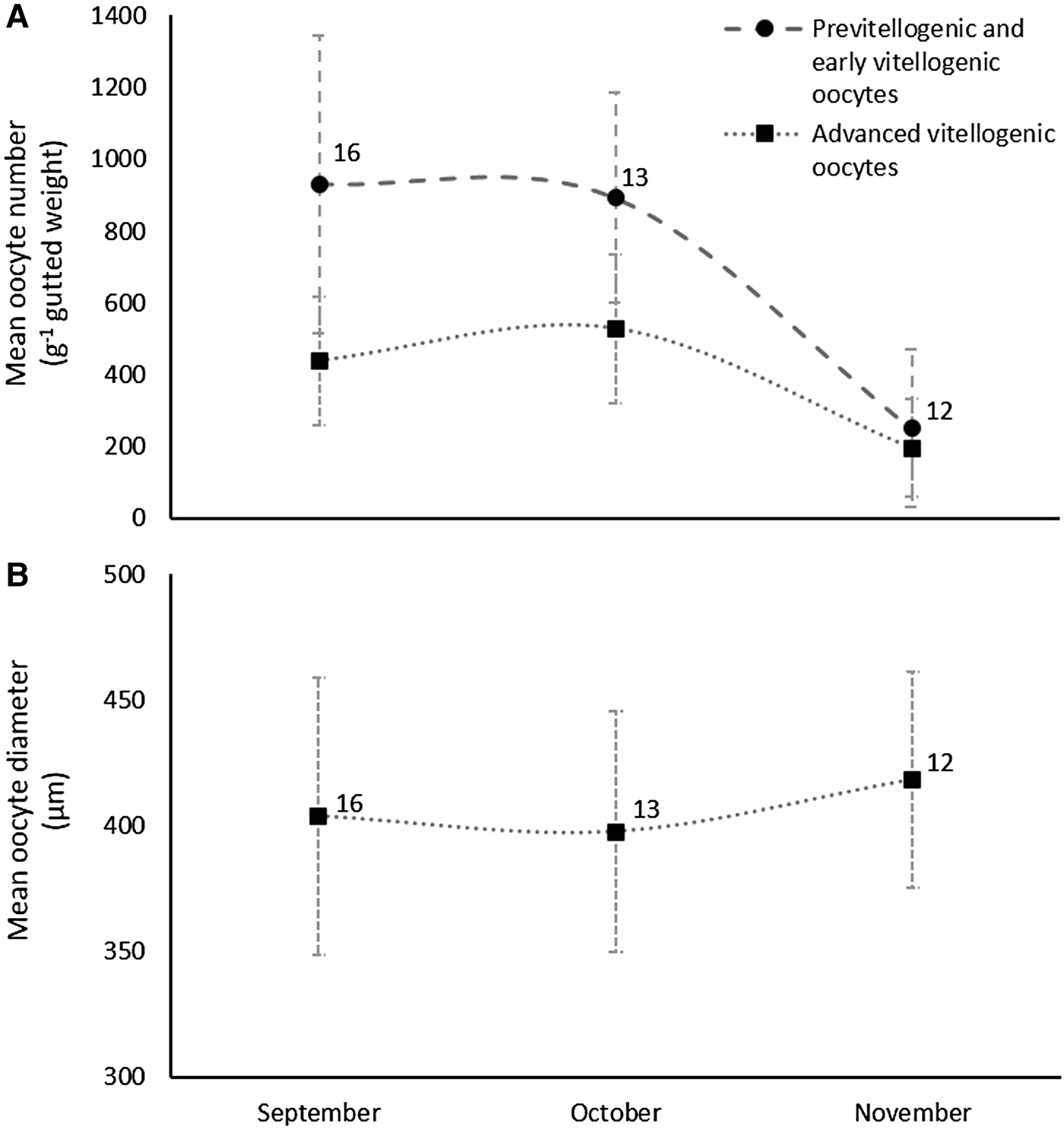
In this study four lines of evidence were analysed in order to classify the fecundity type of salema. For the (i) line of evidence, the oocyte size-frequency distribution, of the actively spawning females during the spawning season, was continuous between primary and secondary oocytes for September and October, but at the end of the spawning season, in the period between 1–15 November, a gap starts to form between 125 and 375 µm, separating the less developed oocytes from the more developed ones, and in the period between 15–30 November only oocytes lower than 125 µm and oocytes larger than 475 µm were present (Figure 7). Regarding the (ii) line, the mean oocyte number of previtellogenic and early vitellogenic oocytes showed a decreasing statistically significant trend (ANOVA: P < 0.05) throughout the spawning season (Figure 8A); the mean oocyte number of advanced vitellogenic oocytes throughout the spawning season also showed a decreasing statistical significant trend (ANOVA: P < 0.05). For the (iii) line, the mean oocyte diameter of the advanced vitellogenic oocytes increased during the spawning season but it was not statistically significant (ANOVA: P = 0.06) (Figure 8B). Finally for the (iv) line of evidence, the relative intensity of alpha atresia was low throughout the spawning season, varying between a monthly mean value of 7 ± 3.09 and 14 ± 6.85%, and no significant differences between months were found (ANOVA: P = 0.17).
Sarpa salpa oocyte size-frequency distribution per 50 µm diameter class throughout the spawning period. n, number of females used in each sampling period.

Variation of the mean and standard error of different oocyte classes (A), and mean diameter of advanced vitellogenic oocytes (B) throughout the spawning season of Sarpa salpa. The number of females used is given in the chart for each month.

The FPa ranged between 273 424 and 2 453 753 oocytes, with a mean and standard deviation of 1 063 297 ± 563 054 oocytes, and FRa ranged between 266 133 and 2 453 753 oocytes, with a mean and standard deviation of 1 048 742 ± 545 361 oocytes, and no significant differences were found between these estimations (t-test: P = 0.92). A significant power relation of FRa with W gon, GW and TL was observed, although it was stronger with W gon (FRa vs W gon: r = 0.91, P < 0.05; FRa vs GW: r = 0.69, P < 0.05; FRa vs TL: r = 0.67, P < 0.05). The relative annual fecundity varied between 462 oocytes g−1 GW (37.5 cm TL and 591.19 g GW) and 2 662 oocytes g−1 GW (41.2 cm TL and 921.62 g GW) with a mean and standard deviation of 1336 ± 571 oocytes g−1 GW.
DISCUSSION
Length–weight relationship
This study presents the greatest length range ever published on the species. Females attained higher lengths than males as already referred by other authors such as Criscoli et al. (Reference Criscoli, Colloca, Carpentieri, Belluscio and Ardizzone2006), in the central western coasts of Italy, and Villamil et al. (Reference Villamil, Lorenzo, Pajuelo, Ramos and Coca2002), in the Canary archipelago. This species is a protandrous hermaphrodite, and therefore the difference in length distribution by sex is due to the hermaphrodite condition and cannot be considered as sexual dimorphism.
The relationship between TL and TW estimated for males showed allometric growth, while isometry was found for females. According to Villamil et al. (Reference Villamil, Lorenzo, Pajuelo, Ramos and Coca2002) and Pallaoro et al. (Reference Pallaoro, Dulčić, Matić-Skoko, Kraljević and Jardas2008) the difference in the TL/TW relationship between males and females is probably due to the difference in length distribution of the two sexes as a consequence of the sexual pattern of salema. The isometry in the relationship between TL and TW for all individuals is in agreement with the results of Dulčić & Kraljević (Reference Dulčić and Kraljević1996) and Villamil et al. (Reference Villamil, Lorenzo, Pajuelo, Ramos and Coca2002) for salema of the Adriatic Sea and of the Canary archipelago, respectively. In these comparisons, data from different areas were not obtained in the same season/year as suggested by Froese (Reference Froese2006), in order to minimize the influence of abiotic (e.g. temperature, salinity) and biotic (e.g. quantity and quality of food, sex and maturity stage) factors, which may influence the TL/TW relationship (Dulčić & Kraljević, Reference Dulčić and Kraljević1996; Pallaoro et al., Reference Pallaoro, Dulčić, Matić-Skoko, Kraljević and Jardas2008).
Age and growth
Otoliths of salema showed the common increment deposition pattern of Teleostei, with translucent rings alternating with opaque rings, attributed to slow and fast growth periods, respectively. The presence of a juvenile band must most certainly be the result of an early migration to nursery areas as happens with other species, such as the European seabass, Dicentrarchus labrax (Linnaeus, 1758) (Gordo, Reference Gordo1989). Although the species presents a good individualization of the growth increments until age 12, the first two are better defined and separated which may be related to the age at first maturity obtained for males. In fact, it is known that after maturation occurs, the available energy must be first channelled to the reproductive effort and secondly to growth, leading to narrower growth increments in the forthcoming years (Wootton, Reference Wootton1992).
Whole otolith readings were compared between two readers to minimize the error associated with the subjectivity of age estimation. The APE measures the amount of variation between ages (Walt & Beckley, Reference Walt and Beckley1997) and the values estimated in the present study are below the APEs calculated for the Canary archipelago (3.1%, Villamil et al. Reference Villamil, Lorenzo, Pajuelo, Ramos and Coca2002) and for the east coast of South Africa (3.9%, Walt & Beckley Reference Walt and Beckley1997), indicating a good reproducibility of age determination for the present study. The ranges of the precision estimates calculated using the two readers were well below the average values reported in the literature (Campana, Reference Campana2001). The high precision indices found in this work also suggested that whole otoliths are adequate for age and growth studies of this species and no further techniques for ring enhancement are needed, thus avoiding expensive and long analysis processes (Paiva et al., Reference Paiva, Neves, Sequeira, Vieira, Costa, Domingos and Gordo2013).
These results suggest that salema is a medium-lived species since the oldest individual was estimated to be 14 years old. The maximum age obtained is similar to the one obtained in the Adriatic Sea (15 years, 44 cm TL) (Pallaoro et al., Reference Pallaoro, Dulčić, Matić-Skoko, Kraljević and Jardas2008), but is higher than the age estimated in the east coast of South Africa (6 years, 27 cm TL) (Walt & Beckley, Reference Walt and Beckley1997), in the central western coasts of Italy (7 years, 33 cm TL) (Criscoli et al., Reference Criscoli, Colloca, Carpentieri, Belluscio and Ardizzone2006) and in the Canary archipelago (11 years, 45 cm TL) (Villamil et al., Reference Villamil, Lorenzo, Pajuelo, Ramos and Coca2002).
The back-calculation approach has proven to be the best one to describe the growth of salema from Portuguese waters, since significant differences were obtained when comparing the estimated growth parameters using this technique with all other areas (Table 2). These discrepancies may be due to different criteria in growth pattern interpretation used in the different laboratories. To overcome this issue, an interchange otolith programme should be implemented between all laboratories involved in the study of the species. Different environmental/habitat characteristics from each area may also contribute to explain the differences found in the growth pattern.
Reproduction
Analysis of gonad organization and development confirmed that salema is a protandrous hermaphrodite. The existence of bisexual gonads between 17.2 and 41.5 cm TL showed that the sex change process is a gradual phenomenon (Criscoli et al., Reference Criscoli, Colloca, Carpentieri, Belluscio and Ardizzone2006). This had already been reported for the species in the central-east Atlantic (Canary archipelago) (Villamil et al., Reference Villamil, Lorenzo, Pajuelo, Ramos and Coca2002) where similar results (sex changed between 22.1 and 38.0 cm TL) were obtained.
Different spawning periods have been described along the distribution area and in the present study salema spawns from September to November, which is similar with the results described for the Mediterranean Sea [Adriatic: September to October (Pallaoro et al., Reference Pallaoro, Dulčić, Matić-Skoko, Kraljević and Jardas2008); western central coast of Italy: March to May and September to November (Criscoli et al., Reference Criscoli, Colloca, Carpentieri, Belluscio and Ardizzone2006); Libyan coast: October to December (El-Etreby et al., Reference El-Etreby, Ahmed, Alwany and Ali2015)] but is different for the results obtained for the Canary archipelago which described a maximal gonadal activity between December and January (Villamil et al., Reference Villamil, Lorenzo, Pajuelo, Ramos and Coca2002). Nevertheless, in the east coast of South Africa the spawning season of salema extended from March to September, with a reproductive peak from April to August (Walt & Mann, Reference Walt and Mann1998). These differences may be the result of different biotic (mainly nutritional) and environmental factors (Sarkar & Upadhyay, Reference Sarkar and Upadhyay2011), or the combination of both (Falcón et al., Reference Falcón, Besseau, Fazzari, Attia, Gaildrat, Beauchaud and Boeuf2003).
The estimated L 50 for males (24.5 cm TL) was bigger than the values recorded in the east coast of South Africa (14.5 cm fork length) (Walt & Mann, Reference Walt and Mann1998), in central western coasts of Italy (19.5 cm TL) (Criscoli et al., Reference Criscoli, Colloca, Carpentieri, Belluscio and Ardizzone2006) and in the Adriatic (20.6 cm TL) (Pallaoro et al., Reference Pallaoro, Dulčić, Matić-Skoko, Kraljević and Jardas2008), but was lower than the value recorded in the Canary archipelago (26.6 cm TL) (Villamil et al., Reference Villamil, Lorenzo, Pajuelo, Ramos and Coca2002). Our results did not allow estimating the females' L 50 since no immature females were found. This means that, after the sexual inversion, all females mature in the following season. However, and for comparison purposes, the smallest mature female obtained in the present study (28.6 cm TL) was similar to the estimated L 50 for females (29.4 cm TL), recorded in the Canary archipelago (Villamil et al., Reference Villamil, Lorenzo, Pajuelo, Ramos and Coca2002). The estimated A 50 for males (2 years) is in agreement with the results reported by Villamil et al. (Reference Villamil, Lorenzo, Pajuelo, Ramos and Coca2002), since these authors pointed out that salema attained sexual maturity between the end of the first and the second year of life.
According to Gordo et al. (Reference Gordo, Costa, Abaunza, Lucio, Eltink and Figueiredo2008), fecundity estimates are essential to calculate the spawning stock biomass, so the clarification of the fecundity type is crucial because the fecundity calculations varied according to the fecundity type. Two types of fecundity can be defined: determinate and indeterminate (Hunter et al., Reference Hunter, Macewicz, Lo and Kimbrel1992; Murua & Saborido-Rey, Reference Murua and Saborido-Rey2003). In fishes with determinate fecundity, oocyte recruitment is completed before onset of spawning and hence the number of advanced oocytes in the ovary corresponds to the FPa; in contrast, in fishes exhibiting indeterminate fecundity, oocyte recruitment and spawning period overlap, i.e. potential fecundity is not fixed before the beginning of spawning (Ganias et al., Reference Ganias, Murua, Claramunt, Dominguez-Petit, Gonçalves, Juanes, Keneddy, Klibansky, Korta, Kurita, Lowerre-Barbieri, Macchi, Matsuyama, Medina, Nunes, Plaza, Rideout, Somarakis, Thorsen, Uriarte, Yoneda, Domínguez-Petit, Murua, Saborido-Rey and Trippel2014). This is the first study to investigate the fecundity type of salema based on four lines of evidence, as suggested by Hunter et al. (Reference Hunter, Macewicz, Lo and Kimbrel1992), Greer-Walker et al. (Reference Greer-Walker, Witthames and Bautista de los Santos1994) and Murua & Saborido-Rey (Reference Murua and Saborido-Rey2003), and modelled in Ganias et al. (Reference Ganias, Murua, Claramunt, Dominguez-Petit, Gonçalves, Juanes, Keneddy, Klibansky, Korta, Kurita, Lowerre-Barbieri, Macchi, Matsuyama, Medina, Nunes, Plaza, Rideout, Somarakis, Thorsen, Uriarte, Yoneda, Domínguez-Petit, Murua, Saborido-Rey and Trippel2014).
For the (i) line of evidence no distinct hiatus could be observed between the primary and secondary oocytes growth stages during the spawning season, although a distinct gap could be observed near the end of the spawning season in November. A distinct hiatus indicates that annual fecundity is determinate whereas the lack of a hiatus may indicate that annual fecundity is indeterminate. However, the lack of a hiatus does not necessarily indicate that fecundity is indeterminate (Murua & Saborido-Rey, Reference Murua and Saborido-Rey2003): Merlangus merlangus (Hislop & Hall, Reference Hislop and Hall1974), Scomber scombrus (Greer-Walker et al., Reference Greer-Walker, Witthames and Bautista de los Santos1994), Solea solea (Witthames & Greer-Walker, Reference Witthames and Greer-Walker1995) and Trisopterus luscus (Alonso-Fernández, Reference Alonso-Fernández2011) did not present a distinct hiatus but had a determinate fecundity. On the other hand, the presence of a hiatus does not necessarily indicate that annual fecundity is determinate. Ganias et al. (Reference Ganias, Lowerre-Barbieri and Cooper2015) observed in the simulation models of extreme indeterminate patterns that oocyte size frequency distribution was continuous until almost the end of the reproductive period when a gap was formed in the last two batches, at 90% of the reproductive period. Regarding the (ii) line of evidence, a statistically significant decrease in the mean number of previtellogenic and early vitellogenic oocytes and in the mean number of advanced vitellogenic oocytes was found during spawning season, which is a clear evidence for determinate fecundity where there is no replacement of oocytes after each spawning event (Murua & Saborido-Rey, Reference Murua and Saborido-Rey2003). Regarding the (iii) line of evidence, a pattern of increase in the mean diameter of advanced vitellogenic oocytes was found throughout the spawning season although with no statistical significance. In fishes with determinate fecundity a seasonal increase in the mean diameter of secondary growth oocytes may be expected during the spawning season (Murua & Saborido-Rey, Reference Murua and Saborido-Rey2003). However, the mean diameter of secondary growth oocytes remains constant or declines as the spawning season progresses in some species with determinate fecundity, for example in S. scombrus (Greer-Walker et al., Reference Greer-Walker, Witthames and Bautista de los Santos1994) and in Gadus morhua (Kjesbu et al., Reference Kjesbu, Witthames, Solemdal and Greer-Walker1990), respectively. The results obtained in this line of evidence would be improved if a larger number of actively spawning females could have been sampled during the spawning season, which reduces the reliability of this analysis. Finally, for the (iv) line of evidence, the relative intensity of alpha atresia calculated was low throughout the spawning season, which favours the criterion of determinate fecundity. These lines of evidence suggested that the fecundity of salema can be considered as determinate and fecundity estimation was made accordingly.
El-Etreby et al. (Reference El-Etreby, Ahmed, Alwany and Ali2015) studied the fecundity of salema in Libya and found that the potential fecundity ranged from 22,952 to 15,123,096 oocytes and the relative fecundity ranged from 568 to 12,287 oocytes g−1 GW: these estimated ranges of both potential and relative fecundities were much larger than the ones obtained in the present study. These differences may be caused by the method of counting and by the different environmental conditions existing in each area where the individuals inhabit.
As mentioned in the Introduction section, salema has an unusual reproductive strategy associated with cystic structures in fish ovaries; these structures could correspond to remains of hydrated oocytes that can appear either isolated or in groups, forming a cystic structure (Paiva et al., Reference Paiva, Neves, Vieira, Sequeira, Vendrell, Costa, Peleteiro and Gordo2014). Their duration in the ovaries and their role in the reproductive strategy are not fully understood and further studies are necessary to clarify these issues but their presence may result in a reduction of the fecundity estimates.
Life history parameters can be used to provide baseline data to be applied in ecological modelling, to inform and improve the fisheries management and for stock assessments. The knowledge of the life history parameters of salema, such as medium-slow growth, short spawning season, L 50 around 25 cm, and fecundity estimates could be used in future assessment models in order to implement sustainable management measures. For example, in Portuguese waters, 18 cm TL is the minimal length allowed to catch salema (DGRM, 2015) but the estimated L 50 in the present work was higher, suggesting the need to modify the present value. Thus, the determination of the life history parameters is particularly valuable to improve effective and prudent management plans.
ACKNOWLEDGEMENTS
The authors thank José Neves for helping with sample collection of the smaller individuals for this study. We also thank the anonymous reviewers whose comments and suggestions helped to improve this manuscript.
FINANCIAL SUPPORT
R. Barros Paiva, A. Neves, V. Sequeira and A.R. Vieira were funded by grants from the Fundação para a Ciência e a Tecnologia (SFRH/BD/80268/2011, SFRH/BD/92769/2013, SFRH/BPD/70200/2010 and SFRH/BD/73506/2010).