Introduction
Post-traumatic stress disorder (PTSD) is typically associated with high-risk population groups (e.g., Vietnam war veterans, victims of rape or natural disasters), but in recent years there has been a growing interest in the extent to which the disorder applies to a wider range of traumas experienced by individuals in the community (Breslau, Reference Breslau2001; Creamer et al. Reference Creamer, Burgess and McFarlane2001; de Vries & Olff, Reference De Vries and Olff2009; McManus et al. Reference McManus, Meltzer, Brugha, Bebbington and Jenkins2009; Roberts et al. Reference Roberts, Gilman, Breslau, Breslau and Koenen2011). PTSD is a unique psychiatric disorder in that exposure to a specific type of traumatic event is one of the diagnostic criteria in the Diagnostic and Statistical Manual IV (DSM-IV) and DSM-5. Although PTSD is relatively rare in the community, with the estimated lifetime prevalence ranging between 1 and 7.8% (Helzer et al. Reference Helzer, Robins and McEvoy1987; Kessler et al. Reference Kessler, Sonnega, Bromet, Hughes and Nelson1995; McManus et al. Reference McManus, Meltzer, Brugha, Bebbington and Jenkins2009; Roberts et al. Reference Roberts, Gilman, Breslau, Breslau and Koenen2011), around one-third (Helzer et al. Reference Helzer, Robins and McEvoy1987; McManus et al. Reference McManus, Meltzer, Brugha, Bebbington and Jenkins2009; Roberts et al. Reference Roberts, Gilman, Breslau, Breslau and Koenen2011) to a half (Kessler et al. Reference Kessler, Sonnega, Bromet, Hughes and Nelson1995; Creamer et al. Reference Creamer, Burgess and McFarlane2001; de Vries & Olff, Reference De Vries and Olff2009) of adults report experiencing a DSM-IV qualifying traumatic event at any time in life.
Previous epidemiological studies have estimated exposure to trauma and PTSD prevalence using traumatic events covered by structured diagnostic interviews (Gray et al. Reference Gray, Litz, Hsu and Lombardo2004) to closely replicate the list of events covered by the DSM-IV A1 criterion. This approach may however underestimate prevalence if qualifying events are not listed. It also precludes analysis into the risk of PTSD associated with traumas which are not covered, which may be useful for clinicians in providing a more sensitive diagnosis of PTSD in the community. An unbiased estimate of the risk of PTSD given a traumatic event could be obtained by allowing participants to describe traumatic events which are then subsequently coded as qualifying or not. To our knowledge, no study of this type has been reported.
With the introduction of DSM-5 the diagnostic criteria for PTSD changed. In an effort to address concerns of a ‘criterion creep’ (Summerfield, Reference Summerfield and Rosen2004; Rosen et al. Reference Rosen, Lilienfeld, Frueh, McHugh and Spitzer2010) DSM-5 restricted the range of qualifying traumatic events which would allow a diagnosis to be made (American Psychiatric Association, 2013). This concern arose, in part, from the broadening of qualifying events that occurred in DSM-IV to include those in which a person is not directly exposed to trauma, but rather learns about someone else being traumatised. There was also an accompanying increase in the number of ways in which a person could meet the minimum symptom criteria for PTSD, from 135 in DSM-III (from 12 symptoms) to 1750 in DSM-IV (17 symptoms); as well as reports during the drafting of DSM-5 that the witnessing of televised events might be included as qualifying events (Rosen et al. Reference Rosen, Lilienfeld, Frueh, McHugh and Spitzer2010). It is not clear what impact the changes in the diagnostic criteria from DSM-IV to DSM-5 will have on the reported prevalence of PTSD in the community.
The present study examines traumatic events and PTSD in a sample of 4558 adults, ranging from early adulthood to old age, resident in a socially diverse post-industrial area of south Wales, in the UK (Fone et al. Reference Fone, Dunstan, White, Kelly, Farewell, John, Lyons and Lloyd2013). Our first objective was to investigate the risk of PTSD associated with specific traumatic events in a community sample using a new method of recording trauma. Our second objective was to investigate the effect that changes from DSM-IV to DSM-5 would have on the reported prevalence of PTSD in community-based studies.
Method
Participants
Data were drawn from wave 2 of the Caerphilly Health and Social Needs (CHSNS) longitudinal study, described in detail elsewhere (Fone et al. 2012). Briefly, the baseline study included a postal questionnaire survey of 17 797 individuals aged 18–74 years based on a small-area stratified random sample from the 118 392 residents of Caerphilly County Borough, Wales, UK aged 18 and over on May 31st 2001. Valid responses were obtained from 10 892 participants, representing an adjusted response of 63%. The follow-up survey was conducted in 2008 when 9551 subjects were alive and still resident in the study area. Of these, a total of 4558 (50.2%) participants returned valid questionnaires. The study was approved by the South East Wales Research Ethics Committee.
Measurements
Exposure to traumatic events
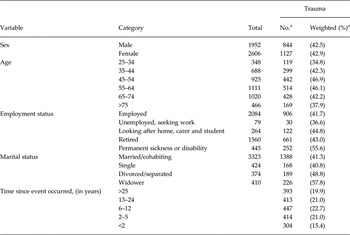
Exposure to traumatic events was assessed in the follow-up survey using two questions: ‘Have you ever experienced a major traumatic event?’ (yes/no) followed by, ‘What is the worst traumatic event you have experienced in your life?’ with a box to describe the event. Descriptions of events were coded against those listed in the Composite International Diagnostic Interview (CIDI) and Life Events Checklist (LEC) (Kessler et al. Reference Kessler, Sonnega, Bromet, Hughes and Nelson1995; Gray et al. Reference Gray, Litz, Hsu and Lombardo2004). Following piloting of coding, 39 traumatic events reported by participants were not covered by CIDI and 36 not covered by the LEC. We collapsed common events across the CIDI and LEC, and created categories for events which were not covered (e.g., miscarriage, learned about a transportation accident). When participants reported multiple events (23.6% instances; 465/1971), the first listed traumatic event was taken as the ‘worst' event. The final taxonomy had 25 individual types of traumatic events, categorised into six composite groups (assaultive violence includes: physical assault; sexual assault; other injury or traumatic event includes: natural disaster; other serious accident; transportation accident; child abuse; other life-threatening traumatic events; witnessed violent or unexpected death includes witnessed illness or death of someone; finding a loved one dead; death of a child or grandchild; miscarriage/still born/death of a new born; learned about traumas including learning about: physical assault; sexual assault; transportation accident; unexpected death; life-threatening illness or injury; learned about a non-life-threatening illness or injury). DSM-IV non-qualifying events include: non-life-threatening events; death of a partner; death of a parent; death other than parent/partner/child/grandchild; divorce/separation/custody (see eTable 1 for a full list) (Table 1).
Characteristics of 4558 men and women according to exposure to trauma
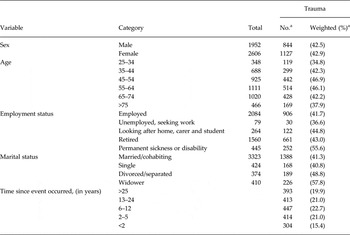
aUnweighted numbers of persons exposed to each trauma and weighted percentages adjusting for sampling design and non-response.
Some of the variables for those reporting no trauma have missing data and the numbers do not add up to the total.
Two independent coders assigned each description of a traumatic event to the appropriate category on the taxonomy. This coding was then independently repeated on a randomly selected 30% of all of the events by a third coder. If coders classified open responses as being two different types of traumatic event, disagreements were resolved through discussion. The percentage of agreements and Cohen's kappa statistic (Cohen, Reference Cohen1960) were used to assess inter-rater reliability of coding.
Post-traumatic stress disorder caseness
All participants who reported a traumatic event completed the Traumatic Screening Questionnaire (TSQ; Brewin et al. Reference Brewin, Rose, Andrews, Green, Tata, McEvedy, Turner and Foa2002), and questions on DSM-IV (A1 and A2) and DSM-5 (A) criteria. The TSQ was used to assess symptoms and reactions to traumatic events experienced at least twice in the past week. A cut-point of ≥6 symptoms in the past week was applied to the TSQ. This cut-point has a high level of agreement with DSM-IV diagnosis of PTSD using structured clinical interviews (Clinician-Administered PTSD Scale: sensitivity = 0.86; specificity = 0.93, Blake et al. Reference Blake, Weathers, Nagy, Kaloupek, Gusman, Charney and Keane1995) and established self-report measures of PTSD (PTSD Symptom Scale–Self Report version: sensitivity = 0.76; specificity = 0.97, Foa et al. Reference Foa, Riggs, Dancu and Rothbaum1993) suggesting the TSQ is a sensitive and specific measure of PTSD against DSM-IV criteria.
In DSM-IV the definition of a qualifying traumatic event was revised. To qualify, an traumatic event in DSM-IV had to meet A1 criterion – that a person must have ‘experienced, witnessed, or been confronted with an event that involves actual or threatened death or injury, or a threat to the physical integrity of self or others’ (p. 467), and also meet A2 criterion, the person's response must have ‘involved intense fear, helplessness or horror’ (p. 467, APA 1994). In line with DSM-IV, A1 criterion was assessed using the question, ‘Did the event involve actual or threatened death or serious injury, or a threat to the physical integrity of yourself or others?’, and A2 criterion with ‘Did your response at the time of the event involve intense fear, helplessness or horror?’
A DSM-IV PTSD case was defined as a participant who met all of the following criteria: (1) they provided a description of a DSM-IV qualifying traumatic event; (2) they met the DSM-IV A1 criterion, (3) they met the DSM-IV A2 criterion and, (4) had a TSQ score ≥6.
Owing to the ambiguity in traumatic events that are covered under the DSM-5 A criterion (American Psychiatric Association, 2013), in particular the interpretation of ‘threatened death,’ we constructed two measures of the DSM-5 A criterion and therefore two diagnoses of DSM-5 PTSD. In the first, we excluded A1 events classified as learning about a long-term illness or injury, and learning about an unexpected death. In the second, we excluded these events as well as life-threatening illnesses or injuries. Participants were defined as a DSM-5 PTSD case if they had a TSQ score ≥6 and described an event which met either of the above described DSM-5 A criterions. For both DSM-5 diagnoses, in line with the revised criteria, we excluded the DSM-IV A2 criterion (American Psychiatric Association, 2013).
Thus, the definitions of PTSD caseness applied are derived from DSM-IV and DSM-5 criteria and a screening measure previously used to estimate PTSD prevalence in the community (McManus et al. Reference McManus, Meltzer, Brugha, Bebbington and Jenkins2009) rather than a clinical interview.
Social and demographic variables
The survey recorded information on participants’ age, sex, marital status and employment status, and the age at which the traumatic event occurred using open responses to the question, ‘How old were you when the event occurred?’
Statistical procedures
We used the χ2 test to examine differences in the exposure to traumatic events between men and women. We then estimated the proportion of participants in each composite traumatic event group who were a case of PTSD on the TSQ; met DSM-IV A1, DSM-IV A2, DSM-5 A criterion, and were a DSM-IV and DSM-5 case of PTSD. In line with published methods, (Breslau et al. Reference Breslau, Kessler, Chilcoat, Schultz, Davis and Andreski1998) we calculated the percentage of PTSD cases attributed to each type of traumatic event as the number of cases attributed to a trauma in a social and demographic category/total N cases in that social and demographic category.
The data were weighted using the product of design weights for unequal small-area sampling fractions and non-response weights based on the probability of response by age, sex and socioeconomic status at both waves using standard methods (Crockett et al. Reference Crockett, Rafferty, Higgins and Marshall2011). All analyses were carried out with Stata v.12 computer software.
Results
A total of 2142 participants reported a traumatic event of whom 1971 (92.0%) provided information on the type of traumatic event, A1 and A2 criteria, TSQ items and sociodemographic factors. The rate of agreement between coders of the free-text descriptions of traumatic events was high (92.1% agreement) as was the level of inter-rater reliability (κ = 0.91).
Prevalence of exposure to traumatic events
Approximately one-half of those who reported a trauma listed a DSM-IV qualifying event. Of these, life-threatening illness or injuries and learned about traumas were the most common.
Of life-threatening illnesses or injuries, cancers (28.9%) and cardiovascular disease (28.6%) were the most frequently described. DSM-IV non-qualifying events were reported by just under half of the sample, death of a parent (18.6%) being the most common non-qualifying event (see eTable 1 in online supplement). Table 1 shows traumatic events were more common in participants who were permanently sick or disabled (p < 0.001), widowed (p < 0.001) and divorced (p = 0.01), but reported less frequently by those who were married (p = 0.002) or single.
There was a non-significant difference in the proportions of women and men reporting a traumatic event (56.8% v. 43.2%; p = 0.33). Women were approximately twice as likely to report witnessing death or illness (66.6% v. 33.4; p = 0.01), whereas men reported more events classed as other injuries or traumatic events (43.9% v. 56.9; p = 0.002), and life-threatening illnesses or injuries (43.6% v. 56.4; p < 0.001).
Comparison of PTSD caseness using DSM-IV and DSM-5 criteria
The percentage of participants defined as a DSM-IV PTSD case was 14.3 (95% CI = 12.8, 15.9%), with a slightly higher prevalence in women than men (15.8% v. 12.5%; 3.3% difference; 95% CI = 0.2, 6.4). Using the DSM-5 criteria, excluding events regarding learning about a long-term illness or injury and learning about an unexpected death, 11.7 (95% CI = 10.4, 13.2%) of participants were identified as a case of PTSD. Using the more stringent A1 criterion, which also excluded life-threatening illnesses or injuries, 8.1 (95% CI = 6.9, 9.4%) were defined as a DSM-5 case of PTSD.
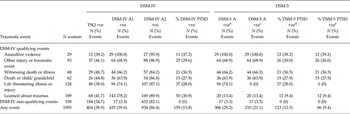
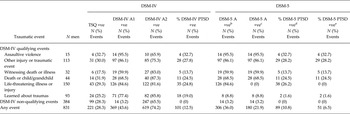
Tables 2 and 3 show that around 30–40% of events described were a case of PTSD on the TSQ and met the DSM-IV A1 criterion. Application of DSM-5 A criterion which omitted events classed as learning about a long-term illness or injury and learning about an unexpected death led to a 7.6% (men) and 10.4% (women) reduction in the percentage of A1 qualifying events. Further exclusion of life-threatening illnesses halved the proportion of events classified as a DSM-5 A qualifying event in comparison to DSM-IV A1. The majority of events reported by women (86.4%) and men (74.2%) met the DSM-IV A2 criterion. Thus, removal of A2 criterion had very little effect on estimates using DSM-5 as PTSD case status was predominately determined by case status on the TSQ and the type of traumatic events covered in A1.
Proportion of PTSD cases associated with different types of trauma according to DSM-IV and DSM-5 criteria in 1095 women a
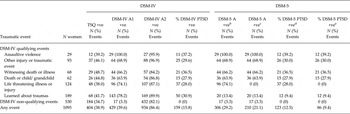
PTSD, post-traumatic stress disorder; DSM-IV, Diagnostic and Statistical Manual IV; DSM-5, Diagnostic and Statistical Manual V.
a Unweighted numbers of persons exposed to each trauma and weighted percentages adjusting for sampling design and non-response.
bReplicates DSM-IV A1 except for removal of learned about life-threatening illness or injury and learned about unexpected death.
cReplicates DSM-IV A1 except for removal of life-threatening illness or injury, learned about unexpected death and learned about a life-threatening illness or injury.
dDSM-5 case using DSM-5 A criterion removing learned about life-threatening illness or injury and learned about unexpected death.
eDSM-5 case using DSM-5 A criterion without life-threatening illness or injury and learned about life-threatening illness or injury and learned about unexpected death.
Proportion of PTSD cases associated with different types of trauma according to DSM-IV and DSM-5 criteria in 831 men a

PTSD, post-traumatic stress disorder; DSM-IV, Diagnostic and Statistical Manual IV; DSM-5, Diagnostic and Statistical Manual V.
a Unweighted numbers of persons exposed to each trauma and weighted percentages adjusting for sampling design and non-response.
bReplicates DSM-IV A1 except for removal of learned about life-threatening illness or injury and learned about unexpected death.
cReplicates DSM-IV A1 except for removal of life-threatening illness or injury, learned about unexpected death and learned about a life-threatening illness or injury.
dDSM-5 case using DSM-5 A criterion removing learned about life-threatening illness or injury and learned about unexpected death.
eDSM-5 case using DSM-5 A criterion without life-threatening illness or injury and learned about life-threatening illness or injury and learned about unexpected death.
Around one-third of participants who reported a qualifying or non-qualifying event were a case of PTSD on the TSQ (p = 0.11), with little variation across the type of event suggesting there was little difference in the level of trauma associated with different types of events (see eTable 2 in online supplement). As there were differences in the proportion of participants classified as DSM-5 case according to the different definitions of A1 qualifying events, we calculated the proportion of cases and risk of PTSD resulting from different traumas using DSM-IV criteria only.
Comparison of proportion of PTSD cases and risk of PTSD resulting from different types of traumas
Life-threatening illnesses or injuries contributed the most DSM-IV PTSD cases, with 19.3% (95% CI = 14.0, 26.0%) cases in women and 33.1% (95% CI = 25.0, 42.2%) in men. Although rare, physical and sexual assaults were most likely to translate into a case of PTSD using DSM-IV criteria, with 37.2% of events meeting DSM-IV criteria.
Discussion
In our analysis of 4500 adults in early adulthood to old age, life-threatening illness or injuries were the most prevalent DSM-IV A1 qualifying event, and contributed the largest proportion of DSM-IV PTSD cases. Assaultive violence was associated with the highest risk of PTSD. Application of DSM-5 criterion, which removed life-threatening illness and injuries (American Psychiatric Association, 2013) reduced the proportion of PTSD cases in women by 6.4% and in men by 6.0%.
Few studies have examined which events are most likely to precipitate a DSM-IV PTSD diagnosis. In the cohorts we identified, two in US cities examined trauma in early adulthood (Breslau et al. Reference Breslau, Kessler, Chilcoat, Schultz, Davis and Andreski1998, Reference Breslau, Wilcox, Storr, Lucia and Anthony2004) and one national survey (Roberts et al. Reference Roberts, Gilman, Breslau, Breslau and Koenen2011) found around 15–20% of assaults of a physical or sexual nature, which occurred as an adult or child, (Roberts et al. Reference Roberts, Gilman, Breslau, Breslau and Koenen2011) translated into a case of DSM-IV PTSD. Our findings demonstrate that although very rare, 32.7% of men and 37.2% of women who reported a physical or sexual assault were identified as a DSM-IV case of PTSD. These findings suggest one reason for peak incidence of PTSD in early adulthood is because assaultive violence is more common in this age group (Breslau et al. Reference Breslau, Davis, Andreski, Peterson and Schultz1997a , Reference Breslau, Davis, Peterson and Schultz b ).
At least five previous cohorts have examined the prevalence of different types of traumatic events (Breslau et al. Reference Breslau, Kessler, Chilcoat, Schultz, Davis and Andreski1998, Reference Breslau, Wilcox, Storr, Lucia and Anthony2004; Perkonigg et al. Reference Perkonigg, Kessler, Storz and Wittchen2000; de Vries & Olff, Reference De Vries and Olff2009; Roberts et al. Reference Roberts, Gilman, Breslau, Breslau and Koenen2011). In the 1996 Detroit Area Survey of Trauma (Breslau et al. Reference Breslau, Kessler, Chilcoat, Schultz, Davis and Andreski1998), sudden or unexpected deaths of a close friend or relative were the most commonly reported type of event, and also made up the greatest proportion of PTSD cases. In a long-term follow-up of young adults from a trial conducted in deprived US schools (Breslau et al. Reference Breslau, Wilcox, Storr, Lucia and Anthony2004), witnessing a killing or serious injury was the most frequently reported, and another sample of young adults (aged 14–24) from Munich (Perkonigg et al. Reference Perkonigg, Kessler, Storz and Wittchen2000), found assaultive violence was the most prevalent type of event.
Our estimates are more consistent with those from random samples in the US (Roberts et al. Reference Roberts, Gilman, Breslau, Breslau and Koenen2011) and Netherlands that show life-threatening illnesses and injuries are the most commonly reported trauma, accounting for around one-third of PTSD cases in the community. DSM-IV PTSD cases in men were predominately due to life-threatening illnesses, and other injuries (e.g., transportation accidents), whereas for women witnessing death and illness and learning about traumas were more common. These sex differences for PTSD are likely to reflect the higher rate of occupational hazards faced by men (Salminen, Reference Salminen2004), and higher rate of life threatening illness in middle aged men (Singh-Manoux et al. Reference Singh-Manoux, Guéguen, Ferrie, Shipley, Martikainen, Bonenfant, Goldberg and Marmot2008), which are witnessed by women.
We could find only one recent study which examined the impact of changes in DSM-5 on PTSD prevalence. In a web-based survey of college aged students, application of the proposed changes in DSM-5 A-F criteria led to between a 0.4 and 1.8% increase in prevalence (Elhai et al. Reference Elhai, Miller, Ford, Biehn, Palmieri and Frueh2012). However, this study used the Stressful Life Events Screening Questionnaire (Goodman et al. Reference Goodman, Corcoran, Turner, Yuan and Green1998) which only includes 12 traumatic events and so may under-report the true prevalence of A1 qualifying events. Lending some support to the abolition of criterion A2 in DSM-5 and retention of A1 (Kilpatrick et al. Reference Kilpatrick, Resnick and Acierno2009), we showed that the majority of DSM-IV non-qualifying events in our study (73.2%) met the A2 criterion, whereas only 3.4% of non-qualifying events met the A1 criterion, suggesting greater discrimination by A1 than A2 criterion. Application of the version of the DSM-5 A criterion removing life-threatening illnesses and injuries led to around a 6.2% fall in the proportion of PTSD cases in comparison to DSM-IV, questioning the decision to restrict the A1 criterion in DSM-5. It also suggests that DSM-5 could lead to an underestimation of prevalence and diagnosis in adults in middle to old age who are more likely to experience a life-threatening illness.
Our findings also challenge the argument that the vast majority of cases of PTSD do not develop without exposure to a DSM-IV A1 qualifying traumatic event (Brewin et al. Reference Brewin, Lanius, Novac, Schnyder and Galea2009; Kilpatrick et al. Reference Kilpatrick, Resnick and Acierno2009; Friedman et al. Reference Friedman, Resick, Bryant and Brewin2011). Replicating the work other studies (de Vries & Olff, Reference De Vries and Olff2009), we showed that participants often described a DSM-IV non-qualifying as their ‘worst’ traumatic event. Extending previous work we showed that around a third of people reporting a non-qualifying event were a case PTSD on the TSQ, suggesting a comparable level of symptoms experienced by participants who reported a qualifying or non-qualifying event.
The main strengths of this study lie in its size, in-depth sampling and wide age range between 25 and 81 years. An important advance in this study was the use of a free text, or idiographic, method of recording the type of traumatic event, which attempted to reduce the likelihood that qualifying events were missed that may occur when checklists of traumatic events are presented. It is not, however, without limitations. First, although attrition is inevitable in prospective cohorts, the dataset we used represented a 50.2% response. Respondents at wave 2 had better mental health and were more likely to be resident in less deprived areas than non-respondents; (Fone et al. Reference Fone, Dunstan, White, Kelly, Farewell, John, Lyons and Lloyd2013) thus estimates of PTSD case status are likely to have been underestimated. Second, we used items to assess DSM-IV and DSM-5 A criterion and a screening measure rather than a clinical interview, such that we did not quantify the duration of symptoms (DSM-IV criterion E). This is potentially important as our analysis may have generated slightly different results applying a stricter diagnostic criterion. However, the TSQ cut-point of ≥6 is sensitive in identifying cases of DSM-IV PTSD compared to a structured clinical interview, suggesting exclusion on criterion E would not have produced a large difference in screening rates (Brewin et al. Reference Brewin, Rose, Andrews, Green, Tata, McEvedy, Turner and Foa2002), and application of a screening measure would not have compromised our aim of assessing the relative risk of PTSD associated with trauma and the impact of changes to A criterion. Third, recall bias is possible since the data in this study are based on respondents’ recall of their experiences over a lifetime. However, because the assessment of events across the life span was important in this study, short of longitudinal studies from childhood to adulthood, retrospective lifetime data of this nature are essential.
To our knowledge, this is the largest study to estimate the risk of PTSD associated with specific traumatic events in the general population, and describe the impact that changes in the A criteria from DSM-IV to DSM-5 would have on the estimated prevalence of PTSD in community-based studies. Our results demonstrate that although the highest risk of PTSD in adults is from physical and sexual assaults, life-threatening events and illnesses are the most common type of traumatic event and they account for the majority of PTSD cases. The high prevalence of life-threatening illness being reported as the worst traumatic event participants had experienced, along with its association with high levels of PTSD symptomatology, suggests that strong consideration should be given to including life-threatening illness as a qualifying traumatic event in the next iteration of the DSM-5 (DSM-5.1). Exclusion of these events from in DSM-5 could mean that fewer people, particularly those in middle to old age, will be identified as a case of PTSD, leading not only to a reduction in the number of cases identified in the community, but also access to treatments to alleviate the disabling symptoms of PTSD.
Acknowledgements
The baseline Caerphilly Health and Social Needs survey was supported by the Wales Office of Research and Development (R00/1/017). The follow-up survey was supported by a Welsh Assembly Government/Medical Research Council Health Research Partnership Award (H07-3-030). We would like to thank the study participants and many of the staff of the former Gwent Health Authority, the Caerphilly Local Health Group and their successor organisations and Caerphilly county borough council, in particular the Chief Executive's Office and the Electoral Services Department, for their help in running this collaborative study. The sampling frame was prepared by Dr Gareth John of the NHS Wales Informatics Service. The work was undertaken with the support of The Centre for the Development and Evaluation of Complex Interventions for Public Health Improvement (DECIPHer), a UKCRC Public Health Research: Centre of Excellence.
Financial Support
Funding from the British Heart Foundation, Cancer Research UK, Economic and Social Research Council (RES-590-28-0005), Medical Research Council, the Welsh Government and the Wellcome Trust (WT087640MA), under the auspices of the UK Clinical Research Collaboration, is gratefully acknowledged.
Statement of Interest
None.
Ethical Standards
The authors assert that all procedures contributing to this work comply with the ethical standards of the relevant national and institutional committees on human experimentation and with the Helsinki Declaration of 1975, as revised in 2008.
Supplementary materials and methods
The supplementary materials referred to in this article can be found at http://dx.doi.org/10.1017/S2045796014000110