Introduction
Since the 1990s, significant progress has been made in the dating of Middle and Upper Palaeolithic humans in Eurasia (e.g. Kuzmin & Keates Reference Kuzmin and Keates2014). The importance of the direct dating of human remains, rather than associated deposits (e.g. Trinkaus Reference Trinkaus2005: 211; Keates et al. Reference Keates, Hodgins, Kuzmin and Orlova2007), is now recognised. Generally, the most secure way to establish the age of this material is to conduct radiocarbon (14C) dating, and the most commonly used material is the organic component of bone—collagen (e.g. Longin Reference Longin1971; Stafford et al. Reference Stafford, Hare, Currie, Jull and Donahue1991; Brock et al. Reference Brock, Higham, Ditchfield and Ramsey2010; Marom et al. Reference Marom, McCullagh, Higham, Sinitsyn and Hedges2012). Although there are other methods of dating bones, tusks and teeth, the application of uranium-series or electron spin resonance for direct dating of humans is less straightforward than the radiocarbon technique because several types of additional information are required (e.g. Grün Reference Grün2006).
Recently, new radiocarbon dates have been obtained for several Upper Palaeolithic human burials at Sungir and Kostenki in the central Russian Plain; general information about these sites can be found in Hoffecker (Reference Hoffecker2002: 148–52, Reference Hoffecker2017: 252–92). Sungir (also Sungir’ and Sunghir) is a unique middle Upper Palaeolithic site and burial ground, extremely rich in grave goods. Bones from three skeletons were radiocarbon dated: an adult male (S-1), and two adolescent males (S-2 and S-3) in a double burial; a fragment of femur (S-4) placed near the S-2 individual was also dated (Marom et al. Reference Marom, McCullagh, Higham, Sinitsyn and Hedges2012; Kuzmin et al. Reference Kuzmin, van der Plicht and Sulerzhitsky2014; Nalawade-Chavan et al. Reference Nalawade-Chavan, McCullagh and Hedges2014). At the Kostenki site cluster, the Kostenki 1 and 14 locales belong to the early Upper Palaeolithic, and Kostenki 18 is associated with the middle Upper Palaeolithic. Human remains from the Kostenki 1, 14 and 18 locales were directly radiocarbon dated (Higham et al. Reference Higham, Jacobi and Ramsey2006; Marom et al. Reference Marom, McCullagh, Higham, Sinitsyn and Hedges2012; Reynolds et al. Reference Reynolds, Dinnis, Bessudnov, Devièse and Higham2017). These results raise several important issues related to radiocarbon dating of Upper Palaeolithic human burials in European Russia, which have more general implications for the dating of these early periods: 1) the reliability of ‘compound-specific’-based and ‘single-amino acid’-based radiocarbon values vs ‘bulk collagen’-based radiocarbon values; 2) the influence of taphonomy at Upper Palaeolithic sites where megafaunal remains feature in their radiocarbon chronology; and 3) the ‘true’ age of the Sungir and Kostenki 18 sites and their burials in wider context. All calibrations are based on the IntCal13 dataset, with ±2σ (see Table 1).
Radiocarbon dates for the Kostenki 18 site (after Reynolds et al. Reference Reynolds, Dinnis, Bessudnov, Devièse and Higham2017, with additions).

* IntCal13-based software Calib Rev 7.0.2 (http://calib.qub.ac.uk/calib/) was used; values are rounded to the next 10 years.
** Bulk collagen date.
*** The same individual was radiocarbon-dated.
**** Hyp-based date.
Which of the bone dating materials is the most reliable?
The regular use of bulk collagen for radiocarbon dating, extracted by demineralisation of either bone powder (Longin Reference Longin1971) or small bone fragments (Gillespie & Hedges Reference Gillespie and Hedges1983; Sulerzhitski et al. Reference Sulerzhitski, Pettitt, Bader, Alekseeva and Bader2000), began in the 1970s. Subsequently, two other techniques were developed: ultrafiltration (UF) (e.g. Brock et al. Reference Brock, Higham, Ditchfield and Ramsey2010) and the extraction of single amino acids (SAA) (e.g. Marom et al. Reference Marom, McCullagh, Higham, Sinitsyn and Hedges2012). The latter method, introduced in the 1980s, was soon abandoned because of inconsistencies observed between the radiocarbon ages of individual amino acids and bulk collagen (e.g. Stafford et al. Reference Stafford, Hare, Currie, Jull and Donahue1991). Subsequently, researchers have returned to SAA dating as a viable methodology (e.g. Marom et al. Reference Marom, McCullagh, Higham, Sinitsyn and Hedges2012).
Some scholars consider that the use of UF and SAA allow them to overcome the problems with radiocarbon dating of bones (Higham Reference Higham2011; Marom et al. Reference Marom, McCullagh, Higham, Sinitsyn and Hedges2012; Reynolds et al. Reference Reynolds, Dinnis, Bessudnov, Devièse and Higham2017). Several studies, however, including radiocarbon dating of Palaeolithic humans (e.g. Kostenki 1; see Kuzmin & Keates Reference Kuzmin and Keates2014), have shown that there are no significant discrepancies between the radiocarbon values obtained from either non-UF or UF collagen. Moreover, although it is suggested that the dating of SAA, mainly hydroxyproline (Hyp), is reliable because this compound is assumed to be “almost only ever naturally found in mammalian collagen” (Reynolds et al. Reference Reynolds, Dinnis, Bessudnov, Devièse and Higham2017: 1441), this is not exactly true. Hydroxyproline is also known in vascular plants (e.g. Philben & Benner Reference Philben and Benner2013; Trinkaus et al. Reference Trinkaus, Buzhilova, Mednikova and Dobrovolskaya2014: 11), and therefore contamination of collagen by plant-based Hyp cannot be completely ruled out.
It seems that when bone collagen is well preserved, the radiocarbon date of the bulk fraction is generally reliable (e.g. Kuzmin et al. Reference Kuzmin, Fiedel, Street, Reimer, Boudin, van der Plicht, Panov and Hodgins2018); in the case of poor preservation, the result is highly unpredictable regardless of what fraction is used (e.g. Stafford et al. Reference Stafford, Hare, Currie, Jull and Donahue1991). This situation is evident from the radiocarbon dating of the Kennewick and Anzick remains in North America (Taylor Reference Taylor2009). For the latter, the use of different amino acids and bulk collagen resulted in ages between c. 10 240 BP and c. 11 550 BP, which do not overlap with ±2σ and are approximately 1470 calendar years apart using calibrated centroids (see the latest data: Becerra-Valdivia et al. Reference Becerra-Valdivia, Waters, Stafford, Anzick, Comeskey, Devièse and Higham2018). An example of an even larger discrepancy is the radiocarbon dating of the Neanderthal individual from Okladnikov Cave in southern Siberia (Krause et al. Reference Krause, Orlando, Serre, Viola, Prüfer, Richards, Hublin, Hänni, Derevianko and Pääbo2007: supplementary information: 1–3). There, three radiocarbon values on the same humerus, with supposedly well-preserved collagen, extracted by Longin's (Reference Longin1971) and UF methods, are more than 7800 radiocarbon years apart: c. 29 990 BP vs c. 37 800 BP; the reason for this deviation is unknown (see Higham Reference Higham2011).
The reliability of bulk collagen radiocarbon dates can also be demonstrated by numerous infinite (i.e. greater than c. 45 000–48 000 BP) radiocarbon dates from Siberian mammoth bones, tusks and teeth (e.g. Nikolskiy et al. Reference Nikolskiy, Sulerzhitsky and Pitulko2011). If contamination by ‘younger’ carbon had occurred regularly, it would be almost impossible to obtain such aforementioned infinite ages, beyond the limit of detection for radiocarbon dating.
Are older bone radiocarbon values more reliable than the younger ones?
It is argued by a number of scholars that older radiocarbon values on bone collagen (as well as on other material such as wood charcoal) are more reliable than younger ages due to the better degree of the removal of contaminants. Higham (Reference Higham2011: 238) assumed that “In assessing the reliability of radiocarbon ages from the Palaeolithic, it is usual to consider older ages as being more likely to be closer to the ‘true’ age than younger ones”. In another paper it is stated that “the most ancient dates for each of the Kostënki sites or layers can generally be treated as more accurate than younger dates […] for any given layer, more recent dates need to be treated with greater caution than more ancient dates” (Reynolds et al. Reference Reynolds, Dinnis, Bessudnov, Devièse and Higham2017: 1444). In the case of the ‘older’ Sungir and Kostenki radiocarbon dates on animal bones, however, it is necessary to consider the specific formation processes and taphonomy identified at the Upper Palaeolithic sites in the central Russian Plain (e.g. Hoffecker Reference Hoffecker2002).
At many of these sites, bones and other remains of megafauna, mostly woolly mammoth (Mammuthus primigenius) and woolly rhinoceros (Coelodonta antiquitatis), are abundant. The radiocarbon age of this material does not necessarily correspond to the time of human occupation because ancient people scavenged for the subfossil bones and tusks of predeceased megafauna for a variety of purposes (e.g. Soffer Reference Soffer, Vasil'ev, Soffer and Kozlowski2003). In this scenario, radiocarbon dates of the megafaunal remains would be older than (or at least contemporaneous with) human-related materials such as hearth charcoal and bones of smaller animals that were probably their prey (Pleistocene bison, horse and other ungulates; carnivores; and lagomorphs). It is, therefore, impossible to rely on the older radiocarbon values (sensu Higham Reference Higham2011) because the ages of animal bones at several Upper Palaeolithic sites in central European Russia are quite heterogeneous (Praslov & Sulerzhitski Reference Praslov and Sulerzhitski1999).
Is it possible to establish the ‘true’ age of Palaeolithic burials by radiocarbon dating?
It is crucial for the evaluation of the reliability of radiocarbon dates for Palaeolithic human burials to apply independent controls to establish their ‘true’ age—that is, confirmation by other Quaternary dating method(s) or by a stratigraphic marker such as volcanic ash (tephra) with a secure date. In the case of the Sungir burials, there are no markers that can independently corroborate the upper or lower limit for the ages of the four buried individuals. Their direct radiocarbon dates vary from c. 26 000–27 210 BP (calendar age—c. 29 780–33 140 cal BP; Kuzmin et al. Reference Kuzmin, van der Plicht and Sulerzhitsky2014) to c. 28 890–30 700 BP (c. 31 700–35 300 cal BP; Marom et al. Reference Marom, McCullagh, Higham, Sinitsyn and Hedges2012; Nalawade-Chavan et al. Reference Nalawade-Chavan, McCullagh and Hedges2014; see also Reynolds et al. Reference Reynolds, Dinnis, Bessudnov, Devièse and Higham2017) (Figure 1). According to Bader and Bader (2000; see also Kuzmin et al. Reference Kuzmin, van der Plicht and Sulerzhitsky2014: 456, fig. 2; and Trinkaus et al. Reference Trinkaus, Buzhilova, Mednikova and Dobrovolskaya2014: 5, fig. 2.5), the burial pits for S-1 to 3 were dug from the lower part of the cultural layer. The only way to evaluate the reliability of radiocarbon dates from the Sungir humans is through comparison with those on animal bone from the same stratum. The latter can be accepted with some reservations as a terminus post quem. Given the issue with dating bones that may have been scavenged, the most secure dates from animals are those from taxa most frequently recognised as prey: in this case, radiocarbon values from reindeer (Rangifer tarandus) and horse (Equus caballus).
Calendar ages (at ±2σ) of the Sungir 1–4 humans and animals (modified after Kuzmin et al. (Reference Kuzmin, van der Plicht and Sulerzhitsky2014) & Reynolds et al. (Reference Reynolds, Dinnis, Bessudnov, Devièse and Higham2017)). Hydroxyproline-based dates abbreviated to ‘Hyp-based’.

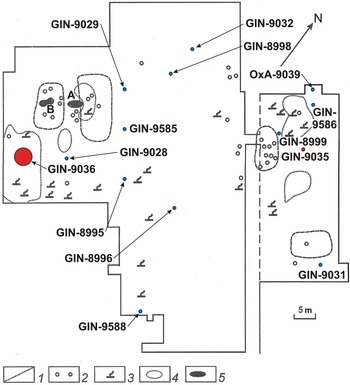
Stratigraphy and spatial distribution of animal radiocarbon dates from the Sungir site (Bader & Bader Reference Bader, Bader, Alekseeva and Bader2000; Sulerzhitski et al. Reference Sulerzhitski, Pettitt, Bader, Alekseeva and Bader2000; see also Figure 2) indicate that the most probable age of the cultural layer based on radiocarbon dated samples of reindeer bones is c. 26 900–27 300 BP (c. 30 700–32 500 cal BP); radiocarbon values on horse bones (bulk samples collected from across a relatively large area, including distances farther away from the burials), date to c. 25 800–27 400 BP (c. 28 700–32 300 cal BP) (Figures 1–2). The radiocarbon dates on mammoth bones from a clear stratigraphic context (horizons 3–4, the bottom of the cultural layer) are 27 200±500 BP (GIN-9586) and 27 460±310 BP (OxA-9039) (Figure 2). The majority of other mammoth bones from Sungir have similar radiocarbon dates, c. 26 300–28 800 BP. The UF- and Hyp-based radiocarbon values of c. 29 640–30 100 BP (Marom et al. Reference Marom, McCullagh, Higham, Sinitsyn and Hedges2012: 6879) were obtained on the same mammoth bone located away from the S-1 burial (Figure 2; see Kuzmin et al. Reference Kuzmin, van der Plicht and Sulerzhitsky2014: 453–55) contra Marom et al. (2012: 6880). Whereas non-UF collagen dates on the same bone yielded an age of c. 27 460 BP (OxA-9039) (Sulerzhitski et al. Reference Sulerzhitski, Pettitt, Bader, Alekseeva and Bader2000), the new UF and Hyp dates seem too old. Therefore, Hyp-based radiocarbon values (except, perhaps, for OxA-X-2464-12) for the Sungir humans are also too old (see Figure 1). It is worth noting that Trinkaus et al. (Reference Trinkaus, Buzhilova, Mednikova and Dobrovolskaya2014) considered direct dates on Upper Palaeolithic humans, including Sungir, as only approximations of their chronological position—early, middle or late stages of the Upper Palaeolithic. Strictly speaking, the ‘true’ age of the Sungir humans is unknown (Kuzmin et al. Reference Kuzmin, van der Plicht and Sulerzhitsky2014).
Plan of the Sungir site, and position of the radiocardon dated bones of reindeer (red dots) and woolly mammoth (blue dots), with laboratory codes (after Bader & Bader Reference Bader, Bader, Alekseeva and Bader2000: 22; Sulerzhitski et al. Reference Sulerzhitski, Pettitt, Bader, Alekseeva and Bader2000; Trinkaus et al. Reference Trinkaus, Buzhilova, Mednikova and Dobrovolskaya2014: 5): 1) suggested dwellings; 2) hearth pits; 3) hearths; 4) bone concentrations; 5) burials (A—Sungir 1; B—Sungir 2–3).

The two radiocarbon values for the Kostenki 1 individual are almost identical to one another: c. 32 600 BP (non-UF) and c. 32 070 BP (UF) (Higham et al. Reference Higham, Jacobi and Ramsey2006); this corresponds to an interval of c. 35 520–36 370 cal BP (the calibrated range of the UF-based radiocarbon date). These ages are in accordance with both the chronology of layer 3, where human remains were found (with the oldest charcoal radiocarbon date of c. 32 600 BP), and with the site's stratigraphy—layer 3 probably lies above the tephra dated to c. 39 000–40 000 cal BP; see below (Holliday et al. Reference Holliday, Hoffecker, Goldberg, Macphail, Forman, Anikovich and Sinitsyn2007: 193 & 209).
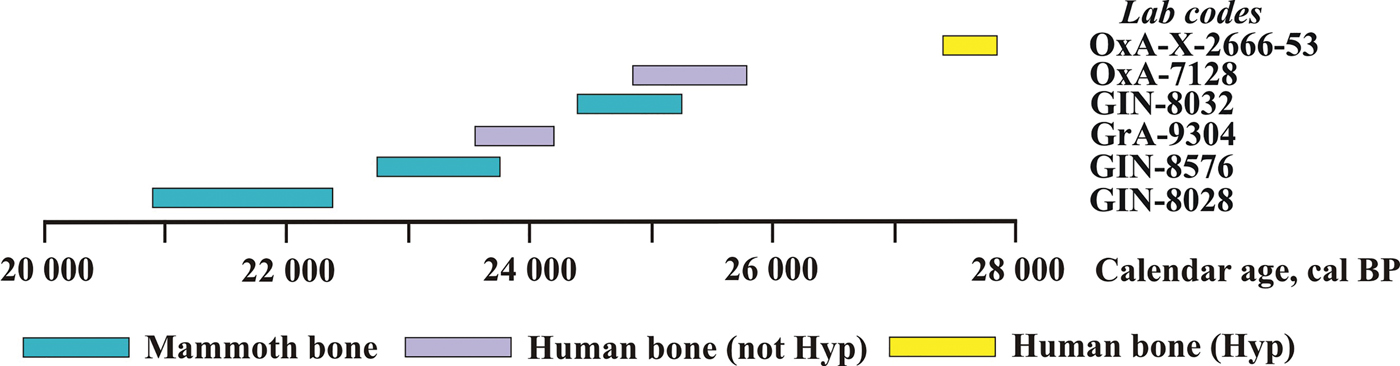
The ‘true’ age for the Kostenki 18 human is less clear. At this site, no independent markers are present, and it is therefore difficult to accept the conclusion by Reynolds et al. (Reference Reynolds, Dinnis, Bessudnov, Devièse and Higham2017) that the Hyp-based radiocarbon date is more reliable than other radiocarbon values (Table 1). According to their work (Reynolds et al. Reference Reynolds, Dinnis, Bessudnov, Devièse and Higham2017: 1438–1441), both the human and mammoth bones formed parts of the same artificial arrangement. The radiocarbon dates on mammoth bones, however, were not treated with any conservants or preservatives prior to dating—meaning that their ages should not be affected—they are much younger than the Hyp-based human bone radiocarbon value (Figure 3). No explanation is given by Reynolds et al. (Reference Reynolds, Dinnis, Bessudnov, Devièse and Higham2017) for this inconsistency or for their preference for accepting the older date. I posit two possible interpretations, although neither is particularly probable. First, that the mammoth bones and human skeleton do not belong together, although original photographs and a drawing of the burial suggest, in fact, that they do (see Reynolds et al. Reference Reynolds, Dinnis, Bessudnov, Devièse and Higham2017: 1439–41, figs 4–7). Second, that there is a large discrepancy between the radiocarbon values run on mammoth and human bones (although the cause of this would be unclear), despite the fact that the collagen yield for GIN dates is sufficient at 0.4–1 per cent (the content of collagen in bone of 1 per cent and more is considered as enough for getting reliable dates; e.g. Brock et al. Reference Brock, Higham, Ditchfield and Ramsey2010). In either case, the Hyp-based radiocarbon age for the Kostenki 18 individual is not in accordance with the stratigraphy of the site, and the most recent sample (OxA-X-2666-53) does not bring any certainty in this regard (see Figure 3), despite the conclusion of Reynolds et al. (2017: 1441) that it provides “a more reliable age estimate”.
Calendar ages (at ±2σ) of 14C dates on human and mammoth bones from the Kostenki 18 site (see Table 1).

The Kostenki 14 burial presents a rare case where a terminus post quem can be established. Here the stratigraphic marker is the Campanian Ignimbrite (CI) tephra layer dated to c. 39 000–40 000 cal BP (see Figure 4) (e.g. Holliday et al. Reference Holliday, Hoffecker, Goldberg, Macphail, Forman, Anikovich and Sinitsyn2007); the burial is associated with layer 3 and is located in a pit that cuts through this CI tephra (see Marom et al. Reference Marom, McCullagh, Higham, Sinitsyn and Hedges2012: 6879). The first attempts at radiocarbon dating the individual directly resulted in Holocene and Terminal Pleistocene ages, between c. 3730 and 13 610 BP (see Marom et al. Reference Marom, McCullagh, Higham, Sinitsyn and Hedges2012: 6879). The subsequent dating of the Hyp fraction of collagen yielded the radiocarbon value of c. 33 900 BP (c. 36 200–38 600 cal BP) (Marom et al. Reference Marom, McCullagh, Higham, Sinitsyn and Hedges2012), an age in accordance with the terminus post quem provided by the CI tephra. It also fits well with the site's chronology (the charcoal radiocarbon values for layer 3 are between c. 28 400 and 31 800 BP) and stratigraphy (Holliday et al. Reference Holliday, Hoffecker, Goldberg, Macphail, Forman, Anikovich and Sinitsyn2007); the latest data (Dinnis et al. Reference Dinnis, Bessudnov, Reynolds, Devièse, Pate, Sablin, Sinitsyn and Higham2019) also support the age of layer 3 at Kostenki 14 as younger than c. 33 150–34 400 BP. Additional support for the Late Pleistocene age of the Kostenki 14 individual comes from the relatively primitive structure of its DNA, similar to other Palaeolithic-age humans (Seguin-Orlando et al. Reference Seguin-Orlando, Korneliussen, Sikora, Malaspinas, Manica, Moltke, Albrechtsen, Ko, Margaryan, Moiseyev, Goebel, Westaway, Lambert, Khartanovich, Wall, Nigst, Foley, Lahr, Nielsen, Orlando and Willerslev2014).
Variation in the oxygen isotopes in the GISP2 ice core for the last 40 000 years (after Seierstad et al. Reference Seierstad, Abbott, Bigler, Blunier, Bourne, Brook, Buchardt, Buizert, Clausen, Cook, Dahl-Jensen, Davies, Guillevic, Johnsen, Pedersen, Popp, Rasmussen, Severinghaus, Svensson and Vinther2014, generalised; green circles are tie-points) and positions of Campanian Ignimbrite (CI) and the Sungir and Kostenki human burials: S) Sungir; K1) Kostenki 1; K14) Kostenki 14; and K18) Kostenki 18.

Regarding the proposed correspondence between the burials and palaeoclimatic events in the Late Pleistocene at Sungir site, the combined palynological and radiocarbon data for the cultural layer (Lavrushin et al. Reference Lavrushin, Sulerzhitski, Spiridonova, Alekseeva and Bader2000) demonstrates that the site existed throughout a period of fluctuating environmental conditions. The most intense occupations took place during climatic warmings within the interval of c. 25 500–28 800 BP (c. 28 600–33 600 cal BP). According to Trinkaus et al. (2014: 9–11), the age of the Sungir humans most probably corresponds to the warm Greenland interstadial GI-5; more specifically, GI-5.2 interval (32 500–33 600 cal BP; see Rasmussen et al. Reference Rasmussen2014) (Figure 4). The results achieved by our group (Kuzmin et al. Reference Kuzmin, van der Plicht and Sulerzhitsky2014: fig. 1) support this conclusion. With regard to the Kostenki humans, Kostenki 1 can be correlated with the cold GS-8 stadial, centred on c. 36 000 cal BP (see Rasmussen et al. Reference Rasmussen2014), between the GI-8 and GI-7 interstadials, while Kostenki 14 corresponds to the GI-8 interstadial at c. 37 400 cal BP (GI-8c stage, 37 100–38 200 cal BP; see Rasmussen et al. Reference Rasmussen2014). All of these humans pre-date the Greenland stadial GS-3 associated with the Last Glacial Maximum (Figure 4).
Conclusions
Evaluation of the reliability of radiocarbon dates for Palaeolithic humans is one of the most important current topics for prehistoric archaeologists around the world. All lines of evidence—especially in terms of stratigraphy, overall chronology and palaeoenvironmental details—should be taken into account, although the determination of the ‘true’ age of any individual is often impossible. It seems that the radiocarbon age of the Sungir burials is c. 26 000–27 210 BP; the date for the Kostenki 18 human is still unclear. Chronostratigraphic integrity is the key for understanding the antiquity of Palaeolithic human remains, and there is no magic tool that can solve the problem of radiocarbon age determination for bones, especially in cases such as the Sungir and Kostenki 18 burials. Currently, there are more than 20 early modern humans of presumed Upper Palaeolithic age, but without direct radiocarbon dates, from the East European Plain, the Caucasus and Siberia. Their ‘true’ ages, however, remain unknown. So far, any attempts to assume the superiority of radiocarbon values on Pleistocene human fossils produced by an ‘advanced’ technique such as SAA (for Sungir, sensu Marom et al. Reference Marom, McCullagh, Higham, Sinitsyn and Hedges2012; for Kostenki 18, sensu Reynolds et al. Reference Reynolds, Dinnis, Bessudnov, Devièse and Higham2017), lack proper justification.
Acknowledgements
I greatly benefited from discussions on the radiocarbon dating of bones with the late Leopold Sulerzhitski. I am grateful to Thomas Higham (Oxford University) and Johannes van der Plicht (University of Groningen) for providing information on collagen extraction; to Maria Pevzner (Geological Institute, Moscow) for providing details on GIN dates for the Kostenki 18 site; to Konstantin Gavrilov (Institute of Archaeology, Moscow) for information on the Sungir site; and to the anonymous reviewer for useful comments and suggestions. This research was supported by the Tomsk State University Competitiveness Improvement Programme and by State Assignment Project 0330-2016-2018.