INTRODUCTION
In ancient Greek religion and mythology, Pan was god of the wild nature, resident of mountains, forests and caves, protector of shepherds, and companion of the Nymphs with whom he was often worshipped. According to legend, he was born in Arcadia, but he was worshipped in Athens as well from the 5th century BC on, because according to the ancient written sources Pan helped the Athenians win against the Persians during the battle of Marathon in 490 BC (Herodotus VI: 105) by instilling in them fear and panic.
After that, several Attic caves became sacred to him: a small cave on the northwest side of the Acropolis of Athens, another one near the Ilissos river, “Lychnospilia” on Mount Parnes, the cave at Oinoe—Marathon, the “Cave of the Nympholept” or “Cave of Archedamos” at Vari on Mount Hymettos, a cave at Daphni on Mount Aigaleo, a cave on Eleusis’ west hill (destroyed in 1955), and one more at Megara (Wickens Reference Wickens1986).
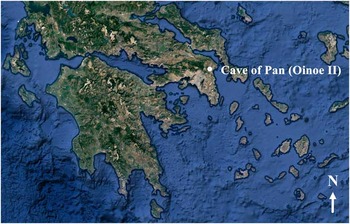
The purpose of this study is twofold: the accelerator mass spectrometry radiocarbon (AMS 14C) dating of the Neolithic phase of the Cave of Pan anthropogenic deposits, which is located on the N/NE slope of the hill of Oinoe at Marathon (38°09′31.60′′N, 23°55′48.60′′E), as well as the calculation of the regional marine reservoir effect in the estuarine Marathon Bay region (Figure 1) during the Neolithic period. The latter is part of a large-scale project aiming to calculate the marine reservoir effect in various regions of the Aegean Sea, as it was found that this fluctuates considerably through time (Facorellis and Vardala-Theodorou Reference Facorellis and Vardala-Theodorou2015).
Google Earth map showing the location of the Cave of Pan at Marathon (white bullet) in southern Greece.

HISTORY
The acropolis of Oinoe is a low height expanse of a roughly triangular shape, spreading west of modern Marathon and south of the river named Oinoes or Charadros. It is called the “Hill of Pan” or “Tamburi Gura.” The first name is owed to the ancient traveler Pausanias, who describes a cave of special attraction, located beyond the plain of Marathon, upon the hill of Pan (Pausanias, I: 32, 7). The second name is noted on a 19th century map in the Karten von Attika elaborated by Curtius et al. (1881–1903).
The existence of a cave situated on the hill and dedicated to god Pan, is also reported by travelers from the 19th century (Hobhouse Reference Hobhouse1817; Dodwell Reference Dodwell1819; Chandler Reference Chandler1825; Leake Reference Leake1841), who tried in vain to relocate and visit it (Wickens Reference Wickens1986: 223–33).
The Cave of Pan is a large, dark cave with two entrances, abundant ornamentation of stalagmites, stalactites, columns, rimstone dams and small hollows with water. It was shown in February 1958, by the looter Miltiades Gikas, to Karavassilis, a technician of the archaeologist Ioannis Papadimitriou (Petrakos Reference Petrakos1993). Papadimitriou was, on behalf of the Archaeological Society of Athens, in persistent search of the cave and after its relocation he conducted a small-scale excavation during the same year.
The finds discovered (human skeletal remains, ceramics, tools, ornaments made of stone, shell, and other materials, lamps, etc.), some of which are on display in the Archaeological Museum of Marathon, date the use of the cave, at least from the Late Neolithic (end of the 6th millennium BC) to the Late Roman times (6th century AD). Pottery, figurines, and a pair of golden earrings, found in the deposits excavated by Papadimitriou and dated to the 5th and 4th centuries BC, along with part of an inscribed marble stele dated to 61/60 BC found inside the east entrance, suggest the cave had been transformed into a sacred place dedicated to Pan and the Nymphs (Daux Reference Daux1959; Orlandos Reference Orlandos1959; Petrakos Reference Petrakos1995; Steinhauer Reference Steinhauer2009).
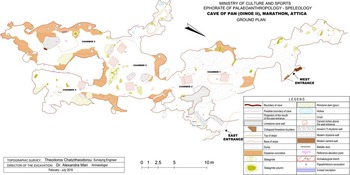
The Ephorate of Palaeoanthropology-Speleology relocated the Cave of Pan within a program of GPS recording the coordinates of caves of archaeological interest in Attica. Collection of the abundant, scattered finds covering the surface of the deposits of all five chambers of the cave began in May 2012. Collection of the surface finds continued during 2013 and 2014. In addition, six trenches were opened up from 2014 to 2016 (Figure 2). The excavation research revealed a large amount of pottery (dated to the Middle, Late, and Final Neolithic periods, the Early and Late Bronze Age, the Archaic, Classical, Hellenistic, and Roman periods), animal bones, many human bones and parts of skulls, chipped stone tools (mainly of obsidian), and small finds made of clay, bone, stone, glass, shell (such as Neolithic and Classical figurines; Neolithic, Mycenaean, and Classical spindle whorls and loom weights; jewelry; beads; bronze coins; lamps, etc.).
Ground plan of the Cave of Pan (by Th Hatzitheodorou 2016).

MATERIALS
During the last three years’ rescue excavation campaigns, numerous charcoal and seashell samples, among other finds, were collected.
In this study the AMS dates of 7 charcoal pieces and 1 seashell sample are presented. All charcoal pieces were taken from carbonized wood. Their species has not been identified, as an anthracological study of the carbonized material unearthed so far has not yet been undertaken. This means that the possibility of these samples belonging to long-lived trees, resulting in an old wood effect of perhaps 100 years, cannot be excluded. However, this is may be counterbalanced by the 14C age and calibration curve uncertainty.
The seashell sample [Lyon-12517(GrA)] belongs to the species Cerastoderma glaucum and it was collected exactly in the same location and depth with one of the charcoal samples [Lyon-12518(GrA)] from an undisturbed anthropogenic deposit, thus ensuring that they were both deposited simultaneously in the past.
See the online supplement for Figures S1–S11, which show the locations of the dated samples together with characteristic associated pottery.
METHODS
The samples were prepared in the Centre de Datation par le RadioCarbone in Lyon, France, and graphitized (Aerts-Bijma Reference Aerts-Bijma, Meijer and van der Plicht1997) and measured in the radiocarbon dating facility of the Centre for Isotope Research (CIO) in Groningen, Netherlands (Wijma Reference Wijma and van der Plicht1997; van der Plicht Reference van der Plicht, Wijma, Aerts, Pertuisot and Meijer2000).
The charcoal samples were chemically pretreated using the usual ABA protocol. ABA treatments performed in Lyon are similar to those used in many other 14C laboratories. Samples are roughly crushed before being treated with 2N HCl (room temperature, 1 hr then 4 hr at 95°C), followed by 0.1N NaOH (room temperature, 1 hr then 1 hr at 95°C), and then treated with 2N HCl (room temperature, 1 hr). The samples are washed 3 times with ultrapure MilliQ™ deionized water after each treatment.
All glassware used is baked out at 450°C prior use for a minimum of 5 hr to remove any organic contaminants.
After pretreatment, the charcoal samples are combusted in an automated Thermo Finnigan Flash EA 1112 (EA). The EA consists of a Cr2O3 combustion tube, a cobaltous/ic oxide silvered purification furnace, a Cu reduction tube, and a water trap. The EA system is expended with an automatic cryogenic trapping device. This system consists of 16 separate freeze fingers in a vacuum system. Each trap has a pneumatic valve and a Dewar vessel filled with liquid nitrogen. The CO2 sample is collected cryogenically in a glass ampoule, sealed and sent to the CIO in Groningen. When stable isotopic values are requested by sample submitters (e.g. shells), a part of the CO2 is collected and sent to the measurement on an isotope ratio mass spectrometer (IRMS) at the Institut des Sciences Analytiques (ISA).
After surface cleaning by air abrasion with aluminium oxide powder to remove the outer surface and rinsing with ultrapure water, the seashell was etched with aqua regia (0.5–1.0N HCl and HNO3, 3:1) until 10–30% of the sample has been removed to eliminate the surface contaminants (Goslar and Pazdur Reference Goslar and Pazdur1985). The sample was then dried and roughly crushed (Hedges Reference Hedges, Law, Bronk and Housley1989). Afterwards, the sample was reacted with concentrated H3PO4 (3 mL, 85%) under vacuum in a two-armed Pyrex reaction vessel. The reaction vessel was transferred to a water bath at 60°C and left to equilibrate for an hour to ensure stable isotopic equilibrium, before adding the acid to the sample and leaving to react overnight. The CO2 obtained is transferred to a glass ampoule and sealed.
RESULTS
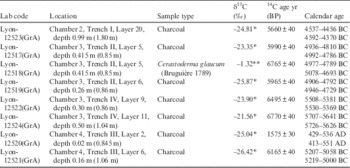
Table 1 presents the samples laboratory code and location, the obtained 14C and calibrated calendar ages and the corresponding δ13C values sorted by the cave’s chamber, trench, and depth. Depths outside parentheses were measured from the present surface of the cave, whereas the inside parentheses ones were measured from the same level of origin.
Summary of the AMS dating results of the samples from the Cave of Pan sorted by chamber, trench, and depth.

* Measured by AMS.
** Measured by IRMS.
Six of the charcoal samples gave calendar dates spanning from the second quarter of the 6th millennium (Middle Neolithic period) till the beginnings of the 5th millennium BC. Furthermore, one charcoal sample [Lyon-12520(GrA)] collected from a depth of 2 cm from the present surface of the cave yielded an age falling within the 6th century AD, giving thus the absolute time span of the cave use.
The regional sea surface reservoir R(t) value is calculated by subtracting the 14C conventional age (5990±40 yr BP) of the charcoal sample [Lyon-12517(GrA)] from that (6765±40 yr BP) of the seashell sample [Lyon-12518(GrA)]. The R(t) standard deviation (σR(t)) was calculated by using the following formula for summing errors:
 $$\sigma _{{R\left( t \right)}} {\equals}\sqrt {\sigma _{c}^{2} {\plus}\sigma _{{ss}}^{2} } $$
where, σc the standard deviation of the 14C charcoal age and
σss the standard deviation of the 14C seashell age
The local deviation ΔR value was calculated by combining the calibrated age of the charcoal [Lyon-12517(GrA)] and the marine sample [Lyon-12518(GrA)], using the latest issues of the atmospheric and the marine international curves (Reimer et al. Reference Reimer, Bard, Bayliss, Beck, Blackwell, Bronk Ramsey, Buck, Cheng, Edwards, Friedrich, Grootes, Guilderson, Haflidason, Hajdas, Hatté, Heaton, Hoffmann, Hogg, Hughen, Kaiser, Kromer, Manning, Niu, Reimer, Richards, Scott, Southon, Staff, Turney and der Plicht2013), respectively as follows: the measured 14C age of the charcoal sample gives a calendar date using the atmospheric calibration curve. Based on this calendar date, the marine calibration curve gives an equivalent 14C age. ΔR is the difference between this equivalent and the measured 14C age for the marine sample (Southon et al. Reference Southon, Rodman and True1995; Facorellis et al. Reference Facorellis, Maniatis and Kromer1998). In this study, this is performed with the OxCal v4.2.4 software using the following routine (supplemental Figure S10):
Plot()
{
Curve(“IntCal13”,“IntCal13.14c”);
Curve(“Marine13”,“Marine13.14c”);
Delta_R(“Local”,U(170,640));
Combine()
{
Curve(“=IntCal13”);
R_Date(“Lyon-12517(GrA)”,5990,40);
Curve(“=Local”);
R_Date(“Lyon-12518(GrA)”,6765,40);
};
The uncertainty U(x 1 ,x 2 ) was set so that the ΔR probability distribution is at the center of the plot (supplemental Figure S11).
Consequently, the marine reservoir age R(t) and the local sea surface reservoir deviation ΔR in the Marathon Bay during the 5th millennium BC, based on this particular pair of samples, were found to be 775±57 yr and 402±63 14C yr (1σ), respectively.
The 14C ages of the charcoal samples were calibrated with the latest issue IntCal13 of the international calibration curve (Reimer et al. Reference Reimer, Bard, Bayliss, Beck, Blackwell, Bronk Ramsey, Buck, Cheng, Edwards, Friedrich, Grootes, Guilderson, Haflidason, Hajdas, Hatté, Heaton, Hoffmann, Hogg, Hughen, Kaiser, Kromer, Manning, Niu, Reimer, Richards, Scott, Southon, Staff, Turney and der Plicht2013). The 14C age of the seashell sample was calibrated using the calculated ΔR value in conjunction with the Marine13 international calibration curve. All calibrations were performed with the OxCal v4.2.4 software (Bronk Ramsey Reference Bronk Ramsey2009, Reference Bronk Ramsey2013; Bronk Ramsey et al. Reference Bronk Ramsey, Dee, Lee, Nakagawa and Staff2010).
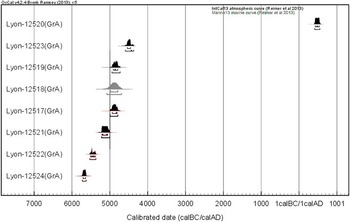
Figure 3 presents the probability distribution plot of the calibrated dates sorted by age.
Probability distribution plot of the calibrated dates from the Cave of Pan sorted by age.

DISCUSSION
Dating the Cave’s Stratigraphy
The Cave of Pan at Marathon has an oblong shape (Figure 2) roughly orientated to a N–S axis with a downward slope toward the south and a total area of approximately 970 m2 (Petrocheilos Reference Petrocheilos1959). It comprises several chambers from which those closer to the entrances (Chambers 1 and 2) have thicker deposits and seem to have been heavily used in antiquity and heavily looted in modern times. The excavated trenches confirmed that the deposits of Chambers 3, 4, and 5 are thin and often variously mixed by animals, humans or water. However, both prehistoric and historic finds were picked up during the rescue excavation of the Ephorate of Palaeoanthropology-Speleology from the surface of all the chambers.
Trench I (within Chamber 2) was the first trench opened. It preserves a deposit more than 3.00 m deep (according to the excavation data of 2016) with the upper 0.80 m presenting certain signs of disturbance by looters. The charcoal sample Lyon-12523(GrA) [4537–4456 BC], was collected from an excavated layer almost 1.00 m below present surface (supplemental Figure S1a), preserving ceramics dated to the beginning of the Final Neolithic (see the chronological terminology in Papadimitriou-Tsirtsoni Reference Papadimitriou and Tsirtsoni2010) and either decorated with burnishing and/or worn red painted motifs on a worn whitish slipped background [supplemental Figure S1b; cf. page 112 (Phelps Reference Phelps2004)], or having unpainted coarse surfaces sometimes decorated with relief and impressed bands (supplemental Figure S2a). Among them, a small unpainted open vessel with a broken spout and two horizontally pierced lugs (supplemental Figure S2b) was also found.
Trench II (in Chamber 3), yielded the charcoal samples Lyon-12517(GrA) [4936–4810 BC] and Lyon-12519(GrA) [4906–4792 BC] (supplemental Figure S3a). The excavated deposit had a maximum thickness of 0.42 m. Joining fragments of a Late Neolithic II asymmetrical open vessel with burnished rounded body and unpierced horned lugs (supplemental Figure S3b) came from the layer above the one where sample Lyon-12517(GrA) was collected [cf. the “LNIb scoop” (Sampson Reference Sampson1993: 3, figure 78)]. A restored Late Neolithic I shallow matt-painted carinated bowl [supplemental Figure S4a; cf. Kakavogianni et al. (Reference Kakavogianni, Tselepi, Dimitriou, Katsavou and Douni2016: 441, note 27); Phelps (Reference Phelps2004: 95)] came from the layer below that of sample Lyon-12519(GrA), whereas the upper part of a Late Neolithic coarse-ware open (possibly cooking?) vessel bearing two vertical handles was found in pieces scattered within the layers of the specific samples (supplemental Figure S4b).
One hundred and fifty-nine pieces of a Late Classical–Hellenistic chytra (dated around 300–250 BC) were found scattered above, within and below the layer of Trench III (Chamber IV) from which sample Lyon-12520(GrA) [429–536 AD] was analyzed (supplemental Figure S5a–5b). The sample was gathered 0.02 m below the present surface of the deposit which does not exceed 0.21 m in thickness. The analysis gave an even later date, showing that people of late antiquity (6th century AD) were visiting the cave, as already suggested by the study of the pottery found. However, one more sample, Lyon-12521(GrA) [5207–5058 BC], collected from the same trench (supplemental Figure S6a) confirmed a Late Neolithic I use of the specific part of the cave which had already been inferred from the exposure (during the 2014 excavation campaign) of a “floor” or “work area” shaped from unbaked clay. In full accordance with the Late Neolithic date acquired are two joining sherds from a thin-walled matt-painted closed vessel (supplemental Figure S6b) as well as a fragment of a small, closed, unpainted pot, which preserves a horizontal, vertically pierced, double lug [supplemental Figure S7; cf. (Sampson Reference Sampson1993, figure 32: 30)].
Trench ΙV (in Chamber 3), held a deposit with a maximum thickness of 0.64 m. A Late Neolithic matt-painted “mug” with worn surfaces due to taphonomic conditions and nine mending holes (opened after firing) (supplemental Figure S8b), was picked up while excavating a layer 0.14 m below present surface. At a depth of 0.30 m was found the sample Lyon-12522(GrA) [5508–5381 BC], which yielded a late Middle Neolithic date (supplemental Figure S8a). At a lower layer 0.50 m below present surface (supplemental Figure S9a), was discovered sample Lyon-12524(GrA) [5707–5641 BC] as well as a fragment from a thin walled Middle Neolithic monochrome Urfirnis bowl or basin, with a reddish-yellow to yellowish-red paint on the exterior walls and on the interior rim and four mending holes (supplemental Figure S9b), which seems to match with the results of the AMS date of Lyon-12524(GrA) [cf. Mee et al. (Reference Mee, Cavanagh and Renard2014: 19, table 7) with 14C dates from Franchthi cave covering Franchthi Ceramic Phase 2 (Vitelli Reference Vitelli1993)].
The results of the analyzed charcoal samples testify that the first use of the Cave of Pan at Marathon is dated long before 5500 BC (Lyon-12524) (GrA). It is not yet clear whether the Middle Neolithic tenants inhabited the cave although this seems doubtful at least for the case of Chamber 3, which yielded the relevant sample, due to inadequate amount of contemporary ceramics. Additionally, taking into consideration that Middle Neolithic people occupied open sites like the one at the nearby Nea Makri, where they constructed dwellings, storerooms (replacing chronologically earlier underground storage pits), auxiliary installations and even public constructions (Pantelidou-Gofa Reference Pantelidou-Gofa1991), it seems rather erroneous to consider that this cave (with its specific morphological traits) was used for habitation in the middle of the 6th millennium BC. The fact that the sample Lyon 12524(GrA) was found in a layer where parts of disintegrated bones of a male adult aged 20–24 were discovered as well, cannot confirm whether the cave constituted a place of secondary burials and ritual action during the Middle Neolithic, although the excavation data of 2016 proved that this practice applies for the Late and Final Neolithic periods.
The main prehistoric use of the cave is dated to the Late and Final Neolithic periods. Pottery along with tools, small and other objects, which accompanied buried human bones and parts of skulls, indicate intensive use of this natural monument as an ossuary during the Late Neolithic. A similar habit performed in a more careless and/or hastier manner seems to have been carried out in the Final Neolithic. Other usage of the rooms located closer to the entrances may be detected by the loads of sherds from big coarse-ware thick-walled vessels that testify to a possible Final Neolithic use as a storage area. The possibility of a Late and/or Final Neolithic temporary habitation site in the cave by small groups of people awaits further confirmation through the study of the archaeological material brought to light. It should be borne in mind that a small-scale use of the cave is also noted during the Early and the Late Bronze Age.
During the end of the 7th century BC, the cave was transformed into a sanctuary dedicated to the Nymphs (Valavanis Reference Valavanis2001: 53–4), and several years later (in the 5th century BC) it became sacred to Pan as well. Arapapogianni (2000) proposed that it may have lasted until the beginning of the 1st century AD as a cult site. In the 2nd century AD the monument constituted a destination of tourist attraction as Pausanias’ testimony suggests.
People continued to reach the cave in late antiquity (6th century AD) as indicated by clay lamps discovered (Arapogianni Reference Arapogianni2000), and verified by the analysis of the sample Lyon-12520(GrA). Their visits might at a minimum have aimed to collect precious water which drips even today from its lime ceiling.
Marathon Bay Marine Reservoir Effect
The Marathon coastal plain has been continuously inhabited since the Neolithic period and has a great historical as well as archaeological significance. The area is famous for the ancient battle of 490 BC between the Athenians and the Persians and, based on this, it has been designated as a national park.
The plain is divided into two parts by the River Oinoes channel. In the southwest of the deltaic fan of the River Oinoes (Kainourgio Rema), there was a marshy area (Breksiza) that was drained some decades ago. The large marsh of Marathon (also known as the Great Marsh) extends to the east, separated from the sea by a barrier beach with low sand dunes.
Baeteman (Reference Baeteman1985) conducted a systematic drill-hole study for the area and presented detailed information on the stratigraphic sequence of the plain. Triantaphyllou et al. (Reference Triantaphyllou, Pavlopoulos, Tsourou and Dermitzakis2003) investigated the microfauna recovered from the deposits and determined three distinct biofacies based on foraminifera and ostracoda assemblages: the shallow mesohaline-oligohaline biofacies, indicative of low march environments approximately at the mean sea level, the shallow oligohaline-fresh waters biofacies indicative of high-middle marsh environments suggesting an approximate elevation of 20 cm above mean sea level and finally the mesohaline-oligohaline to oligohaline-freshwater biofacies characteristic of an intermediate mesohaline-oligohaline to oligohaline-freshwater lagoonal environment.
Pavlopoulos et al. (Reference Pavlopoulos, Karkanas, Triantaphyllou and Karymbalis2003, Reference Pavlopoulos, Karkanas, Triantaphyllou, Karymbalis, Tsourou and Palyvos2006) determined the sequence of depositional environments and the sea level changes recorded in the area for about the last 6000 yr, using micromorphological and micropalaeontological methods in addition to AMS radiocarbon datings. Three sedimentary units, namely A, B, and C, were recognized after grouping the sedimentary facies characteristics.
Sedimentary unit A consists of fossiliferous bioturbated lagoonal mud predominating in the central part of the embayment, with peloidal charophytic mud prevailing in the lower parts of the unit. Three peat layers are included in unit A.
The lower one (peat 1), dated at approximately 5500 cal BP, starts as laminated algal peat in the lower horizons and changes to a reed swamp peat. The other two peats were found in unit A (peat 2 dated to about 4700 cal BP and peat 3 dated to about 3800 cal BP are composed of almost pure plant remains). The depositional environment of unit A is a typical mesohaline-oligohaline lagoon with an embayment depth never exceeding a few meters.
The 14C ages of the paired charcoal-seashell samples showed that the marine reservoir age R(t) in the Marathon Bay during the 5th millennium BC is 775±57 yr (Figure S10). The only measured and published marine reservoir effect R(t) from the Aegean Sea during this millennium is that from the Neolithic site Ftelia on Mykonos, which yielded a mean R(t)=–26±96 yr. This low Ftelia R(t) value is most likely caused by the low mixing rates of the sea surface waters due to the reduced deep-sea circulation of 14C-depleted waters during the sapropel S1 formation during that time in the Aegean (Mercone et al. Reference Mercone, Thomson, Croudace, Siani, Paterne and Troelstra2000; Casford et al. Reference Casford, Rohling, Abu-Zied, Cooke, Fontainer, Leng and Lykousis2002) and as it derives from three different terrestrial-marine paired samples whose individual R(t) values overlap within 1 standard deviation, thus it cannot be attributed to post-deposisional mixing of the paired samples (Facorellis and Vardala-Theodorou Reference Facorellis and Vardala-Theodorou2015). The prebomb Aegean Sea mean R(t) is 480±72 yr (or 420±55 yr) (Reimer and McCormac Reference Reimer and McCormac2002), while the Mediterranean prebomb mean R(t) is 390±85 yr (Siani et al. Reference Siani, Paterne, Arnold, Bard, Métivier, Tisnerat and Bassinot2000).
Moreover, the corresponding local sea surface reservoir deviation ΔR was found to be 402±63 14C yr (Figure S11). This value is considerably higher than that calculated for the same time period in the Aegean Sea. The corresponding mean ΔR from Ftelia on Mykonos during the 5th millennium is –400±113 14C yr (Facorellis and Vardala-Theodorou Reference Facorellis and Vardala-Theodorou2015), while the prebomb mean ΔR in the Aegean Sea is 154±52 14C yr (or 109±37 14C yr) (Reimer and McCormac Reference Reimer and McCormac2002).
Although, the sea surface marine reservoir effect exhibits an important fluctuation through time in the Aegean Sea (Facorellis and Vardala-Theodorou Reference Facorellis and Vardala-Theodorou2015), the higher R(t) and ΔR values measured in this study are probably due to the fact that the Cerastoderma glaucum seashells incorporated considerable amount of dead carbon from the shallow lagoon estuary environment of Marathon Bay, where they were living and they were collected.
Terrestrial/marine paired samples located very close to one another, thus ensuring a simultaneous deposition in undisturbed archaeological deposits and contemporaneous age, are hard enough to find. However, due to the fact that the calculation of the regional marine reservoir effect was based on only one pair of samples, more measurements of such paired samples should be done in the future in order to investigate whether these new R(t) and ΔR values are consistent through time and valid for the entire Marathon Bay estuarine region.
CONCLUSIONS
Our results show that the Cave of Pan was used even earlier than it was originally thought and more specifically from the second quarter of the 6th millennium (Middle Neolithic period) until the beginnings of the 5th millennium BC.
One sample collected from a depth of 2 cm from the present surface of the cave yielded an age falling within the 6th century AD, giving thus the absolute time span of the cave use.
Moreover, the 14C ages of one pair of charcoal-seashell samples showed that the marine reservoir age R(t) in the Marathon Bay during the 5th millennium BC is 775±57 yr.
This allowed the calculation of the local sea surface reservoir deviation ΔR, which is found to be 402±63 14C yr (within 1σ). This is considerably higher than that calculated for the same time period in the Aegean Sea. Apparently, this is due to the dead carbon effect of the Marathon Bay region.
However, more paired samples should be measured in order to confirm the consistency of this marine reservoir effect through time in this particular estuarine region.
Acknowledgments
Alexandra Mari wishes to express warm thanks to the Institute for Aegean Prehistory for granting awards for the project “Excavation of the Cave Oinoe II (Cave of Pan) and Oinoe IV at Marathon,” as well as to the Ephorate of Palaeoanthropology-Speleology for its constant help and the supply of all the necessary excavating equipment.
The pencil drawing of supplemental Figure S7 was made by V Trizonis. The inking of the drawings presented in supplemental Figures S1–S9 was done by archaeologist J Nakas.
SUPPLEMENTARY MATERIAL
To view supplementary material for this article, please visit https://doi.org/10.1017/RDC.2017.65