Autism spectrum disorder (ASD) is a neurodevelopmental disorder mainly characterised by deficits in social communication as well as by narrow patterns of behaviour and interests (American Psychiatric Association, 2013), often accompanied by language, intellectual and sensory impairments. The severity of these impairments may lead to deficits in the development of daily living activities such as simple meal preparation and feeding, community skills (e.g. buying groceries), personal care (e.g. dressing) and personal hygiene skills (bathing, toileting, hand washing, teeth brushing) needed for independence. Among others, the lack of independence in personal hygiene skills increases the burden of the caregiver and makes children with ASD more dependent (Flynn & Healy, Reference Flynn and Healy2012). Therefore, it is important to develop tools for helping individuals with ASD in increasing their ability to perform these basic life activities which will lead to savings that can be invested in other critical areas of needs.
Video Modeling (VM) is a successful strategy for developing various skills in individuals with ASD, such as social, communication and daily living skills (Rosenberg et al. Reference Rosenberg, Schwartz and Davis2010). The VM consists in showing a video in which a model performs a target behaviour or a specific task, then the participant has to perform the skills presented in the video (Shukla-Mehta et al. Reference Shukla-Mehta, Miller and Callahan2010). Any person familiar or unknown to the participant can act as a model, adult or peer. Two main versions of the VM have been developed: video Self Modeling (VSM), where the video shows the participant itself as a model, and Video Modeling Point of View (VPOV), where the target skill is filmed from the participant's perspective, at him/her eye level.
The advantages of these strategies include: (i) the use of visual information, which are better processed by individuals with ASD (Cottini, Reference Cottini2016); (ii) media support which attract their attention; (iii) procedures that eliminate visual and auditory interfering stimuli; (iv) no face-to-face interaction that may be stressful for individuals with ASD (Cottini, Reference Cottini2016). Furthermore, in ASD rehabilitation research, the high variability among the autism spectrum favours the use of single-subject designs, which have been preferred in many studies on VM interventions (Cottini, Reference Cottini2016).
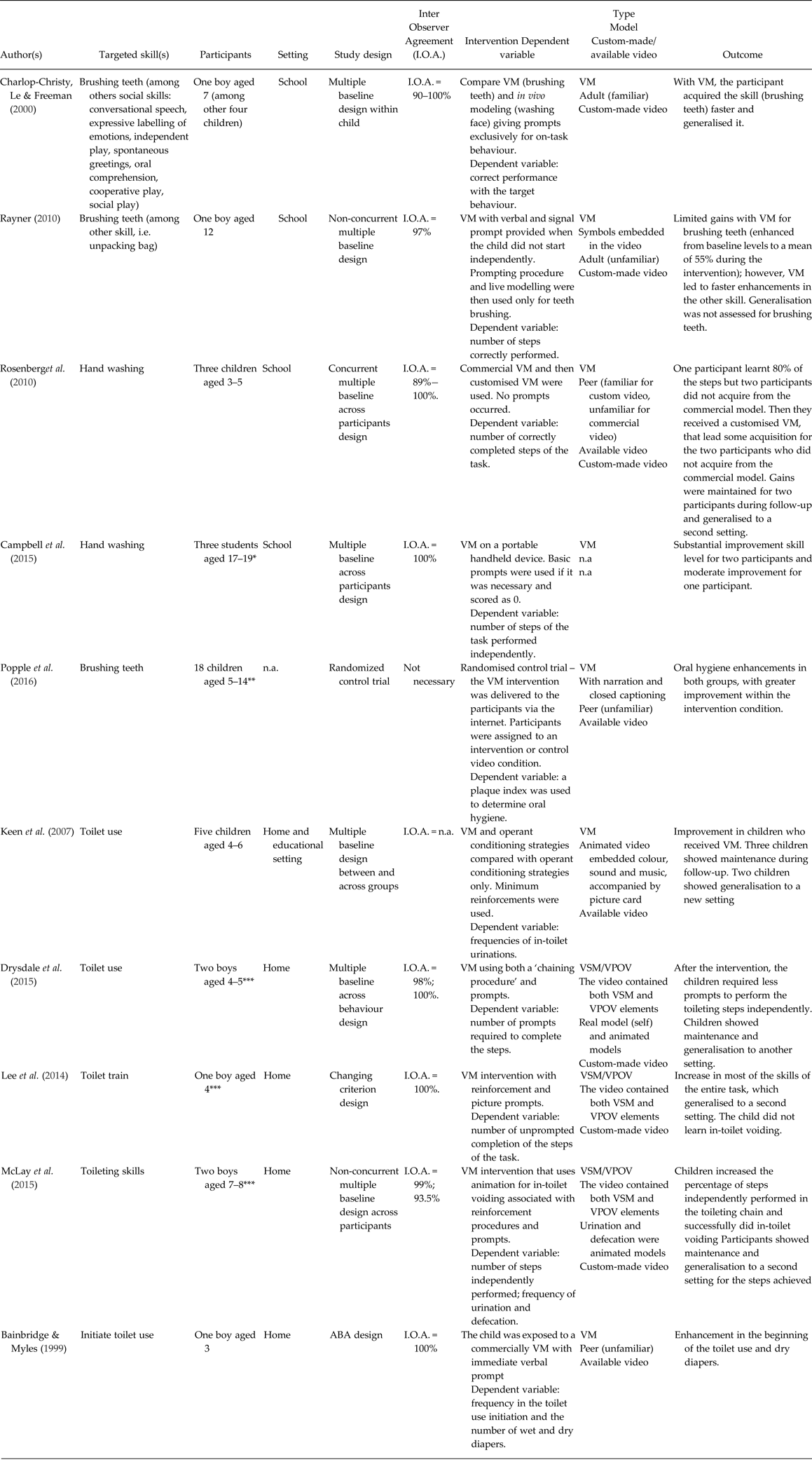
Although VM is a widely used intervention in the field of ASD (Shukla-Mehta et al. Reference Shukla-Mehta, Miller and Callahan2010), a small body of research has been reported regarding the development of personal hygiene skills in children and adolescents with ASD. An overview of these studies can be found in Table 1. The studies were selected by a systematic search in PubMed and Google Scholar for peer-reviewed articles in the English language; search words included video modeling, video self modeling, autism spectrum disorder, hand washing, teeth brushing, toileting, hygiene skills, daily living skills, functional skills and self-help skills. This body of work focused on toileting, hand washing, teeth brushing and took place mostly in educational settings.
Studies using VM for the development of personal hygiene skills in children and adolescent with ASD

VM, video Modelling; VSM, video self-modelling; VPOV, video modelling point of view; n.a., not available; I.O.A., Inter Observer Agreement (two independent raters scored the study and then an I.O.A. was obtained based on the following formula: 100×agreement/(agreement + disagreement)).
Note: the mental age of the participants was between 2 and 7 years old, *one participant with borderline to normal cognitive range, **unknown mental age, ***unknown mental age, presumably lower mental age.
Investigators have examined the benefit of VM in targeting toileting skills. Keen et al. (Reference Keen, Brannigan and Cuskelly2007) examined the effectiveness of a VM in combination with operant conditioning strategies in comparison to the latter alone in teaching urinary control to five children with ASD. Results showed gains for the children who received VM. More recent investigations used a custom-made video with VSM plus VPOV elements associated with reinforcements and prompts (Lee et al. Reference Lee, Anderson and Moore2014; Drysdale et al. Reference Drysdale, Lee, Anderson and Moore2015). One video incorporated animation model for urination and defecations. These studies obtained positive outcomes using VM to toilet train participants with ASD. However, the participants did not independently acquire the behaviours of the entire toileting chain (e.g. undressing, sitting on the toilet, in-toilet voiding, redressing and flushing) (Lee et al. Reference Lee, Anderson and Moore2014). McLay et al. (Reference McLay, Carnett, van der Meer and Lang2015) reported on two participants who acquired the entire chain as well as in-toilet urination. In this study, the authors used a custom-made video with VSM plus VPOV elements associated with reinforcements and prompting procedure and the video included animation model for urination and defecations. Investigators examining the development of toilet skills in individuals with ASD largely used reinforcements and prompts procedures as well as elements in the videos. Interestingly, studies that used commercial available videos showed poorer acquisitions in contrast to investigations that used custom-made videos (McLay et al. Reference McLay, Carnett, van der Meer and Lang2015). With respect to hand washing, Rosenberg et al. (Reference Rosenberg, Schwartz and Davis2010) explored the benefits from watching a commercially VM with three children with ASD and reported that one child learned 80% of the steps but the other two children did not profit. The three children then received a customised VM with a familiar peer as model, which led to some skill achievements for the two participants who did not learn from the commercially available model. Two children who acquired from commercial VM and one child who only achieved some skills with the customised VM showed maintenance and generalisation to a second setting. Campbell et al. (Reference Campbell, Morgan, Barnett and Spreat2015) implemented a VM on a handheld device to teach hand washing to three pre-adolescents with ASD. Two participants exhibited substantial improvement and one participant showed moderate improvement (up to 84.3% of task steps performed independently).
Three studies investigated the use of VM in oral hygiene in children with ASD. Charlop-Christy et al. (Reference Charlop-Christy, Le and Freeman2000) used a VM to teach a child to brush his teeth and compared it to an in vivo modeling for teaching the same individual to wash his face (prompts were provided exclusively for on-task behaviour). The model in the video was a familiar adult. In this case, VM allowed faster achievement and generalisation of teeth brushing. However, limited gains with VM for brushing teeth were found in the report by Rayner (Reference Rayner2010). Although video prompting and live modeling were introduced only for teeth brushing, the child showed limited gains in this skill while exhibiting rapid increases in the steps performed in the other skill trained (i.e. unpacking bag). Difficulties with motor skills related to the target behaviour could explain this result. Furthermore, the oral reinforcements that the child received during the intervention may have competed with some of the actions required for the tooth brushing task. Finally, there is only one study (Popple et al. Reference Popple, Wall, Flink, Powell, Discepolo, Douglas, Mademtz, Volkmar and Shic2016) that randomly assigned children with ASD to a control group or an experimental condition. In this study, 18 participants were assigned to an intervention condition and received a 3-week VM via the internet compared to a control video condition. Oral hygiene enhancements were found in both groups, with greater improvement within the intervention condition.
The studies reviewed here have found positive results with VM or its variations in enhancing personal hygiene skills, with at least some benefits in selected domains. No studies found negative effects with VM. Interestingly, VM interventions often promoted generalisation and maintenance of the behaviours achieved in participants with ASD. Custom-made interventions and interventions using video with peer or familiar as model appear to be more effective. Furthermore, VM interventions are often effective in teaching some steps but not the entire chain of the task, especially in the toilet use interventions. Therefore, VM focusing on the task steps the participants performed poorly should be interesting to realise. Our review contributes to the small body of literature indicating the effectiveness of VM in helping children and adolescents with ASD to develop personal hygiene skills. In this mini-review, only one study performed a randomized control trial (RCT), while the others used single-subject designs. This is because rehabilitation programmes often involve one or few children. Moreover, the high variability within the autism spectrum, where different IQ levels can be present with jeopardised level of social and motor deficits, makes it difficult to recruit comparable ASD subjects in terms of the level of impairment. Nonetheless, it is crucial that future research includes large RCT on homogeneous ASD individuals with professionally developed videos on personal hygiene skills. The videos should be implemented on handheld technology to allow wide-broad dissemination to promote autonomy for children and adolescents with ASD.
Financial Support
Professor Brambilla (RF-2011-02352308) and Dr Crippa and Dr Piccin (GR-2011-02348929) were partly supported by grants from the Italian Ministry of Health.
Conflict of Interest
None.