

1. Introduction
As a vital element in the institutional landscape of market economies, bankruptcy rules and procedures are intended to encourage the liquidation of unviable firms and promote the restructuring of viable firms that are suffering from temporary distress (White, Reference White1989, Reference White1994). Bankruptcy institutions thus enable the processes of selection (Hodgson and Knudsen, Reference Hodgson and Knudsen2006: 479–81), which in turn facilitate the socially efficient allocation of scarce resources. Yet empirical evidence on the effectiveness of bankruptcy regimes at achieving this primary objective is very scant. This is especially true in the context of developing, emerging-market, and post-socialist countries, even though the design of effective bankruptcy institutions was among the paramount concerns during transition (Aghion et al., Reference Aghion, Hart, Moore, Blanchard, Froot and Sachs1994) and continues to be a subject of ongoing reform debates worldwide (Cirmizi et al., Reference Cirmizi, Klapper and Uttamchandani2012).
How effective are bankruptcy institutions at promoting the reorganization of viable enterprises and encouraging the exit of non-viable ones? More specifically, how common are “filtering failures,” defined as instances of socially inefficient allocation of resources when either non-viable firms are encouraged to reorganize (Type I errors) or viable firms are discouraged from reorganizing and are instead steered toward liquidation (Type II errors)? These are the questions we address in the present paper. To this end, we examine a uniquely detailed dataset on court-supervised firm reorganization proposals filed in post-socialist Slovenia.
To our knowledge, the only scholarly contribution to date that has attempted to rigorously assess the extent of socially costly filtering failures in bankruptcy is the seminal study by Fisher and Martel (Reference Fisher and Martel2004). Drawing on a sample of financial reorganization proposals of Canadian firms, Fisher and Martel (Reference Fisher and Martel2004) demonstrate, first, that filtering failures do occur and, second, that Type I errors are more likely than Type II errors. Due to scarcity of suitable data, however, the literature has until now not been able to answer Fisher and Martel's (Reference Fisher and Martel2004: 163) call for further research on the topic in the context of other bankruptcy systems internationally. We take a step toward filling this gap.
Slovenia lends itself as an interesting jurisdiction in which to study the effectiveness of bankruptcy institutions for three key reasons. First, the possibility of fully fledged financial reorganization in Slovenia is a relatively recent phenomenon. During socialism, the concept and institutions of bankruptcy as known in Western Europe or North America did not exist. Thus, an assessment of the effectiveness of recently adopted bankruptcy rules and procedures at promoting socially efficient resource allocation in Slovenia is an especially relevant and timely exercise.
Second, under the Slovenian “simplified reorganization procedure” (SRP) that we examine, a firm filing for financial reorganization is not mandated to enter liquidation in the event that its reorganization proposal does not obtain the necessary support. This institutional feature renders the Slovenian SRP markedly different from related bankruptcy reorganization proceedings used internationally, under which all firms with rejected proposals automatically enter liquidation. The Slovenian SRP therefore offers a one-of-a-kind possibility to observe non-liquidated firms with rejected reorganization plans. Unlike Fisher and Martel's (Reference Fisher and Martel2004) data, our dataset has a further advantage of allowing us to track the post-attempted-reorganization survival of all firms, including those with accepted reorganization plans. Under the tenable assumption that firm survival constitutes an adequate conceptualization of firm viability, the Slovenian bankruptcy framework therefore allows us to observe directly the incidence of both Type I and Type II errors.
Third, in the context of the Slovenian SRP, the critical decision to accept or reject a proposed reorganization plan is left to ordinary unsecured creditors. The courts assume an exclusively supervisory role and have no say in decisions on the merit and the substance of the proposed reorganization. The Slovenian SRP therefore provides an opportunity to assess the extent of socially harmful filtering failures in a bankruptcy system that awards an important institutional actor, the judiciary, a minimalistic role. Because in other financial reorganization schemes used internationally courts often assume a more significant role, the case of the Slovenian SRP provides an important benchmark for any future comparative analysis of the impact of bankruptcy courts on the extent of socially (in)efficient resource allocation.
We analyze filtering failures in Slovenian SRP using two distinct yet complementary empirical approaches suggested by Fisher and Martel (Reference Fisher and Martel2004). The first approach adopts an ex-post conceptualization of firm viability and relies on observed outcomes of firms pursuing reorganization. The second approach employs an ex-ante conceptualization of firm viability and utilizes predicted outcomes derived from an empirical model of firm survival after attempted reorganization. Based on the former (ex-post) approach, we estimate the probability of Type I error to be 41%, the probability of Type II error 16%, and the incidence of filtering failure (the relative frequency of Type I and Type II errors combined) 27%. Based on the latter (ex-ante) approach, we find that a given reduction in the incidence of Type II errors would at the margin give rise to nearly three times as many Type I errors. Socially inefficient resource allocation therefore more likely arises via overcommitting of resources to unproductive use than via withdrawing of resources from productive use. We contextualize these findings in light of Fisher and Martel's (Reference Fisher and Martel2004) estimates for Canada, in view of alternative mechanisms for insolvency resolution in Slovenia, and with regard to related financial reorganization schemes that award courts a comparatively more prominent role in the unfolding of the proceedings.
The incidence of Type I and Type II errors as a normative criterion for assessing the effectiveness of an institution has also been emphasized in contexts other than bankruptcy. Concerns about socially detrimental erroneous decisions have long been at the very heart of considerations about the institutional design of law enforcement (Posner, Reference Posner2007: 648) and civil litigation (Shavell, Reference Shavell1995). Filtering errors have been the focus of literature on the allocation of authority in organizations (Lazear and Gibbs, Reference Lazear and Gibbs2009: Chapter 5), the architecture of economic systems (Sah and Stiglitz, Reference Sah and Stiglitz1986), and governance mechanisms for personnel decisions (Perri, Reference Perri2018). Yet we are aware of no studies that empirically document the actual occurrence of Type I and Type II errors in these settings. Contributing to the literature on institutional and organizational design, we offer one of the very first empirical measurements of the incidence of socially costly filtering failures as a means of assessing the effectiveness of an institutional regime.
More generally, the question of how to measure institutions and their effectiveness has been the subject of an ongoing scholarly debate (Robinson, Reference Robinson2013; Shirley, Reference Shirley2013; Voigt, Reference Voigt2013). Our analysis casts light on the effectiveness of bankruptcy rules and procedures at fulfilling their central role of promoting socially efficient resource allocation. In doing so, we rely on factual, objective data that casts light on the observed behavior of pivotal economic actors (in our case, ordinary unsecured creditors) in response to the posited formal rules and utilizes the notion of the incidence of false positive and false negative decisions as the metric for assessing the performance of a bankruptcy regime. Our analysis therefore provides one illustrative example of how within-country research design can be productively used to measure the functioning and success of a particular institutional arrangement.
The rest of the paper is organized as follows. Section 2 provides the necessary institutional background. Section 3 discusses key conceptual considerations. Section 4 introduces our data. Sections 5 through 7 present and discuss our results. Section 8 concludes.
2. Business bankruptcy and financial reorganization in Slovenia
The simplified reorganization procedure
From the fall of socialism to 2013, the resolution of firms’ financial distress through reorganization was possible in Slovenia under a single reorganization procedure roughly modeled after Chapter 11 in the US. In 2013, five years into the Great Recession, the SRP was introduced as part of a comprehensive bankruptcy reform. The SRP was intended as a procedurally simpler and cheaper non-liquidation bankruptcy alternative for micro and small businesses, while medium-sized and large businesses were and are expected even after 2013 to continue to file for reorganization under the somewhat reformed version of the previous reorganization procedure.
Slovenian bankruptcy law dictates that, upon insolvency, the insolvent firm's management must decide whether to attempt reorganization or to liquidate. The SRP must be initiated by the debtor. Much like under Chapter 11, creditors under the SRP cannot force the debtor into liquidation if the debtor chooses to attempt reorganization. Moreover, the debtor's decision to enter non-liquidation bankruptcy is not contingent on fulfillment of any specific financial or timing conditions.
The SRP officially begins with a court order. As under Chapter 11, the debtor's bankruptcy filing at the court triggers the automatic stay rule (an injunction) that halts all creditors’ claims vis-à-vis the debtor. The firm's management by default remains in control of the business. While Chapter 11 provides for the possibility of the appointment of a bankruptcy trustee, under the SRP a bankruptcy trustee is never appointed.
Unlike in Chapter 11, where a reorganization plan may affect all classes of creditors, a reorganization plan put forth by the debtor under the SRP may encompass only the reduction and/or the postponement of repayment of debt held by ordinary unsecured creditors (suppliers, customers, and contractors). Priority unsecured creditors (employees entitled to arrears in wages and social security contributions) and secured creditors (who have their claims secured by a lien) are legally excluded from the reorganization plan under the SRP.
Under the SRP the decision to accept or reject the reorganization plan proposed by the debtor is thus in the hands of ordinary unsecured creditors. In order for a reorganization plan to be accepted, the plan filed under the SRP must be supported by the majority of ordinary unsecured creditors that appear on the official list of ordinary unsecured creditors as compiled by the debtor. This majority of listed ordinary unsecured creditors must together represent at least 60% of the value of all listed ordinary unsecured creditors’ claims.
If the plan proposed under the SRP is accepted, its content by law extends to all listed ordinary unsecured creditors and the firm begins to execute it. If the plan is rejected, however, then under the SRP the debtor is not legally required to enter liquidation but is instead allowed to continue to operate without any additional mandates. This particular feature of the SRP distinguishes it markedly from Chapter 11 and related reorganization frameworks used internationally where firms with a rejected reorganization plan automatically enter liquidation. The Slovenian legislators’ intent not to automatically liquidate all firms with rejected proposals filed under the SRP most likely reflects the desire to curb the disproportionately large increase in the number of liquidation bankruptcies during the latest global financial crisis.
Once the ordinary unsecured creditors under the SRP reach the decision to accept or reject the proposed reorganization plan and their decision is formally confirmed by the court, the automatic stay rule ceases to apply. If the plan is accepted, the debtor is expected to fulfill the agreed-upon terms of reorganization.
The court's role within the Slovenian SRP is exclusively supervisory. At the filing stage, the court can dismiss a petition to reorganize only on procedural grounds. At acceptance versus rejection stage, the court is legally mandated to confirm a plan that has received support from the required majority of creditors and is legally precluded from confirming a reorganization plan that was not accepted by the required majority of creditors. The court thus makes no decisions regarding the merit and the substance of the proposal. Such narrowing down of the court's jurisdiction is congruent with the incentive-based argument concerning the design of bankruptcy schemes. Because they (normally) have no personal stake in the success of firms filing for bankruptcy, judges are generally considered to be poorly positioned to make savvy decisions about whether and how to financially reorganize these businesses (Rasmussen and Skeel, Reference Rasmussen and Skeel1995). The decision to legally preclude the possibility of judicial discretion in addition likely constitutes Slovenian legislators’ deliberate response to concerns about the possibility of judicial overreach (see Cepec et al., Reference Cepec, Grajzl and Zajc2017: 592–93).
Simplified financial reorganization in the broader context of resolution of financial distress
The SRP currently constitutes the primary means for addressing the financial distress of those small businesses in Slovenia for which liquidation is not (yet) viewed as the imminent outcome. The SRP is an appealing institutional vehicle for resolving the insolvency of small businesses for multiple reasons. First, when contrasted with its less formal alternative of contractual debt renegotiation, the decisive advantage of the SRP lies in the application of the automatic stay rule. The resulting injunction on creditors’ claims buys the management of the insolvent company much-needed time, thereby increasing the prospects of successful reorganization.
Second, both managers and owners of small insolvent companies tend to prefer to attempt financial reorganization under the SRP to pursuing reorganization under the conventional financial reorganization procedure that at least in principle still remains a possible route for resolution of financial distress for small businesses. From the management's standpoint, the SRP is attractive because the rejection of a reorganization proposal under the SRP does not automatically result in firm liquidation and, hence, management dismissal. From the owners’ perspective, the SRP is inviting because it keeps original owners in positon and precludes ownership-diluting debt-to-equity swaps. For all of the above reasons, an empirical understanding of the functioning of the SRP is of paramount importance for assessing the effectiveness of Slovenian bankruptcy institutions at facilitating the resolution of financial distress of small businesses, the oft-alleged backbone of the economy.
3. Conceptual considerations
The primary aim of corporate bankruptcy from the social standpoint is to encourage the liquidation of non-viable firms and promote the restructuring of viable ones (White, Reference White1989, Reference White1994). Whenever this objective is not met, socially costly filtering failures are said to occur. Intuitively, tying up resources in the reorganization of a non-viable business precludes the use of those resources in more efficient ways. The withdrawal of resources from a viable, but erroneously dissolved, business venture similarly detracts from social efficiency. Accordingly, the central purpose of bankruptcy institutions from the perspective of social efficiency may be equivalently restated as minimizing instances of filtering failure. This, in turn, raises the question of how filtering failures should be conceptualized and measured.
Conceptualizing filtering failures
Under the SRP, it is the ordinary unsecured creditors of the distressed business that ultimately decide on whether to promote or prevent the firm's reorganization. Drawing an analogy between the creditors’ decision to accept or reject a reorganization proposal and classical statistical hypothesis testing, Fisher and Martel (Reference Fisher and Martel2004) suggest as the null hypothesis that firms proposing reorganization are not financially viable; given that firms are able to pursue financial reorganization only upon insolvency, this is a tenable assumption. In the parlance of classical statistics, ordinary unsecured creditors therefore commit a Type I error, from the social efficiency standpoint, when they accept a proposal from a non-viable firm (that is, reject the null when the null is true) and a Type II error when they reject a proposal from a viable firm (fail to reject the null when the null is false). We say that socially costly filtering failure occurs whenever a Type I or a Type II error occurs.
Because in reality the firm putting forth a reorganization proposal is either viable or not viable, there exist four possible outcomes based on the ordinary unsecured creditors’ decision: acceptance of a plan from a non-viable firm (Type I error); acceptance of a plan from a viable firm; rejection of a plan from a non-viable firm; and rejection of a plan from a viable firm (Type II error). Let N be the total number of observed reorganization proposals, N CA the number of correct acceptances, N CR the number of correct rejections, N I the number of wrong acceptances (Type I errors), and N II the number of wrong rejections (Type II errors). Denote the total number of accepted plans as N A, the total number of rejected plans as N R, the number of viable firms as N V, and the number of non-viable firms as N N. We have the following identities:
 $$N_A = N_{CA} + N_I$$
 $$N_R = N_{CR} + N_{II}$$
 $$N_N = N_{CR} + N_I$$
 $$N_V = N_{CA} + N_{II}$$
 $$N = N_A + N_R = N_N + N_V.$$
It then follows that:
 $${\rm Prob(Type\ I}{\;\rm error)} = {\rm Prob(accept\ proposal\ \vert\ }\hbox{non-viable firm})} = \displaystyle{{{{N_I} / N}} \over {{{N_N} / N}}} = \displaystyle{{N_I} \over {N_{CR} + N_I}}$$
 $${\rm Prob(Type\ II}{\;\rm error)} = {\rm Prob(reject\ proposal\ \vert\ viable\ firm)} = \displaystyle{{{{N_{II}} / N}} \over {{{N_V} / N}}} = \displaystyle{{N_{II}} \over {N_{CA} + N_{II}}}.$$
With the joint incidence of Type I and Type II errors equal to N I + N II, we can therefore define the relative frequency of Type I and Type II errors combined (see Fisher and Martel, Reference Fisher and Martel2004) as:
 $${\rm Incidence\ of\ filtering\ failure} = \displaystyle{{N_I + N_{II}} \over N}.$$
Conceptualizing firm viability
A central conceptual challenge when attempting to measure filtering failure in bankruptcy reorganization involves the definition of firm viability and the corresponding classification of firms as either viable or non-viable. There are two aspects to the notion of firm viability that must be considered: first, the meaning of viability and, second, for a given conceptualization of what renders a firm viable, the timing based on which viability is assessed.
Viability as defined by the Oxford English Dictionary depicts “the ability to live” and “ability to continue.” An entity is said to be viable when it is “capable of living.” Accordingly, we define a firm's viability in terms of the firm's post-attempted-reorganization survival, that is, its continued operation as a going concern or as part of a merged entity. From the ex-post standpoint, we classify a firm that has completed reorganization proceedings as viable as long as it is observed not to have entered liquidation or filed for yet another court-supervised financial reorganization by the end of our observation window (see section 5). From the ex-ante perspective, we classify a firm as viable if its ex-ante predicted probability of survival following attempted reorganization exceeds a chosen threshold value (see section 6).
The conceptualization of firm viability based on firm survival is, we argue, a particularly natural and appropriate one for the purposes of assessing the incidence of filtering errors in the resolution of bankruptcy. Nevertheless, it should be clear that, under this approach, the classification of a given set of firms as either viable or non-viable is sensitive to the length of the researcher's observation window. By the very nature of survival, the longer one tracks the survival of a given set of firms that have proposed to financially reorganize, the fewer firms from that set will be observed to survive; thus, the more firms will be classified as non-viable and, at the same time, the fewer firms will be classified as viable. Classifying firms as viable and non-viable based on a wide observation window namely conflates the effect of financial reorganization on firm survival with the survival effects due to the firms’ life-cycle; thus, it precludes one from ascertaining the true filtering effect of financial reorganization per se. Consequently, in our empirical analysis below, we proceed under the assumption that the length of our observation window, exogenously determined with the end of our data collection, is adequate for the purposes of assessing the filtering outcomes from financial reorganization. In section 5, we provide descriptive statistics in support of this claim.
Alternative definitions of firm viability are possible. Unable to observe the firms’ survival owing to data availability constraints, Fisher and Martel (Reference Fisher and Martel2004) utilize a definition of viability based on the firm's success at completing the proposed reorganization plan. Under Fisher and Martel's definition, a firm is thus classified as viable as long as the firm has successfully completed the proposed reorganization plan. Another alternative would be to combine Fisher and Martel's conceptualization with our conceptualization, viewing a firm as viable only if it has survived in the marketplace beyond the plan's successful completion.
The adoption of any of the above two alternative conceptualizations of firm viability, however, comes at a cost. Defining firm viability based on the firm's success at completion of its reorganization plan requires the researcher to track all firms with an accepted plan for long enough to ascertain unambiguously whether the proposed reorganization plan had in fact been successfully completed.Footnote 1 In practice, approved repayment plans often stretch across a number of years. Ascertaining a firm's viability based on the successful completion of the plan would thus necessitate either examination of historic data that may not (yet) be available, or, alternatively, dropping from the sample a potentially large number of approved plans, involving repayment schedules spread over a longer period of time, for which the completion success cannot yet be ascertained. Adopting the latter approach, for example, would have no effect on either the incidence or the probability of Type I errors, but would, by reducing the number of firms counted as viable, artificially increase the ex-post estimates of the probability of Type II errors. Furthermore, in the case of firms for which the proposed reorganization plan was rejected, as long as those firms do not automatically enter liquidation (as is the case in Slovenia), viability would still have to be ascertained based on the firm's survival as we define it above. A researcher would therefore be faced with the inconsistent application of classification criteria for the viability of firms with accepted versus rejected reorganization proposals. For all these reasons, in our analysis we use the definition of firm viability based on firm survival.
4. Data
Court files on all bankruptcy reorganizations in Slovenia are stored on a public website maintained by the Agency of the Republic of Slovenia for Public Legal Records and Related Services (AJPES). Drawing on the information available in these records, we hand-collected data and coded variables for the complete set of 343 attempted financial reorganizations that satisfy two criteria. First, the reorganizations had to be initiated under the SRP between the time the SRP scheme was first made available to firms and the end of year 2017. Second, for attempted reorganizations that satisfy the first criterion, the courts must have formally endorsed the creditors’ acceptance or rejection of the debtor's reorganization proposal by as late as March 10, 2018, the end of our observation window and the last date on which we verified the firms’ survival. We merged the data on firms’ reorganization plans with firms’ financial and accounting data for the last year prior to reorganization filing, available through a separate AJPES database. After dropping observations with incomplete data, our final sample consists of 331 financial reorganization plans.
Aside from Fisher and Martel's (Reference Fisher and Martel2004) dataset on Canadian reorganizations, ours is, to our knowledge, the only other dataset amenable to measuring socially costly filtering failures in bankruptcy reorganization. Our dataset differs from Fisher and Martel's in three primary ways. First, we are able to track the survival of firms after attempted reorganization. Consequently, we are able to conceptualize a firm's viability based on the firm's survival. Second, owing to the specifics of the Slovenian SRP, we observe not only exiting, but also surviving, firms with rejected reorganization proposals. Third, the number of reorganization plans in our dataset is 9% larger than in Fisher and Martel's.
Consistent with the objective of the SRP, the overwhelming majority (98%) of firms in our data are small-sized business establishments. The few exceptions are medium-sized businesses that exploited a legal loophole and successfully filed for reorganization under the SRP instead of pursuing conventional financial reorganization as originally envisaged by the legislators.Footnote 2 Accordingly, the mean value of assets in our sample is a little over €3 million. The majority (62%) of firms are from the service sector, with remaining firms operating in manufacturing, agriculture, or mining (22%) and the construction industry (16%). As expected, the financial indicators demonstrate that in the year prior to the attempted financial reorganization a typical firm had a negative return on assets, faced a high ratio of total liabilities to assets, and experienced liquidity concerns. From the 331 firms attempting reorganization, 136 firms entered liquidation or filed for yet another attempted reorganization before the end of our observation window. The remaining 195 firms are observed as surviving, either as a going concern (192 firms) or as part of a merged entity (three firms).
5. Measuring filtering failures based on ex-post conceptualization of firm viability
Adopting the ex-post definition of viability, we classify a firm as viable if at the end of our observation window the firm operates either as a going concern or as part of a merged entity. We classify a firm as non-viable if by the end of our observation window the firm has either entered liquidation or begun yet another financial reorganization. Importantly, because of the specific nature of the Slovenian SRP, in our data the set of firms observed as surviving at the end of the observation window consists of both firms with an accepted reorganization proposal and firms with a rejected reorganization proposal. Given our conceptualization of firm viability based on firm survival, we are hence able to observe directly the incidence of both rejected proposals of non-viable firms and rejected proposals of viable firms (Type II errors). This, in turn, allows us to directly compute (rather than estimate) the probability of Type I and Type II errors as measures of the (expected) extent of socially inefficient resource allocation.Footnote 3
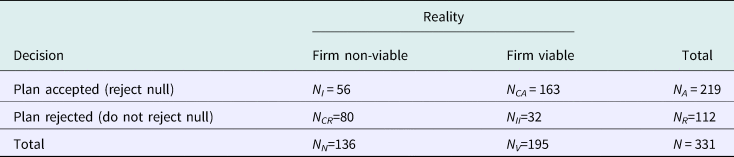
Table 1 summarizes the empirical distribution of outcomes based on the ordinary unsecured creditors’ decision and ex-post conceptualization of firm viability for the 331 proposed reorganizations in our data. Ordinary unsecured creditors accepted the reorganization proposals of 219 firms and rejected the reorganization proposals of 112 firms. Among the 219 firms that had their reorganization proposal accepted, 163 firms are observed as surviving at the end of the observation window, with the average length of time for which we observe these 163 firms equal to 745 days. 56 firms that had their proposal accepted did not survive until the end of our observation window. The average length of time to either liquidation or another reorganization attempt for these 56 firms is 463 days.
Distribution of reorganization proposals, ex-post conceptualization of firm viability

Notes: The null hypothesis is that firms filing for financial reorganization are not viable. N I denotes the number of wrong acceptances (Type I errors), N CA denotes the number of correct acceptances, N CR the number of correct rejections, N II the number of wrong rejections (Type II errors), N A the total number of accepted plans, N R the total number of rejected plans, N V the number of viable firms, N N the number of non-viable firms, and N the total number of proposed plans.
Among the 112 firms that had their proposal rejected, 32 are observed as surviving at the end of the observation window. The average length of time for which we observe these 32 firms is 497 days, with a minimum equal to nine days and a maximum equal to 1,464 days. 80 out of 112 firms with a rejected proposal do not survive until the end of our observation window. The average length of time to either liquidation or yet another reorganization attempt for these 80 firms equals 181 days, with 20 firms (i.e. one quarter) entering liquidation within seven days of the court-recorded date of rejection of the reorganization proposal.
Thus, when firms survive following a rejected proposal, we observe them on average for nearly a year and a half. On the other hand, when firms enter liquidation or yet another financial reorganization following a rejected proposal, they often do so quite quickly. These descriptive statistics lend credibility to our conceptualization of firms as ex-post viable as long as they are observed as surviving at the end of our observation window.
Using the data summarized in Table 1 and applying expressions (2), (3), and (4) we obtain:
 $${\rm Prob}\lpar {{\rm Type\ I\ error}} \rpar = \displaystyle{{56} \over {136}}\approx 0.412$$
 $${\rm Prob}\lpar {{\rm Type\ II\ error}} \rpar = \displaystyle{{32} \over {195}}\approx 0.164$$
 $${\rm Incidence\ of\ filtering\ failure} = \displaystyle{{56 + 32} \over {331}}\approx 0.266.$$
Based on an ex-post conceptualization of firm viability, the Slovenian financial reorganization process is not immune to socially costly filtering errors. Filtering failure occurs in a little more than one-fourth of reorganizations attempted under the SRP. The ratio of the probability of Type II error to the probability of Type I error is approximately 0.4, rendering Type I errors about 2.5 times as likely as Type II errors.
6. Characterizing filtering failures based on ex-ante conceptualization of firm viability
Ordinary unsecured creditors should approve the debtor's reorganization proposal if their expected gain from reorganization is greater than their expected gain from no reorganization; the latter scenario may (but need not) imply liquidation. Taking into account the uncertainty over the future prospects of the firm, ordinary unsecured creditors must form expectations about the likelihood of the firm's survival after attempted reorganization. This ex-ante probability of survival can be econometrically estimated and the resulting estimates can be utilized to classify firms as viable or non-viable.Footnote 4
Predicting firm survival
Given our focus on firm survival as the measure of firm viability, we define a binary variable Survive that takes on the value of one if at the end of the observation window the firm is observed as surviving either as a going concern or as a merged entity and zero if the firm has entered liquidation or yet another financial reorganization. We model the probability of firm survival with a logistic distribution:
 $$p_i\equiv {\rm Prob}\lpar {Survive_i = 1 \vert x_i} \rpar = \displaystyle{{\exp ({{x}_i^{\prime}}\beta )} \over {1 + \exp ({{x}_i^{\prime}}\beta )}},$$
where x i is the vector of covariates for firm i∈{1, … ,N} and β the vector of coefficients to be estimated. To predict firm survival we employ a wide range of covariates that are available in our dataset, many of which have been shown to be empirically relevant predictors of post-bankruptcy firm performance (see e.g. Barniv et al., Reference Barniv, Agarwal and Leach2002; Hotchkiss, Reference Hotchkiss1995; LoPucki and Doherty, Reference LoPucki and Doherty2015). Tables A1 and A2 in the appendix define key variables and provide the corresponding descriptive statistics.Footnote 5 In what follows, we briefly discuss each covariate.
A firm's financial health prior to attempted reorganization plausibly exhibits a persistent effect on the firm's performance even after attempted reorganization. Following an extensive literature on predictors of bankruptcy (for an overview, see Altman and Hotchkiss (Reference Altman and Hotchkiss2006)), we include as covariates measures of the firm's profitability (the return on assets), leverage (the ratio of liabilities to total assets), and liquidity (the ratio of the difference between assets and inventories to liabilities).
A firm's performance after attempted reorganization may depend on the firm's size. Larger firms pursuing reorganization may be more likely to identify new projects that can serve as the core of the reorganized business and thus may face better odds of eventual success (Moulton and Thomas, Reference Moulton and Thomas1993). Yet larger firms may also find it harder to innovate or otherwise adapt to changing conditions than smaller firms (Nooteboom, Reference Nooteboom1994). We measure firm's current size with (logged) total assets as recorded at the beginning of attempted reorganization.
The Slovenian bankruptcy law classifies creditors of an insolvent firm into four distinct categories based on the type of their claim: secured, priority unsecured, ordinary unsecured, and excluded creditors. We observe the firm's debt vis-à-vis each creditor group. Different groups of creditors may have different incentives with regard to the debtor's survival. Secured creditors may favor quick liquidation (White, Reference White1989). Priority unsecured creditors affect the survival of an indebted firm by subjecting it to continuous liquidity pressure. Many ordinary unsecured creditors and excluded creditors (e.g. owners of property leased to the debtor) benefit from the debtor's successful reorganization as it facilitates a continued business relationship. We include as covariates the (logged) value of claims by each of the four identified creditor groups.
Based on the rules of the Slovenian SRP, ordinary unsecured creditors’ rejection of a firm's reorganization proposal does not result in automatic liquidation of the firm. The creditors’ decision, however, may nevertheless influence firm survival. Their rejection of the reorganization proposal provides the debtor with no relief vis-à-vis the claims of existing creditors pertinent to the proposed reorganization and, moreover, provides a negative signal about the firm's future performance to the firm's current and potential business partners. We thus include an indicator variable for whether the reorganization proposal was accepted by ordinary unsecured creditors.
Rational creditors should in general reject unsustainable reorganization proposals. However, if creditors are less than fully informed, the proposed terms of reorganization may plausibly predict firm survival beyond the effect on the creditors’ acceptance or rejection decision, for example, by subjecting a firm with an accepted proposal to unsustainable liquidity pressure. We include two different measures of reorganization terms that a debtor must provide in the proposed reorganization plan: the proposed percentage of, and the length of time for, repayment of ordinary unsecured creditors.
The time that a firm spends in reorganization proceedings may predict the firm's post-attempted-reorganization survival. On the one hand, the length of time spent in proceedings may be viewed as a proxy for the degree of contentiousness of proposed reorganization. On the other hand, the automatic stay rule that applies during the proceedings provides the firm with an opportunity for restructuring. We therefore include a variable measuring the number of days that the firm spent in reorganization proceedings.
Hotchkiss (Reference Hotchkiss1995) demonstrates that the absence of management turnover during reorganization is negatively associated with the firm's post-reorganization performance. We thus include an indicator for whether the firm experienced a change in management either one year prior to attempted reorganization or before the creditors’ decision to accept or reject the debtor's proposal. Finally, we include multiple sets of fixed effects to control for the effect of the firm's legal form, the firm's industry, the firm's classification based on its size (as a micro, small, medium-sized, or large company), the identity of the court supervising the attempted reorganization, and the year of filing of the attempted reorganization. To economize on space, we do not display the corresponding coefficient estimates.
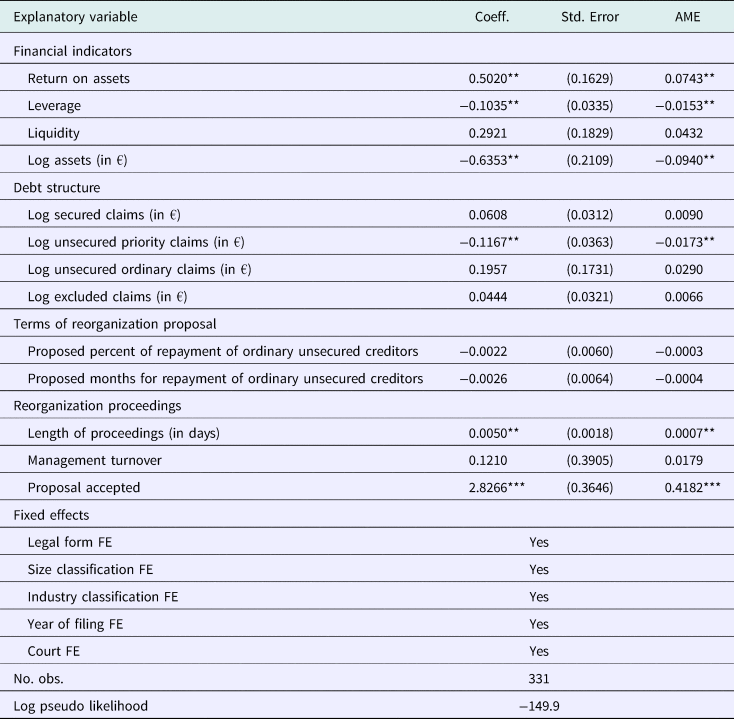
Table 2 reports the results in the form of the estimated coefficients as well as the corresponding average marginal effects. We emphasize that we are primarily interested in the estimates in Table 2 to predict the probability of firm survival. Thus, we discuss the results very briefly, highlighting only the key patterns in the data. We also caution against too readily interpreting the featured average marginal effects as causal in nature.
Logit estimates of firm survival

Notes: The table presents coefficient estimates, robust standard errors, and average marginal effects (AME) based on a logit regression. The outcome variable Survive takes on the value of one if the firm filing for reorganization has survived as a going concern or as part of a merged entity until the end of the observation window, and zero if the firm has enter liquidation or another reorganization. Based on the comparison of actual and fitted values of the variable Survive for the cut-off value of probability equal to 0.5, the model correctly predicts 76.74% of the observations.
***, **, and * denote statistical significance at the 0.1%, 1%, and 5% level, respectively.
Subject to the above caveats, the results in Table 2 indicate that the prospects of firm survival are, as anticipated, statistically significantly positively associated with the firm's profitability prior to the start of attempted reorganization and with creditors’ acceptance of the proposed reorganization plan. The likelihood of firm survival is further positively associated with the length of time spent in proceedings. On the other hand, the firm's survival prospects are, as expected, statistically significantly lower when the firm is highly leveraged prior to filing for reorganization and when the volume of claims by priority unsecured creditors is high. The likelihood of firm survival is also lower when the firm is comparatively large as measured by total assets. None of the remaining covariates and sets of fixed effects are statistically significant predictors of firm survival.
Estimating the tradeoff between Type I and Type II errors
Substituting the vector of coefficient estimates  $\hat{\beta}, $ reported in Table 2, into (5) we compute the estimated probability of survival for each firm i∈{1, … ,N} as:
 $$\hat{\,p}_i\equiv \displaystyle{{\exp ({{x}_i^{\prime}}\hat{\beta} )} \over {1 + \exp ({{x}_i^{\prime}}\hat{\beta} )}}.$$
By choosing a threshold probability  $\bar{p},$ we can use the estimated probability of survival for each firm i to classify the firm as ex-ante viable or non-viable. From the ex-ante standpoint and for a given
 $\bar{p},$ firm i is defined as viable if
 $\hat{p}_i \ge \bar{p}$ and non-viable if
 $\hat{p}_i \lt \bar{p}.$
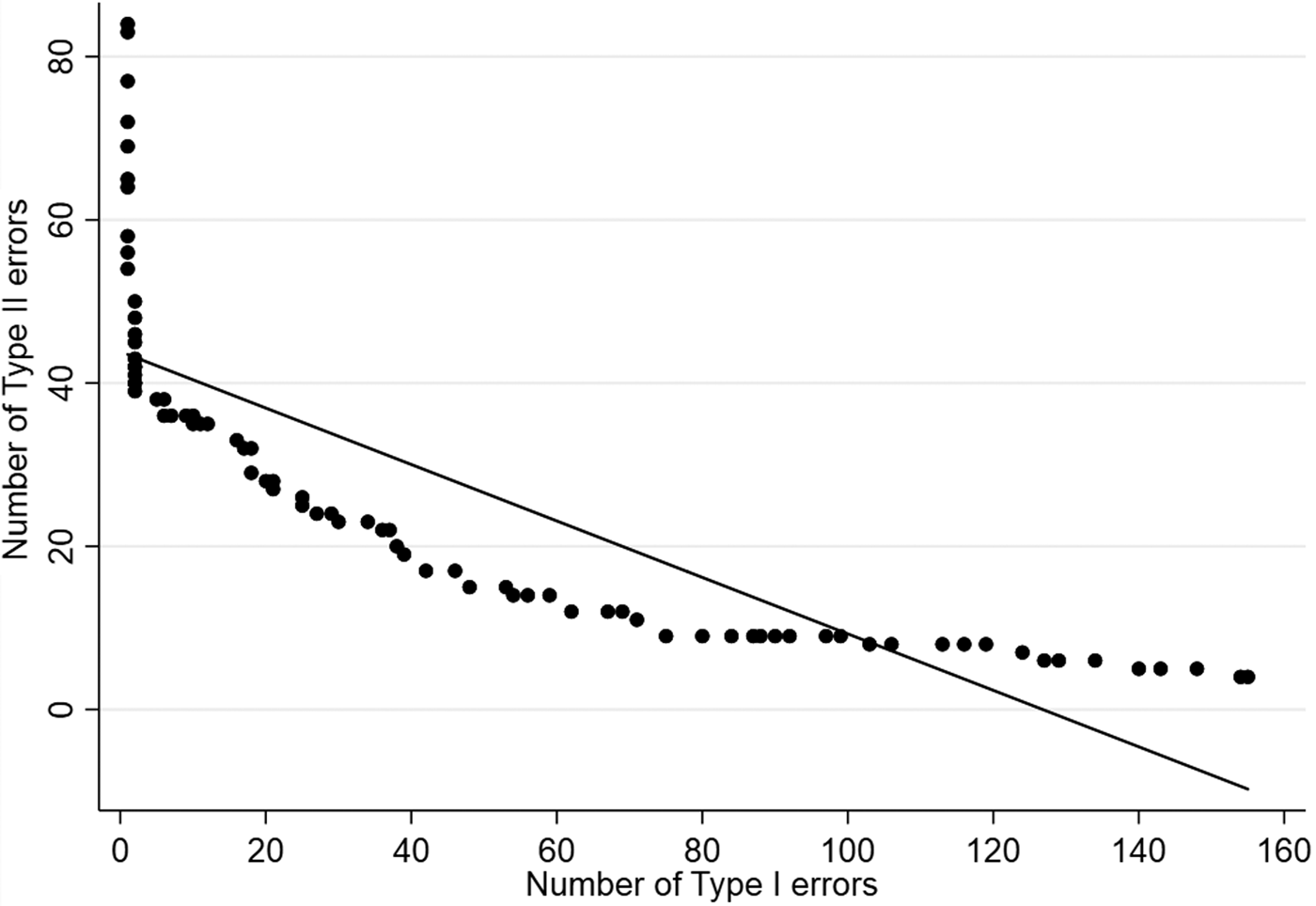
Varying  $\bar{p}$ for a given sample size alters the distribution of outcomes based on the ex-ante definition of firm viability, thereby facilitating estimation of the tradeoff between the two types of socially costly filtering errors. Figure 1 summarizes the incidence of Type I errors and Type II errors when varying the range of values for the threshold probability
 $\bar{p}$ from 0.1 to 0.9 in increments of 0.01. Every observation in the scatter plot corresponds to a particular value of
 $\bar{p}$ and depicts the associated number of Type I and Type II errors. The slope of the featured line of best fit, estimated using ordinary-least-squares, is equal to -0.3458 and quantifies the marginal tradeoff between Type II errors and Type I errors.
Marginal tradeoff between Type I errors and Type II errors based on ex-ante conceptualization of firm viability

Based on our estimates, each reduction in the number of Type II errors equal to Δ > 0 on average gives rise to an increase in the number of Type I errors equal to Δ/0.3458≈2.9Δ. Thus, under the SRP, any given reduction in the number of rejected reorganization proposals put forth by viable firms would at the margin give rise to an increase three times as large in the incidence of accepted reorganization proposals put forth by non-viable firms.
7. Discussion
Comparing filtering failures in Slovenia and Canada
How do our estimates for Slovenia compare with Fisher and Martel's (Reference Fisher and Martel2004) for Canada, the only other jurisdiction for which at least reasonably comparable estimates of filtering failures in non-liquidation bankruptcy have been put forth in the literature? Based on ex-post conceptualization of firm viability, our estimate of the ratio of the probability of Type I error to the probability of Type II error, equal to 2.5, is somewhat lower than the corresponding estimate by Fisher and Martel (Reference Fisher and Martel2004: 154). They report that in Canada, “Type I errors are roughly four times more likely to occur than Type II errors.” Our estimate of the incidence of filtering failure, equal to 26.6%, falls within the range of Fisher and Martel's estimate, which varies between 18 and 41%. Based on ex-ante conceptualization of firm viability, our estimate of the marginal tradeoff between Type I and Type II errors coincides nearly exactly with Fisher and Martel's.
Thus, the effectiveness of the Slovenian SRP during the 2013–2018 period is quite similar to that of Canadian reorganization during the 1977–1988 period. Slovenia's relatively recent socialist past and the associated lack of institutional memory of bankruptcy would perhaps suggest that the incidence of filtering failures in Slovenia should be higher than in Canada. Yet on the other hand, by the time the SRP was first launched in 2013, Slovenian creditors and firms had already accumulated non-trivial experience with related bankruptcy reorganization schemes. When viewed in this light, our findings are less surprising.
Understanding the comparative prospect of different types of filtering errors in Slovenia
Why would Slovenian ordinary unsecured creditors tend to commit relatively more Type I than Type II errors and thereby disproportionately encourage a socially inefficient commitment of resources to non-viable projects as opposed to engaging in likewise socially inefficient discontinuation of viable projects? Answering this question requires an understanding of how ordinary unsecured creditors are expected to fare in the event of firm liquidation, the alternative mode of resolution of severe financial distress.
Cepec et al. (Reference Cepec, Grajzl and Zajc2017) show that, in the event of firm liquidation in Slovenia, creditors fail to recover any of their claims in as many as 79% of the cases. Furthermore, in the remaining 21% of the cases in which the total amount paid to creditors after liquidation is positive, the mean total payment to creditors amounts to a meager 6.2% of the mean value of all declared claims. While these estimates apply to the comprehensive set of firm liquidations that took place between 2008 and 2013, the figures for small businesses should be very similar: firm size is in general not a significant predictor of liquidation outcomes in Cepec et al.’s (Reference Cepec, Grajzl and Zajc2017) analysis.
Under the rules of SRP, the rejection of a reorganization proposal does not of course automatically result in firm liquidation. However, the rejection of a reorganization proposal certainly increases the prospects of eventual liquidation (see Table 2). Thus, the expected benefit to ordinary unsecured creditors from rejecting a reorganization proposal tends to be rather low. In this sense, much as in Canada (Fisher and Martel, Reference Fisher and Martel2004: 162), acceptance of a reorganization proposal provides ordinary unsecured creditors in Slovenia with at least the possibility of a higher payoff. Consistent with our empirical findings, the probability of Type I error hence tends to exceed the probability of Type II error.
Toward comparing the role of courts versus creditors in causing filtering failures
In other bankruptcy systems internationally, courts often have a comparatively more significant role than they have under the SRP. For example, under Chapter 11, prior to approving a proposed reorganization plan the court is expected to double-check whether the plan is congruent with the creditors’ best interests and whether the plan is feasible. US courts may further impose (‘cram down’) the implementation of a reorganization plan even if an entire class of creditors voted against it, an outcome that would normally prevent the plan's implementation. The court's role has been traditionally comparatively most pronounced in France where the judge actively exerts authority over decisions about both the mode and the nature of proposed resolution of corporate financial distress (Aghion et al., Reference Aghion, Hart and Moore1992). For instance, if a company has ceased paying its debts, the court decides whether reorganization proceedings should commence in the first place. Moreover, while the court appoints a bankruptcy administrator, the decision on confirming a reorganization plan is left to the court (Couwenberg, Reference Couwenberg2001).
The above discussion raises the question of how far our estimates of the prospects of different types of filtering errors in Slovenia are a reflection of the particular institutional arrangement for financial reorganization where courts play a very limited role. More generally, how does the scope of judicial discretion impact the effectiveness of a financial reorganization framework at promoting the restructuring of viable firms and encouraging the exit of non-viable ones?
From the theoretical standpoint, creditors and judges differ with respect to incentives and inherent expertise. Creditors are likely to be more aware of the expected payoff under debtor liquidation, in particular when that payoff is low. All else being equal, we would thus expect arrangements where the plan confirmation decision is left to creditors to result in more plan confirmations, and thus typically a higher likelihood of Type I errors, than arrangements that afford courts a more significant decision-making role. To the extent that generalist judges lack the expertise to assess the prospects for survival of an insolvent business as well as having an incentive to expedite case disposition (Dimitrova-Grajzl et al., Reference Dimitrova-Grajzl, Grajzl, Sustersic and Zajc2012; Posner, Reference Posner1993), we would further expect greater court involvement in plan confirmation to increase the share of rejected proposals (which require no subsequent judicial effort) and, thus, the prospect for Type II errors.
An empirical examination of the above hypotheses would require access to data on the reorganization plans generated via a non-liquidation bankruptcy scheme that is similar to the Slovenian SRP but allows for an elevated role of the court. Such data currently do not exist. However, an indicative answer about the comparative role of creditors versus courts in causing at least one type of socially costly filtering error may be gleaned by contrasting our results for Slovenia with estimates for France.
Using a sample of financial reorganizations attempted between 2006 and 2012, Fattah et al. (Reference Fattah, Barthélémy, Levratto and Trempont2016) estimate that in France the share of confirmed among all proposed financial reorganizations (N A/N) is 0.21 and the share of attempted reorganizations that result in liquidation (N N/N) is 0.57. Utilizing our conceptual framework and ex-post conceptualization of firm viability, it follows that the upper bound on the estimated probability of Type I error for the French system is about 0.37 (≈0.21/0.57). (In contrast, the probability of Type II error cannot be adequately estimated.) With the actual probability of Type I error likely lower than the estimated upper-bound value, we may conclude that the French financial reorganization scheme gives rise to lower prospects for acceptance of non-viable proposals than does the Slovenian SRP. While subject to the caveats about the preliminary nature of the analysis, other differences in nuances of the contrasted bankruptcy procedures, as well as different composition of the samples (ours focuses on small firms), this finding is consistent with our theoretical prior.
8. Concluding remarks
We provide a rare empirical insight into the effectiveness of bankruptcy institutions at promoting socially efficient allocation of resources. Under the rules of Slovenian simplified financial reorganization, firms with a rejected proposal are not automatically liquidated, a peculiar legal provision that aids the estimation of filtering errors indicative of the extent and nature of system-wide resource misallocation. Furthermore, the decision to reject or accept a reorganization proposal is left exclusively to ordinary unsecured creditors. Our analysis thereby offers a unique empirical glimpse into the functioning of a non-liquidation bankruptcy scheme under which courts are stripped of the powers to make decisions on either the merit or the substance of proposed reorganization.
Our estimates of filtering failure do not necessarily extend to the Slovenian bankruptcy system as a whole. False positive and false negative decisions may also occur at earlier stages of the process, during the distressed firm's decision to pursue reorganization versus liquidation. The incidence of filtering failure in other types of proceedings and at other stages of the bankruptcy resolution process should be explored in further research, as should be the extent of filtering failure in bankruptcy systems where courts are awarded a more prominent role.
Acknowledgments
For helpful comments and suggestions we are grateful to Valentina Dimitrova-Grajzl, Barbara Mörec, and two anonymous reviewers. The first draft of this paper was written when Jaka Cepec was visiting the Washington and Lee University School of Law as a Fulbright scholar. We thank the Fulbright Commission for enabling the visit and the faculty and staff of the Washington and Lee University School of Law for their hospitality.