INTRODUCTION
In the wake of successive revolutions in the Arab world, one of the most compelling matters in question is the role Islamist partiesFootnote 1 will play in these new democratic transitions. In other words, the concern is that Islamist parties will dominate electoral processes severely enough to choke the fragile infantile systems rather than allow for a clean and uneventful democratization process to unfold. While this question does indeed attract much publicity and is rightly pertinent, a more pressing and enigmatic question remains — Can Islamist parties even win free and fair democratic elections? Two arguments dominate the scholarly literature in terms of Islamist parties’ performance in democratic elections. The conventional one — “one man, one vote, one time” — asserts that due to Islamist parties’ widespread popularity in the Muslim world, they would assume power via free elections and then suspend democracy. More recently, Kurzman and Naqvi (Reference Kurzman and Naqvi2010) challenge this argument, showing that Islamists tend to lose in free elections rather than win them. Islamists are not, indeed, as popular as they are made out to be under conditions of electoral freedom.
Existing theories of Islamist party electoral performance focus heavily on political openness, and as such, we seek to challenge these long-standing perceptions about Islamists’ electoral prospects, arguing that existing arguments fall short by failing to account for other factors that may shape Islamist parties’ electoral performance, including the levels of political and economic developments and the political platform of the Islamist party in question, as not all Islamist parties rally on similar platforms. Additionally, these arguments take all Islamist parties to be essentially similar, while they are not. Specifically, we hypothesize that moderateness of the political platform of Islamist parties plays a key role in increasing the popularity of these parties and leads to higher levels of electoral support. Using data collected by Kurzman and Naqvi (Reference Kurzman and Naqvi2010), we test how our argument holds when controlling for political platform and political economic factors in a quantitative analysis. We find that there is empirical support for our argument. Our analysis shows that Islamist parties’ support level is, indeed, positively associated with moderateness of their platforms; openness pushes Islamist parties to moderate, which, in turn, boosts their electoral prospects. Incorporating Islamist parties’ ideological orientations allows us to connect with a growing Islamist moderation literature. This connection challenges conventional assumptions about the normative implications of Islamist participation in elections and government. We also find that economic growth negatively affects Islamist prospects at the polls.
The question regarding Islamist parties’ electoral performance is an important one for several reasons. First, it should be noted that our understanding of the dynamics of Islamist electoral politics and strategic decision-making is limited. To date, there has been little research conducted on Islamist parties’ electoral performance in a cross-national setting.Footnote 2 By contrast, our understanding is shaped by case studies, depriving us of the ability to control for alternative factors that might potentially affect the proposed causal relationship. Lack of data has been a major obstacle. Relatedly, Islamist parties are assumed to be actors largely stuck in, and confined to, their ideological precepts. Little flexibility exists for them to change their political discourse, according to this perspective. Yet, Islamist parties, just like any other party, are strategic actors, constantly reviewing their positions. Popular sentiment, other parties, state response, economic conditions, and electoral rules are only a few factors that shape their ideological positions, in order to achieve their electoral goals (Hallward Reference Hallward2008; Gidengil and Karakoc Reference Gidengil and Karakoc2014).
Islamist moderation cannot be considered independent of electoral performance. Such rational and strategic decision-making on the part of Islamist parties could lead to a moderation in their conservative ideology. Under changing socio-economic conditions, Islamist parties may face waning popular support — or increasing irrelevancy — by insisting on outdated notions of societal conflict, which ultimately leads to unpopular political discourse. Note that Islamist ideology hails from a distinct socio-economic and political context, aiming to offer a solution to a particular set of political problems. For example, when political Islam rose to pre-eminence as a political ideology in the 1970s, this rise was largely due to the failure of secular ideologies and regimes to deliver on their economic and political promises from the 1950s and 1960s, worsening income inequality, and causing humiliation at the international level (Ayoob Reference Ayoob2008). However, when such conditions change, Islamist parties must adapt their discourses (as has been the case in Turkey, Morocco, and Tunisia) to reflect the emergence of new issues and areas of contention. Yet, contrary to popular belief, not all Islamist parties are popular. While some Islamist parties win elections, others struggle for any political existence and relevance. And, not all Islamist parties are conservative. Just as there are conservative and moderate Islamist parties that win elections, there are conservative and moderate ones that do not — ones with a proven record of sustained electoral failure. A better understanding of the electoral dynamics of Islamist parties is an integral step to deciphering the dynamics of change in Islamist discourse and moderation.
Finally, also of note, Islamist parties and organizations are often the well-organized political groups in their respective societies. As a result, their participation and involvement in the electoral process constitutes one of the keys to successful democratization.Footnote 3 Yet, as they also tend to be the most polarizing political organizations in most Muslim majority societies, if they are unable or unwilling to usher stable democratization, the opposite may just as easily occur — they could provoke strong anti-democratic movements by other domestic actors. What transpired in Egypt in the summer of 2013 is a case in point.
The rest of the article is organized as follows. We first begin with a discussion of the scholarly literature on the electoral success of Islamist parties. This discussion will help us identify relevant variables/hypotheses to test. Then, we explain how political discourse and policy positions of Islamist parties might offer a better explanation for the electoral performance of these parties. In the third section, we discuss our data and methods for empirical analysis. In the fourth section, we analyze the results of our regression estimations. We conclude with a discussion of the implications of our analyses and future research avenues.
EXPLAINING ISLAMIST ELECTORAL SUCCESS
There exist two major accounts of Islamist electoral success in the literature, both of which deal with level of political openness. In wake of the recent revolutions in the Arab Spring, many fear, paradoxically, that Islamist parties could come to power through democratic means, only to replace the newly democratic state with an undemocratic and theocratic one (Gause Reference Gause2005; Nasr Reference Nasr2005).Footnote 4 This notion of a swift end to democracy through “one man, one vote, one time” originated with American diplomat Edward Djerejian, who coined the term in response to Algeria's sudden electoral repression in 1991. While the reasons for Islamic Salvation Front's growing popularity prior to the 1991 Algerian elections are varied (Kapil Reference Kapil1990; Chhibber Reference Chhibber1996), the regime's actions in the events leading up to the scheduled election set a precedent and lent an answer to the question of why democracy is largely lacking in the Middle East. The regime's uncertainty regarding Islamist popularity led the regime to feel secure enough to offer freer elections, yet, at the realization that Islamic Salvation Front's victory was forthcoming, elections were abandoned for fear that in this single election, Islamists would win the majority, take control, and institute an Islamist state (Blaydes and Lo Reference Blaydes and Lo2012). Somewhat ironically, democracy is stifled as a result, even though the threat of Islamist victory is not always a valid concern. Conclusively, this theory easily explains the reasons for the successive failures of Islamist parties under repressive regimes and suggests that in free elections, Islamist success may be inevitable. However this theory does not fully explain the reasons for the alleged inevitability of their successes if elections were indeed free, nor their supposed popularity.
However, others contend that Islamists will succeed in free elections due to their ascribed popularity, making no predictions regarding the future of democracy under the control of these new Islamist regimes (Blaydes Reference Blaydes2006; Hamid 2009; Rumman and Suliman Reference Abu Rumman2007). Schwedler (Reference Schwedler1998) in particular finds that Islamist electoral success is impossible in repressive electoral conditions. Election data from the Middle East, hence, might be misleading as a result of this oppression. To understand the poor performance of Islamist parties, electoral manipulation in the form of gerrymandering, sudden changes in voting laws, and proxy voting need to be taken into account. To suggest that Islamists are unpopular due to their inability to win elections, or even to win a significant number of votes, is to ignore the more substantive problem of undemocratic electoral repression. Hence, freer elections could lead to greater Islamist success (Schwedler Reference Schwedler1998), regardless of the prevailing circumstances.
Kurzman and Naqvi (Reference Kurzman and Naqvi2010) suggest an alternative view. They argue that the very existence of election repression is evidence enough that Islamists are sufficiently popular to win free elections. They find, however, that Islamists are, across the board, doing poorly in elections. They suggest that Islamists do poorly in states with freer elections due to lower popularity (as discerned from the regime's allowance of elections), yet also do poorly in states with high levels of popularity due to repressive electoral conditions. Similarly, data by Garcia-Rivero and Kotze (Reference Garcia-Rivero and Kotzé2007) indicate that repressive conditions tend to ignite support for Islamists rather than “erode” support. Conversely, freer elections tend to take place when the Islamist “threat” is not as high. Thus, there is a selection process at work, and this can be used to explain why Islamists are doing poorly in the few states that experience free elections. This suggests that free elections may never take place in states where Islamist parties enjoy higher levels of support. Accordingly, it should be noted that free elections and other forms of liberalization will only occur in authoritarian regimes when there is either low support for Islamist parties (Kurzman and Naqvi Reference Kurzman and Naqvi2010) or if the regime is uncertain of Islamists’ popularity (Blaydes and Lo Reference Blaydes and Lo2012). Islamist parties are more concerned with their continued existence rather than electoral wins. This they discern from survey data that suggests that a majority of voters are in support of sharia, a fact that seriously conflicts with the actual electoral performance of Islamist parties (Esposito and Mogahed Reference Esposito and Mogahed2007; Fish Reference Fish2011). If a majority of voters are ideologically inclined toward Islamist ideals, what can account for Islamist electoral failures if not for their strategic participation and calculated running of candidates?
A variation of this argument is that Islamist parties lose elections on purpose. As Hamid (Reference Hamid2011) argues, Islamists will not participate in elections if they fear repression by the regime; they would rather ensure their survival by permeating society slowly.Footnote 5 Since there is an unwillingness to participate in elections to contest the ruling regime, democracy is stifled. Hamzeh (Reference Hamzeh2000), in his analysis of Lebanon's Hezbollah, shows that rather than concerning itself with a landslide victory, Hezbollah prefers to work within the existing electoral system to win individual municipalities in an attempt to safeguard their survival while still being able to gain support. This gradualist approach allows Hezbollah to “Islamize” society slowly, decreasing the chance of conflicting with the current regime. It could be said that Hezbollah was losing elections on purpose until recent years. Another theory states that Islamists may avoid fully participating in elections since election participation can moderate political parties. Therefore, by strategically integrating themselves into society progressively, Islamists not only ensure the survival of their parties but also of their ideologies and platforms (Baylouny Reference Baylouny2004; Brown Reference Brown2012).
MODERATION AND ISLAMIST ELECTORAL SUCCESS
We propose an alternative explanation to account for the electoral performance of Islamist parties. A body of literature whose currency has been growing in recent years is the Islamist moderation literature (Clark Reference Clark2006; Gumuscu Reference Gumuscu2010; Schwedler Reference Schwedler2006 & Reference Schwedler2011; Wegner and Pellicer Reference Wegner and Pellicer2009; Wickham Reference Wickham2004; Tezcur Reference Tezcur2010; Karakaya and Yildirim Reference Karakaya and Yildirim2013; Cavatorta and Merone Reference Cavatorta and Merone2013). As the number of Islamist parties' increases in the Muslim world partly due to increasing levels of electoral competition, the spectrum of ideological positions of such parties also becomes more varied, ranging from very traditional and conservative Islamist parties like the Muslim Brotherhood in Egypt to the Muslim democratic Justice and Development Party in Turkey. The moderation literature explores the causes of and motivation behind Islamist parties’ drive for more moderate ideological positions.Footnote 6 Mostly, however, this literature developed independent of the potential for electoral success of Islamist parties. Whether those parties that moderated or not were popular and will achieve electoral success remains beyond the scope of this literature. Yet, there is a strong possibility of a natural connection between why Islamist parties moderate and how their electoral prospects are affected by this moderation. As the interest in Islamist parties grows due to the concern with democratization prospects in the region, many scholars ventured into explanations of the sources of the moderation of such parties. This concern with Islamist parties is largely due to the conviction that Islamist parties stand tall and strong in front of democratization efforts. Ironically, this is the same argument developed by secular and authoritarian dictators in the region such as Mubarak and Ben Ali, at least until the Arab Spring.
We think, indeed, that moderation might be one of the key variables to explain Islamist parties’ electoral popularity. The broader literature on political parties offers possible reasons why that is the case. Several studies show that electoral dynamics push political parties (Islamist or otherwise) to adopt ideological revisions to their platforms. Usually, these ideological changes involve moderation of the core tenets of their platforms. The goal for parties to engage in such moderation is either to pursue electoral victories (Sanchez-Cuenca 2004) or to avoid political marginalization (Cavatorta and Merone Reference Cavatorta and Merone2013). Shifts in voter preferences (Adams et al. Reference Adams, Clark, Ezrow and Glasgow2004; Kaminski Reference Kaminski2006; Kollman, Miller, and Page Reference Kollman, Miller and Page1998) or recent electoral defeats (Budge Reference Budge1994; Poutvaara Reference Poutvaara2003; Somer-Topcu Reference Somer-Topcu2009) usually underlie such soul searching within parties.
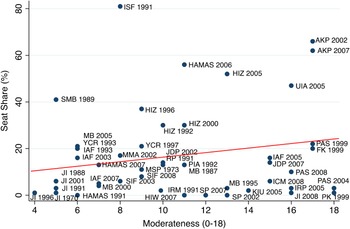
A casual observation of Islamist party platforms indicates a positive correlation between moderateness of Islamist discourse and electoral success (Figure 1), which leads us to further analyze the empirical evidence for a causal relationship between moderateness in Islamist discourse and electoral success. For example, the overwhelming success of AKP in Turkey since 2002 is attributed to its moderated policy platform (Yavuz Reference Yavuz2009; Gumuscu Reference Gumuscu2010). Al-Nahda in Tunisia and JDP in Morocco echo both AKP's electoral success and political platform in recent years (Torelli Reference Torelli2012; Karakaya and Yildirim Reference Karakaya and Yildirim2013; Cavatorta and Merone Reference Cavatorta and Merone2013).
Seat Share and Moderateness of Islamist Parties

Before we proceed with our discussion of data and methods and a thorough discussion of the party platform data, we will briefly review other factors discussed in the literature as being conducive to Islamist electoral success, which we will use as control variables in our analysis.
The fact that in many instances, such as in the case of Algeria in 1990, Islamist parties are the main opposition party to the ruling regime, some maintain that in the event of a free election, Islamist victory would be all but guaranteed and a potential cause could be extreme levels of dissatisfaction with the current regime (Kapil Reference Kapil1990; Baylouny Reference Baylouny2004; Gause Reference Gause2005; Robbins 2009). Such “revenge voting,” as Tessler (Reference Tessler1997) refers to it, occurred in the case of Algeria in the early 1990s or as in a rebellion against the “extravagant lifestyles” of PLO officials in Palestine in the 2000s, noted in the instance of Palestinian Christians voting in large numbers for Hamas. In this case, ideological support and other factors are irrelevant in determining whether or not an Islamist party could succeed in a free election, provided that there is high discontentment with the ruling regime (Robbins 2009). As Rivero-Garcia and Kotze (Reference Garcia-Rivero and Kotzé2007) assert, generally, those who support Islamists are not rejecting democracy outright but are simply rejecting the “repressive state apparatus” under which they live. They even find that in Jordan, support for Islamist parties is positively correlated with support for democracy.
Another explanation is that parties that engage in clientelism, that is, vote-buying through provision of public goods, often enjoy the support of lower classes (Harik Reference Harik1996; Ismail Reference Ismail2001; Woltering Reference Woltering2002), although this type of support has very little, if anything, to do with party ideology. Hence, without public opinion surveys, it is nearly impossible to determine if such supporters are ideologically inclined toward Islamist parties or if they are simply showing their appreciation for the provision of goods and services that the regime cannot or does not supply (Blaydes Reference Blaydes2006). Generally, a poor economy is a relatively robust indicator of support for Islamist parties across all classes, as Islamists are better able to convince the electorate of their ability to redistribute wealth (Masoud Reference Masoud2014). Pellicer and Wegner (Reference Pellicer and Wegner.2012) refer to this type of support as voting for “policies rather than politics.” Clearly, those of lower classes will support Islamist parties when social services are provided, yet many have found that middle and upper classes are often the primary supporters of Islamist parties (Pellicer and Wegner Reference Pellicer and Wegner.2012; Waltz Reference Waltz1986; Woltering Reference Woltering2002).
Also, similar to lower classes, middle and upper classes may be dissatisfied with the regime's apparent inability to improve the economy. While the lack of growth in economic sectors such as housing and education in comparison to a rapidly growing populace is certainly a concern, in many cases, regimes are more concerned with ensuring the continuance of their “elite privilege” rather than addressing economic issues. This suggests that support for Islamism is largely a response to exploitative and corrupt governance (Tessler Reference Tessler1997). Among these groups specifically, being overly qualified for jobs is a major concern in poor economies (Woltering Reference Woltering2002). If the ruling regimes were able to deliver good policy outcomes, the fear of Islamist parties and their “power grab” would be irrelevant — more people would express their support for ruling regimes and not vote for Islamist parties. But, because they deliver poor outcomes, Islamist parties become a viable option for many voters (Masoud Reference Masoud2014). Although it may seem that an upturn in the economy would decrease support for Islamist parties, Waltz (Reference Waltz1986), in her study of Tunisia, contends that ideological support is enough to maintain Islamist success even in good times. Hence, we think that by controlling for good policymaking in our empirical analysis, we should be able to test the merit of this argument.
Based on our discussion thus far we will test the following hypotheses in our statistical analyses:Footnote 7
Hypothesis 1: Moderate Islamist parties should have higher electoral support.
Hypothesis 2A: In free elections, Islamists should receive higher support.
Hypothesis 2B: In unfree elections, Islamists should receive higher support.
Hypothesis 3: In poor countries, support for Islamist parties should be higher.
Hypothesis 4: In countries with higher corruption, support for Islamist parties should be higher.
Hypothesis 5: When inequality is prominent, support for Islamist parties should be higher.
Hypothesis 6: Higher economic growth rates should lead to lower support for Islamist parties.
DATA AND RESULTS
In an attempt to find the causes of electoral success or failure of Islamist parties in a cross-national context, we will conduct a series of statistical analyses to test for multiple hypotheses as discussed above. Primarily, we will utilize a recent dataset compiled by Charles Kurzman on Islamist parties’ discourses and their electoral performances across the Muslim world for the period 1968–2010. Integrating party platform information into a moderateness index, as discussed below, yields 48 cases for our statistical analyses. We supplement this dataset with information from other sources as discussed below.
In regards to the political discourse of Islamist parties, we rely on Islamist party platform data from Kurzman to determine how moderate Islamist parties are. Before we proceed with a discussion of the data itself, we want to explain our decision to use party platform data. Party platforms generally represent party officials’ concerted efforts to develop and present their positions on various issues that are of significance to the electorate (although there are some exceptions, such as the many parties of the post-Soviet world that revolve around personalities rather than ideologies, i.e., personalistic parties) (Papkova Reference Papkova2007). As imperfect as party platforms may be, we take them to be a “plausible proxy” for actual party positions and as an approximation of how the party will act in office (Janda et al. Reference Janda, Harmel, Edens and Goff1995; Oliver and Marion Reference Oliver and Marion2008).
In the case of Islamist parties, focusing on party platforms provides three distinct advantages. First, various documents explaining party stance on political issues are important because Islamist parties tend to be ideologically well-established and claim to represent a particular interest in the society, rather than being amorphous or personality-oriented. Islamist parties go to great lengths to draft such documents in order to reflect their ideological positions as accurately as possible. The debates surrounding the Egyptian Muslim Brotherhood's draft party program in mid-2000s illustrates the point (Brown and Hamzawy Reference Brown and Hamzawy2008). Second, while there may be skepticism about “their true goals and practices” (Kurzman and Naqvi Reference Kurzman and Naqvi2009), most Islamist parties will never find themselves in government, thereby depriving us of an opportunity to know what the actual policies of parties might be. Hence, party platforms are the best option available.
Last, Islamist parties generally are regarded as passive actors, simply reacting to circumstances. While it is plausible to accept the idea that these parties do react to political, social, and economic developments in their own societies, we should also bear in mind that Islamist parties, just like other parties, also have agency. They make independent decisions to determine their political fate. The political discourses with which they represent themselves are a major indicator of such agency. Like other parties, they craft their platforms to express ideological stances on key issues, to state their priorities, and to positively affect their electoral fortunes. Therefore, policy platforms are likely to establish a connection between the party and the electorate and allow voters to determine whether to sympathize with a political party or not.
As far as moderateness is concerned, we conceive an encompassing definition of it, rather than viewing moderateness as a uni-dimensional phenomenon. It entails both commonly-discussed issues such as democracy, women's status, and sharia, as well as less frequently-emphasized issues such as foreign policy and the economy. Kurzman and Naqvi provide information on 13 policy items for Islamist parties on a global scale.Footnote 8 Of the 13 policy items, we selected nine as being relevant to the moderateness of an Islamist political platform:Footnote 9 democracy, sharia, women's rights, minority rights, jihad, Israel/Palestine conflict, interest-based banking, free market economy, and foreign investment. The main motivation for selecting these nine policy items is how commonly these factors are considered to be the markers of conservatism or moderateness of Islamist parties in the literature.Footnote 10
We created an index of moderateness, combining the remaining nine policy items.Footnote 11 The online appendix discusses how we coded these variables to create a moderateness index.Footnote 12 The index ranges between 0 and 18, with those that are higher scored indicating a more moderate platform.
For the dependent variable in our analysis, we use the seat share variable. Seat share indicates the total percentage of seats obtained by the Islamist party in the same parliamentary election as a share of total parliamentary seats up for election, and ranges between 0 and 100.Footnote 13 The seat share variable is from Kurzman's dataset.
To determine if Islamist parties’ electoral performance is linked to the level of economic prosperity within a country, we use GDP and GDP per capita for each case's respective year and country. Both indicators were taken from World Bank data, which are measured using the current US dollar exchange rate. Along these lines, to test whether negative economic growth rates lead to higher Islamist success, we have included the economic growth rate variable, which the World Bank measures using the annual percentage of GDP growth at market prices, with the baseline as constant local currency. With higher levels of poverty, it would be expected that Islamists should have a greater vote share. Hence, we use such indicators as Gini index and unemployment rate (percentage of unemployed out of total of labor force) to test for Hypothesis 5. Unemployment rates are taken from World Bank data, while Gini index data comes from the World Income Inequality Database. As one indicator of economic openness, we look at imports and exports both as percentage of total GDP, also from the World Bank. As another openness indicator, we use Penn World Table's data on percentage of openness at current US dollar prices. This dataset spans from 1950 to 2010.
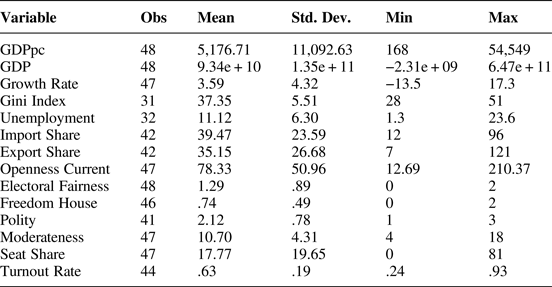
To measure political openness, we use three separate indicators. From Kurzman and Naqvi's original dataset, we gather the indicator of electoral fairness, with 0 coded as “independents only” (Islamist parties were banned for that year, therefore candidates must run independently), 1 as electoral “irregularities” and 2 as “basically free.” We also use Freedom House data using the traditional coding scheme of 0 as “not free,” 1 as “partly free,” and 2 as “free.” Polity IV serves as an indicator of regime type, ranging between (−10) (perfect autocracy) and (+10) (perfect democracy). We recoded this variable to make the interpretation simpler. In the new Polity variable, a value of 1 corresponds to (−6) or less in Polity IV; a value of 2 corresponds to values between (−5) and (+5); and, a value of 3 corresponds to values (+6) or larger in Polity IV variable. Finally, voter turnout is a variable indicating the proportion of the electorate that cast votes in the election. The variable ranges between 0 and 100, and this data comes from the Kurzman dataset. In Table 1, we present the descriptive statistics of all variables.
Descriptive Statistics

In our statistical analyses, we use weighted least squares regression (WLS). Our choice reflects two advantages of this method (Gujarati and Porter Reference Gujarati and Porter2008). First, our dataset consists of 48 cases, with several variables having missing values on different sets of observations; hence most models did not have the full sample. WLS performs well with small data sets, which is a quality we need in order to make the most out of our small sample. Second, weighted least squares offer a way to address the heteroskedasticity which is present in our data; WLS assumes that the entire residual is heteroskedastic and not just the first component of the residual.Footnote 14 Furthermore, WLS has been found to provide similar results as alternate approaches to addressing heteroskedasticity, including using Huber-White standard errors (Cohen Reference Cohen2004).
Finally, as with any statistical analysis, our estimates could be sensitive to outliers. We checked for possible outlier effects on our results and found that significance, direction, and size of the effects of individual variables in our regressions do not change in any meaningful way.Footnote 15
Sample selection and sample size are important consideration in using these data. In the introduction to the data that Kurzman and Naqvi (Reference Kurzman and Naqvi2009) collected on Islamist party platforms, they reveal of the data. Specifically, they draw attention to sample representativeness by stating, “These 48 platforms may not be representative of all 151 Islamic parties and movements that have participated in parliamentary elections since 1968. We were only able to locate platforms for one-quarter of Islamic parties before 2000, as compared with one half of Islamic parties since then.” Likewise, Kurzman and Naqvi underscore a concern with the distribution of parties in respect to their electoral success: “We were less likely to locate platforms for marginal parties than for successful parties — we have less than a third of the parties that received fewer than 10 percent of seats, but all five of the Islamic parties that won a majority of parliamentary seats” (Kurzman and Naqvi Reference Kurzman and Naqvi2009, 14).
We think both points are valid. As such, we assessed whether the sample we work with (n = 48) is significantly different from the universe of Islamist parties that contested elections between 1968 and 2010 (n = 151). We found that the smaller sample, indeed, over-represents larger parties at the expense of the more marginal parties; likewise, party platforms before 2000 are slightly less moderate as compared to platforms after 2000, which Kurzman and Naqvi (Reference Kurzman and Naqvi2009, 14) also note. The basic inference we deduce from these tests is that our sample might be disproportionately drawn from the more moderate and successful end of Islamist parties at the expense of conservative and marginal parties. In that case, we can determine which direction the bias in the statistical analysis will be; we will be more likely to commit a Type II error, i.e., a false negative. In other words, the results of our regression estimates should be less significant than the case in which we might have had the full sample. Thus, it is harder for us to find a statistically significant result. If our results are significant, then we can have confidence in the findings. Similarly, from a statistical point of view, there is little reason to be concerned about the relatively small sample size. It would only make us less likely to obtain statistically significant results even if there is a significant causal relationship between the main variables of interest (Type II error). Overall, these issues lead us to use greater caution in our analysis.
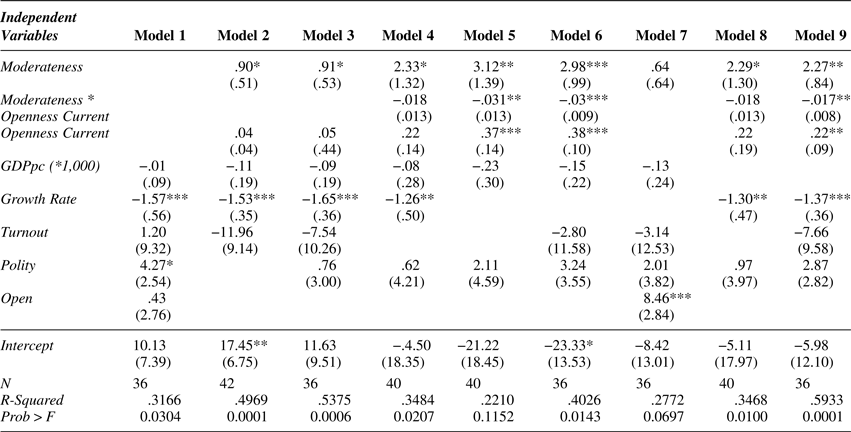
We report the regression estimations in Table 2. In reporting the results, we included a variety of specifications. Due to space limitations, we do not report on some models that include variables of interest per the theoretical discussion above. Among these variables are GDP, Gini Index, and unemployment rate. The unreported models either failed to achieve statistical significance at all levels, or they ended-up with too few cases, making regression estimations impossible.Footnote 16
Weighted Least Squares Regression Estimations (Dependent Variable: Seat Share)

We estimated a number of regression models without including the moderateness variable to see how electoral openness variables would perform, as it is a critical test of our argument. As an alternative and indirect indicator of political openness, we also included the electoral turnout rate in some of the models. Our assumption was that in more open electoral systems, turnout rates would be higher. We found that the Polity variable comes close to reaching statistical significance (Model 1), which seems to lend support to the “one man, one vote, one time” hypothesis, Yet, when we include the moderateness variable in regression models, openness variables are no longer statistically significant. Of the three indicators of political openness, none of them reach statistical significance. Because the effects are virtually identical, we only report on the Polity variable in our results to save space. Likewise, the Turnout variable fails to reach statistical significance in any of the models in which it was included.
We think that this is a significant finding and fundamentally challenges conventional ways of examining Islamist parties’ electoral success. The results indicate that the relationship between electoral openness and Islamist electoral success is possibly a spurious one. Because analyses of Islamist electoral performance usually do not include moderateness of Islamist platforms as a control variable, there appears to be a relationship between political openness and Islamist electoral success when there is none. In other words, electoral openness is a proxy for the moderateness of Islamist party platforms.Footnote 17 These results lead us to reject both the “one man, one vote, one time” hypothesis, which suggests that Islamists should fare better in free elections (Hypothesis 2A) and the Kurzman-Naqvi hypothesis, which suggests that political openness should lead to higher support levels for Islamist parties (Hypothesis 2B). We take this finding as an indication that moderateness is a critical explanatory variable to include in analyses of Islamist electoral performance.
Moderateness is the best performing variable of all the predictors in our models, following growth rate. It has a statistically significant and positive effect on seat share of Islamist parties with the exception of Model 7. The effect holds when the moderateness variable is included in the regression estimations both on its own and with an interaction term, as we discuss below. The result lends strong support for our hypothesis that, on average, moderateness of the platform leads to better electoral performance for Islamist parties. This effect is particularly striking when various indicators of political openness are included in the analysis, as we explain below.
Economic variables yield mixed results. In all models, per capita income is an insignificant predictor of Islamist support level, failing to support Hypothesis 3. By contrast, growth rate is statistically significant in all models (either at the 95% or the 99% level), and the effect is negative. When the economy grows, Islamist parties are more likely to experience lower support levels in the elections, whereas poor economic performance should lead to higher support for Islamists. The results lend support to Hypothesis 6. In terms of economic openness (Openness Current), the effect is statistically not significant when included in the regression by itself. As an alternative indicator of openness, we created an ordinal variable based on the Openness Current variable. The open variable takes on three values: Low (less than 50 on Openness Current variable), middle (between 50 and 95), and high openness (equal to or greater than 96). The baseline values of the Openness Current variable were determined based on the distribution of the values on this variable in our dataset. The ordinal open variable in Model 7 is statistically significant and has a positive sign, suggesting that more open economies lead to greater support for Islamist parties.
We are interested in seeing whether moderateness’ effect on electoral success is conditioned by other factors. Recent research shows that various economic factors such as openness, deprivation, and inequality might spur support levels for conservative Islamist parties (Harik Reference Harik1996; Woltering Reference Woltering2002; Blaydes Reference Blaydes2006; Sokhey and Yildirim Reference Sokhey and Yildirim2013). By contrast, Islamist parties with moderate platforms tend to perform better in countries with better economic prospects because the core constituency behind Islamist parties tends to benefit from increased prosperity. Such benefits might accrue in two principal mechanisms. First, greater integration to the global economy can allow previously marginalized sectors of the economy, primarily the conservative small firm owners, to find greater opportunities for increased prosperity (Gulalp Reference Gülalp2001; Nasr Reference Nasr2005). Second, masses (i.e., lower and lower middle classes) might experience increased income due to lower cost of living (i.e., cheaper imports), decreasing income inequality, or economic growth. The combined implication is that conventional conservative Islamist discourse based on the societal conditions of the 1960s and 1970s does not reflect contemporary socio-economic dynamics in many Muslim-majority countries. An ideology aiming to introduce an overhaul of the current system threatens to undermine the prosperity of many, including the principal supporters of Islamist parties. Hence, more moderate Islamist discourse may be more attractive to voters under these favorable economic conditions. By contrast, when the initial conditions that gave rise to Islamist ideology persist, i.e., poverty, inequality, and lack of economic opportunities, non-moderate Islamist ideologies should electorally be more successful.
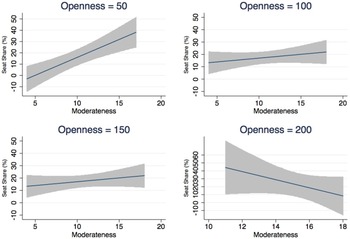
When we combine economic openness with moderateness, the coefficient for the economic openness variable (Openness Current) is positive and significant at the 95% and 99% levels in Models 5, 6, 9 and comes very close to statistical significance in Models 4 and 8. The coefficient for the interaction term (Openness Current × Moderateness) is also statistically significant but the sign is negative. The coefficient for the moderateness variable remains significant and positive. In order to better understand the effect of moderateness on the dependent variable (seat share), we have created a graph (Figure 2). The predicted effects of the moderateness variable are based on Model 9. In creating the table, we have set the values of all predictors to their mean values, while changing the values of the moderateness and economic openness variables. To make the interpretation easier, we have set the value of the openness variable to 50, 100, 150, and 200, respectively. The results indicate that our prediction is not borne out by the results. The predicted values based on the interaction of economic openness and moderateness show that in less open economies, a moderate platform translates into increasing support for these parties. By contrast, as the level of openness increases, the effect of moderateness is reversed. In high levels of openness, a more moderate political discourse suppresses the support for Islamist parties.
Predicted Effects of Moderateness on Seat Share at Different Levels of Economic Openness.

We think that the results for the economic openness variable are in need of qualification. That conservative Islamist parties become more popular as the level of economic openness increases seems counterintuitive because qualitative analysis conducted elsewhere contradicts this finding, as we discuss above. There are a couple of different ways to think about the results. One possible explanation as to why the results do not lend support to our theoretical expectations is that our economic openness indicator may not be capturing what we have in mind. Our interest in economic openness emerged from the assumption that more open economies provide better economic opportunities for the larger population, leading indirectly to the popularity of more moderate Islamist platforms. The indicator we used simply measures the volume of integration to the global economy, not necessarily the quality of it, i.e., whether better economic opportunities are offered to a larger population rather than to a select group of elites. Another explanation is that when integration to the global economy occurs, certain sectors of the economy, as well as their workers, might be harmed by such integration. A large body of literature in comparative politics advances a compensation hypothesis in which expanding trade leads to a larger public sector, possibly because the government is trying to offset the negative consequences of trade (e.g., Adsera and Boix Reference Adsera and Boix2002; Katzenstein Reference Katzenstein1985; Rosrik Reference Rodrik1998).Footnote 18 Such effect would be exacerbated when phases of integration coincide with recession. It is during such periods that ideologically extremist parties gain electorally, including conservative Islamist parties.
DISCUSSION
We think that the implications of our analysis challenge some of the long-standing convictions about Islamist parties’ electoral prospects. Existing theories of Islamist party electoral performance disproportionately focus on political openness. On one hand, one line of argument (the “one man, one vote, one time” hypothesis) suggests that Islamist parties are wildly popular in the Muslim world and will win free and fair elections. On the other hand, another hypothesis also places electoral openness to the center and suggests that Islamist parties tend to perform poorly in freer elections (Kurzman-Naqvi hypothesis). There is a striking similarity between these two arguments for they take Islamist parties to be essentially similar. Yet, not all hope to win elections and suspend democracy, and not all exist under repressive regimes and poor economic conditions, losing elections purposefully in order to ensure their survival or engaging in clientelism to win votes.
In contrast to the “one man, one vote, one time” hypothesis, our results suggest that whether Islamist parties will be successful in elections depends on their platforms and the economic conditions on the ground, making a critical contribution to the literature. The more moderate political platforms appear to enable Islamist parties to secure a greater share of parliamentary seats, all else being equal. By contrast, political openness fails to figure in as a significant factor to explain Islamist electoral performance, especially when the level of Islamist moderateness is controlled for.
Economic factors also seem to play a key role in determining how Islamist parties will perform in elections. Specifically, economic growth tends to suppress popularity of Islamist parties. Yet, it is obvious that economic growth can cut the other way as well; when economic growth comes about when an Islamist party is in power, that party will benefit from its good economic performance (Akarca Reference Akarca2013).
Our analysis has limitations — including our limited sample size — but suggests that we should take seriously an alternate explanation that counter the conventional wisdoms about Islamist parties. Specifically, our results establish a correlation between more moderate Islamist party platforms and electoral success. This has potentially important policy implications, especially for those focused on diminishing the role of Islamist parties in the Muslim world. The resources channeled into undermining Islamist parties should be rechanneled to better policy outcomes. Noting the conditions that gave rise to Islamist parties initially in the 1960s and 1970s, our findings imply that removing those conditions is the best remedy to curtailing conservative-radical discourse from politics, including political Islam. We envision that future research on this question might pursue two distinct avenues. Some of the variables that we were interested in closely analyzing had limited availability of data, including items such as perceptions of corruption, current regime, and economic conditions. Undeniably, some of the variables we tried are difficult to test given data availability. These are all individual level variables and present unique challenges in integrating them into our current empirical analysis. Combining country level indicators with individual level, survey-based data requires use of multi-level models for empirical analysis. Ideally, such data can be obtained from World Values Surveys’ different waves. Another direction for future research concerns finding more qualitative and detailed indicators of economic openness to tease out the exact mechanism as to how the relationship between moderateness and Islamist support is conditioned by economic openness. We look forward to future research about the nature and success of Islamist parties as this promises to continue to be an important theoretical and practical area of research.
APPENDIX
There are 9 components of the Moderateness index we created. All indicators are obtained from the Kurzman dataset. Each indicator can assume three values, 0, 1, or 2. All components of the Moderateness index are arranged such that the high value (2) refers to the moderate position on that issue while the low value (0) corresponds to highly conservative/Islamist position. Several indicators had their original values reversely ordered (i.e. high values referring to more conservative positions while lower values indicating more moderate positions). Most indicators are simply recoded to conform to this order of moderateness. In other cases where the relevant information was covered by more than one variables, we have combined them into a single indicator as discussed below. We list the original questions from the Kurzman dataset, and indicate how the item is coded into specific values.
Democracy (Q2) – The original question includes a response as “Opposition to Democracy”, however none of the cases are coded to reflect this answer. Therefore, we left this answer out and simply recoded the variable to reflect the following order without a change in categories.
Does the party support democracy? Do they define democracy?
0 – Islamic democracy. Statement of support for democracy with explicit reference to Islamic principles (e.g. shura) in agreement with democratic state structures.
1 – No mention of democracy.
2 – Secular democracy. Statement of support for democracy and a secular polity.
Sharia (Q3) – We combined questions 3(a), 3(b), and 3(c) into one variable. Specifically, if the answer to question 3(a) is “no”, then we coded the case 2. If the answer to question 3(a) is “yes”, then we looked to question 3(b). If the answer to question 3(b) is either 0 (no details) or 1 (weak form), then we coded the case as 1. All other cases are coded as 2.
3(a) Does the party require the implementation of the sharia? What is their definition of the sharia? Who will adjudicate disputes over the meaning of the sharia?
3(b) Definition/view of the implementation of Sharia
3(c) Adjudication
0 – Strong form of implementation. Qur'an and Sunnah as the only source of law.
1 – Weak form. No law that goes against the sharia, or some other statement, which acknowledges the Sharia as a guiding framework for legislation.
2 – No requirement or mention of sharia.
Women's rights (Q5) – Where does the party stand on women's rights and the implementation of Islamic family law?
0 – A distinct women's role in family and society (Islamic).
1 – No mention.
2 – Full legal equality for women.
Minorities (Q6) – How does the party propose to treat minorities?
0 – “Separate but equal” style of inclusion with reference to some Islamic criteria.
1 – No mention.
2 – Full legal equality for minorities.
Jihad (Q8) – Two questions deal with Jihad; we combined the two into a single variable. If the answer to question 8(a) is 0 (no mention), then we coded it as 2. If the answer to question 8(a) is 1, then we looked into question 8(b), which asks the context in which Jihad is used. If the answer to 8(b) is 0 (non-violent usage), 1 (self-defense only), or 2 (with reference to a specific circumstance, such as in Palestine or the historic struggle against colonial powers), then we coded it as 1. If the answer to question 8(b) is 3 (combating external enemies generally), then we coded it as 0.
Is Jihad defined? In what context? How is Jihad defined?
0 – Combating external enemies more generally.
1 – Self-defense, or with reference to a specific circumstance, such as in Palestine or the historic struggle against colonial powers.
2 – No mention.
Israel-Palestine (Q9) – What is the party's position on the Israel/ Palestine conflict?
0 – Explicit support for Palestinian independence.
1 – General support for Muslim freedom movements.
2 – No mention.
Interest-based banking (Q11) – Does the party platform propose banning interest based banking?
0 – Yes.
1 – No, but Islamic banking is supported.
2 – No.
Free market economy (Q12) – Is the party platform accepting of a free market economy?
0 – Price controls and active government role in distribution.
1 – No mention.
2 – Support for market based competition as organizing principle of economic activity.
Foreign investment (Q13) – Is the party platform encouraging towards foreign investment?
0 – Opposes foreign investment, proposing some measure of autarkic self-reliance.
1 – No mention.
2 – Engaging in global economy.