Introduction
The prevalence of diabetes for all age-groups worldwide has been estimated to be 2.8% in 2000 and 4.4% in 2030 (Wild et al., Reference Wild, Roglic, Green, Sicree and King2004). In addition to its complications on the microvessels of the eyes, kidneys and peripheral nerves, Type 2 diabetes is a major risk factor for macrovascular disease and causes significant morbidity and mortality from ischaemic heart disease and stroke (Strachan et al., Reference Strachan, Frier and Deary2003). As a consequence, another potential impact of type 2 diabetes, cognitive impairment, has been subject to increasing scientific attention (Strachan et al., Reference Strachan, Frier and Deary2003; Verdelho et al., Reference Verdelho2007). Learning and memory impairment is widely believed to be a consequence of type 2 diabetes, particularly in adults 65 years of age or older. Large community-based epidemiological studies have identified type 2 diabetes as a strong independent predictor of poorer performance on learning and memory tasks (Strachan et al., Reference Strachan, Deary, Ewing and Frier1997; Ryan and Geckle, Reference Ryan and Geckle2000). Taiwan has one of the most rapidly growing elderly populations in the world. Between 1950 and 2009, the percentage of individuals aged 65 years and above increased from 2.4% to 10.5% in Taiwan (Yen et al., Reference Yen2010). Cognitive function declines with age (Euser et al., Reference Euser, Schram, Hofman, Westendorp and Breteler2008), or comorbidity (Verdelho et al., Reference Verdelho2007; Knopman et al., Reference Knopman, Mosley, Catellier and Coker2009; Yen et al., Reference Yen2010), and cognitive impairment has become an important issue in healthcare delivery due to its tremendous impact on medical and socioeconomic systems (Yen et al., Reference Yen2010). There is strong evidence to show that the risk of cognitive impairment is significantly elevated in diabetes, by between 20% and 60% (Strachan et al., Reference Strachan, Frier and Deary2003; Luchsinger et al., Reference Luchsinger, Reitz, Patel, Tang, Manly and Mayeux2007; Crosby-Nwaobi et al., Reference Crosby-Nwaobi, Sivaprasad and Forbes2012).
Potentially inappropriate medications, drugs reasonably contraindicated for prescribing to elderly people, and unnecessary treatment duration have been substantially underestimated (Tamblyn et al., Reference Tamblyn1994; American Geriatrics Society Beers Criteria Update Expert, 2012). A systematic review for those compares use of any benzodiazepines, zopiclone, zaleplon, or zolpidem versus placebo for at least 5 nights. Eight studies (719 participants) report sleep quality significantly better with hypnotics use (mean effect size 0.14, 0.05 to 0.23; p < 0.005) (Glass et al., Reference Glass, Lanctot, Herrmann, Sproule and Busto2005). Improvements in insomnia are statistically significant, but the magnitude of effect is small. In people over 60, the benefits of these drugs may not outweight the increased risk, particularly if the patient has extra risk factors for falls and cognitive impairment. Adverse cognitive events are 4.78 times more common (95% CI 1.47 to 15.47, P < 0.01) (Glass et al., Reference Glass, Lanctot, Herrmann, Sproule and Busto2005). Observational studies also imply that benzodiazepines are related to an increased risk of falls, hip fractures, cognitive impairment, and car accidents (Grad, Reference Grad1995). Benzodiazepine and nonbenzodiazepine hypnotics (BZD/nonBZD) were classified as potentially inappropriate medications (PIMs) in elderly patients by the 2012 Beers criteria because they may increase risk of cognitive dysfunction (American Geriatrics Society Beers Criteria Update Expert, 2012).
Research demonstrating a link between type 2 diabetes and cognitive dysfunction has focused on adults over 65 years of age (Ryan and Geckle, Reference Ryan and Geckle2000). We also examined BZD/nonBZD prescriptions to assess their effect on cognitive function in Taiwan's elderly DM patients.
Methods
Data source
The study was cross-section designed. Data were drawn from the “2005 Taiwan National Health Interview Survey (NHIS)”, a population-based study of a national sample of adults aged 65 years and older. 2005 NHIS multi-stage stratified systematic sampling design was adopted. This design was established on the geographic setting and the grade of urbanization. All selected individuals were interviewed by well-qualified interviewers using structured questionnaires. A substitute respondent was cross-examined if the respondent was not capable to reply the questions. There were 2,727 participants in NHIS, but only 1,760 participants agreed to link NHIS to “National Health Insurance Research Database (NHIRD)”, which consists of all medical expenditures. Then we excluded participants that responded “don't know” or refused to answer, and missing responses for any of the questions; the total remaining samples numbered 653. The process of sample selection is shown in Figure 1. Our protocol was approved by the Institutional review board of the ethics committees of Chung Shan Medical University.
The process of sample screening.

Outcome variables
The Mini-Mental State Examination (MMSE) was used to evaluate patients’ cognitive function (Folstein et al., Reference Folstein, Folstein and McHugh1975). The MMSE is the most widely used neuropsychological measure of cognitive function, and there is a 30-point scale in this test that assesses numerous domains of cognition including memory, orientation, and arithmetic ability. A higher score means greater cognitive function. We used a cut-off score as indicated below to evaluate possible cognitive impairment. Identical cut-offs for cognitive impairment has been conducted in Taiwan. In Guo's study, using an education-adjusted cut point has been suggested to reduce the possibility of mis-screening patients (Guo et al., Reference Guo, Liu and Wong1988). Based on his large research study population, we used his suggestion that a cut-off of 23 or less be made for individuals with over two years of education and that a cut-off of 14 for individuals with 2 or less years of education (Guo et al., Reference Guo, Liu and Wong1988; Liu et al., Reference Liu1995).
Other independent variables
The 2012 version of the Beers criteria does not recommend using benzodiazepine and nonbenzodiazepine hypnotics in elderly patients because they may increase risk of cognitive dysfunction (American Geriatrics Society Beers Criteria Update Expert, 2012). We screened NHIRD from 2004 to 2005 in which participants had taken the following short and intermediate acting hypnotics : benzodiazepine, alprazolam, astazolam, lorazepam, oxazepam, triazolam, and long acting clorazepate, chlordiazepoxide, chlordiazepoxide-amitriptyline clidinium-chlordiazepoxide, clonazepam, dia- zepam, flurazepam, and nonbenzodiazepine hypnotics, eszopiclone, zolpidem, zaleplon as, potentially inappropriate medications (PIMs) (American Geriatrics Society Beers Criteria Update Expert, 2012). Diabetes was identified with any of the following definitions: (1) self-reported DM, (2) diagnosis of diabetes (ICD-9-CM = 250, including outpatient department visited at least twice or admission at least once during 2004~2005). Demographic variables such as age, gender, urbanization, body mass index (BMI), education, marital status, household monthly income, exercise, drinking, smoking, chewing betel, Charlson Comorbidity Index(CCI), hypertension, hyperlipidemia, activity of daily living (ADL), and instrumental activity of daily living (IADL) were collected in 2005.
Hypertension and hyperlipidemia status was self-reported by the survey participants and was making certain by the question “Did you ever have Hypertension/ hyperlipidemia? (yes/no/not sure).” Restricted in ADL and IADL & mobility was defined as experiencing any one limitation in 6-items ADLs (Katz and Akpom, Reference Katz and Akpom1976), and any one limitation in 8-activities IADLs (Lawton and Brody, Reference Lawton and Brody1969), or 8-activities of mobility (Sussman and Association, Reference Sussman and Association1966). Marital status was classified as married (living with spouse) or single (living without spouse or partner). Educational background was divided into four groups: illiterate or elementary school (the reference group), junior school, high school, and college degree or above. Degree of urbanization was divided into: 1-highly urbanized, 2-moderate urbanization, 3- newly developed towns, 4- including 4 ordinary towns, 5- aging towns, 6- agricultural towns, and 7-remote towns. BMI was divided between greater than or equal to, or less than 24 (kg/m2). Household monthly income was divided into those earning below thirty thousand or less, 30–50 thousand (New Taiwan dollars), and those earning above 50 thousand. Comorbidity was estimated by the CCI according to the record in the NHI.
Statistical analysis
Descriptive statistics were used to characterize the study population. Multivariate logistic regression was used to evaluate the association effect of factors that contributed to cognitive impairment. All candidate independent variables were examined for statistical significance (p < 0.05). All statistical analyses were using a weighted sample and were performed using Stata software, version 11.0 (2009, Stata, College Station, TX), the pweight process was adopted to analyze the multistage, stratified, systematic sample.
Result
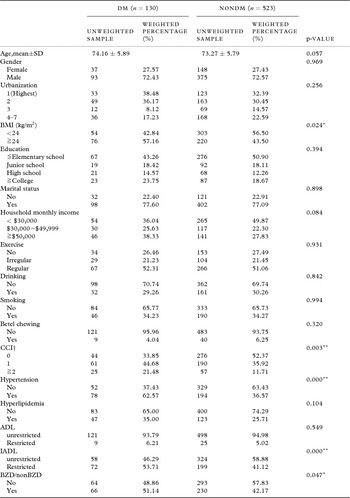
There were 130 participants left in the diabetic group and 523 participants in the control group. The average age was 74.2 and 73.3 respectively. The rate of cognitive dysfunction in DM and non DM participants is 11.5% (15/130) and 8.4% (44/523) (p = 0.14) respectively. Distributions of age, gender, urbanization, education, marital status, household monthly income, exercise, drinking, smoking, chewing betel, diabetes, hyperlipidemia, and ADL were similar in both groups. By contrast, the diabetic group were more likely than control participants to have BMI (57.2 vs 43.5%), CCI (21.5 vs 11.7%), hypertension (62.6 vs 36.6%), IADL (53.7 vs 41.1%), and BZD/nonBZD PIM use (51.1% vs 42.1%) (Table 1).
Demographic data of study population

ADL = activity of daily living; IADL = instrumental activity of daily living; BZD/nonBZD = benzodiazepine/nonbenzodiazepine ;.
†Charlson Comorbidity Index; *p < 0.5, **p < 0.01
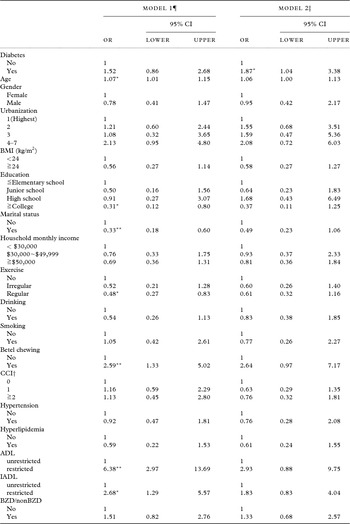
The results of model 1 and model 2 were produced by univariate and multivariate logistic regression separately. Using univariate analysis (Table 2, model 1), age, betel chewing, restricted ADL and restricted IADL had a positive association with cognitive impairment. By contrast, college education, companion and regular exercise were protectively associated with cognitive function. Diabetes seems to have a neutral relation (OR 1.52, 95% CI 0.86–2.68) in Table 2 model 1 since the regular exercise provides more weightiness.
Risk factors of cognitive dysfunction in elderly participants

ADL = activity of daily living; IADL = instrumental activity of daily living BZD/nonBZD = benzodiazepine/nonbenzodiazepine;
¶Univariate logistic regression; ‡Multivariate logistic regression.
†Charlson Comorbidity Index.
*p < 0.5, **p < 0.01.
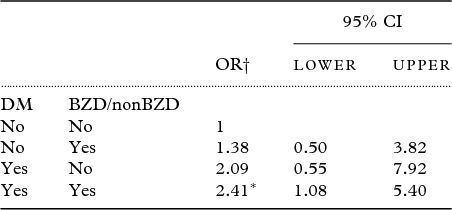
Compared with those without diabetes in multivariate regression, the odds ratio of developing cognitive impairment was 1.87-fold higher for diabetic patients (95% CI 1.04–3.38) (Table 2, model 2) after adjusting for sociodemographic characteristics, comorbidities, and PIMs. Other factors were not significant. We further compared the joint effect of diabetes and PIM on cognitive impairment. Our data showed that the rate of BZD/nonBZD PIM use is 51.1% (66/130) and 42.2% (230/523) in DM and non DM cases respectively. To further address whether PIM use confers additional risk of cognitive impairment in diabetic patients, we performed an additional logistic analysis showing that the odds ratio of cognitive impairment in diabetic patients with PIM was significantly increased to 2.41 (95% CI 1.08–5.40) (Table 3) than for patients without diabetic and use.
The additional risk of cognitive impairment with benzodiazepine/nonbenzodiazepine use

BZD/nonBZD = benzodiazepine/nonbenzodiazepine.
†Adjusted age, gender, urbanization, BMI, education, marital status, household monthly income, exercise, drinking, smoking, betel chewing, Charlson Comorbidity Index(CCI), hypertension, hyperlipidemia, activity of daily living(ADL), instrumental activity of daily living(IADL).
*p < 0.5, **p < 0.01.
Discussion
The rate of cognitive impairment in this national sample of Taiwan's elderly diabetic patients is 9.4% (59/630), obtained from the education-adjusted cut-off point. There is rising proof that some forms of cognitive decline are identifiable as an early symptom of dementia (Petersen et al., Reference Petersen, Smith, Waring, Ivnik, Tangalos and Kokmen1999). The prevalence of dementia in Taiwan's adults over 65 year is about 3–6% and comparable with other states (Liu, Reference Liu2006). In this cross section study, only DM was found to be significantly associated with cognitive decline by logistic regression analysis in Taiwan's older diabetic patients. Our result was compatible with previous studies finding that diabetes is associated with a raised risk of dementia and cognitive impairment (Strachan et al., Reference Strachan, Deary, Ewing and Frier1997; Cukierman et al., Reference Cukierman, Gerstein and Williamson2005; Biessels et al., Reference Biessels, Staekenborg, Brunner, Brayne and Scheltens2006). Systematic reviews and meta-analysis also show a mild to moderate decline in cognitive functioning for patients with T2DM (Stewart and Liolitsa, Reference Stewart and Liolitsa1999; Awad et al., Reference Awad, Gagnon and Messier2004). However, there are complex mechanisms to induce cognitive dysfunction in type 2 diabetes patients. For example, higher mean glycated haemoglobulin concentrations, microvascular disease, and shorter term changes in blood glucose levels, genetic predisposition, hypertension, hyperlipidemia, macrovascular disease, depression, and drug therapy are also involved in this disorder (Strachan et al., Reference Strachan, Price and Frier2008).
Another major purpose of the study was to exam the hypothesis that PIM is associated with cognitive dysfunction in elderly DM patients. A previous 10-year's study from the “Survey of Health and Living Status of the Elderly in Taiwan” has shown that older age, being female, having a lower education level, exhibiting restricted IADLs, and having DM or a stroke diagnosis were good predictors for cognitive dysfunction (Yen et al., Reference Yen2010), but not included was PIMs. We added the factor of BZD/nonBZD drugs to assess the relationship between elderly DM patients and cognitive function. The most common undesirable effects of BZD/nonBZD are drowsiness, lasting daytime sedation lightheadedness, dizziness, cognitive impairment, motor incoordination, and dependence (Nowell et al., Reference Nowell, Mazumdar, Buysse, Dew, Reynolds and Kupfer1997; Holbrook et al., Reference Holbrook, Crowther, Lotter, Cheng and King2000; Buscemi et al., Reference Buscemi2007). Older adults have a mostly elevated risk of adverse effects, including unwarranted sedation, cognitive impairment, delirium, nightly wandering, agitation, confusion, balance troubles, falls and fractures, and impaired performance of daily activity (Cumming and Le Couteur, Reference Cumming and Le Couteur2003; Gray et al., Reference Gray2006). In adults older than 60 years, the benefits of BZD/nonBZD were relatively small compared to adverse cognitive events (Glass et al., Reference Glass, Lanctot, Herrmann, Sproule and Busto2005). The 2012 American Geriatrics Society Beers Criteria suggested that benzodiazepines (any type) should not be recommended for treatment of insomnia, agitation, or delirium, and that nonbenzodiazepine hypnotics should be avoided in treating chronically ill elderly patients (American Geriatrics Society Beers Criteria Update Expert, 2012). In our results, elderly diabetic adults with PIM use were associated with cognitive dysfunction more than those who were not diabetic and were not prescribed PIMs. Although PIM use is not significantly associated with cognitive dysfunction, extra caution is required when prescribing BZD/nonBZD drugs to an older diabetic patient. The magnitude of BZD/nonBZD medications may need a large study to understand the effects in older DM adults. As the number of ageing Taiwanese grow, cognition impairment and dementia have become an increasingly serious burden on medical and socioeconomic system. A previous study from the Taiwanese National Health Insurance program, showed that 13.3% involved long acting BZD hypnotics among 2,133,864 ambulatory care visits by patients aged 65years or older in 2004 (Lai et al., Reference Lai, Hwang, Chen, Chen, Lin and Chen2009). However, the PIM rate in our elderly DM patients was up to 51.1%. Much more attention should be given to educating both providers and patients in appropriate use of sedative medications.
The major limitations of this research are first that one third of the samples were not involved. The DM group (130) sample size is relatively small compared with that of non-DM group (523), and patient demographics were shown to be not comparable. Second, because this research was a cross-section study, cause and effect relationships were not clear. A large cohort study would seem to be warranted.
In our research, cognitive dysfunction was associated with diabetes. That BZD/nonBZD use may confer additional risk of cognitive impairment seems apparent in our study. Regularly examining mental function of DM patients seems warranted.
Conflict of interest
None.
Description of author's roles
Y. Lai and J. Chiou designed the study, supervised the data collection and wrote the paper. Y. Yang and M. Tsai collected the data and assisted with writing the article. J. Huang and J. Chiou were responsible for the statistical design of the study and for carrying out the statistical analysis.
Acknowledgments
This study was supported by grant CSH-2013-A-039 from Chung Shan Medical University Hospital, Taichung, Taiwan. This study is based (in part) on data from the National Health Interview Survey Original Database provided by the Health Promotion Administration, Ministry of Health and Welfare, National Health Research Institutes, Food and Drug Administration, Ministry of Health and Welfare. The interpretation and conclusions contained herein do not represent those of Health Promotion Administration, Ministry of Health and Welfare, National Health Research Institutes and Food and Drug Administration, Ministry of Health and Welfare. We would like to thank Dr. Roger L. Amidon who gave comments and edited our manuscript, and Mr. Yu-Hsun Wang for assisting data analyses.