Implications
Similar fattening performance of Krškopolje pigs can be expected in organic and conventional production system when nutrition is similar and adequate. Organically raised pigs experience outdoor activity and more diverse stimuli during life and consequently seem to confront better the pre-slaughter handling. Krškopolje pigs like to consume roughage feed (alfalfa hay) however this can affect fat tissue oxidative stability.
Introduction
Krškopolje pig is the only Slovenian autochthonous pig breed. The breed was abandoned in the second half of last century because of its low performance compared to modern, genetically improved pig breeds. Krškopolje pig is also reputed for its excellent meat quality, but scientifically based facts to support these claims are scarce (Kastelic and Čandek-Potokar, Reference Kastelic and Čandek-Potokar2013). In the past years, owing largely to the preservation programme for genetic resources, the interest and use of this breed has been growing among farmers; however, the pigs of this breed remain predominantly reared on small-scale, non-intensive farms, very often on organic and agro-touristic farms (Kastelic and Čandek-Potokar, Reference Kastelic and Čandek-Potokar2013). The legislation on organic production and labelling of organic products (OJ EU L250/1, 2008) recommends the use of breeds which are better adapted to local conditions with a preference for indigenous breeds. It has been shown that indigenous local pig breeds (e.g. Angler Sattelschwein and Schwäbisch-Hällisches; Brandt et al., Reference Brandt, Werner, Baulain, Brade and Weissmann2010) may be less affected by reduced dietary protein (and energy) intake in organic rearing system. Namely, the regulation on organic production and labelling of organic products precludes the use of synthetic amino acids (and genetically modified organisms) in organic feed. In addition, roughage feed and larger space allowance including outdoor access must be provided to organically reared pigs. These factors can exert an impact on growth, carcass and meat quality traits (Lebret, Reference Lebret2008). The limitations in amino acid supply could also affect intramuscular fat (IMF) content which is a key property of meat eating quality (Bonneau and Lebret, Reference Bonneau and Lebret2010). Until now, no scientific information on the effect of the rearing practice in Krškopolje pigs exists. In view of the mentioned circumstances, the aim of the present study was to evaluate meat and fat quality traits of this breed reared in conventional and organic system.
Material and methods
Animals and treatments
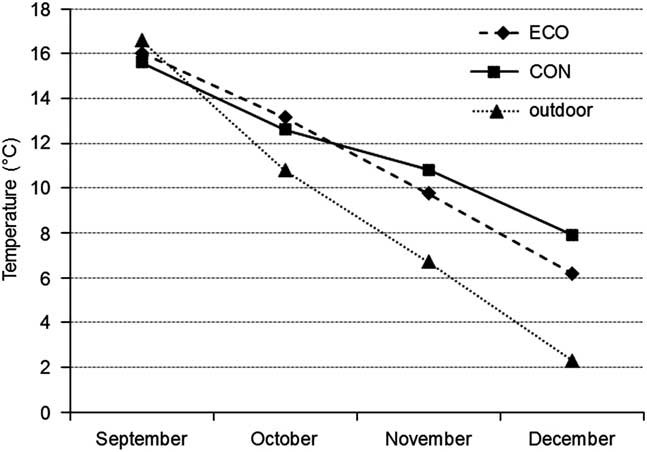
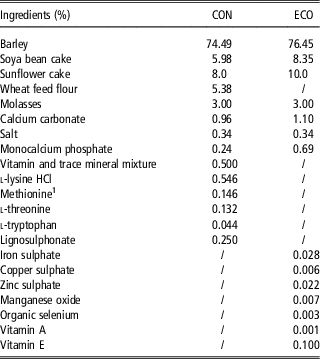
Twenty-four barrows of Krškopolje breed originating from 12 litters and farms (two pigs per litter/farm) and born within 2 weeks period were assigned within litter to either conventional (CON) or organic (ECO) rearing system. Pigs had a known genotype at ryanodine receptor 1 (RYR1) gene (i.e. five and seven carriers of the RYR1 mutation in CON and ECO group, respectively). Group CON (n=12) was housed indoors in two pens of 7.5 m2 with partly slatted floor. Group ECO (n=12) was held in a sty with sheltered area (16 m2, solid floor, bedded with straw) and outdoor area (100 m2). Ambient temperature of the indoor and outdoor areas was monitored (Figure 1). Although all experimental animals were reared on the same farm, the pigs in group ECO were reared respecting the legislation on organic farming. Before the start of the trial (from weaning until the age of 157±6 days), the pigs were fed commercial diets ad libitum (organic or conventional for ECO and CON group, respectively). For the experiment, two barley-based diets were formulated (Table 1); group ECO received a feed mixture composed of ingredients from organic agriculture, while group CON was fed a diet composed of same ingredients from conventional agriculture. During the trial (73 days), daily feed distribution was limited to 3.5 kg in ECO and CON groups and provided in two portions (morning and late afternoon). Pigs in group ECO were supplemented with alfalfa hay on ad libitum basis. Feeding regime was planned to allow pigs to exhibit their growth potential, but to limit an excessive fat deposition in the last phase of fattening. The pigs were weighed every two weeks. At the same occasion their backfat thickness at the level of last rib was measured ultrasonically using 4Vet mini ultrasound scanner (Draminski S.A., Olsztyn, Poland).
Outdoor and indoor ambient temperature recorded during the experiment in organic (ECO) and conventional (CON) group of Krškopolje pigs.

Ingredient composition of finishing diets for conventionally (CON) and organically (ECO) reared Krškopolje pigs (Škrlep et al., Reference Škrlep, Čandek-Potokar, Tomažin, Batorek Lukač and Flores2017)

1 Methionine hydroxy analogue, 80% efficiency.
Feed
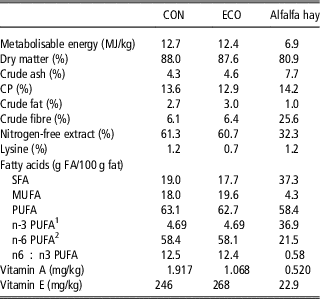
Two barley-based feed mixtures were formulated as already described by Škrlep et al. (Reference Škrlep, Čandek-Potokar, Tomažin, Batorek Lukač and Flores2017). For the ECO group it was formulated according to the legislation on organic farming with all the ingredients originating from organic agriculture. A formulation as similar as possible, but with the conventional ingredients was used for CON feed with addition of synthetic amino acids and the mineral–vitamin premix (Table 1). Diets ECO and CON were similar with regard to fatty acid composition (Supplementary Table S1) and estimated digestible amino acid composition (exception being lysine) using EvaPig® software (Supplementary Table S2). Chemical analysis of feed mixtures and alfalfa hay (dry matter, CP, crude fat, crude fibre and crude ash) was determined according to the standard procedures (Association of Official Analytical Chemists, 2000) and is given in Table 2.
Chemical composition of diets for conventionally (CON) and organically (ECO) reared Krškopolje pigs

SFA=saturated fatty acids; MUFA=monounsaturated fatty acids; PUFA=polyunsaturated fatty acids.
1 Includes C18:3 n-3.
2 Includes C18:2 n-6 cc and C20:2 n-6.
Carcass and meat quality measurements
At the average age of 228 days, the pigs were transported to a nearby commercial abattoir. The transport (30 km) lasted 40 min, after unloading the pigs rested for 1.5 h and were slaughtered according to routine procedure (CO2 stunning followed by exsanguination). Last feeding of pigs was in the morning a day before slaughter. After the slaughter, the pigs were eviscerated, leaf fat was removed and weighed, carcasses were weighed and classified by official classification body using a method approved for Slovenia (OJ EU L56/28, 2008). Backfat thickness was measured on split carcasses at the level of withers and over gluteus medius muscle. The pH was measured in the longissimus lumborum muscle (LL) at the level of the last rib 45 minutes postmortem (pH45) and a day after the slaughter (pH24) using the MP120 pH meter equipped with a combined glass electrode InLab427 and a temperature correction probe (Mettler-Toledo GmbH, Schwarzenbach, Switzerland). The carcasses were cut at the level of last rib perpendicularly to the spine. Measurements of LL loin eye area, area of corresponding fat and marbling subjective and objective colour (CIE L*, a*, b* colour parameters) were performed as described in Batorek et al. (Reference Batorek, Škrlep, Prunier, Louveau, Noblet, Bonneau and Čandek-Potokar2012). Colour was evaluated on the LL surface immediately after cutting (no blooming). In addition, colour parameters chroma (numerically quantified as
 $C^{{\asterisk}} {\equals}(a^{{{\asterisk}2}} {\plus}b^{{{\asterisk}2}} )^{{1\,/\,2}} $
) and hue angle (
 $h^{^{\circ}} {\equals}\tan ^{{{\minus}1}} b^{{\asterisk}} \,/\,a^{{\asterisk}} $
) were calculated. Two LL chops were trimmed of epimysium and external fat and used for the determination of chemical composition, drip, thaw and cooking loss, and shear force. Chemical composition (moisture, IMF and protein content) in minced samples was determined by near infrared spectroscopy (NIR Systems 6500 Monochromator; Foss NIR System, Silver Spring, MD, USA) using internal calibration with the following predictive ability based on R
2
(0.81, 0.82, 0.97, 0.81, for moisture, IMF and protein content, respectively) and Sy.x (0.65%, 0.30%, 0.73%, for moisture, IMF and protein content, respectively). Drip loss was determined according to the EZ-Drip loss method (Christensen, Reference Christensen2003). Thaw and cooking losses were determined on LL chop (8×5×4 cm) which was weighed, vacuum packed and frozen at −20°C until analysis. To determine thaw loss, the samples were thawed overnight at 4°C, softly drained with a paper towel and reweighed. The same sample was afterwards used for cooking loss and shear force measurement. The samples were cooked in a thermostatic water bath (ONE 7-45; Memmert GmbH, Schwabach, Germany) until the internal temperature reached 72°C, cooled and weighed. On the next day, three to four 1.25 mm cylindrical cores were excised from cooked samples and shear force was measured perpendicular to the direction of fibres using a TA Plus texture analyser (Ametek Lloyd Instruments Ltd., Fareham, UK) equipped with a 60° V-shaped rectangular-edged blade and a crosshead speed set at 3.3 mm/s. The average value of the measurements within one sample was calculated and used for statistical analysis. Additional LL sample was homogenized to fine dust in liquid nitrogen and stored at -80°C to determine fatty acid composition, concentration of thiobarbituric reactive substances (TBARS), carbonyl groups, myoglobin and collagen content.
Samples of backfat were also taken and objective colour (CIE L*, a*, b* colour parameters) was measured. The samples were homogenized to fine dust in liquid nitrogen and stored at −80°C before the analysis of fatty acid composition, TBARS, and vitamins A and E.
Fatty acid analysis
The fatty acid composition of feed, LL muscle and backfat samples was determined by gas chromatography following the transesterification of lipids (as described by Rezar et al., Reference Rezar, Salobir, Levart, Tomažin, Škrlep, Batorek Lukač and Čandek-Potokar2017). Approximately 0.5 g of sample was transmethylated in situ (Park and Goins, Reference Park and Goins1994) using 0.5 M NaOH in methanol followed by 14% BF3 in methanol. Fatty acid methyl esters (FAME) were extracted using hexane. For FAME separation, an Agilent 6890 GC (Agilent, Santa Clara, CA, USA) equipped with an Omegawax 320 column (30 m×0.32 mm i.d. ×0.25 μm; Supelco, Bellefonte, PA, USA) and flame ionization detector (FID) was used. An Agilent GC ChemStation (Agilent, Santa Clara, CA, USA) was used for data acquisition and processing. The programmed initial temperature was 185°C, subsequently increased to 215°C at 1°C/min. The injector and FID temperatures were set at 250°C and 290°C, respectively. Individual FAMEs were identified using standard mixtures (Nu Chek Prep Inc., Elysian, MN, USA). Adipose tissue fatty acid concentrations were determined using an internal standard (C19:0) and the tissue lipid concentration was calculated by multiplying the values with the factor 1.049.
Intra-assay CV of fatty acid analyses in the present study was 2.2%. The laboratory results of inter-assay CVs resulting from interlaboratory comparison are 10.5%, 5.1%, 2.9%, 2.5% and 2.3% for fatty acids with weight percentages of <1%, 1% to 5%, 6% to 10%, 11% to 20% and >20%, respectively.
Lipid and protein oxidation
Concentration of TBARS in LL and backfat samples was analysed according to the method described by Lynch and Frei (Reference Lynch and Frei1993). Briefly, samples of 0.5 g were minced in 10 ml of 0.15 M KCl with 0.1 mM butylated hydroxytoluene, centrifuged and the supernatant (0.5 ml) incubated with 1% (w/v) 2-thiobarbituric acid in 50 mM NaOH and 2.8% (w/v) trichloroacetic acid in a thermostatic heating block for 10 min. After cooling to room temperature, the pink chromogen was extracted into n-butanol and its absorbance was measured at 535 nm (BioSpectrometer Fluorescence; Eppendorf, Hamburg, Germany). Concentration of TBARS were calculated using 1,1,3,3-tetramethoxypropane as a standard and expressed in microgram malondialdehyde (MDA)/kg. Inter-assay CV of TBARS analysis was 4.5%, and intra-assay CV was 2.7%.
Protein oxidation was measured in myofibril isolates according to description by Rezar et al. (Reference Rezar, Salobir, Levart, Tomažin, Škrlep, Batorek Lukač and Čandek-Potokar2017). Two aliquots of myofibrillar suspension were treated with 2 N HCl (to determine the concentration of proteins), while two aliquots were treated with 0.2% (w/v) 2,4-dinitrophenylhydrazine (DNPH) in 2 N HCl to determine the concentration of carbonyl groups. Samples were incubated for 1 h at room temperature under shaking and afterwards precipitated by 50% trichloroacetic acid. After centrifugation (4000×g for 15 min at 4°C), the pellets were washed three times with ethanol and ethyl acetate (1 : 1) to eliminate traces of residual DNPH. The pellets were afterwards dissolved in 6 M guanidine HCl with 20 mM sodium phosphate buffer (pH 6.5) and centrifuged for 15 min at 4000×g. The protein and carbonyl group concentrations were determined spectrophotometrically with BioSpectrometer Fluorescence (Eppendorf GmbH, Wesseling-Berzdorf, Germany). The concentration of protein was calculated from absorbance at 280 nm according to the standard concentrations of BSA in 6 M guanidine HCl while the concentration of carbonyl groups was measured at 370 nm in the samples treated with DNPH (considering that the extinction coefficient for DNPH at 370 nm is 21 mM-1/cm) and expressed in nmol/mg proteins. Inter-assay CVs for chemical analysis of carbonyl groups was 7.7%, and intra-assay CV was 6.0%.
Muscle pigment
Myoglobin concentration was analysed spectrophotometrically (BioSpectrometer Fluorescence) according to the method described by Trout (Reference Trout1991). Briefly, 2 g of LL samples were homogenized in 20 ml 0.04 M potassium phosphate buffer (pH 6.5) and filtered; 4 ml of filtrate was mixed with 1.4 ml 10% (v/v) Triton X-100 and 0.1 ml 0.065 M sodium nitrite. After 60 min incubation at 22°C, the absorbance at 370 and 409 nm was measured and used for calculation of myoglobin concentration (mg/g) in the samples. Inter-assay CV of myoglobin analysis was 4.2% and intra-assay CV was 2.5%.
Collagen content
For the determination of total collagen, hydroxyproline was determined according to the ISO 3496 standard (1994). Briefly, cooked sample (at 77°C for 90 min) was incubated with 3 M H2SO4 for 16 h at 105°C. After the hydrolysis, the samples were filtered, diluted with deionized water, neutralized with 1 M NaOH and 4 ml of this solution was transferred to a glass tube, mixed with chloramine T and incubated at room temperature for 20 min. After the incubation, 2 ml of colour reagent (p-dimethylaminobenzaldehyde dissolved in perchloric acid and propan-2-ol) was added and the samples were incubated in a water bath for 20 min at 60°C. The cooled samples were then incubated at room temperature for 30 min. The absorbance was measured spectrophotometrically at 558 nm (BioSpectrometer Fluorescence) and hydroxyproline content was determined according to a standard calibration curve. For insoluble collagen fraction, LL sample was heated (to 77°C for 90 min) in Ringer’s solution and centrifuged. The supernatant was discarded and the pellet was then further processed as in the case of total collagen. Soluble collagen was determined from the difference between total and insoluble collagen content. Inter-assay CV of collagen analysis was 4.7% while intra-assay CV was 3.4%.
Vitamins A and E
Vitamins E and A in feed and fat were determined in a commercial laboratory (Nutricontrol, Veghel, The Netherlands) according to the accredited ISO 17025 method. Briefly, after saponification under nitrogen environment and extraction, the vitamins were separated by liquid chromatography and detected by fluorescence spectrophotometry. Inter-assay CV was 10.0% for vitamin E and 5% for vitamin A analysis, while intra-assay CV was 2% and 2%, respectively.
Statistical analysis
Data were analysed using one-way ANOVA (GLM procedure of SAS; SAS Institute Inc., Cary, NC, USA) with fixed effect of treatment group (equation 1). In the case of carcass and meat quality traits (Tables 3 and 4, respectively) RYR1 genotype was added as main effect in the model (equation (2)). Interaction T×RYR1 was always insignificant and therefore not considered. Not being the objective of this study, the data on RYR1 effect are not further shown or discussed. The differences between treatment groups were considered significant when P<0.05.
 $$Y_{{ij}} {\equals}\mu {\plus}T_{i} {\plus}e_{{ij}} $$
where μ is the intercept; T i the effect of treatment group; i the CON, ECO; e ij the residual error.
 $$Y_{{ij}} {\equals}\mu {\plus}T_{i} {\plus}RYR1_{j} {\plus}e_{{ijk}} $$
where μ is the intercept; T i the effect of treatment group, i the CON, ECO; RYR1 j the effect of RYR1 genotype, j the NN, Nn; e ij the residual error.
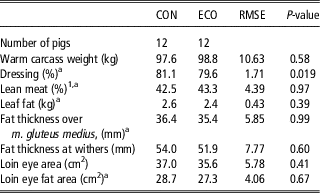
Carcass traits of conventionally (CON) and organically (ECO) reared Krškopolje pigs

RMSE= root mean square error.
a Traits significantly affected by ryanodine receptor 1 (RYR1) genotype.
1 % of lean meat in the carcass assessed with the official method approved for Slovenia.
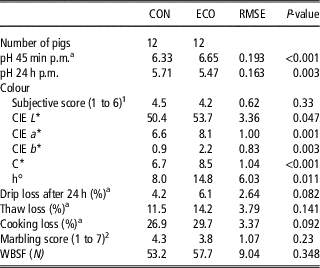
Meat quality (longissimus lumborum (LL) muscle) traits of conventionally (CON) and organically (ECO) reared Krškopolje pigs

RMSE= root mean square error; p.m.=post mortem; WBSF=Warner–Bratzler shear force; C*=chroma; h°=hue angle.
1 Visually assessed on a freshly cut LL using a scale from 1 (for light, non-intensive) to 6 (for dark, intensive colour).
2 Visually assessed on a freshly cut LL using a scale from 1 (extremely lean) to 7 (extremely marbled sample).
a Traits significantly affected by ryanodine receptor 1 (RYR1) genotype.
Results
All the pigs finished the experiment and were slaughtered at an average age of 230 days and 122.4 kg BW. As previously reported by Škrlep et al. (Reference Škrlep, Čandek-Potokar, Tomažin, Batorek Lukač and Flores2017) average daily feed intake in the experimental period was 3.38 and 3.37 kg per pig for CON and ECO groups, respectively, and there were no differences between the two groups in starting and final BW or backfat gain, only average daily gain tended to be higher (P=0.10) in ECO than CON pigs. Pigs in group ECO had lower dressing percentage than CON pigs (P=0.02), while all the other carcass traits (lean meat percentage, backfat thickness measured at different locations, loin eye area, loin eye fat area) did not differ between ECO and CON pigs (Table 3).
The two groups differed in some of the quality traits of LL muscle (Table 4). Pigs of ECO group had higher pH45 than CON pigs (P<0.001), whereas pH24 was lower in ECO than CON pigs (P=0.003). Consequently, the LL muscle of ECO pigs tended to have lower water holding capacity as evidenced by somewhat higher drip (P=0.08), cooking (P=0.09) losses and different objective colour parameters; ECO pigs had higher CIE L* (P=0.04), CIE a* (P=0.002) and CIE b* values (P=0.003) in addition to higher chroma (P<0.001) and hue angle (P=0.018). There were no differences in subjective colour and marbling score or mechanical resistance (Warner–Bratzler shear force) of cooked LL samples.
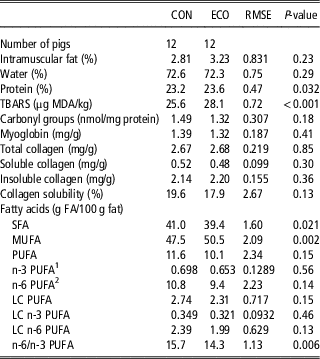
Results of chemical analyses (Table 5) showed no differences in water and IMF content of LL muscle between ECO and CON group, but a higher LL muscle protein content (P=0.03) in ECO pigs. No differences were either noted for collagen (content and solubility), myoglobin and carbonyl groups concentrations. The only significant differences were noted for TBARS and fatty acid composition of LL muscle (Table 5, Supplementary Table S3). In IMF of LL muscle, pigs of ECO group had lower proportion of saturated fatty acids (P=0.02) and a higher proportion of monounsaturated fatty acids (MUFA) (P=0.02) mostly due to stearic (C18:0) and oleic acids (C18:1), respectively. Oxidation of muscle lipids, measured by concentration of TBARS, was also higher in ECO than CON pigs (P<0.001).
Chemical analysis and fatty acid (FA) composition of longissimus lumborum (LL) muscle of conventionally (CON) and organically (ECO) reared Krškopolje pigs

RMSE= root mean square error; TBARS=thiobarbituric reactive substances; MDA=malondialdehyde; SFA=saturated fatty acids; MUFA=monounsaturated fatty acids; PUFA=polyunsaturated fatty acids; LC=long chain.
1 Includes C18:3 n-3, C20:3 n-3, C20:5 n-3, C22:5 n-3 and 22:6 n-3.
2 Includes C18:2 n-6, C20:2 n-6, 20:3 n-6, 20:4 n-6 and 22:4 n-6.
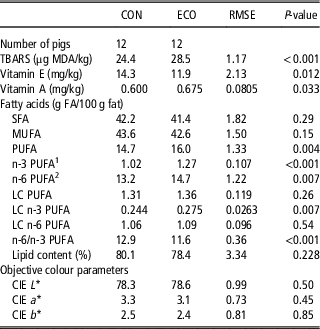
Chemical analyses of backfat (Table 6) showed a more pronounced lipid oxidation in ECO than CON pigs as depicted by higher TBARS values (P<0.001). Backfat of ECO pigs had a higher concentration of vitamin A (P=0.03), and a lower concentration of vitamin E (P=0.01), was more unsaturated as backfat of CON pigs, than demonstrated by higher concentration of polyunsaturated fatty acids (PUFA) (P=0.004), n-6 PUFA (P=0.007) and n-3 PUFA (P<0.001) due to higher concentrations of linoleic (C18:2n-6), linolenic (C18:3n:3), arachidonic (C20:4n-6) and EPA (C20:5n-3) acids (Supplementary Table S4). The n-6 to n-3 PUFA ratio of backfat was lower in ECO than CON pigs (P<0.001).
Chemical analysis and fatty acid (FA) composition and colour of backfat of conventionally (CON) and organically (ECO) reared Krškopolje pigs

RMSE= root mean square error; TBARS=thiobarbituric reactive substances; MDA=malondialdehyde; SFA=saturated fatty acids; MUFA=monounsaturated fatty acids; PUFA=polyunsaturated fatty acids; LC=long chain.
1 Includes C18:3 n-3, C20:3 n-3, C22:5 n-3 and C22:6 n-3.
2 Includes C18:2 n-6, C20:2 n-6, 20:3 n-6, 20:4 n-6 and 22:4 n-6.
Discussion
Overall, the daily gain of Krškopolje pigs in the present study (745 g/day) shows a moderate growth potential compared with modern pig genotypes, however relatively good if compared with growth rates generally reported for local pig breeds (Čandek-Potokar et al., Reference Čandek-Potokar, Batorek Lukač, Tomažin and Nieto2017). Organically reared pigs demonstrated 13% higher daily gain in spite of similar feed use and absence of differences in BW, backfat gain or carcass traits/composition and the fact that their assumed energy expenditure was higher as they could move around and be more active. Two circumstances could explain this result, one being a substantial consumption of alfalfa hay of pigs in ECO group, and the other that less feed was wasted in ECO group. Under the given conditions, it was not possible to estimate the intake of alfalfa hay, but it was observed, pigs liked it and consumed it a lot (substantial usage). It is likely that lower ambient temperatures, in particular outdoor, stimulated the appetite in ECO pigs (Lebret et al., Reference Lebret2008). Usually the pigs reared outdoors exhibit lower growth rate compared with their indoor reared peers due to increased energy demands for exercise and thermoregulation (Bee et al., Reference Bee, Guex and Herzog2004; Hansen et al., Reference Hansen, Claudi-Magnussen, Jensen and Andersen2006). However, faster growth of organically reared pigs (due to higher feed intake) was also reported (Millet et al. Reference Millet, Raes, Van den Broeck, De Smet and Janssens2005). In the present study, there was no effect of rearing system on growth rate or carcass traits, only a tendency of lower dressing percentage in ECO pigs was noted which can be attributed to heavier digestive tract due to higher intake of fibrous feed (alfalfa hay), in agreement with observation of Rey et al. (Reference Rey, Daza, López-Carrasco and López-Bote2006) for free range Iberian pigs. Fatness of pigs was generally high (average lean meat percentage ≈43%) which is typical for local pig breeds, nowadays primarily used for the production of high value-added processed products and less for fresh meat consumption. In the present study, higher pH45 along with lower pH24 of LL muscle of ECO pigs is indicative of lower stress sustained during the pre-slaughter handling and higher muscle glycogen reserves at slaughter, in agreement with Terlouw et al. (Reference Terlouw2005). As reviewed by Millet (Reference Millet2004) effect of housing on meat quality can be mainly related to differences in physical training and pre-slaughter stress. Exercised pigs seem more resistant to pre-slaughter handling, as demonstrated by higher pH45 of ECO pigs. On the other hand with regard to pH24, higher glycogen stores in exercised pigs (Bonneau and Lebret Reference Bonneau and Lebret2010) can explain their lower pH24, whereas any effort before slaughter can lead to a depletion of muscle glycogen (Fernandez and Tornberg, Reference Fernandez and Tornberg1991) which explains higher pH24 in CON pigs. Moreover, in the last period of the experiment (Figure 1) the temperatures (esp. outdoor) to which ECO pigs were submitted were lower which also stimulates glycogen reserves (Lebret, Reference Lebret2008). As the nature of pH decline in meat is related to water-holding capacity (Huff-Lonergan and Lonergan, Reference Huff-Lonergan and Lonergan2005) and colour parameters (Mancini and Hunt, Reference Mancini and Hunt2005), it explains slightly lower water holding capacity and higher objective colour parameters in ECO than CON pigs. Chemical analyses of LL muscle showed no major effect of rearing system, exception being higher protein content, which is in agreement with Olsson et al. (Reference Olsson, Andersson, Hansson and Lundström2003), and a higher degree of lipid unsaturation and oxidation in ECO pigs. The main factors influencing fatty acid composition of porcine tissues are diet, breed, sex and the level of adiposity (Wood et al., Reference Wood, Richardson, Nute, Fisher, Campo, Kasapidou, Sheard and Enser2003). Pigs used in our study were of the same breed and sex, and siblings from 12 litters were assigned to treatment group within litter. Moreover, no differences in carcass adiposity and IMF content between groups were observed; therefore, the differences in fatty acid composition can be attributed to rearing/feeding system. Fatty acid composition of ECO and CON diets were similar since they were composed of equivalent/same ingredients, thus the observed differences in fatty acid composition could be related to alfalfa hay supplementation of ECO pigs, which agrees with reports where organically or outdoor reared pigs had access to green feed (Nilzén et al., Reference Nilzén, Babol, Dutta, Lundeheim, Enfält and Lundström2001; Hansen et al., Reference Hansen, Claudi-Magnussen, Jensen and Andersen2006). Moreover, exercise may increase the content of linoleic and linolenic acids and total PUFA in the neutral lipid fraction as shown in psoas major muscle of exercised Iberian pigs in comparison to pigs fed the same diet under sedentary rearing system (Daza et al., Reference Daza, Rey, Olivares, Cordero, Toldrá and López-Bote2009). Ambient temperature is another factor influencing the fatty acid composition (as reviewed by Lebret, Reference Lebret2008). Namely, lower temperatures may increase MUFA and decrease PUFA. Fatty acid composition of IMF can be affected also by dietary lysine (Wang et al., Reference Wang, Crenshaw, Regmi, Rude, Hasan, Sukumaran, Dinh and Liao2018), which could also explain the higher MUFA observed in LL muscle of ECO pigs and their higher (though not significant) IMF content.
Although high PUFA content in meat is beneficial in terms of human health, it also has a potential for higher lipid oxidation during storage, with adverse effects on organoleptic quality (Edwards, Reference Edwards2005). Although TBARS as a marker of lipid oxidation determined in muscle and backfat of pigs was well below the threshold for detection of off flavour (0.5 mg MDA/kg) in both groups, higher concentrations were observed in ECO pigs that were supplemented with alfalfa hay. Vitamin E is one of the main factors preventing lipid oxidation (Jensen et al., Reference Jensen, Lauridsen and Bertelsen1998). Its concentration was lower in backfat of ECO pigs despite its slightly higher concentration in organic feed, and can be related to its depletion for antioxidant protection of PUFA (as demonstrated by Fritsche and McGuire (Reference Fritsche and McGuire1996) in plasma of rats fed highly unsaturated fish oil v. lard). Contrary to vitamin E, vitamin A concentration was higher in backfat of ECO pigs, despite being almost twofold lower in organic diet which can be ascribed to alfalfa hay, a good source of carotenes which are converted to vitamin A in the pig intestine and absorbed (McDowell, Reference McDowell2000).
In conclusion, organic rearing of Krškopolje pigs provided with the diet composed of organic ingredients and alfalfa hay did not lead to any major differences in productive performance compared with their conventionally reared and fed peers. Differences in dynamics of LL muscle pH decline (reflected also in water holding capacity and colour of meat) are indicative of higher glycolytic potential of organically reared pigs which can be related to more exercise and lower ambient temperature. The provision of alfalfa hay to the pigs reared in organic system generated higher content of unsaturated fatty acids in muscle and fat tissue leading to higher lipid oxidation, and also to higher vitamin A content of backfat.
Acknowledgements
The research has received funding from the European Union’s Horizon 2020 research and innovation programme under grant agreement No 634476 (Project acronym TREASURE). The content of this paper reflects only the authors’ view and Research Executive Agency is not responsible for any use that may be made of the information it contains. Authors also acknowledge core financing grant (P4-0133) of Slovenian Research Agency. Special thanks go to the breeders of Krškopolje pigs for their help and support in conducting the experiment.
Declaration of interest
The authors declare that there is no conflict of interest.
Ethics statement
The research was undertaken on a family farm respecting the Slovenian law on animal protection (Zakon o zaščiti živali, 2007), rules of protection of farm animals (Pravilnik o zaščiti rejnih živali, 2010) and legislation on organic production and labelling of organic products (OJ EU L250/1, 2008). No procedures on animals were conducted which would demand ethical protocols according to Directive 2010/63/EU (2010).
Software and data repository resources
The data of this study are not deposited in any official repository.
Supplementary material
To view supplementary material for this article, please visit https://doi.org/10.1017/S1751731118002409