1. INTRODUCTION
A flow line is a conventional manufacturing system where all jobs must be processed on all machines with the same operation sequence (Fig. 1). Jobs are processed only once by each machine, as opposed to reentrant flow lines.
(Color online) Two flow lines, with and without buffers. Permutation (PFS) and nonpermutation flowshop (NPFS) are compared. In both cases, jobs see machines (routing) in the same sequence (flowshop). In NPFS, buffers allow changes (permutations) of job sequences on subsequent machines.

Examples of flow lines include transfer lines, assembly lines, chemical plants, logistics, and many more (Rossi et al., Reference Rossi, Puppato and Lanzetta2012, in press); the problem is scalable in many senses: a job can be a part, the whole product, or a batch; machines (or stages) can be a single operating unit, a cell, a line, or their combinations; time is measured by nondimensional units and can indicate seconds, hours, days, and so on. Flow line is referred to as the physical layout; flowshop is the mathematical model, as defined in the next chapter.
The flowshop scheduling problem occurs whenever it is necessary to schedule a set of n jobs on m machines so that each job visits all machines in the same order. In nonpermutation flowshop (NPFS) scheduling, the most general flowshop case, which is examined here, the order in which all m machines are visited by the n jobs changes, allowing job sequences to be different on subsequent machines.
In a permutation flowshop (PFS), the sequence in which jobs visit machines (routing) is the same for all jobs, as for nonpermutation. The sequence of jobs on all machines is the same in PFS; instead, in NPFS the sequence of jobs can be different on subsequent machines.
To allow nonpermutation, buffers between, on board, or shared among machines are necessary. Examples of buffers are shown in the U-shaped flow line of Figure 2: input and output buffers are at the two ends and between machines, cells, lines, or plants; they can be shared, in the form of an automatic warehouse or an open space. To allow permutations, jobs travel through buffers between machines. The flow line in the pictorial example itself is made of flow lines: a transfer line and a flexible cell.
(Color online) The flow line (clockwise from top left) with m machines (or stages) M (bright red online only) and different examples of buffer configurations (dark blue online only) to allow job sequence permutation between machines.
The buffer requirement has been formally included in the proposed model. If buffers are not present, either the blocking or the no-wait condition should be applied to the algorithm to achieve a feasible schedule. In the former case, a job completed on one machine may block that machine until the next downstream machine is free; in the latter case, the next machine must be available before a job leaves the previous one.
As for the problem complexity, there are (n!)m different schedules for ordering jobs on machines in NPFS; the number of schedules for PFS reduces to n!.
In this work, transport and setup times are neglected. This hypothesis often applies when pallet changing systems on machines and fast transport and buffer loading/unloading devices are present. The processing time can be increased by standard transport and/or setup time, if it is relatively small with respect to the processing time; a transport time to and from the warehouse of hours can be considered negligible if the processing time is in the order of days, like in the case of welding, heat treatments, painting, and inspection of large and bulky parts.
Operations and transport can be automated, like in computer-integrated manufacturing, or manual. Manual operations can also be represented, using standard times.
Examples of scheduling optimization targets are minimizing total completion time (makespan) or weighted tardiness, balancing mean flow time, and meeting due date. The problem examined here is referred to as F m|B i = +∝ |C max using Graham notation, where F m stands for flowshop with m machines; B i = +∝ denotes that buffers with infinite capacity are present, allowing nonpermutation schedules; and C max denotes the makespan minimization as the optimization criterion. Minimizing the makespan is one of the most common criteria in the literature: lower total completion time is associated with less idle time, higher machine utilization, and efficiency.
Some authors generate random problems or use data taken from realistic cases to test the performance of their proposed algorithms. Demanding benchmark problems allow comparing objectively and quantitatively the performance of different algorithms, also belonging to different classes (e.g., heuristics and metaheuristics). Among the most used flowshop benchmarks is the set by Taillard (Reference Taillard1993) considered in this work, which includes small, medium, and large sets, as opposed to Demirkol, whose data set is limited to medium size. Nonpermutation bounds from several authors are available at http://www.mathematik.uni-osnabrueck.de/research/OR/fsbuffer/taillard2.txt (mirrored in http://www.ing.unipi.it/lanzetta/flowshop/taillard2.txt), and they have been included in the current analysis.
Biologically inspired general-purpose optimization algorithms are capable of dealing with large job-size problems and with the exponential increase in the solution search space with the number of machines and jobs. Examples of metaheuristics include taboo search, simulated annealing, genetic algorithms (Elbeltagi et al., Reference Elbeltagi, Hegazy and Grierson2005), and memetic algorithms (Amaya et al., Reference Amaya, Cotta and Fernández-Leiva2012). Despite their successful performance, in the extensive reviews by Ruiz and Maroto (Reference Ruiz and Maroto2005) and by Ribas et al. (Reference Ribas, Leisten and Framinan2010), ant colony or pheromone-based systems are not present. Ant colony systems, a subset class of ant colony optimization (ACO), use artificial or swarm intelligence by exploiting the experience of an ant colony as a model of self-organization in cooperative food retrieval (Wang et al., Reference Wang, Liu, Li and Zhong2003).
ACO has been selected among metaheuristics because of its ability to build constructively arbitrary permutations of job sequences (NPFS schedules) by two inverse mechanisms: negative and positive pheromone deposition, respectively, through the local update rule and off-line pheromone update rule, detailed in the ACO description. Diversification by the local update rule pushes toward permutated schedules and is the core mechanism to generate natively nonpermutation solutions.
Standard ACO by Bonabeau et al. (Reference Bonabeau, Dorigo and Theraulaz1999) and disjunctive graph model inspired by Rossi and Dini (Reference Rossi and Dini2007) are combined in this paper. It seems that the only ant colony algorithm applied to NPFS scheduling is by Sadjadi et al. (Reference Sadjadi, Bouquard and Ziaee2008), which provides the relative average performance on Taillard's benchmarks. Other NPFS benchmarks from Demirkol have been considered by Ying and Lin (Reference Ying and Lin2007) and by the authors (Rossi & Lanzetta, Reference Rossi and Lanzetta2013a, Reference Rossi and Lanzetta2013b).
Sadjadi et al. (Reference Sadjadi, Bouquard and Ziaee2008) applied the standard ACO specifications from Bonabeau et al. (Reference Bonabeau, Dorigo and Theraulaz1999), except for the diversification mechanism. The other main difference is on the selection of the initial population, which is determined by improving a permutation solution found by heuristics using local search.
Other approaches to the PFS problem tested on benchmarks based on ant colony systems by Rajendran and Ziegler (Reference Rajendran and Ziegler2004), min–max ant systems by Stuetzle (Reference Stuetzle1998), the state of the art based on tabu search by Brucker et al. (Reference Brucker, Heitmann and Hurink2003), and genetic algorithms by Färber and Coves Moreno (Reference Färber and Coves Moreno2006) are also compared with the proposed ACO.
2. NPFS PROBLEM
The mixed-integer linear programming model for the NPFS problem is the following:
1. Parameters:
 $$\eqalign{p_{ij} &= \hbox{processing time of job}\ i \ \hbox{on machine}\ j \cr BigM &= \hbox{a sufficiently large positive value}}$$
2. Decision variables:
$$\eqalign{Z_{ilj} &= 1\comma \; \hbox{if job}\ i\ \hbox{is assigned to sequence position} \cr &\quad l\ \hbox{on machine}\ j\semicolon \; 0\ \hbox{otherwise}}$$3. Dependent variables:
where i and i′ are jobs, i, i′ = 1, 2, … , n; l and l′ are the sequence positions, l, l′ = 1, 2, … , n; j is the machines, j = 1, 2, … , m; and the variables n and m are the number of jobs and machines, respectively.$$\eqalign{S_{lj} &= \hbox{starting time of job in sequence position} \cr & \quad l \hbox{on machine j}}$$4. Objective function:
$$\hbox{Min} C_{\max}$$Subject to the following constraints:
(1)$$\eqalign{\sum\limits_{i = 1}^n Z_{ilj} = 1 &\quad l = 1\comma \ldots\comma \; n \cr &\quad {j = 1\comma \ldots\comma \; m} }$$(2)$$\eqalign{\sum\limits_{l = 1}^n Z_{ilj} = 1 &\quad i = 1\comma \ldots\comma \; n \cr &\quad j = 1\comma \ldots\comma \; m }$$(3)$$\eqalign{S_{1j} + \sum\limits_{i = 1}^n p_{ij} Z_{ilj} \leq S_{1\lpar j + 1\rpar } &\quad j = 1\comma \ldots\comma \; m - 1 }$$(4)$$\eqalign{S_{lj} + \sum\limits_{i = 1}^n p_{ij} \times Z_{ilj} \leq S_{l\lpar j + 1\rpar } &\quad i = 1\comma \ldots\comma \; n - 1 \cr &\quad j = 1\comma \ldots\comma \; m }$$(5)$$\eqalign{& \hbox{BigM} \lpar 2 - Z_{ilj} - Z_{il^{\prime}\lpar j + 1\rpar }\rpar\geq S_{lj} + p_{lj} + S_{l^{\prime} \lpar j + 1\rpar} \cr & \quad i\comma \; l\comma \; l^{\prime} = 1\comma \ldots\comma \; n \quad j = 1\comma \ldots\comma \; m - 1} $$(6)$$\eqalign{& \vert \langle i\comma \; i = 1\comma \ldots\comma \; n\comma \; i\ne i^{\prime}\colon\ S_{1j} \lt S_{lj} \times Z_{ilj} \leq S_{1j} + p_{i^{\prime}j} Z_{j^{\prime}l}\comma \cr & \quad l = 2\comma \ldots\comma \; m \rangle \vert \leq n - 2 \quad j = 2\comma \ldots\comma \; m} $$




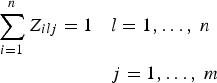
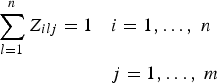

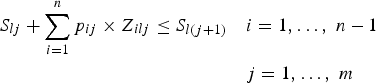


Constraint (1) ensures that each job is assigned to exactly one position of the job sequence on every machine. Constraint (2) states that each position of the job sequence processes exactly one job on every machine. Constraint (3) denotes the starting times of the first job on every machine. Constraint (4) insures that the (l + 1)th job in the sequence of machine j does not start on machine j until the lth job in the sequence of machine j has completed. Constraint (5) insures that the starting time of job I, which is assigned to position l in the sequence on machine j + 1, is not earlier than its finish on machine j. Constraint (6) ensures that the buffer size is subject to:
Lemma
The flowshop scheduling with n jobs and m machines is B i = +∝ if and only if the interoperational buffer size for machine j (2 ≤ j ≤ m) is at least (n – 2). ■
The buffer size for machine j = 1 and j = m + 1 is n (i.e., the input and output buffers contain up to n jobs).
Proof: In the worst case, only one blocking with (n – 1) jobs waiting occurs. Let j (2 ≤ j ≤ m) be the blocked machine. If the last job on machine (j – 1) is completed, no blocking occurs because (n – 1) jobs have been already processed on machine (j – 1). Hence (n – 2) jobs wait in the interoperational buffer between machines (j – 1) and j. ■
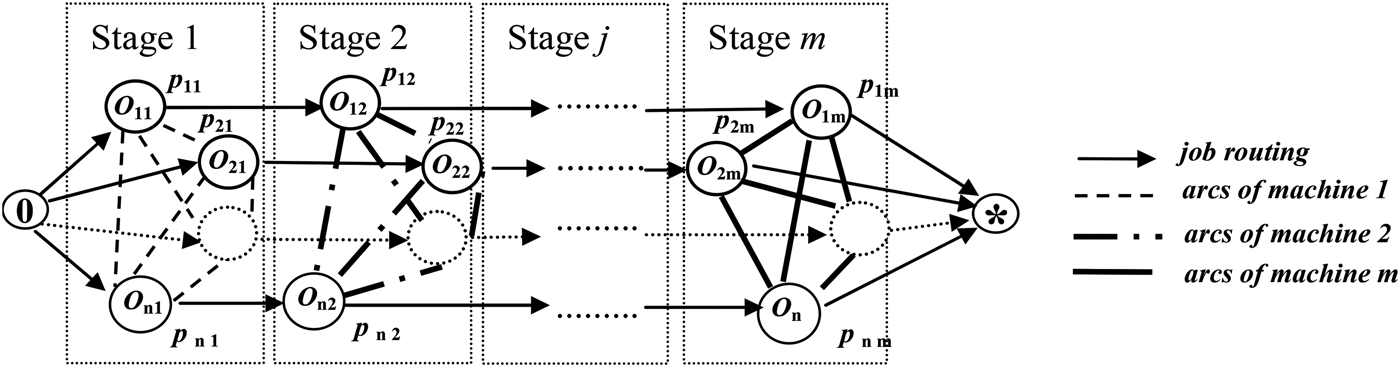
The optimization problem (1)–(6) can also be represented by a disjunctive graph (DG; Fig. 3):
 $$\hbox{DG} = \lpar N\comma \; A\comma \; E_j\comma \; W\rpar \comma \; $$
where N is the set of operations, plus the dummy start and finishing operations represented by the symbols 0 and *; A is the set of conjunctive arcs (directed arrows) between every pair of operations on a job routing; E j is the set of disjunctive arcs between pairs of operations at stage j; and W is the set of weights (processing times) on nodes.
A disjunctive graph (digraph) for flowshop scheduling, with processing times p ij at nodes O ij for n jobs on m machines.
3. ACO FOR NPFS
The pheromone trail is the basic mechanism of communication among real ants. It is mimicked by ACO by an iterative method (in epochs) able of finding the shortest path connecting source 0 (nest) and destination * (food) on a weighted graph (Fig. 3), which represents the optimization problem.
The ant runs the nest–food path by a probabilistic selection of nodes according to the following mechanisms: intensification to select a node in the vicinity of the current best paths; and diversification in order to produce promising alternative paths.
The proposed ACO follows the standard recommendation for applications to scheduling problems, as opposed to the other implementations available in the literature for the flowshop problem introduced above.
The proposed digraph approach builds natively nonpermutation sequences by the path generation mechanisms. In this stochastic process, each artificial ant selects probabilistically the next node (move selection) according to the amount of pheromone on the connecting arc (learned desirability).
The path associated with each ant starts from 0, follows routing arcs, directs disjunctive arcs, and ends in *. By design, nonpermutation schedules are achieved by directing arcs differently at each stage. Here, C max is evaluated from W (7). At each epoch, as soon as all the paths of the ants in the colony are generated, the best ant (lowest C max) deposits on its arcs an amount of pheromone proportional to the path length (pheromone updating). A pheromone decay routine is also performed to prevent stagnation in local optima solutions (evaporation ρ = 0.12).
The two inverse mechanisms are achieved by negative and positive pheromone deposition, respectively, through the local update rule and off-line pheromone update rule. Diversification by the local update rule pushes toward permutated schedules and is the core mechanism to generate natively nonpermutation solutions.
This is a constructive way to generate a schedule. A complete solution is generated forward by a partial solution using the stigmergy of the colony (i.e., the selection of the more promising disjunctive arcs where a higher amount of pheromone is laid). The main goal of the ACO mechanism is to generate optimal solutions by constructive schedules. The concept is similar to “divide et impera,” because the stigmergy progressively concentrates the search in a low number of very small promising regions. Differently to local search, this fact makes the algorithm intrinsically parallel and may take advantage of modern processors.
3.1. Path generation
By the pheromone mechanism, ants may select arbitrary path, consequently the resulting scheduling sequences (ant tours) are different permutations (nonpermutation approach). Random initial solutions are generated and iteratively improved at each epoch by the ant behavior. By this natively constructive approach we are able to assess the net performance of the algorithm.
An ant a to generate an acyclic conjunctive graph with weights on the conjunctive arcs (i.e., feasible schedule S a), visits every operation on the pheromone-learning model DG (7) one and only one time with a complexity of O(m · n) in order to transform the digraph in a feasible schedule. Path generation is a stochastic process where an ant starts from the dummy 0 and selects the next node from the set of allowed operations. It uses the following transition probability rule as a function of both the heuristic function of desirability, η (termed visibility function), and the amount of pheromone τ on the edge (O ij, J), with J ∈ AL, of the pheromone trail:
 $$z = \left\{\matrix{\hbox{argmin}_{o_{ij} \in {\rm AL}} \left\{{\rm \tau} \lpar o_{i^{\prime}j}\comma \; o_{ij}\rpar ^{\rm \alpha} {\rm \eta} \lpar o_{i^{\prime}j}\comma \; o_{ij}\rpar ^{\rm \beta}\right\}\comma \; \hfill &\hbox{if}\, q \leq q_0 \hfill \cr J\comma \; \hfill &\hbox{if}\, q \leq q_0 \hfill}. \right.$$
The nonnegative parameters α and β represent the intensity of respectively, the amount of pheromone, and the visibility included in the transition probability function. The nonnegative parameter q 0 is the cutting exploration, a mechanism that restricts the selection of the next operation from the candidate list AL. If a random number q is higher than the cutting exploration parameter q 0 (0 ≤ q 0 ≤ 1), the candidate operation is selected by examining the probability of all candidate operations that are as much desirable as higher visibility and pheromone amount are; otherwise, the most desirable operation is selected (i.e., the arc with the highest amount of pheromone and the highest visibility).
The role of cutting exploration is that of explicitly splitting the search space in order to achieve a compromise between the probabilistic mechanism adopted for q ≤ q 0 or the further intensification mechanism of exploring near the best path so far, which corresponds to an exploitation of the knowledge available about the problem. Cutting exploration by tuning parameter q 0 near 1 allows the activity of the system to concentrate on the best solutions (exploitation activity) instead of letting it explore constantly (exploration activity), achieved by tuning parameter q 0 near 0. In fact, when q 0 is close to 0, all the candidate solutions are examined in probability, whereas when q 0 is close to 1, only the local optimal solution is selected by Equation (8). In this paper, a freezing function is considered, which is similar to the one proposed by Kumar et al. (Reference Kumar, Tiwari and Shankar2003). This function progressively freezes the system by tuning q 0 from 0 to 1, in order to favor exploration in the initial part of the algorithm and then favor exploitation by means of the following expression:
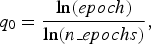 $$q_0 = {\ln \lpar epoch\rpar \over \ln \lpar n\_epochs\rpar }\comma \; $$
where epoch is the current iteration and n_epochs is the total number of iterations of the ant colony system.
The heuristic function of desirability η is a very critical component of ant colony systems. Generally, it is implemented by dispatching rules. A comparison among a number of dispatching rules to implement the visibility function has been performed by Blum and Sampels (Reference Blum and Sampels2004). In this paper, the earliest starting time rule is used, the best one according to Blum and Sampels.
3.2. Local update rule
The local update rule is applied to favor the exploration of not visited nodes by other ants of the colony. This rule imposes to the ant that has selected a candidate operation J, of laying on the connecting arc (O i′j, J) the following negative amount of pheromone:
 $${\rm \tau} \lpar O_{i^{\prime}j}\comma \; J\rpar = \lpar 1 - {\rm \rho}\rpar \times {\rm \tau} \lpar O_{i^{\prime}j}\comma \; J\rpar + {\rm \rho} \times {\rm \tau}_0. $$
The local update rule is a convex combination of parameters equal to the evaporation coefficient; in this case, the convex combination has points τ(O ij, J) and τ0. The amount of pheromone that remains on a selected edge diminishes because it ranges between the previous value τ(O i′j, J) and the initial value τ0. As a consequence, the effect of this rule is making nodes less and less attractive as they are visited by ants, indirectly favoring the exploration of not visited nodes. This is a basic diversification mechanism because it pushes the next ants to generate alternative paths.
3.3. Off-line pheromone update rule
This feature arises when a positive amount of pheromone has to be deposited. The ant that detects the best path at each epoch is termed best-epoch ant (S be). In order to direct the exploration of the best nest–food path by the entire colony, an off-line update rule of pheromone is performed. At the end of each epoch, the best-epoch ant S be deposits on all paths of the acyclic graph generated a further amount of pheromone, proportional to the following convex combinations of points τ(O i j, J) and makespan(S be)−1. This produces search intensification by other ants of the colony in the vicinity of the best solution:
 $$\eqalign{{\rm \tau}^{\prime} \lpar O_{ij}\comma \; J\rpar &= {\lpar 1 - {\rm \rho}\rpar \times {\rm \tau} \lpar O_{ij}\comma \; J\rpar + {\rm \rho}\quad } \cr &\quad \times \,makespan \lpar S_{\rm be}\rpar ^{-1}\comma \; \quad\hskip5pt \lpar O_{ij}\comma \; J\rpar \in S_{\rm be} \cr &= \lpar 1 - {\rm \rho}\rpar \times \tau \lpar O_{ij}\comma \; J\rpar \comma \; \qquad \hbox{otherwise.}} $$
As for the local update rule, the amount of pheromone τ′(O ij, J) that remains on the selected edge ranges between the previous value, τ(O ij, J), and a value closer to the optimum: makespan(S be)−1. A routine of pheromone decay on pheromone trails is performed on other arcs of the digraph, thus indicating that a path rarely used probably does not lead to optimal solutions.
3.4. Pseudocode
The Ant Colony System for NPFS has been implemented in C++ according to the following high-level description:
Input: a weighted digraph WDG = (N, A, E j, W N, W E)
// Initialization
for each disjunctive arc (O i′j′,O ij) of E A deposit a small constant amount of pheromone
 $$W_{\rm E}\lpar O_{i^{\prime}j^{\prime}}\comma \; O_{ij}\rpar = \lpar t_{0}\comma \; {\rm \tau}_{0}\rpar \, \hbox{where}\, {\rm \tau}_0 = \left[n \times m \times \max\nolimits_{\,j=1\comma \ldots\comma m} \sum\limits_{i = 1}^n t \lpar O_{ij}\rpar \right]^{-1}$$
epoch ← 1; not_improve ← 0;
// Main Loop
while (not_improve < stability_condition) do
//Epoch Loop
for each ant a, a = 1 topopulation_size do
// Path Generation
S a ← Ø;
1. O ← {O ij| i= 1, … , n, j = 1, … , m};
2. Initialization of candidate nodes: ALw ← O;
for eachw = 1 ton × m do
3. Initialization of feasible moves (i.e., the disjunctive arcs connected to operations of ALw);
4. Move selection: select a feasible move (O i′j, O ij) of E A where O i′j is the last operation in the queue of machine m (O i′j = dummy 0, if m = 1) by means of the transition probability rules (8); directing the related disjunctive arc (O i′j = dummy 0, if m = 1);
5. Arc removal: remove all the remaining disjunctive arcs connected to O i′j (i.e., no other operation can be immediately subsequent to Oi′j at stage j);
6. Computing length: move t(O ij) ∈W N from the selected node to the directed one; also, move t(O ij) on (O i (j−1), O i) ∈ A;
7. Path length evaluation: the longest path between the one connected to the directed arc and the one connected to the arc of the job routing is placed as a mark of the scheduled operation;
8. Local updating: apply the local update rule (10) to the arcs (O i′j′, O ij) ∈ W E;
9. Update allowed list: remove the scheduled operation from the allowed list, ALw ← ALw/{O ij};
end for
10. Directing the remaining disjunctive arcs (i.e., the arcs are connected to dummy *).
11. Local search: Apply local search to S a with neighbor structure from Nowicki and Smutnicki (Reference Nowicki and Smutnicki1996);
12. Best evaluation: if (makespan(S a) < makespan(S be))
then (makespan(S be) ← makespan(S a) andS be ← S a)
end if
end for
Global updating: Apply the global update rule (11);
Best ant evaluation: if (makespan(S be) < makespan(S*))
then ((makespan(S*) ← makespan(S be); S* ← S be andepoch ← 0) andnot_improve ← 0;
elseepoch ++ andnot_improve ++;
end if
end while
Output:S*
4. COMPUTATION EXPERIMENTS
Benchmark instances are arrays b n×m. The n × m operations of each job on all m machines are represented by their processing times ordered by routing. Taillard's (Reference Taillard1993) benchmarks include 12 sets of 10 instances for job numbers i = 20, 50, 100, 200, 500 and machine numbers j = 5, 10, 20. Each benchmark instance k includes a nontrivial lower (LBijk) and upper bound (UBijk). The lower (upper) bound is the maximum (minimum) known theoretical minimum (maximum) attainable makespan. The upper bound can be reduced by new, improved solutions. If it coincides with the lower bound, the optimum for benchmark b ijk has been reached.
Metrics for algorithm performance are the individual relative distances from the upper bound of benchmark instances b n×m or the mean relative error (MRE) in each set (i, j):
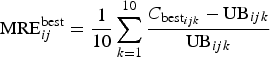 $$\hbox{MRE}_{ij}^{\rm best} = {1 \over 10} \sum\limits_{k = 1}^{10} {C_{{\rm best}_{ijk}} - \hbox{UB}_{ijk} \over \hbox{UB}_{ijk}} $$
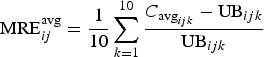 $$\hbox{MRE}_{ij}^{\rm avg} = {1 \over 10} \sum\limits_{k = 1}^{10} {C_{{\rm avg}_{ijk}} - \hbox{UB}_{ijk} \over \hbox{UB}_{ijk}} $$
where the best and the average makespan solutions for each set (i, j) of 10 benchmark instances k= 1, … , 10 are  $C_{{\rm best}_{ijk}}$ and
 $C_{{\rm avg}_{ijk}}$, respectively.
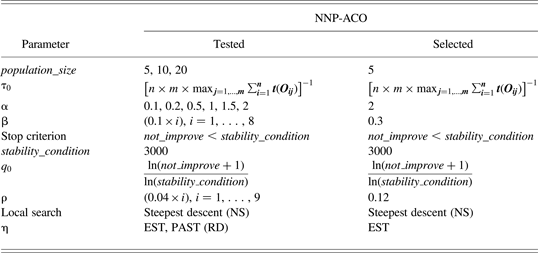
The proposed NNP-ACO has been run 10 times with the (selected) parameters in Table 1 on 3-GHz 32-bit Intel Pentium IV based PCs with 2 GB RAM.
Preliminarily tested and selected parameters for the proposed NNP-ACO
Note: NNP-ACO, native nonpermutation ant colony optimization; NS, Nowicki and Smutnicki (Reference Nowicki and Smutnicki1996); RD, Rossi and Dini (Reference Rossi and Dini2007); EST, earliest starting time (dynamic visibility); PAST, precedence-ordering average starting time (static visibility).
The main ACO parameters described and summarized in Table 1 have been derived from the job shop application in Rossi and Dini (Reference Rossi and Dini2007) and have been explored in preliminary tests with the values indicated for population_size, α, β, ρ, and η.
As for the population size, fewer ants have been used compared to Rajendran and Ziegler (Reference Rajendran and Ziegler2004; 40 ants) and compared to Sadjadi et al. (Reference Sadjadi, Bouquard and Ziaee2008; 1000 ants) in order to reduce the processing time. Consequently, the evaporation rate has been reduced compared to Sadjadi et al. (ρ = 0.9) to reduce the effect of random search.
The stop criterion from Sadjadi et al. (Reference Sadjadi, Bouquard and Ziaee2008) is a fixed computation time. Instead we use a stability condition, corresponding to 3000 epochs with error reduction of at least one processing time unit.
4.1. Results
The average performance (MREavg) of the proposed ACO are compared in Figure 4 within the same class of problems with Sadjadi et al. (Reference Sadjadi, Bouquard and Ziaee2008), Rajendran and Ziegler (Reference Rajendran and Ziegler2004), and Stuetzle (Reference Stuetzle1998), which do not provide results for data sets of 200 and 500 jobs.
(Color online) The performance of ant colony optimization (ACO) systems in nonpermutation and in permutation (PFS) configuration on the Taillard's (Reference Taillard1993) benchmarks with respect to permutation upper bounds from Stuetzle (S; Reference Stuetzle1998), Rajendran and Ziegler (RZ; Reference Rajendran and Ziegler2004), and Sadjadi et al. (SBZ; Reference Sadjadi, Bouquard and Ziaee2008).
Although results are discrete, a graphical representation with connecting lines has been preferred to show the separation among the performance of different algorithms.
The differences of makespan of the proposed algorithms of the respective authors have been calculated from the upper bound of the PFS benchmark. Because the detailed values are not available, the proposed algorithm has been compared with the (slightly higher) permutation upper bound for performance assessment.
A lower value of MREavg means a better performance (lower makespan) of the proposed algorithm compared to the state of the art. A negative value represents a new (lower) upper bound.
For comparison within the same class of algorithms (ACO), MREavg has been conservatively calculated with respect to the original permutation upper bounds from Taillard (Reference Taillard1993), because most available results are for PFS, except Sadjadi et al. (Reference Sadjadi, Bouquard and Ziaee2008).
The MREavg of the proposed ACO ranges between +0.035 and +0.159, while Sadjadi et al. (Reference Sadjadi, Bouquard and Ziaee2008) is between –0.075 and +1.12, Rajendran and Ziegler (Reference Rajendran and Ziegler2004) is between +0.72 and +1.86, and Stuetzle (Reference Stuetzle1998) is between +0.196 and +2.475 (not shown). This also means that the MREavg of the proposed ACO is upper limited to 16% as opposed to 112% from Sadjadi et al. The algorithms in Rajendran and Ziegler (Reference Rajendran and Ziegler2004) and Stuetzle (Reference Stuetzle1998) show the worst performance overall. Out of scale MREavg values (available on the respective articles) have not been represented to achieve a higher visualization detail on the best results. The nonpermutation algorithm from Sadjadi et al. behaves clearly better than with the permutation (PFS) constraint. The algorithm from Sadjadi et al. has the best performance with 20 jobs or with 5 machines (small problems). Although the performance on large instances (200 and 500 jobs) are not available from these authors, a degradation of performance with benchmark size (job and machine number) is clearly visible on medium instances. This is enhanced by the steeper trend line for the better (nonpermutation) algorithm from Sadjadi et al.
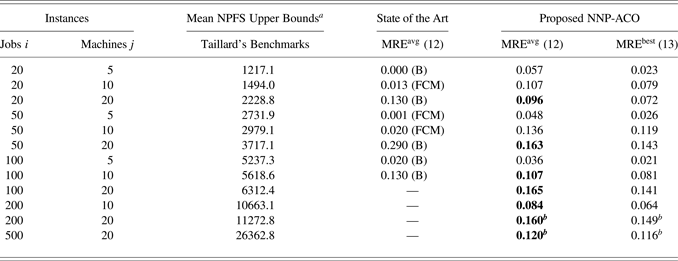
The upper bounds for the makespan of all 12 sets of 10 benchmark instances in NPFS configuration from various authors and methods, averaged, are reported in Table 2. The MREavg found by the state of the art from Brucker et al. (Reference Brucker, Heitmann and Hurink2003) and Färber and Coves Moreno (Reference Färber and Coves Moreno2006), based on tabu search and genetic algorithms, respectively, is compared with the proposed ACO. The better results (highlighted) have been obtained for higher machine numbers and job numbers. Results are not available from Brucker et al. and Färber and Coves Moreno for the 40 largest instances, where the proposed ACO becomes the best known solution.
Performance assessment in NPFS configuration
Note: NPFS, nonpermutation flowshop; MRE, mean relative error;  $C_{{\rm best}_{ijk}}$, the best makespan obtained by the proposed ant colony optimization (ACO) in a single run or otherwise defined by Brucker et al. (B; Reference Brucker, Heitmann and Hurink2003) and Färber and Coves Moreno (FCM; Reference Färber and Coves Moreno2006); NNP, native nonpermutation.
b300 epochs.
Here the nonpermutation upper bounds have been used for comparison between the proposed NNP-ACO and the state of the art of metaheuristics in general, using Taillard's (Reference Taillard1993) benchmarks.
The last four sets of instances are one order of magnitude more time consuming compared to the other instances (200 compared to 10 min) because of their large size. Other methods use a stop criterion based on a fixed number of epochs or computation time. Instead, we use a stability condition (of 3000 epochs with an improvement of at least one processing time unit), which has been reduced by one order of magnitude and still results in a processing time one order of magnitude higher. By the stability condition instead of a stop criterion, convergence is assured regardless of the epoch number.
4.2. Discussion
As shown, the proposed algorithm becomes the state of the art on the benchmarks used, with the ACO approach, particularly on larger instances.
Possible reasons of the better performance compared to Sadjadi et al. (Reference Sadjadi, Bouquard and Ziaee2008) as a function of the benchmark size are inferred:
1. The ACO implementation by Sadjadi et al. (Reference Sadjadi, Bouquard and Ziaee2008) has a higher colony size and lower epoch number, which do not allow sufficient differentiation despite their higher evaporation, particularly on larger instances.
2. Sadjadi et al. (Reference Sadjadi, Bouquard and Ziaee2008) find an initial permutation schedule (pheromone trails) by the Nawaz et al. (Reference Nawaz, Enscore and Ham1983) heuristic. Initial good solutions provide good final solution for small-sized benchmarks. For larger benchmarks, the Nawaz et al. heuristic suffers some performance decrease. Consequently, the ACO search can be trapped in local optima.
3. Sadjadi et al. (Reference Sadjadi, Bouquard and Ziaee2008) start from a solution of the permutation problem and find an NPFS solution by a local search, which causes a further performance decrease.
The proposed ACO has also been compared with permutation upper bounds from Rajendran and Ziegler (Reference Rajendran and Ziegler2004) and still provides better performance, despite the higher problem complexity of NPFS (n!m compared to n!).
A regression analysis has been carried out to assess the effect of the machine and job number on the makespan of the best scheduling found by the proposed ACO. A correlation has been found between MREavg and machine number at constant job number. This is also qualitatively shown by the periodic MREavg increase in Figure 4. The same trend also shows the relative independence of the algorithm performance on the job number.
A stronger correlation has been found between computation time and both job number and machine number. The computation time with the proposed ACO, which has not been optimized in this work, is one order of magnitude higher than Sadjadi.
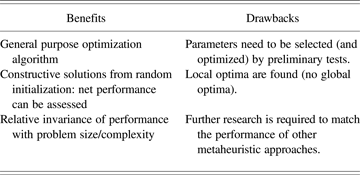
Compared to nonpermutation metaheuristics, new upper bounds have been proposed on larger instances and there is still a margin of improvement by parameters optimization. A summary of benefits and drawbacks of the proposed approach is available in Table 3.
Summary of benefits and drawbacks of the proposed approach
5. CONCLUSIONS
A mathematical model of the flow line scheduling problem with buffers has been proposed. The few existing approaches have been compared using well-known benchmarks characterized by a wide size range, available from Taillard (Reference Taillard1993).
The NP-hardness has been tackled by metaheuristics, and ACO have been selected. The proposed ACO is natively nonpermutation as opposed to other authors who apply a local search to permutation solutions. Natively means that initial ant paths are selected arbitrarily and the pheromone mechanism stimulates differentiation among permutated schedules (nonpermutation scheduling). The proposed approach shows the best performance in NPFS configuration, particularly on larger instances and is very close to the state-of-the-art metaheuristics.
Based on computation experiments, it can be concluded that such a general-purpose optimization tool has high potential in NPFS and can provide good solutions, regardless of the problem complexity increase in the examined range.
Andrea Rossi has been a Research Fellow with the Department of Civil and Industrial Engineering at Pisa University since 2000. He received his PhD in industrial automation and robotics (1998) and his MS in computer science (1993) from Pisa University. He is a referee for international journals and a member of the Italian Association of Mechanical Technology. Dr. Rossi's main interests in manufacturing processes and systems include flexible manufacturing systems production planning and scheduling; inspection planning with coordinate measuring machines; and e-manufacturing and new solution techniques of artificial intelligence, particularly ACO, genetic algorithms, and parallel metaheuristics.
Michele Lanzetta has been an Associate Professor in engineering at Pisa University since 2005. Prior to that, he was an Assistant Professor (1998) at the same institution, where he received his PhD in industrial automation and robotics (1997) and his MEng in aeronautical engineering (1992). He has been visiting scholar at MIT (2011, 2009, 2002, 2000), Stanford University (2007, 2004, 1996), and Tokyo University (2006). Dr. Lanzetta's main interests in manufacturing processes and systems include scheduling, metrology, rapid prototyping, and assembly and visual inspection, particularly in leather and stone. He patented a reflectometer for stone polishing (commercialized) and has published more than 100 papers. He is a Cirp associate (2007–) and Aitem (1995–) member.