The original rotunda and the present crypt
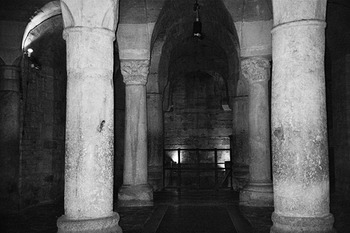
In the first decades of the eleventh century the monastery church at Dijon, on the site of the present cathedral, was extended to the east by a singular chimney-like three-stage rotunda with oculus. Nothing of this remains to be seen now except for its reconstructed circular crypt along with a few carved capitals, a little sculpture from the cornice and several drawings of the building before its demolition at the end of the eighteenth century.Footnote 1 The two capitals that are the subject of this paper marked the junction of the circular crypt of the rotunda with the crypt of the abbey church. The capitals are the largest that survive from the old building and their sculpture is much the most elaborate, all faces being closely covered with three-dimensional figures and animals. Their columns continue the circuit of responds on the wall of the rotunda but they are free-standing. The three-fold opening linked the rotunda with the altar, shrine and grave of the patron saint, Bénigne, immediately to the west (fig 1).
View looking west from the rotunda to the burial place of St Bénigne, showing the east face of the two major capitals. Photograph: Rita Wood

The building is attributed to William of Volpiano, who was abbot from c 990 to 1031, having come from Cluny to reform the monastery at the request of the Bishop of Langres. The new abbot was anxious to discover the lost bones of the martyr Bénigne; when he did so, he was ‘inflamed with a sharper passion’ to rebuild the basilica ‘in the way he had decided’. As at any great medieval church, the relics of the patron saint were the most precious thing the monks of Dijon possessed; their new resting-place was made ‘a shrine of incomparable beauty’ and ‘the tomb of the glorious martyr’ soon became famous as a place of healing.Footnote 2 Consecrations are recorded in the church in 1016 and in the rotunda in 1018.
Eighteenth-century architectural drawings and plans, along with surviving medieval documents and selective excavation, have been used by Professor Carolyn Malone to reconstruct the functions of the various spaces in the interconnected rotunda and abbey church. Seasonal observances took place at appropriate parts of the building.Footnote 3 On the brightly lit top floor of the rotunda were altars dedicated to the Holy Trinity, to St Michael and to St Paul. The intermediate level was continuous with the monks’ choir and it contained altars in honour of St Mary and the Apostles. At crypt level there were altars for local saints and martyrs, and for John the Baptist, also a martyr, as well as for St Bénigne himself. This area was accessible to the laity from the extensive nave crypt, as well as to the monks from the higher parts of the church.
As far as the old drawings can be trusted,Footnote 4 the two major capitals were much the most important in the whole rotunda, the capitals in the two upper floors being shown without figural carving. Professor Maylis Baylé has given thorough consideration to the art-historical aspect of the surviving sculpture in the crypt of the rotunda and in the adjacent parts of the basilica.Footnote 5 She demonstrates that the ten or so sculpted capitals here are from one workshop, then she locates similar capitals with chamfered angles, also similar column-bases, that occur over a wide geographical area from north Italy into Switzerland. Further influences, from north of the Alps, are indicated by capitals drawn in an Ottonian manuscript and others extant in the ninth-century rotunda at Fulda,Footnote 6 and by the surface treatments of Merovingian and other metalwork. However, she finds there is almost nothing to compare with the sculpture on the two major capitals, partly because of the rarity of sculpture of this date, and partly because their deep modelling is so different from that of metalwork. Their quality is high; as M F Hearn attests, these capitals reveal ‘an astonishing degree of virtuosity’; K J Conant describes them as ‘extraordinarily energetic early Romanesque capitals’.Footnote 7
The rotunda and basilica suffered many changes over the centuries, some accidental, some deliberate. A fire in 1137 caused the draughty oculus to be covered by a tower,Footnote 8 but substantially the rotunda survived into modern times. Then, in 1792, in a desire to improve lighting for the newly designated cathedral, the upper floors of the rotunda were demolished, while the crypt was filled in and levelled off. In the mid-nineteenth century the crypt and adjacent areas were restored and a concrete vault was constructed. The two major capitals had been damaged especially on the angles, and their present orientation is not as at first.Footnote 9 When seen by the author in 2007, lighting was good for the various complete, small, capitals at scattered locations, but was inadequate for the complexities of the two major capitals. The combination of damage and darkness has undoubtedly stifled interest in this rare and important survival of early Romanesque sculpture. A study devoted to its iconography is desirable not only for the fuller understanding of the rotunda but because William of Volpiano was influential in Normandy and thus in Britain.Footnote 10
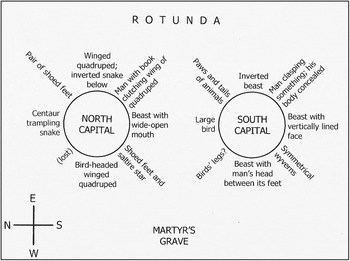
The main features of the capitals, omitting the volute-creature on the upper part of each angle. Diagram: Rita Wood

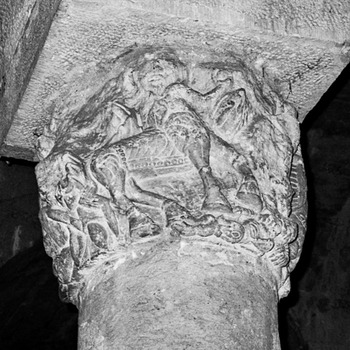
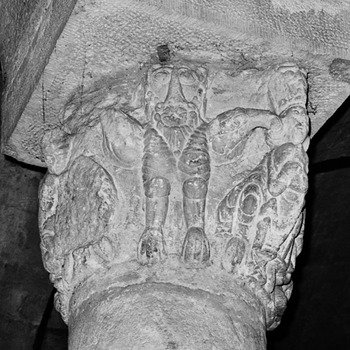
North capital, south-east angle and east face: volute-creature and complete standing man; first quadruped. Photograph: Rita Wood

Detailed description of the capitals
The two capitals as developments of Corinthian form
Maylis Baylé notes many comparisons for capitals such as the smaller ones in the crypt, with spreading lines of foliage, and sometimes with human heads or medallions – that is, classical forms that had become inhabited.Footnote 11 This process is carried to the extreme in the two major capitals. They retain the strong angle volutes of Corinthian capitals and there is carving over the whole bell and a collar of smaller motifs around the bottom, but the foliage has been completely replaced by animal and human forms. In the middle of each face is a different animal, the heads being approximately at the position of the die or block at the top centre. Another large animal takes the place of the angle volute; the profile below this projects strongly rather than being concave and the subjects added here are partially cut free from the background, emphasizing the thrust of this new component. The usual row of short leaves at the bottom has been replaced by a medley of tails and feet. The general effect is of violent movement, very different from the original Corinthian capital with its living but quiet and regular foliage.
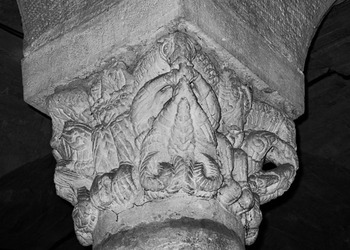
The capitals are a pair (fig 2); they share an ordered arrangement of motifs, and both capitals have, or had, the same animal forming the volute on the angle. This comprises a head with – seen on each side of the corner – a long neck with incised patterns. Below the neck are smaller, pear-shaped forelegs, also patterned, both ending in a clawed paw curled up close under the animal’s head. In about half the cases the features just described have been broken off, but enough scars remain for it to be certain that this same creature was repeated with only slight variations on all four angles of both capitals. The larger of the coils at the lower edge of the capitals could belong to the volute-creatures which therefore can be termed wyverns – that is, snakes with animal heads, forelegs and a serpentine body. Beneath the large volute-creatures, on the projecting lower part of the angle which is additional to the classical form, were carved either small human figures or small animals, both kinds being placed in the same relationship to the volute-creatures. When complete, the paired motifs on every angle – of the volute-creature and the smaller figure or animal below them – would have been much more imposing than they now appear in their present broken state: the powerful curves, the presence of human figures and the overarching power of the larger creatures would have drawn the eye.
The north capital
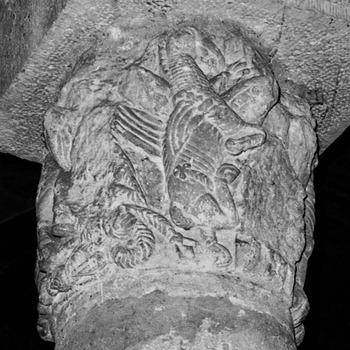
Among the crowded and damaged sculptures on the angles, three pairs of neat, shoed feet are instantly recognizable. One complete figure stands erect on the south-east angle (fig 3). He is dressed in a long robe, holds an open book against his chest with his right hand, and has a saltire cross between his feet. His face is expressionless and serene. This saintly figure is not actually in the mouth of the volute-creature although he is immediately below it; his head is held between closed rounded paws with the claws averted,Footnote 12 as they are in every other case. On the north face of the same capital a second recognizable motif is a large centaur (fig 4). It is climbing up to the right as if going up steps, but its human face looks out at the viewer. The centaur treads down an inverted snake with its large hooves.
North capital, north face: second quadruped, a centaur. Photograph: Rita Wood

North capital, west face: third quadruped. Photograph: Rita Wood

In the centre of the adjacent east face, and also with an inverted snake below it, another creature rises up to the right; this is a large winged quadruped, with a trefoil end to its tail (fig 3). The raised and bent back leg is posed like that of a horse in a classical statue, an oddity now, considering the rough state of the surfaces, but possibly a sign of virtue originally. The head is worn, but retains a decorated eye. The left hand of the man on the south-east angle grasps the tip of one of its wings. Further, it seems that one front leg of the animal held the right hand of the broken human figure on the north-east angle.
On the other side of the centaur, on the west face of the capital, a third quadruped facing right and moving upward has the head of a bird, with an eye decorated as before (fig 5). Its tail, passing between the legs and lying against the body, also ends in a trefoil. The creature has one front leg stretched out to rest against the neck of the volute-creature on the south-west angle, while the other foreleg is folded back as before. The three rising quadrupeds bring to mind the animals climbing the columns at the doors of the church of San Ambrogio in Milan – but those are natural animals, whereas these three composite animals are not natural. The fourth side of the north capital has a monstrous creature confined in a narrow rectangular space between the more extensive motifs on the angles; more of this kind are discussed below.
South capital, north face: a large bird. Photograph: Rita Wood

South capital, south-east angle and east face: volute-creature and shrouded man; the overturned beast. Photograph: Rita Wood

The south capital
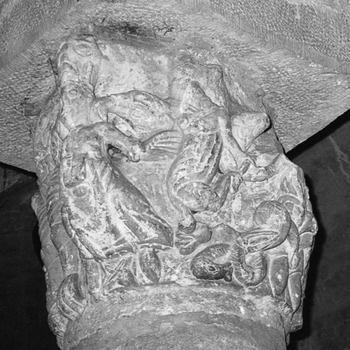
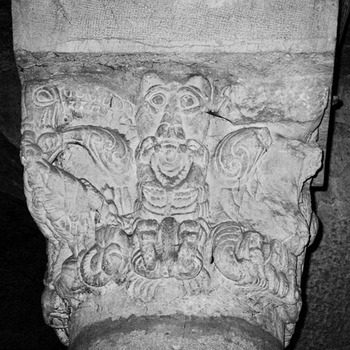
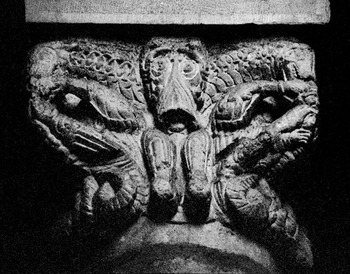
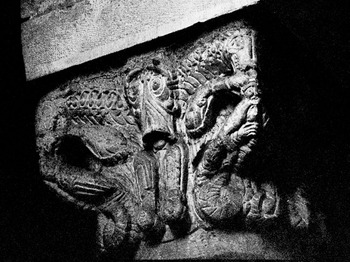
This capital has three out of the four beasts that are restricted to a rectangular area in the centre of a face. Two here, and one on the south face of the northern capital, are unreal creatures of which only the bestial mask, capacious mouth and forelegs are seen (figs 8, 9 and 11, left). Between the feet of the beast on the west face is what seems to be a human head (fig 11, left). Unfortunately this detail is too abraded for any expression to be detected on the little face; behind it, and not visible from below, there is perhaps a body.Footnote 13 Baylé identified ‘eyes’ on the beasts,Footnote 14 but they occur on two only; they are arranged in a row round the mouth and were probably intended as curls of hair. The fourth beast, on the east face, is a complete animal but overturned (fig 7). Its chubby body and big round eyes suggest a creature with a positive nature, but its posture contradicts that. The tail is drawn aside to show its anus, while there are hands (of the same animal, or perhaps of something else, since the digits are reversed) holding open the large mouth and allowing us to look down the animal’s gullet, which is empty. It is much the same with the other beasts – despite the exaggerated threatening mouths there is no sign of any prey, only the one head, and possible body, lying between the paws at the bottom of the west face.
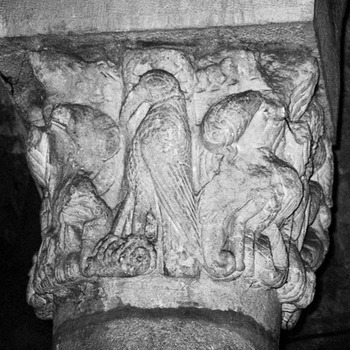
A human figure survives on the south-east angle below the volute-creature (figs 7, left, 8, right, and 10, right). His lower body is swathed in what looks like folds of clothing and he pushes out from the capital in a forceful curve; the tongue of the volute-creature touches his head. Between the man’s chin and hands is a small indistinct object; his hands are one above the other, as if he were holding a short stick or staff. Close beside him, one at each elbow, is a small snake or wyvern with a coiled tail. On the south-west angle the form below the volute-creature is also complete (figs 8, left, and 11, centre). It is not human, but is made up of a symmetrical pair of small wyverns with the dorsal view of a third wyvern between them on the axis of symmetry. The final motif on the south capital is a standing bird facing left on the north face (fig 6). It is a natural bird, but it stands on a scroll and it has a cross-halo. The small characters on the angles adjacent to the large bird are not identifiable, since only the feet remain, but they seem to have been animals rather than human figures. In total, on the lower parts of the angles of the two capitals, there seem to have been four human beings and four non-human (that is, animals, wyverns or birds); these are shared between the capitals as three and one of each kind.
Modern attitudes to the sculpture on the two capitals
Modern accounts of this elaborate sculpture are surprisingly brief: monsters or things monstrous are repeatedly seen.Footnote 15 It is important to recognize that initially such terms were used merely to pass on the impression made by the form of the sculpture; the very brevity of the accounts shows that they were not intended as a serious interpretation of content. Scholars believed meaning was irrecoverable, or even that it may never have existed in sculpture of this non-figural kind. They avoided interpretation and studied sculpture as arrangements of decorative or fantastic elements assembled from one or other earlier source. It is unfortunate that nowadays the description as ‘monsters’ is widely accepted as a statement of fact.Footnote 16
The features that have given rise to these universally negative perceptions seem to be as follows. Firstly, seen from below, the eight volute-creatures on the angles advance wave-like, unstoppably. One rises over the complete human figure, threatening to overwhelm him. Faute de mieux, it is assumed that all these creatures clutch and gnaw the heads below them. The sight of a head with apparently two necks, though derived simply from the symmetry of the leaf forming the Corinthian volute, is disturbing and adds to the tendency to see these unidentified creatures as malevolent. The intensity of the sculpture, without relief from architectural division, foliage or pattern, together with the random damage, encourages a reading of disorder and struggle. These assumptions are largely subjective, and in part are based on inadequate inspection of the sculpture. Lastly to alarm the viewer, there are the three individual images made up of the grotesque heads and forelegs of various uncanny creatures, and with these can be included the inverted animal. Their facial features are exaggerated, while having a gaping mouth or showing the anus are impolite or repulsive in any century: these four motifs have a genuine and, it is suggested, an intentional, nightmarish quality.
Recent scholarship has concentrated on the history of this rotunda and others, together with an interesting exploration of the use of the building and the theological concepts generating its novelty.Footnote 17 Only Baylé has engaged with the interpretation of the crypt’s sculpture, but her brief discussion is marred by inaccurate observations and unjustified assumptions.Footnote 18 There is one overriding objection to her conclusions and to all the preceding negative descriptions, which is that they do not accord with the medieval accounts of the surroundings of the martyr’s tomb quoted in the first section of this paper. Some other explanation of the sculpture must exist, one that would be consistent with the historical record.
It is, after all, the medieval attitude to the eastern crypt of a great church that is at issue, and much is known about such centres of pilgrimage in general. Dijon Cathedral is only one of many continental churches founded over the tomb of a martyr-saint. The importance of the martyrs was that their fight was over, they were victorious and their souls were already in heaven; the purpose of visiting their bones was to share in their triumph. As Rodulfus Glaber knew, there was no more powerful place in the abbey-church than this. The dedication of the rotunda was to ‘Sancta Maria ad martyres’, not just to St Mary. If the Mary altar on the next higher level was a place of intercession, the crypt, paradoxically, was a place of attainment, of victory. It will be shown that a relevant Biblical event is represented by the sculpture on the two major capitals.
A new interpretation of the two capitals
The three quadrupeds on the north capital as the Trinity
Two winged quadrupeds and the centaur are rising uniformly upwards to the right; they are shown moving freely over their respective faces; they each interact with adjacent motifs. This is all in marked contrast with the bestial heads in the centre of the fourth face and on the south capital which are restricted to a narrow central panel and are apparently immobile (figs 7 to 11). Baylé has compared the head of the centaur, the second of the three quadrupeds, to that of the crucified Christ on the relief of Landelous.Footnote 19 The Livre des Créatures of Philippe de Thaon, written about a century after the rotunda was consecrated, includes an interpretation of the centaur Sagittarius as Christ the God-Man enduring his Passion:Footnote 20
South capital, south face: a restricted beast in the centre of the face; two complete volute-creatures, below which, on the left, are a cluster of small wyverns, and, on the right, the shrouded man. Photograph: Rita Wood

North capital, south face: a restricted beast; on the right, the complete standing man. Photograph: Rita Wood

South capital, south face and south-east angle: beast with lined face; the shrouded man. Photograph: Rita Wood

South capital, west face and south-west angle: the human head between the paws of the beast; on the angle, the symmetrical cluster of wyverns. Photograph: Rita Wood

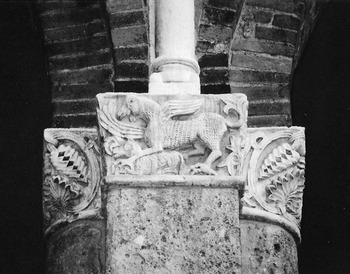
A capital in the atrium of San Ambrogio, Milan. Photograph: Rita Wood

Sagittarius … has a human figure down to the waist, and is a horse behind, it draws back a bow … The bow which he holds in his hand … signifies that … when he was hanged on the cross, and his body pierced, his spirit departed for those whom he loved, who were in hell, and waited for help from him.
Similarly, in English sculpture of the twelfth century, a centaur is used to represent the incarnate Son.Footnote 21 If we test that possibility here, we see that the centaur (fig 4) wears a decorated horse blanket suitable to cover the victorious God-Man after the exertions of his battle; there is a large star pattern on his chest, and his big hooves are trampling a snake as he climbs. The centaur tramples the serpent, so Christ is triumphing over Death. The battle being won, the attributes of bow and arrow are no longer appropriate, but those of victory and kingship would be. The centaur’s left hand is raised, holding a round object – perhaps an orb of the world? If so, the lost right arm might have carried some form of sceptre.
The winged quadrupeds either side of the centaur are less individualized. It is not necessary to conclude that the animal on the east face (fig 3) is fighting with the human figures adjacent.Footnote 22 Certainly, they are holding on to it or being held by it but, as God the Father, the quadruped could be assisting the upright holy men beside it to rise. The third quadruped is similarly posed to the first (figs 3, 4 and 5). It has the head of a bird, and could therefore signify the Holy Spirit. The three are arranged around the capital in the usual order, Father, Son and Holy Spirit.
If the three quadrupeds represent the Trinity, what are the three Persons doing here, in this maelstrom of creatures good and bad? Whatever is happening on these capitals, it cannot be taking place in heaven. A possible context is suggested by an eleventh-century document of the abbey quoted by Carolyn Malone. Regarding the upper floor of the rotunda she writes: ‘the altar of St. Paul was included between those of the Trinity and St. Michael because, as the Chronicle of Saint-Bénigne points out in reference to 2 Cor. 12.2–4, St. Paul “was caught up to the third heaven and saw the secrets of God” ’.Footnote 23 The Greek verb translated as ‘caught up’ is used only twice by St Paul.Footnote 24 The second passage in which it occurs (1 Thess. 4: 13–18) is one often used in masses for the dead, as will be discussed in the final section of this paper. It describes the general resurrection at the end of the world:
But we would not have you ignorant, brethren, concerning them that fall asleep; that ye sorrow not, even as the rest which have no hope. For if we believe that Jesus died and rose again, even so them also that are fallen asleep in Jesus will God bring with him. For this we say unto you by the word of the Lord, that we that are alive, that are left unto the coming of the Lord, shall in no wise precede them that are fallen asleep. For the Lord himself shall descend from heaven, with a shout, with the voice of the archangel, and with the trump of God: and the dead in Christ shall rise first: then we that are alive, that are left, shall together with them be caught up in the clouds, to meet the Lord in the air: and so shall we ever be with the Lord. Wherefore comfort one another with these words. [Revised Version; author’s italics]
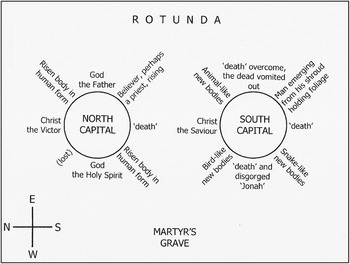
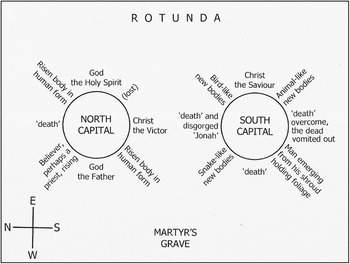
It is suggested that this is the event depicted on the two capitals (fig 13). That ‘the Lord’ is portrayed as three individual Persons may have been prompted by the three sounds drawn from prophecies of the end of time – the shout, the voice and the trumpet – but also by the need to design the sculpture to fill the sixteen fields on two capitals. It has already been noted that the human figures and small animals on the lower parts of the angles are divided three and one between the two capitals; the grotesque beasts are three of one pattern and a singleton. The next section suggests a symbol on the south capital corresponding to the Trinity on the northern.
The bird on the south capital as Christ
The bird stands alert, again in contrast with the bestial motifs in the centre of other faces on this capital (fig 6). The eagle of St John often holds a scroll in this manner as, for example, on the tympanum at Moissac, where conventional evangelist symbols feature as the Four Living Creatures of Ezekiel and Revelation. However, an eagle on its own, not in a set of four, and particularly one with a cross-halo, is unlikely to represent St John.Footnote 25 Jeffrey Hamburger illustrates a Mosan ivory clasp of c 1100 that has Christ in the centre as an upright eagle with cross-halo and standing on a scroll; four human evangelists are seated at writing desks in the border.Footnote 26
Gregory the Great, commenting on Job 39: 27–30 in his Moralia in Job (xxxi: ch 94), lists numerous interpretations of the eagle: this bird may designate ‘malignant spirits, the despoilers of souls, sometimes the powers of the present world, but sometimes either the very subtle understandings of the saints, or the Incarnate Lord, swiftly flying over things below, and presently seeking again those on high’. Hrabanus Maurus, Abbot of Fulda (c 784–856) incorporated this source in his commentary on Ezekiel. By the twelfth century, bestiaries included a lengthy passage on the eagle, describing it from actual observation, how it watches from above and swoops down to catch fish from the sea, while the accompanying illustration commonly shows the eagle with a fish in its talons. Only a few bestiaries go on to repeat Gregory’s culminating spiritual interpretation of the eagle, that God is drawn down to earth seeking mankind, that Christ is the raptor par excellence. One of the fullest of these passages is in the Bestiaire of Philippe de Thaon, whose Livre des Créatures was quoted above regarding the centaur.Footnote 27 On the eagle, the Bestiaire says:
Eagle is the king of birds … From aloft into the depth of the sea it sees well the fish swim, and it comes … flying, seizes the fish as it swims, drags it to the shore, and does its will with it … The eagle signifies the Son of Saint Mary, king over all people, without any doubt; and he dwells on high and sees far, he knows well what he ought to do. The sea represents this world; the fishes, the people who are in it. For us God came on the earth to obtain possession of our souls, he came flying to us; from the world by such semblance, he drew us, by right, as the eagle does the fish.
The activity of swooping down and catching up is represented on both capitals: on the south capital it represents the redemptive visit of Christ by the form of an eagle, and on the north capital it pictures the analogous activity of the three Persons of the Trinity at the general resurrection. The arrangement of motifs on these capitals in the rhythm of one and three has its model in the One and Three of the Godhead.
The four beasts as ‘death’
As foreseen in 1 Thessalonians, the Lord will descend from heaven at the end of time to resurrect the bodies of believers: death and hell will deliver up the dead (Rev. 20: 13) and ‘death shall be no more’ (Rev. 21: 4). It is suggested that the four grotesque beasts in rectangular areas on the two capitals (figs 7 to 11) represent threats subsequent to death like those mentioned in some liturgies: the hand of hell, the lion’s mouth, darkness and annihilation, or, the power of the dog, the lion’s mouth and the horns of wild oxen;Footnote 28 Odo of Cluny describes a sinner being torn up like grass and chewed by a monstrous cow.Footnote 29 In the pristine state of the capitals, these four motifs would have been of relatively low visual impact despite their central position on each face. The confinement of the beasts to a narrow rectangular field contrasts with the unrestricted space allowed to the quadrupeds (the Trinity), and with the surging lines of both the volute-creatures and the smaller bodies below them. These three-dimensional features are best appreciated in the crypt itself, but a comparison of Figures 8, 10 and 11 shows how impressive the relief of the angles is when complete. The eye is naturally alert to the representation of movement and to the human form: the beasts, although malevolent, are static. Within the sculptural scheme, they are ignored by the other characters, they are defeated, confined, and one is literally overturned. The three similar beasts with limp legs and feet (figs 8, 9 and 11) can be seen as if hanging from the die of the capital, empty as a coat on a hook. There are three monsters on the south capital and one on the northern; however, the three motifs with a head and two legs are not on one capital, as are all the quadrupeds of the Trinity, but they are divided between the two capitals, an irregularity which reinforces their subjection. It would not have been proper to allow them to mimic the perfect numbers of the Godhead too closely.
In the case of two of the four monsters we can see not only inside the open mouth but down into the gullet (figs 7 and 9), while a third monster has its mouth ajar. The inverted beast has its anus closed and its mouth open. All four mouths are empty, so perhaps we should assume that their prey have been disgorged and that the resurrection of believers was being envisaged as like that of Jonah: ‘the Lord spake unto the fish, and it vomited out Jonah’ (Jonah 2: 10).Footnote 30 The man’s head or complete body between the feet of the monster on the west face of the south capital has perhaps been vomited out ‘upon the dry land’ like Jonah (fig 11, left). There is the alternative possibility that this detail represents a doomed sinner still in the power of the beast – a chilling warning for any unrepentant onlooker – but, because the beasts are represented as completely powerless, the preferred reading is that the man has just been disgorged.
The resurrection of the body as understood at this period is more appropriately discussed in the following section, but the vomiting out of prey by all four monsters makes a point about the resurrection which would have been of particular interest in Dijon, where nearby altars and burials commemorated not only St Bénigne but other martyr-saints too. Theologians taught that the resurrection body will be perfect: it will not have been made unrecognizable by digestion or by dispersal of parts.Footnote 31 Men will resurrect complete; they are delivered ‘from the lion’s mouth’ (Ps. 22: 21).
The motifs on the angles as Soul and Body
Vitruvius tells the story of Callimachus, a Greek sculptor in the fifth century bc, who was inspired to create the first Corinthian capital by the sight of an acanthus plant springing up from the grave of a young girl. The surging lines of such capitals, the fresh foliage, and probably the story too, would have been recognized by the early Church as potentially expressive of its own distinctive assurance of resurrection to life after death; there is a long development of the Corinthian capital in post-classical and medieval sculpture.Footnote 32 The modifications made for the major pair of capitals in Dijon (figs 3 and 7 to 11) were thus a play on a familiar form whose association with resurrection would almost certainly have been recognized by the monks of Cluny and St Bénigne. The prominent lower angles were added to represent the rising dead.
It may be necessary at this point to outline the Christian teaching on the after-life that was current at the turn of the first millennium.Footnote 33 For brevity, the following summary deals only with the fate of the just, and terminology is simplified.Footnote 34 The chief authorities were Augustine of Hippo and Gregory the Great, who based themselves on the parable of Dives and Lazarus (Luke 16: 19–31) and on various texts of St Paul; they also followed Plato in believing the soul to be superior to the body and immortal. Gregory described the soul as the invisible servant of the invisible God the Creator, who, with his breath and immanent power, gives souls life and movement, while souls in turn give movement and sensation to visible bodies of flesh and blood.Footnote 35 At death, the souls of the just are received into the kingdom of heaven as soon as they leave the body. On the day of resurrection these souls, having experienced the bliss of the soul in the interim,Footnote 36 will additionally enjoy bodily bliss, for the body in which they suffered grief and torments will then share in their happiness.Footnote 37 Augustine had established this framework.Footnote 38 He likens the relationship of soul and body to that of Christ and the Church, or man and wife.Footnote 39 He writes of the glory the soul will enjoy when the body (which, when an earthly body, was a burden to the soul) becomes a spiritual body and man exists in harmony within and without.Footnote 40 The soul, or spirit, is to be the active partner in the resurrection: ‘the flesh does not supply the spirit with the merit of resurrection, but it is the spirit which supplies it for the flesh’.Footnote 41 At the resurrection, ‘the saints will inhabit the actual bodies in which they suffered … yet with no trace of corruption or frustration … or sorrow or mischance’.Footnote 42 These two authorities, therefore, taught that the soul is superior to the body and gives it life at the resurrection.
It is suggested that the volute-creatures represent the souls. They are literally superior to and greater than the small bodies below them, which they protect and guide, moving upwards with them in accord with the movement of God the Trinity. The depiction of the soul alongside the body is rare in early medieval art, apart from deathbed scenes, where the soul is usually shown as a small naked human figure emerging from the mouth. Other events requiring the soul to be illustrated separately from the body are few: the soul entering the body at the creation of Adam or, as here, rejoining it at the general resurrection. Depiction was so rarely required for these latter purposes that no single conventional image was in use even in later centuries.Footnote 43 In an eighth-century ivory, a soul returning to a body at the last trump is shown as a small bird flying in at the mouth, but other bodies on the same item resurrect without illustration of a soul.Footnote 44 On the capitals, the soul, the active partner in resurrection, is depicted as a large wyvern, one of the many forms of snake. There were classical associations of the snake with the after-life which would have prompted this form to be used here, and Biblical references to its wisdom.Footnote 45
The dominating position of the volute-creatures has previously been seen as threatening the creatures below them, but a similar configuration was used with a positive intention in the Uta Codex, a Regensburg manuscript of c 1025.Footnote 46 Corner medallions depict discussions between the Evangelist Mark, his lion symbol and the symbol of the other three Evangelists in turn. In these medallions, the lion stands behind St Mark, paw on his shoulder, speaking in his ear like a teacher to his pupil. The fourth medallion has Mark alone with the lion, which rears itself symmetrically above and behind the man, a paw on each shoulder and its open mouth against his head. The man looks surprised, even alarmed, but we know that a spiritual being is imparting a heavenly message to a human evangelist. At Dijon, the volute-creatures hang over the smaller ones nestling in their paws; they are ready to breath new life into their physical charges, literally inspiring or inspiriting them, as anticipated by Augustine and Gregory. They will shortly enter the new bodies like the bird flying into the mouth of the figure on the ivory mentioned above. The soul will be absorbed by the body in the manner of breath being inhaled, as it was when the Creator breathed on Adam (Gen. 2: 7). But this time the soul moves independently: Augustine writes that ‘when the spirit without the need of any intermediary vivifies the flesh subject to it’, there will at last be complete concord of body and soul.Footnote 47 In the sculpture at Dijon this blissful reunion of soul and body is imminent.
There are two instances on the south capital where the volute-creature shows its tongue; this happens on the south-east and south-west angles, above the head of a man and above the cluster of small wyverns (figs 10 and 11). Showing the tongue can indicate breathing; alternatively, the tongue might perhaps be licking the head below it. There are parallels for this with sculpture in San Ambrogio, Milan, where eleventh- or twelfth- century capitals in the atrium include several with large creatures standing over smaller ones (fig 12). The large winged creatures use their claws to open the mouths of the small ones; that is, they can be understood as helping them breathe. If the small creatures, which are wingless, are earthly bodies reborn in heaven, then it is the inspiritation of eternal life which is being encouraged by the winged, or spiritual, larger creatures. Cleaning up the newborn is a necessary process in the birth of young, as is freeing of the airway. Whether licking or breathing is taking place in the sculpture in Dijon, either could suggest the attention necessary for bodies being reborn.
The suggested interpretation of the features described in Figure 2. There is a soul on every angle above the various forms of new body. Diagram: Rita Wood

The motifs on the lower angles, it is being suggested, all represent resurrected bodies, and these motifs take the form of humans, animals, snakes or birds. That there are apparently more bodies than souls may be to acknowledge the immense crowd of the dead summoned to this event. The forms used for the bodies, human or non-human, follow two broad concepts of the resurrected body: that it will have a perfected human form,Footnote 48 or that it is an unknowable ‘new creature’.Footnote 49 The complete standing human figure carries a book (figs 3 and 9), which indicates he is a believer, probably a priest. The human demi-figure swathed in cloth on the south-east angle of the south capital is likely to be emerging from his shroud (figs 7, 8 and 10).Footnote 50 The small detail below the chin of this man could be a sprig of foliage, the stem of which is held in the hands: this would be a symbol of new life in Paradise.Footnote 51 Of two other figures only the feet survive, and it is not certain these were male: there are female saints commemorated nearby. The only non-human forms surviving complete on the angles are the cluster of small wyverns, snakes similar to those that represent the souls (figs 8, 10 and 11). The broken angles adjacent to the eagle have the remains of different small creatures, probably animals to the left and birds to the right (fig 6). A phrase from Moralia in Job has already provided authority for the interpretation of the large bird as Christ, but Gregory’s discussion contains further material appropriate to the sculptural programme at Dijon. He explains that the interpretation of ‘eagle’ relevant to his passage is as ‘holy men’, whose eagle-like qualities are their subtle understanding, their ability to contemplate the sublime and their despising of earthly things (ch 94). Men rapt with the vision of God are mentioned (ch 102) and St Paul is compared to a lofty eagle who flew to the third heaven (ch 103). Gregory reminds his readers that God has said he will exalt the souls of the elect also to heavenly places when he has released them from the flesh (ch 105). The figures on the angles of the south capital are holy men; the capitals are adjacent to the memorial of the martyr who despised earthly things, and it is possible that some of the broken small animals on the north-west angle adjacent to the large bird might be smaller eagles, the young of the eagle who are described in the bestiaries as carried up by their parent to look at the sun, that is, to see the vision of God.
The relationship of the suggested scheme to the building and use of the rotunda
The Pantheon in Rome, a temple built by Hadrian, was consecrated as a Christian church and dedicated to ‘Sancta Maria ad martyres’ on 13 May 609.Footnote 52 Subsequently, 13 May became established in the Roman calendar as All Saints’ Day.Footnote 53 The rotunda at Dijon had architectural similarities to the Pantheon, it had the same dedication and it was also consecrated on 13 May, in 1018. By then, 13 May was no longer kept as All Saints’ Day, but it was the third Rogation Day that year,Footnote 54 that is, it was the eve of Ascension Day. It would have been appropriate for a rotunda with an oculus that the first official celebration in it should be for the Ascension of Christ, the Head (Eph. 1: 22, 23), who is to be followed by his Body, the saints, at the end of time. Perhaps, then, the year of consecration was chosen not because of the readiness of the building, which might have been finished some years before, but because of the relationship of 13 May to Ascension Day. The main feast-day of St Bénigne, the day of his martyrdom, had been kept on 1 November, but this now clashed with the new date for All Saints’ Day, and so was normally transferred to 2 November, as is seen in the third customary.Footnote 55
The comforting passage which it is suggested is embodied in the sculpture (1 Thess. 4: 13–18) has been connected with the commemoration of the dead from at least the time of Augustine.Footnote 56 In the seventh- or eighth-century Bobbio Missal, and in the late tenth-century Sacramentary of Ratoldus, it was read at masses for the dead. In the thirteenth-century Bec Missal it was the epistle in a mass for the dead. It is therefore likely to have been read very frequently in the crypt, at burials and anniversaries of the individual saints commemorated there and at services for the deceased generally.
Much later, in the sixteenth-century Sarum Missal, the passage from 1 Thessalonians additionally appears as the lesson in the mass on All Souls’ Day. The introduction of this special day to commemorate all the faithful who had died since the beginning of the world is attributed to Odilo of Cluny.Footnote 57 It was ordered by him, probably in 998, to be adopted in all Cluniac congregations, with the hope expressed that others would unite themselves with Cluny’s prayers.Footnote 58 William of Volpiano is likely to have introduced the observance promoted by his friend at the earliest opportunity,Footnote 59 and the new mass almost certainly included the usual reading from 1 Thessalonians. The keeping of All Souls’ Day is indicated by Lanfranc, former Abbot of Bec, in his Constitutions of c 1077.Footnote 60 Given the sparse survival of liturgical documents, and their variety, this is ‘a region in which it is wise to speak with extreme caution’ but it is accepted that the Constitutions show considerable dependence on Cluniac models and on practices in Normandy derived from Dijon.Footnote 61 The commemoration of All Souls was to be kept on the day following All Saints’ Day, that is, on 2 November, with the effect at Dijon of some further adjustment in the feast of St Bénigne, but also concentrating even greater liturgical interest in this season.
The offertory prayer in the mass for the dead, as found in the Bec Missal, petitions that the dead should be spared the threats listed above,Footnote 62 and requests that St Michael ‘bring them into the holy light’.Footnote 63 As built, the oculus was open to the sky, recalling the circular window in the firmament seen in illuminations, most commonly with the hand of God reaching down to give a blessing. With the oculus open, the victorious dead could rise to heavens even higher than the third heaven:Footnote 64 they might soar like the eagle to gaze at the Light of God himself. Light was almost more than a metaphor for God in this period; it would be decades before the humanity of Christ or the tenderness of the Virgin featured large in monastic writings.Footnote 65 The significance of the light-well is glimpsed in the variety of texts cited by Malone when discussing the well-known phrase of Rodulfus Glaber, the ‘shining white mantle of churches’. Notably, the Ambigua of Maximus the Confessor seems to have been known to Abbot William’s biographer in translation. Maximus writes of man sharing in the divine nature, a concept known to theologians as deification. Perhaps the first Christian writer with connections in the West to employ the idea was Irenaeus of Lyons, who had an altar in the crypt near the rotunda.Footnote 66 Augustine of Hippo believed that deification, participation in God, could only happen at the resurrection.Footnote 67 Deification was perhaps approached in contemplation, and it has been suggested that the chapel of St Michael, the highest part of the building, could have been a place of retreat for senior monks.Footnote 68 Here their souls might rise to heaven though their bodies were not yet free to follow; the idea recalls a carving of c 1070 in the Cluniac abbey of Payerne, Switzerland, showing a row of wide-eyed monks below a line of stars: they grip the rope-like arcading as if afraid of floating out of the body. Above the line of stars, perhaps the men with larger heads that ride piggyback are the souls of the physical men who carry them.Footnote 69
The upper floor, with its noted brilliance and all-round light,Footnote 70 brings to mind the pastel colours of the illustration for All Saints’ Day in a late tenth-century Fulda sacramentary.Footnote 71 In discussing this illustration, Professor Mayr-Harting notes the interest at Fulda in the eighth to tenth centuries in their Totenannalen, or lists of the dead, of both monks and magnates.Footnote 72 Many abbeys, including St Bénigne, had their own lists of the dead, or necrologies, which they laid on the altar at mass, and they perhaps had confraternal arrangements with related communities requesting mutual prayers.Footnote 73 The interest in the welfare of the dead was widespread, and, over the centuries, it had increasingly entered the calendar. The list of saints’ days detectable in the sermons of St Augustine in the early fifth century is almost entirely one of martyrs.Footnote 74 During the fifth century, a few ascetics and teachers were added.Footnote 75 All Saints’ Day, celebrated first in seventh-century Rome, was encouraged in the Carolingian empire by Alcuin.Footnote 76 The memorials broadened beyond the first devotion to martyrs to include all known and unknown saints: the introduction of the Commemoration of All Souls at the end of the tenth century reveals an urgent interest in the fate of the ordinary believer, and the passage from 1 Thessalonians includes even the living in its aspiration for heaven. Monks spent much of their private time in penance and intercession, sometimes even confronting monsters, but when assembled at the tomb and altar of their patron St Bénigne, and facing the rotunda, they contemplated their ultimate triumph, the ascension of man.
The group of altars and burials in the crypt include confessors, virgins, martyrs and priests, recalling an early tenth-century illumination in the Athelstan Psalter having those ranks distinctly marked.Footnote 77 With the diffused light of the rotunda ahead, and in company with the living, the local saints in the crypt await resurrection in relative darkness; perhaps the three-fold opening would have been thought of as a triumphal arch. The individuals represented on the lower parts of the angles of the two capitals, either as human or as animal symbols of faithful men, embody the hopes of all present. Death still exists and is grotesque, but empty. The descent of the Trinity enables perfect bodily resurrection and opens an immediate path to heaven. This corpus of teaching explains the foliage and the praise of the orants on lesser capitals at this level.
If the two major capitals were rotated to their original positions (fig 14)Footnote 78 and viewed from the east, Christ the Eagle would have been seen paired with the Holy Spirit – these two motifs are perhaps the most ready to fly into the rotunda and up through the oculus. From the west, God the Father treading down a snake, with one of the defeated beasts opposite, would be seen above the altar, along with three resurrecting men and the cluster of small wyverns. Is it just coincidence that, with the capitals as originally set, Christ the centaur on the north capital and the little ‘Jonah’ between the monster’s feet on the south capital could have been looking at each other? There is no strong focal point in the scheme, either visually or theologically, which suggests that the capitals were designed to be seen from all round, for example, by processions or by a gathering centred on the tomb and altar of St Bénigne.
The capitals in their original orientation, interpreted as in Figure 13. Diagram: Rita Wood

The theatricality of the building – rotunda and church combined – far exceeds that of the church at Abbot William’s monastery at Fruttuaria, with its ‘Holy Sepulchre’ in the east end for the Visitatio play.Footnote 79 At Dijon, Passiontide and Easter were suitably celebrated ‘in the world’, in the western part of the church used by the laity.Footnote 80 The light-well in the rotunda at all times suggested the hope of heaven, undoubtedly the doctrine of most interest to monks and to believers generally. Seasonally, the liturgies of Ascensiontide and Pentecost probably employed its evocative vertical dimension; the Annunciation and the Assumption of the Virgin were opportunities to use the rotunda in this imaginative way.Footnote 81 On Trinity Sunday, the monks climbed up through all levels.Footnote 82 Christmas and Epiphany liturgies used the rotunda,Footnote 83 because these seasons were festivals of the descent of God as Light, leading to the possibility of the ascent of enlightened man.
Acknowledgements
The author is greatly indebted to Professor Carolyn Malone for sparking an interest in the rotunda by her lecture at the Leeds International Medieval Congress in 2001, for her detailed presentation of the historical sources in her papers of 2000 and 2003, and for engaging in a brief correspondence in 2007 as her book was going to press. Without the clues her painstaking work provided, it is doubtful that this paper could have emerged from a tantalizing afternoon in the crypt. I would like to thank my neighbour, Peter L Wood, for assistance with the Greek and for a preview of his translation of the Occupatio of St Odo of Cluny. My thanks also to Martin Foreman and John Dabell for archaeological information about medieval burials with sticks, and to Gareth Parry for turning flash photographs into credible prints.
 (harpadzein).