1. Introduction
Surface duality and Petrie duality of cellularly embedded graphs have a long history, for both plane graphs and those embedded in other surfaces, as finding and characterising embedded graphs that are self-dual, self-petrial or self-trial is central to the study of graph symmetry. In [Reference Wilson26], Wilson examined the action on regular maps generated by surface duality and Petrie duality, and Lins [Reference Lins15, Reference Lins16] considered maps in general. Duality and Petrie duality are operations of order two that do not commute, and hence yield an action of
 $S_3$
on regular maps, with the action of the elements of order three called triality.Footnote 1 Subsequently, surface and Petrie dualites were refined to the individual edges of general embedded graphs, first with Chmutov’s partial duality in [Reference Chmutov2], and then the twisted duals of [Reference Ellis-Monaghan and Moffatt7, Reference Ellis-Monaghan and Moffatt8], which apply all six of the Wilson group operations to individual edges. We refer to these full and partial dualities and trialities that arise from twisted duality in aggregate as twuals, speaking of self-twualities, twualising a graph, etc., thus coining a word that captures a sense of both ‘twist’ and ‘dual’, as well as ‘duality’ and ‘triality’, while having the necessary grammatical forms analogous to those of the word ‘dual’
Here we situate the various forms of embedded graph twuality in a new, more finely grained, setting, presenting a algebraic framework for determining various forms of self-twuality for cellularly embedded graphs, including not only the surface duals, Petrie duals and trials (all the direct derivatives of Wilson [Reference Wilson26]) but also any application of partial duals and twists. Critically, this new ribbon group action encompasses the more common natural twuality, which allows any isomorphism between an embedded graph and its twual, and not only the canonical twuality of prior ribbon group actions given for example in [Reference Ellis-Monaghan and Moffatt7], where twuality was restricted to the canonical identification of edges between an embedded graph and its twual. We then leverage this framework to show that all forms of self-twuality may be completely captured through the orbits of orientable embedded bouquets (OEBs), i.e. single-vertex orientable embedded graphs.
The ribbon group action defined here provides theoretical tools applicable to the many current directions in partial twuality. In one direction, there has been interest in the forms of partial duals of general embedded graphs, particularly their genus(es) as well as when the partial duals are Eulerian or bipartite. For instance, Ellingham and Zha investigate when a partial dual has the property that every face is bounded by a cycle [Reference Ellingham and Zha6], Huggett and Moffatt characterise when partial duals of plane graphs are bipartite [Reference Huggett and Moffatt11], and Metsidik and Jin characterise when partial duals of plane graphs are Eulerian [Reference Metsidik and Jin17]. In another direction, research has focused on full self-twuals for regular maps and when they are self-dual, self-petrial or self-wilsonial, [Reference Conder5, Reference Jones and Poulton12, Reference Richter, Širáň and Wang22]. In some sense, halfway between these areas is the work of Orbanić, Pellicer and Weiss; they use Wilson’s operations to generate examples of k-orbit maps, a slight loosening of regularity [Reference Orbanić, Pellicer and Weiss21].
In particular, to illustrate the power of the techniques we are introducing here, we show how manipulating OEBs with the ribbon group action leads to a systematic way of generating graphs with any desired form of self-twuality, for all ribbon graphs and not just regular maps. The techniques here also apply to discovering graphs with desired self-twuality properties in the orbits of highly symmetric graphs, which have rich automorphism groups. Indeed, regular maps are a central example of such graphs, which illuminates why regular maps have been a natural search space in the past for self-twual maps of various kinds.
Previous studies such as [Reference Jones and Poulton12, Reference Richter, Širáň and Wang22, Reference Servatius and Servatius24–Reference Wilson26] of self-dual, self-petrial and self-trial graphs have largely focused on either plane graphs or regular maps. One benefit of the approach presented here is that it provides a method of generating and studying self-dual, self-petrial, and in particular self-trial, graphs in arbitrary surfaces with no assumption of any form of regularity at all. For example, it was originally conjectured by Wilson that there are no Class III regular maps, that is, regular maps that are self-trial without also being self-dual or self-petrial. Wilson [Reference Wilson26] subsequently found a non-orientable dual pair of type
 $\{9,9\}_9$
on 126 edges with characteristic
 $-70$
; Jones and Poulton [Reference Jones and Poulton12], leveraging a computer search of Conder (referenced in [Reference Jones and Poulton12]), proved that these have the greatest possible Euler characteristic, while the lowest possible genus in the orientable case, corresponding to a regular map of type
 $\{16, 16\}_{16}$
, is 193. They also give constructions such as coverings and parallel connections that yield some infinite families of Class III regular maps, but ask for families that do not arise in this way. Here, we produce such examples by reducing the search space to OEBs. This facilitates an exhaustive computer search for Class III examples among general graphs, and we find that there are in fact a large number of small, low genus, self-trial graphs that are not also self-dual or self-petrial. We also find an infinite family of Class III graphs that do not arise as covers or parallel connections of regular maps, thus answering the question posed by Jones and Poulton.
For an embedded graph G, let
 $G^*$
and
 $G^{\times}$
denote its surface dual and Petrie dual, respectively. At the heart of our constructions is the very simple classical result that if a graph G is self-petrial, that is if
 $G^{\times} = G$
, then
 $H=(G^*)^{\times}$
is self-dual. In particular, new self-dualities arise from old through conjugation in Wilson’s group action, as noted at the beginning of Section 5. Here we use special kinds of conjugations (Proposition 5.2), or ‘near-conjugations’ (Theorem 5.4), within the ribbon group action to discover new self-twual graphs in the orbit of a given graph with some form of self-twuality, thus generating new highly structured graphs. To do this, however, we must first devise a manageable search for the initial graphs with known self-twuality properties. OEBs serve in this role, since they can be encoded by chord diagrams and hence can be systematically generated. Furthermore, checking for isomorphism between OEBs involves considering only the dihedral group action on the chord diagrams, a much more manageable process than general ribbon graph isomorphism.
In Sections 2 and 3, we review the basics of ribbon graphs and twuality. We then define our main algebraic object in Section 4; the key idea is that we fully develop the ribbon group construction of [Reference Ellis-Monaghan and Moffatt7, Reference Ellis-Monaghan and Moffatt8] by labelling edges and incorporating edge permutations into the group action. With this, the algebraic framework then encompasses the most natural understanding of self-twuality – e.g. that a ribbon graph is considered self-dual if there exists any isomorphism between itself and its dual. This is in contrast to the original ribbon group action given by [Reference Ellis-Monaghan and Moffatt7, Reference Ellis-Monaghan and Moffatt8] which restricts self-twuality to the canonical bijection of edges between a ribbon graph and its twual. Definitions 4.2 and 4.3 identify within this framework the various notions of self-twuality underpinning our main applications. From our algebraic perspective, the study of self-twuality becomes the study of stabilisers of the ribbon group action.
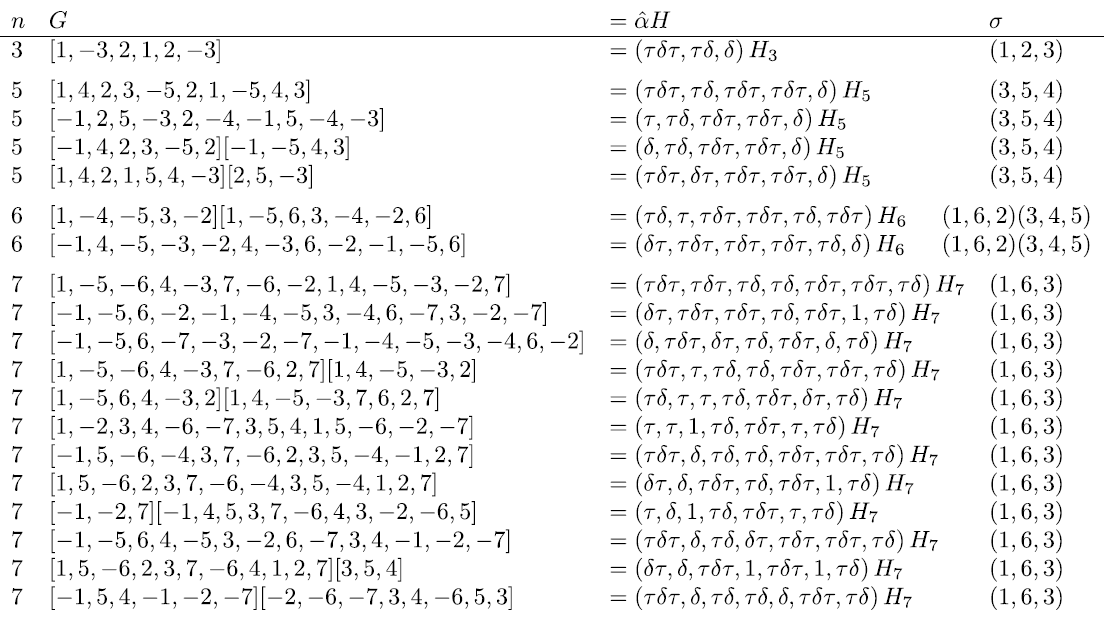
Our main results, Theorems 5.3, 5.4, and 5.5, show that self-twuality, in its various forms, propagates throughout the orbits of the ribbon group action. In Section 6, we prove that that every orbit contains an OEB, which provides essential leverage for the examples of Section 7. In particular, Figure 9 lists, up to isomorphism, all self-trial non-self-dual ribbon graphs on up to 7 edges, and Proposition 7.1 shows how Theorem 5.6 can be used to generate an infinite class of self-trial non-self-dual ribbon graphs.
Section 8 discusses the implementation of the computation reported in Figure 9, after which Section 9 closes the paper with a selection of the many further research directions arising from this algebraic framework for exploring ribbon graph twualities.
2. Ribbon graphs and arrow presentations
There are multiple representations of graphs cellularly embedded in surfaces, and each has its expository and computational advantages. We will use several of these different representations for different purposes in the following sections. Thus, we provide here a very brief reminder of some of the various ways to represent a graph embedded in a surface. A more detailed treatment may be found in [Reference Ellis-Monaghan and Moffatt8].
We begin with ribbon graphs as we will mainly use this representation in the figures.
A ribbon graph
 $G = (V(G),E(G))$
is a surface with boundary presented as the union of two sets of discs, a set V(G) of vertices and a set E(G) of edges, satisfying the following conditions:
-
1. The vertices and edges intersect in disjoint line segments.
-
2. Each such line segment lies on the boundary of precisely one vertex and precisely one edge.
-
3. Every edge contains exactly two such line segments.
A cellular embedding of a graph G on a closed compact surface
 $\Sigma$
is a drawing of G on
 $\Sigma$
such that edges intersect only at their endpoints and each component of
 $\Sigma - G$
is homeomorphic to a disc. Two cellularly embedded graphs in the same surface are considered equivalent if there is a homeomorphism of the surface taking one to the other, and two cellularly embedded graphs are isomorphic if there is a homeomorphism of the surfaces that induces a graph isomorphism when restricted to the graphs embedded in the surfaces.
A cellularly embedded graph can be obtained from a ribbon graph by gluing discs into the boundary components of the ribbon graph and and then retracting the ribbon graph in the resulting surface to get the embedding of the graph in the surface. See Figure 1. Two ribbon graphs are isomorphic if they are isomorphic when represented as cellularly embedded graphs.
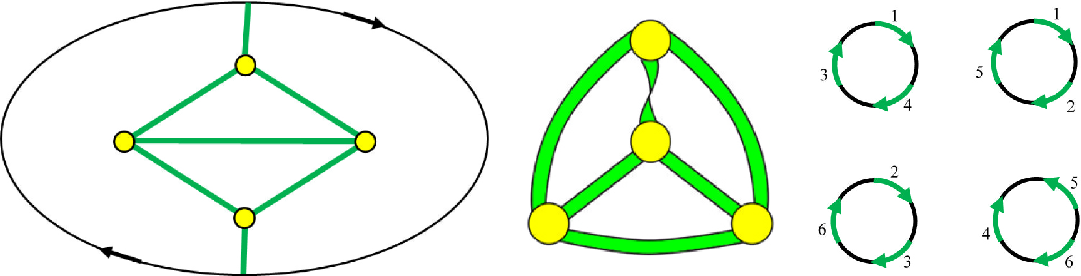
Three ways of representing
 $K_4$
on the projective plane.

Arrow presentations, due to Chmutov [Reference Chmutov2], are a concise way of representing a ribbon graph. We simply draw the vertices of the ribbon graph as circles and make small directed arcs where the edges intersect the vertices (we do not draw the edges). The two arcs for a given edge are both directed clockwise (or equivalently both directed counterclockwise) if the edge has no twist, and directed as one clockwise and one counterclockwise if the edge is twisted. See Figure 1.
Arrow presentations are clearly equivalent to signed rotation systems, which encode cellularly embedded graphs by specifying, for each vertex, a cyclic rotation of its incident edges, and for each edge, a sign of
 $+$
or
 $-$
. Two signed rotation systems (and hence two arrow presentations) are equivalent up to vertex flips, which are the result of reversing the cyclic order at a vertex and toggling the sign of each of its incident edges. This corresponds to ‘flipping over’ a vertex disc in an arrow presentation. See e.g. [Reference Mohar and Thomassen18] for a good exposition of rotation systems.
Two embedded graphs G and H given by arrow presentations are isomorphic if there is a map from the vertex discs of G (including the arrow markings) to any one of the arrow presentations equivalent to the given arrow presentation of H that preserves edge incidences and agreement of arrow directions (i.e. arrows corresponding to an edge in the arrow presentation given for G are consistently oriented if and only if they are consistently oriented in the arrow presentation chosen for H). We can thus also say that two ribbon graphs are isomorphic if they are isomorphic as arrow presentations.
Because we allow loops and multiple edges and will use edge ordering to encode graph isomorphisms in the following sections, we will need the following formal definition of graph and graph isomorphism. An abstract graph consists of a set V of vertices and a set E of edges, together with an incidence map
 $\psi$
taking E to unordered pairs of elements of V (elements may be repeated in the pair in the case of loops). Two abstract graphs
 $G = (V_G, E_G)$
and
 $H=(V_H, E_H)$
are isomorphic if there are bijections
 $f\colon V_G \rightarrow V_H$
and
 $g\colon E_G \rightarrow E_H$
such that
 $\psi_G(e) = (u,v) \iff \psi_H(g(e)) = (f(u), f(v))$
.
Since ribbon graphs are the relevant objects in the remainder of the paper, we simply use the word graph to indicate a ribbon graph, with the adjective ‘ribbon’ or ‘embedded’ only for occasional emphasis. We will use the term abstract graph for the usual definition of a graph given only in terms of its vertices and edges and their incidences.
3. Dualities and the Wilson group action
Two operations on an embedded graph, forming its geometric dual and forming its Petrie dual, are the foundation of the ribbon group action central to this paper.
The geometric dual of a cellularly embedded graph is formed by placing a vertex in the center of each face, and drawing an edge in the surface between two of these vertices whenever there is an edge shared by the faces that contain them. The geometric dual is contained in the same surface as the original graph. The Petrie dual of a graph has the same vertices and edges as the original graph, but the faces are given by ‘left-right’ paths, achieved by choosing an edge, following it to one of its endpoints, and then turning either left or right to follow one of its incident faces in the original embedding, and continuing in this way, alternating the choice of turning left or right until the path closes. This process of building faces is repeated until every edge has been traversed exactly twice. The Petrie dual is generally not embedded in the same surface as the original graph.
Since we will be working primarily in the setting of ribbon graphs, we recall the formation of geometric and Petrie duals in that setting. To form the geometric dual of a ribbon graph, we sew discs into the boundary components and remove the original vertex discs. The new discs become the vertices of the dual, and the edges remain the same, although the intervals along which they coincide with the new vertices are the complements of those that coincided with the vertices of the original graph. The Petrie dual is formed for a ribbon graph by detaching one end of each edge from one of its incident vertex discs, giving the edge a half-twist, and reattaching it to the vertex disc.
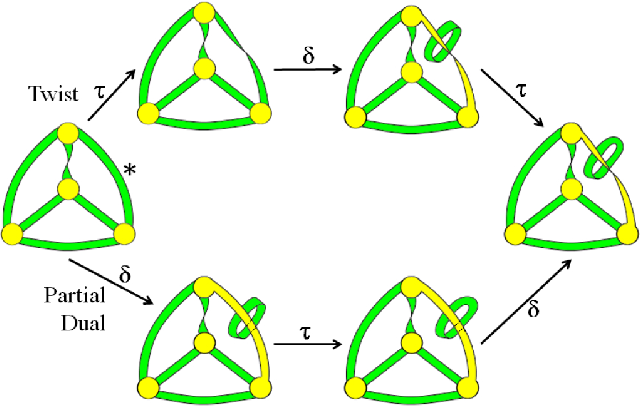
Chmutov’s partial duality, and the partial Petrie duality given in [Reference Ellis-Monaghan and Moffatt7], apply these notions of duality to one edge at a time. If G is an embedded graph given by an arrow presentation and e is an edge of G, then the partial dual with respect to e changes the arrow presentation as follows. Suppose A and B are the two arrows labelled e in an arrow presentation of G. Draw a line segment with an arrow on it directed from the the head of A to the tail of B, and a line segment with an arrow on it directed from the head of B to the tail of A. Label both of these arrows e, then delete A and B and the arcs containing them to complete taking the partial dual with respect to e. To take the partial petrial with respect to e, simply reverse the direction of the arrow on exactly one of the arrows labeled e. See Figure 2. A full orbit on a single edge is shown in Figure 3. Note that taking the partial dual of an edge with distinct endpoints always reduces the number of vertices, while taking the partial dual of a loop may or may not increase the number of vertices. Also note that applying the partial dual operation to all edges gives the geometric dual, and applying the partial petrial operation to all edges gives the Petrie dual.
The twist operation
 $\tau$
and partial dual operation
 $\delta$
given as arrow presentations.

The full action of
 $\delta$
and
 $\tau$
on a single edge (marked with a * on the left). Note that the four graphs with loop edges each have three vertices, shown in yellow.

Wilson noticed that taking the geometric dual and taking the Petrie dual could be thought as operators on embedded graphs (although his attention was mainly on regular maps), and that, although each are of order two, together they generate a group isomorphic to
 $S_3$
, now known as the Wilson group [Reference Wilson26]. The ribbon group and restricted ribbon group action from [Reference Ellis-Monaghan and Moffatt7, Reference Ellis-Monaghan and Moffatt8] extend the Wilson group and the Wilson group action to account for partial dualities. Here, we take the further step of incorporating ribbon-graph isomorphism.
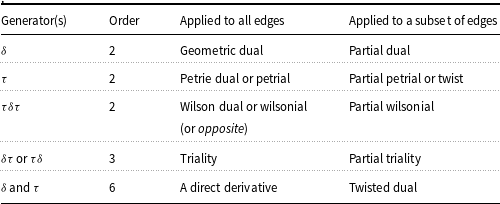
We use the lexicon from [Reference Ellis-Monaghan and Moffatt7, Reference Ellis-Monaghan and Moffatt8] given in Table 1.
Operators on embedded graphs or subsets of their edges

4. A new algebraic framework for the ribbon group action
The ribbon group and ribbon group action were defined in [Reference Ellis-Monaghan and Moffatt7, Reference Ellis-Monaghan and Moffatt8]. These constructs fully generalise surface duality and the Wilson group, and thus provide new tools for understanding ribbon graphs. For example, [Reference Ellis-Monaghan and Moffatt7] shows that if G and H are graphs, then their medial graphs,
 $G_m$
and
 $H_m$
, are isomorphic as abstract graphs if and only if G and H are twisted duals, while [Reference Chmutov2, Reference Ellis-Monaghan and Moffatt7–Reference Ellis-Monaghan and Moffatt10] give numerous results for topological graph polynomials arising from twisted duality and the ribbon group action, and several authors have explored genus ranges of partial duals in various settings [Reference Ellingham and Zha6, Reference Moffatt19]. However, the ribbon group action of [Reference Ellis-Monaghan and Moffatt7, Reference Ellis-Monaghan and Moffatt8] is limited in that self twuality properties under it are restricted to only the case of canonical self-twuality, in which the canonical identification of the edges of the graph and its twual yields an isomorphism. Here, we develop a new algebraic framework incorporating the role of graph isomorphism in graph twualities, and thereby facilitate moving beyond canonical self-twuality to exposes also the more commonly occurring natural self-twuality.
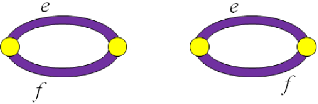
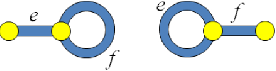
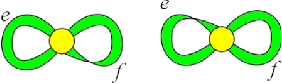
Since in the broader setting here the six twisted duality operations apply to individual edges, the edge ordering formalism below keeps track of which operation applies to which edge. More importantly however, the edge ordering enables recording of graph isomorphism following a duality operation. For example, in Figure 4, after a partial dual operation is applied to each edge, so that the net result is the classical dual of the whole graph, the graph and its dual are isomorphic under the map that takes e to e and f to f. However, in Figure 5, the isomorphism between the graph and its dual maps e to f and f to e. We will distinguish between these two kinds of self-duality as canonical and natural, respectively, formalising this in Definitions 4.2 and 4.3 below.
A vertex flip is accomplished by switching the twistedness/non-twistedness of all edges at a single vertex. Because ribbon graphs are equivalence classes under vertex flips, twists on non-loop edges may propagate through a ribbon graph. Note, therefore, that the graph in Figure 4 is also canonically self-petrial, since in this case propagation of twists results in cancellation. Likewise, if one edge of the digon is twisted, the resulting graph is canonically self-petrial under the map that takes e to e and f to f, The graph in Figure 5 is self-dual, but not canonically self-dual, since the isomorphism between the graph and its dual is not the canonical identification of edges. The graph in Figure 5 is not self-petrial. Also, the join of two loops, one twisted and one not, as in Figure 6, is self-petrial, but not canonically self-petrial, as a twist cannot move from one loop to another.
A graph that is canonically self-petrial and also canonically self-dual.

A self-dual graph.

A self-petrial graph.

Because of this distinction between canonical and natural self-duality, we will begin by working with graphs with a linear ordering of the edges. Let
 ${\mathcal{G}}_{(n)}$
denote the set of equivalence classes under isomorphism of ribbon graphs with exactly n edges, and let
 \begin{equation*}{\mathcal{G}}_{or (n)} := \left\{ (G,\ell) \mid G \in {\mathcal{G}}_{(n)} \text{ and } \ell \text{ is a linear ordering of the edges} \right\}\end{equation*}
be the set of equivalence classes of ribbon graphs with exactly n ordered edges.
In particular, we think of
 $\ell$
explicitly as a bijection
 $\ell\colon [n] \mapsto E(G)$
, whose input is a position in the ordering, and whose output is the edge in that position. Two elements
 $(G, \ell_G)$
and
 $(H, \ell_H)$
of
 ${\mathcal{G}}_{or (n)}$
are isomorphic if there is an isomorphism of G and H as ribbon graphs so that the bijection
 $g\colon E_G \rightarrow E_H$
agrees with the linear orderings in that
 $\ell_G(i)= e \iff \ell_H(i) = g(e)$
.
The two operations, the twist
 $\tau$
and partial-dual
 $\delta$
, act on a specified edge
 $e_i$
of an embedded graph as shown in Figures 2 and 3.
In [Reference Ellis-Monaghan and Moffatt7] it was shown that, for each edge e, in
 $(G,\ell)$
, applying
 $\tau^2$
,
 $\delta^2$
, or
 $(\tau \delta)^3$
acts as the identity. Thus, the group
 \begin{equation*} {\mathfrak{S}} := \langle \delta, \tau \; |\; \delta^2, \tau^2, (\tau \delta)^3 \rangle ,\end{equation*}
which is isomorphic to the symmetric group of order six, acts on any fixed edge of a graph
 $(G,\ell) \in {\mathcal{G}}_{or(n)}$
.
This action readily extends to a group action of
 ${\mathfrak{S}}^n$
on
 ${\mathcal{G}}_{or (n)}$
by allowing the various group elements to act on any subset of the edges independently and simultaneously, not just on a single distinguished edge.
If
 ${\hat{\gamma}} = ( g_1, g_2,g_3, \ldots , g_n ) \in {\mathfrak{S}}^n$
, then, for any
 $(G,\ell) \in {\mathcal{G}}_{or(n)}$
, the action of
 ${\hat{\gamma}}$
on
 $(G,\ell)$
applies
 $g_i$
to the edge
 $e_i$
in the ordering given by
 $\ell$
. We will view the indexing as a map, i.e. think of
 ${\hat{\gamma}}$
as
 ${\hat{\gamma}}\colon [n] \rightarrow {\mathfrak{S}}$
, so that the action applies the element
 ${\hat{\gamma}} (i)=g_i$
to the edge
 $ \ell (i)$
of G.
Twisted dualities, in particular partial duals, can be specified for graphs without ordered edges by partitioning the edges into six subsets according to which element of
 ${\mathfrak{S}}$
is applied. In particular, Proposition 3.7 of [Reference Ellis-Monaghan and Moffatt7] shows that every twisted dual of G admits a unique expression of the form
 \begin{equation}G^{\prod^6_{i=1}{{\xi}_i(A_i)}},\end{equation}
where the
 $A_i$
partition E(G), and where
 ${\xi}_1=1,\ {\xi}_2=\tau,\ {\xi}_3=\delta,\ {\xi}_4=\tau \delta,\ {\xi}_5= \delta \tau$
, and
 ${\xi}_6 = \tau \delta \tau \in {\mathfrak{S}}$
. This may also be written in the expanded form
 \begin{equation}G^{\prod_{e \in E(G)}{{\xi}_{s(e)}(e)}},\end{equation}
where if
 $e \in A_i$
, then
 $s(e) =i$
. Often, if only one element of
 ${\mathfrak{S}}$
is applied to some subset
 $A \subseteq E(G)$
, then the notation is simplified to
 $G^{{\xi}(A)}$
for
 ${\xi} \in {\mathfrak{S}}-\{1\}$
, e.g. writing
 $G^{\delta (A)}$
for the partial dual with respect to A.
With the preceding, we can write the action of
 ${\hat{\gamma}}$
on
 $(G,\ell)$
as
 \begin{equation}{\hat{\gamma}}(G,\ell) = \left(G^{\Gamma({\hat{\gamma}},\ell)}, \ell\right),\end{equation}
where
 $\Gamma({\hat{\gamma}},\ell) = \prod^6_{i=1}{{\xi}_i(\ell {\hat{\gamma}}^{-1}({\xi}_i))}=\prod_{e \in E(G)}{\left[ {\hat{\gamma}} \ell^{-1}(e) \right] (e)}$
. Here,
 $\Gamma({\hat{\gamma}},\ell)$
just sorts the edges of E(G) into a 6-partition according to the operation applied to them by
 ${\hat{\gamma}}$
, and then applies the appropriate operation to each partition. Although the edge order
 $\ell$
is used to determine
 $\Gamma({\hat{\gamma}},\ell)$
, note that
 $\ell {\hat{\gamma}}^{-1}({\xi}_i)$
is a set, so the result may be applied to G, which is unordered, without reference to edge order.
We make the following observations that will be used to prove the compatibility condition in Proposition 4.1 below. We first note that permuting the order of the edges translates simply to permuting which element of
 ${\mathfrak{S}}$
applies to which edge.
 \begin{equation}\Gamma({\hat{\gamma}},\ell \pi^{-1}) =\prod_{e \in E(G)}{\left[ {\hat{\gamma}} (\ell \pi^{-1})^{-1}(e) \right] (e)} = \prod_{e \in E(G)}{\left[ ({\hat{\gamma}}\pi) \ell^{-1}(e) \right] (e)}=\Gamma({\hat{\gamma}} \pi,\ell).\end{equation}
Furthermore, note that composition of a group element with an edge permutation distributes over the group operation
 $\circ$
in
 ${\mathfrak{S}}^n$
, so that
 \begin{equation}{\hat{\gamma}}_1 \pi \circ {\hat{\gamma}}_2 \pi = ({\hat{\gamma}}_1 \circ {\hat{\gamma}}_2) \pi,\end{equation}
 \begin{equation} {\hat{\gamma}}_1 \circ ({\hat{\gamma}}_2 \pi) = ({\hat{\gamma}}_1 \pi^{-1} \circ {\hat{\gamma}}_2 ) \pi,\end{equation}
and
 \begin{equation} ({\hat{\gamma}}_1 \pi) \circ {\hat{\gamma}}_2 = ({\hat{\gamma}}_1 \circ {\hat{\gamma}}_2 \pi^{-1}) \pi;\end{equation}
also,
 \begin{equation} ({\hat{\gamma}} \pi) ^{-1} = {\hat{\gamma}} ^{-1} \pi, \text{ since } \left({\hat{\gamma}}\pi \circ {\hat{\gamma}}^{-1}\pi \right) = \textbf{1} \pi = \textbf{1}.\end{equation}
Lastly, iterated applications of
 $\Gamma$
are captured by the group operation
 $\circ$
, in that
 \begin{equation}(G^{\Gamma({\hat{\gamma}}_2,\ell)})^{\Gamma({\hat{\gamma}}_1,\ell)} = G^{\Gamma({\hat{\gamma}}_1{\hat{\gamma}}_2,\ell)}.\end{equation}
Caution: Note that with this notation,
 $(G^{\times})^* = G^{(* \times)}$
.
There is also a second group action on
 ${\mathcal{G}}_{or(n)}$
. The symmetric group on n elements,
 $S_n$
, acts on
 ${\mathcal{G}}_{or(n)}$
by permuting the edge order, so
 $\pi (G,\ell) = (G,\ell \pi^{-1})$
, where
 $\ell {\pi}^{-1}$
is just composition of the functions
 $\ell$
and
 $\pi^{-1}$
. Thus, applying
 $\pi$
to
 $(G,\ell)$
permutes the ordered list of edges. We write
 $ \iota $
for the identity in
 $S_n$
.
We turn to a semidirect product of
 ${\mathfrak{S}}^n$
and
 $S_n$
for an action on
 ${\mathcal{G}}_{or(n)}$
that combines these two actions in a compatible way. This will be the primary algebraic tool for manipulating ribbon graphs, as its function is to apply specific elements of the ribbon group to specific edges, and furthermore to keep track of isomorphisms between graphs via the edge orderings.
Proposition 4.1 Let
 $\phi\colon S_n \rightarrow \mbox{Aut}\, {\mathfrak{S}}^n$
be defined by
 $\phi(\pi) \mapsto \phi_{\pi}$
, where
 $\phi_{\pi}({\hat{\gamma}}) = {\hat{\gamma}} \pi^{-1}$
. Then
 $\phi$
is a homomorphism, and the semidirect product
 ${\mathfrak{S}}^n \rtimes_{\phi} S_n$
acts on
 ${\mathcal{G}}_{or(n)}$
by
 $({\hat{\gamma}}, \pi)(G,\ell) = {\hat{\gamma}}(G, \ell \pi^{-1}) =(G^{\Gamma({\hat{\gamma}},\ell\pi^{-1})}, \ell \pi^{-1}) = (G^{\Gamma({\hat{\gamma}} \pi,\ell)}, \ell \pi^{-1})$
.
Proof. Showing that
 $\phi$
is a homomorphism is routine since
 $\phi_{\pi_1\pi_2}({\hat{\gamma}}) = {\hat{\gamma}} (\pi_1 \pi_2)^{-1} = \phi_{\pi_1} \phi _{\pi_2} ({\hat{\gamma}})$
. Thus, we have a well-defined semidirect product
 ${\mathfrak{S}}^n \rtimes_{\phi} S_n$
with multiplication given by
 $({\hat{\gamma}}_1, \pi_1) ({\hat{\gamma}}_2, \pi_2) = ({\hat{\gamma}}_1 \phi_{\pi_1}({\hat{\gamma}}_2), \pi_1 \pi_2)$
.
It remains to verify the compatibility condition that
 $({\hat{\gamma}}_1,\pi_1)\cdot\left[({\hat{\gamma}}_2,\pi_2)\cdot(G,\ell)\right] = \left[ ({\hat{\gamma}}_1,\pi_1)({\hat{\gamma}}_2,\pi_2)\right] \cdot (G,\ell)$
.
We give two proofs of the compatibility condition for the action of
 ${\mathfrak{S}}^n \rtimes_{\phi} S_n$
on
 ${\mathcal{G}}_{or(n)}$
, as the first aligns more readily with topological intuition and the second is more fundamentally an application of algebraic machinery. However, at the heart of both proofs is the observation that first applying
 $({\hat{\gamma}}_2,\pi_2)$
and then applying
 $({\hat{\gamma}}_1,\pi_1)$
, requires ‘undoing’ the edge ordering given by
 $\pi_1$
so that the operations in
 ${\hat{\gamma}}_2$
apply to the correct edges. This exactly corresponds to the
 $\pi_1^{-1}$
that appears when first multiplying
 $({\hat{\gamma}}_1,\pi_1)({\hat{\gamma}}_2,\pi_2)$
and only then applying the result to
 $(G,\ell)$
, rather than applying the multiplicands iteratively to
 $(G,\ell)$
.
Proof 1. The first proof leverages the identities in equations (4) through (7). We compute as follows:
 \begin{equation*}\begin{array}{rcl}({\hat{\gamma}}_1,\pi_1)\cdot\left[({\hat{\gamma}}_2,\pi_2)\cdot(G,\ell)\right]&=&({\hat{\gamma}}_1,\pi_1)\cdot\left(G^{\Gamma({\hat{\gamma}}_2 \pi_2,\ell)}, \ell \pi_2^{-1}\right) \\ \\[-9pt]&=&\left((G^{\Gamma({\hat{\gamma}}_2 \pi_2,\ell)})^{\Gamma({\hat{\gamma}}_1 \pi_1 ,\ell\pi_2^{-1})}, \ell \pi_2^{-1}\pi_1^{-1}\right) \\ \\[-9pt]&=&\left((G^{\Gamma({\hat{\gamma}}_2 \pi_2,\ell)})^{\Gamma({\hat{\gamma}}_1 \pi_1 \pi_2 ,\ell)}, \ell \pi_2^{-1}\pi_1^{-1}\right) \\ \\[-9pt]&=& \left(G^{\Gamma({\hat{\gamma}}_1\pi_1\pi_2\circ{\hat{\gamma}}_2 \pi_2,\ell)}, \ell \pi_2^{-1}\pi_1^{-1}\right) \\ \\[-9pt]&=& \left(G^{\Gamma(({\hat{\gamma}}_1\circ{\hat{\gamma}}_2 \pi_1^{-1})\pi_1\pi_2,\ell)}, \ell \pi_2^{-1}\pi_1^{-1}\right) \\ \\[-9pt]& = & \left({\hat{\gamma}}_1 \circ {\hat{\gamma}}_2\pi_1^{-1}, \pi_1\pi_2\right)\cdot(G,\ell)\\ \\[-9pt]& = & \left[ ({\hat{\gamma}}_1,\pi_1)({\hat{\gamma}}_2,\pi_2)\right] \cdot (G,\ell).\end{array}\end{equation*}
Here the third equality follows from equation (4), the fourth from equation (7), and the fifth from equation (5).
Proof 2. The second proof uses the following observations, which are reductions of operations within the action of the semidirect product:
 \begin{equation}\begin{array}{rcl} ({\hat{\gamma}}, \iota) \cdot\left[ (\textbf{1},\pi)\cdot(G,\ell)\right] & = & \left( [ G^{\Gamma(\textbf{1},\ell\pi^{-1})} ]^{\Gamma({\hat{\gamma}},\ell\pi^{-1})},\ell\pi^{-1} \right)\\[3pt] & = & \left(G^{\Gamma({\hat{\gamma}},\ell\pi^{-1})}, \ell\pi^{-1} \right) \\ & = & ({\hat{\gamma}},\pi)\cdot(G,\ell), \end{array} \end{equation}
 \begin{equation} \begin{array}{rcl}(\textbf{1},\pi)\cdot\left[ ({\hat{\gamma}}\pi, \iota) \cdot (G,\ell)\right]& = & \left( [ G^{\Gamma({\hat{\gamma}}\pi,\ell)} ]^{\Gamma(\textbf{1},\ell\pi^{-1})},\ell\pi^{-1} \right)\\& = & ({\hat{\gamma}},\pi)\cdot(G,\ell),\end{array}\end{equation}
 \begin{equation}(\textbf{1},\pi_1\pi_2)\cdot(G,\ell) = \left(G^{\Gamma(\textbf{1},\ell\pi_2^{-1}\pi_1^{-1})}, \ell\pi_2^{-1}\pi_1^{-1} \right) = (\textbf{1},\pi_1)\cdot\left[(\textbf{1},\pi_2)\cdot(G,\ell)\right], \text{and}\end{equation}
 \begin{equation}({\hat{\gamma}}_1{\hat{\gamma}}_2,\iota)\cdot(G,\ell) = ({\hat{\gamma}}_1,\iota)\cdot\left[({\hat{\gamma}}_2,\iota)\cdot(G,\ell)\right].\end{equation}
In fact, each of these is a particular instance when the compatibility condition of the action holds, although we don’t need that observation per se.
Now we have in general that
 \begin{align*}({\hat{\gamma}}_1,\pi_1)\cdot\left[({\hat{\gamma}}_2,\pi_2)\cdot(G,\ell)\right]& = ({\hat{\gamma}}_1,\pi_1)\cdot\left[ (\textbf{1},\pi_2)\cdot\left[ ({\hat{\gamma}}_2\pi_2, \iota) \cdot (G,\ell)\right] \right]\\[3pt]& = (\textbf{1},\pi_1)\cdot\left[ ({\hat{\gamma}}_1\pi_1, \iota) \cdot\left[ (\textbf{1},\pi_2)\cdot\left[ ({\hat{\gamma}}_2\pi_2, \iota) \cdot (G,\ell)\right]\right] \right]\\[3pt]& = (\textbf{1},\pi_1)\cdot\left[ (\textbf{1},\pi_2) \cdot\left[ ({\hat{\gamma}}_1\pi_1\pi_2, \iota) \cdot\left[ ({\hat{\gamma}}_2\pi_2, \iota) \cdot (G,\ell)\right]\right] \right]\\[3pt]& = (\textbf{1},\pi_1\pi_2) \cdot \left[ ({\hat{\gamma}}_1\pi_1\pi_2 \circ {\hat{\gamma}}_2\pi_2, \iota) \cdot (G,\ell)\right]\\[3pt]& = ({\hat{\gamma}}_1 \circ {\hat{\gamma}}_2\pi_1^{-1}, \pi_1\pi_2)\cdot(G,\ell)\\[3pt]& = \left[ ({\hat{\gamma}}_1,\pi_1)({\hat{\gamma}}_2,\pi_2)\right] \cdot (G,\ell). \\[-35pt]\end{align*}
Recall that applying a permutation to an indexed set applies the inverse permutation to the indices, so that
 $\phi_{\pi}$
acts by permuting the indices of
 ${\hat{\gamma}}$
, where if
 ${\hat{\gamma}} = ( g_1, g_2,g_3, \ldots , g_n )$
, then
 $\phi_{\pi}({\hat{\gamma}})= ( g_{\pi^{-1}(1)}, g_{\pi^{-1}(2)},g_{\pi^{-1}(3)}, \ldots , g_{\pi^{-1}(n)} )$
.
Also note that
 $({\hat{\gamma}}, \pi)^{-1}=({\hat{\gamma}}^{-1} \pi, \pi^{-1})$
, applying equation (5) as needed.
We close this section by establishing some notation that will facilitate our exploration of the orbits and stabilisers of the ribbon group action.
As usual
 $Orb((G,\ell_G)) = \{(H, \ell_H) \mid ({\hat{\gamma}}, \pi)(G, \ell_G) =(H, \ell_H) \text{ for some } ({\hat{\gamma}}, \pi) \in {\mathfrak{S}}^n \rtimes_{\phi} S_n \}$
, although we will usually write
 $Orb(G,\ell_G)$
for
 $Orb((G,\ell_G))$
. In addition, we will often focus particularly on the action of the subgroup
 ${\mathfrak{S}}^n \rtimes_{\phi} \iota$
and will denote its orbit as
 $Orb_{\iota}(G,\ell_G) = \{(H, \ell_H) \mid ({\hat{\gamma}}, \iota)(G, \ell_G) =(H, \ell_H) \text{ for some } {\hat{\gamma}} \in {\mathfrak{S}}^n \}$
.
We will see that the various twualities a graph may exhibit may be revealed by examining appropriate kinds of stabilisers.
Definition 4.2 We say that an embedded graph
 $(G,\ell)$
is self-
 ${\hat{\gamma}}$
if
 ${\hat{\gamma}}$
is not the identity and there exists
 $\pi \in S_n$
such that
 $({\hat{\gamma}}, \pi)(G, \ell) = (G,\ell)$
, and we say that
 $(G,\ell)$
is canonically self-
 ${\hat{\gamma}}$
if
 $({\hat{\gamma}}, \iota)(G, \ell) = (G,\ell)$
.
In particular,
 $(G,\ell)$
is self-
 ${\hat{\gamma}}$
for some
 ${\hat{\gamma}}$
different from the identity if it has a non-trivial stabiliser in
 ${\mathfrak{S}}^n \rtimes S_n$
, and canonically self-
 ${\hat{\gamma}}$
if it has a non-trivial stabiliser in
 ${\mathfrak{S}}^n \rtimes \iota$
.
We will be most interested in the case that G is self-dual, self-petrial, self-trial, etc. in the traditional sense. This corresponds to
 ${\hat{\gamma}}$
being uniform, that is, every entry of
 ${\hat{\gamma}}$
is the same.
Definition 4.3 We say that an embedded graph
 $(G,\ell)$
is self-twual via
 $\pi$
(or just self-twual) if there is a uniform
 ${\hat{\gamma}} \in {\mathfrak{S}}^n$
and a
 $\pi \in S_n$
such that
 $({\hat{\gamma}}, \pi)(G, \ell) = (G,\ell)$
. We say that
 $(G,\ell)$
is canonically self-twual if
 $(G,\ell)$
is self-twual via
 $\iota$
.
Thus, for example, a graph G is canonically self-dual if
 $(\boldsymbol{\delta}, \iota)(G, \ell) = (G,\ell)$
.
Note that because
 ${\mathcal{G}}_{or(n)}$
is a set of equivalence classes,
 $({\hat{\gamma}}, \pi)(G, \ell) = (G,\ell)$
means that there is an isomorphism between
 $G^{\Gamma ({\hat{\gamma}},\ell\pi^{-1})}$
and G, and the correspondence of edges under this isomorphism is given by the mapping
 $\ell\pi^{-1}(i) \mapsto \ell(i)$
.
Remark 4.4 A comparison with the ribbon group and ribbon group action on graphs with ordered edges of [8, Definition 2.21] shows that this action is exactly the action of
 ${\mathfrak{S}}^n \rtimes \iota$
. The permutation group in
 ${\mathfrak{S}}^n \rtimes S_n$
allows us to define natural self-twuality precisely as
 $({\hat{\gamma}}, \pi)(G, \ell) = (G,\ell)$
, with
 $\pi$
specifying the isomorphism. The limitation of the canonical action of [Reference Ellis-Monaghan and Moffatt8] is evident in [8, Theorem 2.25] where the most that can be said is that two graphs have a given self-twuality if they both belong to a particular set, with the isomorphism unspecified.
5. Propagation of twuality
We show here that if a graph H is self-
 ${\hat{\gamma}}$
for some non-trivial
 ${\hat{\gamma}}$
, then any graph G in its orbit is also self-
 ${\hat{\gamma}}'$
for some
 ${\hat{\gamma}}'$
. Thus, once any graph is found to have some twisted duality property, that property propagates through its whole orbit. Furthermore, as we will see later, it possible to search the orbit efficiently for graphs with desired self-twuality properties.
Recall that in the classical setting, we get new self-twualities by conjugation, so that if G has some self-twuality property and H is an element of the orbit of G under the Wilson group action, then H will have a self-twuality that is conjugate to the self-twuality of G. For example, if G is self-dual, with
 $G=G^{\delta(E)}$
and
 $H=G^{\tau(E)}$
, then H is self-
 $\tau \delta \tau^{-1}$
.
This same principle holds for any pair of elements in the Wilson group. Here we adapt this principle to the more refined setting of the ribbon group action, which then allows us to study twuality systematically in the subsequent sections.
We begin with a short technical lemma to verify the intuitively clear fact that if H is self-
 ${\hat{\gamma}}$
, then this property is preserved if the edge order and the entries of
 ${\hat{\gamma}}$
are permuted simultaneously by the same permutation.
Lemma 5.1 If
 $(H, \ell)$
is self-
 ${\hat{\gamma}}$
via
 $\mu$
, then for any permutation
 $\pi$
,
 $(H, \ell \pi^{-1})$
is self-
 ${\hat{\gamma}} \pi^{ -1}$
via
 $\pi \mu \pi^{-1}$
.
Proof. It suffices to verify the commutativity of the following diagram:

By the compatibility condition of the action, this follows from the following calculation in
 ${\mathfrak{S}}^n \rtimes_{\phi} S_n$
.
 \begin{equation*} \begin{array}{rcl} ({\hat{\gamma}} \pi^{-1}, \pi \mu \pi^{-1} ) (\textbf{1}, \pi) &=& ({\hat{\gamma}} \pi^{-1} \cdot \textbf{1}\pi\mu^{-1}\pi^{-1}, \pi \mu )\\ &=& ({\hat{\gamma}}\pi^{-1} \cdot \textbf{1}, \pi\mu) \\ &=& (\textbf{1}\cdot{\hat{\gamma}}\pi^{-1},\pi\mu)\\ & = & (\textbf{1},\pi)({\hat{\gamma}},\mu). \end{array} \end{equation*}
The following proposition gives our main result in the simplest setting, where there are no permutations of the edges to keep track of, and hence the principle of the proof is easier to see.
Proposition 5.2 Suppose
 $(H, \ell_H)$
is canonically self-
 ${\hat{\gamma}}$
, and
 $(G, \ell_G) \in Orb_{\iota}(H, \ell_H)$
with
 $({\hat{\alpha}}, \iota)(H,\ell_H)=(G, \ell_G)$
. Then G is also canonically self-
 ${\hat{\gamma}}'$
where
 ${\hat{\gamma}}'$
is the result of conjugation, specifically
 ${\hat{\gamma}}'={\hat{\alpha}} {\hat{\gamma}} {\hat{\alpha}}^{-1}$
.
Proof. The compatibility condition of the action and a simple calculation in
 ${\mathfrak{S}}^n \rtimes_{\phi} S_n$
verify that the following diagram is commutative, which proves the result.

A consequence of Proposition 5.2, given in the following theorem, is that canonical self-twuality propagates throughout the entire orbit of a graph.
Theorem 5.3 Let
 $(F, \ell_F)$
be a graph. Then the following are equivalent:
-
1. There is a graph
 $(H, \ell_H) \in Orb_{\iota}(F, \ell_F)$
that is canonically self-twual, i.e. self-dual, -petrial, or -wilsonial (respectively, self-trial);
-
2. Every graph
$(G, \ell_G)$
in
$Orb_{\iota}(F, \ell_F)$
is canonically self-
${\hat{\gamma}}'$
where every element of
${\hat{\gamma}}'$
has order 2 (respectively, 3); -
3. There exists a graph
$(G, \ell_G)$
in
$Orb_{\iota}(F, \ell_F)$
that is canonically self-
${\hat{\gamma}}'$
where every element of
${\hat{\gamma}}'$
has order 2 (respectively, 3).


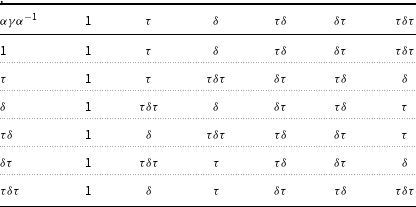
Proof. The proof uses the conjugacies for
 $S_3$
given in Table 2.
Conjugacy Table (
 ${\alpha}$
labels the rows,
 ${\gamma}$
the columns)

To see that Item 5.3.1 implies Item 5.3.2, suppose that
 $(H, \ell_H)$
is a canonically self-twual graph via uniform
 ${\hat{\gamma}}$
. Then by Theorem 5.2, every graph
 $(G, \ell_G)$
in
 $Orb_{\iota}(H, \ell_H)=Orb_{\iota}(F, \ell_F)$
is canonically self-
 ${\hat{\alpha}} {\hat{\gamma}} {\hat{\alpha}}^{-1}$
for some
 ${\hat{\alpha}}$
. However, conjugation preserves order here, so by Table 2, if
 ${\hat{\gamma}}$
is
 $\delta$
-,
 $\tau$
-, or
 $\tau \delta \tau$
-uniform, then each element in
 ${\hat{\alpha}} {\hat{\gamma}} {\hat{\alpha}}^{-1}$
is in
 $\{\tau, \delta, \tau \delta \tau \}$
. Similarly, if
 $(G, \ell_G)$
is canonically self-trial, then every element of
 ${\hat{\alpha}} {\hat{\gamma}} {\hat{\alpha}}^{-1}$
must be in
 $\{ \tau \delta, \delta \tau \}$
. Note that
 ${\hat{\alpha}}$
may be trivial, in which case
 ${\hat{\gamma}} ={\hat{\gamma}}'$
and still has every element of order 2 or 3.
That Item 5.3.2 implies Item 5.3.3 is immediate.
To show that Item 5.3.3 implies Item 5.3.1, assume
 $(G, \ell_G)$
is a graph in
 $Orb_{\iota}(F, \ell_F)$
that is canonically self-
 ${\hat{\gamma}}'$
where every entry of
 ${\hat{\gamma}}'$
is in
 $\{\tau, \delta, \tau \delta \tau \}$
. We may then use the conjugacy table to select elements of
 ${\hat{\alpha}}$
so that
 ${\hat{\alpha}} {\hat{\gamma}}' {\hat{\alpha}}^{-1}$
is
 $\delta$
-,
 $\tau$
-, or
 $\tau \delta \tau$
-uniform. With this,
 $(H, \ell_H) = ({\hat{\alpha}}, \iota)(G, \ell_G)$
is the canonically self-dual, -petrial, or -wilsonial graph we seek, since if
 ${\hat{\gamma}}$
is the desired twuality, then
 $({\hat{\gamma}}, \iota) (H, \ell_H) = ({\hat{\gamma}}, \iota) ({\hat{\alpha}}, \iota)(G, \ell_G) = ({\hat{\alpha}}, \iota)({\hat{\gamma}}', \iota)({\hat{\alpha}}, \iota)^{-1} ({\hat{\alpha}}, \iota)(G, \ell_G)=({\hat{\alpha}}, \iota)({\hat{\gamma}}', \iota)(G, \ell_G)=({\hat{\alpha}}, \iota)(G, \ell_G)=(H, \ell_H)$
. An analogous approach proves the self-trial case.
The general case where
 $(G, \ell_G)$
is any graph in the orbit of
 $(H, \ell_H)$
(that is, in
 $Orb(H, \ell_H)$
, not necessarily
 $Orb_{\iota} (H, \ell_H)$
) and where
 $(H, \ell_H)$
is self-
 ${\hat{\gamma}}$
but not necessarily canonically so, is essentially the same, but involves keeping track of the permutations. Although the conjugation is somewhat obfuscated by the appearance of the permutations, we are simply reordering to be sure that the conjugation is applied to the correct edges at each step.
Theorem 5.4 Suppose
 $(H, \ell_H)$
is self-
 ${\hat{\gamma}}$
via
 $\mu$
and that
 $(G, \ell_G) \in Orb(H, \ell_H)$
with
 $({\hat{\alpha}}, \pi)(H,\ell_H)=(G, \ell_G)$
. Then
 $(G, \ell_G)$
is self-
 ${\hat{\gamma}}'$
via
 $\mu'$
where
 ${\hat{\gamma}}'$
is a ‘near-conjugate’ of
 ${\hat{\gamma}}$
by
 ${\hat{\alpha}}$
, with
 \begin{equation*}{\hat{\gamma}}' = {\hat{\alpha}} \cdot {\hat{\gamma}} \pi^{-1} \cdot {\hat{\alpha}}^{-1} \pi \mu^{-1} \pi^{-1},\end{equation*}
and
 $ \mu'= \pi \mu \pi^{-1}.$
Proof. It suffices to verify the commutativity of the following diagram:

By the compatibility condition of the action, this follows from the following calculation in
 ${\mathfrak{S}}^n \rtimes_{\phi} S_n$
.
 \begin{align*} \left({\hat{\alpha}} \cdot {\hat{\gamma}} \pi^{-1} \cdot {\hat{\alpha}}^{-1} \pi \mu^{-1} \pi^{-1}, \pi \mu \pi^{-1}\right)({\hat{\alpha}},\pi) &= \left({\hat{\alpha}} \cdot {\hat{\gamma}} \pi^{-1} \cdot {\hat{\alpha}}^{-1} \pi \mu^{-1} \pi^{-1} \cdot {\hat{\alpha}}\pi\mu^{-1}\pi^{-1}, \pi \mu \pi^{-1}\right)\\[3pt] &= ({\hat{\alpha}} \cdot {\hat{\gamma}}\pi^{-1},\pi\mu) \\[3pt] &= ({\hat{\alpha}},\pi)({\hat{\gamma}},\mu). \\[-35pt] \end{align*}
Since
 ${\mathfrak{S}}$
is not commutative, we write
 $\prod_{i=m}^{1} {{\xi}_{i}} $
in the following theorem statement to indicate the product
 ${\xi}_m {\xi}_{m-1} \ldots {\xi}_1$
. We also write ord(g) for the order of a group element in
 ${\mathfrak{S}}$
.
Theorem 5.5 Let
 $(F, \ell_F)$
be a graph,
 $g \in {\mathfrak{S}}$
, and
 $\mu$
a permutation. Then the following are equivalent:
-
1. There is a graph
$(H, \ell_H) \in Orb(F, \ell_F)$
that is self-
${\hat{\gamma}} = (g, g, \ldots , g)$
via the permutation
$\mu$
, i.e.
$(H, \ell_H)$
is self-dual, -petrial, -wilsonial, or -trial; -
2. Every graph
$(G, \ell_G) \in Orb(F, \ell_F)$
is self-
${\hat{\gamma}}'= ({\xi}_1, {\xi}_2, \ldots, {\xi}_n)$
via
$\mu'$
, where
$\mu'=\pi \mu \pi^{-1}$
for some
$\pi$
, and where
${\hat{\gamma}}'$
has the property that if
$C=(c_1, c_2, \ldots, c_m)$
is a cycle in the cycle decomposition of
$\mu'$
, then
$ord (\prod_{i=m}^{1} {{\xi}_{c_i}} ) = ord(g ^m)$
; -
3. There exists a graph
$(G, \ell_G) \in Orb (F, \ell_F)$
that is self-
${\hat{\gamma}}'= ({\xi}_1, {\xi}_2, \ldots, {\xi}_n)$
via
$\mu'$
, where
$\mu'=\pi \mu \pi^{-1}$
for some
$\pi$
, and where
${\hat{\gamma}}'$
has the property that if
$C=(c_1, c_2, \ldots, c_m)$
is a cycle in the cycle decomposition of
$\mu'$
, then
$ord (\prod_{i=m}^{1} {{\xi}_{c_i}} ) = ord(g ^m)$
.


Proof. To see that Item 5.5.1 implies Item 5.5.2, suppose that
 $(H, \ell_H)$
is a self-twual graph via uniform
 ${\hat{\gamma}}$
and permutation
 $\mu$
, and
 $(G, \ell_G)$
is a graph in
 $Orb(H, \ell_H)=Orb (F, \ell_F)$
. Then, by Theorem 5.4,
 $(G, \ell_G)$
is self-
 ${\hat{\gamma}}' = {\hat{\alpha}} \cdot {\hat{\gamma}} \pi^{-1} \cdot {\hat{\alpha}}^{-1} \pi \mu^{-1} \pi^{-1} $
via
 $\mu'= \pi \mu \pi^{-1}$
where
 ${\hat{\alpha}}$
and
 $\pi$
satisfy
 $({\hat{\alpha}}, \pi)(H, \ell_H) = (G, \ell_G)$
. In particular, for this
 ${\hat{\alpha}}$
and
 $\pi$
, we have that
 \begin{equation}({\hat{\gamma}}, \mu) \, = \,({\hat{\alpha}}, \pi)^{-1}({\hat{\gamma}}', \mu')({\hat{\alpha}}, \pi) \, = \,\left(({\hat{\alpha}}^{-1} \cdot {\hat{\gamma}}' \cdot {\hat{\alpha}}\mu'^{-1})\pi,\, \pi^{-1}\mu'\pi\right).\end{equation}
Hence,
 $({\hat{\alpha}}^{-1} \cdot {\hat{\gamma}}' \cdot {\hat{\alpha}}\mu'^{-1})\pi={\hat{\gamma}}$
, and so
 $({\hat{\alpha}}^{-1} \cdot {\hat{\gamma}}' \cdot {\hat{\alpha}}\mu'^{-1})={\hat{\gamma}}\pi^{-1}$
. However,
 ${\hat{\gamma}}$
is uniform, so
 $ {\hat{\gamma}}\pi^{-1}= \pi$
, and we have that
 \begin{equation} ({\hat{\alpha}}^{-1} \cdot {\hat{\gamma}}' \cdot {\hat{\alpha}}\mu'^{-1})={\hat{\gamma}}.\end{equation}
We now write
 ${\hat{\gamma}}'=({\xi}_1, {\xi}_2, \ldots, {\xi}_n)$
and also write
 ${\hat{\alpha}}=({\alpha}_1, {\alpha}_2, \ldots, {\alpha}_n)$
, recalling that
 ${\hat{\alpha}}\mu'^{-1}= ({\alpha}_{\mu'^{-1}(1)}, {\alpha}_{\mu'^{-1}(2)}, \ldots, {\alpha}_{\mu'^{-1}(n)})$
. Considering each entry of equation (15) individually, this yields that
 \begin{equation}{\alpha}_i^{-1} \cdot {\xi}_i \cdot {\alpha}_{\mu'^{-1}(i)}=g \text{ for all } i.\end{equation}
In particular, if
 $C=(c_1, c_2, \ldots, c_m)$
is a cycle in the cycle decomposition of
 $\mu'$
(we use the convention that a cycle begins with its lowest number), then equation (16) becomes
 \begin{equation} {\alpha}_{c_i}^{-1} \cdot {\xi}_{c_i} \cdot {\alpha}_{ c_{i-1}} = g \text{ for all } i \in \{1, 2, \ldots,m\}, \text { where we write } c_0= c_m. \end{equation}
Thus,
 ${\alpha}_{ c_{m-1} }={\xi}^{-1}_{c_m} \cdot {\alpha}_{c_m} \cdot g$
, and
 ${\alpha}_{c_{m-2}}= {\xi}^{-1}_{c_{m-1}} \cdot {\xi}^{-1}_{c_m} \cdot {\alpha}_{c_m }\cdot g^2$
, and in general
 \begin{equation} {\alpha}_{c_{m-i}}= \left ( \prod_{j=m-i+1}^{m}{{\xi}_{c_j}^{-1}} \right ) \cdot {\alpha}_{c_{m}} \cdot g^i.\end{equation}
When
 $i=m$
, it follows that
 ${\alpha}_{c_{m}}= \left ( \prod_{j=1}^{m}{{\xi}_{c_j}^{-1}} \right ) \cdot {\alpha}_{c_{m}} \cdot g^m$
and hence
 $\left ( \prod_{j=m}^{1}{{\xi}_{c_j} }\right ) ={\alpha}_{c_{m}} \cdot g^m \cdot {\alpha}_{c_{m}}^{-1}$
. Since conjugation preserves order in
 ${\mathfrak{S}}$
, this proves the implication.
That Item 5.5.2 implies Item 5.5.3 is immediate.
To show that Item 5.5.3 implies Item 5.5.1, suppose
 $(G,\ell_G) \in Orb (F, \ell_F)$
is self-
 ${\hat{\gamma}}'= ({\xi}_1, {\xi}_2, \ldots, {\xi}_n)$
via
 $\mu'=\pi \mu \pi^{-1}$
for some
 $\pi$
, and that
 ${\hat{\gamma}}'$
has the property that if
 $C=(c_1, c_2, \ldots, c_m)$
is a cycle in the cycle decomposition of
 $\mu'$
, then
 $ord (\prod_{i=m}^{1} {{\xi}_{c_i}} ) = ord(g ^m)$
.
We observe that we can assume
 $\mu'=\mu$
, i.e. that we can take
 $\pi = \iota$
. This follows from Lemma 5.1, which says that we can simply re-order the edges of
 $(G,\ell_G)$
so that G is self-
 ${\hat{\gamma}}' \pi$
via
 $\mu=\mu'$
. We then note that since in
 $\prod_{i=m}^{1} {{\xi}_{c_i}}$
the indices are from a cycle of
 $\mu'$
, it follows that
 $ord (\prod_{i=m}^{1} {{\xi}_{\mu'(c_i})} = ord(\prod_{i=m}^{1} {{\xi}_{c_{i+1}}} ) = ord (\prod_{i=m}^{1} {{\xi}_{c_i}} ) = ord(g ^m)$
.
Thus, Item 5.5.3 implies that there is some
 $(G,\ell_G) \in Orb (F, \ell_F)$
that is self-
 ${\hat{\gamma}}'= ({\xi}_1, {\xi}_2, \ldots, {\xi}_n)$
via
 $\mu'=\mu$
, and that
 ${\hat{\gamma}}'$
has the property that if
 $C=(c_1, c_2, \ldots, c_m)$
is a cycle in the cycle decomposition of
 $\mu'$
, then
 $ord (\prod_{i=m}^{1} {{\xi}_{c_i}} ) = ord(g ^m)$
.
We will construct
 ${\hat{\alpha}} \in {\mathfrak{S}}^n$
as follows. Given a cycle C of length m in the cycle decomposition of
 $\mu'$
, since
 $ord (\prod_{j=m}^{1} {{\xi}_{c_j}} ) = ord(g ^m)$
, we may use the conjugacies in Table 2 to choose
 ${\alpha}_{c_m}$
such that
 $ {\alpha}_{c_{m}} \cdot \left( \prod_{j=m}^{1}{{\xi}_{c_j} }\right ) \cdot {\alpha}_{c_{m}}^{-1} = g^m$
. Then, for
 $1\leq i < m$
, recursively define
 ${\alpha}_{c_i}=g^{-1} \cdot {\alpha}_{c_{i+1}} \cdot {\xi}_{i+1}$
. Note that we have
 ${\alpha}_{c_i}=g^{-(m-1)} \cdot {\alpha}_{c_m} \cdot \left( \prod_{j=m}^{i+1}{{\xi}_{c_j} }\right )$
for
 $1\leq i < m$
, and also that
 ${\alpha}_{c_1}=g \cdot {\alpha}_{c_{m}} \cdot {\xi}^{-1}_{1}$
.
Then, for all i, and reading indices of the
 $c_i$
’s mod m, we find that
 \begin{equation} g= {\alpha}_{c_{i+1}} \cdot {\xi}_{i+1} \cdot {\alpha}^{-1}_{\mu'^{-1}(c_{i+1})}.\end{equation}
We repeat this, choosing some suitable
 ${\alpha}_{c_m}$
for each cycle of length m in
 $\mu'$
for all lengths m.
Since equation (19) holds for all entries and
 $\mu = \mu'$
, it follows that
 $({\hat{\gamma}}, \mu)=({\hat{\alpha}}, \iota)({\hat{\gamma}}', \mu') ({\hat{\alpha}}, \iota)^{-1}.$
With this,
 $(H, \ell_H) = ({\hat{\alpha}}, \iota)(G, \ell_G)$
is the desired self-dual, -petrial, -wilsonial, or, respectively, self-trial graph, since then
 $({\hat{\gamma}}, \mu)(H, \ell_H) = ({\hat{\gamma}}, \mu)({\hat{\alpha}}, \iota)(G, \ell_G) = ({\hat{\alpha}}, \iota)({\hat{\gamma}}', \mu') ({\hat{\alpha}}, \iota)^{-1}({\hat{\alpha}}, \iota)(G, \ell_G) = ({\hat{\alpha}}, \iota)({\hat{\gamma}}', \mu')(G, \ell_G)=({\hat{\alpha}}, \iota)(G, \ell_G)=(H, \ell_H)$
.
Observe that
 ${\hat{\alpha}}$
, as constructed in the proof of Theorem 5.5 is not uniquely determined, as each cycle of
 $\mu'$
gives rise to several possibilities. Each of the resulting
 ${\hat{\alpha}}$
’s can give a different self-twual graph H, although some of them might possibly be isomorphic to one another.
Theorems 5.3 and 5.5 imply that if we find any graph G that is self-
 ${\hat{\gamma}}$
via a permutation
 $\mu$
for any
 ${\hat{\gamma}}$
and
 $\mu$
, then we can quickly test for the existence of an
 ${\hat{\alpha}}$
so that
 ${\hat{\gamma}} $
has the form
 ${\hat{\alpha}} {\hat{\gamma}}' ({\hat{\alpha}}^{-1} \mu^{-1})$
for some uniform
 ${\hat{\gamma}}'$
, and thus identify self-twual graphs in the orbit of G. We will see this in action in the following sections, starting in Section 6 by identifying graphs for which it is reasonable to test for being self-
 ${\hat{\gamma}}$
for some
 ${\hat{\gamma}}$
, and then in Section 8 giving a polynomial time algorithm to determine the existence of such an
 ${\hat{\alpha}}$
.
Note that in the special case that
 $\mu=\iota$
, Theorems 5.4 and 5.5 reduce to Theorems 5.2 and 5.3, respectively. In the case of Theorem 5.2, we have that
 ${\hat{\gamma}}'$
is trivial if and only if
 ${\hat{\gamma}}$
is. However, in Theorem 5.4, if
 ${\hat{\gamma}} = \textbf{1}$
but
 $\mu \neq \iota$
then H has a non-trivial automorphism group, with
 $\mu \in \mbox{Aut}\,\!(H)$
. In this case, it is possible that
 ${\hat{\gamma}}'$
is non-trivial, which leads to the following theorem and a new strategy for generating self-twual graphs.
Theorem 5.6 Suppose the permutation
 $\mu$
corresponds to an element of the automorphism group of H (as an embedded graph), that is,
 $(\textbf{1}, \mu)(H, \ell_H)=(H, \ell_H)$
. Then for every ribbon group element
 ${\hat{\alpha}}$
we have that
 $(G, \ell_G) = ({\hat{\alpha}}, \iota)(H, \ell_H)$
is self-
 ${\hat{\gamma}}'$
via
 $\mu$
with
 ${\hat{\gamma}}'= {\hat{\alpha}} \cdot {\hat{\alpha}}^{-1} \mu^{-1}$
, and
 ${\hat{\gamma}}'$
non-trivial exactly when
 ${\hat{\alpha}} \neq {\hat{\alpha}} \mu^{-1} $
.
Proof. This follows from Theorem 5.4 with
 ${\hat{\gamma}} = \textbf{1}$
and
 $\pi = \iota$
, and the observation that
 $({\hat{\alpha}}^{-1} \mu^{-1})^{-1} = {\hat{\alpha}} \mu^{-1} $
.
Thus, if a graph H has a non-trivial automorphism group, as is the case for example with regular maps, then there is potential for finding self-twual graphs in its orbit by seeking solutions to
 ${\hat{\gamma}}'= {\hat{\alpha}} \cdot {\hat{\alpha}}^{-1} \mu^{-1}$
for uniform
 ${\hat{\gamma}}'$
. We give a small example applying Theorem 5.6 in Example 5.7, and use Theorem 5.6 to give an infinite family of graphs that are self-trial but neither self-dual nor self-petrial in Subsection 7.2.
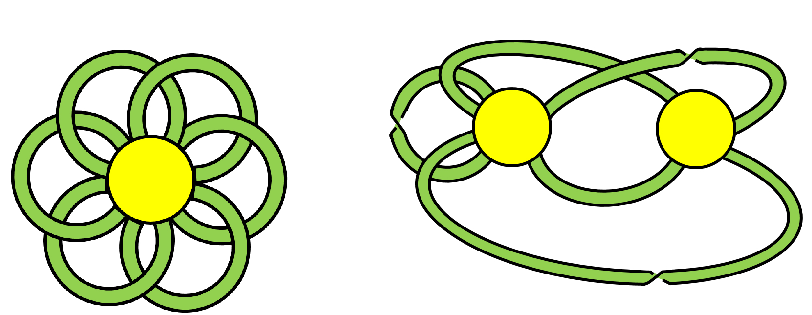
Example 5.7 Let H be the bouquet with six edges shown on the left of Figure 7. Let
 $\mu$
be the automorphism that rotates H by
 $120^{\circ}$
. We solve
 ${\hat{\alpha}} \cdot {\hat{\alpha}}^{-1} \mu^{-1}=\{\delta \tau, \delta \tau,\delta \tau,\delta \tau,\delta \tau,\delta \tau \}$
to get
 ${\hat{\alpha}} = \{1, 1, \delta \tau, \delta \tau, \tau \delta, \tau \delta\}$
. With this,
 $(G, \ell_G) = ({\hat{\alpha}}, \iota)(H, \ell_H)$
, shown on the right of Figure 7, is self-trial. Since G has a single loop it cannot be self-petrial, and hence it also cannot be self-dual.
A graph H (left) with non-trivial automorphism group, and a graph G (right) in its orbit that is self-trial but neither self-dual nor self-petrial.

6. Single vertex orientable ribbon graphs
In this section, we show that the search for self-twual graphs may be reduced to studying the self-
 ${\hat{\gamma}}$
properties of single-vertex orientable graphs, i.e. orientable embedded bouquets (OEBs). Since, by the results of Section 5, any OEB encodes the twisted duality properties of every graph in its orbit, this provides a new approach for searching for self-dual, self-petrial, self-trial, etc. graphs.
Our next step is to show that every graph has an OEB in its orbit. Thus, OEBs provide representatives of the orbits under the ribbon group action that may be more readily analysed than general graphs.
Proposition 6.1 If
 $(G,\ell_G)$
is a connected graph, then there is an OEB in its orbit.
Proof. We induct on the number of vertices of G. Suppose that
 $(G,\ell_G)$
has more than one vertex. Since G is connected, it has some non-loop edge, say
 $\ell_G(i)$
. Define
 ${\hat{\gamma}}_1\in{\mathfrak{S}}_n$
to have
 ${\hat{\gamma}}_1(i)=\delta$
and
 ${\hat{\gamma}}_1(j) = 1$
for
 $j\neq i$
, and define
 $(G_1,\ell_G) = ({\hat{\gamma}}_1,\iota)\cdot(G,\ell_G)$
. Note that
 $G_1$
has one fewer vertex than G does. Iterating this process, we obtain a bouquet
 $(G_k,\ell_G) = ({\hat{\gamma}}_k,\iota)\cdot\ldots \cdot({\hat{\gamma}}_1,\iota)\cdot(G,\ell_G)$
in the orbit of
 $(G,\ell_G)$
.
If G is orientable then we are done. If not, then because G has only a single vertex we can unambiguously identify a subset
 $S =\{ \ell(i_1),\ldots, \ell(i_r) \}$
of edges of
 $(G_k,\ell_G)$
which are twisted. Defining
 ${\hat{\gamma}}' \in {\mathfrak{S}}_n$
to have
 ${\hat{\gamma}}'(i) = \tau$
for
 $\ell(i)\in S$
and
 ${\hat{\gamma}}'(i) = \iota$
otherwise, we obtain an OEB
 $({\hat{\gamma}}',\iota)\cdot(G_k,\ell_G)$
in the orbit of
 $(G,\ell_G)$
.
We now set the stage for searching for self-twual graphs. We again begin with the special case of being canonically self-
 ${\hat{\gamma}}$
and canonically self-twual, as here results can be found simply by checking a conjugation table.
Proposition 6.2 Suppose H is an OEB that is canonically self-
 ${\hat{\gamma}}$
for some non-trivial
 ${\hat{\gamma}}$
. Then every graph in its orbit is also canonically self-
 ${\hat{\gamma}}'$
where
 ${\hat{\gamma}}'$
is a conjugate of
 ${\hat{\gamma}}$
.
Proof. This follows immediately from Theorem 5.2 in the special case that H is an OEB.
The following Theorem 6.3 gives a practical application of Theorem 5.3 to generating all canonically self-twual graphs by confirming that determining the canonically self-
 ${\hat{\gamma}}$
properties of an OEB indeed captures all possible canonically self-twual graphs in its orbit.
Theorem 6.3 Every canonically self-dual, -petrial, or -wilsonial (respectively, self-trial) graph G is in the orbit of an OEB H that is canonically self-
 ${\hat{\gamma}}'$
for some
 ${\hat{\gamma}}'$
of order 2 (respectively, 3).
Proof. This follows from Theorem 5.3 by taking
 $G=F$
, recalling that
 $Orb(G)=Orb(H)$
for any
 $H \in Orb(G)$
, and from Proposition 6.1 that tells us that there is always an OEB H in Orb(G).
The following two results are the analogs of Proposition 6.2 and Theorem 6.3 where the twuality is not necessarily canonical. The proofs, which use Theorem 5.5 instead of Theorem 5.3, with some attention to technical details since the ‘conjugation’ for the proof of Theorem 6.5 involves a permutation, are left to the reader.
Proposition 6.4 Suppose H is an OEB that is self-
 ${\hat{\gamma}}$
for some non-trivial
 ${\hat{\gamma}}$
, via a permutation
 $\mu$
. Then every graph in Orb(H) is also self-
 ${\hat{\gamma}}'$
via
 $\mu'$
, where
 ${\hat{\gamma}}'$
is the ‘near-conjugate’
 \begin{equation*}{\hat{\gamma}}' = {\hat{\alpha}} \cdot {\hat{\gamma}} \pi^{-1} \cdot {\hat{\alpha}}^{-1} \pi \mu^{-1} \pi^{-1} \end{equation*}
of
 ${\hat{\gamma}}$
, and
 $\mu'= \pi \mu \pi^{-1}$
.
Theorem 6.5 Every self-dual, -petrial, or -wilsonial (respectively, self-trial) graph G is in the orbit of an OEB H that is self-
 ${\hat{\gamma}}'$
via
 $\mu'$
for some
 ${\hat{\gamma}}'$
with the property that if
 $C=(c_1, c_2, \ldots, c_m)$
is a cycle in the cycle decomposition of
 $\mu'$
, then
 $ord (\prod_{i=m}^{1} {{\xi}_{c_i}} ) = ord(g ^m)$
.
Thus, to search for self-twual graphs, we can generate OEBs and test for self-
 ${\hat{\gamma}}$
properties. If we find an OEB H that is self-
 ${\hat{\gamma}}$
with the elements
 ${\hat{\gamma}}$
having the required order properties, we can then just look in the conjugacy table to generate the self-twual graphs in its orbit. If we have exhaustively found all
 ${\hat{\gamma}}$
such that H is self-
 ${\hat{\gamma}}$
, then we will be able generate all of the self-twual graphs in its orbit. This process and the algorithm for it are discussed further in Sections 7 and 8.
7. New graphs from old
Here we use the results of the previous sections and a computer search to determine all graphs on up to 7 edges that are self-trial, but neither self-dual nor self petrial. We then apply Theorem 5.6 to generate a new infinite family of self-trial graphs that are neither self-dual nor self-petrial.
We represent a graph
 $(G,\ell_G)$
as a collection of cyclically ordered tuples
 $[r_1,r_2,\ldots,r_n]$
, each tuple conveying the information for attaching ribbon-ends to one of the vertices of G. The entries
 $r_i$
are integers whose absolute value
 $|r_i|$
is the label of a ribbon and such that
 $r_i<0$
exactly when ribbon
 $r_i$
has a twist. Such representations are referred to in Section 8.2 as being in ‘end-label form.’ Further details about the computer implementation are discussed in Section 8.
7.1. All small self-trial graphs
Figure 8 lists a few self-
 ${\hat{\gamma}}$
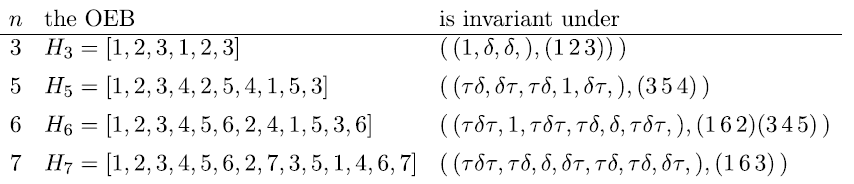
OEBs. There are in fact many others for the indicated numbers of ribbons, but these are the ones needed for Figure 9. Figure 9 lists all examples, up to isomorphism, of self-trial, non-self-dual (and hence also non-self-petrial, since
 $\delta\tau$
and
 $\tau$
generate
 ${\mathfrak{S}}$
) graphs G having n ribbons for
 $3\leq n\leq 7$
. In each case, these examples arose as
 $(G,\ell_G) = ({\hat{\alpha}},\iota)(H,\ell_H)$
for multiple self-
 $({\hat{\gamma}},\pi)$
OEBs
 $(H,\ell_H)$
, for various
 $({\hat{\gamma}},\pi)$
, but only one such OEB is listed. The graph G itself is self-trial under the action of
 $(\boldsymbol{\delta}\boldsymbol{\tau},\sigma)$
for the given element
 $\sigma$
. Computationally, the list in Figure 9 was constructed by exhaustively running through all possible OEBs with the given number of ribbons, recording an example when it represented an isomorphism class not previously encountered. As discussed in Section 8, by using a well-chosen data structure our setup allows for rapid determination of isomorphism.
Some self-
 ${\hat{\gamma}}$
OEBs.

7.2. Examples from Theorem 5.6
We now use Theorem 5.6 to generate an infinite family of graphs that are self-trial but neither self-dual nor self-petrial. This family differs from the infinite family of such graphs given in [Reference Jones and Poulton12] which contains very large regular maps in that this family starts with quite small graphs and the members are not generally regular maps.
Motivating the example below is the observation that twuality acts independently on the components of a one-point join of two graphs. Thus, if G is an OEB, then the one-point join of the three graphs G,
 $G^{(* \times)}$
, and
 $G^{(\times *)}$
will automatically be self-trial. The example below is more general, as it is not a one-point join of graphs.
We begin with the OEB
 $(H_k,\ell_{H_k})$
on 3k untwisted edges
 $e_1, \ldots, e_{3k}$
, where
 $e_i=\ell_{H_k}(i)$
, which are attached according to the following (cyclic) pattern:
 \begin{equation*}e_2, e_1, e_3, e_2, e_4, e_3, e_5, e_4, \ldots, e_i, e_{i-1}, e_{i+1}, e_i, \ldots, e_{3k}, e_{3k-1}, e_1, e_{3k}.\end{equation*}
Defining
 ${\hat{\alpha}}$
to be the ribbon group element
 $$\hat \alpha = ({\mkern 1mu} \overbrace {{\bf{1}},{\bf{1}}, \ldots ,{\bf{1}}}^{k{\rm{ }} \, times},\overbrace {\delta \tau ,\delta \tau , \ldots ,\delta \tau }^{k{\rm{ }} \, times},\overbrace {\tau \delta ,\tau \delta , \ldots ,\tau \delta }^{k{\rm{ }} \, times}{\mkern 1mu} ),$$
we obtain the graph
 $({\hat{\alpha}}, \iota)(H_k, \ell_{H_k})$
depicted in Figure 10. Note the labelling of the edge-ends; we will make heavy use of this labelling below.
Up to isomorphism, all self-trial, non-self-dual graphs on n edges with
 $3\leq n \leq 7$
. In all cases, we have
 $G = (\boldsymbol{\delta}\boldsymbol{\tau},\sigma)G$
.

The graph
 $({\hat{\alpha}}, \iota)(H_k, \ell_{H_k})$
as described in the text, depicted as an arrow presentation, with potentially multiple vertex discs. For each i the ends of edge
 $e_i$
are labelled
 $(i)_a$
and
 $(i)_b$
, respectively.

Proposition 7.1 The graph
 $({\hat{\alpha}}, \iota)(H_k, \ell_{H_k})$
depicted in Figure 10 is self-trial but not self-dual.
Proof. Fix k and write
 $(G, \ell_G)$
for
 $({\hat{\alpha}}, \iota)(H_k, \ell_{H_k})$
Clearly, the permutation
 $\mu$
given by
 $\mu(i) = i+k \!\! \mod 3k$
gives an automorphism of
 $(H_k, \ell_{H_k})$
. With
 ${\hat{\alpha}}$
defined as above we have
 $$\hat \alpha \cdot{{\hat \alpha }^{ - 1}}{\mu ^{ - 1}} = ({\mkern 1mu} \overbrace {\delta \tau ,\delta \tau , \ldots ,\delta \tau }^{3k{\rm{ }} \, times}{\mkern 1mu} ).$$
Corollary 5.6 thus tells us that the graph
 $(G, \ell_G)$
is self-trial. To show that
 $(G,\ell_G)$
is not self-dual it suffices to show that it is not self-petrial, since
 $\delta\tau$
and
 $\tau$
generate
 ${\mathfrak{S}}$
.
The graph
 $(G,\ell_G)$
has one or more vertices, depicted in Figure 10 as one or more cyclic strings of labeled arrows. We cut these at the tails of the arrows
 $(k)_b$
,
 $(k+1)_a$
,
 $(2k)_a$
,
 $(3k-1)_a$
,
 $(3k)_a$
and
 $(3k)_b$
and at the heads of the arrows
 $(2k-1)_b$
and
 $(2k)_b$
, to obtain the following linear ‘strands’, where we use
 $(i)^{-1}_x$
to indicate that the arrow is traversed backwards in the sequence of the strand.
 \begin{align*}S_{k+1,a} & := (k+1)_a \ (k+2)_b^{-1} \ (k+4)_a \ (k+5)_b^{-1} \ (k+7)_a \cdots \\[3pt]S_{k+1,b} & := (k+1)_b^{-1} \ (k+3)_a \ (k+4)_b^{-1} \ (k+6)_a \ (k+7)_b^{-1} \cdots \\[3pt]S_{k,b} & := (k)_b \ (k+2)_a \ (k+3)_b^{-1} \ (k+5)_a \ (k+6)_b^{-1} \ (k+8)_a \cdots \\[3pt]S_{2k-1,b} & := (2k-1)_b^{-1} \ (2k+1)_a \ (2k+3)_a \ (2k+5)_a \ (2k+7)_a \cdots \\[3pt]S_{2k,a} & := (2k)_a \ (2k+1)_b \ (2k+2)_b \ (2k+3)_b \ (2k+4)_b \cdots \\[3pt]S_{2k,b} & := (2k)_b^{-1} \ (2k+2)_a \ (2k+4)_a \ (2k+6)_a \ (2k+8)_a \cdots \\[3pt]S_{3k,a} & := (3k)_a \ (2)_a \ (1)_b \ (3)_a \ (2)_b \ (4)_a \cdots (k-1)_b \\[3pt]S_{3k,b} & := (3k)_b \ (1)_a^{-1} \ (3k-1)_a^{-1}\end{align*}
By construction, these strands account for all edge ends, but the particular sequence of strands found in
 $(G,\ell_G)$
depends on the value of
 $k \!\! \mod 6$
. In each case, we provide the simplest argument we could find.
 $\bullet$
Case
 $k \equiv 1 \!\! \mod 6$
. There is one vertex, given by the cyclic concatenation
 \begin{equation*}S_{3k,a} \ S_{k+1,a} \ S_{2k,a} \ S_{3k,b} \ S_{2k,b}^{-1} \ S_{k+1,b}^{-1} \ S_{k,b} \ S_{2k-1.b}.\end{equation*}
Since there are 3k loops and k is odd, it is not possible for
 $(G,\ell_G)$
to have the same number of twisted loops as untwisted loops. Thus
 $(G,\ell_G)$
is not self petrial in this case.
 $\bullet$
Case
 $k \equiv 5 \!\! \mod 6$
. There is one vertex, given by the cyclic concatenation
 \begin{equation*}S_{3k,a} \ S_{k+1,a} \ S_{2k,b} \ S_{3k,b}^{-1} \ S_{2k,a}^{-1} \ S_{k,b}^{-1} \ S_{k+1,b} \ S_{2k-1,b}.\end{equation*}
As for the case
 $k \equiv 1$
,
 $(G,\ell_G)$
is not self-petrial in this case.
 $\bullet$
Case
 $k \equiv 2 \!\! \mod 6$
. There are two vertices, given by the cyclic concatenations
 \begin{equation*}S_{3k,a} \ S_{k+1,a} \S_{2k,b}\end{equation*}
and
 \begin{equation*}S_{k+1,b} \ S_{2k-1,b} \ S_{3k,b}^{-1} \ S_{2k,a}^{-1} \ S_{k,b}^{-1}.\end{equation*}
We have
 $k = 6m+2$
for some
 $m>0$
. Let v denote the vertex corresponding to the concatenation
 $S_{3k,a}S_{k+1,a} \ S_{2k,b}$
and let w denote the other vertex. Note that the only loops on v, namely edges
 $2,3,4, \ldots, k-1$
, have both their ends in
 $S_{3k,a}$
, and these are all untwisted. This is a total of
 $k-2 = 6m$
loops on v. In all, there are 3 additional edges (3k, 1, and k) attached in
 $S_{3k,a}$
,
 $2(\frac{k+1}{3})$
attached in
 $S_{k+1,a}$
, and
 $\frac{k-1}{2}$
attached in
 $S_{2k,b}$
. Thus, the number of loops on w is
 \begin{equation*}3k - \left[ (k-2)+3 + 2\left(\frac{k+1}{3}\right) + \frac{k-1}{2} \right] \ = \ 5m+1.\end{equation*}
Since the petrial of
 $(G,\ell_G)$
has a vertex with 6m twisted loops whereas
 $(G,\ell_G)$
itself does not, we see that
 $(G,\ell_G)$
is not self-petrial for any
 $k \equiv 2 \!\! \mod 6$
.
 $\bullet$
Case
 $k \equiv 3 \!\! \mod 6$
. There are two vertices, given by the cyclic concatenations
 \begin{equation*}S_{3k,a} \ S_{k+1,a} \ S_{2k-1,b}\end{equation*}
and
 \begin{equation*}S_{k+1,b} \ S_{2k,a} \ S_{3k,b} \ S_{2k,b}^{-1} S_{k,b}^{-1}.\end{equation*}
Let
 $k=6m+3$
for some
 $m\geq 0$
, let v denote the vertex corresponding to the concatenation
 $S_{3k,a} \ S_{k+1,a} \ S_{2k-1,b}$
and let w denote the other vertex. As in the case
 $k \equiv 2$
, the vertex v has
 $k-2$
loops, all untwisted; in the case
 $k\equiv 3$
this is
 $6m+1$
untwisted loops. Also attached to v are additional edges as follows:
 $(k-2)+3$
attached to
 $S_{3k,a}$
,
 $2\frac{k}{3}-1$
attached to
 $S_{k+1,a}$
, and
 $\frac{k+1}{2}$
attached to
 $S_{2k-1,b}$
. The number of loops on w is then
 \begin{equation*}3k - \left[ (k-1)+3 + 2\frac{k}{3}-1 + \frac{k+1}{2} \right] \ = \ 5m+2.\end{equation*}
As in the case
 $k\equiv 2$
, we see that
 $(G,\ell_G)$
is not self-petrial for any
 $k \equiv 3 \!\! \mod 6$
.
 $\bullet$
Case
 $k \equiv 0 \!\! \mod 6$
. There is one vertex, given by the cyclic concatenation
 \begin{equation*}S_{3k,a} \ S_{k+1,a} \ S_{2k-1,b} \ S_{3k,b}^{-1} \ S_{2k,a}^{-1} \ S_{k+1,b}^{-1} \ S_{k,b} \ S_{2k,b}.\end{equation*}
We will show that, along the single vertex, there is a sequence of length
 $2k-2$
of consecutive untwisted edge-ends, whereas the longest sequence of consecutive twisted edge ends is at most of length
 $\frac{4}{3}k-1$
. This discrepancy guarantees that
 $(G,\ell_G)$
is not self-petrial.
To verify the claim, we proceed as follows. First, note that in strand
 $S_{3k,a}$
, in the sequence from
 $(2)_a$
to
 $(k-1)_b$
, we have both ends of the
 $k-2$
untwisted loops
 $2, 3, 4, \ldots, k-1$
as well as
 $(1)_b$
and
 $(k)_a$
. The other end of loop 1 is in
 $S_{3k,b}^{-1}$
, and thus
 $(1)_b$
is an untwisted edge end, and the other end of loop k is at the beginning of
 $S_{k,b}$
, and thus
 $(k)_a$
is also an untwisted edge end. In all, then, we have in
 $S_{3k,a}$
a total of
 $2(k-2)+2 = 2k-2$
consecutive untwisted edge ends.
We now bound the length of any sequence of consecutive twisted edge ends. From the discussion above we know that edges 1, 2 and
 $k-1$
are untwisted. It is also true that edge 2k is untwisted since end
 $(2k)_a^{-1}$
in
 $S_{2k,a}^{-1}$
is paired with
 $(2k)_b^{-1}$
in
 $S_{2k,b}$
. We use the ends of these edges to break up the cyclic sequence of all edge-ends into five subsequences we denote I, II, III, IV, V as follows:
 \begin{equation*}(1)_a \ \mbox{I} \ (2k)_a^{-1} \ \mbox{II} \ (2k)_b^{-1} \ \mbox{III} \ (2)_a \ \mbox{IV} \ (k-1)_a \ \mbox{V} \ (1)_a.\end{equation*}
Of course, any sequence of consecutive twisted edge ends must lie entirely within one of the numbered subsequences other than IV, which has only untwisted edge ends. We can thus complete the proof by determining the lengths of I, II, III and V, respectively, and observing that all are less than
 $2k-2$
.
-
I. The end
$(3k)_b^{-1}$
in
$S_{3k,b}^{-1}$
together with the
$k-1$
edge-ends of
$S_{2k,a}^{-1}$
other than
$(2k)_a^{-1}$
yield k edge ends in I. -
II. The
$\frac{2}{3}k -1$
edge-ends from
$S_{k+1,b}^{-1}$
together with the
$\frac{2}{3}k$
edge-ends from
$S_{k,b}$
give
$\frac{4}{3}k -1$
edge-ends in II. -
III. There are a total of
$\frac{1}{2}k$
edge-ends in III, namely,
$\frac{1}{2}k-1$
edge-ends other than
$(2k)_b^{-1}$
from
$S_{2k,b}$
, together with
$(3k)_a$
in
$S_{3k,a}$
. -
IV. In V there are a total of
$\frac{2}{3}k + \frac{1}{2}k$
edge-ends. These are the
$\frac{2}{3}k-1$
edge-ends in
$S_{k+1,a}$
, the
$\frac{1}{2}k$
edge-ends in
$S_{2k-1,b}$
, and the edge-end
$(3k-1)_a$
in
$S_{3k,b}^{-1}$
.


This completes the case when
 $k\equiv 0 \!\! \mod 6$
.
 $\bullet$
Case
 $k \equiv 4 \!\! \mod 6.$
There is one vertex, given by the cyclic concatenation
 \begin{equation*}S_{3k,a} \ S_{k+1,a} \ S_{2k,a} \ S_{3k,b} \ S_{2k-1,b}^{-1} S_{k,b}^{-1} \ S_{k+1,b} \ S_{2k,b}.\end{equation*}
In the case that
 $k=4$
, the single vertex is given by the cyclic sequence
 \begin{equation*}\begin{array}{cccccccccccc}(12)_a & (2)_a & (1)_b & (3)_a & (2)_b & (4)_a & (3)_b & (5)_a & (6)_b^{-1} & (8)_a &(9)_b & (10)_b\\+ & + & - & + & + & - & + & - & + & - & - & + \\ (11)_b & (12)_b & (1)_a^{-1} & (11)_a^{-1} & (9)_a^{-1} & (7)_b & (6)_a^{-1} & (4)_b^{-1} & (5)_b^{-1} & (7)_a & (8)_b^{-1} & (10)_a\\- & + & - & - & - & + & + & - & - & + & - & +\end{array}\end{equation*}
Here, we have indicated under each edge-end whether it belongs to an untwisted edge (
 $+$
) or a twisted edge (
 $-$
). Note that there is exactly one all-“
 $+$
” consecutive subsequence of length three (on ends
 $(10)_a (12)_a (2)_a$
), and exactly one all-“
 $-$
” subsequence of length three (on ends
 $(1)_a^{-1} (11)_a)^{-1} (9)_a^{-1}$
). Thus, any isomorphism of
 $(G,\ell_G)$
with its petrial necessarily maps either of these length three subsequences to the other. Considering the surrounding edge-ends, however, even allowing for reversing the orientation, we see this is not possible. The subsequence

 $++-$
needs to map to

 $--+$
, whereas the subsequence actually present is

 $-++$
.
We now address the cases where
 $k\geq 10$
by analysing the lengths of sequences of consecutive twisted, or consecutive untwisted, edge ends.
-
• From
$(3)_a$
to
$(k-2)_a$
in
$S_{3k,a}$
is a length
$2k-6$
sequence of consecutive untwisted edges ends. -
• From
$(k)_a$
in
$S_{3k,a}$
to
$(2k)_a$
in
$S_{2k,a}$
is a sequence of edge ends alternating between twisted and untwisted which both starts and ends with twisted edges. -
• From
$(2k+1)_b$
in
$S_{2,a}$
to
$(3k)_b$
in
$S_{3k,b}$
is a sequence of edge ends alternating between twisted and untwisted which starts with a twisted-edge end and ends with an untwisted-edge end. -
• From
$(1)_a^{-1}$
in
$S_{3k,b}$
to
$(2k+1)_a^{-1}$
in
$S_{2k-1,b}^{-1}$
is a length
$\frac{1}{2}k+2$
sequence of twisted-edge ends. -
• From
$(2k-1)_b$
in
$S_{2k-1,b}^{-1}$
to
$(k+2)_a^{-1}$
is a length
$\frac{2}{3}(k-1)$
sequence of untwisted-edge ends. -
•
$(k)_b^{-1} $
in
$S_{k,b}^{-1}$
is twisted, and then from
$(k+1)_b^{-1}$
in
$S_{k+1,b}$
to
$(2k)_b^{-1}$
in
$S_{2k,b}$
is a sequence of edge ends alternating between twisted and untwisted which starts and ends with a twisted-edge end. -
• from
$(2k+2)_a$
in
$S_{2k,b}$
to
$(3k)_a$
in
$S_{3k,a}$
is a length
$\frac{1}{2}k$
sequence of untwisted-edge ends.


Since there is a length
 $2k-6$
sequence of consecutive untwisted edges ends but there is no sequence of consecutive twisted edge ends of that length, we see that
 $(G,\ell_G)$
cannot be isomorphic to its petrial.
8. Code discussion
In this section, we describe some of the more interesting points involved in developing a computational implementation to make use of the theoretical framework discussed above.
8.1. Labeled graphs
Let
 $(G,\ell)$
be a graph. In the implementation, where we do not have topological objects themselves but their symbolic encodings, we treat the elements of
 $\{1,2, \ldots,n\}$
as the names of the edges and take
 $\ell$
in all cases to be the identity function.
8.2. Single-vertex graphs as chord diagrams
An OEB can be represented as a signed chord diagram, with the outer circle representing the vertex, the chords representing the ribbons, and a chord being signed positive or negative according as the corresponding ribbon is untwisted or twisted. For implementation purposes, we linearise the chord diagram by making an arbitrary choice of a designated point on the circle. Thus, to work with chord diagrams as representations of OEBs, we need to consider orbits under a dihedral action; this is discussed more below.
We use a 2k-tuple D to represent a chord diagram with k chords in three different ways, as given below. In all cases, a negative entry indicates the corresponding edge is twisted, and a positive entry indicates it is not twisted.
-
• If D is in offset form then
$|D(i)|=j$
indicates that the ribbon with one end at spot i has its other end at spot
$$i + j{\rm{ }}\;mod\;2k$$
. This representation has the benefit that a cyclic shift does not change the values, so it is useful when considering equivalence modulo a dihedral action and, more generally, isomorphism of unlabeled ribbon graphs. -
• If D is in end-spot form then
$|D(i)|=j$
indicates that the ribbon with one end at spot i has its other end at spot j. This representation has the benefit that it is easy to work with in terms of splicing and concatenating. -
• If D is in end-label form then
$|D(i)|=j$
indicates that the ribbon with label j has one end at spot i. This representation works best with the
$(G,\ell)$
notation. Moreover, note that this is a direct encoding of the arrow representation discussed above in Section 2.


Conversion between forms is a quick linear process.
8.3. Isomorphism of graphs using chord diagrams
Let
 $(G,\ell)$
and
 $(G',\ell')$
be OEBs, and let
 $\hat D, \hat D'$
be the chord diagrams in end-label form corresponding to
 $(G,\ell)$
and
 $(G',\ell')$
, respectively. If
 $\phi\colon (G,\ell) \to (G',\ell')$
is an isomorphism, then there is a corresponding dihedral permutation
 $\sigma \in \mathcal{D}_{2k}$
such that the bijection on edges corresponding to
 $\phi$
is
 $\ell'(\hat D '(\sigma(i))) \mapsto \ell(\hat D(i))$
. Since we are viewing the OEBs from the perspective of the arrow representation, the dihedral group action is readily seen to yield an isomorphism as defined in Section 2; the order-two “flip” action of
 $D_{2k}$
corresponds to vertex flipping, and the order 2k rotation preserves cyclic orderings.
In our computations, we take
 $\ell$
and
 $\ell'$
to be the identity map. Therefore, because
 $\phi$
preserves labels, we have
 $\hat D'(\sigma(i)) = \hat D(i)$
for
 $i = 1, 2, \ldots, 2k$
. Of course, this framework accounts for the case when
 $\hat D$
and
 $\hat D'$
are two different chord diagrams in end-label form for the same OEB
 $(G,\ell)$
.
Given
 $(G,\ell)$
and
 $(G',\ell')$
and an isomorphism
 $\phi\colon G \to G'$
of unlabelled underlying abstract graphs, there is a permutation
 $\pi\in S_k$
such that
 $\phi$
gives an isomorphism
 $(G,\ell) \to (G',\ell'\pi^{-1})$
. The necessity of
 $\pi$
when working with the end-label form of linearised chord diagrams slows computation down considerably. Offset form is preferable for this purpose, but working with the dihedral action in this case requires slightly more care. Let
 $\mathcal{D}_{2k} = \langle \rho, \tau \rangle$
where
 $\rho$
represents the order-k cyclic shift and
 $\tau$
represents the order-2 flip. For any size-2k linearized chord diagram D in offset form, we write
 $\underline{D}$
to denote the size-2k linearised chord diagram given by
 $\underline{D}(i) = 2k - D(i)$
. We define a right-action of
 $\mathcal{D}_{2k}$
as follows: If
 $\sigma \in \langle \rho \rangle < \mathcal{D}_{2k}$
, then
 $D\cdot\sigma = D\circ \sigma$
, whereas if
 $\sigma \in \tau\langle \rho \rangle$
, then
 $D\cdot\sigma = \underline{D}\circ\sigma$
. Since
 $\langle \rho \rangle$
is an index-2 (hence normal) subgroup and
 $\underline{\underline{D}}=D$
, this action is well defined.
With the dihedral action set up this way, isomorphism of unlabelled graphs becomes computationally much easier. If D and
 $D^{\prime}$
are the linearised chord diagrams in offset form corresponding to
 $(G,\ell)$
and
 $(G',\ell')$
, respectively, then G is isomorphic to
 $G^{\prime}$
as an unlabelled abstract graph if and only if there is
 $\sigma \in \mathcal{D}_{2k}$
such that
 $ D' \cdot \sigma = D$
. Given such a
 $\sigma$
, we can recover the corresponding permutation
 $\pi$
as the unique permutation satisfying
 $\hat D'(\sigma(i)) = \pi\hat D(i)$
for all
 $i= 1,2, \ldots, 2k$
, where
 $\hat D', \hat D$
are the linearised chord diagrams in end-label form corresponding to
 $(G,\ell), (G',\ell')$
, respectively.
8.4. Enumerating chord diagrams
To enumerate chord diagrams up to isomorphism, we first used the algorithm of Nijenhuis and Wilf [Reference Nijenhuis and Wilf20] to enumerate linear diagrams. The basic approach of the algorithm is to build up larger diagrams from smaller ones; accordingly, the end-spot representation proved to be most useful for these computations. In order to obtain the desired list of representatives of isomorphism classes of (cyclic) chord diagrams, after reinterpreting the linear diagrams as cyclic they were put into a canonical linear representation modulo the dihedral action, and then duplicates were removed from the resulting list.
8.5. Ribbon group actions
To perform ribbon group actions on graphs, i.e. to form twuals, we encode ribbon graphs using jewels, which are properly 4-coloured 4-regular simple graph with colors red, green, blue and yellow, say, in which the red-green-blue subgraph is a disjoint union of 4-cliques. A jewel encodes an embedding of a graph G as follows:
-
vertices of G = components of red-yellow subgraph
-
edges of G = components of red-blue subgraph
-
faces of G = components of yellow-blue subgraph
Jewels are a generalisation of gems, which incorporate only red, blue and yellow edges. Gems were mentioned as early as [Reference Robertson23], but importantly for us gems and jewels were used by Lins [Reference Lins16] to reframe the work of Wilson [Reference Wilson26] on which this paper is based. Given a jewel
 $\Gamma$
, let
 $G = G(\Gamma)$
denote the corresponding ribbon graph. For an edge e of
 $G(\Gamma)$
, let
 $K_e$
denote the red-green-blue 4-clique corresponding to e. Ribbon graph operations may now be realised by the following actions:
-
dual of an edge e: switch the red and blue colourings in
$K_e$
-
petrial of an edge e: switch the blue and green colourings in
$K_e$


A jewel which encodes a single vertex graph has a single red-yellow jewel-cycle v. To convert this to a linearised chord diagram requires choosing a red jewel-edge to be the initial jewel-edge, assigning that edge a direction and then ordering the other red jewel-edges sequentially around v.
8.6. Finding stabilizers
Given labelled graph
 $(G,\ell)$
with k ribbons, we want all pairs
 $({\hat{\gamma}},\pi)$
such that
 $({\hat{\gamma}},\pi)(G,\ell) \cong (G,\ell)$
. Let
 $D, \hat D$
be linearised chord diagrams for
 $(G,\ell)$
in offset form and label form, respectively. For each
 ${\hat{\gamma}} \in {\mathfrak{S}}^n$
, apply
 ${\hat{\gamma}}$
to
 $(G,\ell)$
and determine the corresponding linearized chord diagrams
 $D_{{\hat{\gamma}}}, \hat{D}_{{\hat{\gamma}}}$
in offset and label forms, respectively. For each
 $\sigma \in \mathcal{D}_{2k}$
such that
 $D_{{\hat{\gamma}}\sigma} \equiv D$
, define
 $\pi\in S_k$
by
 $\pi^{-1}\hat{D}_{{\hat{\gamma}}\sigma} \equiv \hat D$
, and return
 $({\hat{\gamma}}\pi^{-1},\pi) = (1,\pi)({\hat{\gamma}},\iota)$
.
8.7. Finding self-twual graphs
Suppose we are given n-ribbon
 $(H,\ell_H)$
, ribbon-group element
 ${\hat{\gamma}}$
and permutation
 $\mu \in S_n$
such that
 $({\hat{\gamma}},\mu)(H,\ell_H) \cong (H,\ell_H)$
, and
 ${\hat{\gamma}}' \in {\mathfrak{S}}^n$
. We want a graph
 $(G,\ell_G)$
of the form
 $(G,\ell_G) = ({\hat{\alpha}},\iota)(H,\ell_H)$
, for some
 ${\hat{\alpha}}\in{\mathfrak{S}}^n$
, which is self-
 ${\hat{\gamma}}'$
by
 $\mu$
. By Theorem 5.4,
 ${\hat{\alpha}}$
must satisfy
 ${\hat{\alpha}}{\hat{\gamma}}\phi_\mu({\hat{\alpha}}^{-1}) = {\hat{\gamma}}'$
. Since
 $\phi_\mu$
is a homomorphism, this gives
 $\phi_\mu({\hat{\alpha}}) = ({\hat{\gamma}}')^{-1}{\hat{\alpha}}{\hat{\gamma}}$
which, in coordinates, says
 \begin{equation}(\alpha_{\mu^{-1}(1)}, \alpha_{\mu^{-1}(2)}, \ldots, \alpha_{\mu^{-1}(n)}) \ = \ \left((\gamma^{\prime}_1)^{-1}\alpha_1\gamma_1, (\gamma^{\prime}_2)^{-1}\alpha_2\gamma_2, \ldots, (\gamma^{\prime}_n)^{-1}\alpha_n\gamma_n \right)\end{equation}
We use the following algorithm to find all possible
 ${\hat{\alpha}}$
: Consider each cycle
 \begin{equation*}C = \left(i \; \mu^{-1}(i) \; \mu^{-2}(i) \; \ldots \; \mu^{-r}(i)\right)\end{equation*}
in the cycle decomposition of
 $\mu$
, and for each C consider each element
 $a \in {\mathfrak{S}}$
. Assign a to
 $\alpha_i$
and use equation (20) to iteratively determine
 $\alpha_{\mu^{-1}(i)}, \alpha_{\mu^{-2}(i)}, \ldots, \alpha_{\mu^{-r}(i)}.$
If the determined value of
 $\alpha_{\mu^{-r}(i)}$
agrees with a, then we record the computed data as an option for the portion of
 ${\hat{\alpha}}$
corresponding to cycle C. If each cycle of
 $\mu$
had at least one computation recorded, assemble all possible
 ${\hat{\alpha}}$
by choosing, in all possible ways, one of the available options for each portion of
 ${\hat{\alpha}}$
.
9. Further directions
The work outlined here would be greatly facilitated by a systematic way to study OEBs. In particular, a canonical choice of OEB representative for each orbit would streamline not only computer searches, but the theory of twuality in general.
Also, while we found many examples of Class III graphs, none of the examples given here are canonically self-trial. This raises the question of whether or not canonically self-trial graphs exist.
The results of Section 5 have broader implications than just for the OEBs we used in the examples given here. In particular, the results apply to any H, not just an OEB. Thus, it is possible to take any self-twual graph H and use conjugation to generate others. Numerous examples of various kinds of self-twual graphs are known. It is already known and clear that conjugating by the same group element throughout will yield another self-twual graph. However, the conjugacy table shows that at each edge there is a choice of several elements that can be applied. This opens the potential for many more self-twual graphs arising from any known example. It is then a matter of checking whether the result is isomorphic to the known example, which is easy in the canonical case. Given the wealth of existing information in the literature about regular maps and their automorphism groups, Theorem 5.6 should lead to a rich source of new graphs with desirable self-twuality properties of all kinds.
Another natural direction following from this research is generalising the results from ribbon graphs to delta-matroids, which are to embedded graphs as matroids are to abstract graphs. There are recently developed frameworks extending twuality operations of partial duality and partial Petrie duals to delta-matroids, and the ribbon group action lifted to this setting would open investigation into various forms of self-twuality for delta-matroids. See [Reference Chun, Moffatt, Noble and Rueckriemen3, Reference Chun, Moffatt, Noble and Rueckriemen4].