Introduction
Trichinellosis is a zoonosis, caused by ingestion of raw or undercooked meat containing larvae of the nematode genus, Trichinella. Species of Trichinella can be found worldwide in a variety of hosts, ranging from mammals to birds and reptiles. Wildlife acts as a natural reservoir for Trichinella. Links between the sylvatic and domestic cycle are well reported and, depending on human cultural food practices, the causative agent may enter the human food chain, resulting in infection (Pozio & Murrell, Reference Pozio and Murrell2006).
The genus Trichinella is divided into an encapsulated clade and a non-encapsulated clade, referring to the collagen capsule that surrounds the larvae of some species in the host muscle. Currently, the genus Trichinella is classified into eight species (T. spiralis, T. nativa, T. britovi, T. pseudospiralis, T. murrelli, T. nelsoni, T. papuae and T. zimbabwensis) and three unclassified genotypes (Trichinella T6, Trichinella T8 and Trichinella T9) (Pozio & Zarlenga, Reference Pozio and Zarlenga2005; Rodriguez et al., Reference Rodriguez, Olmedo, Ubeira, Blanco and Garate2008). All known Trichinella species are morphologically indistinguishable except for T. pseudospiralis, which is smaller in size than other species. The geographical distribution of the different species is related to ecology, climate and host behaviour (Pozio et al., Reference Pozio, La Rosa, Rossi and Murrell1992; Kapel, Reference Kapel1997; Muller, Reference Muller2002).
The identification of sequence regions in the genomes of pathogens, which can be useful to distinguish among species and genotypes, is of great importance for epidemiological, molecular and phylogenetic studies. The 5S ribosomal DNA intergenic spacer region has been identified as a good target to distinguish the eight Trichinella species and genotypes (Rombout et al., Reference Rombout, Bosch and Van Der Giessen2001; De Bruyne et al., Reference De Bruyne, Yera, Le Guerhier, Boireau and Dupouy-Camet2005; van der Giessen et al., Reference van der Giessen, Fonville, Briels and Pozio2005). This method is simple (only one primer pair), sensitive (DNA from a single larva suffices) and inexpensive (low-cost sequencing is available). It can also be applied directly to muscle biopsy specimens (Rombout et al., Reference Rombout, Bosch and Van Der Giessen2001).
In Iran, Trichinella has been reported in different wild reservoir hosts. In the northern part of Iran, it has been reported in wild boars (Sus scrofa) (Afshar & Jahfarzadeh, Reference Afshar and Jahfarzadeh1967; Mobedi et al., Reference Mobedi, Arfaa, Madadi and Movafagh1973), jungle cats (Felis chaus) (Mobedi et al., Reference Mobedi, Arfaa, Madadi and Movafagh1973), brown bears (Ursus arctos) (Mobedi et al., Reference Mobedi, Arfaa, Madadi and Movafagh1973), golden jackals (Canis aureus) (Mobedi et al., Reference Mobedi, Arfaa, Madadi and Movafagh1973; Hamidi, Reference Hamidi1977; Massoud & Mahdavi, Reference Massoud and Mahdavi1987; Dalimi & Mobedi, Reference Dalimi and Mobedi1992), red foxes (Vulpes vulpes) (Hamidi, Reference Hamidi1977) and stray dogs (Hamidi, Reference Hamidi1977); in Ardabil Province, north-western Iran, it has been identified in golden jackals and red foxes (Zariffard, Reference Zariffard1995); in Isfahan, central Iran, in golden jackals, red foxes, stray dogs, hyena (Hyaena hyaena) and one species of rodent (Meriones persicus) (Sadighian et al., Reference Sadighian, Arfaa and Movafagh1973); in Khuzestan Province, south-western Iran, it has been found in mongoose (Herpestes auropunctatus) (Mowlavi et al., Reference Mowlavi, Massoud and Rokni2000); in Bandar Abbas, south of Iran, in golden jackals, red foxes, stray dogs (Hamidi & Mobedi, Reference Hamidi and Mobedi1977) and recently in a leopard (Panthera pardus) (Mowlavi, personal communication). No infection has so far been reported in domestic animals. However, human infectivity has been documented twice, in both cases through consuming wild boar meat. The first of these was a single case in 1966, which constituted the first report of trichinellosis in the country and was diagnosed based on clinical symptoms, history of the disease and serology (Moin, Reference Moin1966). There has also been a second, more recent single-source outbreak (Kia et al., Reference Kia, Meamar, Zahabiun, Soodbaksh and Kordbacheh2008). In spite of the occurrence of infection in various animal hosts from different parts of the country, no molecular description of the species has been presented prior to this work.
This study presents a molecular description of Trichinella murrelli isolated from a wild boar in northern Iran. This also constitutes the first recorded occurrence of this species in Asia.
Materials and methods
Source of sample
The source of the sample was part of a frozen thigh muscle of a wild boar hunted in Javaher Dasht forest, Siahkal, Gilan Province, northern Iran in April 2007. The sample was delivered to the helminthological laboratory of the School of Public Health, Tehran University of Medical Sciences in May 2007 by patients who had characteristic symptoms of trichinellosis and were referred for the diagnosis of their infection. The patients were six household members living in Tehran who consumed semi-cooked meat of the described muscle as kebab.
Parasitological examinations
Part of the muscle tissue was prepared for direct microscopic examination and Trichinella encapsulated larvae were observed. Twenty gram of thigh muscle was digested by a pepsin–HCl method. The muscle was minced by scissors and incubated in artificial gastric juice for 24 h at 37°C. After separation of larvae from the digestion fluid by washing three times in distilled water, the size (length and width) of ten larvae was measured. In addition, a piece of muscle was preserved in 10% formalin and, following tissue processing by conventional histological methods, 5 μm sections were prepared and stained with haematoxylin and eosin.
DNA extraction
The parasite DNA was extracted using QIAamp DNA Mini kit (Qiagen, Hilden, Germany) according to the manufacturer's instructions for tissue extraction.
Polymerase chain reaction
A 700 bp region of the 5S ribosomal DNA gene was amplified by polymerase chain reaction (PCR) with two designed primers, 5SF (5′-GGA-ACA-CGC-AGT-GTC-GTA-GAC-3′) and 5SR (5′-TGG-TAT-GAT-CGT-AGA-CAT-TTG-C-3′). Reactions were performed in a 50 μl reaction containing 1.5 mm MgCl2, 200 μm of each dNTP, 1.5 U of Taq polymerase (Roche, Mannheim, Germany), 0.5 μm of each primer and 5 μl DNA sample. Reactions were run in a Perkin-Elmer Thermocycler under the following conditions: 95°C for 6 min for one cycle; 94°C for 30 s, 57°C for 90 s and 72°C for 45 s for 35 cycles; followed by a 5 min extension step at 72°C. The amplicon was electrophoresed on 1.5% agarose gel and visualized under an ultraviolet transilluminator after staining with ethidium bromide.
Sequencing
The PCR product was sequenced by SEQLAB company (Germany) with an ABI 3100 genetic analyser. The nucleotide sequence was aligned with those from the GenBank database, using BLAST software.
Results
Trichinella larvae were visible inside thick collagen capsules by direct microscopic examination of muscle tissue. The average length and width of ten larvae after pepsin–HCl digestion of the muscle was 1083.48 μm and 36.4 μm respectively, with a worm burden of 7 larvae/g. In the histological sections of the muscle, encapsulated Trichinella larvae were observed, surrounded by an inflammatory reaction.
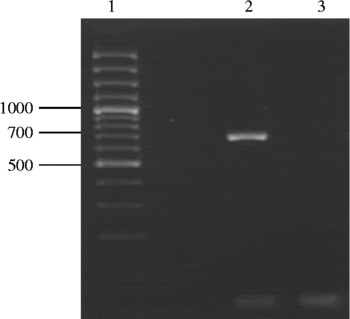
The PCR reaction, using specific primers, yielded a 700 bp band on agarose gel (fig. 1). After gel extraction of the PCR product and DNA sequencing, the sequence was analysed by BLAST and the isolate was identified as T. murrelli. The nucleotide sequence of T. murrelli was submitted to the Genebank/EMBL/DDBJ database under Accession Number AB426627.
Electrophoresis of PCR products of Trichinella murrelli larvae isolated from wild boar. Lanes: 1, molecular weight marker; 2, Trichinella murrelli; and 3, negative control.

Discussion
Trichinella circulates in a sylvatic cycle in various wild animals (Afshar & Jahfarzadeh, Reference Afshar and Jahfarzadeh1967; Mobedi et al., Reference Mobedi, Arfaa, Madadi and Movafagh1973; Sadighian et al., Reference Sadighian, Arfaa and Movafagh1973; Hamidi, Reference Hamidi1977; Hamidi & Mobedi, Reference Hamidi and Mobedi1977; Massoud & Mahdavi, Reference Massoud and Mahdavi1987; Dalimi & Mobedi, Reference Dalimi and Mobedi1992; Zariffard, Reference Zariffard1995; Mowlavi et al., Reference Mowlavi, Massoud and Rokni2000) in different parts of Iran. Despite this, human cases are very rare and there are only two published reports of human infections (Moin, Reference Moin1966; Kia et al., Reference Kia, Meamar, Zahabiun, Soodbaksh and Kordbacheh2008). This is mainly due to Muslim beliefs based on not consuming pork and the meat of some other animal species. However, ethnic minorities and hunters who practise consumption of raw or undercooked meat of wild pork are at risk of trichinellosis. Nevertheless, prior to this work, no molecular description of the species involved in wild animal or human infectivity has been presented.
Shaikenov & Boev (Reference Shaikenov and Boev1983) cross-bred four Trichinella isolates from golden jackal from the north and south-west of Iran with standard strains. They reported the two isolates from the north of the country as T. nelsoni and those from the south as T. nelsoni and T. spiralis. Later, in Khuzestan Province, in two separate studies based on sensitivity of laboratory animals (white mouse and rat) to Trichinella, isolates from golden jackal (Massoud & Mahdavi, Reference Massoud and Mahdavi1987) and mongoose (Mowlavi et al., Reference Mowlavi, Massoud and Rokni2000) were reported as T. nelsoni. Apart from the above-mentioned studies, no other studies reporting trichinellosis in wildlife have attempted to characterize Trichinella species.
This study is the first research on the molecular characterization of Trichinella in Iran. The method used combined PCR-based amplification, sequencing and comparison with the published data, based on the 5S rDNA sequences of the best-known Trichinella species, previously determined by Rombout et al. (Reference Rombout, Bosch and Van Der Giessen2001).
According to the results of the current study, the isolate of Trichinella detected from wild boar in the temperate area of northern Iran was identified as T. murrelli, with only one nucleotide difference compared to T. murrelli from Nearctic America (Accession No. AY009947). This is the first report of T. murrelli in Asia and, to the best of our knowledge, also the first report of occurrence of T. murrelli in wild boar in the world. Trichinella murrelli was considered as a predominant aetiological agent of sylvatic trichinellosis exclusively in temperate regions of North America (Pozio, Reference Pozio2001). It has been detected in red foxes, raccoons, coyotes, black bears, bobcats and in one horse, in Connecticut, Georgia, Illinois, Indiana, New Mexico, Pennsylvania and Texas, USA (Pozio, Reference Pozio2001), and recently in a domestic dog in Chase City, Virginia, USA (Dubey et al., Reference Dubey, Hill and Zarlenga2006). Although, there was a horsemeat outbreak in France, caused by T. murrelli (Ancelle et al., Reference Ancelle, Dupouy-Camet, Bougnoux, Fourestie, Petit, Mougeot, Nozais and Lapierre1988), it was later concluded that the origin of the horse carcass was from Connecticut, USA (Dupouy-Camet et al., Reference Dupouy-Camet, Paugam, De Pinieux, Lavarde and Vieillefond2001).
The newly studied T. murrelli isolate was the aetiological agent of a human outbreak with moderate pathogenicity, making it important for public health. Among the seven people who had consumed semi-cooked meat of the relevant boar, six people, all ranging from 24 to 27 years old, revealed symptoms characteristic of trichinellosis, including fever, myalgia, facial and periorbital oedema, and cramps of the neck and legs, simultaneously. In three of the patients, for whom blood samples could be taken, the average eosinophil count was 2091 mm3, and the average creatine phosphokinase and lactic dehydrogenase enzyme values were 890 U/l (N = 225–500) and 584 U/l (N = 25–200), respectively (Kia et al., Reference Kia, Meamar, Zahabiun, Soodbaksh and Kordbacheh2008).
In conclusion, T. murrelli is circulating in a sylvatic cycle in the temperate region of northern Iran. It was the cause of moderate trichinellosis in humans, even with a low larvae burden in consumed meat. Since Trichinella has been detected in various wild animal hosts from geographic areas with different climates in the country, using DNA-based methods for identification of the species involved is necessary. Integration of the findings from different human cases of T. murrelli from around the world and comparison of its clinical patterns and pathogenicity in humans with the other Trichinella species will provide a better understanding of this zoonotic disease and improve its diagnosis and treatment.
Acknowledgements
The authors would like to acknowledge the help received from Mrs M. Sharbatkhori, School of Public Health, Tehran University of Medical Sciences and Dr E. Razmjou, Faculty of Medicine, Iran University of Medical Sciences.