1. Introduction
Riding as an observer in a patrol car in the central district of a large American city at midnight on a Saturday evening, one sees different patterns of human interaction than in a suburb on a weekday afternoon when school is letting out. In both cases, one observes the production of a public good – local safety – by an official of a local government. Others who are involved in each situation differ in regard to age, sobriety, why they are there, and what they are trying to accomplish. And this context affects the strategies of the police officer one is observing. (Ostrom, Reference Ostrom2010: 645)
By the nature and construct of their inquiries, Elinor Ostrom (1933–2012) and her colleagues pursued a lifetime of research and analysis that was rich in detail and historical context. In order to understand the diversity of institutional arrangements, the mechanisms of on-the-ground rule making, and the self-governing capacities of citizens, Elinor's research demanded that she utilize fieldwork and comparative case studies. The use of fieldwork enabled Elinor to address questions of public organization and institutional development using locally self-determined welfare criteria rather than the more common apparatus of technical efficiency. From our perspective, this emphasis on the individual actor as an unvarnished, fallible individual is the defining characteristic of Elinor's research legacy and should be guarded as such. Furthermore, in this paper, we aim to advance the idea that the multiple methods approach is best employed within the framework of a thorough and well-constructed analytic narrative based on in-depth fieldwork in whichever of its manifestations is most appropriate for the question at hand.
Elinor Ostrom spent much of her career trying to get her colleagues in the social sciences to appreciate the tremendous institutional diversity of human societies. Early in her career, her interest in institutional development by local actors within a polycentric governance structure led to her involvement in the 1960s metropolitan reform debates over the best way to deliver local public goods and services. During this debate, the consolidationists employed arguments about technical efficiency in the production of local public goods to argue that polycentric provision was wasteful and unnecessary. In making this argument, they neglected the role of self-determination in the measurement of welfare and the role of polycentric systems to respond to the policy preferences of the local population. Consolidated and centralized governmental production and provision of public goods, the polycentric model predicted, would become ‘insensitive and clumsy in meeting the demands of the local citizens for the public goods required in their daily life’ (Ostrom et al., Reference Ostrom, Tiebout and Warren1961: 837). In addition to jurisdictional choice as exercised through migration, Elinor's research placed a particular emphasis on active citizen participation and the exercise of voice as important tools available to citizens for the discipline of governmental actors. As such, it is impossible to fully appreciate the argument made on behalf of polycentricity without placing it in the broader Tocquevillian task of crafting a new science and art of association.Footnote 1
What ultimately matters for the Tocquevillian project is the cultivation of citizens capable of democratic self-governance, and collective decision processes that respect the great diversity and desires of local communities. A large number of governments, from this perspective, are not a problem to be overcome, but a characteristic of vibrant democratic self-governance. In order to incorporate this concept of self-determination while still engaging the consolidationists on their own terms, Elinor Ostrom sought to empirically demonstrate that not only did a polycentric system better respond to diverse local populations, but that in doing so it produced and/or provided local public goods more effectively than consolidated governmental units. Toward this goal, Elinor engaged in several on-the-ground field studies in the 1960s–1970s. She rode in cars with police, she visited neighborhoods, and she listened to citizens in diverse communities. In the 1980s–1990s, she extended this on-the-ground methodology to the study of the management of common-pool resources and the institutional analysis of development in general.
The value of studying local public economics through fieldwork is best understood in the context of the specific analytical assumptions adopted by Ostrom and her colleagues. First, changes in welfare can only be self-determined by the community in question. Efficiency experts from afar are to be checked by the criteria of responsiveness to the demands for public goods by local communities. Second, only the voluntary collective action of citizens seeking to improve their lives and communities can reveal whether or not any given public good is worth the cost of production. It is the on-the-ground political economy of everyday life in communities that is the subject of study, and not some abstract notion of optimal social choice. Local consent and local control work hand in hand to make sure that the various local communities within a municipality will be serviced.
A lifelong learner, Elinor Ostrom studied formal game theory with Richard Selten in Germany, and deepened her knowledge of complex systems analysis with the scholars at the Santa Fe Institute; she traveled to less developed regions to study irrigation systems, read detailed histories on mountain grazing and forestry management in varied settings from Switzerland to Japan, and even studied Pacific salmon fisheries and lobster harvesting in Maine. She focused her analytical attention on how diverse populations in a variety of cultural and historical circumstances engaged in on-the-ground constitution-making in order to overcome social dilemmas and learn to live better together. Some of these solutions were new and extremely novel, some proved to be only of fleeting effectiveness and broke down into situations of conflict, but more were examples of long and enduring social institutions. In a very real sense, Elinor Ostrom's great contribution to human understanding was to document in detail how imaginative human beings are finding ways to turn social conflicts into opportunities for social cooperation. Communities demonstrate a great ability to devise rules that align incentives among the various parties so that resource depletion and violent conflict are avoided and groups can reasonably manage common-pool resources and organize their collective choices in a self-governing manner. Elinor Ostrom's presidential address to the American Political Science Association sums up her position – ‘A Behavioral Approach to the Rational Choice Theory of Collective Action’ (Ostrom, Reference Ostrom1998). Elinor Ostrom studied rational actors as if they were human choosers – fallible but capable. And she studied social institutions as if history mattered – contextual and contingent.
Our purpose in this essay is not to survey once again Elinor Ostrom's vast contributions to the discipline of political economy that she made throughout her work on local public economies, common-pool resource management, and the economics of self-governance.Footnote 2 Instead our purpose is to focus on her methodological contributions. Elinor Ostrom was a champion of what she termed ‘multiple methods methodology’, and in particular the combination of fieldwork with formal theory, experimental methods, and computer simulation. She explicitly argued that one of the main threats to scientific progress is the excessive energy devoted to methodological fights with the goal of proving that one approach is right and that other approaches are wrong (see Ostrom, Reference Ostrom2006). But, we argue that for all her methodological promiscuity, her core contributions reflect a deep appreciation for on-the-ground fieldwork and detailed case studies.Footnote 3 It is this aspect of her work that, we fear, is at greatest risk in the assessments of her scientific legacy to political economy.
Though ironic, this risk is understandable because while the formal game-theoretic presentation, experimental testing of the game concepts, and development of complex adaptive agent-based models to simulate the social dynamics appear to conform to modern science as defined by our current scientific culture, fieldwork and case studies are often perceived to be unscientific and therefore less valuable. In this sense, despite Ostrom's warnings about engaging in methodological battles, a rigorous defense of fieldwork and case studies must be offered and similarly a critical assessment of the applicability of alternative methods to the questions the Ostrom's project raises must be made. It is a serious mistake on the part of scientistic critics to ‘conflate methodological practice with the method itself, arguing that examples of poor application discredit the method. A method need not be abandoned because it has been poorly utilized, it makes more sense to encourage greater methodological awareness and better practice’ (Poteete et al., Reference Poteete, Janssen and Ostrom2010: 4).
The case for a renewed defense and demand for better practice of the methodology of fieldwork and case studies is most important if that approach is integral to the purpose of the research project in the first place. What if, we want to ask, fieldwork and case studies are not just immature explorations that had to be supplanted by more rigorous and mature scientific treatments in formal theory and controlled experimentation, but are instead the very foundation for the new science of politics that Vincent and Elinor Ostrom sought to establish with their work at the workshop? If that is the case, then the disregard for fieldwork and case studies in the quest for scientistic precision by her intellectual heirs will derail the quest for human understanding and institutional diversity that was so critical to the Ostroms' joint project. Elinor Ostrom's own argument was that ‘we do not slip from “my research method is the best and only” to “anything goes.” Every research method can be undertaken with rigor or sloppily. Let us not confuse a sloppy case study, survey, or game-theoretical analysis with what we can learn from all of these approaches when undertaken with care and conclusions are modestly framed’ (Ostrom, Reference Ostrom2006: 4).
Furthermore, case studies and field research do not merely hold their own as methods. In complex social environments, the so-called qualitative methods can often illuminate consequences and motivations that are disguised by more aggregative methods. The most obvious way in which this is true is that in-depth fieldwork or case study may reveal a factor to be at play that the researchers would never have considered if they were less familiar with their subject. Chamlee-Wright (Reference Chamlee-Wright2010: 23–35) discusses the revelation of alternative theories for the slow post-Katrina recovery of particular neighborhoods in New Orleans through conversations with residents, describing fieldwork as a process of trial and error for the researcher in which many ideas are explored before those with the greatest relevance are identified. This particular learning process would not have occurred if she had instead chosen to employ statistical analysis. The product of the fieldwork could not have been duplicated by any other method.
Case studies and fieldwork can also generate unique value by enabling the researcher to grapple with questions of greater social complexity than aggregation will allow. The most sophisticated measure of the rule of law will not be able to capture the inarticulable norms and personal circumstances that affect the incentives of any given individual actor. Case studies enable a more narrow identification of the relevant actors and incentives, enabling the researcher to ask questions that would otherwise be unexplored due to data limitations. In the natural sciences as well, case studies are often the best mechanism through which scientists are able to gain understanding and make advances in their research. A prime example of this is Darwin's contributions to evolutionary theory; engaging in detailed investigations led him to develop the theory of natural selection. Hodgson applies these findings in evolutionary theory to the social sciences and explains how the nature of these questions necessitates the use of case studies. He discusses how human sociality involves ‘complex causal interactions’ and they are the ‘basis of emergent social properties. These properties have to be described and analyzed before they play their part in theory of socioeconomic evolution’ (Hodgson, Reference Hodgson2005: 910). In order to understand these interactions, we need to investigate such things as customs, language, and culture, which can only be done using extensive case studies and fieldwork.
This value in fieldwork providing often overlooked yet important details and theoretical realities is best exemplified in Elinor's work on the commons and collective action solutions. Through her fieldwork, Elinor was able to understand how, for example, farmers in Nepal solved irrigation problems and how individuals were able to design rules that enabled self-monitoring mechanisms (Ostrom, Reference Ostrom1990). Studying on-the-ground rule formation enabled Elinor to compile a set of design principles that greatly enhanced our understanding of how tragedy of the commons problems can be solved through collective action. These principles could not have been captured quantitatively. In this sense, Elinor's theoretical contributions to the social sciences were only made possible through the use of case studies and fieldwork. We extend this argument to the study of police services in Section 3 and explain how quantitative statistics, such as the usage of crime or arrest rates, miss the significant interactions, relationships, and incentives at play that reveal how public safety is produced in a given area.
Elinor Ostrom's own scientific tastes were broader than her colleagues, let alone the scientific culture in general. She was comfortable in a variety of disciplines as well as respecting a variety of analytical and empirical methods. But we think it is fair to say that she was most intellectually comfortable with the blending of theory with detailed case studies. Conceptual clarity and comparative case study analysis drawing on knowledge not only from politics, economics, history, but ecology, geography, cultural history and evolutionary theory characterize her work over the years. It would indeed be an intellectual loss if this effort to integrate multiple disciplines and multiple methods was blocked by an obsession over a certain conception of scientific method. In this sense, we will just be witness to another case of scientism killing scientific inquiry. It is our hope to push against the scientistic trend, and to provide a defense of fieldwork and case study methodology in the discipline of political economy. If we are successful in our effort, then the reader will see the intimate connection between the broad social philosophic project of Tocquevillian democratic self-governance, and the methodological approach of the Ostroms that sought to give priority to the on-the-ground words and deeds of the citizens who are crafting the rules by which they live together.
2. The methodological landscape in contemporary social science
Ostrom (Reference Ostrom and Ostrom1982) argued that some intellectual eras come to an abrupt end, while others have a slow and whimpering end. She argues that the age of logical positivism in the social sciences was experiencing such a whimpering end in the late 1970s and 1980s. As she often did in her intellectual negotiations, she complained that the older debate between those who engaged in qualitative analysis and those who pursued quantitative analysis had grown stale and unproductive and that it was time for scholars to transcend this debate and move forward. The naïve acceptance of the positivist philosophy of science had failed to produce the expected intellectual returns as several decades of improved rigor in empirical analysis had not resulted in the accumulation of knowledge into a coherent body of theory. Ostrom likens the positivist era of the discipline to that of the defiant teenager who rebels against their elders, but as maturity is reached such easy dichotomization is rejected and instead a blending between of the fresh ideas of the new generation and the best ideas of the old generation is achieved. Translated into the social scientific realm, this was Elinor's way to carve out an intellectual niche for the qualitative and case study approach within the scientific realm of new theories and new technologies of empirical exploration that had evolved during the positivistic reconstruction of political science and its neighboring disciplines.
In that same volume, Kiser and Ostrom (Reference Kiser, Ostrom and Ostrom1982) provide what could be termed a post-positivist defense of an actor-centered analysis in political and economic analysis. By synthesizing the work of diverse thinkers such as Kenneth Arrow, James Buchanan, John R. Commons, Anthony Downs, Frank Knight, Mancur Olson, Vincent Ostrom, William Riker, Herbert Simon, Thomas Schelling, Gordon Tullock and Oliver Williamson, they argue that there are three levels of analysis that are involved in a rational actor approach to institutional analysis: the operational level, the collective choice level, and the constitutional level. Our purpose here is not to explore this analytical perspective, but to explicate the methodological implications.
One way to understand those methodological implications is to segment aspects of the analytical synthesis offered. Each of the names listed provide multiple possible research directions depending on what one emphasizes from their work. Yet, there is also something to be gained by the list of names, as they are identified with certain conceptual ideas. Herb Simon, for example, is usually identified with the concept of satisficing in human decision-making. Simon's model fits with what we termed above as Elinor's emphasis on rational choosers as if they were human, and thus were fallible but capable choosers. This can be seen through Simon's analogy of human decision-making as a pair of scissors (Simon, Reference Simon1990). The blades of the scissors are defined by cognitive capabilities on the one hand, and the contextualized situation on the other. In other words, what is ‘rational’ is a function of the institutional context within which the decision is made. Abstract and formal models of choice which decontextualize the situation provide a poor model of human decision-making.
Similarly, from Thomas Schelling, one thinks not just of focal points but dynamic causal processes of adaptation and selection, not always for human betterment as in his model of racial segregation. For our purposes, it is useful to think about the analytical framework that results from simply combining Simon and Schelling. You start with a rational actor (not a robot chooser) whose choices are made within a specified institutional context, and the logic of that interaction between preferences and situation results in alternative patterns of behavior.Footnote 4
The methodological question such a method of analysis raises is how do we gain access to the constituent components in the analysis empirically. To come back to our main point, this is where the methodological focus on fieldwork and case studies enters.
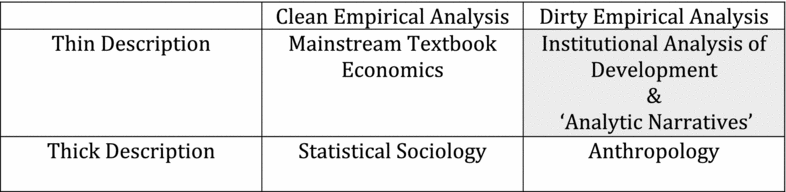
Elinor Ostrom's work occupies a unique place in the methodological landscape in the social sciences. Consider the matrix in Figure 1 of social scientific methodology.
Methodological landscape of the social sciences

Economists have a penchant for thin description, e.g., textbook models of maximizing and perfect competition, and clean empirical work, e.g., sophisticated tests of statistical significance. On the other hand, anthropologists have practiced since the beginning of the discipline dirty empirical work, e.g., fieldwork in an exotic location, and prefer thick description as their guiding theoretical framework. Anthropology and history are the domain of small-N fieldwork, archival scholarship, and case study methodology. Under the influence of positivist philosophy of science and the belief that science means measurement, political scientists and sociologists in the mid-20th century attempted to pursue large-N statistical analysis along the lines first developed in economics, but guided not by the rational actor model of economists but the thick description of political and sociological institutionalism. This leaves one possible under-exploited cell in the matrix of social scientific analysis left in the contemporary landscape. That cell is the one that combines the economists’ and political economists’ theoretical apparatus of a rational choice framework with institutional analysis using the empirical methods of anthropologists and historians. This is the methodological cell that Elinor Ostrom occupied as she produced her most well-known work in economics and political economy.
To bring to life the project of contextualized choice and process tracking that one gets from the synthesis of Simon and Schelling, one must gain empirical knowledge of the on-the-ground situation that the various actors face in making decisions privately and collectively. Drain the analysis of context and processes and what remains provides the analyst with little to no insight into the way human beings devise rules to overcome social dilemmas and realize the gains from social cooperation. The effort to force the contributions of the Ostroms (Vincent as well as Elinor) exclusively into the thin/clean cell for scientific precision reasons results, we contend, in losing the unique insights that were found in that research effort to understand institutional diversity and the foundations of democratic self-governance among diverse populations. To put this another way, our contention is that the Kuhnian loss in this paradigmatic translation will be (and is) significant. Thus, we fear a great deal of the intellectual legacy of the Workshop is at risk if it turns out that the costs associated with small-N field work are taken to be so prohibitive as to discourage scholars from pursuing them in exclusive favor of the more ‘scientific’ methods associated with large-N studies, including formal theory, experimental testing in the lab, or computer simulation.
To give a conceptual example, in her examination of the rules of property use within a community, Elinor distinguished between rules in use and rules in form, and we would like to stress as well the function, or reason, of rules. What matters for human conduct are the rules in use as that is where the functional significance of any rule is determined. In many circumstances, the rules in use are at odds with the rules in form that are formally adopted. When the formal rules are either not enforced or in conflict with the informal rules in use, social intercourse is plagued with social tensions and ambiguities. These will either be worked out in specified contexts, or the lack of enforcement will result in social conflict. Again, the only way to gain access to this is through on-the-ground fieldwork and detailed case studies.Footnote 5
Elinor Ostrom's method of analysis was grounded in the rational actor model and institutional analysis of the pre-cursors of New Institutionalism and the leading figures in that intellectual movement in the 1960s–1980s from Alchian, Buchanan, and Coase to Olson, North, and Williamson.Footnote 6 Her methodology of empirical inquiry required on-the-ground knowledge and historical specificity (including not just recognition of cultural beliefs in practice, but detailed knowledge of the physical realities of the situation as well). Methodologically, and as a matter of normative principle, Elinor gave priority to the people that were on-the-ground solving social dilemmas in their unique way, rather than the usual one-size fits all solutions offered by experts from afar.
From the vantage point of her mature methodological writings inspired by her work on common-pool resources and the institutional analysis of development more generally, we are going to cycle back now to see what lessons one can glean from Elinor's work on police services.
3. Community control and governmental responsiveness
In the work of police services, Elinor and her colleagues apply locally self-determined welfare criteria to the question of public safety. In order to gauge the self-governing capacities of citizens under various institutional arrangements and inquire into whether citizens are better off under polycentric or consolidated police departments, Elinor and her team engaged in various field studies and on-the-ground research – taking advantage of ‘natural experiments’ as they arose. One of the first research initiatives of the Workshop was a field study comparing areas in Indianapolis that had consolidated the provision of police services to areas that had remained autonomous. This study found that the residents under the localized jurisdiction were more satisfied with police services than residents of the large consolidated region (Ostrom et al., Reference Ostrom, Baugh, Gaurasci, Parks and Whitaker1973a, Reference Ostrom, Parks and Whitaker1973b). Further similar studies in Chicago, Grand Rapids, Nashville-Davidson County, and St. Louis validated the original finding that small police departments with a high degree of community involvement were able to leverage important personal knowledge and local ties to improve community satisfaction with the police (Ishak, Reference Ishak1972; Ostrom and Whitaker, Reference Ostrom, Whitaker, Rogers and Hawley1974; Parks, Reference Parks1979; Rogers and Lipsey, Reference Rogers and Lipsey1974). One survey designed to document and evaluate police services in eighty metropolitan areas found that smaller departments were no less effective than larger departments (Ostrom et al., Reference Ostrom, Parks and Whitaker1978). Another study found that in metropolitan areas where a greater proportion of citizens were served by a single, larger police department, there were a smaller proportion of police officers on the street at any one time as compared to smaller police departments (Parks, Reference Parks, Hanf and Toonen1985: 172–180). Overall, the findings of the research team led by Elinor Ostrom challenged the popular belief that consolidation and centralization of services was the only way to effectively provide citizens with public goods. Rather, police and citizens engaging in the coproduction of public safety could serve as a mechanism sufficient to overcome the collective action problem of maintaining public safety.
In the biographical sketch Elinor provided for the Nobel Prize website, she states the following about that original research initiative: ‘The first 15 years of my research career at Indiana University were focused on studying police industries across the United States. Unfortunately, many scholars had confused multiplicity of units serving the same metropolitan area with a chaotic distribution of services. Not that all multiunit service delivery arrangements are effective, but the arrangements we studied in metropolitan areas across the United States were far more effective than the scholarly criticism. We never found a large police department with over 100 officers able to outperform a small- to medium-size department (25–50 officers) in producing direct services including patrol, traffic control, response services, and criminal investigation” (Ostrom, Reference Ostrom2009). In coming to understand why the smaller police departments so consistently did better than the larger, more professionally trained, and well-financed departments, Elinor Ostrom and her colleagues focused on the idea of the coproduction of public services. Coproduction takes place when the producers and consumers of the public good must work in tandem in order to generate the desired outcome. Consequently, the concept of coproduction is linked to the capability of citizens to engage in self-governance and as such the art and science of association. Another way to restate the coproduction conjecture is that those communities that are best policed are those that police themselves. Effectiveness of policing outputs on public safety is not only a function of policing inputs, but of the behavior of the citizens being policed themselves. Locking doors, avoiding certain areas and activities, respecting others property, treating neighbors with dignity and respect, and a willingness to work with police in reporting and identifying wrong-doers in the community all impact the measured effectiveness of police outputs on public safety.
The timing of the police studies is an important factor to keep in mind in modern US political and social history. Not only was the 1970s a period of consolidation and professionalization of local public economies due to the state-led activism of the ‘War on Poverty’, but it came on the heels of the Civil Rights Act and racial tensions and social unrest due to the Vietnam War. Working on urban political economy at that time entailed more than just the assessment of the technical efficiency of public goods provision, but went to the core issues of the viability and vulnerability of democratic governance. Problems in black communities of the unresponsiveness of police, police brutality, and police corruption, for example, jumpstarted the study in Chicago on the case of black neighborhoods. Ostrom and Whitaker (Reference Ostrom, Whitaker, Rogers and Hawley1974) point out that ‘Police are among those officials often thought to be least responsive to citizens. Black citizens are among the constituents cited as least satisfied with the performance of local police and other public officials. Because of the controversy surrounding neighborhood police service to urban black Americans, this area is particularly appropriate for inquiry into the effects of community control’ (203).
The question Elinor Ostrom and her team sought to answer in their comparative case studies of police services among urban populations was whether or not community control is conductive to greater governmental responsiveness. What they found out was that in contrast with the conventional expert policy advice to modernize and professionalize police services, Elinor Ostrom and her colleagues argued that ‘Professionalization alone does not appear to provide sufficient controls so that police will be responsive to [black citizens] needs for protection and respect. Community control places that responsibility on the people themselves and provides them with mechanisms by which to exercise it’ (Ostrom and Whitaker, Reference Ostrom, Whitaker, Rogers and Hawley1974: 226).
In conducting this research, the Workshop research teams utilized surveys and on-the-ground research to determine local populations’ perceptions of government responsiveness. Serious thought was put into case selection as well, with an effort to identify ‘natural experiments’ between independent communities and consolidated districts that could be compared. Because of the interest in services provided to citizens, they utilized survey methods to obtain two types of indicators of police output. The first type of indicator evaluated respondents’ experiences with the police. Levels of criminal victimization and the quality of a variety of police actions are assessed in this way. The second type of indicator consists of citizens’ evaluations of service levels. They found that Chicago police spent almost 14 times the dollar amount that the independent police departments did – but despite this differential in expenditure, citizens in the smaller communities received the same or higher level of services. The similar studies done in Indianapolis, Grand Rapids, and Nashville-Davidson County in Tennessee yielded the same results – smaller, independent police departments either outperformed or performed equally as well as the large consolidated police departments at much lower cost (Ishak, Reference Ishak1972; Ostrom and Whitaker, Reference Ostrom, Whitaker, Rogers and Hawley1974; Parks, Reference Parks1979; Rogers and Lipsey, Reference Rogers and Lipsey1974).
This result is not easily captured in the sort of large-N statistical data that is officially tracked either by the FBI or internal to police departments themselves.
The FBI crime index as a measurement is unreliable, and measuring police inputs does not address the relevant research question concerning governmental responsiveness and citizen control. As Ostrom and Whitaker (Reference Ostrom and Whitaker1973: 180) argued, ‘None of the records which are routinely maintained by the police departments themselves enable analysts to compute easily the effectiveness of a particular police force. The internal records of most police departments consist mainly of workload data: rates of reported crime, traffic citations, and clearance of reported cases, for example’.
When data is difficult to collect or unreliable, then on-the-ground fieldwork is a necessity for conducting research, not a luxury. In Working Together, Poteete, Janssen and Ostrom state that they ‘are particularly concerned with research on topics for which data are scarce, difficult to collect, and not readily comparable’ (Poteete et al., Reference Poteete, Janssen and Ostrom2010: 5). Policing services were an excellent learning experience for Elinor Ostrom in how to overcome these challenges and make scientific progress. Police goods and services are not priced on the market, so the value of outputs is not obtainable, and various measures of the value of inputs does not provide any reliable information on the value of the output produced by those inputs. Furthermore, a significant problem with using input data is also that top police officials place an emphasis on improving performance as measured by the internal indicators (e.g., workload, reported crimes, traffic citations, and clearing of reported cases) and thus police have incentive to inflate the data to improve performance assessment. Again, this misses the fundamental point that the Ostrom-led researchers are attempting to measure, which was how satisfactorily alternative institutional arrangements for the delivery of local public goods meet the basic objectives of the government – to serve the people. Thus, due to the reliability of the data, the availability of the data, and the purpose of the study, the closest measure was to ‘get on the ground’ and survey the people.
It is important for our purposes to link this episode of Elinor Ostrom's research career back to the theoretical framework of polycentric political economy and democratic self-governance that Vincent Ostrom had separately and in collaboration with Elinor developed in the 1960s–1980s (see, e.g., Ostrom, Reference Ostrom1997, Reference Ostrom and McGinnis1999a, Reference Ostrom and McGinnis1999b). Consider the general framework developed by Vincent and Elinor Ostrom in their essay ‘Public Goods and Public Choices’ (Reference Ostrom, Ostrom and Savas1977). In this framework, the nature of the public good under examination must be clarified, the organization of the local public economy must be specified, and the financing, production, and delivery of the public good must be analyzed. At each stage of the analysis, actors are playing various different social games which are nested within other games that are going on simultaneously. The structure of incentives, the flow of information, and the feedback loop in each game must be examined. As discussed above, this is how the Institutional Analysis of Development (IAD) framework emerged through the synthesis of Simon's context-dependent model of human decision-making and Schelling's process-tracking analysis of social dynamics. This analytic framework is then deployed as a guiding tool of discovery and interpretation of the lived reality of the political economy of everyday life. And, it brings into analytical focus the preconditions for democratic self-governance, and thus serves as the basis for the ‘new’ science of association and democratic citizenship. Following this model, it is important to remember that the examination of local public economies requires that the analyst consider not just efficiency, but the sense of control, representation, and self-determination in community affairs.
From a polycentric political economy perspective, the examination of police services begins with describing the public service production process: organizational arrangements and inputs are turned into police activities (patrolling, investigating cases), and these activities convert inputs into outputs. Outputs consist of such things as number of arrests, number of traffic accidents investigated, number of cases filed, etc. The problem is that in the nested game of the local public economy police outputs may have little impact on the citizens who are supposed to benefit from the public service production. Thus, Elinor Ostrom and her research teams want to analyze the consequences of outputs, which they call outcomes, as a basis for evaluation of public organizations.
The outcomes are divided into objective and subjective outcomes. Objective outcomes are defined as the impact on general community conditions such as crime rates – but the outputs of police agencies are not the only factors affecting objective outcomes. Socioeconomic status, unemployment, and income all impact crime rates, and thus they conclude, ‘Objective outcomes, then, result from many factors that make assessment of the unique impact of police output on objective community conditions quite difficult’ (Ostrom et al., Reference Ostrom, Parks, Whitaker, Percy, Baker and Meyer1979: 66). To address the criteria of control, representation, and responsiveness, the research had to gain access to some measure of subjective outcomes as the impact of public agency outputs as well as the objective outcomes on a citizen, and hence the use of survey instruments to gauge the subjective outcomes on the diverse communities that were the subject of the fieldwork.
The importance of democratic self-governance is captured to some extent in the subjective evaluation of the sense of self-determination among the select population. This again links back to the concept of coproduction as an important determinant in the effectiveness of the production of public safety.
Citizen activities will affect the output and outcomes of public efforts at policing. The way citizens behave affects victimization rates, and thus objective outcomes as well a subjective criteria of satisfaction with police services. Citizen activities supplement police activities in the production of police outputs, e.g., consider arrests – citizens talk to police and give them evidence that leads to arrest. Thus, both police and citizen activities operate to produce outputs like arrests. Arrest could involve reporting crime by citizens, provision of information, responding honestly to police questioning, etc. But none of that is likely to occur unless citizens perceive that the police are responsive to the needs of the local community and that they are partners in the democratic process of ensuring public safety.
Ostrom (Reference Ostrom2011: 372) summed up her research on police services and its relationship to democratic constitution making from the ground up, as opposed to from the top down approach that standard political theory and policy analysis stresses. ‘I have kidded people sometimes’, she said, ‘that I have ridden in more police cars than most scholars. I have also visited many jails. Most important, I have seen the ways that police officers serving an independent community, where local citizens have constituted it, deal with citizens. Citizens are treated differently when you live in a central city served by a metropolitan police department. Many of the officers in very big departments do not see themselves as responsible to citizens. They are on duty for specific hours and with an entirely different mentality’. As those supposedly serving the neighborhood become more distant, their ability to meet local citizens’ demands for public safety becomes problematic. ‘When you are in a police car for eight hours with officers from a big department, you learn that they really do not know the area they are currently serving since they rotate so frequently. When I was in a police car with an officer from a moderately sized department, they would start telling me about the local community, where there are trouble spots, and where few problems occur. They watch trouble spots that they see potentially emerging. They would sometimes take a juvenile to their home in order to discuss problems they are observing. They do not put kids in jail the first time they observe behavior that is problematic. In the big cities, officers tend to charge juveniles who have been seen to commit small offenses right away. Many jails are overcrowded with juveniles in large cities. Problems of law enforcement in central urban districts have grown over time and are linked to the way urban governance has been shifted to ever-larger units’.
What Elinor is doing in this summary of her studies on police service acquired through the lengthy rides in cars with police, the visits to jails, and on-the-ground discussions and surveys with local populations is giving concrete evidence of one of Vincent Ostrom's main insights about the nature of public administration: ‘A system of public administration operating through a multiplicity of jurisdictions subject to strong democratic controls, to adjudication of interjurisdictional conflicts and to competitive rivalry under quasi-market conditions engenders patterns of democratic administration that have radically different characteristics from those of bureaucratic administration’ (Ostrom, Reference Ostrom and McGinnis1999a: 73).
4. Conclusion
We have argued that Elinor Ostrom's adventures in the field and in her extensive case studies gave concrete meaning to the polycentric political economy she and Vincent had worked so diligently to develop throughout their respective careers. This is true whether we are talking about Elinor Ostrom's examination of water districts, urban politics, or common-pool resources. There are many aspects of Elinor Ostrom's career as a researcher and teacher that set her apart from her peers in modern economics and political economy. We would like to stress the fundamental commitment analytically, methodologically, and philosophically to the Tocquevillian project of democratic self-governance.
This commitment requires the analyst to reject any pretense of paternalism or presumption of expertise in social arrangements. Institutional problems demand institutional solutions, but those solutions must come from the people themselves. Rule systems will only function based on the self-understanding of those on-the-ground anyway. As she argued, ‘A major question to be pursued is how institutional arrangements help to structure decision situations in complex arenas so that individuals are able to achieve productive outcomes even when we cannot derive analytic solutions’. And she was concerned that methodological straightjackets ‘may continually fail to show how different institutional arrangements help fallible and less than fully informed persons to achieve relatively satisfactory outcomes’ (Kiser and Ostrom, Reference Kiser, Ostrom and Ostrom1982: 218).
‘Understanding how individuals solve particular problems in field settings’, Ostrom (Reference Ostrom1990: 45–46) would write in a different context, ‘requires a strategy of moving back and forth from the world of theory to the world of action. Without theory, one can never understand the general underlying mechanisms that operate in many guises in different situations’. On the other hand, she continues, ‘If not harnessed to solving empirical puzzles, theoretical work can spin off under its own momentum, reflecting little of the empirical world’. Theoretical construction and empirical examination worked together to unlock the underlying mechanism that enables diverse groups to cope with difficult situations, to avoid conflict, and realize the gains from social cooperation. It is in fieldwork and small-N case studies that the analyst is able to gain access to the necessary knowledge of the workings of these mechanisms (see Poteete et al., Reference Poteete, Janssen and Ostrom2010: 51).
Elinor Ostrom wanted to see how institutions worked in practice, not just study how they might work in theory. As Herzberg and Allen (Reference Herzberg and Allen2012: 267) put it: ‘Hers was not a quest for an idealized model, but realized ways of life. She sought to identify the process of discovery and dialogue that might reveal the collective interest in the midst of any community dilemma. Discovery required communication and acceptance of the validity of others’ views with respect to their own goals – every person is the best judge of his/her own interest’. This philosophical commitment translated into a fundamental belief in the capacity of average individuals to find creative ways to engage in effective democratic self-governance even in the most difficult of situations. Just because those creative ways are not necessarily our ways does not mean that they are any less effective or important for resolving the social dilemmas those populations must confront.
Fieldwork and case studies no doubt have serious costs (e.g., language and travel) and the methodology no doubt has a certain messiness associated with it that formal theory and large-N statistical testing appear to eschew. But if the goal of the research project is to unearth the underlying mechanism by which diverse populations transform situations of social conflict into opportunities for social cooperation, then the gains from formal theory and sophisticated statistical analysis may be illusory, and what we may need instead is an approach that provides the necessary depth and detail to discuss complex problems of social dilemmas in a sophisticated way.Footnote 7 As Ostrom (Reference Ostrom1990: 214–215) warned us:
When one chooses to model relationships, one can include only a subset of variables, and even then it is usually necessary to set some of these equal to zero or to an absolute value. The typical assumptions of complete information, independent action, perfect symmetry of interests, no human error, no norms of reciprocity, zero monitoring costs and enforcement costs, and no capacity to transform the situation itself will lead to highly particularized models, not universal theories. It is as essential to map the terrain for a family of modes as it is to develop specific models. If the social sciences are to be relevant for analyses of policy problems, the challenge will be to integrate efforts to map the broad terrain and efforts to develop tractable models for particular niches in that terrain. . . . The intellectual trap in relying entirely on models to provide the foundation for policy analysis is that scholars then presume that they are omniscient observers able to comprehend the essentials of how complex, dynamic systems work by creating stylized descriptions of some aspects of those systems. With the false confidence of presumed omniscience, scholars feel perfectly comfortable in addressing proposals to government that are conceived in their models as omnicompetent powers able to rectify the imperfections that exist in all field settings.
Elinor Ostrom, on the other hand, strove to develop a political economy that accounted for imperfect human actors interacting in imperfect institutions that nevertheless stumbled upon or discovered through reflection and choice rules that would enable them to live better together than apart.
As a life-long learner, Elinor Ostrom is an exemplary scholar/scientist for subsequent generations to imitate. She learned from formal theory, experimental social science, computer simulations, as well as history, geography, ecology and evolutionary theory in addition to her disciplinary grounding in economics and political economy. But throughout her various efforts, she sought to constantly learn from the artisans of everyday life. These efforts took her all over the world as she studied both the on-the-ground crafting of rules designed to realize gains from peaceful and productive cooperation and the all too common external imposition of impediments to the formation of those rules. Riding in cars during her adventures with the police was part of the formative period of Elinor Ostrom's lifetime of scholarship into polycentric political economy and democratic self-governance, and this context should not be overlooked.