Accurate measurements of seed rain are important for understanding tree reproduction (Greene & Johnson Reference GREENE and JOHNSON1994), forest regeneration (Cole et al. Reference COLE, HOLL and ZAHAWI2010, Cubiña & Aide Reference CUBIÑA and AIDE2001, Howe et al. Reference HOWE, URINCHO-PANTALEON, DE LA PEÑA-DOMENE and MARTÍNEZ-GARZA2010, Zahawi & Augspurger Reference ZAHAWI and AUGSPURGER2006), forest ecology (Muller-Landau et al. Reference MULLER-LANDAU, WRIGHT, CALDERON, CONDIT and HUBBELL2008, Terborgh et al. Reference TERBORGH, ALVAREZ-LOAYZA, DEXTER, CORNEJO and CARRASCO2011) and maintenance of community diversity (Harms et al. Reference HARMS, WRIGHT, CALDERON, HERNANDEZ and HERRE2000). Seed traps generally consist of a bucket or net of a fixed area suspended 0.3–1 m above the ground, and seeds are typically collected once or twice per month. An implicit assumption of all seed-rain studies is that traps do not influence seed dispersal. Should birds perch on and defecate seeds into seed traps, seed abundance will be overestimated. This behaviour could produce a directional bias if birds perch on seed traps in one habitat more than others. To our knowledge, no study has considered this potential bias.
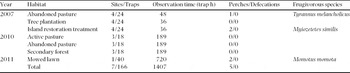
We attempted to characterize bird bias in seed-rain measurements through observations of seed traps in several habitats in southern Costa Rica (Table 1). Observations were conducted in June–September 2007, 2010, and 2011 near the town of Agua Buena (8°44′ N, 82°56′ W; 1100–1300 m asl; rainfall 3–4 m y−1). Seed traps consisted of a 0.25-m2 pocket of fine-gauge (0.5 × 0.5 mm) mosquito netting suspended 0.5 m above the ground on a metal frame with three legs. All observations were conducted in fair weather between 05h30 and 12h00. Groups of seed traps were observed in a randomized order on any given day. Avian nomenclature follows the American Ornithologists’ Union (1998) and its supplements. Statistics are reported as mean ± SE.
Birds observed perching on seed traps in southern Costa Rica during three field seasons (2007–2011). Observation time is reported in trap h. Island restoration treatments consisted of 50 × 50-m areas planted with small patches of trees. All 2007 sites were 2–3 y old. Experimental treatments are described in Cole et al. (Reference COLE, HOLL and ZAHAWI2010). Trap observations are unbalanced among habitats and years because this was an observational study where data were taken opportunistically. Traps were installed in the field 18–20 mo prior to observations in 2007; 1–2 d prior to observations in 2010; and 40 d prior to observations in 2011. This could help explain why no birds were seen in 2010.

During 1407 trap h of observation, we recorded five perching events by three omnivorous bird species (Table 1). All three species consume fruit and are effective dispersers for seeds of some species (Stevenson et al. Reference STEVENSON, LINK and RAMIREZ2005, Tucci et al. unpubl. data, Wütherich et al. Reference WÜTHERICH, AZÓCAR, GARCÍA-NUÑEZ and SILVA2001). We also observed several insectivorous birds roosting or foraging on seed traps (Nyctidromus albicollis (Caprimulgidae), Troglodytes aedon, Thryothorus modestus (Troglodytidae), Tiaris olivaceus (Emberizidae), Geothlypis poliocephala (Parulidae)). Mean omnivore perching time was 2.2 ± 0.5 min. No birds defecated into a seed trap during the observations. The infrequency of omnivore perching observations and lack of defecations suggest that in most cases birds probably do not strongly bias seed-rain measurements through seed addition.
The handful of omnivore perches that we observed were not evenly distributed among sites, habitats, observation periods or traps. Three perching events in 2007 were all from one day at one site, and both perches in 2011 by Momotus momota were from a single seed trap on a single day. All perching events were in open habitat with low-statured vegetation rather than closed-canopy forest or tree plantations, but at the observed perching rate (0.0035 perches h−1) we could not expect to see a perching event in the 225 trap h that we spent in forested habitats. If a bird bias exists, our observations suggest that it may be concentrated in particular sites, traps, or time periods.
Despite the scarcity of observed perching and defecation events, some caution is warranted for researchers working in structurally simple environments such as abandoned tropical pastures. Abandoned pastures typically have extremely low zoochorous seed rain (Aide & Cavelier Reference AIDE and CAVELIER1994, Holl Reference HOLL1999, Wijdeven & Kuzee Reference WIJDEVEN and KUZEE2000, Zimmerman et al. Reference ZIMMERMAN, PASCARELLA and AIDE2000). Cole et al (2010) reported an annual zoochorous seed input of 21.8 ± 3.5 seeds trap−1 y−1 in recently abandoned pastures in southern Costa Rica. This rate of seed deposition is well within the range of seed abundance for faecal samples collected from common, omnivorous birds in the area (range 0–938, mean 30.7 ± 7.7 seeds per faeces, n = 163 faecal samples; Lindell et al. unpubl. data). A single defecation targeted into a seed trap could therefore have significant influence in areas with low annual seed rain.
Our observations demonstrate that bird perching on seed traps is a rare occurrence that in most cases will not create bias in seed-rain measurements. When they occur, such events may be concentrated in particular sites, traps, or time periods. Informal observations of birds perching on seed traps could help explain high variability in zoochorous seed deposition in some seed-rain studies.
ACKNOWLEDGEMENTS
We thank R. Cole, S. Elliott, C. Ericson, J. Figueroa, R. Gómez, J. Reid, J. A. Rosales, O. Sanchez, D. Schweizer, V. Stout, R. Villalobos and R. A. Zahawi for their assistance. This study was funded by the National Science Foundation (NSF-DEB 0918112 and a graduate fellowship to J.L.R.).