1. Introduction
János Kornai's pioneering scholarship examined the mechanisms of the socialist system. The “soft budget constraint” formulated by Kornai (Reference Kornai1979, Reference Kornai1980, Reference Kornai1986) has been widely acknowledged in the contemporary economics literature (especially in the literature of socialist economics and economics of transition, e.g. Csaba (Reference Csaba1995), Kolodko (Reference Kolodko2000), Nuti (Reference Nuti1986), Qian and Roland (Reference Qian and Roland1998), etc.; furthermore, Kornai et al. (Reference Kornai, Maskin and Roland2003) give a very detailed review of the literature of the soft budget constraint). Kornai (Reference Kornai1992) also systematically discusses the details of the socialist system, focusing especially on the economic factors. Following the collapse of the Soviet Union, Kornai's main focus was on the transition process in former socialist countries in central Eastern Europe, especially his native Hungary (e.g. Kornai, Reference Kornai1990, Reference Kornai2006b).
The main goal of Kornai's work is to provide a positive analysis of the economies within the socialist system, and he connects their political characteristics with their economic circumstances. The Socialist System: The Political Economy of Communism (Kornai, Reference Kornai1992) comprehensively examines the sophisticated mechanisms of the socialist system, which were and still are universal. Even though it has been more than two decades since the publication of this masterpiece, many of these mechanisms are still present in modern socialist countries. Kornai (Reference Kornai1992) highlights that there are no horizontal “checks and balances” from outside the party in socialist regimes, and the party is always striving to maintain its power. Kornai (Reference Kornai1986, Reference Kornai1992) also explains the weak “vertical bargaining” (“bargaining between superior and subordinate”) within the party, which leads to the “ratchet effect” (Berliner, Reference Berliner1952).
Given the broad picture of the socialist system, how bargaining within every party branch proceeds can be more clearly illustrated. There are no de facto “checks and balances”Footnote 1 from outside the party, which is mostly vertically ordered obeisance from the top to the bottom. But how do the politicians in the same party and government branch bargain with each other? More specifically, in the contemporary Chinese political structure, the top two de facto powerful figures in different branches on different levels are the party chief of the Communist Party of China (CPC) branch and the leader of the corresponding government sector, who is also a party member in most cases. Are there any “checks and balances” between the two, by intended or unintended designing from the top?
Meanwhile, the division of power between the several central leaders within every political group has existed for thousands of years. There is much research in the political economy literature studying the checks and balances mechanism,Footnote 2 but none of these has investigated it in socialist regimes. The socialist system claims to have its unique “democratic centralism,” which defends the existence of “democracy” in socialist regimes. However, the voting process is not real, and most decisions are not made by real voting, but rather by various political bargains. Can we borrow any tools from the political economy literature on “Western” “checks and balances” to investigate the horizontal bargaining among central officials within every branch in the socialist system, which has not been as extensively studied?
Therefore, my research contributes to the current literature in four ways. First, inspired by and following the analyses on socialist systems by János Kornai, I examine the political system in China, one of the few remaining modern socialist regimes. Kornai (Reference Kornai2000) describes two historical types of transitions and notes that China might be a new, third type. However, the political system in China has been changing much more slowly than the economic system, and the political system has continued to become more authoritarian and centralized in the last six years with more power gathered at the top, under the rule of Xi Jinping. Second, this paper provides an institutional explanation of the bipolar division of power within every branch in socialist regimes, which is also an extension of Kornai's work. Although there are no horizontal “checks and balances” from outside the party (Kornai, Reference Kornai1992), there are horizontal ones within every cell of the party-state, which is partially enhanced by the vertical bargaining (Kornai, Reference Kornai1979, Reference Kornai1980, Reference Kornai1986). Third, the king and council template (Congleton, Reference Congleton2001) focuses on the assignment of power between the “one-man” and the “committee.” However, the king never bargains alone, and there are often confidants serving in his council, either attracted to him by political interests or placed by himself in those positions. This paper expands the king and council template to a more generalized one, where both the king and the premier have their own confidants in the committees. Since this paper illustrates this expanded template with the contemporary politics in China ruled by the CPC, it is named the “party chief and mayor” template. Last but not least, the party chief and mayor template also provides a new perspective with institutional constraints added into the graphic model. Meanwhile, a “collective decision probability function” is provided based on this template, and the solution shows how the system of “checks and balances” works, ultimately limiting the policy space, regardless of whether the policy is exogenous or endogenous. To the best of my knowledge, this is the first paper employing the king and council template to explain political bargaining schemes in socialist regimes.
2. The party chief and mayor template
Horizontal political bargaining in the socialist system
One important feature of politics is partisanship. In a modern democratic regime, there can be many parties. In a one-party regime, there might be other parties but without real ruling power.Footnote 3 However, even in a one-party regime, officials within the same party or government branch normally fall into different interest and ideology groups. Forming themselves into small units and defending themselves against others outside their own small group is a natural human instinct (Hayek, Reference Hayek1988).
China is normally viewed as a one-party state, while there is a mechanism for dividing political power within the governments on the same level and different levels. Although the party is separated nominally from the government, most government officials and leaders are also party members, and there is a party branch in every government sector (Kornai, Reference Kornai1992, Reference Kornai2000). One interesting phenomenon is that the party, government, congress, and other mass organizations share the same office building on the village, town, county, and city levels in China. At the provincial and national levels, they are normally located in different buildings, mainly due to the greater fiscal capacity. This is also how the Communist Party tries to show the relative “independence” between the party and government, congress, and other mass organizations.
For more details of the general features of how the party permeates into every sector of the socialist regime, I strongly recommend readers to read The Socialist System: The Political Economy of Communism (Kornai, Reference Kornai1992), which is an encyclopedia of the socialist system with a main focus on economic factors. Even though it was published 26 years ago, most of the mechanisms described are still running very similarly in contemporary China.Footnote 4 The political power of the party chief and the mayor/governor/premier within the same branch are comparable. However, in most situations, the party chiefs have relatively more political power than the mayors/governors/premier on all the levels, while the party chiefs may have less power in universities, bureaus, and the military.Footnote 5 Meanwhile, the People's Congress is the nominal legislative body on every level and the National People's Congress is the parliament. However, they generally do not have real political power. All in all, the party controls the power.
The political legitimacy of the party's leadership has been given by the Constitution. In the current Constitution of the People's Republic of China (the 1982 document, amended in 2018),Footnote 6 it highlights the leadership of the CPC in the Preamble:
Under the leadership of the Communist Party of China and the guidance of Marxism–Leninism, Mao Zedong Thought, Deng Xiaoping Theory, the Important Thought of Three Represents, Scientific Outlook on Development, and Xi Jinping Thought on Socialism with Chinese Characteristics for a New Era, the Chinese people of all nationalities will continue to adhere to the people's democratic dictatorship and the socialist road[.]
Using terms from Chinese politics to illustrate, there is a party chief, who is the leader of the Communist Party, and a mayor/governor/premier (for simplicity, mayor will be used as the main term, which stands for all different types of government leaders), who is the nominal leader of every government branch. Both of them have relatively strong political power, and the main reason for the mayor or equivalent to have power is because he/she is also a party member. There are many other officials in the committees, from the party, government, congress, or other mass organizations, and they also have political power to some extent.Footnote 7 Whether the policy preference of a committee member is closer to the party chief or the mayor is not dependent on his/her position category: being in the party committee does not necessarily mean that this member's preference is closer to that of the party chief's, and this is also true of a government committee member. Meanwhile, some officials serve in more than one committee at the same time. In short, all of the other officials are “distributed” around the two key leaders, regardless of their nominal committee category. Most of these officials in different committees are party members, and the one or two non-party members are needed to show people that there is still some sort of “democracy” left (Xu, Reference Xu2004). Usually, there are also one or two female committee members for a semblance of political correctness (Goodman, Reference Goodman2002; Xu, Reference Xu2004). Also, working in a position for the party, government, congress, or other mass organizations does not necessarily decide where his/her (since most politicians in China are male, “he/his” will be used in this context for simplicity) position will be in the future, because of the “interweaving” situation (Kornai, Reference Kornai1992).
In this bipolar setting, the party chief has very strong political power, both veto power and agenda control. So does the mayor: albeit slightly weaker than the party chief, but much stronger than the other normal committee members. The party chief takes care of every issue, with a focus on broad ones, e.g. personnel appointments. The mayor also needs to address all issues, with a focus on trivial local issues, e.g. fiscal income and expenditure. Each of the other committee members is in charge of one specific sector: finance, industry, agriculture, commerce, culture and education, public security, military, civil affairs, discipline inspection and supervision, ideological publicity, personnel organization, etc. In other words, each committee member serves as a specialist in one sector, dealing with issues in that sector and providing advice to the two key leaders. In principle, these non-leader officials can also make policy proposals, especially those in their respective sectors. In most situations, a policy or decision needs final “unanimous consent” or at least final “majority consent” to get approved, after a few rounds of implicit and explicit bargaining. The “votes” of officials are documented and reported to senior party and government organizations. However, most of the decisive power is divided between only the party chief and the mayor, while the other committee members provide their specialized knowledge. Especially since 2013, Xi Jinping has highlighted that party and government leaders in local government share the same responsibilities, regardless of whether the party chief or the mayor makes mistakes (Yang, Reference Yang2015). This further pushes the party chief and the mayor to bargain over every major issue in order to achieve consent before making the final decision, which will be reported to the higher level of government.
Though the main focus of this paper is on the bargaining of policies between the party chief and the mayor within the party/government system, it is important to note that the party chief and the mayor are facing various incentives, including both internal ones within the ruling political group and external ones from the people. For example, Chen et al. (Reference Chen, Pan and Xu2016) conducted a field experiment in China and found that threats of collective action and of tattling to senior levels of government make county governments more responsive to civil issues. Landry (Reference Landry2008) argues that the CPC still maintains the ultimate controls of the cadres, even though the “recent” (by Reference Landry2008) reforms have led to extensive decentralization. Manion suggests that local congressional representation in China is functioning more and more as authoritarian parochialism, rather than just a nominal representative system without real representation. This mechanism is actually an “extra-legislative activity of pork-barrel politics” (Manion, Reference Manion2014). Pesqué-Cela et al. (Reference Pesqué-Cela, Tao, Liu and Sun2009) also find that self-governing organizations do exist, and are more likely to exist, where the people have less political trust in local governments.
Meanwhile, China's bureaucracy has grown and responded to social demands for state provision in a way different from the early European bureaucracies. China's particular form of decentralization, “market-preserving federalism,” provides the critical foundations for market success (Qian and Weingast, Reference Qian and Weingast1996). Qian et al. (Reference Qian, Roland and Xu1999) also explain the differences in reform strategies between China and Eastern Europe, from an organization theory perspective: rather than the centralized “U-form” in relatively small-sized countries in Eastern Europe, China's “M-form” is more flexible and enables more local experiments. This flexibility for local governments enables the party chief and the mayor to bargain on many local policy issues with constraint, rather than just obeying orders from the top.
Also, as explained in Kornai (Reference Kornai1992), both price and non-price signals affect officials’ incentives. For example, GDP and fiscal revenue are explicit price signals of the economic and political performance of local bureaucrats. The civil components are non-price signals of people's feedback on the current ruling of the local bureaucrats. Both types of signals will be accepted by themselves and will also be transmitted (directly or indirectly) to senior government officials and incorporated into the cadre evaluation system, thus shaping local officials’ decision incentives dynamically. Meanwhile, in order to secure their relative influences, e.g. by providing more benefits to their confidants who serve as normal committee members or by competing with peers serving in parallel governments, the party chief and the mayor will experience “investment hunger syndrome” (Kornai, Reference Kornai1992). Xu (Reference Xu2015) gives a very detailed overview of investment competition by local governments in China. Officials are political entrepreneurs who seek political opportunities and also need to “recruit” economic entrepreneurs to their parish. They do so in order to enhance their economic, and thus political performances, and extract more rents.
Ultimately, there are four main reasons for this bipolar division of power in the socialist system. First, it is a natural result of evolution within the political systems in human history and also a result of the specific modern history of China. In almost all societies, even in the most authoritarian ones, from the past to present, there are challenging political forces within the core group. They may be strong or weak, and they change over time. Hu (Reference Hu2005) documents the history of the combined political and economic management, which is a historical heritage of the “party-leads-all” structure during wartime before the establishment of People's Republic of China in 1949. During wartime, the party led and controlled the military and the government. For several years after 1949, there was a trend separating the party and the government: instead of giving direct instructions to the government, the party was meant to give only general guidance without touching on specific issues. However, from the mid-1950s, the party gained more power and started giving more direct orders, and both political and economic managements were consolidated into this ‘party-leading-government’ bureaucratic system. During the Cultural Revolution (1966–1976), the party, the government, and the military sectors were all paralyzed, and all the power was in the hands of the Central Cultural Revolution Group and various revolutionary committees on different levels. After the Cultural Revolution, the division between party and governance returned to a semblance of normality, and economic growth under the decentralized system since the Reform and Opening-up in 1978 made economic development an increasingly important issue in the contemporary bureaucratic system.
Second, dividing power between two or more subordinates in lower branches, which induces fighting between them, is the best way to make them obey orders from the top in order to maintain or achieve more political power. Similar observations are also documented in Kornai (Reference Kornai1992). Though “horizontal,” this bipolar bargaining is actually enhanced by the “vertical” bargaining, especially given the decentralization of local governments in China (Qian and Roland, Reference Qian and Roland1998). With the economic development since the Reform and Opening-up in 1978, local governments have had more and more fiscal revenue and limited autonomy under the regionally decentralized authoritarian system (Xu, Reference Xu2015). One unintended consequence of the bipolar set-up in local bureaucracy system is that allowing competition within a local government (a party chief, mayor, and many normal committee members) makes these officials more likely to obey orders from higher levels in exchange for more political support. Thus, the horizontal bipolar bargaining between the party chief and the mayor helps prevent local governments from being a kingdom of just one person (either the party chief or the mayor), but keeps them remaining loyal to and obeying orders from senior government, and ultimately from central government.
Third, no central planners can ever overcome the knowledge or information problem, and they have to make some “natural division of labor” (Kornai, Reference Kornai1992; Kornai et al., Reference Kornai, Maskin and Roland2003). For example, Bendor and Meirowitz (Reference Bendor and Meirowitz2004) explain why in some situations delegation is the optimal policy for bosses facing uncertainty and information problems from a spatial model approach, and they also specify a unique case when there is more than one boss.
Last but not least, the “checks and balances” can help maintain the public image of “democracy” in socialist countries, which defends the legitimacy of their regimes. Again, this “democracy” is not only to make the citizens feel they are not dictated to by a specific bureaucrat in the town they live in, but also to grant senior officials more control over those at lower levels. Hence, the top-down pyramid is maintained.
The king and council template
The “king and council” template defined by Congleton (Reference Congleton2001) provides an institutional mechanism for political bargaining, featuring the bipolar division previously described. The allocation of the power of agenda control and veto between the king and the council affects the potential bargaining equilibrium. Based on this template, Congleton (Reference Congleton2001, Reference Congleton2007) further illustrates how the Western democratic system was gradually achieved, “from royal to parliamentary rule without revolution,” in the last several centuries.
More specifically, this template assumes that the king has most of the power at the beginning, controlling most of the agenda and veto power. However, due to the informational advantages of consulting the council, both kings with rational expectations and kings who are rationally ignorant would prefer to have a council. Thus, the king increasingly gives agenda control or veto power to the council over time, and this is how peaceful bargaining between the king and the council evolves.
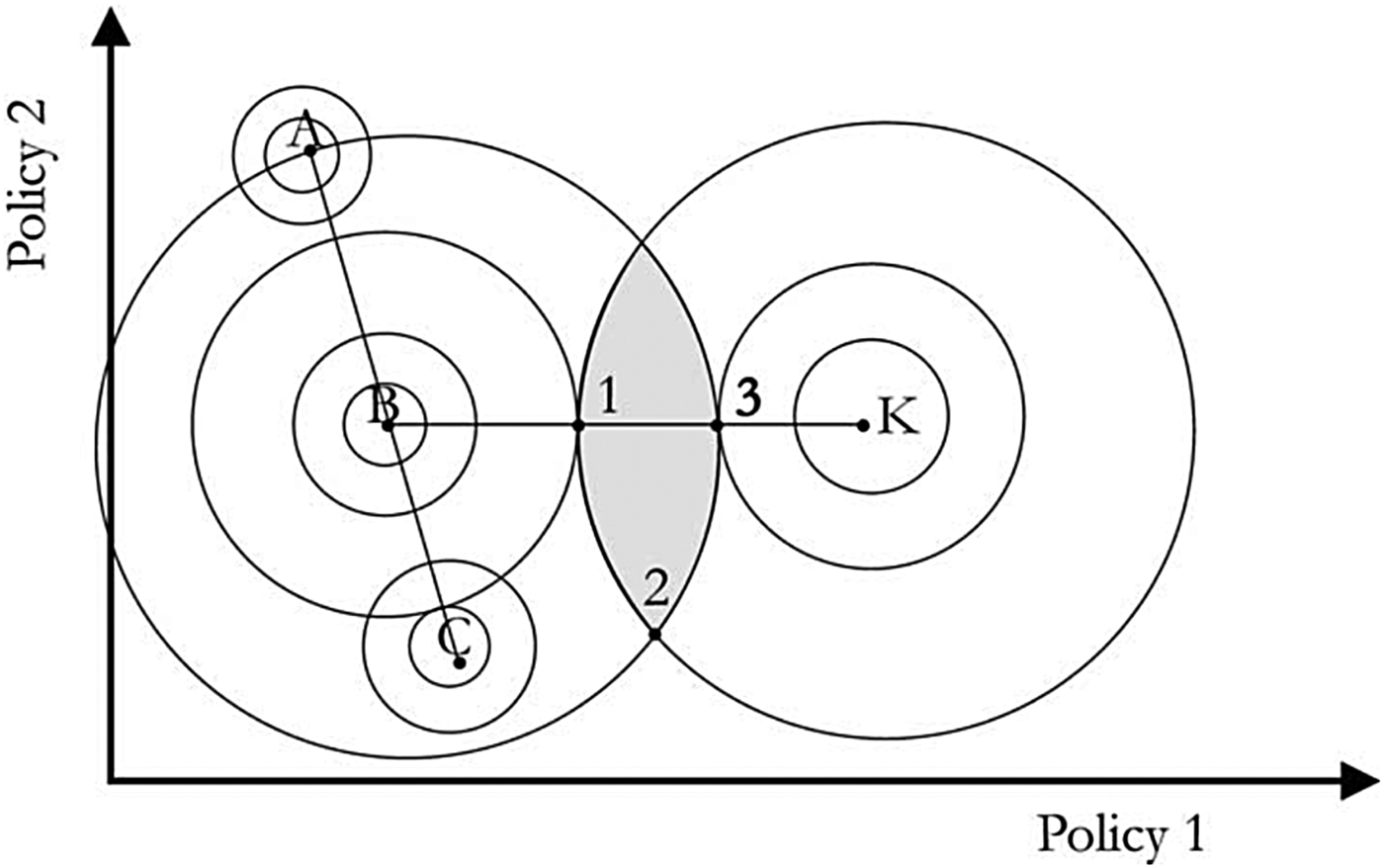
As Figure 1 shows, in the original king and council template, the king's most ideal policy combination is at Point K. The distance from the ideal point is assumed to characterize his ranking of alternative policies: the further away a point is from his ideal point, the less utility he has. The points on the same circle (indifference curve) thus yield the same utility to the king. Similarly, the council members’ respective points of policy combination are A, B, and C, where B stands for both the median voter and his ideal policy combination point. In some situations, the median voter is the leader of the council (the pivotal member, e.g. the premier). Also, B will be the outcome voted for within the council because it is the ideal point of the median voter.
Effects of Veto and Agenda Power of the King and Council Model (Congleton, Reference Congleton2001, p. 202)

Veto power and agenda control are the two main political powers in the king and council bargaining template. When the council is decisive, in other words, both of the branches are actually capable of making policy decisions, and either branch of the government's ideal point can be defended by that branch as long as it has either veto power or agenda control (Congleton, Reference Congleton2001, Reference Congleton2007). If the king has agenda control, then he can just propose policy combination K. The council confronts only policy proposal K, and clearly the result will be K regardless of whether the council votes for the policy or not. If the king has veto power and the council has agenda control, then any point deviating from K that is proposed by the council can be vetoed by the king. A similar situation will still hold for Point B if the council has either veto power or agenda control. The council can also be non-decisive, or weak. In other words, there is no pivotal voter in the council. Thus, every possible proposal can be defeated by a counter-proposal before it is put into practice by the executive, due to the potential majoritarian cycles. In such situations, the king can also confidently secure his ideal point.
There has been a growing literature analyzing the political institutions incorporating the king and council template, e.g. Abghari (Reference Abghari2007) and Hillman (Reference Hillman2007) on the political system in the Islamic regime, Bose (Reference Bose2010) on the evolution of the Indian constitution, and Young (Reference Young2015) on the early Germanic governance from circa 50 bc to ad 50. However, there is no research in the current economics literature using this bipolar political bargaining model to explain the division of powers in the socialist regimes. The rest of this paper will address this context.
The party chief and mayor template
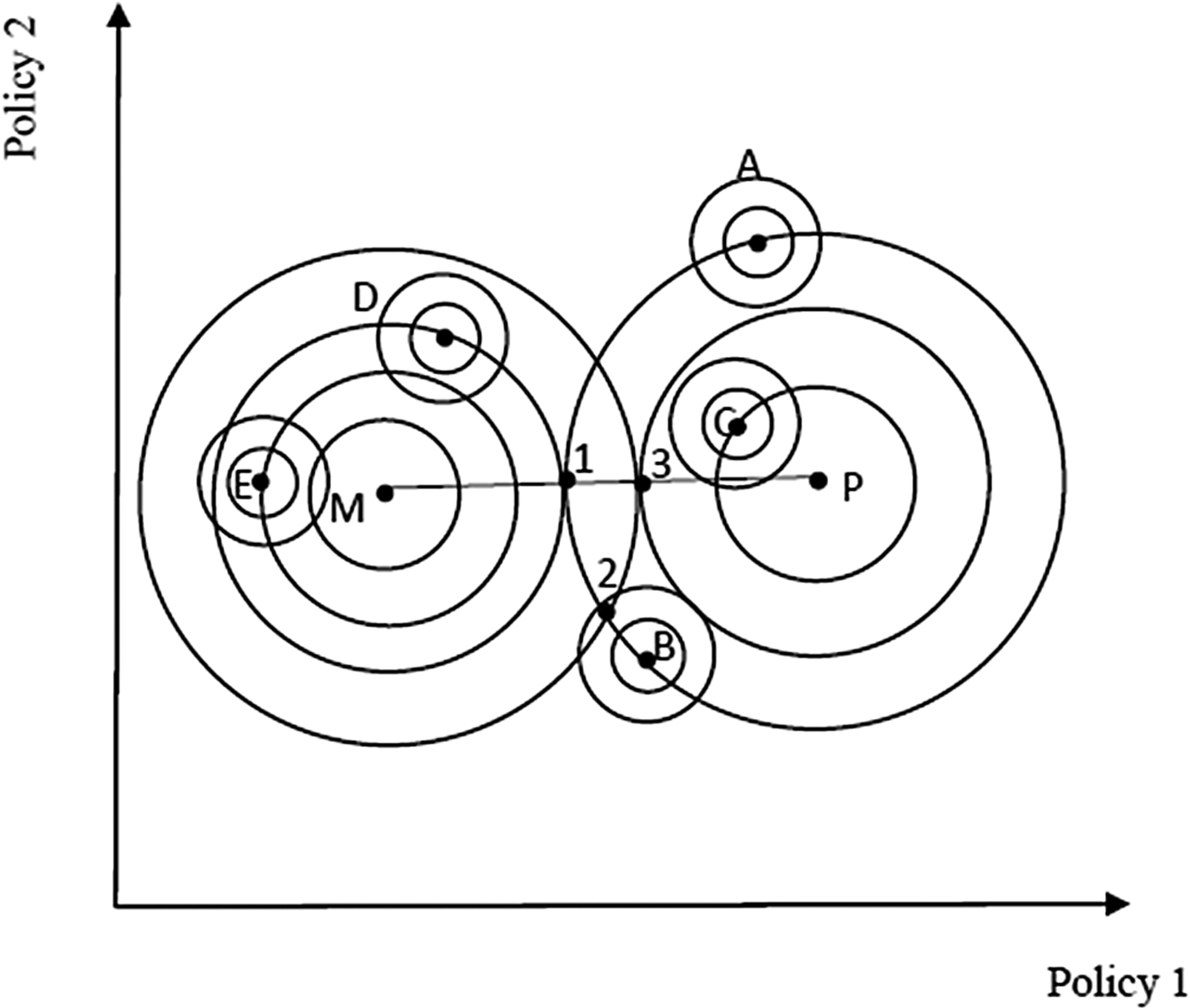
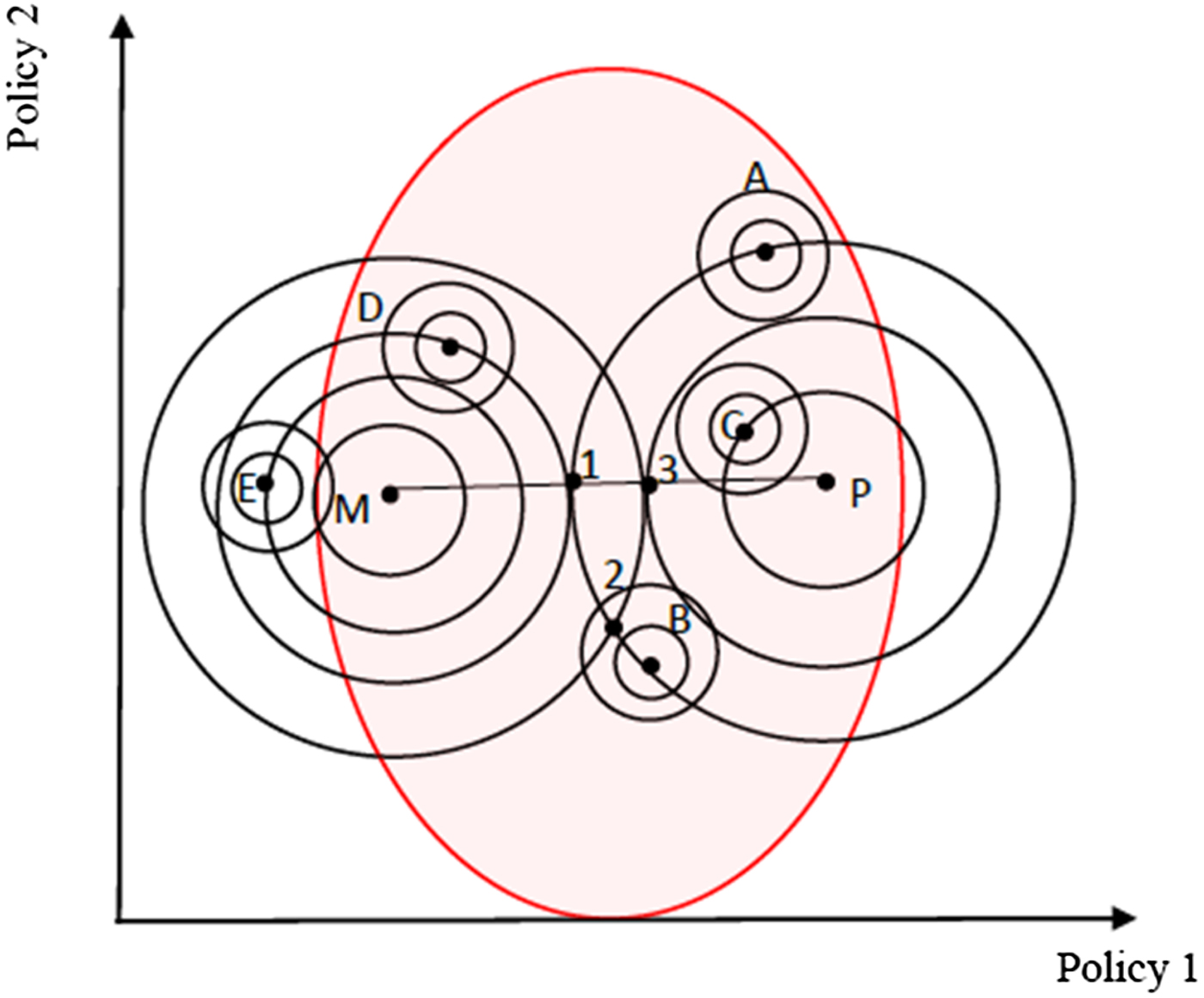
Like the king and council template, each member's respective ideal point yields the highest utility in the party chief and mayor template. Again, the distance from his ideal point is assumed to characterize his ranking order of alternative policies: the further a point is away from his ideal point, the less utility he will have. The points on the same circle (indifference curve) thus yield the same utility to the official. Without losing generality, let us assume that there are seven officials in this committee, divided roughly into two groups.Footnote 8 Graphically, as shown in Figure 2, Point P represents the party chief and his ideal policy combination, and Point M represents the mayor and his ideal policy combination. These two are surrounded by a group of committee members, A, B, C, D, and E, who have their own ideal policy combinations, A, B, C, D, and E, respectively. Since the party chief has relatively more political power in general, I assign three out of the remaining five committee members’ ideal points to be closer to his and the other two to have preferences closer to those of the mayor.
The Party Chief and Mayor Template

Both the party chief and the mayor have the agenda control and veto power, and most decisions need to be made by bargaining and negotiation. Suppose the party chief proposes his ideal policy combination, P, which is far away from that of the mayor, M. Thus, the mayor can just reject Point P and propose Point M. With some compromises, the party chief might propose Point 1 and Point 2, towards both of which he is indifferent. The mayor will vote for Point 1 rather than Point 2, since the former is closer to his ideal point, Point M. Or, if the proposal is between Point 2 and Point 3, then the mayor will vote for Point 3, doing the party chief a favor to garner future support, given the mayor's own indifference between the two policy combinations. In the end, a steady state of the bargaining between the two leaders should yield policy proposals on line segment PM. Such a geometric pattern under the majoritarian voting system is also identified by Buchanan (Reference Buchanan1998). Although only two leaders have comparable political power, this majoritarian rule also holds. In the end, the “votes” documented and reported to the senior party organization and the government should indicate “unanimous consent” or at least “majority consent.”
As explained above, committee members are also endowed with weak agenda control and veto power in principle, and in most situations they can only advise rather than decide. Take member A as an example. Member A does not propose his ideal policy combination, Point A, as he knows it will never be approved. Instead, he knows that his ideal policy combination is closer to that of the party chief, Point P, than to that of the mayor, Point M. Meanwhile, Point 3 is the closest of Points 1, 2, and 3 to Point A. Member A will “vote” for Point 3 when there is a vote between Point 3 and Point 1, or Point 3 and Point 2, because this will result in relatively higher utility for him (by yielding a policy combination closer to Point A) and also has a higher probability of being approved. It is coincidental that of all three policy combinations in this situation Point 3 yields the highest utility to member A.
In some situations, a normal committee member needs to sacrifice his personal interests to get a “less worse” policy combination.Footnote 9 Take member B as an example, whose most preferred combination of Points 1, 2, and 3 is at Point 2. However, he knows that neither of the two key leaders will vote for Point 2. Thus, he will propose Point 3 and/or vote for Point 3 when it is proposed by either of the two leaders. The steady state is that most of the policy proposals are on segment PM (there could be a few outliers), and most of the bargaining results fall on the subset of segment PM closer to the key leader with more political power.Footnote 10
Congleton (Reference Congleton2001, Reference Congleton2011) distinguishes the two situations where the king has rational expectations and where he does not. In the party chief and mayor template, a realistic assumption is that members do not have perfectly rational expectations. In other words, all of them are rationally ignorant to some extent. This is especially true in a socialist regime, where the planners do not have all the knowledge or information they desire (Hayek, Reference Hayek1945; Kornai, Reference Kornai1992). That is also why the leaders need a group of committee members to consult.
The party chief and mayor template applies not only to policy bargaining, but also to position appointments, even political and personal relationships. On the one hand, both the party chief and the mayor want to place officials with professional knowledge into committee positions. On the other hand, both the party chief and the mayor want to nominate their respective confidants or those with close policy preferences. The voting result on major issues after bargaining will be reported to senior party and government organizations for official approval.
Again, as Figure 2 shows, suppose that there are seven officials in the committee, including both of the key leaders. The respective distances from P and M to the member (A, B, C, D, and E) represent the political and personal relationships between the person and the party chief and the mayor, respectively. The further a person is away from P or M, the less close a relationship he has with the party chief or the mayor, respectively. Members on the same circle (indifference curve) of the party chief or the mayor have similarly close relationships to the party chief or the mayor. These networks do matter, especially in a regime without the rule of law. If there is a promotion opportunity for only one out of the five committee members, who are the party chief and the mayor going to vote for? The mayor prefers member E the most, while the party chief prefers member C the most. The “opinions” of the peers also matter. Members A and B will vote for C if they know that the party chief will nominate member C, because they want to please the party chief who will give them more favorable treatment in the future. Another reason is that C is within their small political group, led by the party chief. Member D will vote for member E if he knows that the mayor will nominate member E. Partisanship also matters in this instance. In the end, C will be the winner out of the five normal committee members, and the party chief and the other members in the party chief group will also benefit from the success of their “buddy.”
3. Collective decision probability function
Exogenous policy
This section presents a mathematical form of the probability for approval of the policy when voting under the party chief and mayor template. Using the same notations, P represents the party chief and his most ideal policy combination, and M represents the mayor and his most ideal policy combination. They are the only two members who have veto power, and their powers are not exactly the same but comparable. In most cases, the next step in their political path for the one who has less power is to become the one who has more power within the same branch or in a neighboring one; this is called the “Z-shaped” path (Kornai, Reference Kornai1992). For example, a typical promotion for a city mayor is to the position of party chief in the same city or a neighboring city, following a decision made by the department of organization at the senior levels of the party.
Meanwhile, although committee members in different positions have the same relative power, they also have different absolute power: the chief of the department of organization has more power than someone in charge of forestry. However, assuming these committee members have the same level of political power is a well-balanced trade-off between taking both the rich reality and the simplicity of mathematical modeling into consideration. In short, the other N committee members also have some limited political power.
In principle, a decision made needs a majoritarian consensus, e.g. two-thirds. However, there is one strong but very realistic assumption: if both the party chief and the mayor reach a consensual decision, most of the rest of the committee members will also “agree” with their decision. Although the party chief and the mayor are not the order-givers from the top (Kornai, Reference Kornai1992), they are the two main officials receiving the orders from upper apparatuses and assigning them to the other normal committee members within that branch. In other words, they are the “media” or “order redistributors” between their branch and the higher ones. Normal committee members know that the two leaders have supreme power, and nobody wants to play against either of the two bosses unless they have the support of the other.
Therefore, the probability function of the collective approval decision on an exogenous Policy j can be written as:
 $$\Pr ( {V_j = 1} ) = \Pr ( {V_{\,pj} = 1} ) \times \Pr ( {V_{mj} = 1} ) \times {\rm Pr}\left( {\mathop \sum \limits_{n = 1}^N V_{nj} \ge \displaystyle{2 \over 3}{\rm \;} N} \right){\rm \;} $$
 $\Pr ( {V_j = 1} ) $ is the probability that Policy j will be approved. V pj is a binary dummy variable indicating the vote of the party chief on Policy j: 1 means yes and 0 means no. Similarly, V mj is that for the mayor on Policy j, and V nj is that for committee member n on Policy j. Since both the party chief and the mayor have absolute veto power, the policy will only be approved when both of them vote yes. Thus,
 $\Pr ( {V_{pj} = 1} ) $ is the probability that the party chief votes yes on Policy j, and
 $\Pr ( {V_{mj} = 1} ) $ is the probability that the mayor votes a yes on Policy j. Similarly,
 $$\Pr ( {V_j = 0} ) = \Pr ( {V_{\,pj} = 0} ) \times \Pr ( {V_{mj} = 0} ) \times {\rm Pr}\left( {\mathop \sum \limits_{n = 1}^N V_{nj} \le \displaystyle{1 \over 3}\; N} \right)$$
Although majoritarian consent is necessary, as explained in the context above, it is reasonable to assume (the “Weak Independent Decision Assumption”):
 $$\Pr \left( {\mathop \sum \limits_{n = 1}^N V_{nj} \ge \displaystyle{2 \over 3}{\rm \;} N{\rm \vert} V_{\,pj} = 1{\rm \;} \& {\rm \;} V_{mj} = 1} \right) = 1$$
 $$\,{\rm i}{\rm. e}{\rm.} \,\,\Pr \left( {\mathop \sum \limits_{n = 1}^N V_{nj} \le \displaystyle{1 \over 3}{\rm \;} N{\rm \vert} V_{\,pj} = 0{\rm \;} \& {\rm \;} V_{mj} = 0} \right) = 1$$
However, if the party chief has more power, it is also reasonable to assume (the “Strong Independent Decision Assumption”):
 $$\Pr \left( {\mathop \sum \limits_{n = 1}^N V_{nj} \ge \displaystyle{2 \over 3}{\rm \;} N{\rm \vert} V_{\,pj} = 1{\rm \;} \& {\rm \;} V_{mj} = 0} \right) = {\rm \;\ \beta,\ \,where\ 0} \, \le {\rm \beta} \le 1 $$
i.e.
 $$\Pr \left( {\mathop \sum \limits_{n = 1}^N V_{nj} \le \displaystyle{1 \over 3}{\rm \;} N{\rm \vert} V_{\,pj} = 0{\rm \;} \& {\rm \;} V_{mj} = 1} \right) = {\rm \;} \,{\rm \beta,\ \,where\,\ 0} \, \le {\rm \beta} \le 1 $$
where β is between 0 and 1, indicating the probability of the party chief's decision being supported and passed, even when the mayor is against it. A larger β represents higher probability, indicating the party chief's relative power and support from most committee members. When β = 1, the party chief's preference can be satisfied, regardless of the mayor's. However, when β = 0, the party chief has no more power than the mayor. Taking the graphic model in this paper as an example, there are five normal committee members, three closer to the party chief and two closer to the mayor. In this case,  $\displaystyle{3 \over 5} \lt \displaystyle{2 \over 3}$, thus the “Strong Independent Decision Assumption” is not guaranteed to hold. However, a potential swing member originally closer to the mayor might support the party chief instead in some cases, where the “Strong Independent Decision Assumption” might hold. In this situation, 0 < β < 1. The Independent Decision Assumptions for the two key officials actually indicate the “soft ‘political’ constraint,” which is similar to the “soft budget constraint” (Kornai, Reference Kornai1979, Reference Kornai1980, Reference Kornai1986) for state-owned enterprises.
Both the party chief and the mayor are “utility” (or “rent”) maximizers. If the group voting outcome is the same as what the party chief or the mayor votes for, then he can enjoy one unit of “utility” or “rent” because that is what he desires. If the voting outcome is different from what he votes for, he will have zero units of rent or utility because this is not what he desires. Note that in this binary set up, zero represents a “no” vote. This is not the same as keeping the status quo, leaving the issue unsolved, which also yields zero utility to both parties. Thus, the party chief's expected utility on Policy j is:
 $$\eqalign{EU_{\,pj} &= 1 \times \Pr \left( {V_j = 1\vert V_{\,pj} = 1} \right) \times \Pr \left( {V_{\,pj} = 1} \right) \cr &\quad + 1 \times \Pr \left( {V_j = 0\vert V_{\,pj} = 0} \right) \times \Pr \left( {V_{\,pj} = 0} \right) \cr &\quad + 0 \times \Pr \left( {V_j = 1\vert V_{\,pj} = 0} \right) \times \Pr \left( {V_{\,pj} = 0} \right) \cr &\quad + 0 \times \Pr \left( {V_j = 0\vert V_{\,pj} = 1} \right) \times \Pr \left( {V_{\,pj} = 1} \right)}$$
Similarly, the mayor's expected rent on Policy j is:
 $$\eqalign{EU_{mj} &= 1 \times \Pr \left( {V_j = 1\vert V_{mj} = 1} \right) \times \Pr \left( {V_{mj} = 1} \right) \cr &\quad + 1 \times \Pr \left( {V_j = 0\vert V_{mj} = 0} \right) \times \Pr \left( {V_{mj} = 0} \right) \cr & \quad+ 0 \times \Pr \left( {V_j = 1\vert V_{mj} = 0} \right) \times \Pr \left( {V_{mj} = 0} \right) \cr &\quad + 0 \times \Pr \left( {V_j = 0\vert V_{mj} = 1} \right) \times \Pr \left( {V_{mj} = 1} \right)}$$
Considering both the Weak and Strong Independent Decision Assumptions, the probabilities of an exogenous Policy j being approved or rejected conditional on the party chief's vote are:
 $$\Pr ( {V_j = 1 \vert V_{\,pj} = 1} ) = \Pr ( {V_{mj} = 1} ) + \beta [ {1-\Pr ( {V_{mj} = 1} ) } ] $$
 $$\Pr ( {V_j = 0 \vert V_{\,pj} = 0} ) = \Pr ( {V_{mj} = 0} ) + \beta [ {1-\Pr ( {V_{mj} = 0} ) } ] ,$$
while those for the mayor are:
 $$\Pr ( {V_j = 1 \vert V_{mj} = 1} ) = \Pr ( {V_{\,pj} = 1} ) $$
 $$\Pr ( {V_j = 0 \vert V_{mj} = 0} ) = \Pr ( {V_{\,pj} = 0} ) $$
Thus, the expected utilities of the party chief and the mayor on Policy j are:
 $$\eqalign{ EU_{\,pj} &= 1 \times \Pr \left( {V_{\,pj} = 1} \right) \times [\Pr \left( {V_{mj} = 1} \right) + \beta (1-\Pr \left( {V_{mj} = 1} \right))] \cr &\quad + 1 \times \Pr \left( {V_{\,pj} = 0} \right) \times [\Pr \left( {V_{mj} = 0} \right) + \beta (1-\Pr \left( {V_{mj} = 0} \right))]}$$
 $$EU_{mj} = 1 \times \Pr ( {V_{\,pj} = 1} ) \times \Pr ( {V_{mj} = 1} ) + 1 \times \Pr ( {V_{\,pj} = 0} ) \times \Pr ( {V_{mj} = 0} ) $$
Meanwhile:
 $$\Pr ( {V_{\,pj} = 1} ) + \Pr ( {V_{\,pj} = 0} ) = 1$$
 $$\Pr ( {V_{mj} = 1} ) + \Pr ( {V_{mj} = 0} ) = 1$$
Thus, equations (10) and (11) can be rewritten as:
 $$\eqalign{EU_{\,pj} & = ( {2-2\beta} ) \times \Pr ( {V_{mj} = 1} ) \times \Pr ( {V_{\,pj} = 1} ) + ( {\beta -1} ) \times \Pr ( {V_{mj} = 1} ) + ( {\beta -1} ) \cr & \quad \times \Pr ( {V_{\,pj} = 1} ) + 1}$$
 $$EU_{mj} = 2\Pr ( {V_{mj} = 1} ) \times \Pr ( {V_{\,pj} = 1} ) -\Pr ( {V_{mj} = 1} ) -\Pr ( {V_{\,pj} = 1} ) + 1$$
For the two utility/rent maximizers, the first order conditions are:
 $$\displaystyle{{\partial EU_{\,pj}} \over {\partial {\rm Pr}( {V_{\,pj} = 1} ) }} = ( {2-2 {\rm \beta}} ) \times \Pr ( {V_{mj} = 1} ) + ( {\beta -1} ) = 0$$
 $$\displaystyle{{\partial EU_{mj}} \over {\partial {\rm Pr}( {V_{mj} = 1} ) }} = 2\Pr ( {V_{\,pj} = 1} ) -{\rm \;} 1 = 0$$
Solving equations (16) and (17), we have:
 $$\Pr ( {V_{\,pj} = 1} ) = \displaystyle{1 \over 2}$$
 $$\Pr ( {V_{mj} = 1} ) = \displaystyle{1 \over 2}$$
Similarly, another variable, γ (0 ≤ γ ≤ 1), can be further added into the model, indiciating the mayor's relative power. The solutions are the same. Actually, β and γ can be used as the measurements of the relative weights of the two key officials. When “β” or “γ” is non-zero, it means that the other party loses the absolute veto power but still keeps some power. When “β” or “γ” is 1, the other party loses all the veto power. However, 0 ≤ β + γ ≤ 1 must hold, since one issue can only be solved (either yes or no) or unsolved (status quo), while the total probability of being solved cannot be greater than 1. In other words, if β > 0.5, then γ < 0.5 must hold. A relatively strong party chief must correspond with a relatively weak mayor.
This quantitative solution indicates that in order to maximize their respective utility/rent, the best response for both the party chief and the mayor is not always agreeing on a decision at the same time, nor always rejecting a proposal at the same time. The probability of one of the two key leaders voting yes or no is independent of that of the other. In reality, they might cooperate or bargain with each other, while this result shows how the “checks and balances” work in the party chief and mayor template.
Endogenous policy
In the former discussion, there is a strong assumption that Policy j is exogenous. However, in many situations, the party chief and/or the mayor have endogenous preferences, especially for policies closely related to their personal interests, including but not limited to political, economic, and ideological preferences.
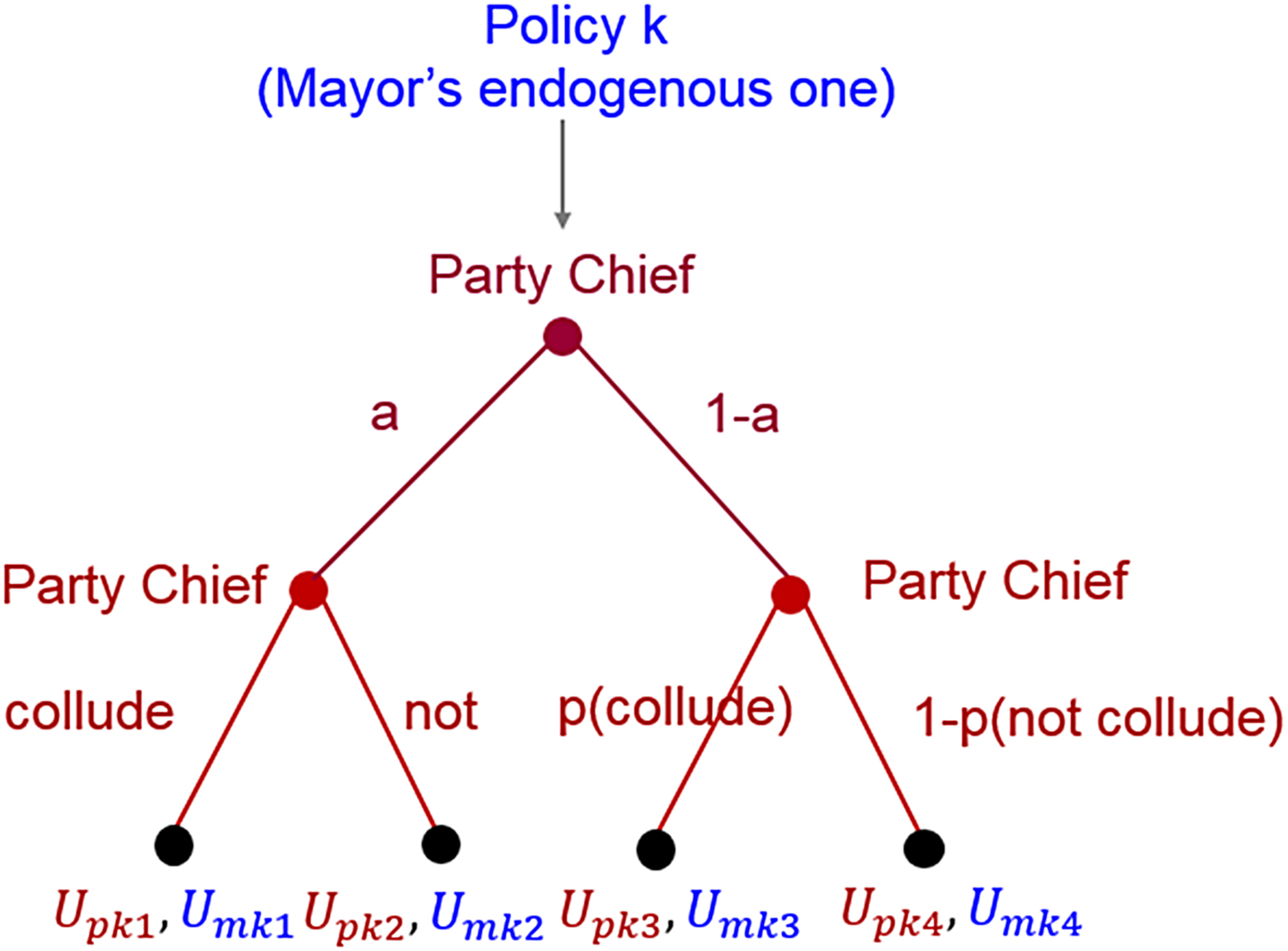
Suppose there is a new policy proposal i which is endogenous for the party chief; and there is another policy proposal k, which is endogenous for the mayor. Take Policy k as an example. Since k is endogenous for the mayor, he will stick with his endogenous preference, regardless of what the party chief votes. However, Policy k may or may not be consistent with the preference of the party chief. As shown in Figure 3, there is a non-zero probability a (0 < a < 1) that the endogenous preference, thus the decision of the mayor, is the same as the party chief's preference. Thus, “collude (support the other party's decision)” should be the dominating strategy for the party chief; in other words, U Pk1( = 1) >U Pk2.
The Party Chief's Decision Tree

However, there is still a non-zero probability 1-a that the mayor's decision contradicts the preference of the party chief. Similarly, the party chief faces two options: to “collude” with the mayor or not. If the party chief colludes (with a probability p, where 0 ≤ p ≤ 1), then the outcome is actually not consistent with his preference, thus his utility is U Pk3 = 0 (as defined in the previous subsection); if he does not (with a probability 1–p), it is still possible that he can get the support of most of the normal committee members, with a probability β (0 ≤ β ≤ 1, as defined in the previous subsection). Thus the expected U Pk4 = β. Note that a is decided by nature (since the party chief and mayor are appointed by senior party officials and the government), while p is a probability choice as a mixed strategy of the party chief.
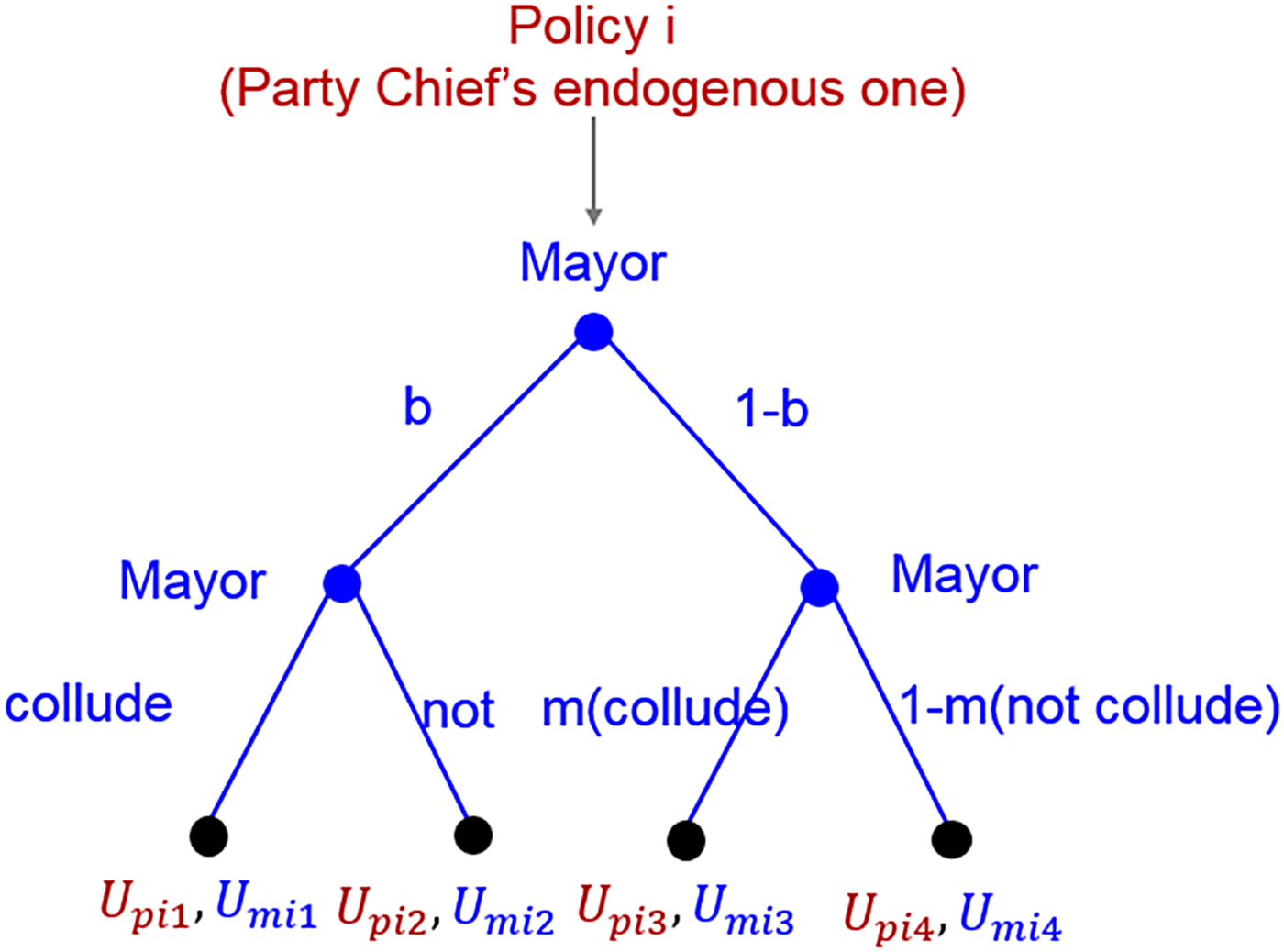
Figure 4 displays the decision tree faced by the mayor, where Policy i is endogenous for the party chief. The party chief will stick with his endogenous preference, and b (0 < b < 1) is the probability that the mayor's preference is the same as that of the party chief, which is decided by nature. Again, m is the probability the mayor chooses, as a mixed strategy. Similarly, U mi1( = 1) >U mi2: colluding with the party chief is a dominating strategy when they have the same preferences. When the mayor's preference contradicts that of the party chief, if the mayor colludes, then, his utility U mi3 = 0. If the mayor decides not to collude, it is still possible that he can win, with a probability γ. Because when one party decides to not collude, voting no is a weakly dominating strategy (yielding a non-zero expected utility, as long as their relative weight (β or γ) is non-zero) compared to doing nothing (yielding a zero expected utility). Therefore, in this scenario, β + γ = 1. β and γ can be influenced by many exogenous and endogenous variables, e.g. their political background, personality, etc. Meanwhile, the political bargaining between the party chief and the mayor is also a repeated game in reality that also shapes the results of β and γ, while being outside the scope of this research.
The Mayor's Decision Tree

Thus, the expected utilities of the party chief and the mayor on Policies i and k are:
 $$\eqalign{EU_p & = EU_{\,pi} + EU_{\,pk} \cr & = [ {b + ( {1-b} ) m + ( {1-b} ) ( {1-m} ) \beta} ] + [ {a + ( {1-a} ) p \times 0 + ( {1 - a} ) ( {1-p} ) \beta} ]}$$
 $$\eqalign{EU_m & = EU_{mi} + EU_{mk} \cr & = [ {b + ( {1-b} ) m \times 0 + ( {1 + b} ) ( {1-m} ) \gamma} ] + [ {a + ( {1-a} ) p + ( {1-a} ) ( {1-p} ) \gamma} ]}$$
Simplifying equations (e-1) and (e-2), and taking partial derivatives of their utility function with respect to their own mixed strategy variable, give:
 $$\displaystyle{{\partial EU_p} \over {\partial {\rm p}}} = \left({{\rm a}-1} \right) \beta \le 0 \, ( " = " {\hbox {holds only when}} \;{\rm \beta} = 0)$$
 $$\displaystyle{{\partial EU_m} \over {\partial {\rm m}}} = \left( {{\rm b}-1} \right)\gamma \le 0\, ( " = " {\hbox {holds only when }} \gamma = 0)$$
Equation (e-3) indicates that the party chief will maximize his own utility when p takes the minimum value available, 0. This suggests that the party chief will always play against the mayor when the mayor's endogenous preference/policy is not the same as his own. Equation (e-4) has a similar implication for the mayor. In conclusion, even when the policies are endogenous, the horizontal “checks and balances” are still in effect in the party chief and mayor template.
4. Political institutions
Institutional constraints added
In the king and council template literature, institutions have been heavily discussed but they have never been explicitly incorporated into the graphic analysis. Institutional constraints might restrict potential policy combinations that the two key officials propose. Meanwhile, some normal committee members’ ideal points might also be outside the institutional constraints. This may influence the outcome marginally (and possibly dramatically) in some situations. Typical constraints include the constitution, ideology, etc. This section illustrates the role institutional constraints play in the party chief and mayor template.
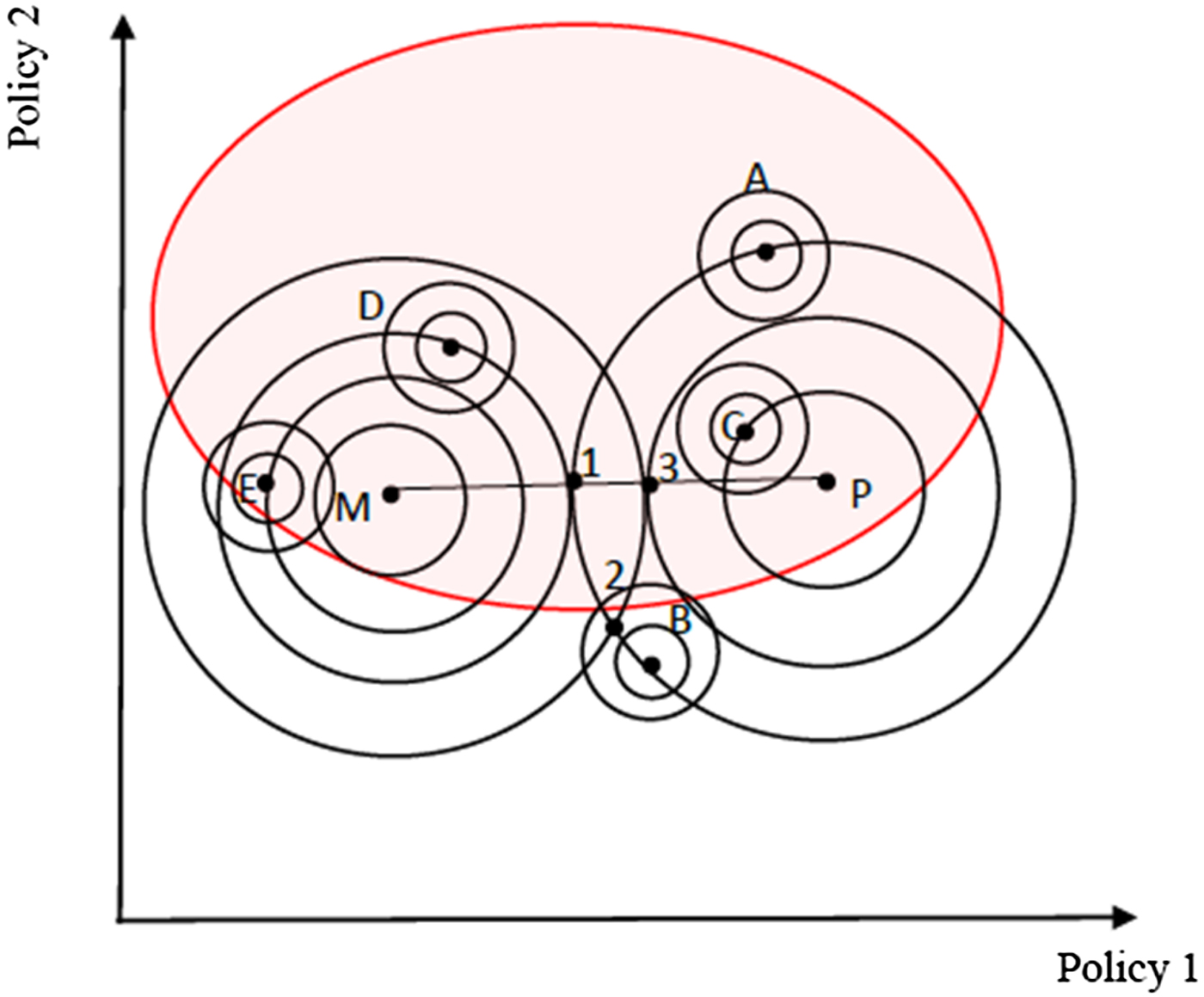
As Figure 5 shows, there is an institutional constraint (the ellipse) imposed by senior party officials or government organizations, or the constitution. As explained before, in reality, both the party chief and the mayor are “appointed” by senior party officials and government organizations, therefore they have to observe this constraint in order to maintain the “legitimate” status of their positions. If either dares to cross the constraint, he might be punished by the senior party organization, for example by the loss of both his current position and the potential of a future political career (Kornai, Reference Kornai1992).
Institutional Constraints Added – A

For example, the institutional constraint (the ellipse) can represent ideology. Any policy combination outside the ellipse may be viewed as deviating from “socialist ideology”: a reasonable or politically correct combination of policies should maintain a good balance between the central planning and the market system. On the one hand, in order to push economic development forward, the officials may want the private sector to play a more important role; on the other hand, due to ideological constraints, they need to maintain the relative share of state-owned enterprises. Member E might have a relatively pro-market policy preference and propose policy combination E. In such a situation he would be viewed as an outlier. Such a system of ideological balance or mixture is reviewed in the Constitution. As the Constitution of the People's Republic of China (the 1982 document, amended in 2018) Article 11 states:
The non-public sectors of the economy such as the individual and private sectors of the economy, operating within the limits prescribed by law, constitute an important component of the socialist market economy.
The state protects the lawful rights and interests of the non-public sectors of the economy such as the individual and private sectors of the economy. The State encourages, supports and guides the development of the non-public sectors of the economy and, in accordance with law, exercises supervision and control over the non-public sectors of the economy.
Figure 6 gives another similar situation, where policy combination 2 is not tolerable to the party's ideology. Here, member B is viewed as an outlier and his suggestions will never be taken up by his fellows. Meanwhile, neither the party chief nor the mayor will dare to propose or approve policy combination 2, since it lies outside the ideological constraint.
Institutional Constraints Added – B

Ideological education, personality cult, and political movements
These formal and informal institutions play an essential role in socialist politics. As a result, using different approaches to impose ideological or constitutional constraints, or even to shape the officials’ inherent policy preferences, is widely observed. For example, Party Schools of the CPC are established at various levels across the country, where working party members get an ideological education. Such systems and institutions across socialist countries are also documented in Kornai (Reference Kornai1992).
Meanwhile, a personality cult can help the party chief and the mayor to attract more confidants. Working with political movements, top figures may manage to build up a personality cult and even gradually shift institutional constraints. In the early years of the CPC, Mao Zedong managed to build up his personality cult through rounds of political movements between the late 1920s and the mid-1940s. His political power reached the first peak of his lifetime during the Yan'an Rectification Movement in early 1940s (Gao, Reference Gao2000). Rome was not built in one day, nor was a personality cult. Such a gradual gain in political power through political movements has also been observed in the history of the early years of the former Soviet Union and other socialist regimes. Another famous political movement is the Cultural Revolution under Mao from 1966 to 1976. However, the aftermath of the Cultural Revolution effectively discredited the red ideology movement, and the ruling elites of the Party realized that policies focusing on economic development should be primary. The CPC, which rarely admits its mistakes, even concluded that “the ‘Cultural Revolution’ has made the party, the state and the people suffer the most serious setbacks and losses since the founding of this country” (Communist Party of China, 1981).Footnote 11 Even recently, gradually obtaining political power via political movements is still seen in political bargaining between senior Chinese politicians. For example, Bo Xilai, party chief of Chongqing Municipality from 2007 to early 2012, employed ideological movements and legal intervention to gain more political power and a better reputation (Zhou, Reference Zhou2018). The Anti-corruption Campaign under Xi Jinping since late 2012 is another example. It is believed that one main aim of this campaign is to “reduce elder influence” – to extinguish the vestiges of influence from former paramount leader Jiang Zemin (Liu, Reference Liu2015).Footnote 12
5. Conclusion
Kornai's pioneering scholarship on the “soft budget constraint” (Kornai, Reference Kornai1979, Reference Kornai1980, Reference Kornai1986), transitions (Kornai, Reference Kornai1990, Reference Kornai2000, Reference Kornai2006b), and the overall economic system (Kornai, Reference Kornai1992) described the mechanisms of socialist systems. In this paper, I build on Kornai's work on socialist systems by analyzing horizontal bargaining between the party chief and the mayor in contemporary China. Specifically, I synthesize both the “no outside checks and balances” (Kornai, Reference Kornai1992) and “vertical bargaining” (Kornai, Reference Kornai1986, Reference Kornai1992) models into my analysis of this bipolar division of power within every party branch, the cell constituting the whole socialist pyramid.
Using the contemporary socialist political system in China for context, this paper extends the original king and council template, where political bargaining occurs between one person and a group of people, to the party chief and mayor template, where political bargaining occurs between two key leaders with confidants. The party chief and mayor template also incorporates institutional constraints, which influence proposals and votes both directly and indirectly. Meanwhile, with the collective decision probability function defined, the solution indicates that “checks and balances” work between the party chief and the mayor, regardless of whether their policy preferences are exogenous or endogenous.
This research pushes forward theory in the socialist system and the bipolar political bargaining literature. The party chief and mayor template provides another way of studying political bargaining, and the illustration in this paper provides more evidence of how contemporary politics in socialist China operates. In reality, the party chief and the mayor may cooperate or bargain with each other in a repeated game. More work is necessary to further reveal the economic and political mechanisms in socialist regimes from a positive perspective, à la János Kornai's work, rather than leaving them unexplored.
Acknowledgments
I would like to thank four anonymous referees for their helpful comments and suggestions. I appreciate the various anonymous government and military officials in China whom I have interviewed in the last years. I am very grateful to Roger Congleton, Joshua Hall, Bobbi Herzberg, Mária Csanádi, Miklós Rosta, Dóra Piroska, and participants at the 2017 Research Colloquium by the Institute for Humane Studies, the 2018 Public Choice Society and Institute for Humane Studies Research Seminar, and the Conference to Celebrate János Kornai's Research and 90th Birthday at Corvinus University of Budapest in Hungary, for all their valuable comments and suggestions. I also appreciate the conference travel grant from the Center for Free Enterprise at West Virginia University. Last but not least, I am in heavy debt to János Kornai for his intellectual inspiration – I probably would not have chosen to work in academia if I had not read his By Force of Thought: Irregular Memoirs of an Intellectual Journey (Kornai, Reference Kornai2006a) when I was still an undergraduate student in China several years ago.