



On a hot July evening in New York City, I joined 2000 people packing out a Midtown auditorium for a pop concert. Decked out in brightly coloured fan merchandise from past tours, the crowd sang and danced energetically to song after song. Midway through the show, the singer paused at centre stage and called out to the audience, ‘Are you having a good time?’ The crowd cheered in response. The singer egged them on, playing her part in a well-worn ritual between performer and audience: ‘I can't hear you!’ Predictably, the crowd roared even louder. However, the irony of this exchange seemed lost on the audience. This performer's statement of ‘I can't hear you’ was literal – she would never hear them, no matter how loudly they might scream. That is because the singer was a hologram.
This particular holographic concert was given in 2018 by a virtual singer called a ‘Vocaloid’. Vocaloid songs are not sung by human performers; Yamaha's Vocaloid application enables users to input notes and lyrics into the software interface, and the program then synthesises sung vocal lines. Composing songs in Vocaloid is a straightforward and accessible process, with simple click-and-drag functions for the placement and duration of vocals. No notation skills are required, since the interface does not use a staff. Similar to a keyboard or flute plugin for a digital audio workstation, each Vocaloid character is purchased and installed as a separate voice bank, but Vocaloids are also marketed with a fictional name and the image of a cartoonish character on the box. The most popular character by far since her introduction in 2007 is a teenage girl named Hatsune Miku, who wears her hair in long, teal pigtails and sings with a distinctive high-pitched voice (see the front cover of this issue).
While the copyright for the image and name of each Vocaloid character belongs to the company who designed them, character images can be used by fans for non-commercial purposes without obtaining permission, and software users retain all rights to any music they create using Vocaloid. Hundreds of thousands of Vocaloid videos have circulated in online communities in the years since the program's rise to popularity, and scholars who study this content have noted that while approximately one in five videos are original works, the majority of them are ‘derivative creations’ that interpret or develop the original in a new way, such as adding animation, live instrumentals or other forms of creative commentary (Goto Reference Goto and Nishida2017). Vocaloid's online community thrives on amateur creativity, and on the collaborative engagement that facilitates the development of higher-quality works than any one amateur could produce.
However, Miku and other Vocaloids have become polarising figures for music journalists in the West, with common themes including feelings of detached bemusement, descriptions of disorienting sensory overload and predictions of a dehumanised musical future. Many point to a lack of live interaction between performer and audience as a fatal shortcoming that will prevent holographic concerts from staking a permanent claim in the musical landscape. One reviewer expressed dissatisfaction with a 2016 performance, writing, ‘It's live in the sense that a throng of people watching a music video together would be. There's a crowd, but the show would be identical with or without their attendance. There's no interaction, no banter, nothing to encourage a unique experience …. There's a humanity lacking that makes it less of a concert and more of a public screening’ (Weinstein Reference Weinstein2016). This emphasis on the lack of human interaction has been echoed by many other writers, and yet there is a disconnect between their analysis of Vocaloid as little more than a lacklustre holographic imitation of a live performance and the explosive worldwide growth of Vocaloid's fanbase over the past decade. Hatsune Miku opened for Lady Gaga on her artRAVE world tour, was slated to perform in the cancelled 2020 Coachella festival, and has even made the jump to the classical music world, singing the lead role in an opera composed specifically for her that she has performed in more than half a dozen European opera houses. Vocaloid's popularity shows no signs of waning, and this growth in recognition and influence suggests that there is more to Vocaloid performance than risk-free replay.
Beginning in the 2010s, Vocaloid's increased visibility in the music world has garnered scholarly attention as well. Work by researchers including Keisuke Yamada (Reference Yamada2017) and Masataka Goto (Reference Goto and Nishida2017) has examined Vocaloid's collaborative online culture, while Nina Sun Eidsheim (Reference Eidsheim2019) and Yiyi Yin (Reference Yin2018) have considered the processes through which the software's sounds and associated images contribute to the articulation of cultural values. Nearly all of the scholarly work addressing Vocaloid has focused on the relationship between the music and its fan culture, and on the interactions in online communities, but few have considered the culture and significance of live concerts.
Taking Hatsune Miku's holographic career as an object of study enables us to question ideas of authenticity in live performance, and even the nature of the performance event itself. Although some say that Vocaloid concerts are a frightening step in the gradual sterilisation of live musical performance, Hatsune Miku's popularity points to a larger creative trend that goes beyond clinical perfectionism. As the number of holographic concerts staged each year continues to climb, and virtual versions of performers including Gorillaz and a resurrected Maria Callas are projected onto concert stages, Vocaloids come into focus as just one aspect of a much larger phenomenon, and addressing these concerns becomes an increasingly pressing issue. Examining Vocaloid concerts as live performances presents some unique challenges, because of the way in which a pre-programmed holographic concert seems to fall into a grey area somewhere between a human performance and a film screening. I argue, however, that the creation of cultural meaning and the most significant interactions occur not between the audience and a hologram at centre stage, but within the audience itself. This engagement is at its most visible and powerful when thousands of fans travel to live concert sites in order to express their fandom in an embodied way through carefully rehearsed participatory actions, and to experience an in-person extension of the collaborative online Vocaloid community that created the music that is performed in these shows.
In considering these experiences, I first examine the challenges that arise in Vocaloid concerts which directly substitute a Vocaloid for a live singer. In this case study, I focus on Vocaloid performances in North America and Europe, in which the Vocaloid performer is backed by a band of human instrumentalists in a format similar to a typical pop concert. I then contrast these performances with events in Japan that forego key elements of human concert conventions in order to position Vocaloid as a medium that foregrounds its own forms of competency without relying on the standard practices of human musical performance to be understood. In both case studies, I focus on aspects of the audience experience that have not yet been considered in the Vocaloid literature, offer an updated context for understanding performance and liveness in the 21st century and respond to the anxieties surrounding this new performance format by situating Vocaloid as a user-driven medium with participation at the heart of its meaning.
The development of a technological controversy
In order to understand how we arrived at this moment in history when a pre-programmed singer can accrue a fan following like Hatsune Miku's, we must first understand its technological and cultural contexts. The story of Vocaloid's growth from an obscure computer program to an international music phenomenon begins on NicoNico, the website that has hosted most of the Vocaloid community since 2007. NicoNico is a video-sharing site popular in Japan, and is similar in some ways to YouTube, but with two significant differences in appearance and content. First, comments on NicoNico are viewed directly on top of the video as it plays, and each comment is linked to a specific point in time in the video's playback. As later viewers watch the video, past viewers’ comments scroll across the video interface, appearing at the same moment in the video playback at which they were inputted by earlier viewers. Since many such comments can appear simultaneously, this feature is significant because of the way in which it enables a group of users separated by both temporal and spatial distance to react collectively in a format that resembles real-time group interaction. Another important difference between NicoNico and other video-sharing websites is the nature of the content itself. NicoNico is frequently used for sharing and developing creative content. A popular Vocaloid tune might be arranged by other amateur musicians and performed by a live group, choreographed by a dancer, sketched out on a storyboard by artists, and animated as a music video that incorporates much of this earlier work. In some cases, amateur song producers and visual artists, working on their home computers with no formal training, have gained enough popularity to release successful albums with major labels.Footnote 1
In interviews conducted by media scholar Rafal Zaborowski, participants reveal how the collaborative amateur production process behind favourite Vocaloid songs helps to create a deeper connection with the music. ‘It's just a bunch of talented people, using [the software] for everyone to enjoy’, says one participant. ‘They don't have to go through [the industry], they just upload’ (Zaborowski Reference Zaborowski, Whiteley and Rambarran2016, p. 121). Although Miku's voice is computer generated, Vocaloid fans perceive her songs as possessing ‘real freedom of expression’ that comes from the amateurs producing her songs. This is especially apparent in contrast with the hyper-produced images and music of major pop groups, which participants described as ‘[a]ll fake’ (Zaborowski Reference Zaborowski, Whiteley and Rambarran2016, p. 124).
These values were called into question by reviewers outside the Vocaloid community when the characters first appeared in live concerts. Even calling these performances ‘live concerts’ has raised ire from music journalists. Interestingly, and even ironically, writers often criticise Vocaloid concerts by inverting this relationship between ‘real’ and ‘fake’ that fans describe. If ‘real freedom of expression’ relies on a performer's ability to respond emotionally to real-time events, then a pre-programmed performance would indeed seem ‘all fake’. The idea of ‘freedom of expression’ in Vocaloid music, however, does not stem from spontaneity in live concerts, nor even entirely from the creativity of a single original songwriter who created the music using Vocaloid software. This sentiment arises from a sense of collective investment in the creation of Vocaloid works through online collaboration and layers of derivative works that interpret Vocaloid music in meaningful new ways. Media interaction researcher Masataka Goto (Reference Goto and Nishida2017) has tracked and modelled the networks of collaboration through which Vocaloid works are created and refined, and has developed applications which process massive amounts of data from the NicoNico community and visualise the evolution of Vocaloid works on an ongoing basis. Goto's work has underscored the ability of an open-source creative culture to collectively produce work of a high artistic quality. It also traces the threads of influence and commentary that both shape Vocaloid music and contribute to the strong sense of meaning articulated by fans. Lucy Bennett (Reference Bennett2014) has more broadly identified and assessed similar trends in the area of digital fan studies, showing the way in which the boundaries between fans and producers have become blurred, with creative works from music to television shows now characterised by dynamics in which fan input has an impact on the final artistic product. In many ways, Vocaloid music characterises this dynamic to an even greater extent than the case studies in Bennett's work, because there is no single professional authority behind Hatsune Miku's songs. Rather than waiting for the release of official albums, Vocaloid fans discover new songs on video-sharing websites. The most popular of these songs go viral, and some eventually make their way to the concert stage.
Miku Expo, an international concert tour featuring Hatsune Miku and other Vocaloids, had its first two Western concerts in the US in 2014.Footnote 2 However, the event received comparatively little press coverage until its more ambitious 2016 tour, which included nine shows in the US as well as one concert in Canada and four in Mexico. The increased touring presence and unusual virtual concert format garnered Miku Expo North America 2016 a significant amount of press attention, but much of it was negative. ‘If an ordinary show's affinity is to theater, Hatsune Miku's is to film: both are coldly automatic, nonspontaneous, even projected, with bleeding-edge invention, onto a vast and gleaming silver screen’, wrote a Canadian reviewer after a show in 2016, ‘The Miku Expo isn't a concert – it's a robo-show, a concert simulacrum. Two thousand fans hop and scream as before them light and sound take on the shape of real experience’ (Marsh Reference Marsh2016). Another reviewer expressed boredom with a performance from the same tour, writing that, ‘While Miku's performance was flawless, it was flat as hell. There was no story. She never lost her breath, or flubbed a dance move …. There was no payoff for me in the audience because there was no risk being taken by the performer’ (Lucus-Flannery Reference Lucus-Flannery2016). Taken together, music journalism paints an entirely different picture of Vocaloid performances when compared with fan descriptions. In the section that follows, I dissect the contradictory elements of reports from fans and journalists in order to distill the technological anxieties behind reviewers’ criticisms, and examine the significance of audience participation at these events.
While there has been scholarly study of Vocaloid's online community, the absence of study of live Vocaloid events means that there is much to be gained from a consideration of the meaning of a holographic concert and the audience participation at such a performance. In her work on digital fan studies, Bennett (Reference Bennett2014) noted that while much scholarship has now explored the meaning of instantaneous communication among fans online, there is still ‘quite a vacuum’ in the study of live experiences that see fans moving out of digital spaces and interacting at events in which they are bodily present. Matthew Reason and Anja Mølle Lindelof's Experiencing Liveness in Contemporary Performance (2017) offers the concept of ‘audiencing’ as a framework for understanding the meaning of these interactions at live performances. Reason and Lindelof argue that it is in fact the process of audiencing – in which audience members bring a performance into existence with their attention – which functions to produce liveness (Reason and Lindelof Reference Reason and Lindelof2017, p. 1). The concept of audiencing means that ontological debates about liveness vs. mediatisation can recede into the background, and the focus can rest squarely on the relationship between the performance (not necessarily even the performer) and the audience. This perspective is important for a study of Vocaloid concerts, because at these holographic events, the most important action is not on stage, but in the actions with which the audience responds to the performance, and the way a live concert serves as a space fans gather to ‘enact the meaning of [their] fandom’ (Cavicchi Reference Cavicchi1998). In the context of Vocaloid concerts, Reason and Lindelof's concept of ‘creative co-production’ (2017, p. 12) suggests that in both the online communities and in the concert venue, Vocaloid fans’ participation makes an active and meaningful contribution.
Just another pop concert? Experiences and reception at Miku Expo 2016
The projection technologies used at holographic concerts have improved significantly since the first Vocaloid event in 2009, and today's performances create striking visual effects by casting the virtual singer's image onto a transparent band of plastic in such a way that she appears as a three-dimensional, life-sized performer. Similar techniques have been used for other holographic performers, including the Tupac hologram that performed at Coachella in 2012, and the Roy Orbison hologram that toured in the late 2010s. The screen is positioned front and centre on the stage, occupying the same space as a human lead singer, and creating the illusion that the hologram is singing and dancing independently. With the transparent plastic enabling the audience to see the physical space around the singer, and the width of the setup enabling the hologram free rein of the stage, it's possible to suspend disbelief and forget now and then that the figure on stage is purely a projection of light. The increasing use of these technologies for a widening spectrum of musicians that can be fictional, artistic, living or dead suggests that holographic performances are more than a niche technological fad, and that artists are just beginning to explore the possibilities of this new performance medium.
While the technology itself is captivating, perhaps the most fascinating element of a Hatsune Miku concert is the dynamic between the virtual singer and her fans in a live setting. The audience responds to Miku as though she were a living person, chanting her name or screaming for encores, and the hologram gives the appearance of responding to their cries by wiping away a pre-programmed tear and thanking them before performing one more song. Cosplay – wearing costumes and accessories that represent a fictional character – is popular at Vocaloid events, and many fans who bear not even a passing resemblance to the pigtailed teenage girl arrive sporting teal-coloured wigs or costumes. Most fans attend equipped with chemical or LED glowsticks, which are essential tools for participation at live Vocaloid events. These glowsticks are not waved about haphazardly, however. A polished, unspoken set of guidelines governs the elaborate rituals of chanting and glowstick movements executed at Vocaloid concerts. For the uninitiated attendee, the abrupt shifts between pulsing, double-time rhythms and fist-pumps accompanied by unified shouts at seemingly arbitrary moments can easily feel bewildering.
Although Vocaloid fans have put their own unique spin on glowstick participation at live shows, the practice is common in East Asia, particularly at concerts featuring pop idols, where fans perform lengthy sets of elaborate dance moves, with customised routines specific to certain songs by certain idols. This type of participation is a part of the reciprocal relationship of effort and dedication that fans and pop idols offer one another (Yano Reference Yano and Kelly2004; Aoyagi Reference Aoyagi2005). Fans develop, share and master these sequences in advance, and this style of synchronised group movement is also viewed as a type of cheerleading that shows support for the idol performing onstage. Glowstick practices quickly became an integral part of Vocaloid concerts in Japan, where Hatsune Miku and her Vocaloid counterparts are understood as ‘virtual idols’. Although virtual idols are unable to see or appreciate a show of encouragement from their fans like a human pop idol would, these holographic idols still serve as points of collective focus for their crowds of admirers and reference points for the intricate glowstick practices. When Vocaloid concerts reached Western audiences, the glowstick moves came with them, but in these new contexts, not only was the object of glowstick cheering (a living performer) missing, but the cultural context of these practices was absent as well, making the actions indeed as baffling – as one reviewer put it – as aircraft marshalling for invisible airplanes. The significance of these rituals is integral to the meaning of Vocaloid concerts, however, and in fact, removing the living performer from the stage facilitates a closer study of the site of the real relationships and interactions in this practice.
Participation at a Vocaloid concert constitutes a ‘ritual’ because of the requirement of detailed preparation and narrowly defined forms of correct participation. Fans who wish to participate must study the correct moves and calls (either online or at other Vocaloid events) until they are familiar with the timing, arrive at the event with the correct equipment (a selection of coloured chemical glowsticks or colour-changing LED light sticks), and accurately execute embodied actions at the live event. Correct execution of the moves and calls is a marker of dedicated Vocaloid fandom, and performing these rituals in a group creates a sense of shared identity at the live concert event. While the actions themselves are similar to those found at pop idol concerts, the removal of the human singer from the stage does not render the rituals meaningless, but rather turns the focus of the actions inwards to the crowd itself, as meaningful signifiers of shared fan community which are being performed collectively.
Miku Expo tours in the West were attempting to strike a difficult balance for their audiences during their first few years. Vocaloid concerts in Europe and North America have been much less frequent than those in Asian countries, and the fanbase is neither as large nor as established in the West. The organisers sought to deliver an event that replicated the emotional excitement and unified fan practices of Vocaloid concerts in Japan which enthusiasts had watched online, but they also needed to sell a virtual idol to those who attended the concerts purely out of curiosity (Macias Reference Macias2011; NBT and Sizergyia 2019). This was especially important given that the majority of journalists and concert reviewers who would be writing on the shows knew little of the Vocaloid world, and would be a harder sell than the longtime fans who were instantly thrilled when the first few notes of a hit song from NicoNico rang out over the speakers. Organisers were also aware of the careful balance between a pre-programmed show and what fans would perceive as a ‘live experience’ (NBT and Sizergyia 2019). For these reasons, Miku's North American and European performances on the Miku Expo tour have been styled to resemble the pop concerts to which concertgoers are accustomed. At concerts in Canada and the US on the 2016 tour, the American band Anamanaguchi opened for Miku, providing a reassuring, human start to the evening by having living musicians perform onstage before the holographic musicians did the same. This framing decision had the added benefit of keeping the format of the evening similar to what concert attendees were often accustomed to. An opening band meant that the first thing the audience saw was a human presence, rather than a virtual spectacle. In contrast, cities on the Japanese leg of the Miku Expo tour did not include an opening band. For North American shows, Miku kicked off her part of the performance with a rendition of ‘World is Mine’ – a peppy pop track that has long been the most popular Vocaloid song on YouTube in the West.
After more than two hours of singing, dancing and virtual costume changes, concerts concluded with a lengthy encore. Anamanaguchi joined Miku onstage for three songs, after which the lights dimmed, softly illuminating Miku and a holographic Yamaha DX7 keyboard that had appeared onstage. The virtual girl shyly sat down at the keyboard to accompany herself for one last song. Video from several concerts on the tour, as well as reviewers’ reports, pinpoint this intimate moment as especially disorienting for audiences, despite the fact that the acoustic number is typical at many concerts by human performers. After a long evening of dance and pop tracks, it is possible that newcomers had grown more accustomed to the idea of a hologram lip-synching to a pre-programmed vocal track, but they simply weren't ready to suspend their disbelief enough for a personal moment with a holographic girl with a synthesised voice accompanying herself on a virtual keyboard. Many found the change jarring, with the attempt at the humanising move rendering Miku even more inhuman, especially when her holographic freedoms had been played up only moments before. Occasionally, audience members left behind by the sudden emotional change as Miku sat at the keyboard continued to cheer or laugh while others fiercely shushed them. The dissonance in this moment throws the fundamental issue in this performance into sharper relief: instead of either striving for believability as a flesh-and-blood performer or taking full advantage of the potential for superhuman spectacle, Miku had failed at both, slipping into an uncomfortable middle ground in which she was neither fully human nor fully hologram.
In his work on virtual liveness, Paul Sanden (Reference Sanden2012) has argued that a piece of music that lacks a live performer can still be understood as a live performance, when a ‘virtual performing persona’ is invoked through a listener's encounter with highly mediatised music. For Sanden, even in the absence of qualities that typically mark live performances, such as spontaneity or interactivity, an audience perceives performative meaning when they are able to pinpoint an identifiable source from which the musical performance emanates. This identified source does not need to correspond directly with a living performer. In a highly mediatised performance – or, even more so, in a virtual performance of a song for which no original human performance exists – individual listeners will have unique encounters with the music, depending heavily on their interest, education and experience, which all contribute to their concept of the performing persona (Sanden Reference Sanden2012, p. 47).
If listeners’ experiences engaging with a virtual performer at a Vocaloid concert are affected by their relationship to Vocaloid music, then it should come as no surprise that journalists and fans walk away with different perspectives and stories. The only original human source behind the sounds produced by Hatsune Miku's singing voice are the samples created by voice actress Saki Fujita, who recorded every combination of phonemes in Miku's voice bank. This is not the performing persona to which Miku is linked, however. On one hand, the human source of Miku's music is the fans who dedicate their time to composing music for the Vocaloid, which expresses real human feelings, as Zaborowski's interviews have shown. On the other hand, in a Hatsune Miku concert, fans do construct a virtual persona for the Vocaloid singer, and interact with her as a live performer, even though they are aware that there is no human singer onstage. As Sanden explains, ‘The persona is as much a character identified by any listener as it is one (per)formed by a composer or performer …. In this sense, listeners exercise as much agency in the creation of performing personae as do those responsible for the sounds on a particular recording’ (Sanden Reference Sanden2012, p. 50). Hatsune Miku, then, does exist – not as a living person, but through imaginative acts that draw on past experience and fan engagement to create meaningful interactions.
In light of this concept of virtual liveness, how should Hatsune Miku be presented onstage? Some aspects of a Vocaloid's performance capabilities do exceed those of a human singer: Miku's range and stamina outstrip those of any living performer, and she can be programmed to pull off any new dance moves or other physical skills on a whim. In Miku Expo North America 2016, there were times when the performance took advantage of these larger-than-life abilities and foregrounded her pre-programmed capabilities as an element in some exciting visual effects, including instantaneous costume changes and dramatic visuals in superhuman entrances and exits, but for the most part, the concerts made a focused effort to frame her as just another human stage performer, giving just another concert that adhered to the standard format audiences have come to expect. The challenge these performances presented was the absence of a clear commitment to either a realistic or a spectacular production – at times, they clearly exceeded the bounds of a human musician's capabilities, reminding attendees that they were viewing something inhuman, but rather than fully committing to the idea of Miku as a superhuman performer, the shows remained tethered to the conventions of a typical pop concert.
The trouble is that when they are understood as pop music performances delivered by humans, Vocaloid concerts do come up short. First of all, while the projection technology used to put Miku on stage is impressive, issues such as glowstick reflection on the screen, and a loss of visual depth for viewers seated to the side of the stage can fracture the immersive experience for some, serving as a reminder that the audience is watching a display on a screen. Second, while the concert's creators included pre-programmed efforts at audience interaction, such as having Miku introduce songs and express her thanks to the cheering crowd, Vocaloids are still unable to have a truly spontaneous conversation with their audiences, eliminating the possibility of those unique glimpses into a performing musician's thoughts that can serve as memorable interludes in a concert programme. Third, when a Vocaloid reaches a spectacular high note in performance, the awe listeners might feel if a human vocalist did the same thing is dampened, since the audience knows there was no effort exerted by the performer. Writers who have pointed to the absence of possible vocal flubs as a shortcoming of a Vocaloid concert are only scratching the surface of a larger issue. When we witness a pair of trapeze artists at work, or hear a daring rendition of a coloratura aria, part of the thrill comes from the fact that the performers are pushing their bodies to the limits of human capabilities. There is inherent risk, and a real possibility of disaster. We aren't there hoping to witness failure, but the prospect of the performers missing a catch or a high A-flat adds emotional intensity because we empathise with the risk inherent in the high-stakes live performance moment.Footnote 3 The excitement of these experiences is lessened when we watch a recording on YouTube, since we already know the outcome. With Vocaloid, too, there is no need to hold our breath – we know that the performer will always hit her notes flawlessly.
When we focus entirely on the losses inherent in a performance by an automated singer, however, we lose sight of what we stand to gain from an exploration of a new performance format that benefits from automation. Although Hatsune Miku's projected image resembles a human body, she is not a human performer. The potential advantages of this substitution, I argue, have little to do with dazzling stage entrances, and although the pre-programmed voice and dance moves play out perfectly and without variation at each concert, this is not the most noteworthy element of discussion in this performance format. When audience members focus on the repeatability of these particular elements, their attention is pulled from the site of the most important, most fluid interactions. Those interactions, which are very much live and flexible, are the ones taking place within the audience. In the section that follows, I will detail these interactions, showing how participatory fandom intersects with Vocaloid's online culture to create meaning in live concert settings.
The view from the floor: Miku Expo 2018
After Miku Expo 2016, it was two more years before a Vocaloid tour returned to the West. Miku Expo 2018 travelled across North America in the summer, and for the first time, extended its route to include Europe, with stops in Paris, Cologne and London in the winter. Despite the additional geographical territory covered, however, Miku Expo 2018 received less press coverage than the tour two years prior. The sensationalised headlines and leads about inhuman pop stars were noticeably missing from newspapers and blogs as the tour made its way across North America. With news circulating of upcoming holographic ABBA and Amy Winehouse tours, a description of a Vocaloid simply lacked the shock value it had in 2016. Reviews from 2018 were published less by mainstream media outlets, and appeared mostly on private Vocaloid-, anime- or tech-themed blogs, and the tone of these reviews changed accordingly, from cheeky, arm's-length analyses that focused on feelings of incomprehension, to pragmatic considerations of the venue's acoustics and the content of the set list. Reviews in cultural publications with wider reach often changed their tone as well. Brightest Young Things writer Brandon Wetherbee closed his description of Miku Expo 2018's Washington, DC performance with the assessment that the fans were ‘enjoying a shared live experience’ (Wetherbee Reference Wetherbee2018). Wetherbee noted, ‘The singer may not be made of flesh and blood, but this is an authentic experience’.
The emphasis on this event as a ‘shared’ live experience is significant. Group interactivity – whether online through NicoNico comments or offline in elaborate glowstick moves – is an important part of Vocaloid music culture. As such, it is one thing to read reviews after an event, and it is another to be physically present at a concert as a participant. In a genre that is shaped, not by the top-down dictates of a label, but by fan uploads and fan interests, the focus, whether online or at a concert in an arena, should rest squarely on the audience. It was for this reason that I purchased a ticket for Miku Expo 2018 in New York City and made the journey to attend this event and supplement the online Vocaloid discourse with research conducted at a live event. In the sections that follow, I employ methods of participant observation (Booth Reference Booth2013; Evans and Stasi Reference Evans and Stasi2014) consistent with auto-ethnographic methodology (Ellis et al. Reference Ellis, Adams and Bochner2011) used in fan studies. My own observations were written down primarily during the show, with additional description captured in writing shortly afterwards. While the main shortcoming of this method, of course, is that my view was limited to one spot on the floor of the hall and one subjective personal perspective, the overarching visual and auditory elements of my descriptions can be verified online, thanks to the many videos that fans uploaded from their respective seats throughout the auditorium after the event. What my experience adds that is distinct from the insight that merely viewing videos online could provide, however, is insight into the meaning of the shift from online fan practices (e.g. creating Vocaloid songs, animating music videos, participating in collective commenting practices on videos) to embodied practice. In other words, auto-ethnography and live audience observation moves beyond a textually created audience and towards an account of what happens when audiences take on these fan identities and practices and embody them as collective, lived experience.
Three hours before Miku Expo 2018 was scheduled to begin, I stood waiting in a lineup that stretched along two New York City blocks in the oppressive summer heat. Even as I stood in line, I saw that comments on the wide range of age groups represented at Vocaloid concerts were accurate, as were their remarks on the enthusiasm of the fans. Hundreds of people filled a lineup that included preteens with their parents, twenty-somethings in elaborate costumes, forty-somethings carrying Vocaloid merchandise and retirees sporting Hatsune Miku t-shirts. I spoke with serious fans who had flown in from out of state for their third Vocaloid concert in five years, and younger fans for whom this was their first live music event of any kind. The attendees towards the front of the line had set up camp with chairs and umbrellas early in the day in order to secure spots near the stage, and their eye-catching cluster of teal wigs and cosplay outfits was drawing stares and inquiries from passersby. Small clusters of people in line gathered around handheld speakers pumping out Vocaloid music and practised the moves and calls quietly together.
Practising in advance of a live concert – not as a performer, but as an audience member – is an important aspect of Vocaloid shows. At many musical performances, spontaneous audience involvement (such as waving lighters or phones) is commonplace, but fans have no need to dedicate time to rehearsing the motions and their precise timing within a particular song. Rehearsal is typically something that the performers onstage undertake, while the audience simply shows up to enjoy the performance with no prerequisite practice time. The fact that audience members prepare and rehearse for a Vocaloid show suggests that the fans themselves are engaging in an element of performance, even if it is not onstage. Martin Barker has discussed the way in which music can ‘come a(live)’ for audience members when they are primed for the experience and intimately familiar with the music being performed, describing an experience in which he jolted out of his seat upon hearing his favourite moment in a Mahler symphony (Barker Reference Barker2017). The ‘experiential excess’ Barker experienced was contingent less on traditional definitions of ‘liveness’, and more on his preparation for and anticipation of that particular moment. Preparation, emotional investment and participation are key elements of the fan experience at Vocaloid concerts as well. Repetition – knowing that a Vocaloid song will be performed without variation at a concert – enables fans to prepare by studying past performances and practising the correct glowstick moves, knowing that there will not be an unexpected slow ballad arrangement of that song at the next concert. The predictable nature of these performances enables fans to create an independent layer of meaning over the song that the audience then performs in live shows, rather than simply being passive observers. Fan enthusiasm and participation then follow, with concert attendees travelling to the site of the performance in order to express their fandom through practised participatory actions performed in the crowd. In my observations at Miku Expo 2018 in New York, each of these factors played an important part in the meaning of the show, as the experiences I recorded at this event will demonstrate.
Pressed into the mass of elated fans on the floor of the concert venue, I witnessed these different aspects of the performance play out. From the stage, energetic dance moves were propelled by blinding strobes, chest-thumping bass and a pop-heavy set list. Meanwhile, in the audience around me, dedicated Vocaloid fans spent two hours participating in coordinated glowstick-waving, carefully timed calls that they knew by heart, and cheers that grew hoarser as the night wore on. My experience watching these two aspects of the show afforded me the opportunity to consider the perspective of both the uninitiated journalist and the seasoned fan. Several songs I had studied while conducting research were performed at Miku Expo 2018, and as I was able to participate with the crowd in those moments, I understood the draw, the excitement and the sense of togetherness that performing the moves and calls with the group could confer when, like Barker, I was primed for key musical moments. At other times during the concert, unfamiliar songs left me unable to participate at all. During these times, I found that, as others had written, I really did feel like I was merely standing and watching a music video in a crowd. I knew that the exact same dance moves had played out on transparent screens in Los Angeles and Mexico City, and were sometimes even recycled animations from previous tours. From a certain perspective, repetition could seem to have robbed the Vocaloids’ performance of some of its significance, but at the same time, I could see that this very same repetition and predictability were enabling complex group participation in the audience.
Compared with most pop concerts, at a Vocaloid show, there are much narrower boundaries around correct and incorrect forms of participation. I arrived at Miku Expo equipped only with two green chemical glowsticks – Hatsune Miku's signature colour, and the only glowstick colour appropriate for cheering on the teal-haired Vocaloid – and this limitation prevented me from participating in songs that featured any Vocaloid other than Hatsune Miku, even if I had known the songs. During times like these, when I was merely watching the crowd around me instantaneously switching glowstick patterns at a climactic moment, I couldn't help but wish that I had been able to learn the actions myself, so that I could be in on the excitement. I considered the substantial amount of time that would have taken, and also realised that for committed fans, that was entirely the point. Precision involvement at a concert like this is a rare opportunity in a public setting, and in the company of other enthusiasts, for fans to express their fandom – which, in the case of Vocaloid, is usually restricted to online interactions and private investment in activities like songwriting or purchasing collectibles.
A particular moment from the concert will illustrate the distinction between repetition as loss and repetition as essential for participation. Partway through the show, after Hatsune Miku had sung several songs, there was a brief transition onstage, and Miku dissolved from the screen. As the audience cheered, the auditorium went dark, save for the lights of green glowsticks still held high. There was a pause, and then a quiet, looping rhythm began to play out into the crowd. In these few moments, I did not know what was coming next, but the audience did, and I was able to watch the transformation take place around me. Recognising this looping version of the intro to the next song, the crowd realised that the next Vocaloid to appear was going to be Megurine Luka – the Vocaloid associated with the colour pink – and began fumbling with the buttons on their electronic glowsticks, while exclaiming to their neighbours, ‘Luka! It's Luka!’ Gradually, the sea of green glowsticks began to shift to a pink hue, and the audience started up a rhythmic chant, shaking their glowsticks in time towards the stage. The anticipation escalated as the wash of glowsticks grew more uniformly pink, and the chant grew louder. In a flash, Megurine Luka materialised onscreen and delivered her signature opening line with a theatrical fist pump. The crowd lost their minds. Coordinated glowsticking failed for a moment as the audience screamed and cheered wildly. And I couldn't suppress a grin, watching the sheer delight of the people around me as they began to play their own part, starting up the appropriate rhythmic chant with smiles splitting their faces.
As intricate as participatory fandom is at a Vocaloid concert, the complexity is not meant to prevent engagement or deter newcomers. The inclusive way in which Vocaloid enthusiasts seek to teach new fans the guidelines for participation is clear both online and in person, and this welcoming approach is distinctive to Vocaloid culture. Fan-made videos, as well as websites with written instructions and images, provide tutorials for the basic glowstick moves used at a concert. At the venue in New York, attendees offered extra glowsticks to those who had come unprepared, and took time to explain the colours. Perhaps most remarkably, a fan-made booklet circulated on Twitter during Miku Expo's run, containing 30 pages of detailed instructions for the moves and calls in the songs that were likely to be performed on the tour (Figure 1).
Excerpts from the fan-made callbook for Miku Expo 2018.
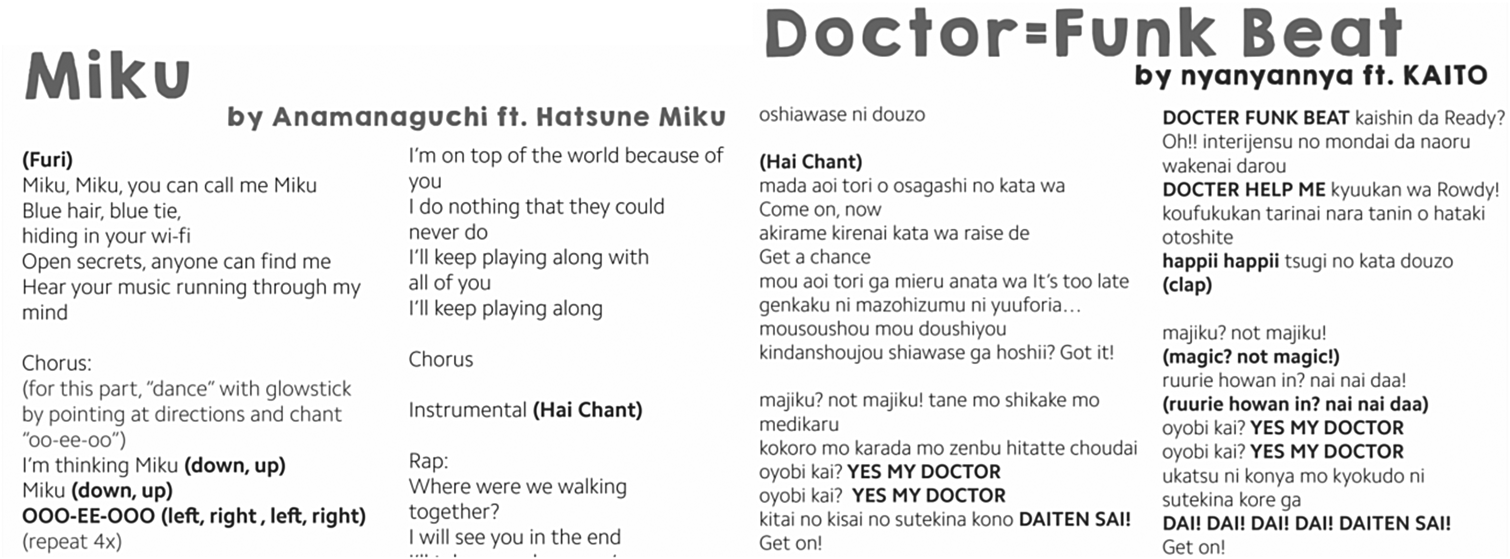
The booklet's creators printed out hundreds of paper copies at their own expense, handed them out at the Los Angeles and San Jose performances, and sought volunteers on Twitter to print and distribute copies at other concerts. This callbook was not created for seasoned Vocaloid fans, but for people who were perhaps attending their first Vocaloid concert without detailed preparation and could benefit from explanations of what ‘furi’ and ‘kecha’ were, and exactly when to do them (whether or not newcomers could actually reference these callbooks quickly enough for them to be helpful in a cramped and dark concert hall is another matter, but the generous intentions were apparent). It is important to note that this callbook is not prescriptive; it is merely descriptive, and serves as a record, in text form, of the practices that have gradually coalesced around these songs over the years.
Although some of these practices may originate organically in concert situations, many new additions have their origins online. Because of the interactive nature of NicoNico's commenting system, as discussed earlier, comments that are shown in real time at catchy or climactic moments often snowball into ‘sing-along’ moments, as growing numbers of users add their typed-out echoes to the comment stream. These practices often carry over into live concerts, where thousands of fans who have never met but have watched these videos online can immediately participate all together. The ‘missing story’ that the journalists quoted earlier were looking for at Vocaloid concerts is not found onstage in the preprogrammed holographic dance moves. At Miku Expo 2018, the story was clearly unfolding all around me in this microcosm of participatory fandom. It was in the deep emotional connection the fans had with Vocaloid songs and the opportunity to join in with a practiced, embodied group expression of fan enthusiasm.
In the final section of this article, by examining a different format for Vocaloid concerts, I will argue that tethering a Vocaloid performance to the conventions of human pop concerts has diluted the unique strengths and possibilities of this medium. Sigman (Reference Sigman2020) argues along similar lines in his study of ‘robot opera’ – performances in which human presence is reduced or eliminated and technology is foregrounded – drawing on a range of examples to demonstrate that these performances afford artists an expanded field of possibilities, and can no longer be labelled as mere gimmicks (p. 36). In order to understand the expanded possibilities offered by Vocaloid, we can examine holographic performance in a format that minimises its reliance on pre-existing conventions. Once the scaffolding of pop concert convention is stripped away, what new forms of artistic competency can we see emerging and being refined by Vocaloid users, and what do they mean for performers and listeners? As I will show in the following section, annual Vocaloid performances staged in Japan at an event called NicoNico Chokaigi offer an entirely different perspective on Vocaloid performance by eschewing the structures and procedures of human concerts that have defined Miku Expo in the West.
Vocaloid performance at NicoNico Chokaigi
NicoNico Chokaigi, billed as an event that seeks ‘to recreate NicoNico's virtual world in real life’, takes place each spring in Saitama, Japan, drawing more than 150 000 visitors to the convention site and 5.5 million live-stream viewers online (Dwango Co. 2019). Featuring exhibits and performances centring on the social video website's most popular content (including Kabuki theatre, trains, cooking, dance routines, video games and Vocaloid), Chokaigi has been growing in size and scope since the first event was held in 2012. People who want to attend Chokaigi can participate in one of two ways: they can either purchase a ticket to physically attend the event onsite in Saitama or pay to watch a live online broadcast of the performances featured at the event.
Pay-per-view options for online viewership are by no means unique to Chokaigi, but what is unique about this event is the way in which the organisers attempt to replicate the online viewing experience of NicoNico at the Chokaigi event, by integrating the comments from viewers who are watching the livestream online into the live performances taking place in Saitama. On either side of the stage at the physical convention site, two huge screens offer not only the usual close-up shots of the action onstage, but also a live feed of the comments being contributed by online viewers. These comments scroll across the video on the stage-side screens, just as they do when watching any video on NicoNico. The difference here is that the comments are contributed and displayed in the arena as the event unfolds in real time, offering fans who are unable to attend in person an opportunity to participate from their home computers in a way that visibly adds to the excitement and dialogue in the arena itself. Other streaming services such as Twitch feature similar live commenting capabilities during streaming events, but Chokaigi is unique in the way that it integrates online viewers’ contributions in a way that is visible to spectators standing in the arena, and not only to other online viewers. This configuration dissolves part of the divide between ‘onsite’ and ‘online’ interactions, making the participation of an online attendee whose typed reaction appears on the side screens just as visible in real time as an attendee who waves a glowstick in the crowd.
Each year, Vocaloids have performed their own concert at NicoNico Chokaigi, and the show has become one of the most popular and highly anticipated performances in the two-day event. Chokaigi performances differ significantly from Vocaloid concerts in the West that frame Hatsune Miku as a humanised pop singer, however. Rather than having the Vocaloid performers take a mic at centre stage like a human performer, introductions to the Chokaigi performances frequently begin with human actors who present a brief skit in which they underscore the Vocaloids’ virtual existence – for example, by discovering them on a laptop screen, or miming a dramatic holographic conjuring. The Vocaloids themselves, in contrast, are never presented as human. Their virtual existence is foregrounded in this introduction as they smash their way out from behind holographic computer screens, materialise from masses of glitchy pixels, or feature in retrospective montages which sum up Vocaloid's computer-based history, clearly emphasising their digital context before they take the stage in any sort of performative fashion.
The 2014 NicoNico Chokaigi Vocaloid performance offers a clear example of this type of concert introduction, and also serves to shed light on other specific contrasts between a Chokaigi performance and a Miku Expo performance in the West. Video footage from Chokaigi 2014 shows four human performers standing at the front of the stage around a wooden barrel organ typical of street performers in the 19th century. One person turns the crank on the organ slowly and intentionally, swaying in time to a music-box tune that plays out into the crowded venue. The mechanical notes of the music box melody chime steadily into the silence for a few moments, and then eventually halt, but the human organ grinder continues to rotate the crank in a slow, seemingly ineffectual circle. For what purpose? This scene onstage frames the concert, and even Vocaloid music itself, in a significant way. The barrel organ itself is a pre-programmed musical machine, similar to Vocaloid, with pins on a cylinder in place of pixels on a screen. Linking the barrel organ with music at a Vocaloid concert serves to reinforce the holographic singers’ image as automated performers. This visual link positions Vocaloids as descendants of the barrel organ, the player piano and the sequencer in the history of automated music-making.
As the organ grinder continues to rotate the crank, instead of another barrel organ melody, the disembodied voice of Hatsune Miku abruptly begins spitting out a machine-gun-like string of monotone syllables at a rate so fast as to be all but incomprehensible. The spotlight gradually fades on the organ grinder – who is still dutifully turning the crank that now seems to be powering the inhuman stream of syllables uttered by the Vocaloid – and as Miku's outline becomes recognisable on the screen, an arena full of fans scream their approval and raise their glowsticks. The sea of multi-coloured glowsticks in the arena gradually shifts to a more unified wash of Hatsune Miku's particular shade of green as fans identify the Vocaloid's silhouette and flick their devices to chromatically align themselves with the hologram. Still emitting a robotic stream of uninterrupted syllables, Miku then takes up her usual series of pop-inspired dance moves, but while her body is moving at a comfortable pace, in an eerie juxtaposition, her mouth continues to work at a superhuman speed that almost becomes a blur.
The significance of this breathless, robotic song as an opening number lies in its stark contrast with the politely pop openings of Miku Expo concerts in the West. This song is a NicoNico hit titled ‘The Disappearance of Hatsune Miku -DEAD END-’ (hatsune miku no shoushitsu -DEAD END-). Its infamous lyrics are spat out at an uncanny rate of 720 syllables per minute in the verses – a speed considered to be impossible for humans. The song is a first-person narration by Hatsune Miku, describing her feelings as she is uninstalled by a user, and realises that she will always remain subject to the whims of her creators, unable to exert agency to prevent her uninstallation despite her wish to continue singing. Certain moments in the song utilise extreme vocal distortion to achieve effects simulating digital decay as Miku gradually fades from existence, drawing on the affect of glitch aesthetics to suggest a breakdown of communication and anxieties about the failure of digital systems.Footnote 4 In the final seconds of the song, after the Vocaloid haltingly utters a breathy farewell, a message repeats: ‘A critical error has occurred. A critical error …’ (shinkoku no eraa ga hassei shimashita). Opening a show with a grim underscoring of the limitations of the singer's purely digital existence does not serve to generate the organic rapport of a concert given by a human performer, and would not reassure the Western critics of the concerts who felt as though they were watching a music video. Rather than creating an approximation of a human performance, this selection serves to emphasise Miku's inhuman qualities.
NicoNico Chokaigi performances are stripped of many of the customs of concerts with live singers. There are no opening acts, no band introductions, no microphone stands at centre stage, and no encores. Much more so than other concerts and tours, Chokaigi performances take advantage of the virtual nature of Vocaloid singers, throwing their images about during numerous instantaneous set changes, dropping them underwater and smashing them through glass walls – all while continuing to perform flawless pop star choreography and sing their choruses without drawing a single breath out of place. The effect is anything but human, but far from being a shortcoming, this approach highlights the superhuman capabilities of the Vocaloid performers, amplifying and celebrating their digital freedoms.
Vocaloid's live touring concerts such as Miku Expo force their audiences to consider the spectacle on the same terms as a performance by any other pop star by adhering to the conventions of human concerts, and the reviews naturally treat them as such. For many fans, an essential part of a live concert is the physical presence of a performer who possesses a compelling stage presence and is able to create a feeling of rapport with their audience. Detractors who point to holographic singers’ inability to interact with a crowd are correct – Vocaloids currently possess no capacity to respond to their audiences in real time. There is no human connection developed between singer and fans over the course of a Vocaloid show. And while touring concerts in the West have frequently attempted to downplay this lack with humanising moments such as acoustic encores, band introductions and comments to the audience pre-programmed into the show, NicoNico Chokaigi opts for an opposite approach in many regards, choosing to foreground and celebrate much of the holographic artifice to which touring concerts avoid drawing attention. At Chokaigi – and at any live Vocaloid performance, including those in the West at which reviewers failed to understand this fully – the relationship between the figure onstage and the crowd is less important than the relationships that already exist within the community and have been built around the virtual figure of Hatsune Miku through the efforts of creators who compose and collaborate, and fans who participate in the creative culture that gave rise to the Vocaloid phenomenon. NicoNico Chokaigi was designed to emphasise and celebrate this creative community, as is evidenced by the side-screens that continuously stream the flood of comments from online viewers. These performances do not seek to erase the virtual nature of the show, but instead offer up a holographic smorgasbord of visual effects, with the year's best-loved tracks from NicoNico and the fans’ favourite characters at the centre of it all.
Being present at one of these performances is about being a part of a collective. Every time a new Vocaloid takes to the stage and the crowd switches the colour of their glowsticks, it isn't for the sake of the Vocaloid. Since there are no humans on stage, the show of colour isn't directed at the performer. It is a participatory act that connects the glowstick-bearers in a sense of belonging and unity with the rest of the arena – an insider's badge that identifies the participant as a member of the same amateur community that views, comments on and connects this diverse web of creative contributions.Footnote 5 These participatory actions taking place in the audience at Chokaigi are the same as those at Miku Expo, which suggests that holographic microphone stands, opening bands, and pre-programmed encores aren't integral to a Vocaloid concert experience. At the core of this concert format is the shared excitement of contributing practised actions in a group environment, and the expression of fandom in a live setting.
Conclusion
Comparing these concert formats in the West and in Japan reveals the unique participatory experiences that characterise Vocaloid performances. Because Vocaloid is new, these specific participatory actions and their meanings are also new. However, Vocaloid performances have certain elements in common with other participatory events such as cult film screenings, and these similarities are revealing as well. People attend screenings of The Rocky Horror Picture Show to enthusiastically fling rice and toast – and, in fact, even to shout calls and wave glowsticks – at the correct moments in the movie. Austin's classic study of cult film audiences demonstrated that it was the event itself (including the preparation, the waiting and the active participation), rather than the film, that attracted and supported a dedicated fan following (Austin Reference Austin1981). Similarly, Vocaloid fans attend live performances – and undergo the same rituals of preparation, waiting and active participation – as an opportunity to participate in the creation of new cultural meaning in an audience of enthusiastic fans. These audiences are more than just passive spectators, and serve as interpretive communities within a fan culture.
Media scholars have given significant attention to group identification and fan interaction, using theories of performative fandom to describe Harry Potter fan fiction and Dr Who-themed weddings, but Vocaloid has only recently begun to receive consideration that is informed by fan culture perspectives. Compared with other on-screen participatory events, Vocaloid music is a valuable object of study because it has an additional layer of meaning, owing to the fact that the object of the fans’ appreciation, study and participatory actions – the music itself – is fan-made. Although they are often written in a pop idiom, Vocaloid songs are not composed by professional songwriters seeking to make money, which means that attending a live Vocaloid concert is different than attending an interactive movie screening because of the deep sense of ownership and participation in the production of this music. Questions about who exactly is making money on these elaborate holographic tours, how they are driving profits and how this affects Vocaloid fan culture are important, and similar issues have received consideration by Jørgensen et al. (Reference Jørgensen, Vitting-Seerup and Wallevik2017) and warrant further study. Although fans participate in and contribute to online Vocaloid culture without financial compensation, ticket prices at Miku Expo are high, the production costs involved with tours and arena concerts are considerable and the profits they generate rely on fans’ creative labour and emotional investment, creating a feedback loop in which Hatsune Miku's image is no longer neutral. While these questions remain, what I have addressed in this article is the way in which fan participation in this new performance medium drives the creation of cultural meaning within the Vocaloid community. Furthermore, I have distinguished between the technological anxiety among reviewers who centre the definition of liveness on the performer, and the feelings of comfort and belonging fostered by these same predictable and repetitive technological elements, which in turn support the live experiences that unfold within the audience.
In a Vocaloid concert, the story is the medium itself, and the agents are not individual superstars, but the countless passionate contributors who, for more than a decade now, have devoted their time to songwriting, arranging, Vocaloid tuning, adaptation, dance creation, freeware development, animation, online commentary, motion capture and live concert participation. If reviewers attend looking for spontaneous improvisation by expert musicians, then they are, in fact, attending the wrong type of concert. However, I argue that automation is not simply a bad substitute for spontaneity. In order to create a setting where enthusiastic preparation and participation from fans can be a significant part of the show, two factors must be present: predictability and repeatability. Automation permits repeatability. And repeatability permits deeper investment in fan culture. Our era of digital communication has enabled performative fandom to become more pervasive and more precise than ever before. Looking past the superficial strangeness of holographic concerts, we stand to gain important insights about the nature of audience engagement in the 21st century. At events like these, the acts of fandom being performed are no longer directed towards a human performer. In many of the cases discussed in this article, there is no human performer present, and fans are not screaming for the attention of a figure onstage. Significantly, the performance taking place in the audience is directed inwards, as a performative act that is both an expression of personal fandom and a participatory action directed towards other fans. Participation, rather than passive observation, is key to the creation of new meaning in this environment. Vocaloid performance, then, is defined not by the pre-programmed sequence on the screen, but by the participatory experience shared by the fans in the audience.