Introduction
Over the past 40 years, both similarities and differences have been identified between the clinical and cognitive symptoms of bipolar disorder (BD) and schizophrenia (SZ). Bleuler’s conceptualisation has been reconsidered in clinical terms, opening up new fields of research comparing BD and SZ (Andreasen, Reference Andreasen1979). From a cognitive perspective, neuropsychological impairments are core features of both disorders, with no obvious specific neuropsychological signature that can facilitate the diagnostic differentiation between SZ and BD (Bortolato et al., Reference Bortolato, Miskowiak, Köhler, Vieta and Carvalho2015). For instance, patients with BD and patients with SZ both display language and thought symptoms (Andreasen, Reference Andreasen1979; Kircher et al., Reference Kircher, Krug, Stratmann, Ghazi, Schales, Frauenheim, Turner, Fährmann, Hornig, Katzev, Grosvald, Müller-Isberner and Nagels2014) that are partially subtended by the disruption of semantic processes (Andreou et al., Reference Andreou, Bozikas, Ramnalis, Giannakou and Fokas2013; Jamadar et al., Reference Jamadar, O’Neil, Pearlson, Ansari, Gill, Jagannathan and Assaf2013; Piguet et al., Reference Piguet, Desseilles, Cojan, Sterpenich, Dayer, Bertschy and Vuilleumier2014), particularly semantic inhibition (Wang et al., Reference Wang, Song, Cheung, Lui, Shum and Chan2013; Schneegans et al., Reference Schneegans, Hoenig, Ruchsow, Spitzer, Connemann and Kiefer2018). Semantic inhibition refers to the inhibition of a primed stimulus that is semantically related to the target (Neumann & DeSchepper, Reference Neumann and DeSchepper1991) and occurs only when the semantic network possesses three basic properties: priming, competition and shared activation (Howard et al., Reference Howard, Nickels, Coltheart and Cole-Virtue2006). Semantic processes are classically explored in clinical populations with tasks featuring homophones (Brown & Kuperberg, Reference Brown and Kuperberg2015). We can learn more about the time course of these processes and their impairments from event-related potentials (ERPs), especially the N400 component, a negative ERP that is notably modulated by the semantic process of contextual integration (Kutas & Federmeier, Reference Kutas and Federmeier2011). However, only three studies have so far explored the N400 component in BD (Ryu et al., Reference Ryu, An, Ha, Kim, Ha and Cho2012; Cermolacce et al., Reference Cermolacce, Faugere, Micoulaud-Franchi, Belzeaux, Maurel, Naudin, Azorin and Vion-Dury2014; Schneegans et al., Reference Schneegans, Hoenig, Ruchsow, Spitzer, Connemann and Kiefer2018).
We conducted a preliminary study to look for differences in semantic processing at the electrophysiological level between patients with BD versus SZ. Patients and healthy controls (HC) underwent EEG recording while they performed a semantic ambiguity resolution task featuring homophones in congruous and incongruous conditions. We predicted that the N400 effect would be modulated differently by semantic ambiguity among patients compared with controls, and among patients with BD versus SZ.
Material and methods
Participants
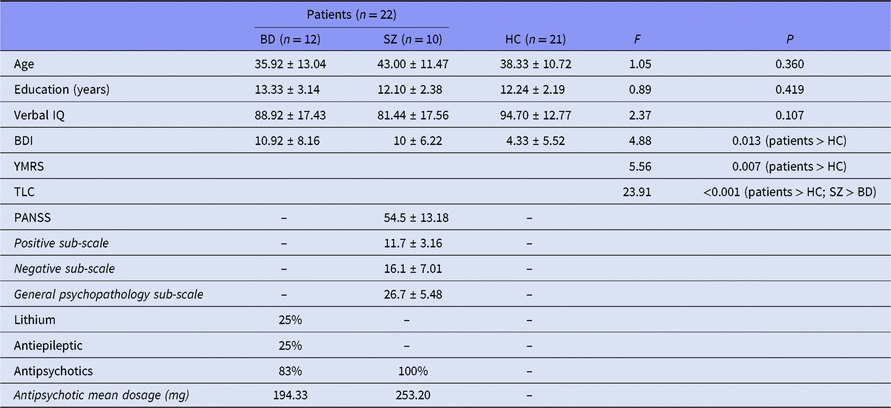
We included 22 right-handed patients: 12 with BD (4 men) and 10 with SZ (4 men). They all met the relevant DSM-IV-TR (American Psychiatric Association, 2000) diagnostic criteria. They were matched for age, education level and verbal IQ (as estimated by Part B of the Mill Hill Vocabulary Scale) with a group of 21 HC (8 men). Participants with intellectual disability, major chronic physical illness, organic mental disorder or substance dependence/abuse (except for nicotine dependence) and uncorrected visual and auditory impairment were excluded. To describe mood symptoms in our populations, we used the Beck Depression Inventory (Beck et al., Reference Beck, Ward and Mendelson1961) and the Young Mania Rating Scale (YMRS; Young et al., Reference Young, Biggs, Ziegler and Meyer1978) in all groups. Thought and language disorders were assessed with the Thought, Language and Communication scale (TLC; Andreasen, Reference Andreasen1979). In the population with schizophrenia, psychopathology was also assessed with the Positive and Negative Syndrome Scale (PANSS; Kay et al., 1986). The demographic and clinical characteristics of the groups are provided in Table 1. No significant difference was found between the two patient groups on antipsychotic dosage (t = 0.70, p = 0.489).
Demographic and clinical characteristics of the groups

IQ, intelligent quotient; BDI, Beck Depression Inventory; STAI, State-Trait Anxiety Inventory; YMRS, Young Mania Rating Scale; TLC, Thought, Language and Communication scale; PANSS, Positive and Negative Syndrome Scale.
Ethics statement
This study was conducted at Reims University Hospital, France, between February 2014 and March 2016. It was designed in accordance with the Declaration of Helsinki. The local ethics committee approved the study, and all participants gave their written informed consent before taking part.
Stimuli and design
Participants performed an ERP task of semantic ambiguity resolution adapted from Hoenig and Scheef (Reference Hoenig and Scheef2009) and described in Raucher-Chéné et al. (2017). Participants heard sentences that ended either with a homophone (ambiguous) or with a control word (unambiguous). Each sentence was followed by a target word displayed on a screen. This target word was either semantically related (congruent) or unrelated (incongruent) to the meaning of the sentence (e.g. featuring the homophone fairy/ferry: ‘she looks like a fairy’ TALE/BOAT). Participants were asked to decide whether or not the printed target word was related to the meaning of the context sentence they had just heard. The task featured four conditions: congruent ambiguous (CA), incongruent ambiguous (IA), congruent unambiguous (CU) and incongruent unambiguous (IU). Two lists of sentences were randomly used, with 22 or 23 sentences per condition.
EEG recording
Brain activity was recorded during the task via 32 electrodes arranged on the scalp according to the 10-10 system. The reference electrode was positioned at FCz, and the ground electrode was located at AFz. Electrode impedance was held below 5 kΩ. The amplification gain was 1000. To record the electro-oculogram, two electrodes were placed below and on the external canthus of the right eye, and the amplification gain was set at 500.
Preprocessing
The EEG signal was digitised online at a sampling rate of 250 Hz, with bandpass half-amplitude cut-offs of 0.01–100 Hz, and was filtered using a 20-Hz low-pass filter. All the electrodes were re-referenced offline to mean activity at the two mastoids. The EEG was segmented into epochs from 100 ms before target onset to 3000 ms after target onset. Baseline correction was performed for the 100ms period before each target onset. Eye blinks were checked by means of an independent component analysis method. Artefacts were also checked by means of an automated analysis performed by BrainVision Analyzer. The following artefact rejection criteria were applied to a period extending 200 ms either side of each epoch: (1) maximum permitted voltage of 50 μV/ms, (2) maximum absolute difference of 100 μV for a 200-ms interval and (3) minimum required activity in a 100-ms interval of 0.5 μV. Only participants with at least 50% (i.e. 11) of usable segments in each condition were retained for the analysis, resulting in the exclusion of two patients with BD and three HC. Thus, 20 patients (10 BD and 10 SZ) and 18 controls were included in the analyses. Artefact-free EEG trials were averaged separately in a 1.7-s time window for each condition: CA (mean number of trials: 19.37 ± 3.11, range: 12–23; HC: 19.89 ± 2.65; BD: 19.60 ± 2.99; SZ: 18.90 ± 3.11); IA (18.76 ± 2.99, 12–23; HC: 20.18 ± 1.70; BD: 18.01 ± 1.94; SZ: 17.9 ± 3.48); CU (19.18 ± 3.11, 12–22; HC: 19.22 ± 2.82; BD: 20.00 ± 2.71; SZ: 18.30 ± 3.09) and IU (19.45 ± 2.41, 12–23; HC: 20.09 ± 2.25; BD: 18.9 ± 2.28; SZ: 19.30 ± 2.17). The mean number of trials averaged in each condition did not differ significantly according to ambiguity, congruity or group, F(2, 35) = 0.65, p = 0.53. For the ERP data, in accordance with Schneegans et al. (Reference Schneegans, Hoenig, Ruchsow, Spitzer, Connemann and Kiefer2018), we focused our analysis of mean N400 amplitudes on a 400–600 ms time window for three pairs of contralateral centroparietal electrodes (CP1, CP5, C3 on the left hemisphere and CP2, CP6, C4 on the right hemisphere).
Statistical analyses
Statistical analyses were conducted using R software (R Core Team, Reference Raucher-Chéné, Terrien, Gobin, Gierski, Kaladjian and Besche-Richard2017), as well as the lme4 (Bates et al., Reference Bates, Mächler, Bolker and Walker2015), MuMIn (Barton, Reference Barton2018) and psych (Revelle, Reference Revelle2017) packages and the easieR megapackage (Stefaniak, Reference Stefaniak2018).
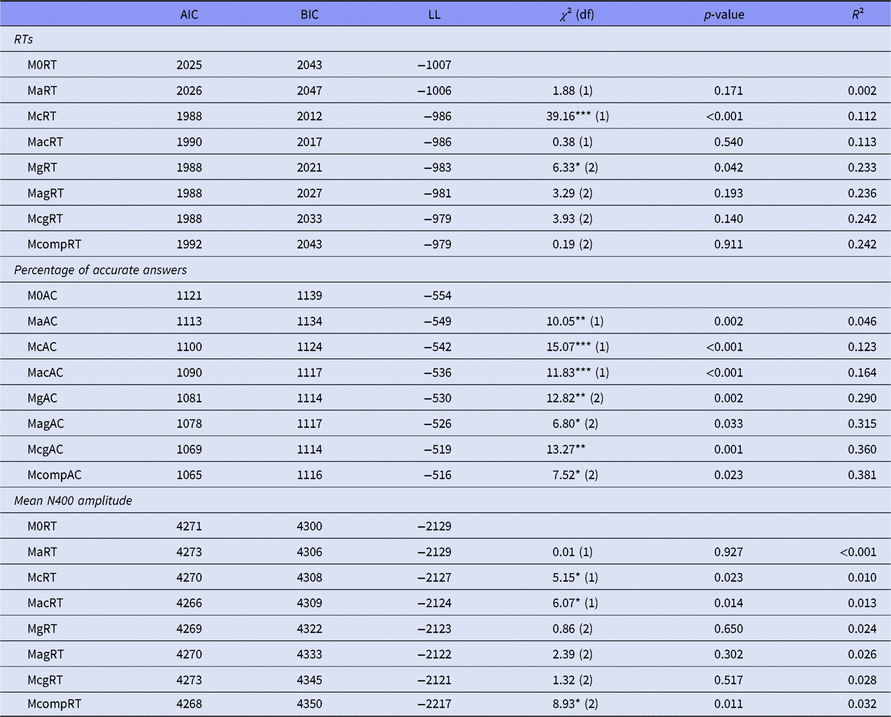
We separately submitted the mean reaction times (RTs), mean percentages of accurate answers and ERP data to a generalised linear mixed model, using an ascending method. Thus, for each analysis, the null model (M0RT/M0AC/M0ERP), including participants as random terms, as well as the intercept parameter, served as the point of comparison for the fit statistics set out in Table 2. We then introduced the effect of each variable of interest in turn to each previous model: (1) ambiguity (homophone vs. control) factor (MaRT/MaAC/MaERP), (2) congruity (congruent vs. incongruent) factor (McRT/McAC/McERP), (3) Ambiguity × Congruity interaction (MacRT/MacAC/MacERP), (4) group (BD vs. SZ vs. HC) factor (MgRT/MgAC/MgERP), (5) Ambiguity × Group interaction (MagRT/MagAC/MagERP), (6) Congruity × Group interaction (McgRT/McgAC/McgERP) and (7) Ambiguity × Congruity × Group interaction (McompRT/McompAC/McompERP). We ran two a priori contrasts to specify the effect of group. The first contrast compared patients (BD and SZ) with HC, and the second contrast compared BD with SZ. To go one step further, we ran Holm-corrected pairwise comparisons between groups on the ERP and accuracy data for the IA condition only, using the phia package (De Rosario-Martinez, Reference De Rosario-Martinez2015).
Fit statistics of the generalised linear mixed models on RTs, mean percentage of accurate answers and mean N400 amplitude

AIC, Akakie Information Criteria; BIC, Bayesian Information Criteria; LL, log likelihood for the model; χ², difference in deviance between the model and the previous one.
Significance: ***<0.001, **<0.01, *<0.05.
Each model was presented on Statistical Section.
To test the impact of mood, thought and language disorders or SZ symptoms in our patient populations, we calculated Spearman’s correlation coefficients between the clinical data (YMRS, PANSS and TLC scores) and N400 amplitudes recorded on the selected electrodes in the IA condition.
Results
Behavioural results
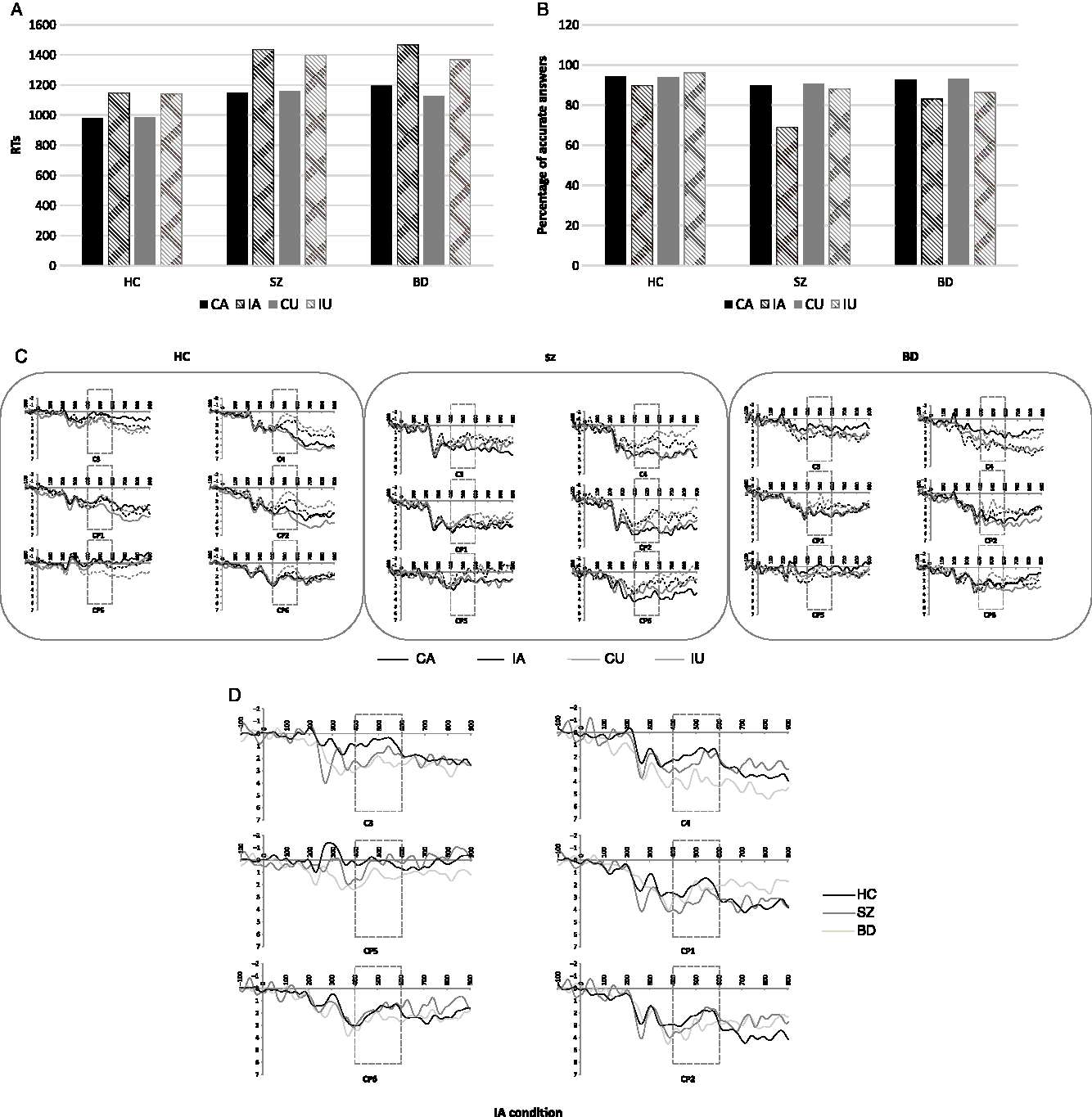
Mean RT (see Fig. 1(A)) analyses showed a significant effect of congruity, with longer RTs in incongruent conditions (1291 ms) than in congruent ones (1077 ms). The effect of group was also significant, with longer RTs for patients (BD: 1289 ms; SZ: 1285 ms) than for HC (1063 ms), t(37) = −2.63, p = 0.012, but no significant difference between BD and SZ, t < 1.
(A) Mean response times (RTs) in each condition (CA: congruent ambiguous; CU: congruent unambiguous; IA: incongruent ambiguous; IU: incongruent unambiguous) and for each group (HC: healthy controls; SZ: patients with schizophrenia; BD: patients with bipolar disorder). (B) Percentage of accurate answers in each condition (CA, CU, IA, IU) and for each group (HC, SZ, BD). (C) Event-related potentials for the six electrodes in each condition (CA, CU, IA, IU) and for each group (HC, SZ, BD). (D) Event-related potentials in the IA condition for each group (HC, SZ, BD).

For accuracy (see Fig. 1(B)), we found main effects of ambiguity, with fewer accurate answers in ambiguous conditions (87.39%) than in unambiguous ones (91.95%), and congruity, with fewer accurate answers in incongruent conditions (86.73%) than in congruent ones (92.6%1). There was also a significant Ambiguity × Congruity interaction, with a greater effect of congruity for homophones (10.21; congruent: 92.49%; incongruent: 82.28%) than for control words (1.56; congruent: 92.73%; incongruent: 91.17%). The main effect of the group was also significant, with fewer accurate responses for patients (BD: 88.67%; SZ: 84.33%) than for HC (93.4%), t(37) = 3.55, p = 0.001, but no significant difference between BD and SZ, t(37) = 1.65, p = 0.108. There was a significant Ambiguity × group interaction, as the difference between the unambiguous and ambiguous conditions was greater for patients with SZ (10; control words: 89.33%; homophones: 79.33%) than for patients with BD (1.78; control words: 89.56; homophones: 87.78%), t(37) = −2.47, p = 0.018, although there was no significant difference between HC (3; control words: 94.9%; homophones: 91.9%) and patients, t(37) = −1.17, p = 0.248. The Congruity × Group interaction was also significant, as the difference between congruent and incongruent conditions was greater for patients (BD: 8; congruent: 92.67%; incongruent: 84.67%; SZ: 11.78; congruent: 90.22%; incongruent: 78.44%) than for HC (1.18; congruent: 93.99%; incongruent: 92.81%), t(37) = 3.81, p < 0.001, although there was no significant difference between patients with BD versus SZ, t(37) = 1.22, p = 0.231. Moreover, there was a significant Ambiguity × Congruity × Group interaction: the effect of congruity was greater for homophones than for control words, and this difference was greater for patients with SZ (homophones: 21.09; congruent: 89.78%; incongruent: 68.69%; control words: 2.67; congruent: 90.67%; incongruent: 88.00%) than for patients with BD (homophones: 9.33; congruent: 92.44%; incongruent: 83.11%; control words: 6.67; congruent: 92.89%; incongruent: 86.22%), t(37) = −2.73, p = 0.009, whereas the Ambiguity × Congruity interaction did not differ significantly between HC and patients, t < 1.
Moreover, when we specifically considered the IA condition, in order to explore the semantic inhibition process, pairwise comparisons revealed fewer accurate answers for SZ (68.89%) than for either HC (89.67%), χ²(1) = 10.80, p = 0.001, or BD (83.11%), χ²(1) = 13.33, p < 0.001, and no significant difference between HC and BD, χ² < 1.
ERP results
Analyses revealed a main effect of congruity on ERP data (see Fig. 1(C)), with a greater mean N400 amplitude for incongruent targets (1.78 µV) than for congruent ones (2.45 µV). There was also a significant Ambiguity × Congruence interaction, as the congruity effect was smaller for homophones (−0.31 µV; incongruent: 1.97 µV; congruent: 2.28 µV) than for control words (−1.04 µV; incongruent: 1.59 µV; congruent: 2.63 µV). Finally, the Ambiguity × Congruity × Group interaction was significant. The Ambiguity × Congruity interaction effect varied between BD and SZ, t(798) = 2.98, p = 0.053, but not between patients and HC, t < 1. For patients with SZ, the effect of congruity was greater for homophones (−1.42 µV; incongruent: 2.08 µV; congruent: 3.50 µV) than for control words (−1.00 µV; incongruent: 1.94 µV; congruent: 2.94 µV). For patients with BD, we found a similar effect of congruity for control words (−1.39 µV; incongruent: 1.47 µV; congruent: 2.86 µV), but the opposite effect for homophones (+0.61 µV; incongruent: 2.68 µV; congruent: 2.07 µV). When we specifically considered the IA condition (see Fig. 1(D)), in order to explore the semantic inhibition process, pairwise comparisons revealed a smaller mean N400 amplitude for BD (2.68 µV) than for HC (1.52 µV), χ²(1) = 4.18, p = 0.041, but no difference between either HC and SZ (2.08 µV), χ² < 1, or BD and SZ, χ²(1) = 2.86, p = 0.091.
Correlations between clinical variables and ERP recordings
No significant correlations were found between clinical variables (YMRS, PANSS and TLC score) and N400 amplitude in the IA condition in the patient group (ps > 0.091). Nor was any correlation found between N400 amplitude in the IA condition and mean antipsychotic dosage (ps > 0.126).
Discussion
As in a previous study (Raucher-Chéné et al., 2017) conducted with the same semantic ambiguity resolution task, we found congruity effects at both the behavioural and electrophysiological levels. However, the specific objective of the present study was to compare semantic processing both between patients with BD or SZ and HCs and between the two patient groups. At the behavioural level, compared with HC, patients exhibited a greater congruity effect for homophones than for control words, whereas no difference was found between the SZ and BD patient groups. At the electrophysiological level, however, results differed between patients with SZ versus BD. For the former, the N400 congruity effect was greater for homophones than for control words, whereas for the latter, it was great for control words than for homophones.
Our behavioural results are in accordance with the literature showing that both patient populations (SZ and BD) have semantic processing impairments (Brown & Kuperberg, Reference Brown and Kuperberg2015; Schneegans et al., Reference Schneegans, Hoenig, Ruchsow, Spitzer, Connemann and Kiefer2018). Many studies have demonstrated a semantic bias in interpreting ambiguous words among patients with SZ compared with HC, characterised by difficulty integrating the context (Salisbury, Reference Salisbury2010). However, few studies have compared patients with SZ and BD on N400 amplitude. For example, Ryu et al. (Reference Ryu, An, Ha, Kim, Ha and Cho2012) reported greater N400 amplitudes for congruent words among manic patients and smaller N400 amplitudes for incongruent words among patients with SZ than in other groups.
To take our analyses one step further, we specifically focused on the IA condition eliciting semantic inhibition. No difference was found at the behavioural level between BD and HC, but the ERP results did differ, with a smaller N400 amplitude in patients with BD than in HC. It should be noted that a previous study of hypomanic personality traits found that the higher the Social Vitality sub-score, the smaller the N400 amplitude over the frontocentral region of interest in the IA condition (Raucher-Chéné et al., 2017). Here, we can hypothesise that in patients with BD, the semantic processing impairment stems from overactivation of the dominant meaning of the homophone and difficulty inhibiting this meaning that is perceptible in the N400 modulation, but compensated for at the behavioural level.
Our study had several limitations that need to be addressed, such as the small number of participants, the low number of trials, the putative impact of psychotropic drugs on the EEG waveforms and limitations arising from the material itself, which prevented us from exploring the topographical aspects of our results. Nevertheless, the results of our preliminary study exploring semantic processes in patients with BD and SZ support the differentiation of processing between these two populations. Further studies with larger populations are required to understand the mechanisms behind formal thought disorders more clearly and to promote the development of neurophysiological markers that discriminate between these two disorders.
Supplementary material
To view supplementary material for this article, please visit https://doi.org/10.1017/neu.2019.9.
Author ORCIDs
D. Raucher-Chéné, 0000-0002-5663-4454
Acknowledgements
We are grateful to Elizabeth Portier for reviewing English.
Authors contributions
DRC, ST, FG, AK and CBR participated in the conception and design of the study, DRC and ST conducted the data acquisition and analysis and DRC, ST and PG contributed to the drafting of the first version of the manuscript. All the authors read and approved the final version.
Financial support
This research did not receive any specific grant from funding agencies in the public, commercial, or not-for-profit sectors.
Conflict of interest
Dr. Raucher-Chéné reports personal fees from LUNDBECK SAS, non-financial support from EISAI SAS, and personal fees and non-financial support from OTSUKA PHARMACEUTICAL, outside the submitted work. Dr. Terrien, Dr. Gobin, Dr. Gierski, Pr. Kaladjian and Pr. Besche-Richard have nothing to disclose.