This report has three interlocking goals. The first examines the co-occurrence of externalizing and internalizing child symptoms for 2 years during family reunification following their fathers’ deployments to recent Middle East conflicts. The second goal is more novel. Co-occurrence (or comorbidity) focuses on the individual. We focus on describing sequential cascades of individual adjustment problems at a family- systems level following fathers’ military deployment to war zones and combat-related trauma exposure, a significant family transition that challenges family members’ adjustment (Gewirtz, Polusny, DeGarmo, Khaylis, & Erbes, Reference Gewirtz, Polusny, DeGarmo, Khaylis and Erbes2010; Lester et al., Reference Lester, Peterson, Reeves, Krauss, Glover and Mogil2010; Milliken, Auchterlonie, & Hoge, Reference Milliken, Auchterlonie and Hoge2007). Third, we use an ontological perspective to examine occurrence and co-occurrence of child externalizing and internalizing symptoms as a function of child and parent emotion regulatory processes, and whether the quality of parent–child relationships serve as key social processes that account for the concurrent and prospective linkages between parental posttraumatic stress disorder (PTSD) symptoms and child internalizing and externalizing symptoms. Child externalizing and internalizing symptoms and their co-occurrence are examined in a longitudinal framework with multiple levels: (a) the family system social context (transactional linkages and cascades of family members’ emotional and behavioral symptoms), (b) the individual vulnerability of each family member (negative emotion reactivity and dysregulation), and (c) the quality of the relationships between family members as assessed by observed parent positive engagement and coercive behavior during interaction with their children.
The following sections describe the multilevel variables included in the hypothesized cascade model. We describe the unique family–developmental transition, which serves as a context for the hypothesized models: fathers’ deployment and trauma exposure during military service in the Operation Enduring Freedom/Operation Iraqi Freedom/Operation New Dawn (OEF/OIF/OND) conflicts. Next, we describe research and theory related to co-occurring child internalizing and externalizing symptoms, and the covariation and cascades of emotional and behavioral problems across family members. Finally, we examine social processes that may link parental PTSD symptoms with their children's development of internalizing and externalizing symptoms, and how children's symptoms, in turn, may affect ongoing parental adjustment.
Parental Military Deployment to Conflict Zones
Parent deployment and involvement in combat and exposure to war-related trauma represent substantial challenges to the deployed parent and to nondeployed intimate partners and their children. Military service members’ combat involvement and trauma exposure increase risk for PTSD, depression, substance use, and violent behavior (Vasterling et al., Reference Vasterling, Proctor, Friedman, Hoge, Heeren and King2010); and these problems may persist and grow during years after deployment (Smith et al., Reference Smith, Ryan, Wingard, Slymen, Sallis and Kritz-Silverstein2007). The multiple and lengthy absences, role transitions, awareness of threats to well-being of the deployed parent, and management of the postdeployment health of service members are sources of considerable stress and challenge to intimate partners and children (Khaylis, Polusny, Erbes, Gewirtz, & Rath, Reference Khaylis, Polusny, Erbes, Gewirtz and Rath2011). Nondeployed spouses take on increasing parenting roles, work, and other management responsibilities. Children move through normative development and transitions in the absence of direct support from the deployed parent (Lester et al., Reference Lester, Peterson, Reeves, Krauss, Glover and Mogil2010). These challenges do not “go away” during postdeployment family reintegration. Roles, responsibilities, and relationships continue to be renegotiated and rebalanced. The postdeployment period is characterized by considerable risk for depression, PTSD, and other forms of anxiety of nondeployed intimate partners (Erbes, Meis, Polusny, & Compton, Reference Erbes, Meis, Polusny and Compton2011) and for child internalizing and externalizing symptoms (Lester et al., Reference Lester, Peterson, Reeves, Krauss, Glover and Mogil2010).
The impact of deployment is also apparent in family relationships. There is increased risk for intimate partner conflict and violence (Monson, Taft, & Fredman, Reference Monson, Taft and Fredman2009). Parenting may be diminished during deployment absences, and parenting roles and parent–child relationships need to be reestablished and renegotiated during postdeployment periods (Gewirtz & Davis, Reference Gewirtz, Davis, MacDermid and Riggs2014; Gewirtz, Erbes, Polusny, & Forgatch, Reference Gewirtz, Erbes, Polusny and Forgatch2011). These family systemic effects reflect multilevel processes in which each family members’ emotion regulatory capacity and adjustment, as well as their functional capacity to renew and sustain mutually supportive family relationships, reciprocally and iteratively contribute to their relative resilience or risk in response to the challenges faced during deployment and postdeployment periods (Pietrzak, Johnson, Goldstein, Malley, & Southwick, Reference Pietrzak, Johnson, Goldstein, Malley and Southwick2009).
Research on military service members who have been deployed to war zones and exposed to violence and trauma, and on their intimate partners and children, provides a unique opportunity to understand the individual and family processes related to risk and resilience. Relative to other challenges experienced by families, deployment of a parent to a war zone involves protracted, clearly identified absences and systems-level role transitions. Deployment to war zones often involves exposure to traumatic events and experiences that are vicarious and direct challenges to their nondeployed intimate partners and children (Salzman et al., Reference Salzman, Lester, Beardslee, Layne, Woodward and Nash2011). In this context, we examine the reverberation of adjustment problems through the family system, and how family members’ emotion-regulatory capacities and parent–child relationship quality may mitigate or exacerbate the cascade of individual-level problems in adjustment.
Co-occurrence and cascades of adjustment problems
Co-occurrence of child externalizing and internalizing symptoms
Co-occurring internalizing and externalizing symptoms during childhood and adolescence occur at rates far greater than expected by chance, represent more serious and chronic disturbance, and presage worse developmental outcomes than non-co-occurring adjustment symptoms (Oland & Shaw, Reference Oland and Shaw2005). Two issues arise in the study of co-occurrence. The first concerns the relative timing and sequencing of trajectories of externalizing and internalizing symptoms. Many longitudinal studies of the temporal relationships between internalizing and externalizing symptoms suggest that externalizing symptoms precede and evoke internalizing symptoms via intermediary processes such as academic and social failure (Patterson & Stoolmiller, Reference Patterson and Stoolmiller1991). Fewer studies find the reverse developmental sequence in which children may act out distress as externalizing symptoms (Lemeirise & Arsenio, Reference Lemeirse and Arsenio2000; Oland & Shaw, Reference Oland and Shaw2005).
We explore same-time co-occurrence and temporal sequencing of internalizing and externalizing symptoms to better describe the heterotypical range of symptoms displayed by children in the context of parental military deployment to war zones. We hypothesize that internalizing symptoms would accelerate externalizing problems. This context-specific hypothesis rests on the notion that child responses to parental combat exposure may more strongly involve worry and anxiety rather than externalizing problems. In support of this hypothesis, Lester et al. (Reference Lester, Peterson, Reeves, Krauss, Glover and Mogil2010) report higher levels of anxiety relative to community norms for children with a parent deployed to the OIF/OEF conflicts. Davidson and Mellor (Reference Davidson and Mellor2001) provide data suggesting military veterans’ PTSD symptoms are linked to increased risk for child anxiety symptoms through compromised affective involvement and problem solving in the family.
The second issue related to the co-occurrence of child internalizing and externalizing symptoms involves identifying the shared and unique risk factors associated with each set of symptoms. Both shared and unique child temperamental factors and social–environmental processes have been identified (Oland & Shaw, Reference Oland and Shaw2005). As described later, we examine how risk processes at three levels are related to the range and durability of child internalizing and externalizing symptoms: parent PTSD symptoms and emotion regulatory capacities, child negative emotional reactivity, and parent–child relationship quality. We also explore how child internalizing and externalizing symptoms are associated with deployed and nondeployed parents’ PTSD symptoms in full transactional models.
Family-systemic cascades among individual family members’ adjustment
The experiences of deployed parents during military service in war zones provides a key initiating context for symptom cascades across family members. The substantial trauma experienced by military service members during the recent Middle East conflicts is well documented. National Guard and Reserve military service members report a mean of more than three combat-related traumatic events, and a mean of more than five traumatic events involving the aftermath of combat (King, King, Vogt, Knight, & Samper, Reference King, King, Vogt, Knight and Samper2006). This trauma is prospectively associated with a two- to threefold increase in risk for the diagnosis of new onset PTSD relative to deployment alone or to nondeployment (Smith et al., Reference Smith, Ryan, Wingard, Slymen, Sallis and Kritz-Silverstein2007). The prevalence of PTSD for National Guard and Reservists serving in the OIF/OEF conflicts ranges from 10% to 20% (Dursa, Reinhard, Barth, & Schneiderman, Reference Dursa, Reinhard, Barth and Schneiderman2014), with considerable subclinical symptom expression. Symptoms of PTSD persist and often increase during the postdeployment period (Smith et al., Reference Smith, Ryan, Wingard, Slymen, Sallis and Kritz-Silverstein2007). Persistent and delayed PTSD symptoms are particularly characteristic of National Guard and Reservist personnel serving in the Middle East conflicts (Milliken et al., Reference Milliken, Auchterlonie and Hoge2007).
Risk for PTSD posed by exposure to war-related trauma is variable, and depends on postdeployment stress and social support (Polusny et al., Reference Polusny, Erbes, Murdock, Arbisi, Thuras and Rath2011). Service members’ regulation of persistent, intrusive, and unwanted aversive thoughts and feelings engendered by war-related experiences contributes to risk for PTSD. Individuals who attempt to avoid, escape, or alter the form, frequency, or context of negative thoughts, memories, or feelings (i.e., who are experientially avoidant) are at greater risk for PTSD (Kashdan, Morina, & Priebe, Reference Kashdan, Morina and Priebe2009). Meyer, Morissette, Kimbrel, Kruse, and Bird Gulliver (Reference Meyer, Morissette, Kimbrel, Kruse and Bird Gulliver2013) report that experiential avoidance is a reliable predictor of PTSD symptoms of military service veterans exposed to trauma during deployment to OIF/OEF and predicts the maintenance of PTSD symptoms (Kumpula, Orcutt, Bardeen, & Varkovitsky, Reference Kumpula, Orcutt, Bardeen and Varkovitzky2011). Trauma exposure and experiential avoidance reported by deployed parents are incorporated as risk factors for PTSD symptoms as one component of the family-systems cascade of adjustment problems.
Pursuant to deployed parents’ PTSD as one source in the cascade model, the question becomes how deployed parents’ PTSD symptoms reverberate through the family system to affect and be affected by their intimate partners’ and children's adjustment. Epidemiological studies indicate significant familial aggregation between parents and children for depression, anxiety disorders, and antisocial behavior, with some specificity of aggregation between parents and children for internalizing and externalizing disorders (Kendler, Davis, & Kessler, Reference Kendler, Davis and Kessler1997). Recent research has specifically focused on the degree to which military service members’ PTSD symptoms or disorder are associated with their intimate partners’ and children's concurrent adjustment. Some data suggest co-occurrence of PTSD symptoms of male service members and their intimate partners (Gorman, Blow, Ames, & Reed, Reference Gorman, Blow, Ames and Reed2011), but most research indicates that service members’ PTSD symptoms increase risk for their intimate partners’ more general psychological distress, including anxiety and depression (Westerink & Giarratano, Reference Westerink and Giarratano1999) rather than being specific to PTSD. Children of parents with combat-related PTSD are at increased risk for displaying depression, anxiety, and behavioral problems relative to community control samples (Lester et al., Reference Lester, Peterson, Reeves, Krauss, Glover and Mogil2010).
Extant studies of the aggregation of family members’ adjustment problems following parental combat deployment have not assessed each family member's adjustment repeatedly over time, nor the cascading linkages among family members’ symptoms using a transactional design. Using repeated measures of deployed fathers’ and their intimate partners’ PTSD symptoms, and their children's internalizing and externalizing symptoms, we tested the hypothesis that family members’ symptoms are concurrently and prospectively interconnected in a cascading manner.
Family members’ emotional reactivity and regulation
Child negative emotionality
Temperament is an important contributor to child social and emotional development (Nigg, Reference Nigg2006). The focus in this report is on child negative emotional reactivity. Negative emotional reactivity refers to frequent and intense emotional responses to stressful environmental events, expressed at emotional, physiological, and behavioral levels. In terms of emotional experience and display, it encompasses fear and sadness, as well as anger and irritability (Kiff, Lengua, & Zalewski, Reference Kiff, Lengua and Zalewski2011). Negative emotional reactivity is biologically associated with heightened responsiveness in the hypothalamus–pituitary–adrenal axis, and with reduced respiratory sinus arrhythmia, which in turn covaries with risk for both externalizing and internalizing problems (Beauchaine, Reference Beauchaine2001). Depending on its interaction with other neurobiological subsystems and processes, negative emotional reactivity may lead to aggressive behavior or to avoidance and withdrawal (Beauchaine, Reference Beauchaine2001). Negative emotionality has been found to have a genetic component in both behavioral (Goldsmith, Lemry, Buss, & Compos, Reference Goldsmith, Lemry, Buss and Compos1999) and molecular genetic studies (involving single nucleotide polymorphisms associated with the serotonin transporter processes; Hariri & Holmes, Reference Hariri and Holmes2006). It shares common genetic variance with both child externalizing and internalizing symptoms (Tackett et al., Reference Tackett, Lahey, VanHulle, Waldman, Krueger and Rathouz2013).
Research has substantiated the contribution of child negative emotional reactivity to risk for child maladjustment. Eisenberg et al. (Reference Eisenberg, Sadovsky, Spinrad, Fabes, Losoya and Valente2005, Reference Eisenberg, Valente, Spinrad, Liew, Reiser and Zhou2009) have found children's negative emotionality is concurrently and prospectively associated with trajectories for child internalizing and externalizing symptoms, and even more strongly with their co-occurrence. Some research suggests that regulation of sadness and fear is more strongly related to internalizing symptoms, whereas regulation of anger/irritability is more strongly related to externalizing symptoms (Eisenberg et al., Reference Eisenberg, Sadovsky, Spinrad, Fabes, Losoya and Valente2005; Kiff et al., Reference Kiff, Lengua and Zalewski2011).
Negative emotionality may be amplified by ineffective, intrusive, and coercive parenting and mitigated by sensitive, skilled parenting. The effects of child negative emotional reactivity and coercive parenting are often reciprocal; child anger and irritability may be evoked by parental coercion and also provoke parental countercoercion, resulting in recurrent and sometimes escalating conflict (Snyder & Stoolmiller, Reference Snyder, Stoolmiller, Reid, Patterson and Snyder2002). The reciprocity of negative emotional and behavioral exchanges may also reflect passive and evocative gene–environment correlations, and indirectly promote the development of emotion dysregulation of both parents and children through parent–child interactions (Cole, Hall, & Hajal, Reference Cole, Hall, Hajal, Beauchaine and Hinshaw2013). In summary, negative emotional reactivity reflects genetic and intermediary neurobiological processes that complement social environmental risk processes in the development of co-occurring child symptoms. Negative emotion reactivity and emotion dysregulation may be related to comorbidity as well as having specific effects on internalizing and externalizing symptoms. Child negative emotional reactivity also interacts in synergistic ways with parenting to affect child adjustment.
Parent mindfulness and emotion regulation
Parents’ emotion regulation and mindfulness contribute to child adjustment in direct and indirect ways. Parents’ emotional regulation and mindfulness are critical to managing the varied and significant challenges and stressors associated with deployment experiences and postdeployment reintegration. Parents’ emotion regulation promotes their own adjustment following trauma exposure (Kopala-Sibley et al., Reference Kopala-Sibley, Kotov, Bromet, Carlson, Danzig and Black2016), and facilitates constructive engagement and reduces conflict with their children (Morris, Silk, Steinber, Myers, & Robinson, Reference Morris, Silk, Steinber, Myers and Robinson2009). Parents’ emotion regulation and mindfulness also provide modeling and coaching that shape their children's emotion regulation skills (Snyder et al., Reference Snyder, Lowe, Bullard, Schrepferman, Wachlarowicz, Marvin, Larzelere, Sheffield and Harrist2013).
In addition to incrementing risk for developing PTSD symptoms following trauma exposure, service members’ experiential avoidance may diminish their capacity to respond constructively to family members’ strong emotions and need for attention during daily interaction. These emotions and demands may evoke unwanted negative affect in service members who then engage in experiential avoidance in an attempt to diminish or control its occurrence. Experiential avoidance may mediate and sustain the associations of trauma exposure and PTSD symptoms with service members’ avoidant and coercive–reactive behavior during family interaction (Galovsky & Lyons, Reference Galovski and Lyons2004; Snyder et al., Reference Snyder, Brockman, Gewirtz, Gird, Quattlebaum and Schmidt2016). Experientially avoidant individuals are less intentional, attentive, environmentally engaged, empathic, and emotionally regulated (Sandoz, Moyer, & Armelie, Reference Sandoz, Moyer and Armelie2015). We hypothesized that the experiential avoidance of deployed fathers would be associated with their own PTSD symptoms and indirectly with less supportive and more coercive social interaction with their children.
Nondeployed intimate partners are key family managers during the postdeployment period. They face multiple challenges: supporting the returning deployed partners who may be emotionally distressed and have multiple health problems, facilitating the deployed partner's reinvestment in coparenting, supporting their children's renewed relationship with the deployed parent, reestablishing their own relationship with their intimate partner, and renegotiating work and household management tasks (Gewirtz, McMorris, Hanson, & Daris, Reference Gewirtz, McMorris, Hanson and Davis2014). These challenges evoke frequent negative emotions, and require strong emotion regulation skills. Nondeployed intimate partners’ capacity for emotion regulation promotes their own well-being during the postdeployment period (Gewirtz & Davis, Reference Gewirtz, Davis, MacDermid and Riggs2014). It is also central to effective parenting (Morris et al., Reference Morris, Silk, Steinber, Myers and Robinson2009), including promoting their children's emotion regulation skills (Snyder et al., Reference Snyder, Lowe, Bullard, Schrepferman, Wachlarowicz, Marvin, Larzelere, Sheffield and Harrist2013), and to reestablishing a supportive relationship with intimate partners. We hypothesized mothers’ lack of emotion regulatory strategies would be associated with their own adjustment difficulties and with less supportive and more contentious social interaction with their children.
The Role of Parent–Child Relationship Quality in Symptom Cascades to Child Externalizing and Internalizing Behavior
Several classic longitudinal studies have shown that the impact of significant family transitions (e.g., economic hardship and divorce) on developmental trajectories into young adulthood is mediated through parenting skills and the quality of the parent–child relationship (Conger, Conger, Elder, Lorenz, & Simons, Reference Conger, Conger, Elder, Lorenz and Simons2008; Elder, Reference Elder1999). These transitions and stressors disrupt effective discipline and monitoring, diminish positive engagement and mutual support, and evoke increased coercive interaction. Building on these classic studies and concerns about the personal and familial costs engendered by multiple deployments of military service members to Middle East conflicts, recent studies have documented the impact of deployment, deployment-related trauma, and service members’ PTSD on family functioning and the adjustment of their spouses and children (Lester et al., Reference Lester, Peterson, Reeves, Krauss, Glover and Mogil2010). This research suggests the risk for child maladjustment associated with deployment and postdeployment family stressors and deployed parents’ PTSD is mediated by disruptions in effective parenting of deployed and nondeployed parents (Gewirtz et al., Reference Gewirtz, Erbes, Polusny and Forgatch2011). These disruptions may persist (MacDermid, Reference MacDermid2006) and even increase (Milliken et al., Reference Milliken, Auchterlonie and Hoge2007) for a substantial period of time during the postdeployment period.
Deployed parents’ PTSD symptoms and nondeployed parents’ distress challenge constructive parenting and parent–child relationship processes (Lester et al., Reference Lester, Peterson, Reeves, Krauss, Glover and Mogil2010). There is diminished involvement, support, and emotional responsiveness and expression (Davidson & Mellor, Reference Davidson and Mellor2001; Khaylis et al., Reference Khaylis, Polusny, Erbes, Gewirtz and Rath2011), and increased negative reactivity, conflict, and aggression (Salzman et al., Reference Salzman, Lester, Beardslee, Layne, Woodward and Nash2011). Parent PTSD, depression, and other forms of distress also disrupt effective discipline, monitoring, and problem solving (Galovski & Lyons, Reference Galovski and Lyons2004). Research suggests the relationships among parental adjustment, parent–child relationship quality, and child adjustment are transactional. Child adjustment problems and negative emotionality contribute to diminished involvement and engagement, and to increased coercion and conflict among family members. Child symptoms and dysfunctional family processes also erode social support and serve as potent sources of stress, which may maintain or exacerbate deployed and nondeployed parents’ PTSD symptoms and distress (Khaylis et al., Reference Khaylis, Polusny, Erbes, Gewirtz and Rath2011; Monson et al., Reference Monson, Taft and Fredman2009).
Extant research is limited by cross-sectional designs and reliance on global parent report of parent–child relationship quality and parenting behavior. Recent research using longitudinal designs and observation of parent–child interaction have replicated and extended earlier findings. Gewirtz, McMorris, et al. (Reference Gewirtz, McMorris, Hanson and Davis2014) found that growth in military service members’ PTSD during a 1-year postdeployment period predicted self-reported impairments in parenting practices, and that their PTSD mediated the association of combat experiences with impaired parenting. Brockman and colleagues (Reference Brockman, Snyder, Gewirtz, Gird, Quattlebaum and Schmidt2015) reported fathers’ postdeployment experiential avoidance was associated with less positive engagement, and with more withdrawal and distress avoidance during father–child interaction, after controlling for children's observed aversive behavior. Gewirtz, Zamir, and DeGarmo (2014) found the association of nondeployed mothers’ PTSD symptoms with parent, teacher, and child reports of child adjustment was mediated by unskilled parenting, and the association of deployed fathers’ PTSD symptoms with child adjustment was mediated through diminished marital adjustment and unskilled parenting.
Hypothesized model
This report examined the transactional relationships among parental PTSD symptoms, child internalizing and externalizing symptoms, and parent–child relationship quality during postdeployment using a longitudinal design, incorporating measures of each family member's difficulties in emotion regulation. The following nested hypotheses were tested.
-
Co-occurring child internalizing and externalizing symptoms: (a) Child internalizing and externalizing symptoms would evidence temporal continuity and concurrent intercorrelations, and (b) internalizing symptoms would prospectively predict higher levels of externalizing symptoms.
-
Symptom cascades across family members: (c) Deployed fathers’ and nondeployed mothers’ PTSD symptoms would be concurrently correlated with their children's internalizing and externalizing symptoms, and (d) there would be reciprocal prospective relationships between parent and child symptoms after controlling for concurrent associations and cross-time continuity in each family members’ symptoms.
-
Risk processes linking symptom cascades across family members: (e) Parents’ PTSD symptoms would be negatively associated with their positive engagement and positively associated with their reactivity-coercion during parent–child interaction, concurrently and transactionally over time; (f) parents’ positive engagement would be negatively associated with their children's internalizing symptoms, and parents’ reactivity–coercion would be positively associated with their children's externalizing symptoms, concurrently and transactionally over time; and (g) each parent's difficulties in emotion regulation would be positively related to that individual's PTSD symptoms and indirectly associated with lower levels of parental positive engagement and higher levels of reactivity–coercion.
Method
Participants
The participants were 184 male National Guard or Reserve military service members who had been deployed to OIF/OEF/OND conflicts, their intimate partner, and one target child per family between 4 and 13 years of age. The men were primarily White, non-Hispanic (85%), an average of 37.2 years old (SD = 6.5), relatively well educated (41.7% had some college education and 52.2% had a 4-year college or advanced degree), and middle to upper middle class (6.8% reported annual family incomes below $30,000, 25.8% from $30,000 to $60,000, and the remaining 67.4% above $60,000). The mean number of deployments was 2 (SD = 1.1, range = 1–8), and the mean total months of deployment was 24 months (SD = 11 months), comparable to that for National Guard and Reservists’ OIF/OEF/OND deployment patterns more generally (Department of Defense Task Force on Mental Health, 2007). The majority of the men were Army National Guard or Army Reservists (72.6%), with the remainder serving in other Guard/Reserve military branches. Based on self-reported military rank, 75.8% were enlisted men or warrant officers, and the remaining held ranks of second lieutenant or above.
The average age of intimate partners was 35.6 years (SD = 6). Most had some college education (39.3%), completed college (37.2%), or had an advanced degree (14.1%). Ninety-four percent of the coupled men were married at the first assessment, 1.9% had never been married, and 3.8% were separated or divorced. The mean length of relationships with partners was 9.6 years. The mean age of the target children was 8.3 years (SD = 2.4, range = 4.1–13.1 years), and 53.3% were girls. The mean number of children in the families was 2.4 (SD = 0.9, range = 1–5).
Procedure
The data for this report were derived from a subset of military service members and their families participating in a larger randomized trial of a parenting skills training intervention, After Deployment: Adaptive Parenting Tools (ADAPT). ADAPT was specifically designed to meet the needs of families of National Guard and Reserve service members deployed to OIF/OEF/OND conflicts (Gewirtz, Pinna, Hanson, & Brockberg, Reference Gewirtz, Pinna, Hanson and Brockberg2014). Participants were recruited via presentations at predeployment and reintegration events for National Guard and Reserve personnel in Minnesota, mailings from the Minneapolis Veterans Affairs Medical Center to OIF/OEF/OND veterans, family picnics for individual units or services, general community events for and by the military, and announcements in fliers, social media, and word of mouth, with facilitation by administrative military service officers and veterans affairs staff. Participation in the research was voluntary.
Interested families could go online to consent to participate, or do so after requesting contact with program staff. Consenting participants and their partners were directed to a Health Insurance Portability and Accountability Act compliant web site to complete separate initial online assessments. After completion of initial assessments, project staff scheduled an in-home assessment with family members during which additional self-report data were collected and video records of family interactions were obtained. Parents each received $25 for the online assessment, and the family received $50 for the in-home assessment. Following baseline assessment, families were randomized to a services-as-usual condition (family “tip sheets” and online parenting resources) or to the ADAPT intervention. Online and in-home self-report measures and rating scales and in-home videotaped family interaction were again collected at 12 and 24 months after the baseline. Baseline assessments occurred on average about 2 years (M = 28.3 months, SD = 28.1 months, range = 1–118 months) following the service members’ return home from their last deployment. The ADAPT intervention was delivered in a group format during the 6 months following baseline assessment.
Measures
Deployment Risk and Resilience Inventory (DRRI)
Two scales from the DRRI (King et al., Reference King, King, Vogt, Knight and Samper2006) assessed combat-related trauma at baseline. The Combat Experiences Scale is composed of 15 yes–no items (e.g., “I fired my weapon at the enemy” and “I personally witnessed someone from my unit or an ally unit being seriously wounded or killed”). The internal consistency of the scale and its association with PTSD symptoms are well established (King et al., Reference King, King, Vogt, Knight and Samper2006; Vogt, Proctor, King, King, & Vasterling, Reference Vogt, Proctor, King, King and Vasterling2008). The internal reliability of the scale for this sample was α = 0.88. The Aftermath of Battle Scale is composed of 15 yes–no items related to experiences of events resulting from combat (e.g., “I took care of wounded or dying people” and “I saw bodies of dead civilians”). The internal consistency of this scale and its association with PTSD symptoms after deployment is well established (Polusny et al., Reference Polusny, Erbes, Murdock, Arbisi, Thuras and Rath2011). Internal reliability of this scale for this sample was α = 0.91. The two DRRI scales were correlated .91 and combined for analyses.
Acceptance and Action Questionnaire—Second edition (AAQ-II)
The AAQ-II (Bond et al., Reference Bond, Hayes, Baer, Carpenter, Guenole and Orcutt2011) is a seven-item self-report questionnaire using a 7-point Likert scale (1 = never true, 7 = always true) assessing experiential avoidance. Items include “I am afraid of my feelings” and “Emotions cause problems in my life.” The AAQ-II has a single factor structure, good internal consistency and test–retest reliability, and is reliably associated with depression, anxiety, and global distress (Bond et al., Reference Bond, Hayes, Baer, Carpenter, Guenole and Orcutt2011). The AAQ-II predicts PTSD symptoms of OIF/OEF veterans who experienced combat-related trauma (Meyer et al., Reference Meyer, Morissette, Kimbrel, Kruse and Bird Gulliver2013). Deployed male service members’ experiential avoidance on the AAQ-II at baseline measured their management of negative emotions and thoughts related to combat-related trauma experiences and to postdeployment family stressors. The internal consistency of the scale in this sample was α = 0.93.
Difficulties in Emotion Regulation Scale (DERS)
The DERS (Gratz & Roemer, Reference Gratz and Roemer2004) is a 36-item self-report scale in which individuals rate on a 1 to 5 scale (1 = almost never, 5 = almost always) how they experience and respond to negative feelings. The instrument yields six subscales with established factor structure and internal consistency (Gratz & Roemer, Reference Gratz and Roemer2004). The DERS is reliably associated with PTSD (Tull, Barrett, McMillan, & Roemer, Reference Tull, Barrett, McMillan and Roemer2007) and borderline personality disorder (Gratz & Gunderson, Reference Gratz and Gunderson2006) symptoms of women. The 8-item limited access to emotion regulation strategies subscale (e.g., “When I'm upset, it takes me a long time to feel better” and “When I'm upset, my emotions feel overwhelming”) was collected at baseline to assess nondeployed female spouses’ problems with emotion regulation. The internal consistency of the subscale in this sample was α = 0.83.
Posttraumatic Stress Disorder Checklist—Military/Civilian (PCL-M and PCL-C)
The PCL-M (Weathers, Litz, Huska, & Keane, Reference Weathers, Litz, Huska and Keane1994) is a 17-item self-report scale in which deployed male service members rated the extent to which they experienced PTSD symptoms over the past 30 days, using a 5-point scale (1 = not at all, 5 = extremely). The items parallel DSM-IV symptoms associated with Criteria B (reexperiencing, 5 items), C (avoidance/numbing, 7 items), and D (hyperarousal, 5 items) for PTSD. The PCL-M has been demonstrated to have good internal consistency and validity (Wilkins, Lang, & Norman, Reference Wilkins, Lang and Norman2011). The comparable PCL-C assessed nondeployed female intimate partners’ self-reported PTSD symptoms. Deployed fathers’ PCL-M and nondeployed mothers’ PCL-C reports were collected at baseline, and again at 12 and 24 months after baseline. The internal consistency of the total symptoms scale in this sample ranged from α = 0.87 to 0.93 across the three assessment points.
Affect Intensity Scale
Child negative emotion reactivity was assessed by the Affect Intensity Scale (Eisenberg et al., Reference Eisenberg, Fabes, Guthrie, Murphy, Maszk and Holmgren1996). Using a 7-point scale (0 = never to 6 = always), parents rate the intensity of children's general, positive, and negative emotions. The internal consistency, test–retest reliability, and predictive validity of the scale have been established (Eisenberg et al., Reference Eisenberg, Fabes, Guthrie, Murphy, Maszk and Holmgren1996). Fathers’ and mothers’ baseline ratings on 5 items (e.g., “When my child gets angry, (s)he over-reacts,” “My child's negative mood states are intense,” and “My child is quick to anger”) about their children's negative emotionality were used in this report. The scale had good internal consistency for fathers’ and mothers’ reports in this sample: α > 0.74. Fathers’ and mothers’ ratings were reliably correlated (r = .73, p < .001), and aggregated as mean scores for analyses.
Child internalizing and externalizing symptoms
Child internalizing and externalizing symptoms were assessed using the parent version of the Behavioral Assessment Scale for Children—Second Edition (BASC-2; Reynolds & Kamphaus, Reference Reynolds and Kamphaus2004). Parents rated the frequency of their children's symptoms on a 4-point scale ranging from 0 (never) to 3 (almost always). The measure has established construct and convergent validity, and has good internal consistency and test–retest reliability (Reynolds & Kamphaus, Reference Reynolds and Kamphaus2004). Two age-specific versions of the BASC-2 (ages 5 to 11 child; and 12 to 13 adolescent) were used. Estimates of externalizing symptoms were defined by the aggression (11 items for children and 10 items for adolescents; e.g., “hits,” “loses temper,” and “disobeys”) and the conduct problem (9 items for children and 11 items for adolescents; e.g., “lies,” “steals,” and “breaks rules”) BASC-2 scales. The aggression and conduct problem items loaded >.38 on a common factor and had an α internal consistency > 0.85 at baseline, 12 months, and 24 months for mother and father reports in this sample. Internalizing symptoms were estimated by the depressive symptom (14 items for children and 13 items for adolescents; e.g., “is sad,” “cries easily,” and “seems lonely”), and anxiety symptom (14 items for children and 11 items for adolescents, e.g., “worries,” “is fearful,” and “is nervous”) scales of the BASC-2. The depression and anxiety items loaded >.37 on a common factor and had an α internal consistency > 0.87 at baseline, 12 months, and 24 months for both mother and father reports. Mothers’ and fathers’ reports of externalizing symptoms were correlated >.46, and their reports of internalizing symptoms were correlated >.35 at the three assessment points. Mothers’ and fathers’ reports were averaged to create an aggregate measure of child externalizing and of child internalizing symptoms at each assessment point.
Parents’ behavior during family interaction
The social interaction of deployed fathers and of nondeployed mothers with their child was videotaped during a series of 5-min structured dyadic or triadic tasks at baseline, 12 months, and 24 months. Interactions from three 5-min tasks assessed father–child relationship quality: (a) father–child problem solving, (b) father–mother–child problem solving, and (c) father–child conversations about deployment. Interactions from three 5-min tasks assessed mother–child relationship quality: (a) mother–child problem solving, (b) father–mother–child problem solving, and (c) mother–child conversation about the father's previous and future deployments. Two coding systems were used to create a robust multimethod aggregate measure of the quality of parent–child relationships: the Macro-Level Family Interaction Coding System (MFICS; Snyder, 2013) and the microlevel Relationship Affect Coding System (RACS; Peterson, Winter, Jabson, & Dishion, Reference Peterson, Winter, Jabson and Dishion2010).
MFICS
Observers rated each family member's behavior at the end of each of the five 5-min tasks using the MFICS. The MFICS is composed of 55 Likert scale items (1 = not true, not occur, 5 = clearly evident, very descriptive), designed using an a priori, face-valid approach to assess the occurrence of behaviors reflecting positive engagement (20 items) and reactivity–coercion (17 items). The positive engagement and reactivity–coercion scales for fathers and mothers during interactions with their child at baseline, 12 month, and 24 month were used in the subsequent analyses.
Four observers who rated the video samples of parent–child interaction were trained until each reached an item level reliability κ of >0.70 on 35-min samples of interaction for four consecutive families. Biweekly recalibration meetings throughout coding at all three assessment points were used to minimize observer drift and continue training. Reliability of observer ratings was assessed for 25% of the video samples, without observer awareness of samples used to assess reliability. The average intraclass correlation for the scales for fathers and mothers resulting from the psychometric analyses (see below) were >.71 for positive engagement and >.47 for reactivity–coercion. Observer ratings from the three 5-min tasks involving fathers and their children assessed the fathers’ positive engagement and coercion with their child. Data from the three 5-min tasks involving mothers and their children were used to assess mothers’ positive engagement and coercion with their children. The triadic problem-solving task was common to fathers’ and mothers’ positive engagement and coercive interaction data.
The construct validity of the scales for positive engagement and coercion from the MFICS were tested in a series of separate fixed n = 1 factor analyses to test the loading of the observer rating items designed a priori to describe those scales separately for each interaction task, for fathers and mothers, and for baseline, 12 month, and 24 month data (Snyder, Reference Snyder2013). Fourteen items describing positive engagement loaded >.70 (M = .73) for all three tasks at baseline, >.43 (M = .71) at 12 months, and >.38 (M = .64) at 24 months for fathers. The same 14 items loaded >.56 (M = .69) for all three tasks at baseline, >.50 (M = .68) at 12 months, and >.30 (M = .67) at 24 months for mothers. These 14 items describe fathers’ and mothers’ social responsiveness, active involvement, interest, and cooperation during interaction with their children. Sample items are “attentive,” “socially responsive,” “cooperative,” “attached and warm,” “gives support and approval,” and “is comfortable with and regulates own emotions.”
Seventeen items describing coercive behavior loaded >.31 (M = .63) for all three tasks at baseline, >.30 (M = .64), at 12 months, and >.34 (M = .65) at 24 months for fathers. The same 17 items loaded >.43 (M = .65) for all three tasks at baseline (>.36; M = .67), at 12 months, and 24 months (>.45; M = .70) for mothers. The 17 items describe fathers’ and mothers’ nattering, verbal aggression, dismissal of children's negative affect, and aversive escalation. Sample items are “volatile and reactive,” “critical and negative” “bossy,” “angry and belligerent,” “natters,” “anger and negative behavior escalate,” and “actively dismisses or invalidates emotion displays of other family members.”Footnote 1
The items for positive engagement and for coercive behavior were standardized separately, and the mean of the standardized items comprising each scale was calculated, separately for mothers and fathers, separately by task, and separately at each assessment point. The correlations among the positive engagement scales and among the coercive behavior scales across the three family interaction tasks were calculated separately for father–child and mother–child interaction. The average cross-task correlation for fathers’ positive engagement at the three assessment points was >.44 (p < .001), and for fathers’ coercive behavior was >.41 (p < .001). The average cross-task correlation for mothers’ positive engagement at the three assessment pints was >.45 (p < .001), and for mothers’ coercive behavior was >.41 (p < .001). A final cross-task aggregate estimate of fathers’ positive engagement and of their coercive behavior was calculated as the average of the scale scores across the three father–child interaction tasks, separately for each of the three assessment points. The same calculation algorithm was used to create cross-task aggregate scores for mothers’ positive engagement and their coercive behavior across the three mother–child interaction tasks, separately for the three assessment points.
RACS
Observers also completed microlevel coding of the behavior of fathers and mothers with their children during each of the five 5-min tasks using the microlevel RACS (Peterson et al., Reference Peterson, Winter, Jabson and Dishion2010). The RACS codes the real-time onset and offset of each of three facets (verbal, physical, and affect) of each family member's behavior along a real time line using mutually exclusive and collectively exhaustive categories, providing estimates of the rates of each coding category. Verbal behavior includes the categories of positive verbal, talk, negative verbal, positive structure, directive, and negative directive. Physical behavior includes categories of positive physical, physical contact and negative physical. Affect categories include anger/disgust, validation, distress, positive affect, and ignore.
Four observers (different than those applying the MFICS) who coded parent–child interaction were trained to an intercoder agreement κ of >0.70 for coding categories on 35-min samples of interaction for six consecutive families. Biweekly recalibration meetings throughout coding at the three assessment points were used to minimize observer drift and continue training. Reliability of observer ratings was assessed for 25% of the video samples, without observer awareness of samples used to assess reliability. The average intercoder κ agreement was >0.90 for each of the three coding facets for each family interaction task across the three assessment points.
Two aggregate coding categories were created for each parent during each interaction task and separately for baseline, 12 month, and 24 month assessment points: (a) positive behavior was defined as the average rpm of the positive verbal, positive structure, validation, and positive affect coding categories; (b) reactive–coercive behavior was defined as the average rpm of the negative verbal, directive, negative directive, negative physical, and anger/disgust coding categories. The average correlation among the categories during each family interaction task for positive behavior was >.45 for fathers and >.43 for mothers. The cross task correlations for positive behavior were >.47 for fathers and >.43 for mothers. The average correlation among the categories during each family interaction task for reactive–coercive behavior was >.48 for fathers and >.39 for mothers. The cross task correlations for reactive–coercive behavior were >.52 for fathers and mothers.
Aggregate constructs for fathers’ and mothers’ behavior
Two aggregate cross-task constructs were created separately for fathers and mothers at each of the three assessment points. An aggregate positive engagement score was defined by the average of z scores for the positive engagement factor from the MFICS and for the average rpm positive behavior from the RACS, which were correlated >.79 at each of the assessment points for fathers and >.77 for mothers. An aggregate reactivity–coercion score was defined by the average of z scores for the reactivity–coercion factor from the MFICS and for the average rpm reactive–coercive behavior from the RACS, which were correlated >.86 at each of the assessment points for fathers and >.84 for mothers. The aggregate positive engagement and reactivity–coercion scores were log transformed prior to subsequent analyses and reduced skewness to acceptable levels.
Results
Preliminary analyses
The mean time from the end of the deployed fathers’ last deployment to the baseline assessment was 28.2 months (SD = 28.1 months). The mean total length of all deployments was 24 months (SD = 11 months). Both time since service members’ last deployment and total months deployed were related to their self-reported trauma exposure (r = .29 and r = .33, respectively, ps < .05), but not to the other variants used in models at the three assessment points.
Fathers’ trauma exposure and mindfulness, mothers’ emotion regulation, and fathers’ and mothers’ PTSD symptoms
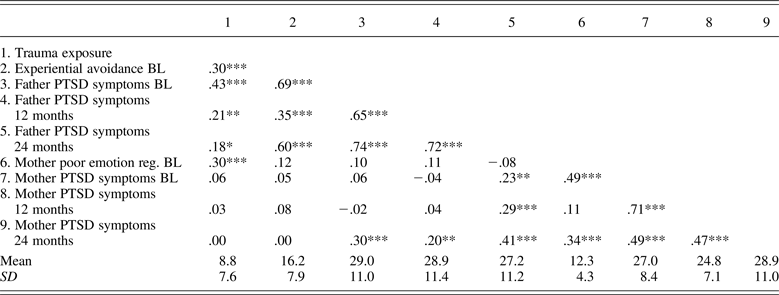
As shown in Table 1, deployed fathers’ mean DRRI trauma exposure score was 8.8 (SD = 7.6), comparable to reports of larger samples of deployed National Guard and Reservist military (King et al., Reference King, King, Vogt, Knight and Samper2006). The fathers’ mean AAQ-II score was 16.2 (SD = 7.9), slightly lower than that reported for OEF/OIF veterans by Meyer et al. (Reference Meyer, Morissette, Kimbrel, Kruse and Bird Gulliver2013). The fathers’ mean PCL-M score for PTSD symptoms ranged from 29.0 (SD = 11.0) at baseline to 27.0 (SD = 11.2) at 24 months, comparable to levels reported by larger samples of deployed National Guard and active duty military (Vasterling et al., Reference Vasterling, Proctor, Friedman, Hoge, Heeren and King2010). Using a cutoff score of 40 (Bliese et al., Reference Bliese, Wright, Adler, Cabrera, Castro and Hoge2008), 24% of deployed fathers report clinical levels of PTSD symptoms at baseline, 17% at 12 months, and 10% at 24 months. Fathers’ trauma exposure, psychological flexibility, and PTSD symptoms were reliably intercorrelated (all ps < .001).
Correlations among and descriptive statistics for father and mother variables
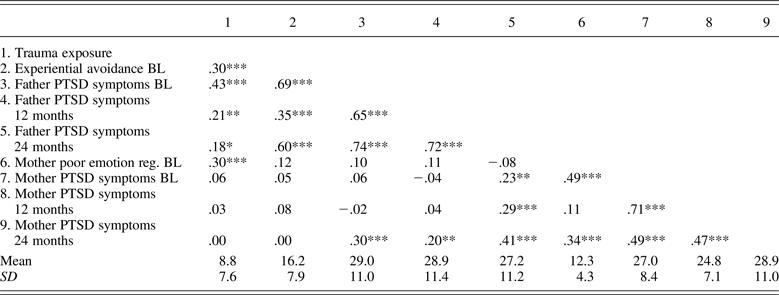
Note: BL, Baseline; PTSD, posttraumatic stress disorder.
*p < .05. **p < .01. ***p < .001.
Shown in Table 1, mothers’ mean on poor emotion regulation strategies from the DERS was 12.3 (SD = 4.3), reflecting averaged item ratings of “sometimes.” Mothers’ levels of poor emotion regulation strategies in this sample was less than that reported by survivors of direct, noninterpersonal trauma (M = 18.8, SD = 8.3; Ehring & Quack, Reference Ehring and Quack2010). Mothers’ mean PTSD symptoms in this sample ranged from 24.8 to 28.9 (SDs from 7.1 to 11.0), comparable to normative samples of college women (Shapinsky, Rapport, Henderson, & Axelrod, Reference Shapinsky, Rapport, Henderson and Axelrod2005). Using a cutoff of 40 on the PCL, 8% of nondeployed mothers report clinical levels of PTSD at baseline, 5% at 12 months, and 15% at 24 months. There were reliable correlations among mothers’ emotion regulation strategies and PTSD symptoms at baseline and 24 months but not at 12 months.
Child negative emotion reactivity and internalizing and externalizing symptoms
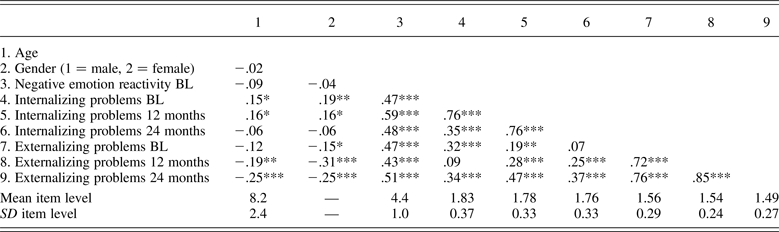
As shown in Table 2, children's mean item-level score on the aggregate parent ratings of child's negative emotional reactivity was 4.4 (SD = 1.0), with a potential range from 1 to 7. On average, parents rated their child as having difficulties in negative emotion regulation “half the time.” The mean item-level ratings for internalizing symptoms ranged between 1.76 and 1.83 across the three assessment points. The mean baseline T score for child anxiety symptoms was 54 (67th percentile) and for child depression symptoms was 51 (63th percentile). The mean item ratings for externalizing problems ranged from 1.49 to 1.56 across the three assessment points. The mean baseline T score for child aggression symptoms was 52 (66th percentile). The mean baseline T score for child conduct problem symptoms was 49 (54th percentile). Female gender and child age were positively correlated with internalizing symptoms and negatively correlated with externalizing symptoms. Child negative emotional reactivity at baseline was reliably correlated with child internalizing and externalizing symptoms at baseline, and at 12 and 24 months. Child internalizing and externalizing problems were highly correlated over time.
Correlations among and descriptive statistics for child variables
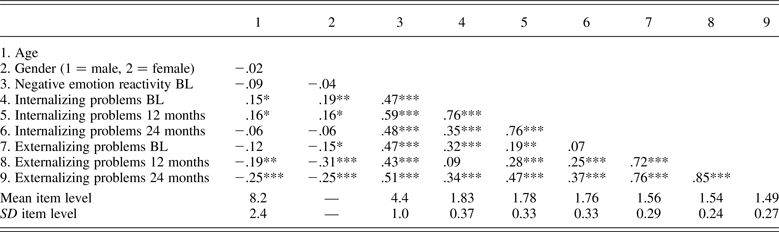
Note: BL, Baseline; PTSD, posttraumatic stress disorder.
*p < .05. **p < .01. ***p < .001.
Fathers’ and mothers’ observed behavior during parent–child interaction
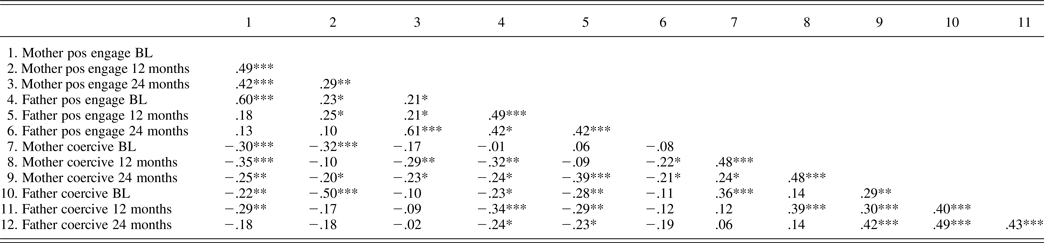
The correlations among fathers’ and mothers’ positive engagement and coercive behavior during parent–child interaction at baseline, at 12 months, and at 24 months are shown in Table 3. There was at least moderate cross-time consistency in mothers’ and in fathers’ positive engagement and in their coercive behavior from one assessment point to the next. The correlations between fathers’ positive engagement and their coercive behavior and mothers’ positive engagement and their coercive behavior at each assessment point were small and occasionally nonsignificant.
Correlations among fathers’ and mothers’ observed behavior during parent–child interaction
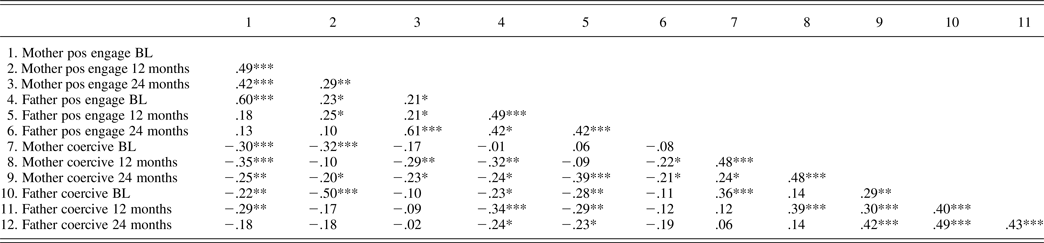
Note: BL, Baseline.
*p < .05. **p < .01. ***p < .001.
Hypothesized models: Analysis plan
The hypotheses were tested in a series of three steps, each using structural equation models in a longitudinal panel design, simultaneously estimating autoregressive, concurrent, and cross-lagged temporal relationships among the target variables. In the first step, the relationships between child internalizing and externalizing symptoms at the three assessment points were examined. In the second step, five models explored cascades of symptoms among family members, involving father and mother self-reports of PTSD symptoms and the aggregated father and mother reports of child internalizing and of externalizing symptoms. The models in the first and second steps incorporated fathers’ deployment-related trauma exposure as one source of symptom cascades. In the third step, four models tested whether observed parent behavior during parent–child interaction served as an indirect link between parent PTSD symptoms and child internalizing and externalizing symptoms. These models incorporated child negative emotional reactivity and mothers’ difficulty in emotion regulation to examine individual self-regulatory processes that may account for observed symptoms at baseline. Child gender and age, and ADAPT treatment effects were treated as covariates in all models.
The hypothesized models were tested using structural equation modeling, applying AMOS 18 software (Arbuckle, Reference Arbuckle2009). At least partial data were available for 78% of the baseline families at the 12-month and 69% at the 24-month assessment points. AMOS uses the full information maximum likelihood estimation method to estimate missing data. Full information maximum likelihood estimation does not delete cases missing from one or more waves of data collection, nor does it delete cases missing one or more variables within a wave of data collection (Wohtke, Reference Wothke, Little, Shnabel and Baumert2000).
Step 1: Co-occurrence of child externalizing and internalizing symptoms
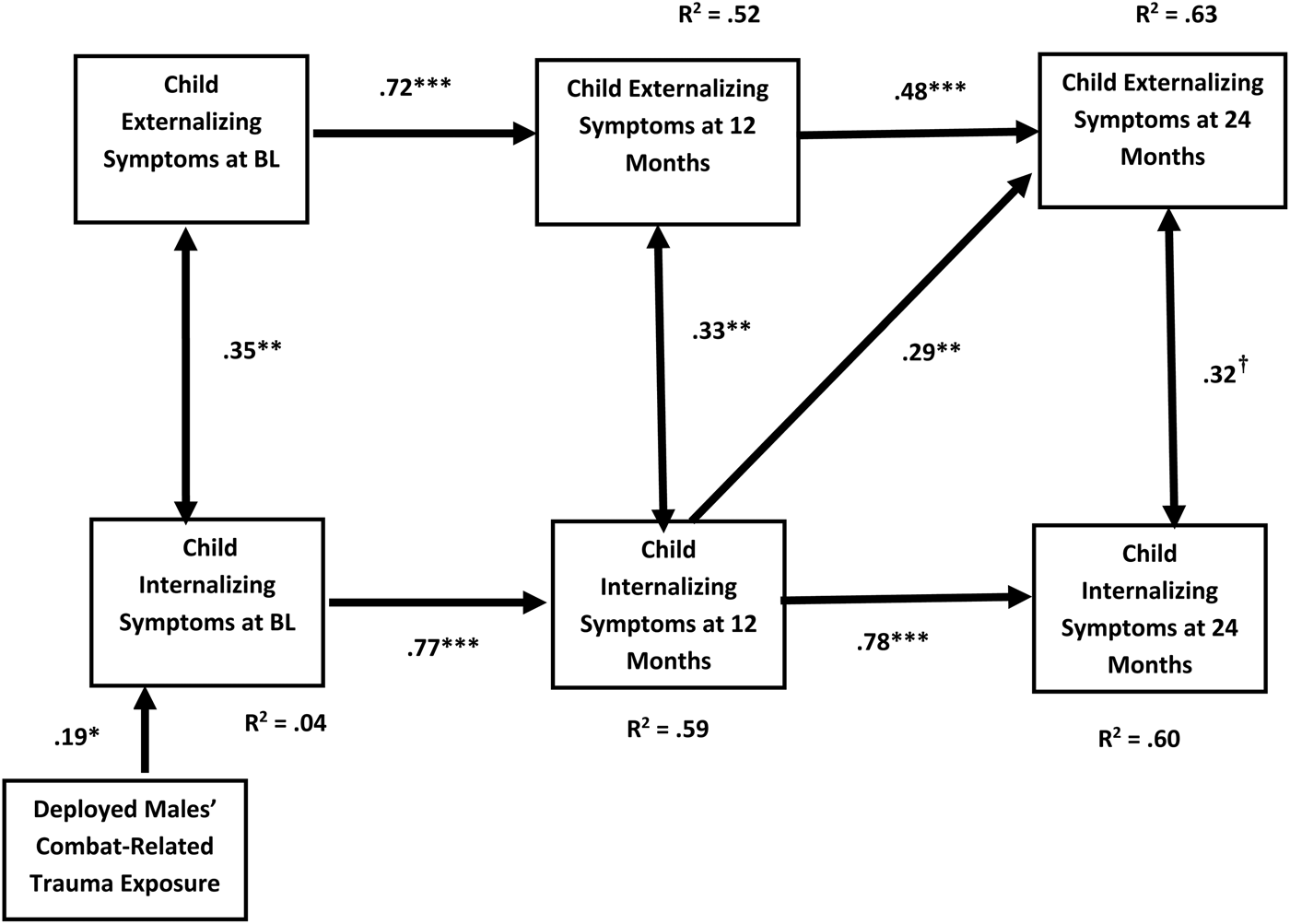
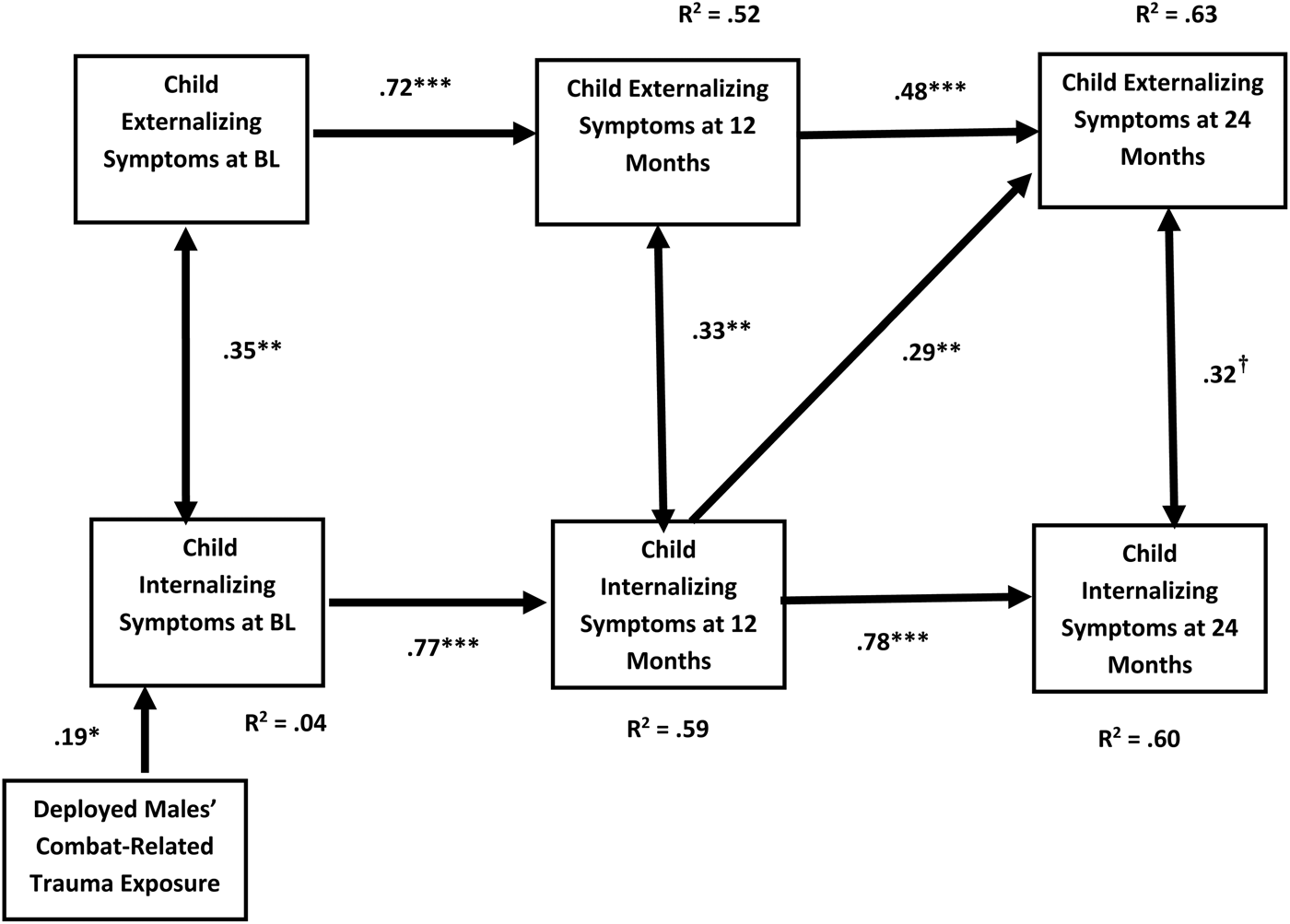
A model of the temporal continuity and co-occurrence of aggregated father and mother reports of child internalizing and externalizing symptoms was tested. The model fit the data well: χ2 (22) = 29.40, p = .13 χ2/df = 1.34, comparative fit index (CFI) = 0.969, root mean square error of approximation (RMSEA) = 0.038. As shown in Figure 1, there was considerable temporal continuity in child internalizing and externalizing symptoms, and modest same-time correlations between those symptoms. The only reliable cross-lagged time relationship was from child internalizing symptoms at 12 months to externalizing symptoms at 24 months postbaseline. Younger children displayed more externalizing and fewer internalizing symptoms, and boys displayed more externalizing and girls more internalizing symptoms. Deployed fathers’ trauma exposure was positively associated with child internalizing symptoms at baseline.
Co-occurrence and relationship between child externalizing and internalizing symptoms. Males had more externalizing (r = .27, p = .005) and fewer internalizing (r = –.26, p < .001) symptoms at baseline. Child age was associated with more internalizing (r = .35, p < .001) and fewer externalizing (r = –.25, p = .012) symptoms at baseline. χ2 (22) = 29.40, p = .13 χ2/df = 1.34, CFI = 0.969, RMSEA = 0.038. Error terms are omitted for clarity. †p < .10. *p < .05. **p < .01. ***p < .001.
Step 2: Symptom cascades among parents and children
Four autoregressive, temporal, cross-lagged models were used to examine the concurrent and prospective associations among parent PTSD symptoms and children's internalizing and externalizing symptoms.
Relationships between deployed fathers’ and mothers’ PTSD symptoms
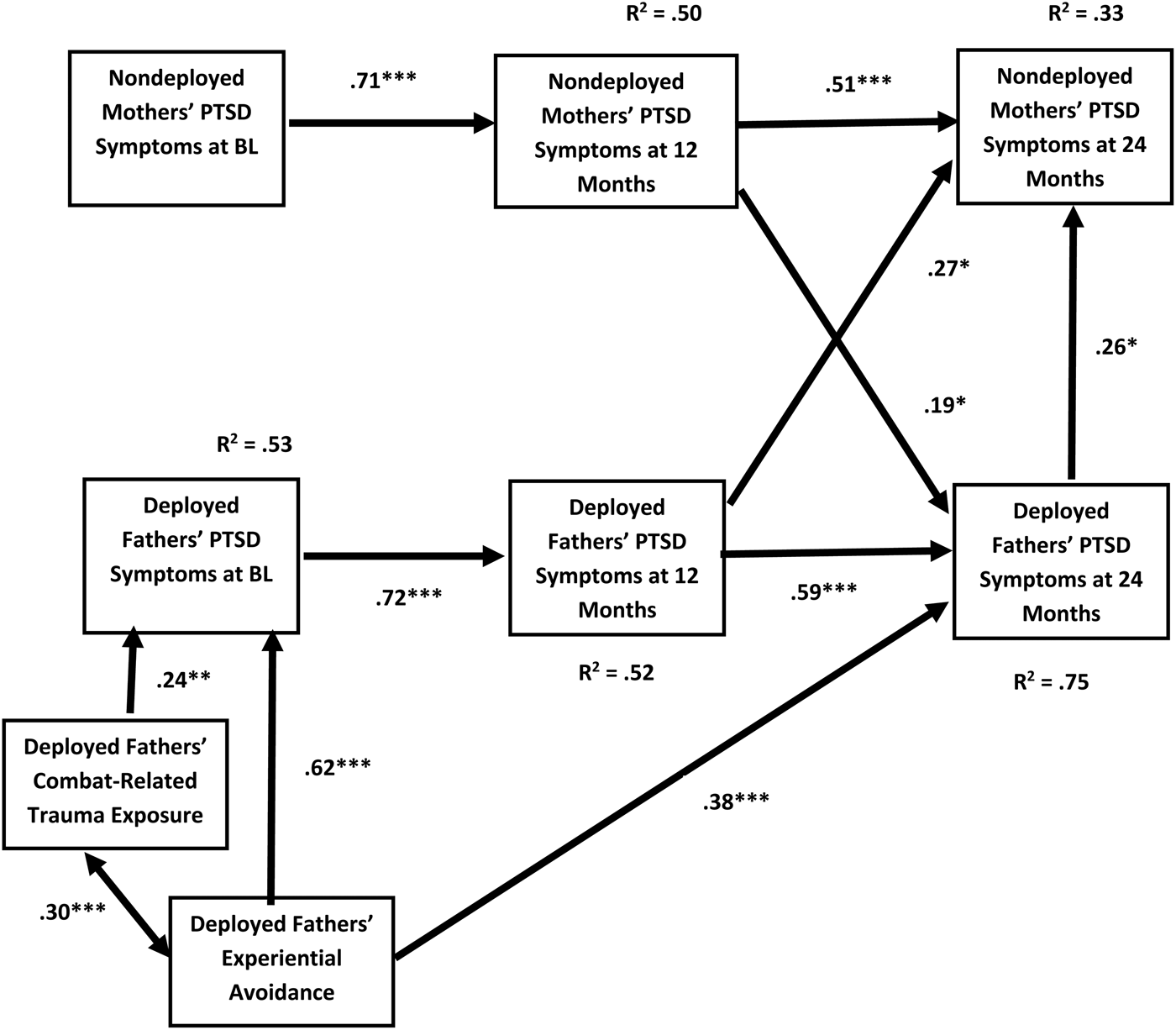
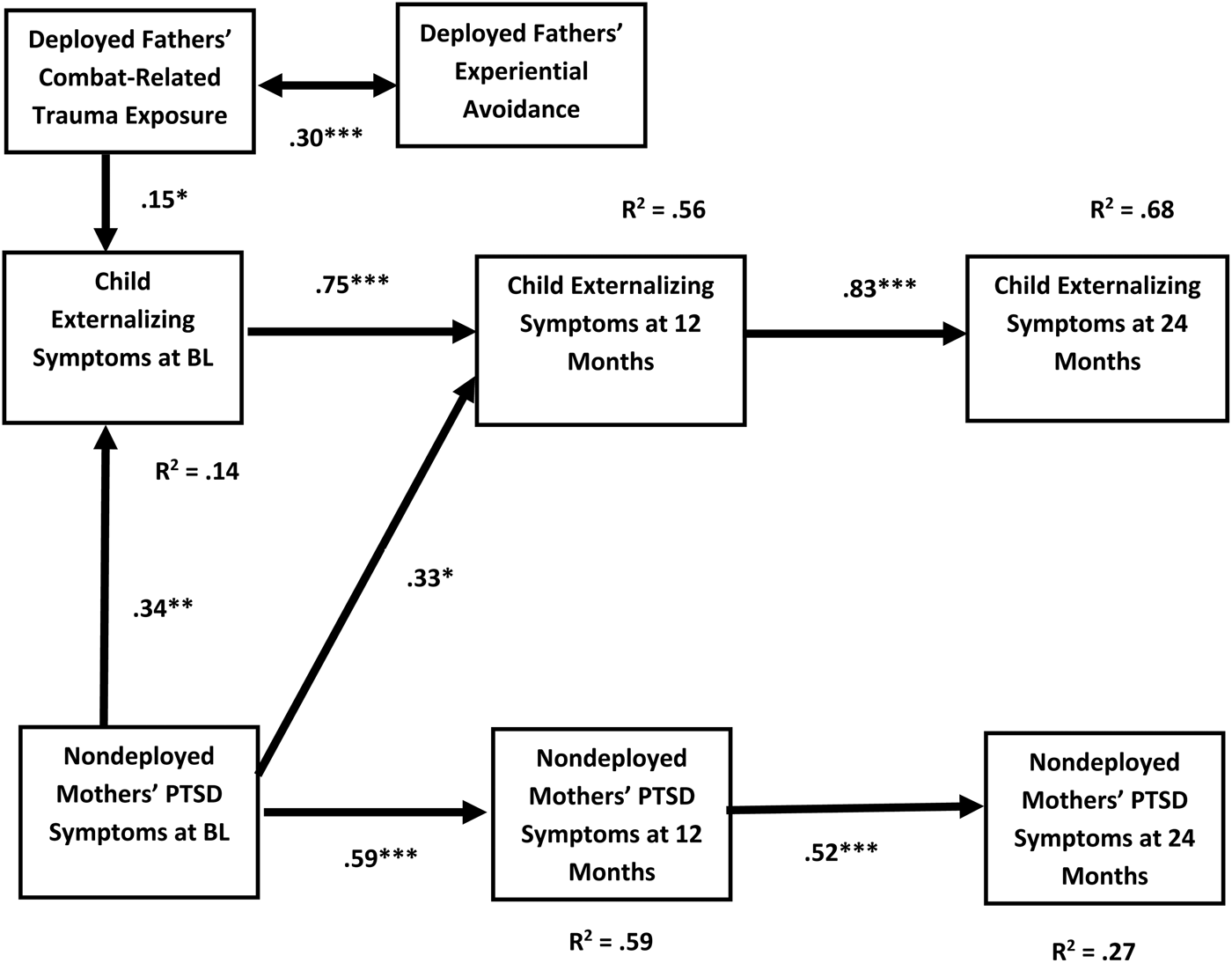
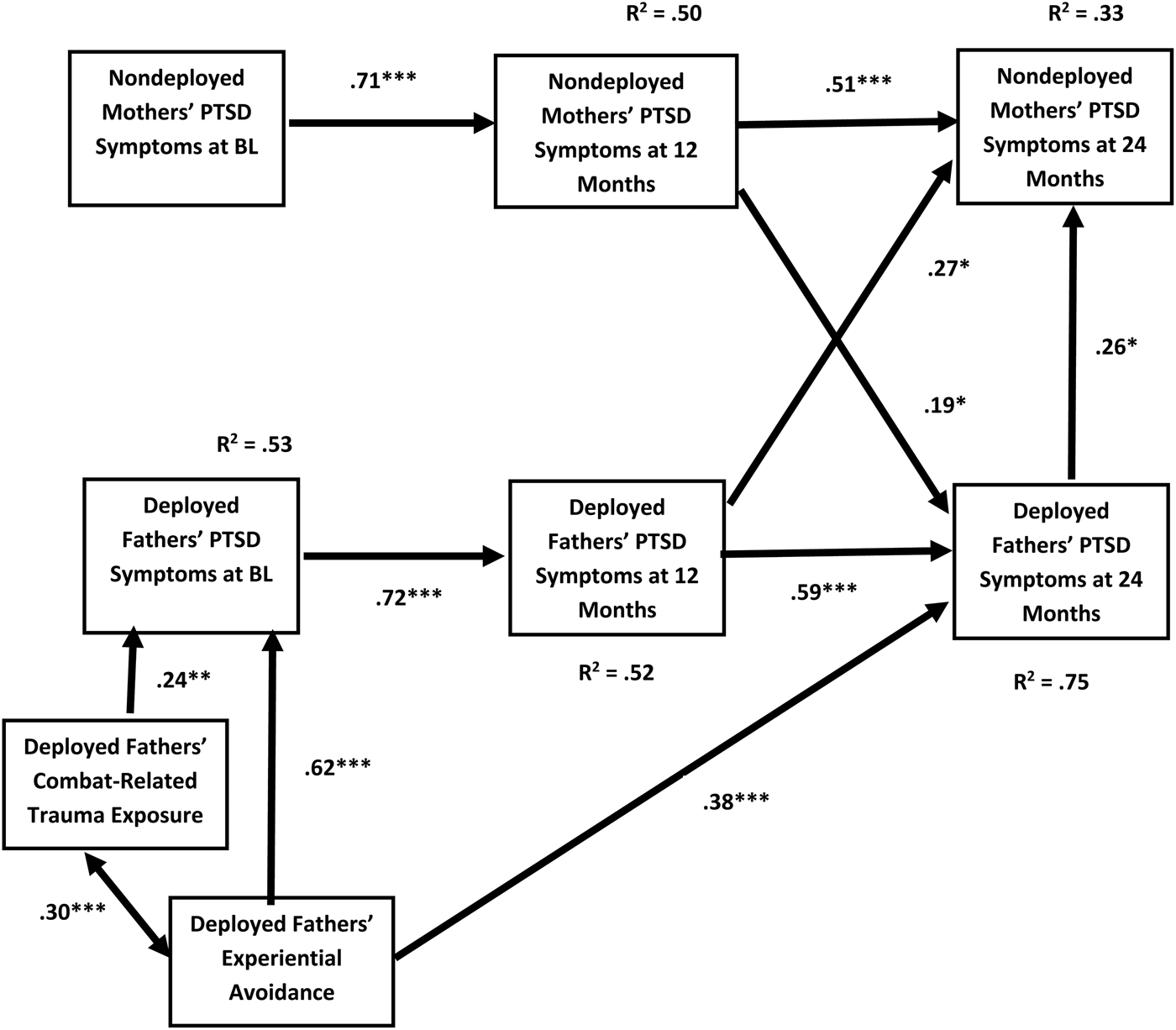
The relationship between the PTSD symptoms of deployed males and their nondeployed female intimate partners is shown in Figure 2; model fit: χ2 (16) = 24.05, p = .12, χ2/df = 1.42, CFI = 0.980, RMSEA = 0.042. Males’ PTSD symptoms at 12 months were positively associated with their intimate partners’ PTSD symptoms at 24 months, and females’ PTSD symptoms at 12 months were positively associated with their partner's PTSD symptoms at 24 months. Intimate partner's PTSD symptoms were concurrently correlated at 24 months, but not at baseline or 12 months. Males’ trauma and experiential avoidance were related to their own PTSD symptoms.
Transmission between deployed fathers’ and nondeployed mothers’ posttraumatic stress disorder symptoms. χ2 (16) = 24.05, p = .12, χ2/df = 1.42, CFI = 0.980, RMSEA = 0.042. Error terms are omitted for clarity. *p < .05. **p < .01. ***p < .001.
Relationships between deployed fathers’ PTSD symptoms and child symptoms
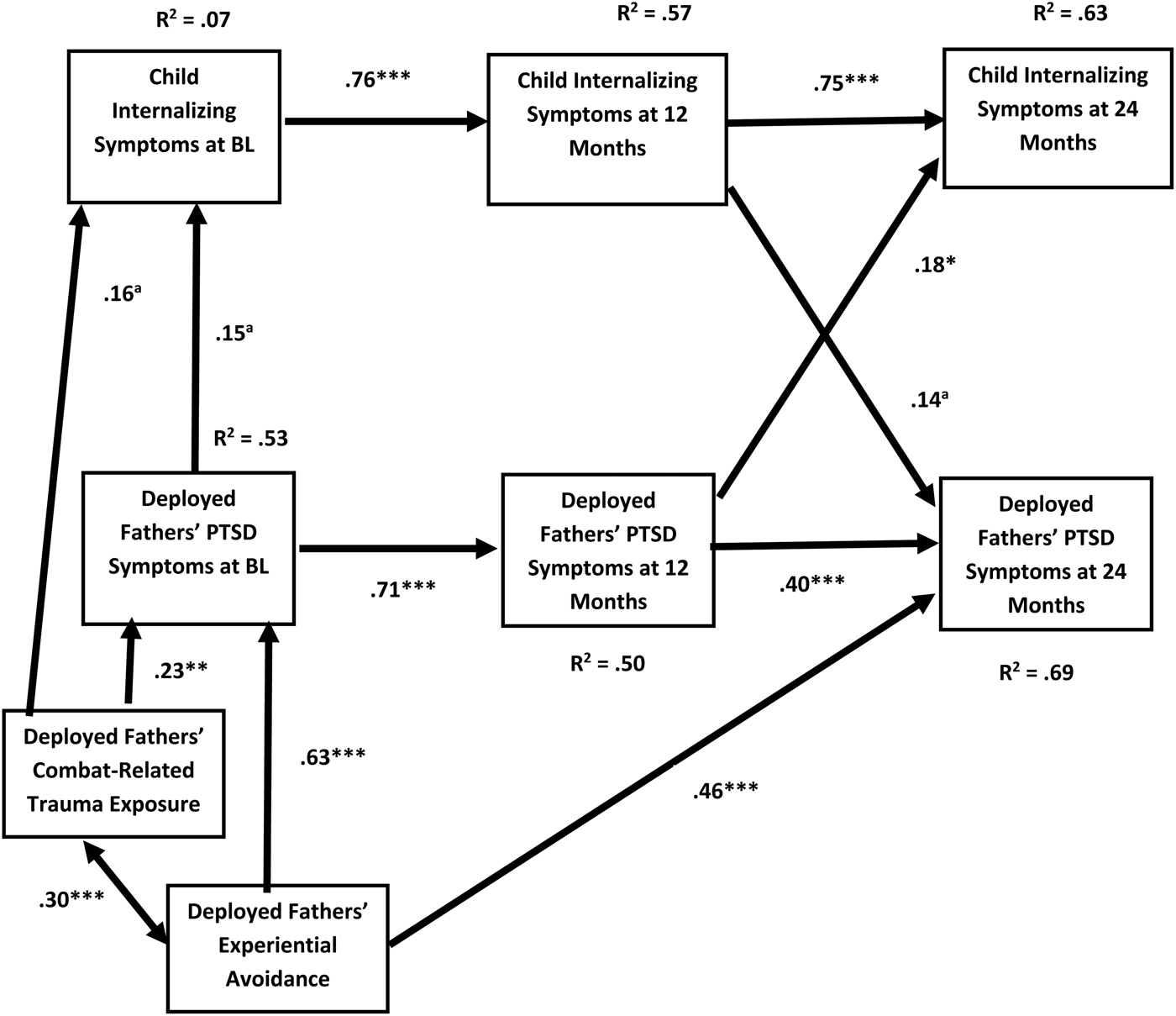
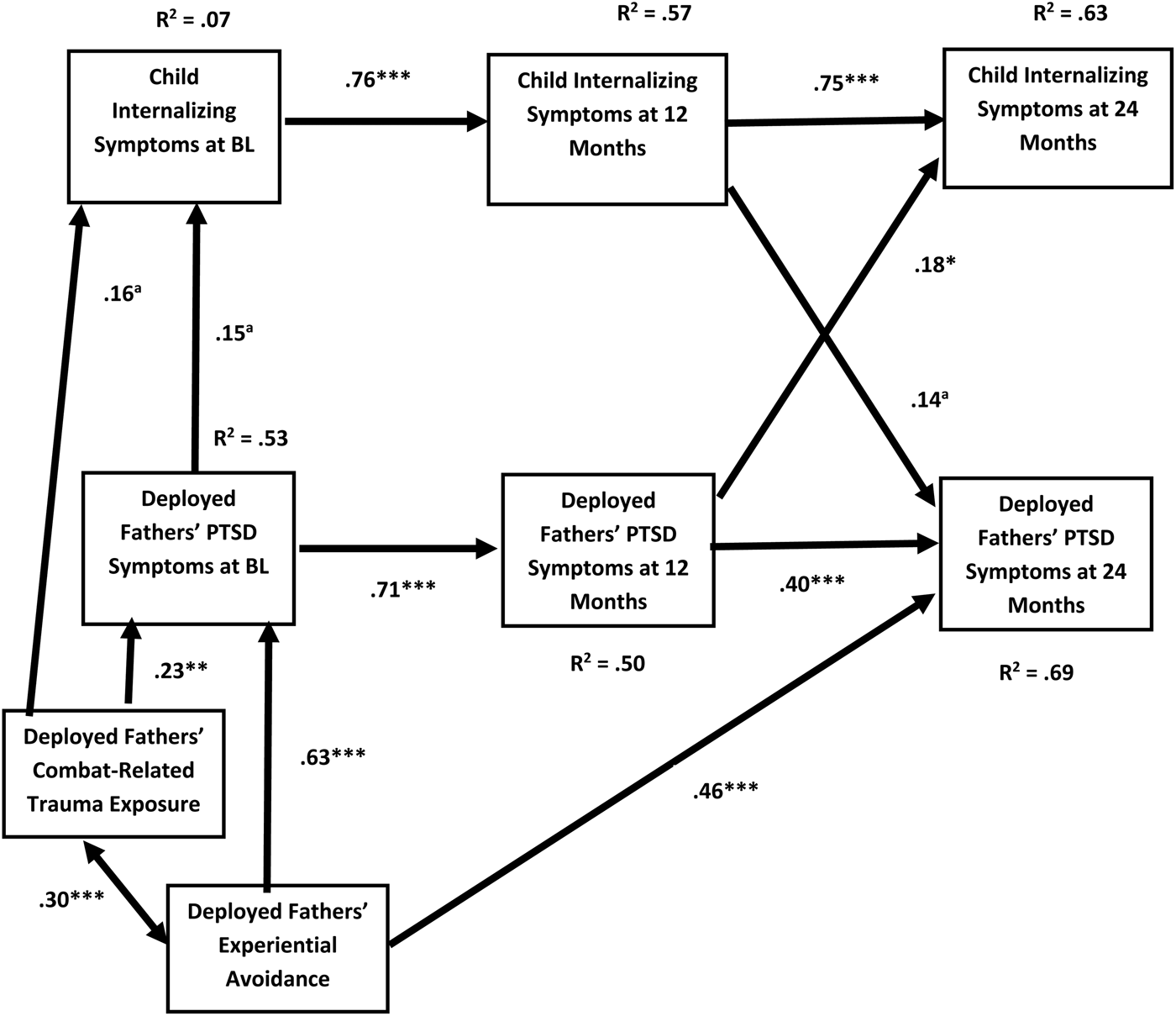
The relationships between deployed fathers’ PTSD symptoms and child internalizing symptoms were examined. The results are shown in Figure 3; model fit: χ2 (29) = 26.04, p = .63, χ2/df = 0.90, CFI > 0.999, RMSEA < 0.001. Fathers’ combat-related trauma was associated with their PTSD symptoms at baseline, and their experiential avoidance was associated with their PTSD symptoms at baseline and 24 months. Fathers’ trauma exposure was also directly related to child internalizing symptoms at baseline. Fathers’ PTSD symptoms at baseline were associated with children's baseline internalizing symptoms. Fathers’ PTSD symptoms at 12 months predicted child internalizing symptoms at 24 months, and child internalizing symptoms at 12 months were marginally predictive of their fathers’ PTSD symptoms at 24 months.
Transmission between deployed fathers’ posttraumatic stress disorder symptoms and child internalizing symptoms. Males had fewer internalizing (r = –.23, p = .008) symptoms at baseline, and child age was associated with more internalizing (r = .33, p = .028) symptoms at baseline. χ2 (29) = 26.04, p = .63, χ2/df = 0.90, CFI > 0.999, RMSEA < 0.001. Error terms are omitted for clarity. a p < .10. *p < .05. **p < .01. ***p < .001.
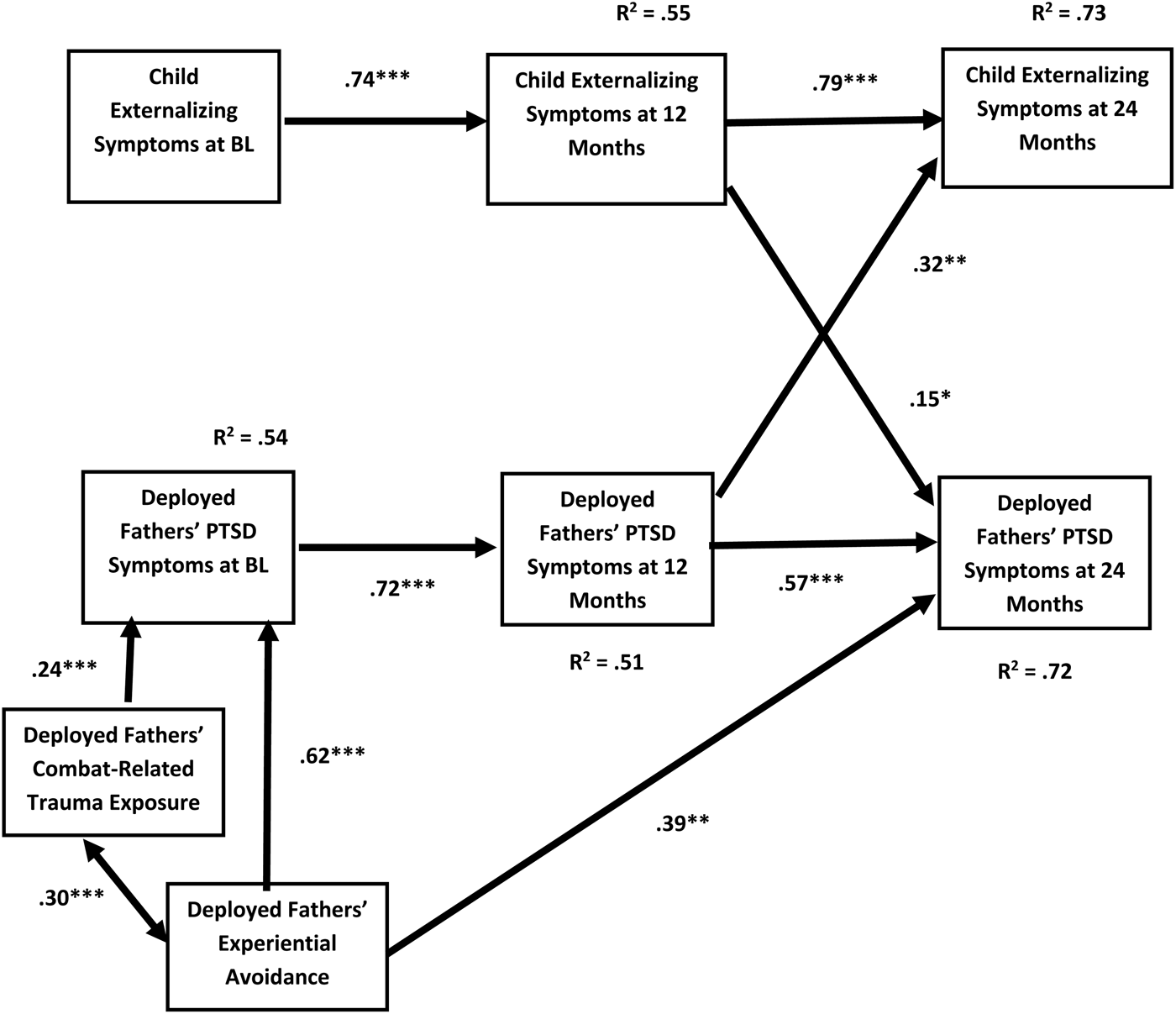
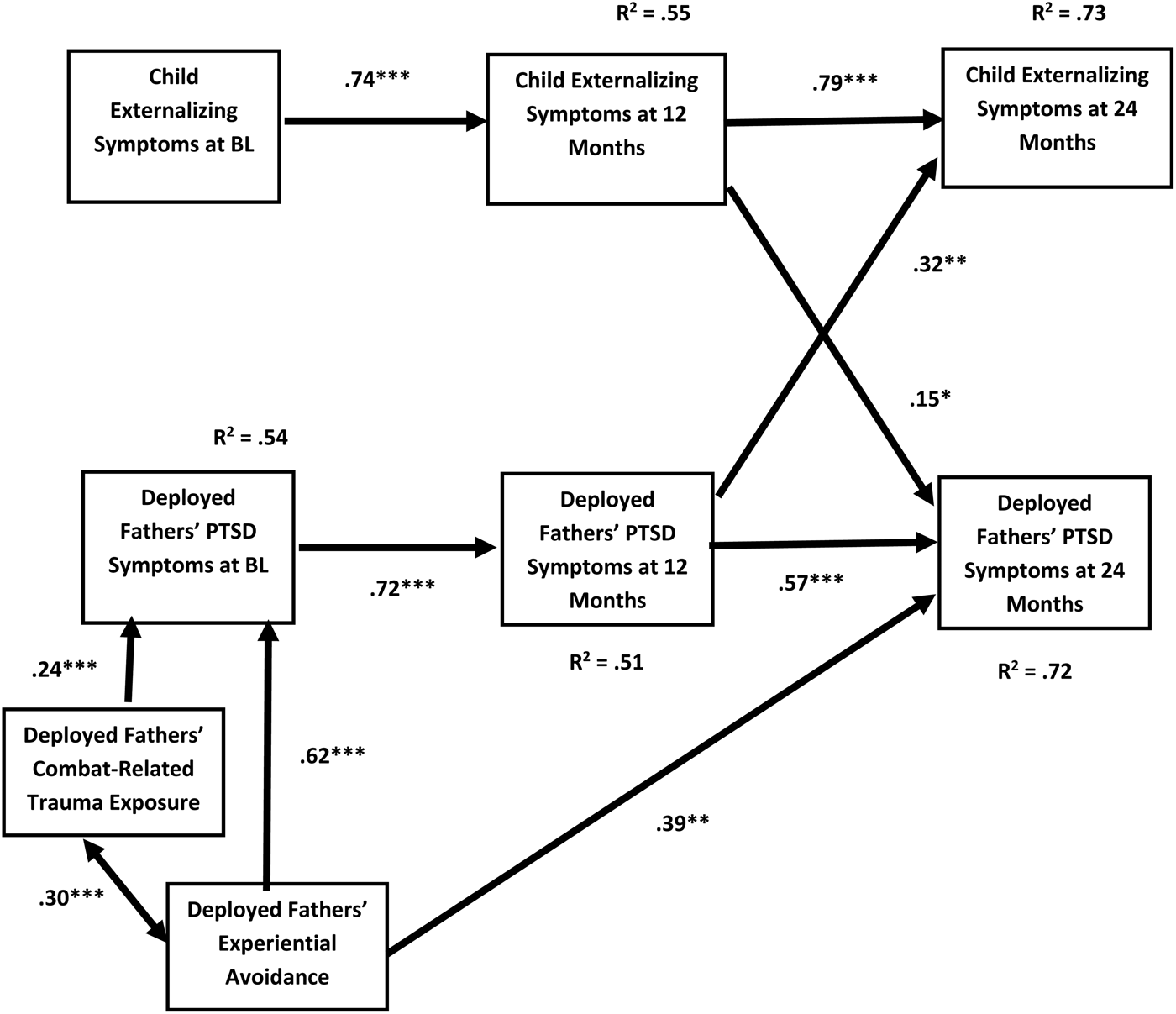
The second symptom cascade model examined the relationship between deployed fathers’ PTSD symptoms and child externalizing symptoms. The model is shown in Figure 4; model fit: χ2 (32) = 53.05, p = .015, χ2/df = 1.61, CFI = 0.945, RMSEA = 0.051. Fathers’ combat-related trauma and experiential avoidance were unrelated to concurrent child externalizing symptoms. Fathers’ PTSD symptoms at 12 months were robustly associated more child externalizing symptoms at 24 months, accounting for an additional 10% of the variance. Child externalizing symptoms at 12 months predicted more father PTSD symptoms at 24 months.
Transmission between deployed fathers’ posttraumatic stress disorder symptoms and child externalizing symptoms. Males had more externalizing (r = .16, p = .081) symptoms at baseline, and child age was associated with fewer externalizing (r = –.15, p = .085) symptoms at baseline. χ2 (32) = 53.05, p = .015, χ2/df = 1.61, CFI = 0.945, RMSEA = 0.051. Error terms are omitted for clarity. *p < .05. **p < .01. ***p < .001.
Relationships between nondeployed mothers’ PTSD symptoms and child symptoms
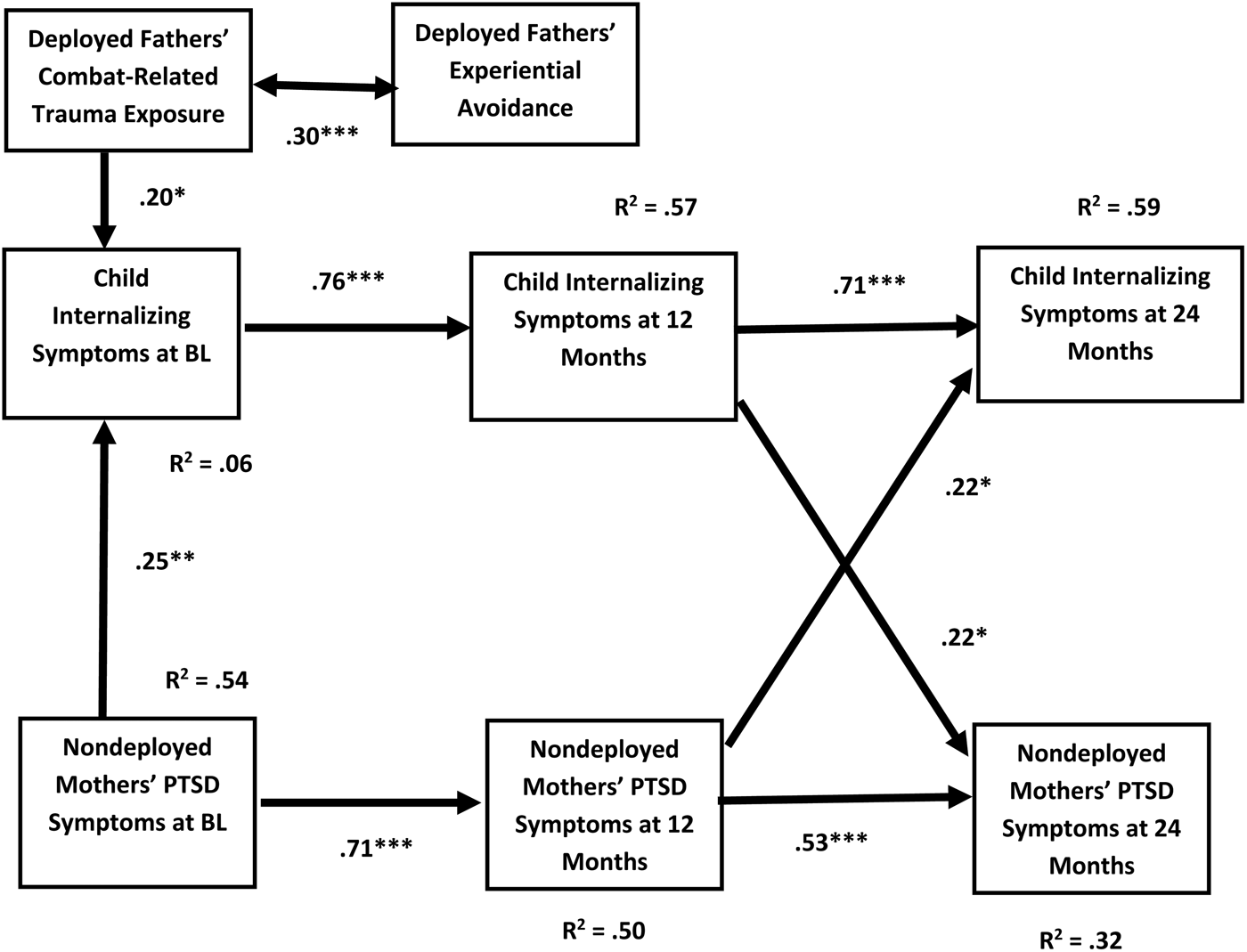
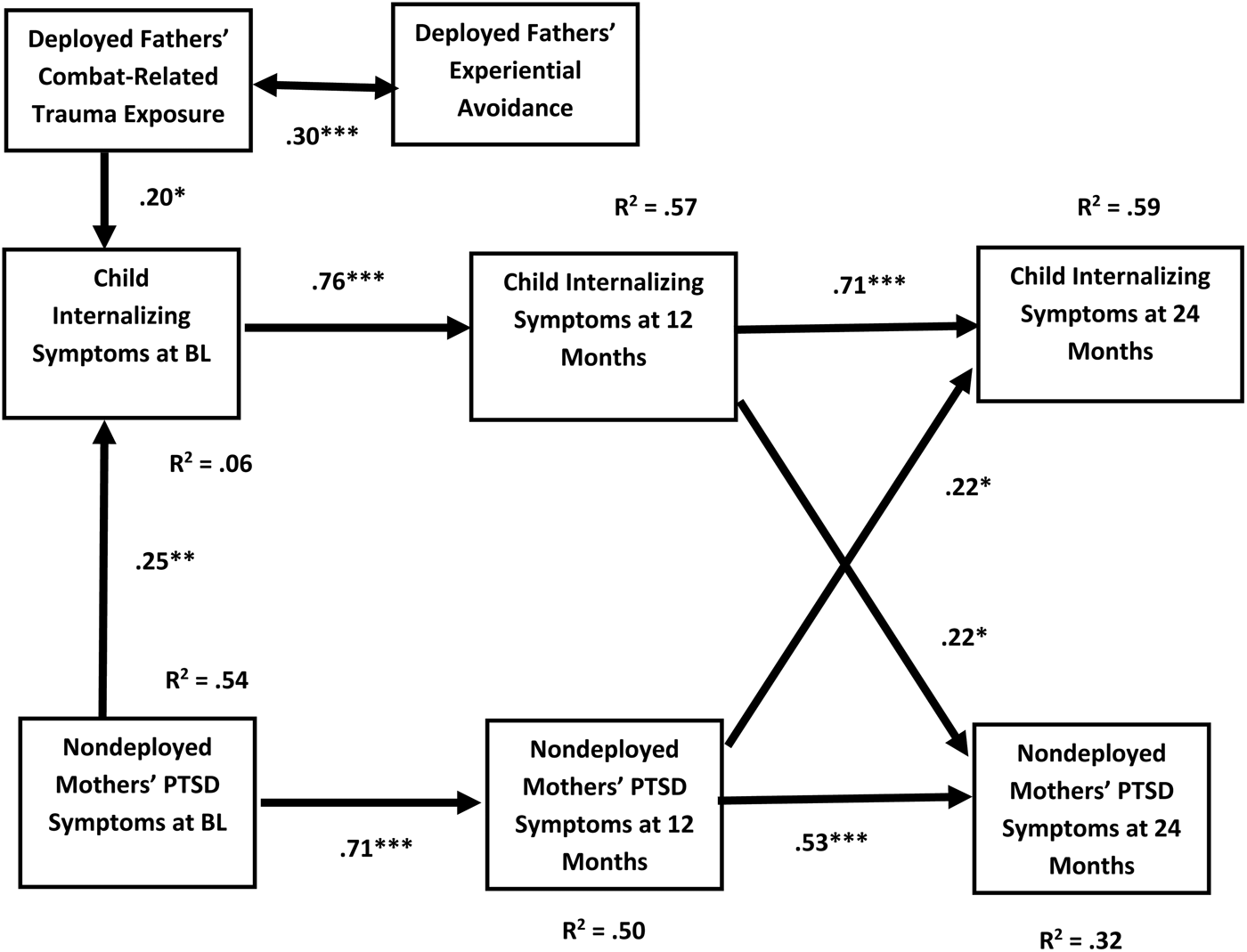
The third symptom cascade model examined the relationship between mothers’ PTSD symptoms and child internalizing symptoms. The model is shown in Figure 5; model fit: χ2 (33) = 24.93, p = .81, χ2/df = 0.78, CFI > 0.999, RMSEA < 0.001. Mothers’ PTSD symptoms and child internalizing symptoms were related at baseline. Mothers’ PTSD symptoms at 12 months predicted child internalizing symptoms at 24 months, and child internalizing symptoms at 12 months predicted mothers’ PTSD symptoms at 24 months, accounting for an additional 5% of the variance in children's internalizing symptoms and mothers’ PTSD symptoms at 24 months.
Transmission between nondeployed mothers’ posttraumatic stress disorder symptoms and child internalizing symptoms. Males had fewer internalizing (r = –.23, p = .007) problems at baseline, and child age was associated with more internalizing (r = .22, p = .102) symptoms at baseline. χ2 (32) = 24.93, p = .81, χ2/df = 0.78, CFI > 0.999, RMSEA < 0.001. Error terms are omitted for clarity. *p < .05. **p < .01. ***p < .001.
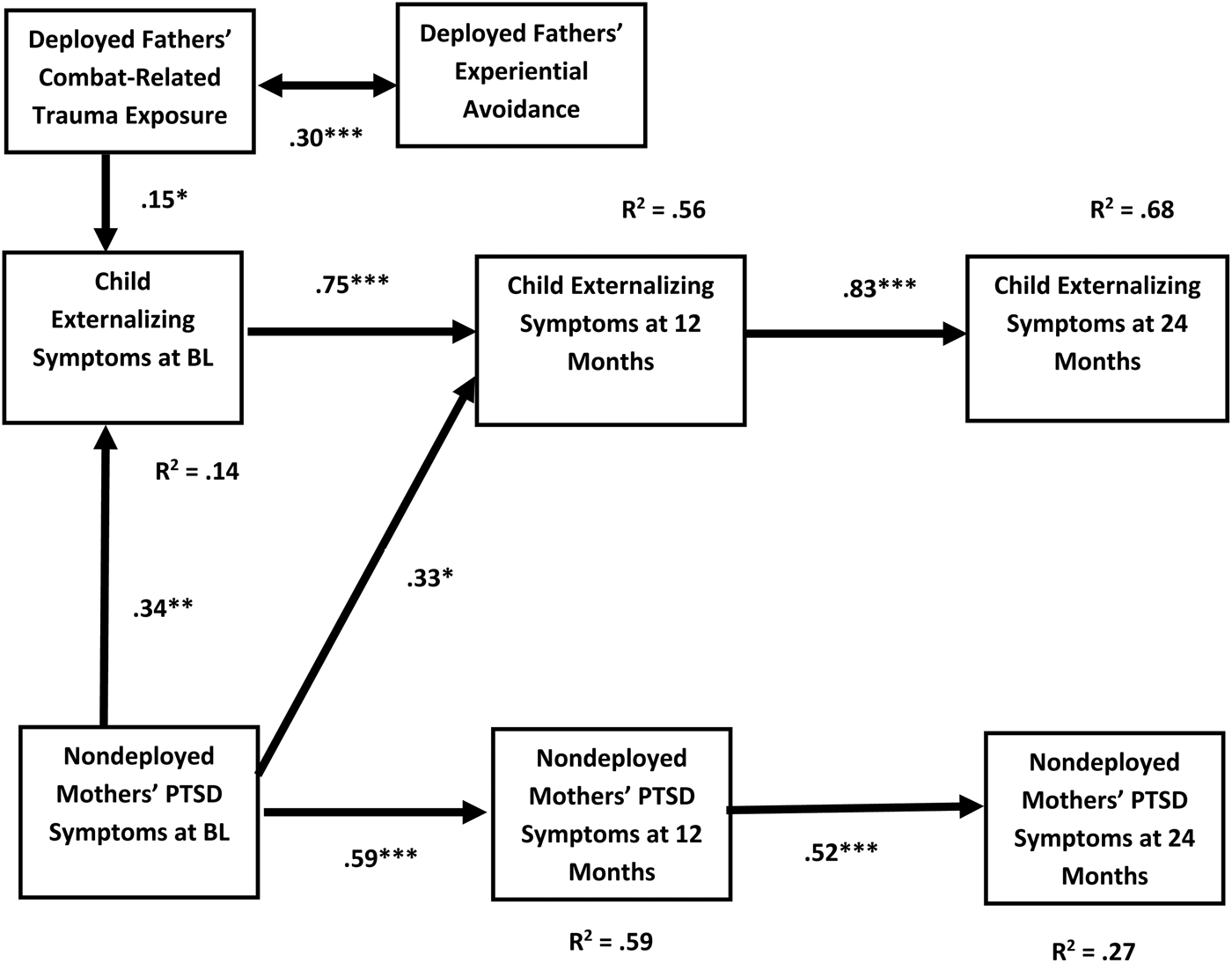
The fourth symptom cascade model examined the relationship between mothers’ PTSD symptoms and child externalizing symptoms, and is shown in Figure 6; model fit: χ2 (35) = 41.46, p = .21, χ2/df = 1.18, CFI = 0.971, RMSEA = 0.028. Fathers’ combat-related trauma was associated with child externalizing symptoms at baseline. Mothers’ PTSD symptoms and child externalizing symptoms were related at baseline. Mothers’ PTSD symptoms at baseline predicted child externalizing symptoms at 12 months. Both associations were robust, accounting for 10% to 12% of the variance in child externalizing symptoms.
Transmission between nondeployed mothers’ posttraumatic stress disorder symptoms and child externalizing symptoms. Males had more externalizing (r = .20, p = .022), and child age was associated with fewer externalizing (r = –.17, p = .057) symptoms at baseline. χ2 (35) = 41.46, p = .21, χ2/df = 1.18, CFI = 0.971, RMSEA = 0.028. Error terms are omitted for clarity. *p < .05. **p < .01. ***p < .001.
Step 3: The roles of parent behavior during parent–child interaction and individuals’ emotion regulation in family symptom transmission
The relationships between parent PTSD symptoms and child internalizing and eternalizing symptoms apparent in symptom transmission models shown in Figures 3 through 6 do not examine the social or individual processes by which these linkages occur. The next set of models assessed whether family members’ emotion regulation and parents’ behavior during parent–child interaction served as processes linking the reciprocal cascades among parents’ PTSD symptoms and child internalizing and externalizing symptoms. Parents’ positive engagement was selected as the intermediary social process linking parent PTSD symptoms and child internalizing symptoms. Parents’ observed coercive behavior was selected as the intermediary social process linking parent PTSD symptoms and children's externalizing symptoms. These models also incorporated child negative emotion reactivity and mothers’ emotion regulation strategies as individual-level predictors of adjustment in addition to fathers’ experiential avoidance.
Fathers’ behavior during father–child interaction, fathers’ PTSD symptoms, child negative emotion reactivity, and child internalizing and externalizing symptoms
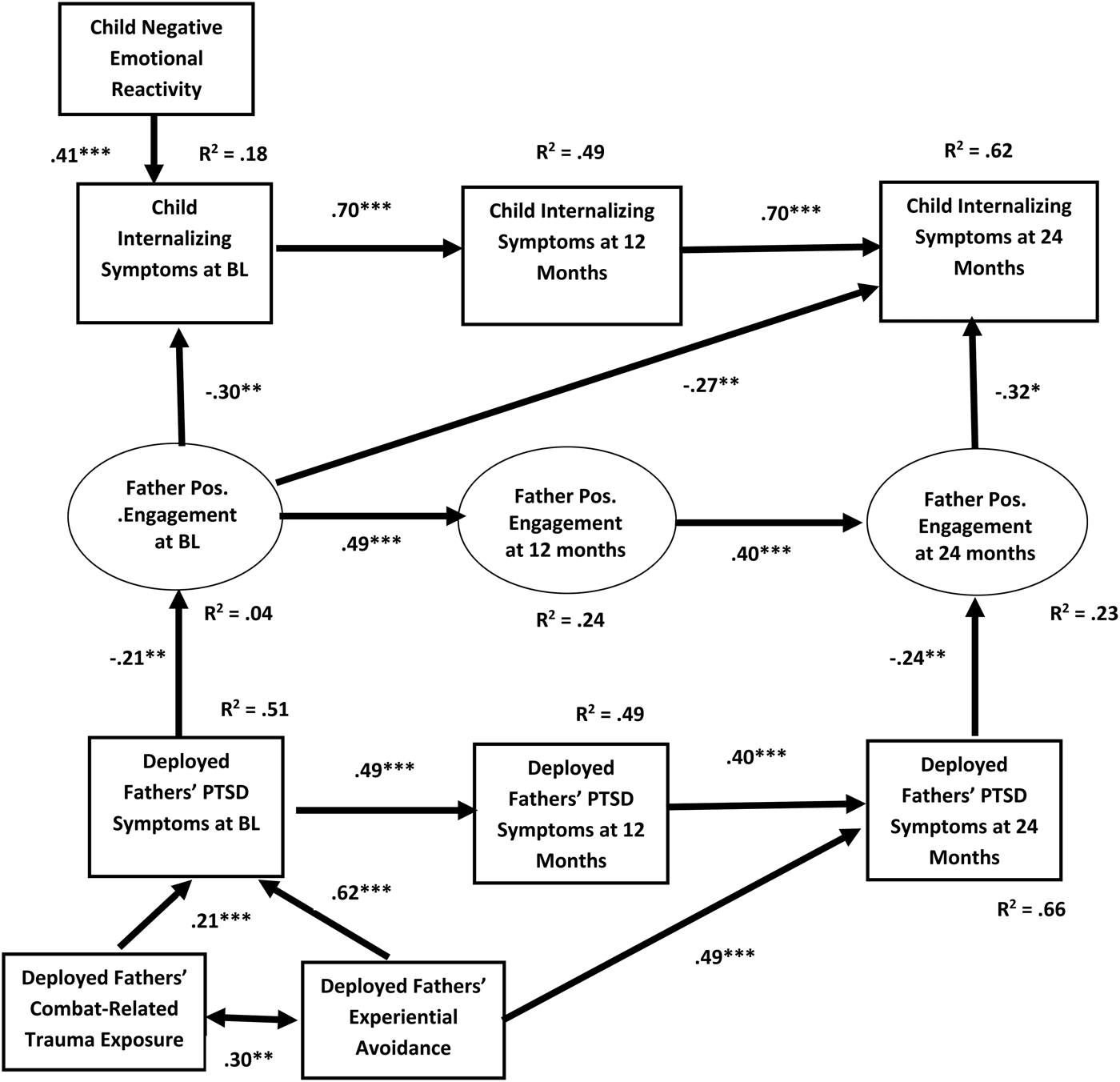
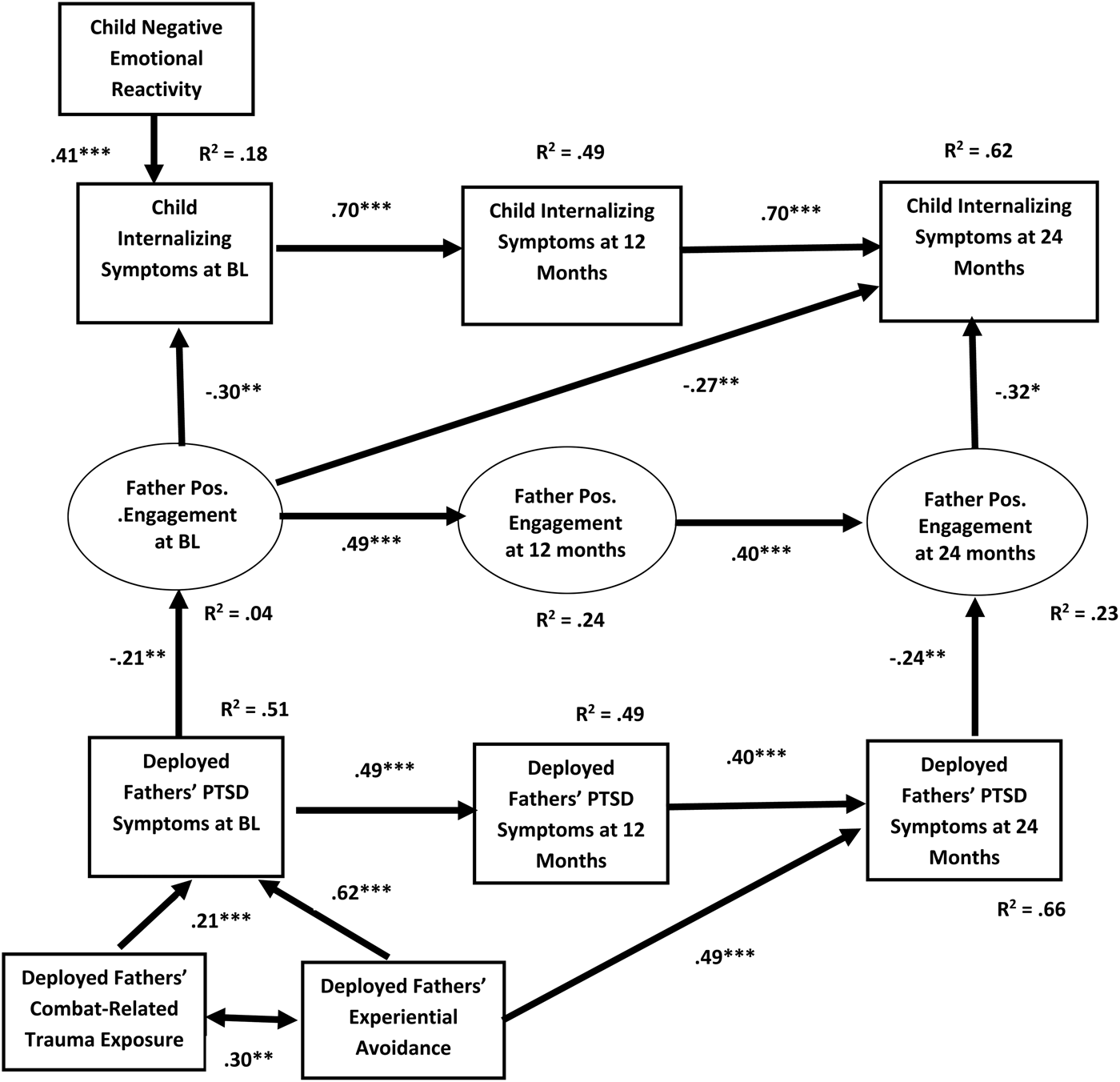
The hypothesized role of a father's observed positive engagement with his child as a linking process in the cascade of fathers’ PTSD symptoms and child internalizing symptoms was tested (see Figure 7). The model fit the data well: χ2 (79) = 74.72, p = .55, χ2/df = 0.97, CFI = 0.987, RMSEA = 0.015. Fathers’ PTSD symptoms were negatively associated with their positive engagement at baseline and at 24 months. Fathers’ positive engagement at baseline was related to child internalizing symptoms at baseline and at 24 months postbaseline. Child negative emotion reactivity was associated with higher levels of child internalizing problems at baseline. The concurrent direct path from father PTSD symptoms to child internalizing at baseline, and the paths from father PTSD symptoms at 12 months to child internalizing at 24 months and from child internalizing at 12 months to father PTSD symptoms at 24 months in the symptom cascade model (Figure 3) were no longer significant. Males had fewer internalizing problems at baseline.
Father positive engagement and symptom transmission between fathers’ posttraumatic stress disorder symptoms and child internalizing symptoms. Males had fewer internalizing (r = –.30, p < .001) symptoms at baseline. χ2 (79) = 74.72, p = .55, χ2/df = 0.97, CFI = 0.987, RMSEA = 0.015. Error terms are omitted for clarity. *p < .05. **p < .01. ***p < .001.
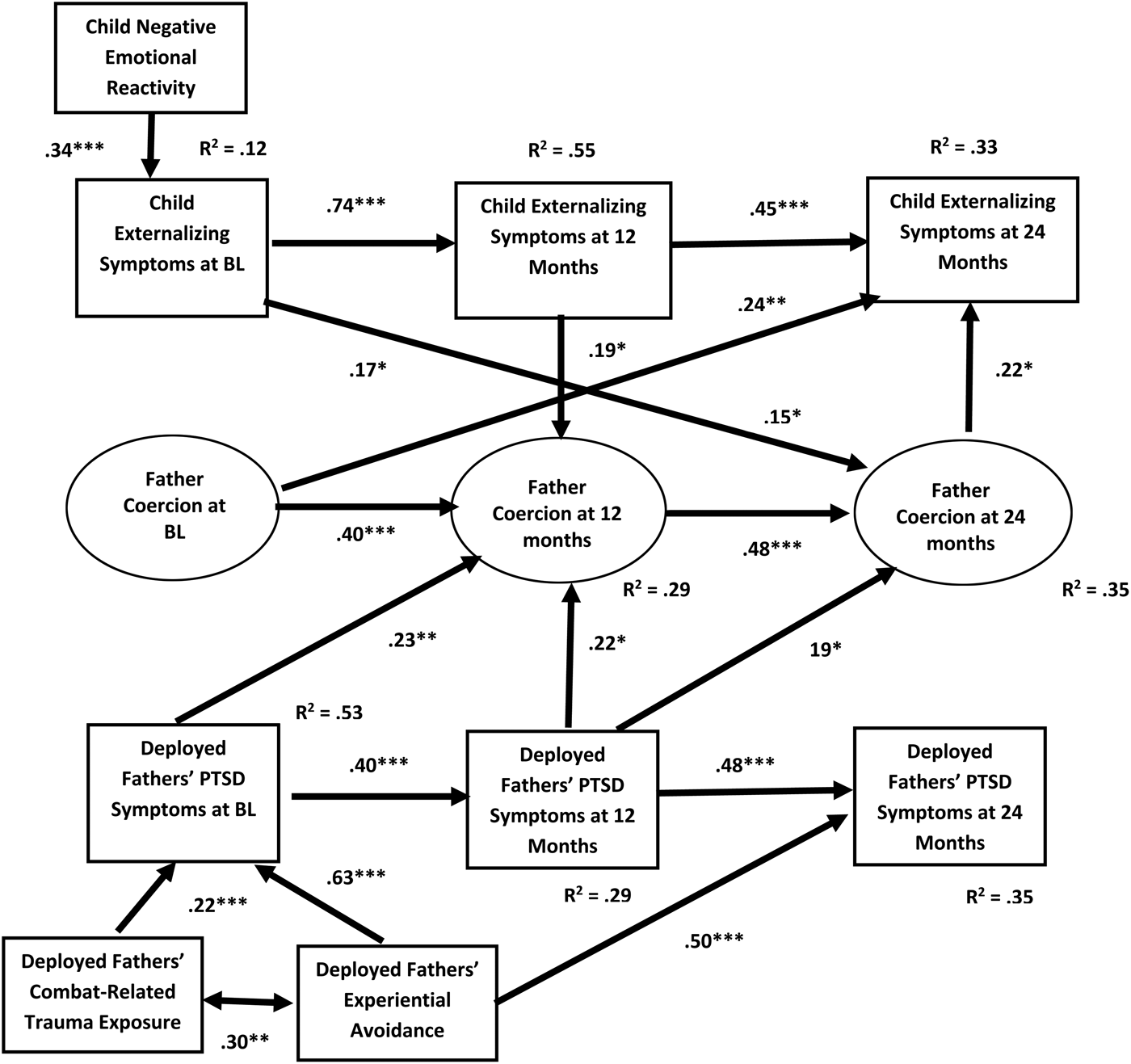
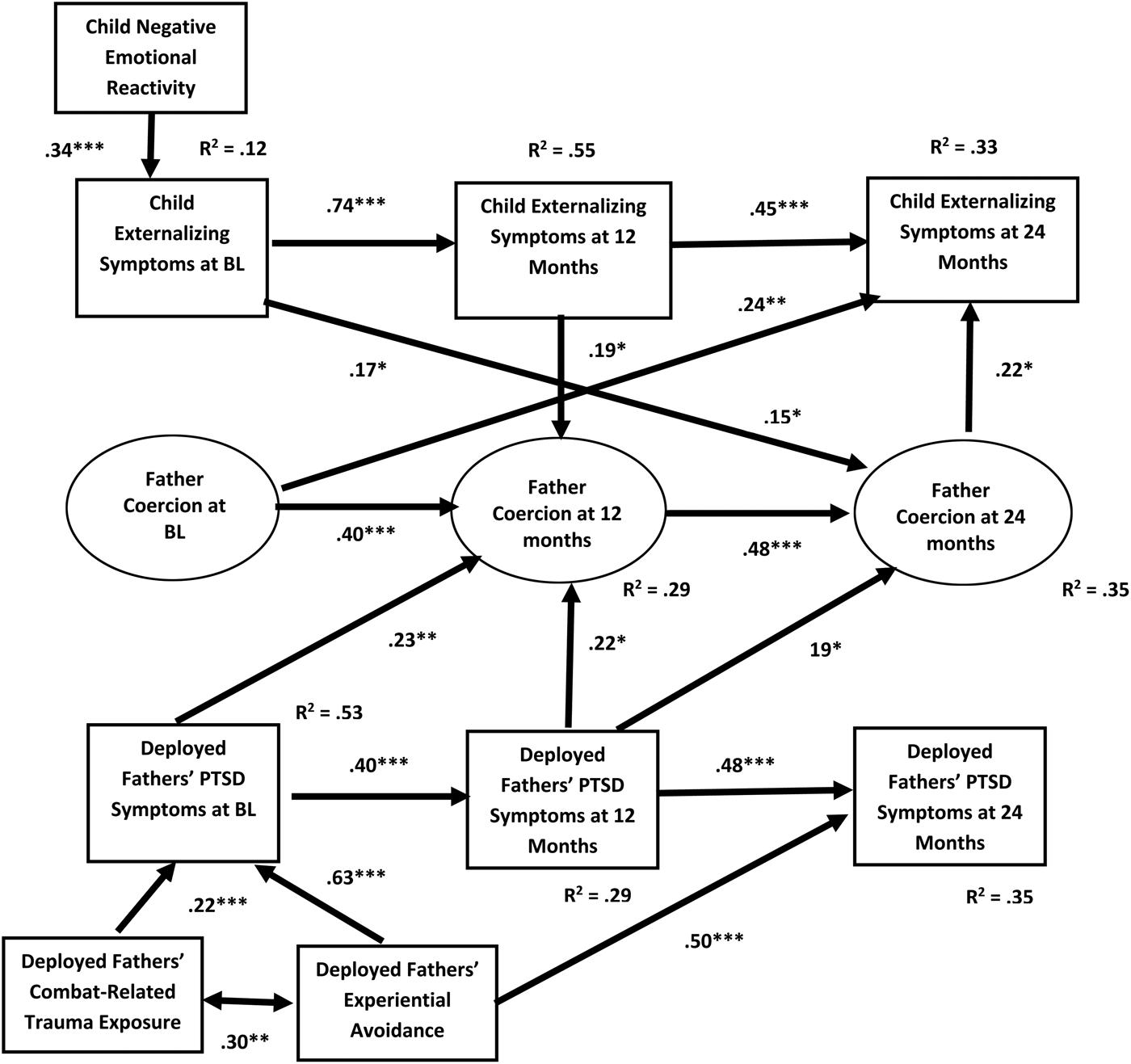
The model assessing the linking function of a father's coercive behavior toward his child as an intermediary process in the cascade of fathers’ PTSD symptoms and child externalizing symptoms is shown in Figure 8. The model fit the data moderately well: χ2 (82) = 94.34, p = .10, χ2/df = 1.15, CFI = 0.955, RMSEA = 0.033. Fathers’ PTSD symptoms at baseline were associated with their coercive behavior at 12 months, and their PTSD symptoms at 12 months were positively associated with their coercive behavior at 12 and 24 months. Fathers’ coercive behavior at baseline and at 24 months was positively associated with child externalizing symptoms at 24 months. Child externalizing symptoms at baseline were positively associated with fathers’ coercive behavior 24 months, and child externalizing symptoms were concurrently associated with fathers’ PTSD symptoms at 12 months. Children's negative emotional reactivity was associated with their externalizing symptoms at baseline. The prospective paths reciprocally linking fathers’ PTSD symptoms and children's externalizing problems from 12 months to 24 months in the cascade model (see Figure 4) were no longer significant in the model incorporating fathers’ coercive behavior. Males evidenced more and older children fewer externalizing symptoms at baseline. The ADAPT intervention was associated with fewer child externalizing problems at 24 months.
Father coercion and symptom transmission between fathers’ posttraumatic stress disorder symptoms and child externalizing symptoms. Males had more externalizing (r = .16, p < .05) symptoms and child age (r = –.16, p < .05) was associated with fewer externalizing symptoms at baseline. After Deployment: Adaptive Parenting Tools was associated with fewer child externalizing symptoms at 24 months (r = –.31, p < .05). χ2 (82) = 94.34, p = .10, χ2/df = 1.15, CFI = 0.967, RMSEA = 0.033. Error terms are omitted for clarity. *p < .05. **p < .01. ***p < .001.
Mothers’ behavior during mother–child interaction, mothers’ PTSD symptoms, child negative emotion reactivity, and child internalizing and externalizing symptoms
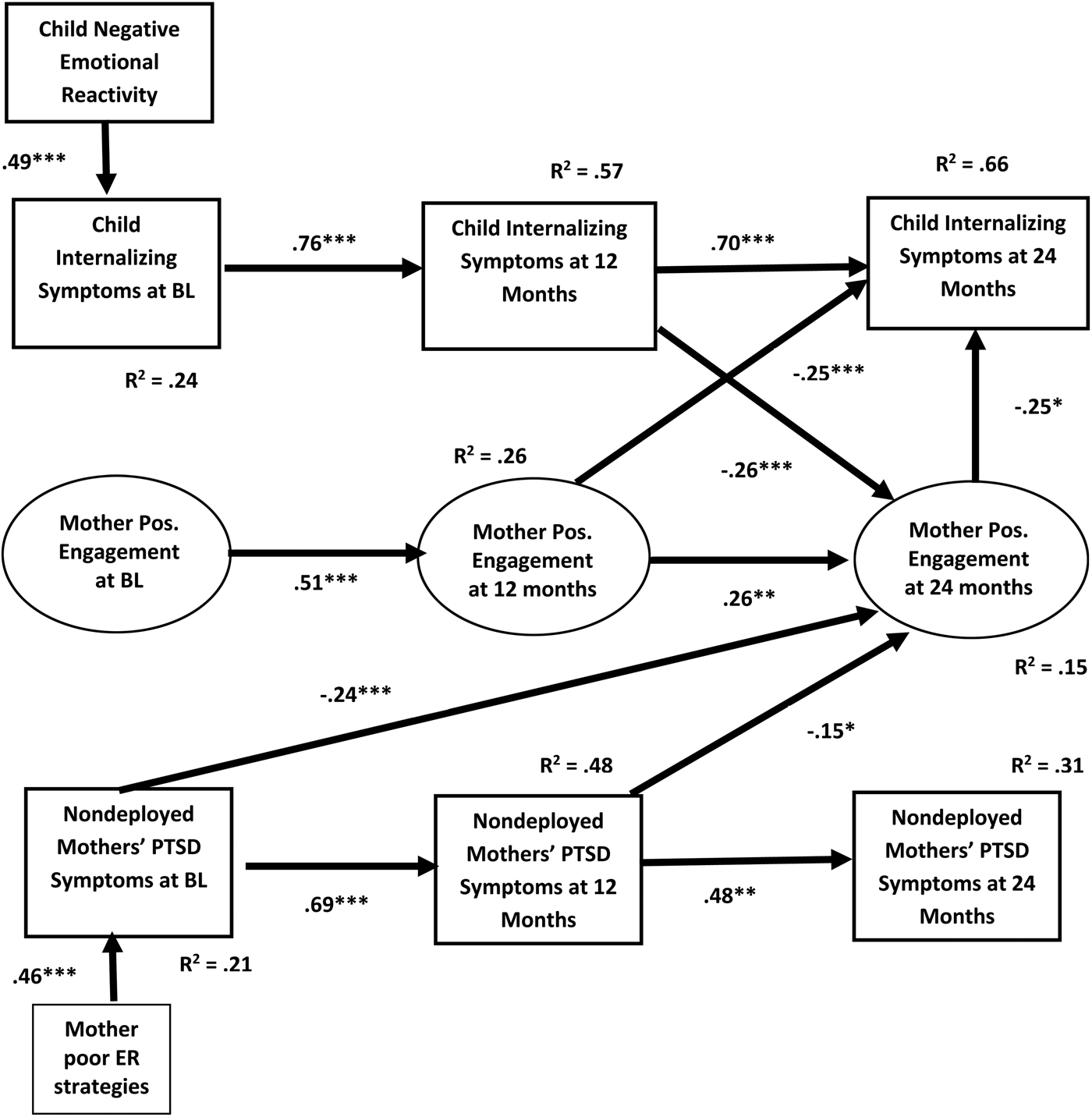
The model assessing the hypothesized role of a mother's positive engagement with her child as an intermediary process in the cascade of mothers’ PTSD symptoms and child internalizing symptoms is shown in Figure 9. The model fit the data well: χ2 (79) = 84.69, p = .31, χ2/df = 1.07, CFI = 0.954, RMSEA = 0.032. Mothers’ PTSD symptoms at baseline and 12 months were negatively related to positive engagement with their children at 24 months. Mothers’ positive engagement at 12 months and 24 months were negatively related to child internalizing symptoms at 24 months. Child internalizing symptoms at 12 months were negatively associated with mothers’ positive engagement at 24 months. Mothers’ poor emotion regulation strategies were associated with their PTSD symptoms at baseline. Child negative emotional reactivity was associated with child internalizing symptoms at baseline. The concurrent path from mothers’ PTSD symptoms to child internalizing symptoms at baseline, and the prospective paths reciprocally linking mothers’ PTSD symptoms and children's internalizing symptoms at 12 months to 24 months in the cascade model (see Figure 5) were no longer significant in the model incorporating mothers’ positive engagement. Males had fewer and older children more internalizing symptoms at baseline.
Mother positive engagement and symptom transmission between nondeployed mothers’ posttraumatic stress disorder symptoms and child internalizing symptoms. Males had fewer internalizing symptoms (r = –.29, p < .001), and child age (r = .18, p < .05) was associated more child internalizing symptoms. χ2 (79) = 84.69, p = .31, χ2/df = 1.07, CFI = 0.954, RMSEA = 0.032. Error terms are omitted for clarity. *p < .05. **p < .01. ***p < .001.
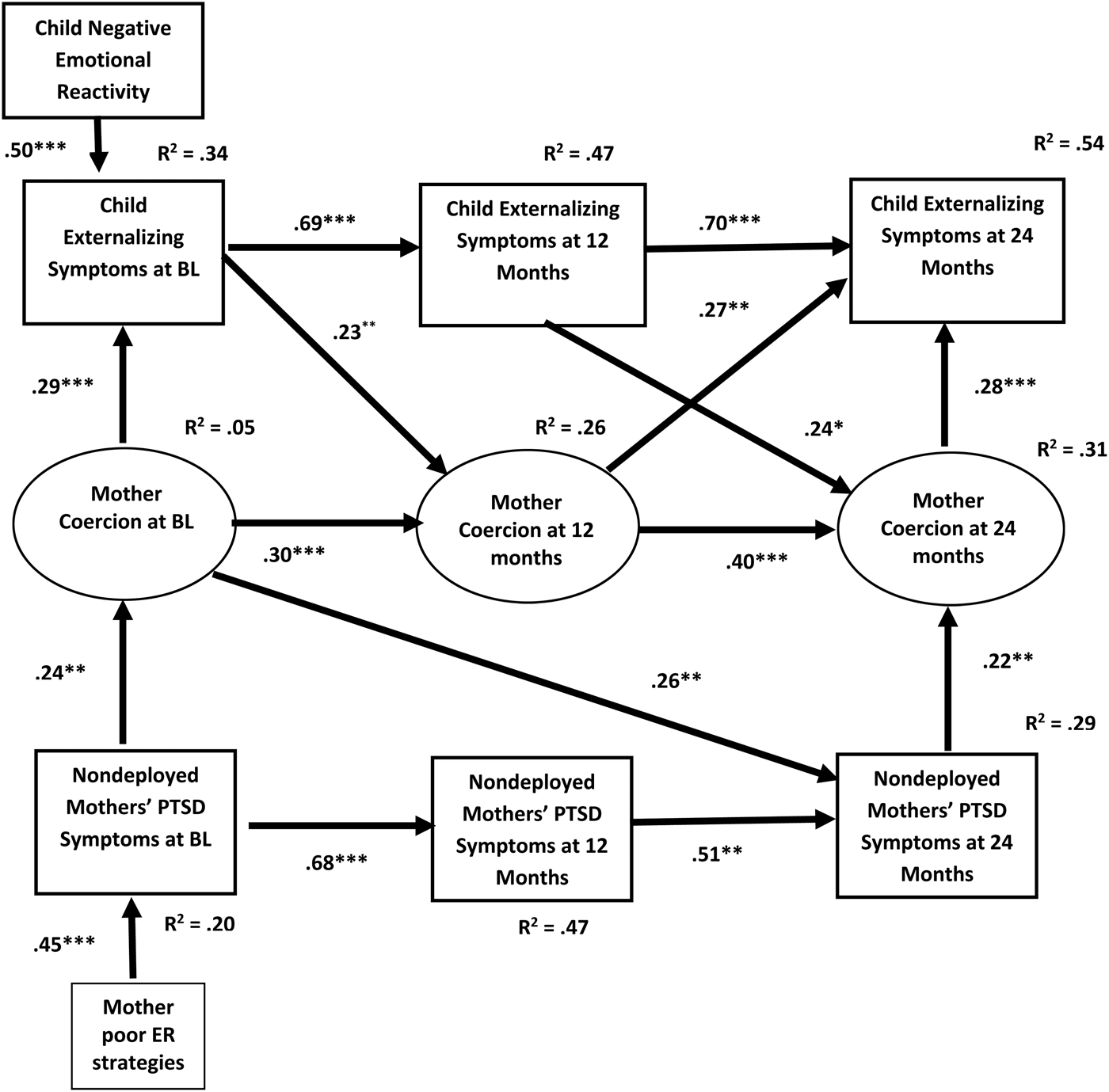
The hypothesized model linking mothers’ coercive behavior as an intermediary process in the cascade of mothers’ PTSD symptoms and child externalizing symptoms is shown in Figure 10. The model fit the data well: χ2 (64) = 58.49, p = .67, χ2/df = 0.87, CFI = 0.989, RMSEA = 0.020. Mothers’ PTSD symptoms at baseline and at 24 months were positively associated with their concurrent coercive behavior. Mothers’ baseline coercive behavior was positively related to their PTSD symptoms at 24 months. Mothers’ coercive behavior at baseline and at 24 months were positively associated with child externalizing symptoms at baseline and 24 months, respectively. Mothers’ coercive behavior at 12 months was positively associated with child externalizing symptoms at 24 months. Child externalizing symptoms at baseline and 12 months were positively associated with their mothers’ coercive behavior at 12 and 24 months, respectively. Child negative emotion reactivity was associated with child externalizing symptoms at baseline, and mothers’ poor emotion regulation was associated with their PTSD symptoms at baseline.
Mother coercion symptom transmission between nondeployed mothers’ posttraumatic stress disorder symptoms and child externalizing symptoms. Males had more externalizing (r = .17, p = .06) symptoms at baseline. χ2 (64) = 58.49, p = .67, χ2/df = 0.87, CFI = 0.989, RMSEA = 0.020. Error terms are omitted for clarity. *p < .05. **p < .01. ***p < .001.

Discussion
This study examined how fathers’ exposure to combat-related trauma cascades through the family system to affect each family members’ adjustment, and how individual emotion regulatory and family interaction processes increase risk or impart resilience in the face of challenges experienced by deployed parents and their family members. The results need to be contextualized in terms of the timing of the longitudinal assessments after deployment and the characteristics of the sample. The 2-year period during which the three annual assessments were completed occurred on average 2 years following the last parent deployment, and represents a series of snapshots of longer term adaptation by family members. As such, the data are derived from the “middle of an ongoing story,” with all the limitations associated with a brief series of assays embedded in a longer developmental history. Given research indicates adaptation challenges continue for an extended period of time following deployment (MacDermid, Reference MacDermid2006), these snapshots provide a sense of the ongoing stressors and challenges experienced by these families, their impact on family members, and the processes by which they cope and adapt.
The families who participated in the study (Gewirtz, Pinna, et al., Reference Gewirtz, Pinna, Hanson and Brockberg2014) were relatively well resourced. The deployed fathers were older than most military service members deployed to the OEF/OIF/OND conflicts. Most of the National Guard and Reserve men and their intimate partners had established families with children, were relatively well educated, were employed, and had good incomes. These resources likely promoted resilience in the face of the challenges and transitions associated with deployments (Polusny et al., Reference Polusny, Erbes, Murdock, Arbisi, Thuras and Rath2011). The majority of the family members were relatively well adjusted as expected in a prevention study, with only 10% to 15% of parents and children having significant impairment. However, the families reported substantial ongoing stressors during the 2-year snapshot captured by data in this study (Gewirtz, McMorris, et al., Reference Gewirtz, McMorris, Hanson and Davis2014). Given these family and timing contexts, we turn to findings related to family system cascades of problem adjustment.
Child internalizing and externalizing symptoms
Parent-reported child internalizing and externalizing symptoms occurred at modest levels, and showed typical child sex differences, between-parent agreement, and cross-time continuity, comparable to community samples (Reynolds & Kamphaus, Reference Reynolds and Kamphaus2004). The concurrent covariation between internalizing and externalizing symptoms was modest, with about 10% shared variance at the three assessment points. Consistent with past research (Lester et al., Reference Lester, Peterson, Reeves, Krauss, Glover and Mogil2010), it appeared that child internalizing symptoms were particularly salient during the postdeployment period. Child internalizing but not externalizing symptoms were associated with their fathers’ reports of deployment-related trauma, and may reflect continuing child distress about their fathers’ wartime experiences. Child internalizing symptoms at the 12-month assessment point predicted externalizing symptoms at 24 months. Baseline child internalizing and externalizing symptoms were more consistently related to fathers’ and mothers’ PTSD symptoms.
Family transmission of symptoms
The hypothesis about transactional cascades among family members’ symptoms was generally supported. Although there was variation in the timing and strength of these cascades, concurrent and cross-lagged prospective covariations were observed in models involving father–child, mother–child, and father–mother dyads. The reciprocal cross-lags from 12 to 24 months between fathers’ and mothers’ PTSD symptoms, and the significant covariation between their PTSD symptoms at 24 months but not at baseline or 12 months suggests convergence in their symptoms over the 2-year period in this study. The cascades between fathers’ PTSD and child internalizing symptoms, and mothers’ PTSD and child internalizing symptoms were similar, with baseline covariation and 12 to 24 month reciprocal associations. This suggests a social contagion or amplifying process, though the effects were relatively small. The concurrent and prospective covariation of fathers’ and mothers’ PTSD symptoms with child externalizing symptoms was less similar. Prospective paths from mothers’ and fathers’ PTSD symptoms to child externalizing symptoms were greater than the reciprocal paths from child to parent, and accounted for an additional 10% of the variance in externalizing symptoms over a 1-year interval.
Mothers’ PTSD symptom levels were comparable to those of their deployed partners, and a few mothers reported clinically significant increases in symptoms over time. The reciprocal cascade between intimate partners’ PTSD symptoms may reflect two complementary processes. The adjustment problems of each partner are likely a salient source of stress for the other (Kaylis et al., 2011) and may undermine the caring and social support each partner needs to effectively manage distress (Monson et al., Reference Monson, Taft and Fredman2009).
The covariation between parent and child adjustment in this study is consistent with previous epidemiological (Merikangas et al., Reference Merikangas, He, Burstein, Swanson, Avenevoli and Cui2010) and longitudinal (Collins, Maccoby, Steinberg, Hetherington, & Bornstein, Reference Collins, Maccoby, Steinberg, Hetherington and Bornstein2000) research linking spouse, parent, and child maladjustment. However, we are unaware of research that has examined family-system symptom cascades in a transactional design. The models in this study suggest reciprocal cascades of symptoms pervade multiple family relationships and reverberate through the family over time. As such, it may be useful to complement the traditional psychiatric perspective focused on comorbidity at the individual level with conceptualization of co-occurrence at a family-systems level. The cascades among family members’ symptoms provide the empirical stage to examine individual and family processes linking these cascades.
Social and individual emotion regulatory processes linking family members’ symptoms
The reciprocal linkage of parent PTSD symptoms and child externalizing and internalizing symptoms may be the result of both shared and distinct social and individual emotion regulatory processes. We hypothesized that parent PTSD symptoms and child externalizing symptoms would be linked via recurring coercive parent behavior, and individual family member's emotion dysregulation (Gewirtz et al., Reference Gewirtz, Polusny, DeGarmo, Khaylis and Erbes2010), and that parent PTSD symptoms and child internalizing symptoms would be linked by low levels of parent support and positive engagement, and each family member's emotion dysregulation.
Social processes
The hypothesized linking role of family social processes was supported. The significant concurrent covariation and reciprocal temporal cross-lag associations between parents’ PTSD symptoms and child internalizing and externalizing symptoms observed in the family symptom cascade models were no longer significant in models that added observed parent behavior as a linking process. For both father–child and mother–child models, parent PTSD symptoms were associated with less parent positive engagement, and parent positive engagement was associated with fewer child internalizing symptoms. This is consistent with research indicating parents’ positive engagement and support mitigates child anxiety and depressive symptoms (Hammen & Rudolph, Reference Hammen, Rudolph, Mash and Barkley2003), and extends that research by finding this mitigating function was characteristic of the interaction of both fathers and mothers with their children. It is also consistent with research that documents children's contribution to the quality of parent–child interaction (Patterson & Reid, Reference Patterson, Reid, Neuringer and Michael1970); children's internalizing symptoms were associated with less parent positive engagement 1 to 2 years later, more so for mothers than for fathers. Thus, this cascade is a “two-way street” with parents’ positive engagement and support at the “intersection.”
For both father–child and mother–child models, the data supported the hypothesis that parents’ coercive behavior toward their child serves as a reciprocal link between their PTSD symptoms and child externalizing symptoms. This is consistent with extensive research documenting the role of coercive family processes in the development of child externalizing symptoms in longitudinal (Snyder & Stoolmiller, Reference Snyder, Stoolmiller, Reid, Patterson and Snyder2002) and intervention studies (Snyder, Reference Snyder, Dishion and Snyder2016). The prospective positive associations between parent coercion and child externalizing symptoms suggest that reciprocal child- and parent-driven processes create a positive feedback/amplification of aversive control (Snyder, Stoolmiller, Wilson, & Yamamoto, Reference Snyder, Stoolmiller, Wilson and Yamamoto2003). Fathers’ PTSD symptoms appear to have a stronger and more consistent association with their coercive behavior than that of mothers, but the linkage of mothers’ coercive behavior to child externalizing symptoms appears stronger than that of fathers. The differences in the father–child and mother–child models suggest that fathers’ coercive behavior may be evoked by their irritability and hyperarousal but does not exacerbate their PTSD symptoms over time. Mothers often play a more prominent parenting role, and more strongly impact and are impacted by child externalizing symptoms via day-to-day coercive interactions with their children (Patterson, Reference Patterson1980). Fathers relative to mothers may be less consistently involved and invested in limit setting and discipline, but when doing so, may use authoritarian approaches (Calzada, Eyberg, Rich, & Querido, Reference Calzada, Eyberg, Rich and Querido2004). These differences may be amplified by postdeployment renegotiation of coparenting roles and fathers’ PTSD symptoms.
Support for the role of parent–child relationship quality as a linking process in family-symptom transmission should be considered tentative for several reasons. The manner in which parent–child relationship quality served as a linking process between parent and child symptoms was often indirect and involved multiple concurrent as well as prospective paths. As such, the size of the indirect associations between parent PTSD symptoms and child internalizing and externalizing symptoms through relationship quality was modest. This study examined different family processes in relation to symptom transmission to and from child externalizing and internalizing symptoms. The correlations between the parent positive engagement and coercive behavior were quite modest, and along with other social processes such as distress avoidance/invalidation, the specificity of relationships of various family processes to the transmission of different symptom configurations bears additional scrutiny.
Individual emotion regulatory processes
The contribution of each family member's emotion regulation capacity was integrated into the family-system symptom cascade models. Fathers’ trauma exposure was associated with their PTSD symptoms, and their experiential avoidance had a concurrent and persisting association with their PTSD symptoms, consistent with previous research (Meyer et al., Reference Meyer, Morissette, Kimbrel, Kruse and Bird Gulliver2013). Fathers’ inability to distance themselves from affective distress, as assessed by experiential avoidance, reflects difficulty in managing the thoughts and emotions associated with their trauma experiences and postdeployment family stressors (Kashdan et al., Reference Kashdan, Morina and Priebe2009). Experiential avoidance may indirectly amplify the impact of their distress on their intimate partners’ and children's adjustment by diminishing their positive engagement and increasing their coercive behavior during family interaction (Buckholdt, Parra, & Jobe-Shields, Reference Buckholdt, Parra and Jobe-Shields2014).
Children's negative emotional reactivity was correlated with their internalizing and externalizing symptoms, consistent with previous research (Eisenberg et al., Reference Eisenberg, Valente, Spinrad, Liew, Reiser and Zhou2009). Parents’ reports of child negative emotionality showed substantial temporal continuity (rs > .70) and comparable covariation with their internalizing and externalizing (rs > .45) symptoms at each assessment point. This suggests that children's emotional regulatory capacity is a stable temperamental trait that contributes to their general adjustment, and may serve as a source of ongoing distress to parents during daily parent–child interaction (Snyder, Schrepferman, & St. Peter, Reference Snyder, Schrepferman and St. Peter1997; Snyder et al., Reference Snyder, Stoolmiller, Wilson and Yamamoto2003).
Mothers’ difficulties in regulating their negative emotions were related to their PTSD symptoms, which, in turn, may have affected their capacity to positively engage their children, avoid parent–child conflict (Morris et al., Reference Morris, Silk, Steinber, Myers and Robinson2009; Snyder et al., Reference Snyder, Lowe, Bullard, Schrepferman, Wachlarowicz, Marvin, Larzelere, Sheffield and Harrist2013), and manage the array of multiple family and personal challenges during postdeployment (Gewirtz & Davis, Reference Gewirtz, Davis, MacDermid and Riggs2014). As key family managers (Gewirtz & Davis, Reference Gewirtz, Davis, MacDermid and Riggs2014), mothers’ difficulty in regulating emotions may contribute to the cascade of symptoms through the family and to their own adjustment problems.
Cascade models
Collectively, these data are consistent with the hypothesized cascade models of symptom transmission in the family system. Each family member's adjustment is affected by his or her emotion regulation capacity, which concurrently and prospectively affects the quality of family relationships during daily interaction. The quality of parent–child relationships may serve as one intermediate process by which symptoms are transmitted among family members. However, the relationships among emotion regulation, symptom patterns, and relationship quality are likely to also involve genetic and neurobiological processes that were not directly assessed in this study. Emotional dysregulation, as reflected in child negative emotionality, mothers’ limited emotion regulation strategies, and fathers’ experiential avoidance, likely involves serotonin neurotransmitter systems and glucocorticoid receptor sensitivity, both of which are genetically influenced (Jovanovic & Ressler, Reference Jovanovic and Ressier2010). Family members’ sensitivity and responsiveness to positive and aversive experiences during family interaction also involve dopamine neurotransmitter systems that are also genetically influenced (Beauchaine & Gatzke-Kopp, Reference Beauchaine and Gatzke-Kopp2012). Given the genetic contribution to these neurobiological systems, the transmission of symptoms between parents and children may reflect passive and evocative gene–environment correlations, and gene–environment interactions (Beauchaine, Reference Beauchaine, Beauchaine and Hinshaw2013) that are not fully represented in these analyses, as well as family social processes. This paper complements research on the role of genetic liabilities and associated neurobiological processes in family symptom transmission by detailing how those processes may be expressed in family social interaction in ways that shape and maintain child internalizing and externalizing symptoms and parent distress.
Design, methodology, and implications for developmental-intervention research
This study has several strong methodological characteristics. Multiple informants were used to create aggregate variables. Multimethod coding of parent–child interaction was used to measure parent positive engagement and coercive behavior, providing a relatively objective measure of parent–child relationship quality and a robust measure of key mediational variables without source overlap with other constructs. However, support for these transactional models should be considered tentative given their complexity and the design limitations of the ADAPT study. The availability of three annual assessment points diminished the ability to optimally examine transactional cascades over briefer intervals and the consistency with which those transaction cascades play out over a longer time period. The three assessment points also limited the opportunity to optimally test parent behavior as a mediator of symptom cascades across family members. The age range of children was large, such that many contextual and developmental differences associated with child age hid important variations in family stressors, child emotion regulation capacities, family processes, and their interrelationships.
Some of these limitations reflect costs involved in implementing a randomized control prevention trial while also repeatedly assessing the wide range of relevant variables at optimal intervals in ways that would ideally align with a developmental cascade model. However, experimental manipulation of key variables provides the opportunity to make stronger inferences about the causal role of variables in these transactional cascades. Preventive interventions, such as ADAPT, are aimed at individuals and families whose maladaptation may unfold over time following some risk-inducing transition or characteristic. As such, intervention effects are often delayed, and involve iterative transactions among proximal variables directly targeted in intervention and variables more distally and indirectly related to the targeted variables in terms of causal–developmental processes. Despite these difficulties, using data from controlled trial preventive interventions to ascertain cascading processes and outcomes provides an opportunity to experimentally test interactions among proximally targeted and causally distal variables that may generate longer term and accumulating developmental outcomes (Forgatch, Patteron, DeGarmo, & Beldavs, Reference Forgatch, Patterson, DeGarmo and Beldavs2009).
Other analyses of ADAPT using the full sample of 336 families indicate intervention effects (Gewirtz, DeGarmo, & Zamir, Reference Gewirtz, DeGarmo and Zamir2016a, Reference Gewirtz, DeGarmo and Zamir2016b) that were less apparent in this report. Examination of intervention effects as a covariate in transactional cascade models provided the means to simplify very complex models, but did not optimize ascertainment of intervention effects and may be relatively insensitive to changes in mean levels of key mediating processes and outcomes. The use of multigroup structural equation models that incorporate growth in targeted and distal variables and their prospective interrelationships would more powerfully capture both short- and long-term cascading intervention effects, but requires a large sample. The combination of multilevel cascade models and experimental manipulation in randomized trial designs would provide a very powerful vehicle to examine complex and multilevel developmental processes with strong causal inference.