Introduction
Survey data from around the world indicate that mothers are more likely to be paid less than non-mothers. This stylized fact is based on a comparison between the labor market earnings of mothers and non-mothers, and is commonly referred to as the “motherhood wage penalty”.Footnote 1 The prevailing argument is that the gap is associated with the depreciation of human capital resulting from interruptions in labor market attachment (Mincer and Polachek Reference Mincer and Polachek1974; Gupta and Smith Reference Gupta and Smith2002). When women have children, they typically shoulder the burden of child-rearing activities. This workload gets heavier if they cannot access paid child care services or other family members’ support. This situation unavoidably leads women to reduce their labor supply. Based on traditional human capital theory, career interruptions indicate a pause in experience accumulation and even human capital deterioration and decline in productivity. Mothers who return to work often have to accept a decrease in labor earnings (Mincer and Ofek Reference Mincer and Ofek1982). Career interruptions may also impede women’s chances of promotion in the workplace and bring about the “glass ceiling” phenomenon. The penalty is more likely to be an issue in the profit-oriented private sector where maternity leave policies are less likely to be followed than in the public sector. This situation creates a bifurcation for women’s potential earnings due to the disparities in these two sectors’ wage-setting mechanisms and work-family policies (Duvier and Narcy Reference Duvier and Narcy2015).
Although the motherhood wage penalty is a universal fact, there are cross-country differences attributable to institutional differences. The highest motherhood wage penalties are estimated for liberal Anglo-Saxon countries followed by conservative Continental European countries, with the lowest found in Nordic countries where the social democratic tradition is strong (Harkness and Waldfogel Reference Harkness and Waldfogel2003; Budig et al. Reference Budig, Misra and Boeckmann2012; Sigle-Rushton and Waldfogel Reference Sigle-Rushton and Waldfogel2007; Gash Reference Gash2009). Women in Nordic European countries have access to work-family reconciliation policies in the form of extensive public child-care arrangements and generous maternity leave, which reduce wage losses for mothers (Gupta and Smith Reference Gupta and Smith2002; Nielsen et al. Reference Nielsen, Simonsen and Verner2004; Albrecht et al. Reference Albrecht, Edin, Sundstrom and Broman1999). Anglo-Saxon countries are at the other extreme. The United Kingdom and Australia take the lead, with at least a 10 percent wage loss for mothers. The USA and Canada closely follow these countries. Extensive research on women in the USA reveals that under-educated mothers may not experience wage loss, but college-educated women’s loss increases with each additional child; if they have two or more children, they experience a 15 percent loss of wages (Anderson et al. Reference Anderson, Binder and Krause2002; Budig and England Reference Budig and England2001). Results from Phipps et al. (Reference Phipps, Burton and Latheridge2001) show similar wage losses for Canadian women. Continental European countries perform better thanks to better work-family reconciliation policies, including progressive maternity leave practices and moderate provision for public child-care expenditure. The estimated penalties are 8 percent and 5 percent for Germany and the Netherlands, respectively (Ejrnaes and Kunze Reference Ejrnaes and Kunze2013; Buligescu et al. Reference Buligescu, Crombrugghe, Menteşoğlu and Montizaan2009).
According to the Global Wage Report 2018/19 published by the International Labour Organization (ILO), Turkey boasts the highest gross motherhood wage penalty (ILO 2018). On average, mothers’ wages are 29 percent less than non-mothers, substantially higher than the reported values for other countries.Footnote 2 However, one should be cautious when comparing the average wages in the two subsamples by only relying on the presence of children. Mothers and non-mothers may differ in substantial ways based on their observable and unobservable characteristics. Therefore, a careful investigation is required to examine the composition bias in the gross wage penalty estimates.
In this article, I engage in a carefully designed analysis of how being a mother affects women’s wages in Turkey by stratifying the data so that the comparison can be done among women who face similar circumstances. This investigation is carried out separately for different groups of women because having children might not be equally disruptive for all of them. I start by dividing the sample into two age groups—25–34 and 35–44—to estimate the penalties at two points in the life cycles of working women. There are several motives for stratifying on age. The most important one is adjusting for differences in the risk of exposure to motherhood. Women in the 35–44 group are more likely to include mothers than women in the 25–34 age group. Moreover, the labor market prospects of young mothers are likely to be different from mothers in the older age range. I return to this point below when education is introduced as another dimension of stratification. Presently, by treating younger and older women as different strata, I also account for differences in cohort behavior. Based on the Turkey Demographic and Health Survey (TDHS) 2018 Report, the highest fertility rates are observed between the ages of 25 and 34 (Hacettepe University Institute of Population Studies 2019). Consequently, these women have to deal with child-rearing activities, and inevitably employment breaks occur in this young age cohort. Evidence from Tunalı et al. (Reference Tunalı1997) also confirms this pattern as an M-shaped age profile in female labor force participation in Turkey. When the data are stratified, the M-shape is spotted in rural areas and in the case of high school or less educated women residing in urban areas.
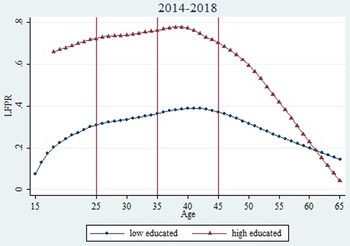
Differences in behavior by education underscored in the rich literature on female labor force participation in Turkey justify the strategy of dividing the sample into four groups, by age (24–34 vs. 35–44) as well as by education (high school or less vs university or above). This effect is present in Figure 1 which exhibits age profiles of female labor force participation rates by education groups. Other studies similarly provide evidence of a clear-cut distinction in participation rates of university-educated women in Turkey (Tunalı et al. Reference Tunalı, Kırdar and Dayıoğlu2021; İlkkaracan Reference İlkkaracan2012; Gündüz-Hoşgör and Smits Reference Gündüz-Hoşgör and Smits2008; Dayıoğlu and Kırdar Reference Dayıoğlu and Kırdar2010; Dayıoğlu Reference Dayıoğlu, Acar and Güneş-Ayata2000; Tunalı Reference Tunalı1997).
Female labor force participation rates by age on low and high educated groups in Turkey, 2014–2018.Footnote 3
Source: Author’s calculations based on the Household Labor Force Survey (HLFS), 2014–18.

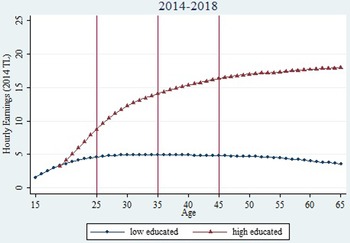
Furthermore, the impact of education is not restricted to participation rates. Women who stay in school longer, marry and transit to motherhood later. That is, the risk of exposure to motherhood differs not only by age but also by education. University-educated women not only marry later, but they also postpone motherhood. It is related to the fact that university education tends to lead to higher wages which serves as a motivation to wait longer to become mothers. Therefore, the driving forces for women’s participation might not be mutual in the high and low educated groups. This can be seen in Figure 2 which displays age-earnings profiles for the education groups. Differences in earnings emerge quickly and the profiles shift up with high education. Experience pays off in the case of high educated women who are able to accumulate skills at a higher rate since on average they have higher ability and the skills acquired at the university level make it easier for them to benefit from on-the-job training.
Female hourly earnings by age on low and high educated groups in Turkey, 2014–2018.
Source: Author’s calculations based on HLFS.

The last element in the stratification strategy is the breakdown of working women by public and private sectors. This distinction is highly warranted in the case of Turkey, where the public sector is perceived as being family-friendly, with improved working conditions for women. Additionally, there is evidence that the age-earning profiles of women are different in the two sectors (Aktuğ et al. Reference Aktuğ, Kuzubaş and Torul2021). A family-oriented environment can easily influence the sector a woman chooses to work in and create self-selection. It is a particularly compelling issue since the gender division of household work is unequal between men and women in Turkey. The degree of inequality is lower if both parents are employed, but it still prevails (Kongar and Memiş Reference Kongar, Memiş, Connelly and Kongar2017).
The four-way breakdown implicitly admits the presence of selectivity into motherhood and permits comparison among equals, to the degree that this is possible. Women who are observed in subsamples are broken down as described to signal their wage prospects. Also, women who return to work after having children are surely not a random subset of those in a given education-age cohort pair. Older mothers who are observed to work are those who enjoy higher rewards, so we would expect the motherhood penalty to be lower. Taken together Figures 1 and 2 suggest that selectivity is likely to operate differently in the education groups. I utilized pooled cross-sectional 2014–2018 microdata from the Household Labor Force Survey, conducted by the Turkish Statistical Institute (TurkStat) to arrive at precise estimates of the motherhood wage penalty on the subsamples created by the stratification strategy. The results are based on pooled ordinary least squares estimation.
The findings contribute to the literature in a number of ways by providing a rich set of empirical findings from a developing country context. First, I find that when observable differences among the women are accounted for, there is a negligible—1 percent net—wage penalty for mothers in the combined sample. This casts doubt on the relevance of the gross wage penalty, estimated as 21.3 percent. This significant difference between the gross and net penalty estimates is primarily associated with disparities in human capital factors, particularly educational attainment. The subsample of non-mothers from the 25–44 age group contains many more university-educated women than the subsample of mothers in Turkey, and non-mothers as a whole work in higher-paid jobs.Footnote 4 Consequently, the gross wage penalty reflects a meaningless comparison. Secondly, mothers in the younger age cohort have a higher wage loss than mothers in the older age cohort. This is attributable to the fact that they are spending time on child-rearing when they could be investing in a career. Also, the subsample of older mothers probably includes a higher share of women who return to work because of better wages. Thirdly, there are stark differences in the wage penalty estimates for the public and private sectors. There is no wage loss (and even wage premium!) for mothers working in the public sector. This might be due to more generous maternity leave and job protection policies, along with ever-increasing wage trajectories observed during the time window in this sector. The highest penalty is 6.1 percent for university-educated mothers in the younger age cohort (25–34). This is about the loss of the gains associated with the steeper portion of the experience profile.
The article contains four more sections. The second section provides the background and is broken down into subsections that in turn offer brief reviews of the literature, the related concept of the gender gap, and the role of institutional context, followed by a closer look at the public sector. The third section is devoted to the empirical methodology. It consists of subsections on the data set and research design, descriptive statistics that offer a first glimpse of the patterns, and the empirical specification of the estimating equations. The fourth section presents the results in a comprehensive manner. The last section offers a brief summary and some concluding remarks.
Background
Theoretical discussion
Many different theoretical explanations have been offered for the motherhood wage penalty. Primarily, having children is partly responsible for women losing employment time to child- care activities. As a result, they drop out of the labor force, which can diminish their human capital due to decreased employment time. This results in a gap in women’s experience accumulation. Based on human capital theory, higher experience drives higher wage returns, and employers offer increased wages to more productive and experienced workers. In the light of this theory, having children would unavoidably cause a break in mothers’ careers, thereby hampering the increase in wage rates. Though this effect on wages is highly dependent on observables and unobservables, it needs to be thoroughly evaluated. Observables mainly include human capital (education, experience, age), workplace, job characteristics, and occupational factors, whereas unobservables include selectivity and timing of motherhood, effort, and discrimination.
Becker’s human capital theory claims that the reason behind the lower wages of mothers is that they need to devote more time to child-rearing and are likely to drop out of the labor force. Consequently, this situation leads to human capital deterioration, thus distorting their earning profiles (Becker Reference Becker1985). Further, mothers are more likely in work part-time jobs than non-mothers, and these jobs are perceived as inferior. The hourly earnings of part-time jobs are less than those of full-time jobs (Hirsch Reference Hirsch2005). Education level, work experience, tenure, the number of entries into and exits out of the labor market, the total time spent out of the labor market, and work status are widely used as the set of explanatory variables to analyze the effect of human capital variables on the wage difference among women. Budig and England (Reference Budig and England2001) studied the motherhood wage penalty in the USA by using these observable factors, which explain nearly half of the mothers’ wage loss—the other half remains unexplained.
Some jobs are more attractive and convenient for mothers as they demand fewer working hours with a flexible schedule. These jobs enable them to spend less time commuting and consequently they are able to spend more time at home. However, the theory of compensating differentials states that jobs with these characteristics generally pay less. In light of this theory, mothers forgo higher wages for being working mothers. The most well-known mother-friendly job type is one that is part time. Findings suggest that part-time employment reduces the penalty by 2–3 points (Waldfogel Reference Waldfogel1997). Budig and England (Reference Budig and England2001) use different variables which may be representative of mother-friendly jobs to discuss their effects on penalties, but they do not explain why mothers earn less than non-mothers. Another study by Gangl and Ziefle (Reference Gangl and Ziefle2009) shows that work interruptions with selection into mother-friendly jobs are the primary reasons for wage penalties.
Mothers earn lower wages than non-mothers because employers discriminate against mothers, which happens in various ways. For example, mothers are promoted less, paid lower wages and bonuses, or assigned less rewarding jobs. Based on experimental evidence from Correll et al. (Reference Correll, Stephen and In2007), mothers are less likely to be hired or, when they are hired, they are given lower starting salaries just because they have children, while this is comparatively not the case for non-mothers and fathers. Discrimination can occur in two different forms: statistical by Phelps (Reference Phelps1972) and taste by Becker (Reference Becker1957). Statistical discrimination simply means that, on average, employers perceive non-mothers as being more productive than mothers. Taste discrimination adds to statistical discrimination, in that employers not only think that non-mothers are more productive than mothers, but they also prefer to employ non-mothers and offer them higher wages. Note that it is almost impossible to show discrimination in the model by using variables. Studies mainly control the set explanatory variables (e.g. human capital and job characteristics). If there is still a positive, unexplained wage difference favoring non-mothers, it is often attributed to discrimination, which is a suggestive but not a decisive outcome.
The gender wage gap and the role of institutions
The arguments found in the literature on the motherhood wage penalty and gender wage gap forcefully establish that these two are intimately connected (Blau and Kahn Reference Blau and Kahn2017). I begin by reviewing the recent empirical evidence on the wage gap. Later, I turn to studies that describe the wage trajectories and the differences in the work-family reconciliation policies in the Turkish private and public sectors.
Up-to-date studies undertaken in developed countries underscore that, together with the help of anti-discrimination laws and regulations, the contribution of gender differences in education and labor market experience to the gender wage gap has significantly decreased (Blau and Kahn Reference Blau and Kahn2017; Klesment and Bavel Reference Klesment and Bavel2017). These laws motivate women to obtain higher education, thus increasing their likelihood of working in upper level and higher-paid jobs. Kurtulus (Reference Kurtulus2012) also shows that the role of regulations is more binding in the public sector where the percentage of women in high-paying positions increased further. However, gender segregation in occupation and industry remains the highest quantifiable contributor to the remaining gender wage gap, even though women have made substantial occupational inroads into previously male-dominated jobs. Additionally, the gender division of labor still stands as an important determinant of gender differences in wages. Research taking a quasi-experimental approach based on event studies in developed countries highlights that having children is responsible for a high share of the remaining unexplained wage gaps (Kleven et al. Reference Kleven, Landais and Sogaard2019; Musick et al. Reference Musick, Bea and Gonalons-Pons2020). A cross-country study finds that parenthood contributes to the wage gap via the wage loss of women after motherhood and male wage premium after fatherhood (Cukrowska-Torzewska and Lovasz Reference Cukrowska-Torzewska and Lovasz2020).
The conventional gender wage gap analysis relies on the differences between women and men’s human capital and job characteristics. The cross-country findings of Blau and Kahn (Reference Blau and Kahn2003) present the highest gaps for Japan and the USA—73 and 40 percent respectively—and the lowest estimates, at around 12 percent, for Slovenia and East Germany between 1985–1994 after controlling individual characteristics. The differences in overall wage structure by gender and institutional arrangements such as unionization and minimum wage policies are the fundamental reasons behind the wage gap. Using more recent data, Arulampalam et al. (Reference Arulampalam, Booth and Bryan2007) report wage gaps of between 10–20 percent in eleven European countries. They argue that, apart from the differences in wage-setting institutions, child-care provision in Europe also contributes to the disparities across countries. Notably, the wage gaps are estimated separately for the public and private sectors to identify the effects of wage-setting institutions and family arrangements.
İlkkaracan and Selim (Reference İlkkaracan and Selim2007) estimate a 9 percent gender wage gap in Turkey when they control for human capital, occupation, sector, and firm-specific variables. The human capital differences due to low potential experience and job tenure are the highest contributors to the gender wage gap. This outcome is not surprising because Turkish women often drop out of the labor force when they have children. Even if they return to work, they have a higher burden to shoulder in the form of more time devoted to housework than men (Kaya Bahçe and Memiş Reference Kaya Bahçe and Memiş2013). The unequal division of housework lowers labor supplied and leads to compromises in job choices.
The public sector
One of the primary choices that workers make is whether to work in the public or private sectors. Careers have different advantages and disadvantages in these sectors. Women might perceive that recruitment and promotion practices are fairer in the public sector. The presence of a highly structured and centralized pay scheme also creates the notion that women are paid based on their qualifications. Rights for equal opportunities are more easily enforced in the public sector, even though legislation applies to all sectors (Mandel and Semyonov Reference Mandel and Semyonov2014). Work in the public sector comes with higher job protection and less wage dispersion in most countries (Clark and Postel-Vinay Reference Clark and Postel-Vinay2009). However, there may be a tradeoff between job protection and lifetime earnings. In Germany, the public sector offers lower wages than the private sector (Bonin et al. Reference Bonin, Dohmen, Falk, Huffman and Sunde2007). The wage trajectories for public sector workers also display a flatter shape (Buurman et al. Reference Buurman, Delfgaauw, Dur and Bossche2012).
Women in Turkey are more likely to share the same experience with job recruitment and protection in the public sector. Studies also present findings on comparing wages in both private and public sectors. Building on selectivity corrected wage equations, women working in the public sector earn higher wages than women with the same qualifications in the formal private sector (Tansel Reference Tansel2005). The estimated results are valid across different education and experience levels. Tansel (Reference Tansel2005) compares public sector workers with the formal private sector workers; if she were also to include the informal workers, the difference between the estimated wages would be even higher. Similar results are also presented by using the up-to-date data set in Turkey (Aktuğ et al. Reference Aktuğ, Kuzubaş and Torul2021). Using HLFS, Aktuğ et al. cover the period between 2004–2018, including the period utilized in this study. The hump shape in the life cycle earnings profile in Turkey is driven by the private sector. Although wages of workers in the private sector peak in their mid-forties, wages in the public sector steadily increase with age. This study reports results consistent with the risk-return trade-off. While mean wages of university graduates are higher, they are dispersed in the private sector. Risk-averse women would be more likely to seek employment in the public sector that offers job security than opting for more dispersed wages and lack of job security in the private sector.
Turkish labor law grants sixteen weeks’ paid maternity leaveFootnote 5 only to mothers and this leave cannot be divided between mother and father. The law allows mothers to change the composition of maternity leave so that they may benefit from sixteen uninterrupted weeks of leave with their newborns or they can begin to use their leave eight weeks before birth. The law regulating maternity leave is guaranteed, and workers in the public sector and individuals registered in the social security system working in the private sector may benefit from it. However, maternity leave is not available for unregistered workers. Moreover, there is a provision for child-care leave in Turkey but it is unpaid.Footnote 6 In the public sector, mothers may take two years of unpaid leave after giving birth, but in the private sector, unpaid leave is for a period of six months for registered workers. Employers in the private sector must approve that leave before the worker is able to take it, and the employer has the option to deny the request. Therefore, mothers in the private sector only use sixteen weeks of paid leave and some of them can have unpaid leave, conditional on employers’ approval. This practice creates inequality between mothers in the public and private sectors (Dedeoğlu Reference Dedeoğlu2012). Related to these weak family-work reconciliation policies, having a child mitigates against the probability of employment for Turkish women. A high proportion of women do not return to the labor force after they have a child (Gündüz-Hoşgör and Smits Reference Gündüz-Hoşgör and Smits2008). Consequently, weak labor market attachments result in reduced labor market experience, which is also one explanation for the gender wage gap in Turkey (İlkkaracan and Selim Reference İlkkaracan and Selim2007). In a nutshell, the different implications of family leave policies in the private and public sectors determine the attachment to employment and the reduction of labor market experience for women.
Empirical methodology
Data set and research design
In my investigation of the motherhood wage penalty, I employ four consecutive cross-sections of the HLFS (2014–2018). In line with the literature on the motherhood wage penalty, I focus on women between the ages of 25 and 44 and exclude women who work as employers, unpaid family workers, or on their own account (Harkness and Waldfogel Reference Harkness and Waldfogel2003; Glauber Reference Glauber2018). Earlier I pointed out that women who stay in school longer tend to marry and have children later. By excluding those under the age of 25, I reduce the confounding influence of prolonged education on motherhood. As I explain in detail further below, to identify mothers, I exploit the relations between household members. At some point, children leave home to pursue higher education or to get married. Therefore, the exclusion of women older than 44 minimizes the likelihood of treating a mother as a non-mother.
Almost 90 percent of women aged between 15 and 49 in Turkey have children.Footnote 7 To control for differences in the risk of motherhood, I subdivide my working sample into four, then tease out the effect of motherhood at two intervals during the working lives of women: when young (25–34) and in middle age (35–44), conditional on education. In my empirical analysis, I formally account for the sector selection and estimate separate earnings equations for the private and public sectors, conditional on being in one of the four age-education boxes. Technically education and motherhood are also endogenous decisions. Modeling selectivity to motherhood and education is difficult, and implementation is precluded by a lack of longitudinal data. Women who finish their education at high school are exposed to motherhood risk earlier than women who pursue higher education. Women who work when young (25–34) and in their middle age (35–44) are likely to be selected differently from the respective age-education subpopulations. Furthermore, women educated to high school level are likely to have more fertility-induced gaps in their working lives compared to university-educated women who have fewer children and access to paid child care. My stratification strategy acknowledges the presence of endogeneity and provides estimates for subpopulations of women who opt for different choices. As Budig and England (Reference Budig and England2001) underscore, the number of interruptions emerges as a key factor in accounting for the gap in the hourly pay between women who have children and those who do not.
The next step is to classify women by their motherhood status. HLFS does not have a separate variable to indicate whether a woman has a child or not. I exploit the information that records the relationship between household members. The primary survey unit is the household, and household members are defined in terms of their relation to the head of household. First, I identify whether the woman is the head of the household herself or the head of the household’s wife with at least one child. In this way, it is easy to find whether she has a child of at least 15 years of age living in the same dwelling. Then, I apply a different identification mode to find mothers with children younger than 15. The data provide the number of total household members without any age restriction and the number of household members at least 15 years of age. Subtracting the latter from the former gives the number of children under 15. If the final number is zero, there is no mother in the household, whereas if this is greater than zero, then there is a mother present. However, there are two possible drawbacks. First, the individuals aged younger than 15 might not be the child of the household head.Footnote 8 Second, this identification is dependent on living in the same household. If children move to another place for education or work purposes, women might not be labeled as mothers even if they have children. With this concern in mind, I truncate my working sample from above the age of 44.Footnote 9 To assess the consequences, I examine the fraction of mothers in different age groups by using cross-sectional data from Turkey Demographic and Health Survey (TDHS) 2013 carried out by Hacettepe University, Institute of Population Studies, and compare this with the fractions obtained from HLFS (see Appendix, Table A2). The results exhibit a similar fraction of mothers aged between 25 and 44.Footnote 10
The dependent variable is the natural logarithm of the hourly wage in women’s current jobs. For the HLFS, respondents are asked to report their monthly earnings and usual weekly working hours. Dividing monthly earnings by 4.5 (average number of weeks in a month) times weekly working hours and taking the natural logarithm yields the dependent variable. The calculated figures are in Turkish Liras (TL), so I deflate them by using the Turkish consumer price index (using 2014 as the base year) to render the cross-section data comparable.Footnote 11 It is important to note that using hourly wages instead of monthly or annual wages removes the bias attributable to the fact that women who devote less time to work or work in part-time jobs are mostly mothers who have to spend time on household chores and child care.Footnote 12
The data set does not contain exact measures of experience, other than seniority, in the current workplace. I prefer not to use seniority due to the endogeneity ushered in by its use. Exits and re-entries of mothers due to child-care interruptions generally result in lower seniority for them than for non-mothers. Since the actual experience level considers all employment breaks, it would give the current experience level (subject to recall errors). However, this measure is not available in the HLFS. I follow the Mincerian tradition and use a quadratic in potential experience.Footnote 13
Descriptive statistics
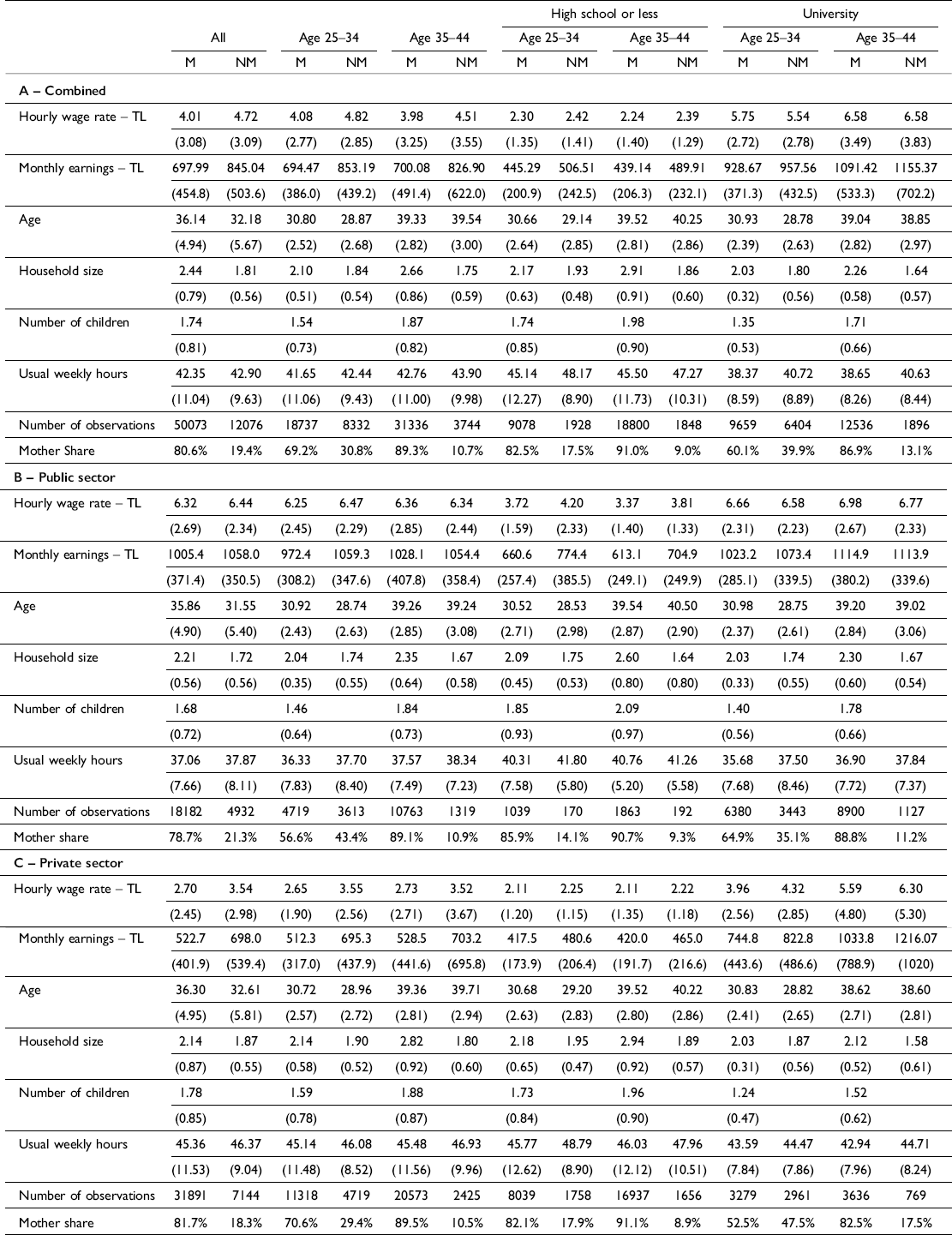
Table 1 displays means and standard deviations in parentheses on selected variables by maternal status.Footnote 14 Based on the stratification strategy, I first present the statistics on the total sample, then on the subsamples for the two age cohorts, 25–34 and 35–44. In the last two columns, I show the statistics calculated on age and education strata. Panel A ignores the sectoral division while Panels B and C include separate statistics for public and private sectors.
Sample means (std. devs.) of selected variables by strata and sectoral differences

Source: Author’s calculations based on HLFS 2014–2018.
M: Mother, NM: Non-mother
First and foremost, the average hourly wage rates of non-mothers are higher than for mothers in each age cohort. This pattern is also applicable to both education levels and the sectoral breakdown, but the wage penalties typically become smaller in each stratum and even they become wage premiums for university-educated women in the public sector. This supports the hypothesis placed on human capital as a source of observed heterogeneity between mothers and non-mothers. Additionally, the hourly wage penalty is greater in the young age cohort, proposing that those who have higher wages postpone motherhood. The average penalty becomes smaller in the older age cohort in which mothers who return to work are selected. They are more likely to get back to work since they can earn higher wages.
Having a university education substantially impacts women’s earnings in Turkey. The average wage rate for university-educated women is more than double the hourly wage rate in each age cohort in the combined sample. This finding substantiates the outcomes of Figure 2 which demonstrate the earnings gaps on two education levels. Take university-educated non-mothers, for instance: if their ratio is high in the total sample due to the high labor force participation rates, this would overestimate the average motherhood wage loss. The average hourly wage rate is 6.58 TL for high educated non-mothers in the older cohort, whereas it is 2.24 TL for less educated mothers in the same age cohort. The educational subdivision is therefore warranted to deal with the biased results.
Closer investigations into the sectoral wage rates reveal substantial earning differences for women. The hourly wage rate is 6.32 TL for mothers in the public sector, while it is 2.70 TL for mothers in the private sector. The average rates for non-mothers are 6.44 TL and 3.54 TL respectively. Mothers in the public sector earn 133 percent and non-mothers 82 percent more than their counterparts in the private sector. These discrepancies exist in the age cohorts with similar percentages. The educational breakdown still favors women in the public sector, but the percentage differences in mean wages are lower than the entire sample. There is an exception for the monthly earnings of the university-educated private sector working non-mothers in the older age cohort. These women earn higher wages than their public sector working counterparts. However, the standard deviation of wage is so high—nearly 80 percent of average wages—pointing out that wages in the private sector are more dispersed. That outcome prevails for other wages in the private sector and suggests that working in this sector involves a high risk of fluctuating wages. Therefore, the wage-setting measures indicating low average earnings with high dispersion in the private sector could easily drive women into a public sector job.
As is often the case, higher education levels are associated with higher wages and fewer children in Turkey. Looking at the family structure, on average, university-educated mothers have 1.35 children for the young cohort (25–34) and 1.71 children for the older cohort (35–44). These numbers are 1.74 and 1.98 for less-educated mothers, respectively. The younger cohort has fewer children since they have a longer child-bearing period in front of them. The sectoral analysis demonstrates that if mothers have a job in the public sector, they are more likely to have more children regardless of their education level. This result is predictable. The public sector in Turkey provides better-paid jobs and more solid job protection than the private sector. However, private sector firms have the wherewithal to offer compensation to laid-off workers. The discrepancy in unpaid leave rights for mothers explained above is another driving factor.
The usual weekly working hours reveal another story. First, mothers put in fewer working hours than non-mothers on average, regardless of sector and education level. Indeed, lower working hours operate as a mediator to decrease the motherhood wage penalty where the monthly penalty is higher than the hourly penalty in every subsample. Furthermore, the sectoral analysis shows that women in the public sector devote less time to work for each education level. The lowest weekly working hours (35.68) belong to university-educated young mothers in the public sector. It reveals that mothers with the same education level and age cohort in the private sector need to work roughly 22 percent more hours than mothers in the public sector. This ratio is smaller for young mothers with high school and less education, at 13 percent. Based on averages, mothers in the public sector enjoy the highest hourly wages as well as the lowest weekly working hours.
Lastly, the share of mothers—81 percent—presents the prevalence of motherhood in the combined sample. This number is 69 percent in the young age cohort, whereas it is 89 percent in the older age cohort, which implies about two-thirds of non-mothers become mothers later. Only 11 percent of women remain non-mothers, and having no child is an even more rare event. The share of mothers increases even in the low educated group, at 82 percent for the young age cohort and 91 percent for the older age cohort. These women leave school, get married, and have children earlier. On the other hand, the share of high educated mothers is 52 percent in the young age cohort. It is the most balanced mother and non-mother sample, presumably due to postponed marriage, but, similar to the combined sample, two-thirds of them have children of older ages. The descriptive statistics provide a good overview of the effect of having children on women’s labor earnings and working hours in different sectors, together with age and education combinations. In the following section, I turn to microdata and investigate how the motherhood wage penalty varies across strata.
Empirical specification
I exploit the traditional Mincerian type human capital model and use the following wage equation for women who work for wages or salaries (Mincer Reference Mincer1974):
 $ln{w_i} = \;\mu + \;\alpha *mothe{r_i} + \;\beta *\;{X_i} + \;{u_i},i = 1, \ldots ,\;N$
where a mother is a dummy variable that takes value one if a woman has children, otherwise zero. Greek letters denote unknown parameters and α is the parameter of interest that shows the effect of motherhood on the natural logarithm of wages; β is the vector of parameters that corresponds to the set of independent variables; and u i is the disturbance term that is assumed to be independent of other independent variables.
Equation (1) using ordinary least squares (OLS) on the pooled cross-sections is used to estimate the effect of being a mother on earnings. The same equations are employed in different subsamples divided by age cohort and education and re-employed for the private and public sectors in the wage equation. Rather than introducing all control variables in one step into the regression, I add a group of variables at a time to distinguish the effects of conditioning on the motherhood wage penalty. There are four models, and the last model includes all independent variables. The first is the shortest model (obtained by setting β = 0) that yields the gross motherhood wage penalty. Model 2 is the standard human capital model (education dummies, potential experience, and its square) augmented by marital status.Footnote 15 In Model 3, to job-setting variables, including dummies for formality, part-time work, temporary work, and public sector status, the indicators of the size of the establishment are added. The final model includes variables in Model 3 and the occupational dummies constructed by using the ISCO-08 grouping of ILO.Footnote 16 The results are presented as Model 4 in Table A5 to evaluate occupational differences. Additionally, robust standard errors are used to test the significance of the estimates.
If HLFS has an available panel component, fixed effects regression would be on the table and be the most widely used model (Waldfogel Reference Waldfogel1997; Budig and England Reference Budig and England2001; Miller Reference Miller2011; Gangl and Ziefle Reference Gangl and Ziefle2009). The most crucial difference between these models is that the fixed effect model can eliminate the effect of individual unobserved characteristics for women. Put another way, some aspects of being a woman do not change over time but cannot be included in the model. For example, some women might be more inclined to give birth or have more children. That is why they do not care much about their careers and earning high wages. There is almost no variable to control for these effects. A fixed-effect model would be able to control the impact of these unobservable characteristics on both fertility and wages. However, Waldfogel (Reference Waldfogel1997) shows that unobservable characteristics do not create significantly biased results on the effects of children on wages. Another well-known study utilizes the pooled OLS model in the absence of panel data (Harkness and Waldfogel Reference Harkness and Waldfogel2003). Glauber (Reference Glauber2018) also points out that unobserved heterogeneity explains only 15 to 30 percent of the estimated penalty.
Empirical analysis
Regression results
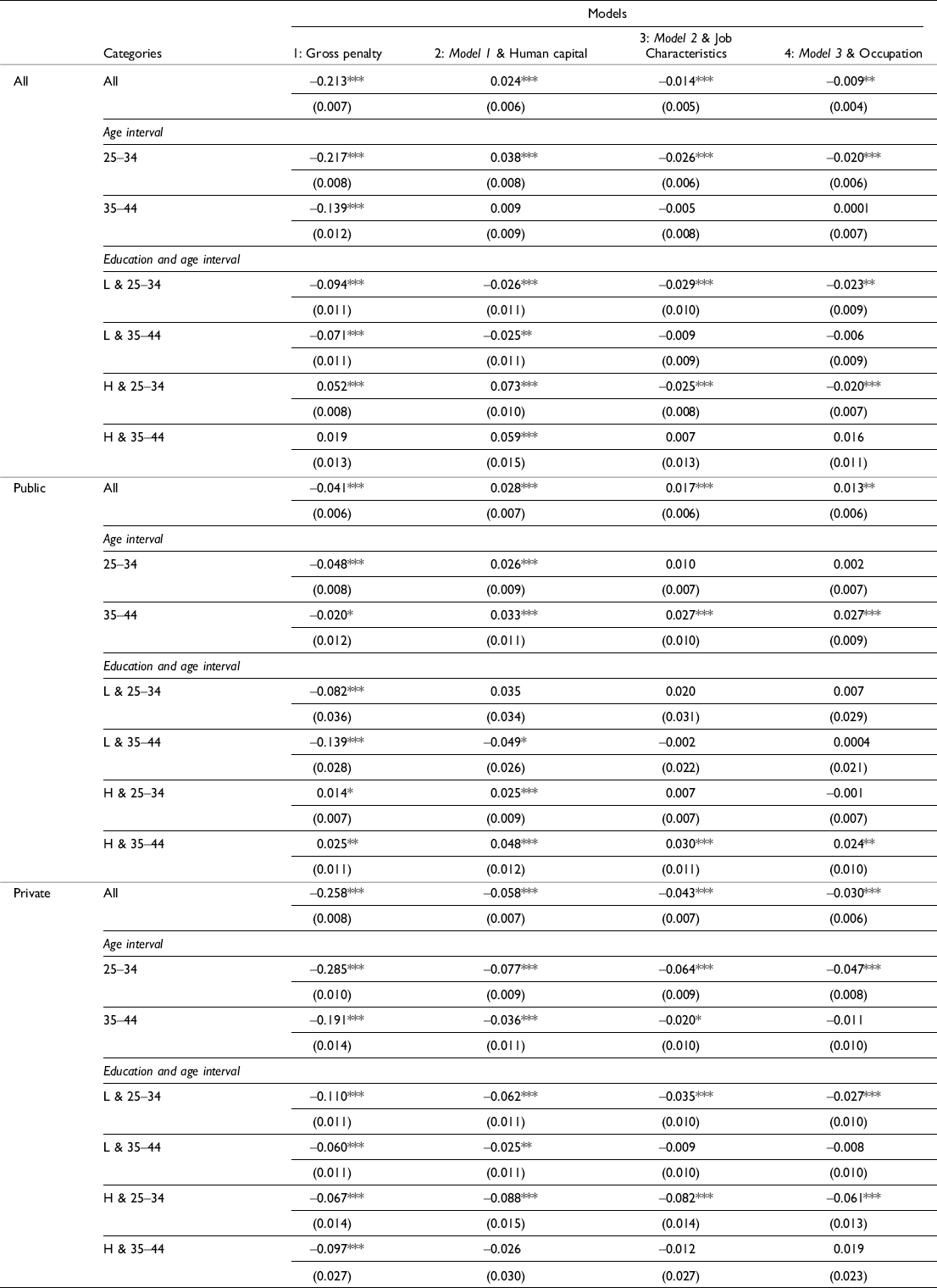
The wage penalty estimates from the pooled OLS regression are shown in Table 2. Since the primary aim is to compare mothers with non-mothers, a motherhood dummy variable is exploited, and it takes value one if women have at least one child; otherwise, it is zero. All explanatory variables besides the potential experience and square in some regression equations are significant at the 5 percent level. The estimation result of the fourth model for the total sample is presented in the Appendix, Table A6 as a representative. First, how being a mother leads to decreased wages compared to non-mothers is examined, and the results are shown in Panel All, Table 2. The gross motherhood penalty in Turkey is estimated at 21.3 percent based on Model 1. While it appears that having children seriously hamper the mothers’ average wage, the following analysis substantiates this is not accurate for all mothers.
Pooled regression results for motherhood wage penalty

L (Low): High school or less educated
H (High): University educated
Note: Standard errors are presented in parentheses. Robust standard errors are used. Each penalty in cell is obtained from a different equation.
*p<0.10, **p<0.05, ***p<0.01 (two-tailed tests)
Attributable to introducing human capital variables—education level, marital status, and potential experience—and its square to the next model, the results turn into the opposite. Mothers indeed have a small wage premium of 2.4 percent at the mean compared to non-mothers. Model 2 primarily compares wage rates for women who share the same human capital variables in two motherhood statuses so that the wage premium might be unexpected at first glance. The rationale behind this finding probably lies in women’s labor market participation decision as a consequence of motherhood. Having children raises the reservation wage to enter the labor market. If the new reservation wage is below the market wage, which is predominantly determined by human capital, mothers stay out of employment. If not, they choose to participate in paid work. This new equilibrium induces selection and changes the composition of workers, more likely favoring high wage earners. Consequently, mothers earn 2.4 percent more than non-mothers who share the same human capital characteristics. Looked at from another perspective, the reason behind the high gross wage penalty is the significant disparity in terms of human capital, especially the education level between mothers and non-mothers. Non-mothers are more educated than mothers on average and consequently can have better paid jobs. Putting them into one basket indeed leads to biased estimation results that offer a considerable wage discrepancy related to motherhood. Therefore, Model 2 substantiates that the gross penalty is not a reliable comparison.
In the next step, Model 2 variables are augmented by a rich set of job characteristics (e.g. formality, part-time and temporary jobs, public sector, and size of establishment in the workplace dummies), which are introduced to Model 3, called the intermediate model. The slight wage premium of 2.4 percent turns into a slight wage penalty of 1.4 percent. The wage comparison of mothers and non-mothers who share the same human capital and job characteristics reveals a statistically significant but small motherhood wage loss. Despite that loss, adding up occupational dummies to Model 3 and reaching Model 4 offsets the previous loss, and the final penalty is 0.9 percent. It might be related to mothers’ selection of lower-paid but mother-friendly jobs and the control of occupational choices decreases mothers’ wage loss.
Age cohort analysis highlights how the motherhood wage penalty differs when there are differences in the risk of exposure to motherhood. Model 4 reveals that having children has a slight negative impact on the earnings of the younger age cohort, but this effect vanishes in the older cohort. This pattern is further spotted in low and high educated groups. A possible interpretation is that as children grow up and become less dependent on their mothers’ care, the reservation wage decreases and mothers can join the labor market. Further, employers’ perception about women’s commitment to the job improves, and they feel that women are less likely to quit work due to motherhood after a certain age. So, they offer higher wages.
Closer scrutiny of OLS estimates in the Public panel in Table 2 discloses a minor wage penalty in the combined sample that turns into a motherhood wage premium in the public sector. This pattern is followed from wage penalty to zero wage loss for the younger cohort, and correspondingly a zero penalty to wage premium for the older cohort after control variables are included in the gross model. Indeed, there is not any statistically significant motherhood wage penalty for having children in different education levels—even high-educated mothers in the older age cohort get motherhood premiums. This outcome might be due to job protection in the absence of a performance-based wage-setting system in the public sector. As revealed by Aktuğ et al. (Reference Aktuğ, Kuzubaş and Torul2021), wage earners have mostly experienced an ever-increasing wage rate in the Turkish public sector. Hence, working in this sector protects mothers from any wage losses.
The penalty trends for mothers in the private sector are not like the public sector and change in education level. The gross wage penalty is 25.8 percent, turning into 3 percent in Model 4. Note that the earning losses in the combined sample are quietly driven by the private sector. Both the estimation results and the pattern of decreasing penalty are two points that resemble each other for the private sector and the combined sample. Further, introducing variables in each step lowers the mean wage penalty, suggesting mothers have lower educational attainment, inferior job characteristics, and lower paid jobs than non-mothers. Similar findings also hold for less educated mothers, yet not for the high educated younger age cohort. Model 1 exhibits a 6.7 percent gross penalty for the latter group, and involving human capital variables increases the loss to 8.8 percent. Human capital variables work in the opposite direction and widen the penalty and increase the unexplained part. Job characteristics and occupational dummies do have a little effect on explaining the wage differences between mothers and non-mothers. The net penalty is 6.1 percent in Model 4 which means the explanatory variables cannot justify the wage loss. Therefore, the effect of a non-negligible period of interruption on wages after having children is highest and unexplainable for the younger and high educated mothers employed in the private sector. This interruption is more likely to trigger a more significant skill erosion, increasing the size of the penalty (Wilde et al. Reference Wilde, Batchelder and Ellwood2010). Even though the duration of breaks in employment is the smallestFootnote 17 , the cost or wage loss due to this break is the highest for the more educated mothers than the less educated ones. University-educated women in the private sector have been the most disadvantaged group when they have children.
Conclusion
This article estimates the gross and net motherhood wage penalties for Turkish women and provides evidence from a developing country. The gross penalty results demonstrate that mothers earn 21.3 percent less than non-mothers on average. However, it is a highly misleading conclusion due to differences of observable and unobservable characteristics between mothers and non-mothers. The stratification strategy, by exploiting subsamples which are broken down by age, education, and the public and private sectors, was utilized to deal with this problem. The age grouping was employed to adjust for the discrepancies in the risk of exposure to motherhood because young and older women might have distinctive labor market behavior. Educational attainment was applied to control the exceptionally different labor force participation rates in high and low educated women. Additionally, higher education postpones the transition to motherhood and indicates better earnings prospects due to the accumulation of skills at a higher rate. The sectoral division between the public and private sectors is particularly essential since the public sector has more family-friendly working conditions to attract women to work and the age earning profiles are different in these two sectors.
Findings show that the net motherhood wage penalty is 1 percent. The high variation between gross and net estimates is associated with the disparity in human capital factors, particularly the educational attainment of mothers and non-mothers. The wage loss of young mothers is higher than older ones. Younger mothers probably spend more time on child-rearing activities and older mothers who earn more return to a job, so it reduces the penalty in the older age cohort. The sectoral analysis provides evidence of no significant wage loss due to motherhood in the public sector, and even mothers in the older age cohorts get a wage premium. However, the highest loss is 6.1 percent, which is experienced by high educated young mothers working in the private sector. It might be attributable to decreasing earnings when they stand in the steeper portion of the experience profile.
Previous research reveals the importance of labor market experience and education to explain the determinants of the gender wage gap in Turkey. By evaluating how being a mother lowers the earnings across education levels and age cohorts in the public and private sectors, this study suggests that it is crucial to further analyze the impact of the motherhood wage penalty on the gender wage gap. Recent studies on developed countries present evidence of the sizeable share of motherhood penalty on the wage discrepancy between men and women, and this share intensifies over time. However, this study has some limitations which can be examined in further research. The first is the lack of a longitudinal data set to control the unobserved characteristics for the selection of motherhood. The second is the selectivity issue operating on many different levels, making proper modeling very complicated. The different subsamples of the sectors and education levels were utilized for two cycles of motherhood timing to tackle this issue. In this empirical strategy, the sectoral and educational choices were made initially and treated as given. Subsequently, this study evaluated the motherhood wage penalties for women based on their educational attainment and the sector in which they are employed. Therefore, the motherhood wage penalty estimates of this study cannot be generalized to the entire population of randomly chosen women.
Supplementary material
To view supplementary material for this article, please visit https://doi.org/10.1017/npt.2022.10
Conflicts of interest
None.