Introduction
Maternal nutritional status and dietary intake can exert a lifelong impact on the health of the offspring. A number of epidemiological studies have shown that maternal malnutrition during the critical period of development can predispose the fetus to an array of diseases including metabolic syndrome, type 2 diabetes, cardiovascular disease and hypertension.Reference Barouki, Peter, Mark and Jerrold 1 , Reference Barker 2 Furthermore, experimental and human evidences suggest that specific components in the maternal diet may have an impact on the status of cardiometabolic risk factors in the offspring.Reference Barker 3 Moreover, micronutrient deficiency in particular stages of gestation has varying impact on fetal growth, which can result in different outcomes at birth.Reference Ravalli 4
Birth weight is considered as a surrogate marker for the growth of the fetus during intrauterine life. Studies have shown that both extremes of birth weight are associated with adverse metabolic programming in the developing fetus.Reference Charls, Pettitt and Hanson 5 In addition, if these children develop nutritional imbalance postnatally, they may lead to the conditions such as additional fat accumulation, insulin resistance (IR) and clustering of metabolic risk factors at an early age.Reference Barouki, Peter, Mark and Jerrold 1 Other anthropometric measurements including crown rump length, abdominal circumference and placental weight at birth were also found to be associated significantly with the occurrence of diseases in later life.Reference Barker 6 , Reference Armitage, Khan, Taylor, Nathanielsz and Poston 7
Yajnik et al.Reference Yajnik, Lubree and Rege 8 have studied the early genesis of IR in Indian babies. They found that Indian babies were smaller compared with Caucasian babies with regard to all body measurements except for the measurements of body fat. Furthermore, a maternal nutritional study conducted in Pune revealed that offspring of mothers with high folate and low vitamin B12 concentrations in early pregnancy were found to be the most insulin resistant.Reference Yajnik, Deshpande and Jackson 9 Results of another study showed that low maternal body mass index (BMI) and subsequent fetal undernutrition may be a potential risk factor for IR syndrome in the adult offspring.Reference Mi, Law and Zhang 10
Studies conducted in Pakistan have shown that inadequate prenatal care and poor nutrition during pregnancy were the major determinants of low birth weight in neonates. In addition to these factors, gestational age, maternal age, pregnancy history (abortion/miscarriage) and anemia were also found to be associated with increased incidence of low birth weight.Reference Rizvi, Hatcher, Jehan and Qureshi 11 , Reference Janjua, Delzell, Larson and Meleth 12
Maternal weight, BMI, body fat mass and fat-free mass are considered as proxy markers for the nutritional status of women during pregnancy.Reference Gernand, Christian and Paul 13 Maternal anthropometrics, nutrients status and its changes during pregnancy are found to be associated with birth weight, but the association between maternal nutritional status and metabolic risk factors of newborns at birth needs to be studied in our setting. To the best of our knowledge, no such study has been conducted in Pakistan. Therefore, the aim of the present study was to observe the association between maternal undernutrition and metabolic risk indicators in newborns at birth.
Materials and methods
This observational study was conducted at Baqai Institute of Diabetology & Endocrinology (BIDE) in collaboration with the University of Oslo, Norway. Ethical approval for the study was obtained from the Institutional Review Board of BIDE. A signed informed consent was obtained from all the study participants before inclusion into the study.
Expectant mothers with singleton pregnancies, no previous history of diabetes, no evidence of diabetes in the current pregnancy and conception without treatment for infertility were considered eligible to participate in the study, whereas women having gestational diabetes, pregnancy-induced hypertension and premature deliveries (gestation<37 weeks) were excluded from the study. The participants were recruited from public and private healthcare facilities from the low and middle socio-economic areas of Karachi, Pakistan. All the eligible mothers attending the facility during the study period and those who fulfilled the eligibility criteria were invited to participate in the study. About 39.8% of eligible women participated in the study. The ones who refused to participate were not significantly different in relation to study parameters. Enrollments continued until the required number of women were included in the study. Demographic and obstetric information was collected through a structured questionnaire. Gestational age was calculated from the 1st day of the last menstrual period, supported by ultrasound measurements.
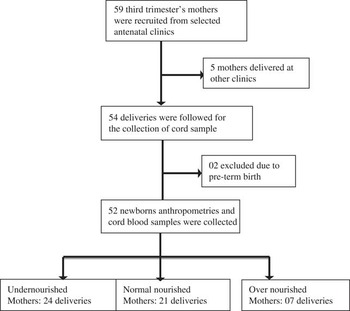
A reference table of weight for height according to the week of pregnancy was used to categorize mothers into undernourished (UN), normally nourished (NN) and overnourished (ON) groups.Reference Miguel, Peter and Bernard 14 Mothers befitting 100% of the reference values were considered as normally nourished, whereas those below and above the reference values were considered as undernourished and overnourished, respectively. A total of 54 deliveries were followed-up. Of those, two newborns were excluded as they were delivered preterm. Cord blood samples of the newborns were collected after the delivery of the placenta and centrifuged within 30 min (Fig. 1).
Flow diagram.

All the recruited mothers were included in the descriptive analysis of the variables. Only 07 deliveries were recorded from the overnourished group of mothers, and therefore were not included in the comparison analysis of newborns (Fig. 1).
Assessment of maternal nutritional status
Anthropometric measurements were used to assess the nutritional status of the mothers. Height was measured in centimeters by fixing a measuring tape to the wall, and weight was measured in kilograms using a portable weighing scale. Maternal BMI was measured by weight in kg divided by height in meter square. Skinfold thicknesses (biceps, triceps and sub-scapular) were measured using digital fat track II skinfold caliper. Mid-upper arm circumference was measured using a non-stretchable measuring tape.
Neonatal measurements
Anthropometric measurements of newborns were recorded within 24 h after birth. Neonatal weight was measured using a digital infant pan scale. Crown–heel length was measured using a portable pedo-baby meter. Biceps, triceps and sub-scapular skinfold thicknesses were measured using skinfold calipers. 15 Head, mid upper arm, chest and abdomen circumferences were measured using a non-stretchable tape.
IR was assessed by homeostasis model assessment (HOMA-IR): insulin (μU/ml)×glucose (mmol/l)/22.5.Reference Matthews, Hosker and Rudenski 16 Neonatal weight <2.5 kg was considered as low birth weight, whereas 2.5–3.9 kg was considered the normal range of birth weight. 17
Assessment of neonate’s metabolic status
The metabolic status of newborns at birth was assessed by determining the cord blood concentrations of glucose, insulin, lipids and leptin and by measuring IR. Methods used for assessing the metabolic status of neonates have been used previously in pre-school children to assess the cardiometabolic status at the age of 4 years.Reference Camila, Ricardo, Juliana and Reynaldo 18
Laboratory assays
Maternal blood samples were analyzed for plasma glucose and hemoglobin levels. Cord blood was collected in EDTA-containing tubes from the distal stump and spun in a refrigerated centrifuge within 30 min. Plasma glucose concentration was measured by glucose oxidase method, whereas serum insulin and leptin levels were estimated by Enzyme-Linked ImmunoSorbant Assay (ELISA) method. Total cholesterol was estimated by CHOD-PAP method, whereas triglycerides (TG) levels were measured by GOP-PAP method. Low-density lipoprotein (LDL) and high-density lipoprotein-cholesterol levels were assessed by homogenous enzymatic calorimetric method.
Statistical analysis
Data were recorded and analyzed using SPSS version 13.0. Values were presented as mean±s.d. for normally distributed data and median for skewed data. Group comparison was carried out by non-parametric tests. Significant results between the groups were adjusted for sex of the newborn (Table 2), mode of delivery, gestational age and intravenous glucose infusion (Table 3). The correlation analysis was performed with Pearson’s correlation test. P-value<0.05 was considered as statistically significant.
Results
Mean age of the mothers was 26.0±5.1 years, whereas mean height was 155.3±4.8 cm. Thirty-four percent of the mothers were primigravida. Anemia was found in 73% of the study population. Fifteen mothers (29%) delivered their babies by cesarean section, whereas 37 (71%) had normal vaginal delivery. Eighteen mothers (34.6%) received IV glucose infusion during labor.
Mean birth weight of the newborns was 2.8±0.43 (CI: 2.1–4.0) kg and mean gestational age at birth was 39.2±1.5 weeks. Incidence of low birth weight (<2.5 kg) in the study was 8%.
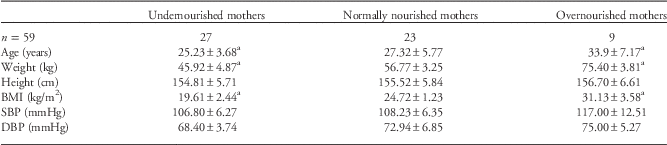
Out of the 59 recruited mothers, 27 were undernourished (45.7%), 23 (39.0%) were normally nourished and nine mothers (15.3%) were found under the category of overnourished mothers. The number of cesarean section deliveries was high in the normally nourished group of mothers. Baseline characteristics of the pregnant women according to three nutrition categories are shown in Table 1. We observed that undernourished mothers were comparatively younger than the other two groups. Moreover, body fat mass and lean body mass were also found to be significantly lower in this group (P-value<0.05).
Baseline characteristics of women in three nutrition categories

SBP, systolic blood pressure; DBP, diastolic blood pressure.
Values are mean±s.d.
a Age-adjusted P-value<0.05 between normal to under and overnourished groups.
P-value<0.05 is considered statistically significant.
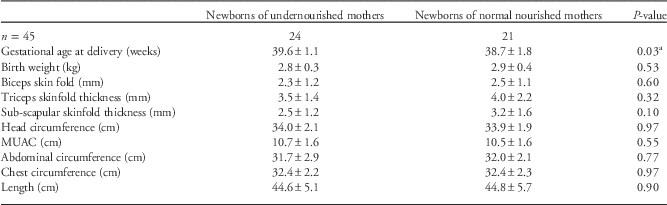
Table 2 shows the comparison between the anthropometric measurements of the newborns according to the two nutrition categories of the mothers. Our results reported that anthropometric measurements as well as skinfold thicknesses were similar in both the groups. However, the babies of normally nourished mothers were delivered an average 1 week earlier compared with the undernourished group (P<0.05).
Anthropometric parameters of newborns of the two groups of mothers

MUAC, mid-upper arm circumference.
Values are mean±s.d.
a Adjusted for sex of the newborn.
P-value<0.05 is considered statistically significant.
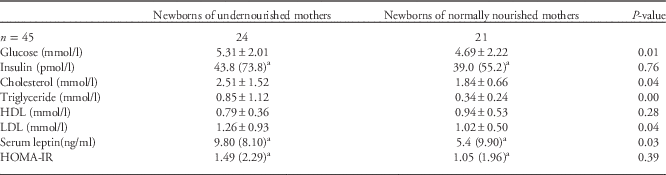
Glucose, insulin, lipids and leptin concentrations were assessed in the umbilical cord blood and compared according to the two nutrition categories of mothers. We found that the concentration of glucose (5.31±2.01 v. 4.69±2.22 mmol/l, P=0.01), total cholesterol (2.51±1.52 v. 1.84±0.66 mmol/l, P=0.04), TG (0.85±1.12 v. 0.34±0.24 mmol/l, P=0.00) and LDL-cholestrol (1.26±0.93 v. 1.02±0.50 mmol/l, P=0.04) were significantly high in the offspring born to the undernourished mothers. However, insulin levels were similar in both groups. Cord plasma glucose and insulin levels were used to estimate IR in the newborns at birth. We observed that HOMA-IR values were comparable between the two groups (Table 3). Significant results were adjusted for the potential confounders (mode of delivery, gestational age, I/V glucose infusion). We observed that difference in LDL-cholestrol was significant between the two groups (Table 3). Cord plasma glucose level was compared between mothers who received glucose infusion during labor and those mothers who did not. No significant difference was found between the groups (5.12±1.85 v. 4.44±2.51 mmol/l, P=0.285).
Metabolic risk indicators in newborns of two groups of mothers

HDL, high-density lipoprotein; LDL, low-density lipoprotein; HOMA-IR, homeostasis model assessment-IR.
Values are mean±s.d.
a Values are median (interquartile range).
P-value<0.05 is considered statistically significant.
Significant results are adjusted for mode of delivery, gestational age and I/V glucose infusion. Only LDL results remained significant after adjustment (P=0.04).
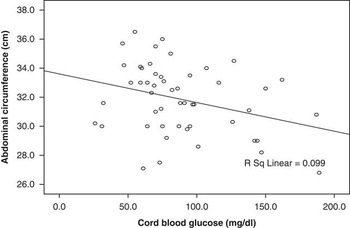
A significant negative correlation was found between cord plasma glucose and abdominal circumference of the newborns at birth (r=−0.315, P=0.026; Fig. 2). Furthermore, a weak association was also observed between maternal body fat mass with serum leptin (r=0.272, P=0.05) and maternal BMI with LDL-cholestrol in the cord blood (r=0.285, P=0.05).
Pearson’s correlation coefficient (r), and P-value of abdominal circumference (cm) of the newborn and concentration of glucose in cord blood (mg/dl). r=−0.315; P=0.026.

Discussion
This study presents information about maternal nutrition and metabolic risk indicators in the offspring at birth. Based on anthropometrics, mothers were categorized into undernourished and normally nourished groups. Metabolic risk indicators in the cord blood were compared in the offspring of these two groups. Our results report that, except insulin, all other metabolic risk markers in the cord blood were found to be significantly high in the offspring born to undernourished mothers. These significant results were further adjusted for the potential confounders. We observed that LDL-cholestrol remained high in the offspring of undernourished mothers. However, difference in other metabolic risk markers disappeared after adjustment. Contrary to our findings, a Chinese study that was conducted to assess the association between the component of IR syndrome and maternal undernutrition and reduced fetal growth showed higher glucose and insulin levels in the offspring of mothers who were underweight in the late pregnancy, whereas no difference was observed in the concentration of LDL-cholestrol.Reference Mi, Law and Zhang 10 The small size of our study sample might be one possible reason for this dissimilarity in the results.
We observed that undernourished mothers were thin and lean and had low lean body mass and body fat mass compared with the normally nourished group. This pattern reflects that these mothers may have low protein stores in the body, which in turn reduces the accessibility of amino acids to the fetus, whereas low fat mass may reduce availability of fatty acid to the growing fetus.Reference James 19 This low protein and fatty acid stores in undernourished mothers may lead to fetal undernutrition, which might be responsible for the disturbance of metabolic risk markers in their offsprings.
Anthropometric measurements of undernourished and normally nourished mothers’ offprings were also compared. Interestingly, we observed that both group of newborns were comparable for all body measurements including birth weight. Studies have shown that diet during pregnancy may influence fetal nutrition without affecting much of its growth rate.Reference Petrik, Reusens and Arany 20 – Reference Frisancho, Klaymon and Matos 22 Previous studies have also reported that even in severe famine period birth weight of the children will reduce only by 250 g.Reference Ravelli, van der Meulen and Michels 23 However, people who were exposed to famines during intrauterine life were more insulin resistant.Reference Barker 6 These studies suggest that fetal adaptation to maternal undernutrition may change fetal metabolism without disturbing growth rate to a large extent. Furthermore, a significant association was observed in our study between BMI of the mothers and LDL-cholesterol in the cord blood. Similar association between maternal BMI and LDL-cholesterol is reported in another study.Reference Mi, Law and Zhang 10
Our study had some limitations. The sample size of our study was small, which resulted in failure to identify the existing relationship significantly due to limited statistical power. Our results showed that once differences in metabolic risk indicators between the groups were adjusted for potential confounders, it disappeared except for the LDL-cholesterol. We believe that by increasing the number of participants, these results might reach the level of significance. The validity of the present study is limited due to its small sample size. Therefore, it is suggested that the present result need to be further investigated in a future longitudinal study. Further, maternal diet, pregnancy and early pregnancy weight were not assessed in our study. Another weakness is the cross-sectional design due to which we could not observe longitudinal consequences of maternal undernutrition in early postnatal life. To minimize bias in the nutritional assessment, anthropometric measurements of mothers and of newborns were collected by the same dietitian.
Conclusions
Our results showed that offspring of undernourished mothers had a relatively higher metabolic risk profile including LDL-cholestrol compared with normal nourished group, suggesting that maternal undernutrition may have an influence on metabolic risk markers of newborns at birth. We recommend that these results should be confirmed by a longitudinal study with a larger sample size.
Acknowledgments
The authors acknowledge the hardwork and dedicated commitment of the study team, especially Dr SamreenWaseem (Study gynecologist), and the valuable support of Mr Bilal Tahir (Research Coordinator) and Ms Fariha Shaheen (Statistician), Research Department of Baqai Institute of Diabetology and Endocrinology. The authors are grateful to all the mothers who took part in the study and gave their precious time during data collection. The authors are thankful to the Research Fund of BIDE for the financial support of the study.
Financial Support
Research Fund of BIDE.
Conflicts of Interest
None.