Introduction
Chronic suppurative otitis media (CSOM) is one of the most common otological conditions encountered in day-to-day practice, and patients suffering from CSOM frequently undergo procedures to eradicate disease in the middle ear and reconstruct the hearing mechanism with tympanic membrane grafting. The procedure can be combined with either an intact canal wall or a canal wall down mastoidectomy to eradicate disease from the mastoid area. The results of tympanoplasty are measured in terms of success or failure of graft uptake and hearing improvement. It must also be remembered that a tympanoplasty may be considered partially successful if a dry, intact ear is obtained regardless of whether there is any hearing improvement.1 However, obtaining a dry ear is often a challenge as intermittent or chronic ear discharge following middle-ear surgery is not uncommon: the rate can be as high as 60 per cent.Reference Ekvall2,Reference Gyo, Hirata and Yanagihara3 Palva and Hallstrom reported that within a group of patients, 10 per cent can have continuous discharge from the surgical cavity and 20 per cent can have an occasionally moist surgical cavity, either because of residual perforation, recurrence of infection or because of continuing infection related to insufficient disease eradication.Reference Palva and Hallstrom4 There are some less discussed but very important causes of persistent ear discharge related to middle-ear surgery cases with an intact ear drum, such as flora of the normal middle ear, flora of the skin of the external auditory canal, pathogenic bacteria hidden within the mastoid air cell system, presence of granulation tissue in the ear canal or over a part or sometimes whole of the neotympanum, and presence of biofilms.Reference Govaerts, Raemaekers, Verlinden, Kalai, Somers and Offeciers5
Biofilms are microbial communities that are formed by microorganisms capable of sensing and attaching to surfaces. In particular, biofilm bacteria are up to 1000-fold more resistant to antimicrobial agents than are free bacterial forms. Therefore, biofilms are one of the causes of many recurrent and chronic infections and have been reported to be present in tissue samples from the middle ear of CSOM patients with recalcitrant otorrhoea.Reference Sayin, Ucan and Sakmanoglu6,Reference Zan, Hubbezoglu, Ozdemir, Tunc, Sumer and Alici7
Otorrhoea after middle-ear surgery may require antibiotic treatment, hospitalisation and even re-intervention. Moreover, identifying and being committed to dealing with this problem carries utmost importance as persistent otorrhoea may impair tympanic graft uptake and long-term functional results of hearing and mastoid cell ventilation.
This study aimed to discuss and estimate the effect of topical application of various chemical compositions (antiseptics) in controlling post-operative otorrhoea in patients with an intact ear drum who have undergone middle-ear reconstructive surgery and have failed to show a satisfactory response to the ototopical or oral antibiotics.
Materials and methods
This retrospective, observational, descriptive study was conducted in 222 patients who had undergone reconstructive middle-ear surgery in a tertiary care centre from January 2015 to December 2019. Out of these 222 patients, it was found that 45 patients fitted the criteria of recalcitrant post-operative otorrhoea.
Inclusion criteria
All patients with an intact tympanic membrane and suffering from otorrhoea after middle-ear surgery refractory to conservative treatment consisting of oral and ototopical antibiotics given for 14 continuous days from onset of discharge were included in the study. This 2-week course of antibiotics consisted of tablet form Augmentin® (amoxicillin 500 mg + clavunic acid 125 mg combination) three times a day and Candibiotic® Plus (neomycin + beclomethasone dipropionate + clotrimazole) ear drops three times a day.
Recalcitrant otorrhoea and pus collection criteria
In patients who had undergone intact canal wall mastoidectomy with tympanoplasty, any discharge after 6 weeks of surgery was considered recalcitrant post-operative otorrhoea, whereas in patients who had undergone canal wall down mastoidectomy with tympanoplasty, any discharge after 12 weeks of surgery (as the cavity would take at least 3 months to completely epithelialise) was considered recalcitrant post-operative otorrhoea.
Exclusion criteria
Exclusion criteria were: any cutaneous infection of the pinna or external auditory canal during or after surgery, perforation in the tympanic membrane, recurrence of disease, patients in an immunocompromised state because of any other concomitant disease or its treatment, cases who responded positively to the conservative treatment within 14 days of onset of discharge, and any known hypersensitivity to antiseptics used in our study.
Pre-, intra- and post-operative data were recorded, and the parameters were patient age and sex, duration of ear discharge before surgery, antibiotic treatment (systemic or topical use) in the intra-operative or immediate post-operative period, results of pre-operative ear examination, onset of discharge post-surgery, use of canal wall up or canal wall down technique in surgery, need for autologous graft (bone, cartilage, fascia), use of foreign material (e.g. gelatine sponge, fibrin glue, non-resorbable implant, Surgicel®).
Aural toilet
Aural toileting was performed in all patients before commencing any ear drops as it cleans the discharge and debris and allows the ear drops to reach the desired site. In cases where discharge was profuse or thick, the external auditory canal was suctioned under otoendoscopic guidance 2 to 3 times a week.
Delivery technique
An important step to propel the drops to the tympanic membrane is to pull the auricle slightly upwards, backwards and laterally to straighten the canal and gently press the tragus inwards at least 4 to 5 times. The patient was advised to maintain the position with the diseased ear up for at least 20 minutes after instillation of antiseptic ear drops.
Pus swab
Sterile pus culture swab sticks were used for pus sample collection from the ear canal. The pus sample was sent from the post-operative discharging ear on their first follow up after onset of discharge, before commencement of any ototopical drops (i.e. prior to the two-week course of oral and topical antibiotics). The sample was processed for gram staining, acid fast bacillus staining, culture of organism and sensitivity to antibiotics. On the basis of the culture report, the patients were allotted antiseptic ear drops sequentially one after the other in the order of boric acid powder, borospirit, gentian violet, diluted acetic acid and povidone iodine. However, the distribution became approximately random in the later part of the study as some of the organisms like acinetobacter and enterococcus were isolated in very few numbers.
Topical antiseptic ear drops were prescribed to patients to be used after gentle dry self-mopping of the ear canal. For a discharging ear with no granulations, patients were asked to come at least once in a week for otoendoscope- or microscope-guided suctioning of the ear.
For a discharging ear with granulations in the external auditory canal or over the neotympanic membrane, patients were asked to come at least twice in a week for otoendoscope- or microscope-guided debridement of granulations.
Patients with recalcitrant otorrhoea without granulation tissue were prescribed antiseptic ear drops for four weeks, whereas patients with recalcitrant otorrhoea with granulation tissue were managed mainly by aural toileting, antiseptic ear drops, cauterisation and needful surgical debridement where necessary.
Aural toileting
Aural toileting was performed using one or two syringefuls of diluted povidone iodine wash which is safe and generally painless. Flushing of the ear should take place 15 to 20 minutes prior to the administration of antiseptic ear drops. Once the ear is dry, the therapeutic ear drops are able to penetrate the source of the granulation tissue.
Antiseptic
As the ultimate aetiology of the formation of granulation tissue is infection, then antiseptic ear drops are preferred and given for four weeks if antibiotic ear drops have failed.
Cautery
Chemical cautery was usually performed with 1 per cent silver nitrate or 20 per cent trichloroacetic acid. The only important point to keep in mind in relation to this is that chemical cautery acts by burning effect, and the control and depth of the burn is somewhat always unknown.
Surgical debridement
Debridement was performed under microscope or endoscope guidance using a micro-curette or micro-cupped forceps or micro-scissors. The dissection technique used should be sharp but gentle to avoid injury to underlying structures.
Antiseptic ear drops or wash response
Responses to antiseptic ear drops or wash were recorded for 45 patients and divided into two groups: (1) poor response and (2) good response. Poor response was defined as no decrease in ear discharge and an ear that was never dry after four weeks of treatment. A good response was defined as: (1) a significant decrease in ear discharge after four weeks of treatment or (2) an ear that was mostly dry with on and off presence of minimal ear discharge after four weeks of treatment, or (3) an absolutely dry ear after four weeks of treatment.
Follow up
Once a dry ear was obtained, patients were followed up every month for the first three months and then every three months. All patients were followed up for 1 to 1.5 years.
Results
A total of 222 patients underwent reconstructive middle-ear surgery in the Department of Otorhinolaryngology and Head and Neck Surgery, Shri Guru Ram Rai Institute of Medical Sciences, Dehradun, India, from January 2015 to December 2019. We conducted a study in 45 of these 222 patients. These 45 cases were those patients who presented with complaint of recalcitrant otorrhoea after middle-ear surgery and who did not respond to conservative management for 2 weeks.
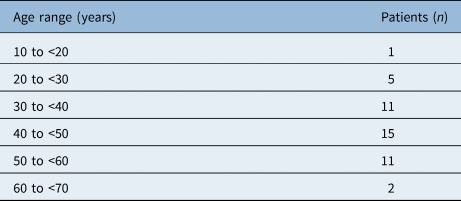
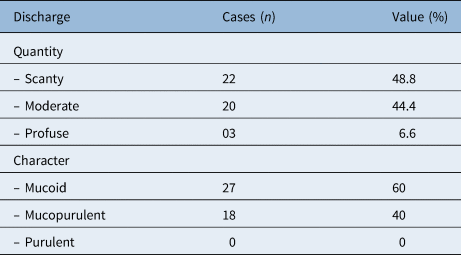
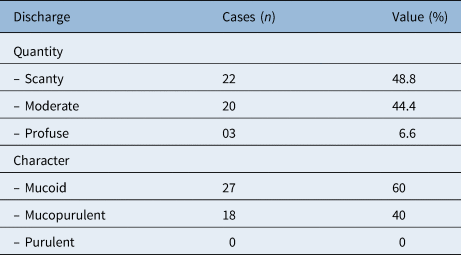
A total of 45 patients were included in this study with an age range of 16 to 62 years (mean age, 42.9 years; Table 1). Ear discharge was the presenting complaint in all patients. Around 48.8 per cent of patients had scanty, 44.4 per cent of patients had moderate and 6.6 per cent of patients had profuse discharge. Sixty per cent of patients presented with mucoid discharge whereas 40 per cent of patients presented with mucopurulent discharge (Table 2).
Distribution of recalcitrant otorrhoea patients according to age

Distribution of recalcitrant otorrhoea patients according to quantity and character of discharge
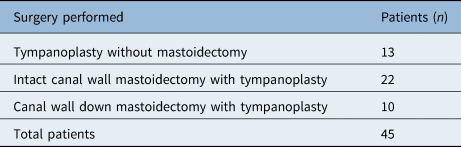
Out of 45 patients who presented with recalcitrant otorrhoea, 13 patients had undergone tympanoplasty without mastoidectomy, 22 underwent intact canal wall mastoidectomy with tympanoplasty and 10 patients underwent canal wall down mastoidectomy with tympanoplasty (Table 3).
Distribution of patients according to surgery performed before development of recalcitrant otorrhoea

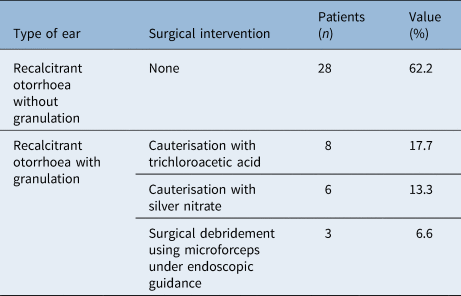
A total of 28 out of 45 (62.2 per cent) patients presented with recalcitrant otorrhoea without granulations, whereas recalcitrant otorrhoea with granulations was present in 17 patients. Out of these 17 patients, 8 patients (17.7 per cent) underwent cauterisation of granulations with 20 per cent trichloroacetic acid, 6 patients (13.3 per cent) underwent cauterisation with 1 per cent silver nitrate and 3 patients (6.6 per cent) underwent surgical debridement using microforceps under endoscopic guidance (Table 4).
Distribution of patients on the basis of presence or absence of granulations and the treating intervention performed

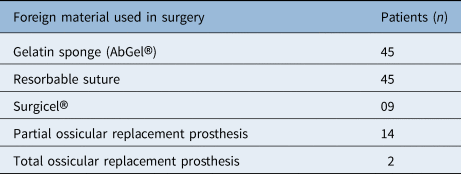
In all 45 patients, foreign body like resorbable suture and medicated absorbable gelatin sponge (AbGel®) was used in the middle ear as well as in the external auditory canal. Absorbable hemostat like Surgicel® (oxidised regenerated cellulose) was used in 9 patients, partial ossicular replacement prosthesis was used in 14 patients and total ossicular replacement prosthesis was used in 2 patients (Table 5).
Distribution of patients according to foreign material used in surgery

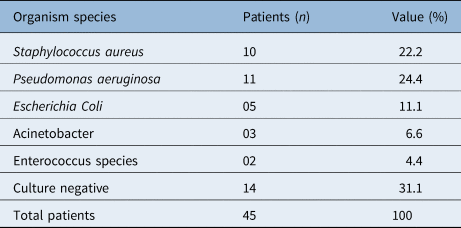
Of the 45 ear pus swabs taken, 31 yielded potential bacterial pathogens, and a total of 5 major isolates were obtained. Staphylococcus aureus was found in 10 patients (22.2 per cent), Pseudomonas aeruginosa was found in 11 patients (24.4 per cent), Escherichia coli was found in 5 patients (11.1 per cent), acinetobacter was found in 3 patients (6.6 per cent), and enterococcus species were found in 2 patients (4.4 per cent), whereas 14 patients (31.1 per cent) were found to be culture negative, meaning no bacteria could be isolated from the pus sample (Table 6).
Total number of patients and the organisms isolated

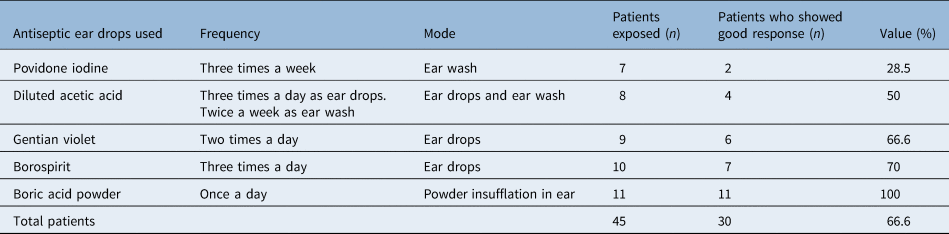
Of the 45 patients who entered the study group, 7 patients were advised to use povidone iodine in the form of ear wash used three times a week in the out-patient department for 4 weeks. Eight patients were given diluted acetic acid in the form of ear drops to be used three times a day and in the form of an ear wash to be used twice in a week in the out-patient department under endoscopic guidance. Nine patients were prescribed gentian violet to be used as ear drops twice daily for 4 weeks, 10 patients used borospirit in the form of ear drops three times a day for 4 weeks and 11 patients were prescribed boric acid powder insufflation to be used in the affected ear once a day for 4 weeks (Table 7).
Distribution of patients on the basis of antiseptic used and its response

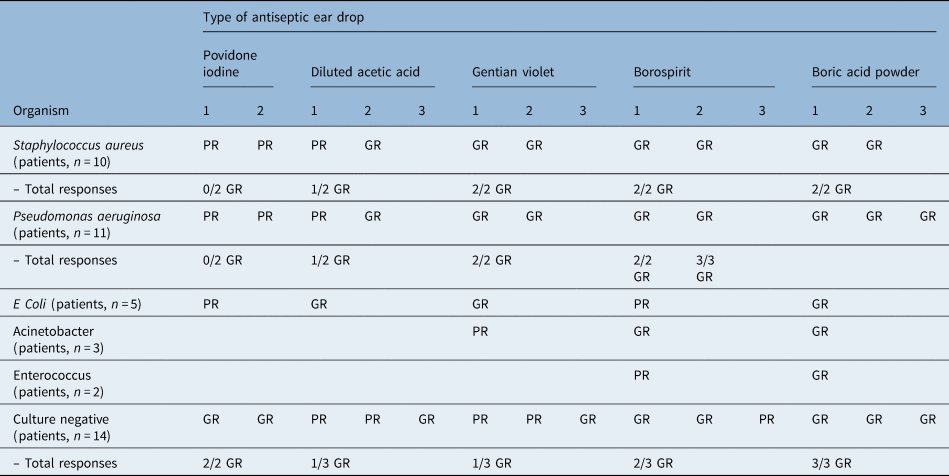
Patients who were culture negative and patients suffering from recalcitrant post-operative otorrhoea because of S aureus, P aeruginosa and E coli were given all five antiseptics (povidone iodine, diluted acetic acid, gentian violet, borospirit and boric acid powder). Fewer patients demonstrated isolates of acinetobacter and enterococcus species on culture; therefore, three patients with acinetobacter were only prescribed gentian violet, borospirit and boric acid powder, and two patients with enterococcus species were given borospirit and boric acid powder only (Table 8).
Distribution of different organisms according to their exposure to the antiseptics and their response to these antiseptics

Poor response (PR) = no decrease in ear discharge and ear is never dry after 4 weeks of treatment. Good response (GR) = significant decrease in ear discharge after 4 weeks of treatment, or ear is mostly dry with on and off presence of scanty ear discharge after 4 weeks of treatment or ear is absolutely dry after 4 weeks of treatment.
We found that povidone iodine showed good activity in patients with only negative cultures (28.5 per cent). There was not a good response to povidone iodine in the rest of the patients. Acinetobacter and enterococcus species were not tested with povidone iodine because they were isolated in lesser numbers (Table 8).
We found that patients with bacterial isolates such as P aeruginosa, S aureus and E coli showed a response to diluted acetic acid ear drops. Eight patients with different bacterial isolates were exposed to diluted acetic acid ear drops and 4 showed good response (50 per cent). Acinetobacter and enterococcus species were not tested for acetic acid ear drops because they were isolated in lesser numbers (Table 8).
The authors used 2 per cent gentian violet ear drops against 4 bacterial species (S aureus, E coli, P aeruginosa and acinetobacter) as well as using gentian violet for patients with otorrhoea who did not have growth of any organism on culture (Table 8). The study showed that gentian violet showed good activity against gram positive bacteria S aureus. We found satisfactory results when gentian violet was used against gram negative species like P aeruginosa and E coli, except acinetobacter which failed to show response to gentian violet. Furthermore, culture negative patients showed mixed response to gentian violet therapy: 2 out of 3 showed no response. A total of 9 patients were exposed to gentian violet and 6 showed a good response to it (66.6 per cent) (Table 8).
The authors found that borospirit showed excellent activity against P aeruginosa, S aureus, acinetobacter and culture negative patients, whereas there was no response against enterococcus species and E coli. A total of 10 patients were given borospirit as antiseptic drops and 7 patients had a good response resulting in an absolutely dry ear (70 per cent) (Table 8).
In our study, 11 patients were given boric acid powder in insufflation form for complaint of recalcitrant otorrhoea. We found that all the 5 classes of bacteria and also the culture negative patients showed good response to local application of dry boric acid powder, resulting in an absolute dry ear and cavity (100 per cent) (Table 8).
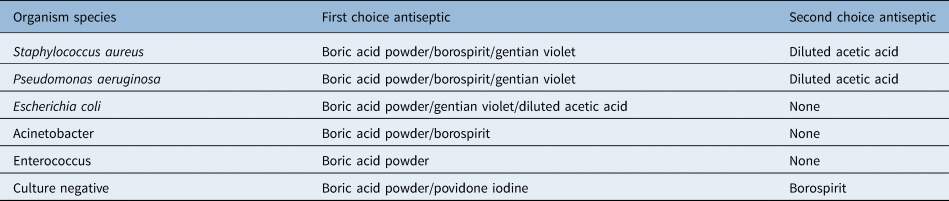
Thirty patients out of 45 showed a good response to antiseptic ear drops and achieved a dry ear at the end of the treatment. In our study, we found that boric acid powder appeared to be the most effective antiseptic against all mentioned bacteria species and for culture negative patients. Borospirit could also be considered as the most effective antiseptic against P aeruginosa, S aureus and acinetobacter, whereas it could be considered as the second antiseptic of choice for culture negative patients. Gentian violet could be considered as the first antiseptic of choice against P aeruginosa, S aureus and E coli. Diluted acetic acid could be considered as the first antiseptic of choice for E coli and second antiseptic of choice for P aeruginosa and S aureus. Povidone iodine could be considered as first antiseptic of choice for patients with negative cultures (Table 9).
Antiseptic of choice for each organism

All patients were followed up every 3 months for 1.5 years, and the ear was found dry on every follow up. Fifteen patients who did not respond to 14 days of oral and ototopical antibiotics and 4 weeks of antiseptic ear drops treatment were managed along the lines of recurrent or residual disease after middle-ear surgery.
Discussion
The most common problem faced by an otologist is persistence of ear discharge in a patient who has undergone middle-ear reconstructive surgery. Physical examination in such patients may show presence of pus and debris in the ear canal in presence of an intact tympanic membrane. This is a less discussed group of patients who pose a dilemma to the surgeon as they will not only complain of persistent ear discharge but on otoendoscopy or microscopy will also show an intact graft or the graft in a healing phase. There is a dearth of knowledge in the literature on treatment strategies in such post-operative patients complaining of recalcitrant otorrhoea.
The most common medical management for resolution of post-operative otorrhoea is aural toileting followed by the use of topical and systemic antibiotics. But the widespread use of antibiotics has precipitated the emergence of multiple resistant strains of bacteria which produce intractable post-operative ear discharge. Moreover, unrestricted use of oral, topical or parenteral antibiotics in today's modern world has led to drawbacks related to cost, adverse effects, toxic reaction, inconvenience, and most importantly, emergence of biofilms that lead to further antibiotic resistance which plays a central role in non-resolution of otorrhoea.Reference Shenoy, Gadag, Megalamani and Mushannavar8
Pus and debris in the ear canal are impediments to successful topical therapy. Therefore, it is imperative that debris is cleaned, often repetitively, to facilitate penetration of the desired medication to the site of infection. Reasons for ototopical therapy failure include: canal obstruction by debris or cerumen, improper administration technique, poor compliance, reinfection, resistant organisms, fungal infection, immunodeficiency, physical factors such as granulation tissue, sequestered nidus of infection, copious ear discharge blocking access and mucosal oedema, and presence of biofilm and planktonic organisms being periodically released from the biofilm leading to repeat acute infections.Reference Daniel, Kozak, Fabian, Hekkenberg, Hruby and Harjee9
Biofilms, which are an important cause of post-operative recalcitrant otorrhoea, are an organised community of microorganisms encased in an extracellular matrix that is adherent to a surface and are a significant source of resistance to host defence as well as resistance to antibiotics. These biofilms are easily formed over non-resorbable implants like piston, lenticular process prosthesis, and total ossicular replacement prosthesis or partial ossicular replacement prosthesis.Reference Stewart and Costerton10
It is known that most pathogenic bacteria associated with human infections require a pH more than 6 as their growth is inhibited in environments with lower pH values. Microbiological studies have proven that applying acid to the infected surfaces lowers the pH and makes the environment unsustainable for bacterial growth and multiplication.Reference Nagoba, Suryawanshi, Wadher and Selkar11 The World Health Organization also suggests that for CSOM, topical antibiotics are better than systemic antibiotics. Moreover, topical antiseptics may be as effective as topical antibiotics.Reference Acuin12,Reference Verhoeff, Van der Veen, Rovers, Sanders and Schilder13
Here we discuss the role of many such chemical compositions of antiseptics that used to be a part of ancient medicine and are used in this study to combat the problem of persistent ear discharge in operated patients with an intact ear drum by changing the pH of the external ear canal. The commonly used antiseptics described in the literature are gentian violet, boric acid in spirit, diluted acetic acid drops, povidone iodine and boric acid powder. The goals of treatment using these antiseptic ear drops remain eradication of ear infection and inflammation, stopping otorrhoea, healing the neotympanic membrane, preventing complications and avoiding recurrence of otorrhoea.
Povidone iodine
Povidone iodine (polyvinyl pyrrolidone iodine) has been used over the past 20 years for various clinical purposes on skin and mucosa without any serious local or systemic adverse effects. The antimicrobial spectrum of this agent is universal and includes both gram-positive and gram-negative bacteria.Reference Fleischer and Reimer14 Studies have demonstrated that polyvinyl pyrrolidone iodine aqueous solution does not show any ototoxic potential, and development of resistance has also not been detected for polyvinyl pyrrolidone iodine.Reference Perez, Freeman, Sohmer and Sichel15,Reference Aursnes16 It seems to be a cost-effective, non-antibiotic preparation with equally effective antibacterial properties but with no potential to develop drug resistance and ototoxicity.Reference Jaya, Job and Mathai17 We found that povidone iodine showed good activity in patients with only negative cultures (28.5 per cent).
Acetic acid (vinegar)
Acetic acid is present in vinegar at 3–5 per cent concentration and has been used in medicine for thousands of years.Reference Johnston and Gaas18 Vinegar as diluted acetic acid has been used since 1961 in the management of otorrhoea in the form of aural wash or topical drops.Reference Jones and McLain19 Acetic acid solution (1.5 per cent solution) is made by mixing one part of white vinegar to two parts of boiling water. After cooling, the solution is instilled into the ear several times using an ear dropper or 1 ml insulin syringe.Reference Kveton, Gulya, Minor and Poe20
We found patients with bacterial isolates such as P aeruginosa, S aureus and E coli showed a response to diluted acetic acid ear drops. Eight patients with different bacterial isolates were exposed to diluted acetic acid ear drops and 4 showed good response (50 per cent).
The 1.5 per cent acetic acid that was used in our study was also used for cleaning and irrigation of the external auditory canal. This proved helpful as it aided in removing the inflammatory debris from the external auditory canal as well as from deep-seated poorly vascularised sites of the ear canal. It had a destructive effect on biofilms, and it caused a change in pH of the external ear canal, which played a critical role in interrupting the growth of bacteria by affecting their amino acids by causing protein denaturation leading to alteration in the three-dimensional structure of the bacterial enzymes.Reference Fabricant and Perlstein21
Gentian violet
Gentian violet, also known as crystal violet or methyl violet, is a triphenylmethane dye that is known for its anti-bacterial, anti-fungal, anti-helminthic, anti-trypanosomal, anti-angiogenic and anti-tumour properties. It is readily available, inexpensive, easy to use and has minimal side effects. With the emergence of antibiotic resistance, there has been a recent resurgence of gentian violet therapy for antisepsis as well as for a variety of medicinal uses.Reference Maley and Arbiser22 This study reviewed the uses of gentian violet in post-operative recalcitrant otorrhoea. The authors used 2 per cent gentian violet ear drops against 4 bacterial species (S aureus, E coli, P aeruginosa and acinetobacter) as well as using it for patients with otorrhoea whose cultures demonstrated no growth of any organism on culture. The study showed that gentian violet had good to excellent activity against P aeruginosa, S aureus and E coli.
Flow diagram showing the working algorithm of this study for treating a case of intractable postoperative otorrhoea.TCA = trichloroacetic acid; AgNO3 = silver nitrate; BIPP = bismuth iodoform paraffin paste

The exact mechanism of action of gentian violet is unknown. However, multiple hypotheses exist for an explanation of its anti-microbial effects, including: an alteration in redox potential by the dye,Reference Ingraham23 inhibition of reduced nicotinamide adenine dinucleotides phosphate oxidases,Reference Perry, Govindarajan and Bhandarkar24 free radical formation,Reference Levin, Lovely and Klekowski25,Reference Harrelson and Mason26 formation of a unionised complex of bacteria with the dye,Reference Stearn and Stearn27 inhibition of protein synthesis,Reference Gustafsson, Nordström and Normark28,Reference Hoffmann, Jang, Moreno and Docampo29 inhibition of glutamine synthesis,Reference Fry30 uncoupling of oxidative phosphorylationReference Moreno, Gadelha and Docampo31 or inhibition of formation of the bacterial cell wall.Reference Park32
Notably, gentian violet is effective against gram positive bacteria (S aureus), which also form adducts with gentian violet because of its ability to penetrate the bacterial cell wall and covalently bond to proteins. Gentian violet has lesser activity against gram negative bacteria, presumably because of its inability to penetrate the lipids surrounding the cell wall.Reference Maley and Arbiser22 However, in our study we found satisfactory results when gentian violet was used against gram negative species like P aeruginosa and E coli, excepting acinetobacter which failed to show response to gentian violet. Furthermore, culture negative patients showed mixed response to gentian violet therapy: 2 out of 3 showed no response. A total of 9 patients were exposed to gentian violet therapy in our study and 6 showed a good response (66.6 per cent).
In the face of increasing incidence and emerging resistance to standard therapies, gentian violet can be a potential treatment option for recalcitrant otorrhoea patients, and given that it is stable at room temperature for years, it has the potential to become a staple of ontological treatment in developing countries like India.
Boric acid in spirit (borospirit)
Two per cent boric acid in 45 per cent alcohol ear drops has been successfully used for decades and is still used in the treatment of cases of CSOM in developing countries like India. It is a significantly less expensive alternative to topical antibiotics.
Owing to the increase in antibiotic resistance, many studies show the use of boric acid in alcohol ear drops can efficiently eradicate the colonisation of microorganisms because of its acidic effect. Boric acid has also been found to have strong anti-biofilm activity against some bacterial strain cultures.Reference Adriztina, Adenin and Lubis33
Borospirit ear drops lower the pH of infected wounds which reduces the activity of protease enzyme produced by the bacteria, which in turn reduces the formation and toxicity of their end products.Reference Nagoba, Suryawanshi, Wadher and Selkar11 Boric acid is derived from boron, and it is required for the maintenance of the structure and function of cell membranes. Boron also has a high affinity for ribose, a constituent of several essential biological molecules, including adenosine triphosphate, nicotinamide adenine dinucleotide, nicotinamide adenine dinucleotide phosphate and RNA, and increased boron to termination of the organism.Reference Sayin, Ucan and Sakmanoglu6,Reference Yilmaz34
The authors found that borospirit showed excellent activity against P aeruginosa, S aureus and acinetobacter as well as for culture negative patients, whereas no response was shown against enterococcus species and E coli.
Meers and Chow also reported the bacteriostatic and bactericidal effects of boric acid on P aeruginosa, Acinetobacter calcoaceticus and group B streptococci at a concentration of 10 or 20 g/l.Reference Meers and Chow35 A study by Moshi et al. evaluated pus swab specimen cultures from 150 patients with chronic otitis media and found that 3 per cent boric acid in a spirit ear drop was effective at inhibiting P aeruginosa growth. This research also determined the shelf life of 3 per cent boric acid in spirit ear drops and showed that this solution was effective even after it had been stored at room temperature for 6 weeks.Reference Moshi, Minja, Ole-Lengine and Mwakagile36
We found that adverse events like ear pain and irritation were frequently observed with borospirit, probably because the alcohol has a stinging characteristic. But this issue mostly resolved with continuous use of the ear drops giving comparable results to antibiotic ear drops.
Boric acid powder
Loock applied boric acid powder directly to the external auditory canal after the external auditory canal was flushed with saline to treat CSOM and had very satisfying results with the finding that boric acid powder was superior to 1 per cent acetic acid and ciprofloxacin drops.Reference Loock37
We also found one case report describing the use of boric acid powder for treating recalcitrant non-tuberculous mycobacterial infection of the middle ear. The patient, after failing to show any response to antibiotics for seven months, received boric acid in powder form and showed almost complete resolution of otorrhoea without any side effects. This case report shows the potency of boric acid powder.Reference Lefebvre, Quach and Daniel38
The authors of the present study also found that all the five classes of bacteria as well as the culture negative patients showed a good response to local application of dry boric acid powder resulting in an absolute dry ear or cavity. We assume that the boric acid powder applied directly to the external auditory canal in high concentration was the key to successful treatment and subsequent resolution of recalcitrant post-operative otorrhoea.
We found that another advantage with using boric acid in powder insufflation form was that adverse events, such as ear pain and irritation, which were frequently observed with borospirit, gentian violet and diluted acid ear drops in nearly all patients, were not seen with boric acid powder application, resulting in much higher compliance of patients to the treatment.
External auditory canal granulations
Granulation tissue can develop in post-operative patients where the circumferential incision is made to raise the tympanomeatal flap and at the site where the tympanic membrane remnant touches the temporalis fascia graft.
• In patients with recalcitrant otorrhoea with or without granulations after middle-ear reconstruction surgery, topical antiseptic ear drops are more effective than topical antibiotic drops
• Boric acid was the most effective substance of all in resolving the complaint of persistent ear discharge in this study
• Significantly fewer adverse events of ear pain and irritation were found with most antiseptic ear drops (except borospirit) than for topical antibiotic ear drops
The formation of granulation tissue in the external ear canal begins with a break in the basement membrane of the surface epithelial cells. This rupture of the basement membrane and epithelial cell lining is caused by bacterial toxins and inflammatory mediators produced by ruptured lysozymes, all of which exert pressure on the surface epithelium.Reference Roland39
Granular myringitis
We encountered some patients where the main cause of recalcitrant post-operative otorrhoea was granular myringitis. Granular myringitis is a chronic inflammation that is confined to the squamous layer of the tympanic membrane. It is known to occur after tympanoplasty surgery and an incidence of up to 5 per cent has been reported.Reference Puls40 It is characterised by granulation tissue on the outer surface of the tympanic membrane with or without the involvement of the deep bony external auditory canal.
At our centre, we managed such post-operative granular myringitis patients by topical application of 20 per cent trichloroacetic acid twice a week with boric acid powder insufflation every alternate day and have had promising results in obtaining a dry ear.
Competing interests
None declared