Introduction
Community integration (i.e. connections to friends and family, work and productive activities, managing activities of daily living) is a general problem for persons with many clinical psychiatric disorders and other vulnerable populations. Problems of community integration (typically called functional outcome in the psychiatric literature) are fundamental to psychosis and part of the diagnostic criteria for schizophrenia (APA, 2013). Similarly, problems with community integration present major challenges for homelessness. One important public health goal is to improve community outcomes for homeless individuals, though this goal remains elusive partly because the determinants of community integration for these individuals are unknown. Homelessness among Veterans is an urgent problem and has received heightened resources in recent years (Balshem, Christensen, Tuepker, & Kansagara, Reference Balshem, Christensen, Tuepker and Kansagara2011; Henry, Watt, Rosenthal, & Shivji, Reference Henry, Watt, Rosenthal and Shivji2017).
For both severe mental illness (SMI) and homelessness, it is useful to separate short-term from long-term goals. For SMI, the shorter-term goal is remission, which refers to the reduction of clinical symptoms. Recovery includes longer-term and broader goals, such as enhancing community engagement. Correspondingly, the first task to address homelessness is to provide housing, which affords safety and comfort. It does not necessarily increase recovery and community integration (Mares & Rosenheck, Reference Mares and Rosenheck2010; Tsai, Mares, & Rosenheck, Reference Tsai, Mares and Rosenheck2012).
Regarding homelessness among Veterans, most of the efforts by the Department of Veterans Affairs (VA) have focused on providing housing and the results are promising. For example, between 2010 and 2018, the number of homeless Veterans decreased by 49% (Henry et al., Reference Henry, Mahathey, Morrill, Robinson, Shivji and Watt2018). However, the broader goal of achieving community integration for Veterans once they receive housing has received much less attention. Not surprisingly, among recently-housed Veterans, unemployment levels are very high, and engagement in social networks and community-based treatment services are very low (Gabrielian, Yuan, Andersen, Rubenstein, & Gelberg, Reference Gabrielian, Yuan, Andersen, Rubenstein and Gelberg2014; Painter et al., Reference Painter, Malte, Rubinsky, Campellone, Gilmore, Baer and Hawkins2018; Tsai et al., Reference Tsai, Mares and Rosenheck2012). Community integration in our previous studies in psychosis includes (1) social and family connections, (2) work, school, and productive activities, and (3) independent living (Brekke, Levin, Wolkon, Sobel, & Slade, Reference Brekke, Levin, Wolkon, Sobel and Slade1993; Brekke, Raine, Ansel, & Lencz, Reference Brekke, Raine, Ansel and Lencz1997).
The largest VA program to address homelessness involves a partnership between the Department of Housing and Urban Development and VA Supported Housing – the HUD-VASH program. HUD-VASH uses a housing-first approach (O'Connell, Kasprow, & Rosenheck, Reference O'Connell, Kasprow and Rosenheck2010). The HUD-VASH program involves several steps: first, eligibility is determined, then Veterans have a housing choice voucher (i.e. a subsidy used for a rental), then housing is attained with the help of case management. The HUD-VASH program presents an excellent opportunity for longitudinal research because participants can be recruited at a common baseline, one in which they are experiencing homelessness, are appropriate for permanent supported housing, have received a voucher, but have not yet found housing. Participants can then be followed forward from this common starting point, though it is often difficult to track homeless Veterans after they receive housing given the transient nature of this population.
Before applying psychosocial treatments for community integration, it is essential to identify factors that lead to integration so interventions are targeted. A large literature in psychotic disorders has identified four categories of predictors and correlates of community outcome: perception (e.g. early auditory and visual perception), non-social cognition (e.g. attention, memory, speed of processing), social cognition (e.g. emotion identification, mentalizing), and motivation (e.g. motivational negative symptoms, dysfunctional attitudes) (Green, Reference Green1996; Green & Harvey, Reference Green and Harvey2014; Green, Hellemann, Horan, Lee, & Wynn, Reference Green, Hellemann, Horan, Lee and Wynn2012; Thomas et al., Reference Thomas, Green, Hellemann, Sugar, Tarasenko, Calkins and Light2017). Given these established connections in psychosis, we considered whether the same factors impact community integration in recently-housed Veterans, many of whom have mental health diagnoses.
The data presented in this paper come from Study 1 of two independent studies that were conducted with Veterans with a history of homelessness engaged in HUD-VASH. These studies started 2 years apart, with different funding sources, and include two entirely different samples using distinct recruitment methods. This paper includes those with a history of psychotic disorders, and the next paper (Wynn et al., Reference Wynn, Gabrielian, H, Horan, Kern, Lee and Greenthis issue) excluded those with such a history. Hence, the two samples are diagnostically non-overlapping and provide complementary findings. The two studies also include differences in performance-based tasks, interview assessments, and measures of community integration. The studies included the same domains for determinants (i.e. perception, non-social cognition, social cognition, and motivation) that were selected based on the literature in psychotic disorders. Thus, findings that emerge in both studies provide added confidence in the conclusions.
The current study had three goals. First, we evaluated whether there were baseline differences in those who returned for assessment at 12 months compared with those who did not on demographic, perceptual, cognitive, and motivational variables. For those who did not return, we also examined any differences in those who remained in the HUD-VASH program v. those who left. Departures from the HUD-VASH program can be for bad reasons (e.g. needing a higher level of care) or good (e.g. finding a job). Second, we assessed the four categories of variables mentioned above (perception, non-social cognition, social cognition, motivation) at baseline when participants had received vouchers but not yet attained housing. We examined the relationships between these variables and community integration cross-sectionally and 12 months later. Third, for any baseline variable that correlated with 12-month community integration, we conducted cross-lagged panel analyses, which is informative regarding whether the pattern is consistent with one set of variables having a causal influence on another set of variables. The overarching goal of this project was to understand the nature of recovery and community integration for recently-housed Veterans and to identify targets for future intervention studies.
Methods
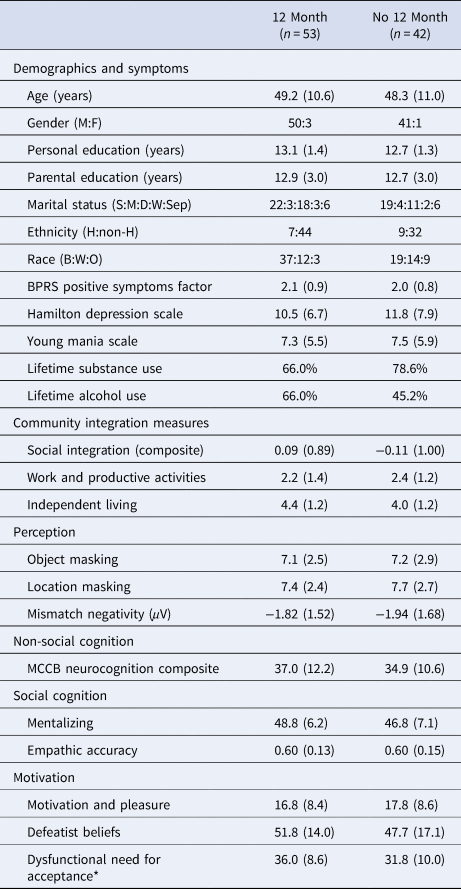
Ninety-five homeless Veterans with psychotic disorders received an assessment at baseline when they had received a HUD-VASH voucher for housing but were not yet housed. Fifty-three of these participants returned for an evaluation after 12 months. Demographic data are provided in Table 1.
Mean (standard deviation) for demographics, symptom ratings, community integration outcome measures, and predictors of outcome presented separately for those with and without 12-month follow up data

Marital: S = single, M = married, D = divorced, W = widowed, Sep = Separated.
Ethnicity: H = Hispanic, Non-H = Non-Hispanic.
Race: B = black, W = white, O = other.
+ note, some declined to answer or provide information.
*p < 0.05.
To recruit participants, a VA administrative database (VA Informatics and Computing Infrastructure, VINCI) was queried monthly to identify all Veterans who enrolled in the HUD-VASH program at the VA Greater Los Angeles Healthcare System (GLA) in the preceding month who had received mental health care for a psychotic diagnosis in the preceding 5 years. Opt-out letters were sent to the last known address of these Veterans and those who did not respond to the letter were subsequently contacted by phone. Additionally, research staff attended orientation sessions for the HUD-VASH program and distributed information about the study. General inclusion criteria included age between 18 and 65 years; estimated premorbid IQ >70; and English proficiency. General exclusion criteria included any medical, physical, cognitive, or language impairment severe enough to adversely affect the validity of data. A diagnosis of schizophrenia, schizoaffective disorder, schizophrenia spectrum, and other psychotic disorder, or a mood disorder with psychotic features based on Structured Clinical Interview for DSM-5 was required (substance-induced psychotic disorder was not permitted). The sample included 32 subjects with a diagnosis of schizophrenia, 11 with schizoaffective disorder, 34 with unspecified schizophrenia spectrum and other psychotic disorder, and 18 with other psychotic disorders (bipolar disorder or depression with psychotic features, delusional disorder). All participants provided written informed consent in accordance with procedures approved by the Institutional Review Board at GLA. Baseline correlates in a subset of measures were presented elsewhere (Horan et al., Reference Horan, Wynn, Gabrielian, Glynn, Hellemann, Kern and Green2020); the current paper and Study 2 are the first to report longitudinal data from this project.
Assessments
Clinical assessments
All interviewers were trained at the Treatment Unit of the VISN 22 Mental Illness Research, Education and Clinical Center (MIRECC) to a minimum kappa of 0.75 for key psychotic and mood items. Diagnoses were determined using the Structured Clinical Interview for DSM-5 (SCID-5) (First, Williams, Karg, & Spitzer, Reference First, Williams, Karg and Spitzer2015) as well as available medical records. Psychotic symptoms were assessed with the UCLA expanded 24-item Brief Psychiatric Rating Scale (BPRS) (Ventura et al., Reference Ventura, Lukoff, Nuechterlein, Liberman, Green and Shaner1993) and we report the positive factor component (Kopelowicz, Ventura, Liberman, & Mintz, Reference Kopelowicz, Ventura, Liberman and Mintz2008). Mood symptoms were assessed with the Hamilton Depression Scale (Hamilton, Reference Hamilton1960) and the Young Mania Rating Scale (Young, Biggs, Ziegler, & Meyer, Reference Young, Biggs, Ziegler and Meyer1978).
Perception
Visual perception: location and object masking: These visual perception tasks have been used in models of functional outcome in SMI (Green et al., Reference Green, Hellemann, Horan, Lee and Wynn2012; Rassovsky, Horan, Lee, Sergi, & Green, Reference Rassovsky, Horan, Lee, Sergi and Green2011). In these tasks, a visual target is obscured by a visual mask. In location masking (Green, Nuechterlein, Breitmeyer, Tsuang, & Mintz, Reference Green, Nuechterlein, Breitmeyer, Tsuang and Mintz2003; Green, Wynn, Breitmeyer, Mathis, & Nuechterlein, Reference Green, Wynn, Breitmeyer, Mathis and Nuechterlein2011; Lee et al., Reference Lee, Nuechterlein, Subotnik, Sugar, Ventura, Grechen-Doorly and Green2008), the target consisted of a single square with a notch that could appear at the top, bottom or left side of the square. The target could appear at one of four different locations. Both forward (mask preceding the target) and backward (mask following the target) masking were assessed. The object masking task used common household objects as targets (Reavis et al., Reference Reavis, Lee, Wynn, Engel, Jimenez and Green2017). We presented one of six different objects, followed by a mask (overlapping black and white curved lines) at 8 time-varying inter-stimulus intervals (ISIs). The dependent measure for each task was the number correctly identified (location or identification) for each interval.
Auditory perception: mismatch negativity: Mismatch negativity (MMN) is an event-related potential that is elicited in fronto-central midline electrode sites in response to infrequent, physically deviant tones interspersed in the repeated presentation of a standard tone (Naatanen, Jiang, Lavikainen, Reinikainen, & Paavilainen, Reference Naatanen, Jiang, Lavikainen, Reinikainen and Paavilainen1993). MMN assesses the development over time of an auditory memory trace and can be used to examine prediction error coding (McCleery et al., Reference McCleery, Mathalon, Wynn, Roach, Hellemann, Marder and Green2019). MMN is related to daily functioning in people with schizophrenia (Light & Braff, Reference Light and Braff2005) and healthy samples (Light, Swerdlow, & Braff, Reference Light, Swerdlow and Braff2007). Subjects were presented with standard and duration-deviant tones binaurally with a fixed stimulus onset asynchrony: standard (90% probability; 50 ms duration) and deviant (10% probability; 100 ms duration). EEG recordings were acquired with a 64-channel BioSemi ActiveTwo amplifier (Biosemi B.V., Amsterdam, The Netherlands). MMN was indexed by subtracting standard from deviant averaged waveforms and taking the mean amplitude over 135–205 ms latency at electrode Fz.
Non-social cognition
Non-social cognition was assessed using the Neurocognitive Composite of the MATRICS Consensus Cognitive Battery (MCCB) (Nuechterlein & Green, Reference Nuechterlein and Green2006). This composite includes nine tests that measure six domains of non-social cognition: speed of processing, attention/vigilance, working memory, verbal memory, visual memory, reasoning and problem-solving. Standardized T-scores were computed for each cognitive domain, correcting for age and gender.
Social cognition
The Awareness of Social Inference Test (TASIT), Part 3. (McDonald, Flanagan, & Rollins, Reference McDonald, Flanagan and Rollins2002): In this task of mentalizing, participants watched a series of videotaped vignettes that depict people interacting and answered four types of questions about what a person in the conversation: (1) believes or knows, (2) means, (3) intends; and (4) feels. Part 3 of the TASIT assesses the ability to use contextual knowledge (visual and verbal), in addition to voice and face cues, to derive meaning from the conversation. It includes 16 vignettes in which there is an untrue comment presented as either sarcasm or a lie. The dependent measure was the number questions correctly answered.
Empathic Accuracy task (Lee, Zaki, Harvey, Ochsner, & Green, Reference Lee, Zaki, Harvey, Ochsner and Green2011): Participants watched nine video clips (2.0–2.5 min each) of people talking about positive or negative autobiographical events and made continuous ratings of how the individual (‘target’) is feeling throughout the clip (in 2-s segments) using a 9-point scale from 1 (extremely negative) to 9 (extremely positive). For each clip, the correlation between the participant's ratings of the targets' emotions and the targets' ratings of their own emotions was computed. An overall score was calculated by computing the average of the correlations across clips.
Motivation
We included two types of assessments of motivational symptoms: a clinical interview for motivational negative symptoms, and a scale for motivationally-relevant beliefs.
Clinical Assessment Interview for Negative Symptoms (CAINS): The CAINS (Kring, Gur, Blanchard, Horan, & Reise, Reference Kring, Gur, Blanchard, Horan and Reise2013) is comprised of two subscales: (1) the Motivation and Pleasure (MAP) subscale (9 items) assesses asociality, avolition, and anhedonia; (2) the Expression subscale (4 items) assesses affective flattening and alogia. Our focus was on the MAP subscale, and the Expression scale was included as a non-motivational clinical measure. Ratings for this subscale are based on both patients' reports of motivation, interest, and emotional experiences, as well as engagement in social, vocational, and recreational activities. The measure was administered in a semi-structured interview with lower scores representing higher levels of MAP.
Dysfunctional Attitudes Scale: Participants completed the Dysfunctional Attitude Scale (Weissman, Reference Weissman1979), which is a 40-item self-report scale designed to measure the presence and intensity of dysfunctional attitudes. We focused on the defeatist performance attitudes subscale (DPAS), which consists of 15 statements describing overgeneralized conclusions about one's ability to perform tasks (e.g. ‘If I fail partly, it is as bad as being a complete failure’) and the dysfunctional need for acceptance subscale (DNAS), which consists of 10 statements that assess the exaggerated importance of being accepted by others (e.g. ‘I cannot be happy unless most people I know admire me’). These attitudes are linked to amotivation and negative symptoms (Campellone, Sanchez, & Kring, Reference Campellone, Sanchez and Kring2016).
Community integration
Work and Productive Activities and Independent Living: The Role Functioning Scale (RFS) (Goodman, Sewell, Cooley, & Leavitt, Reference Goodman, Sewell, Cooley and Leavitt1993) includes separate ratings for Working Productivity (‘Work’ from here on) and for Independent Living/Self Care (‘Independent Living’ from here on). Ratings were based on a semi-structured interview with standardized probe questions. Each domain was rated on a 1–7 scale, with higher scores indicating better functioning.
Social integration: We measured social integration with two different scales: (1) the sum of the Immediate Social Network Relationships, and Extended Social Network Relationships scales (i.e. social and family) ratings from the RFS (Goodman et al., Reference Goodman, Sewell, Cooley and Leavitt1993), and (2) the Lubben Social Network Scale (LSNS) (Lubben, Reference Lubben1988) which is a 12 item self-report measure of social (i.e. family and friends) engagement. We computed a composite social functioning index by obtaining standardized scores for each scale and then averaging them. Higher scores indicate better social integration.
Data analyses
Group differences between those who returned at 12 months and those who did not were examined with chi-squared or t tests. Those who did not return were further subdivided into those who were no longer engaged with HUD-VASH v. those who were lost to follow up. We attempted to follow up on all participants whether they were discharged or not. Associations between baseline predictors and baseline and 12–month functional outcomes (social integration, work, independent living) were assessed with Pearson correlations after ensuring that the distributions were normal and appropriate for that statistic. These analyses were conducted among those subjects who had functional assessments at baseline and follow-up.
To interpret the longitudinal associations between baseline predictors and later community integration we utilized cross-lagged panel correlation analysis. This method assesses the plausibility of causality by comparing the strength of the relationships between Measure A at baseline by Measure B at 12 months, and Measure B at baseline by Measure A at 12 months. If one is much stronger than the other, it is inferred that the baseline measure drives the 12-month measure, rather than the other way around. Hence, this approach examines whether relationships are consistent with causal influence of one variable on another over time, while simultaneously considering their relationship at an earlier assessment point and possible spurious longitudinal associations attributable to an unmeasured third variable (Kenny, Reference Kenny1975). All analyses used an alpha level of 0.05, two-tailed.
Results
Baseline characteristics
The baseline characteristics for demographic, symptom ratings, community integration measures, and predictors are shown in Table 1 for those who returned for testing at 12 months (n = 53) and those who did not return for testing (n = 42). Both samples had a mean age in the late 40s and tended to be male, black, and single. Both samples had high rates of lifetime alcohol and substance use disorder (56.8% and 78.6%, combined for lifetime alcohol and substance disorders, for those who did and did not return, respectively). The groups were comparable on all measures at baseline, except those who returned at the 12-month follow-up had a significantly higher rating on the DNAS compared to those who did not return, t 89 = 2.17, p = 0.033.
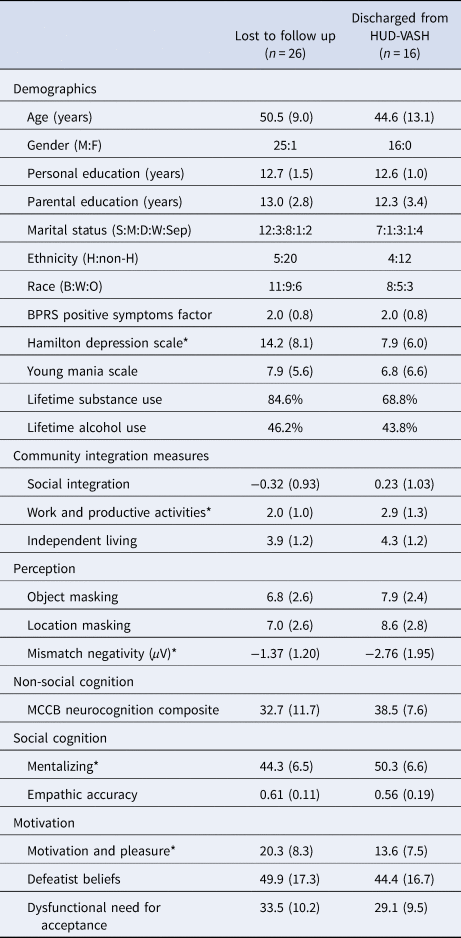
Of those who did not return for testing, we lost contact with 26 and 16 were discharged from the HUD-VASH program prior to the 12-month follow up based on the VA's electronic health record. We examined differences in demographics, symptoms, or in the various predictors between these two subgroups. Those who were discharged from HUD-VASH had significantly better work outcome, better MAP, better mentalizing performance, and stronger MMN compared to those lost to follow-up (Table 2).
Mean (standard deviation) for demographics, symptom ratings, community integration outcome measures, and predictors of outcome, for those who did not return for the 12-month assessment

Marital: S = single, M = married, D = divorced, W = widowed, Sep = Separated.
Ethnicity: H = Hispanic, Non-H = Non-Hispanic.
Race: B = black, W = white, O = other.
+ note, some declined to answer or provide information.
*p < 0.05.
Stability over time
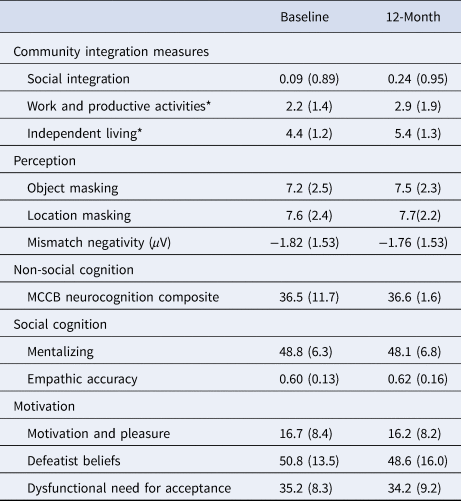
Over the course of 12 months, there were no significant improvements in social integration in the 53 who returned (Table 3). Independent living improved slightly, as expected, due to the provision of housing. The score for work improved very slightly – 0.5 on a 7 point scale in which healthy controls score around a 6. None of the other measures showed significant changes. The correlations over time were rs = 0.73, 0.26, 0.06 for social integration, work, and independent living, respectively. Overall, we saw stability for social integration over 12 months, but not for independent living.
Baseline and 12-month follow-up means (standard deviation) for community integration outcome measures and predictors of outcome 53 Veterans who returned for the 12-month assessment

p < .05
Correlations
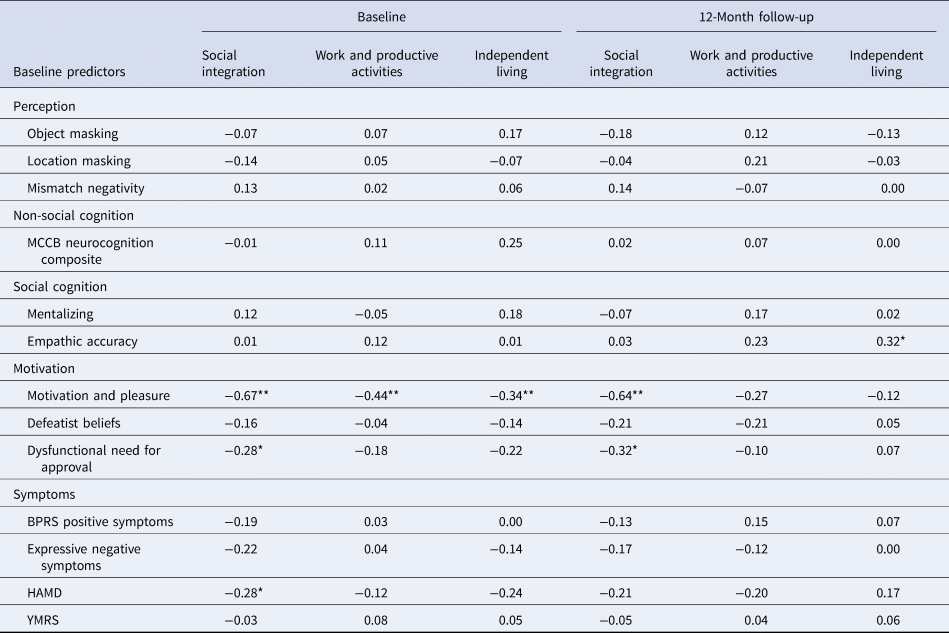
We examined correlations between baseline measures of motivation, non-social cognition, social cognition, and perception to baseline and 12-month measures of social integration, work, and independent living in those participants who had assessments at both time points. The MAP subscale from the CAINS at baseline was highly correlated with social integration at baseline (r = −0.67, p < 0.001) and at 12-month follow-up (r = −0.64, p < 0.001) (Table 4) indicating that those with higher levels of motivation (i.e. lower MAP score) had better social integration. Furthermore, MAP was correlated with work and independent living at baseline (rs = −0.44 and −0.34, respectively) but not at 12-months. A measure of motivational beliefs, DNAS, was modestly related to baseline and 12-month social integration, and empathic accuracy was related to independent living only at 12-months.
Correlations between baseline predictors of motivation, social cognition, non-social cognition and perception and baseline and 12-month follow-up measures of social integration, work and productive activities, and independent living

**p < 0.01, *p < 0.05.
Significant correlations are shown in Table 4. Given the exploratory nature of the study, we present all associations without adjustment for multiple comparisons. Correlations that survive a highly conservative Bonferroni correction (i.e. division by 30) include both the cross-sectional and longitudinal associations between MAP and social integration.
Interpreting longitudinal associations between predictors and community integration
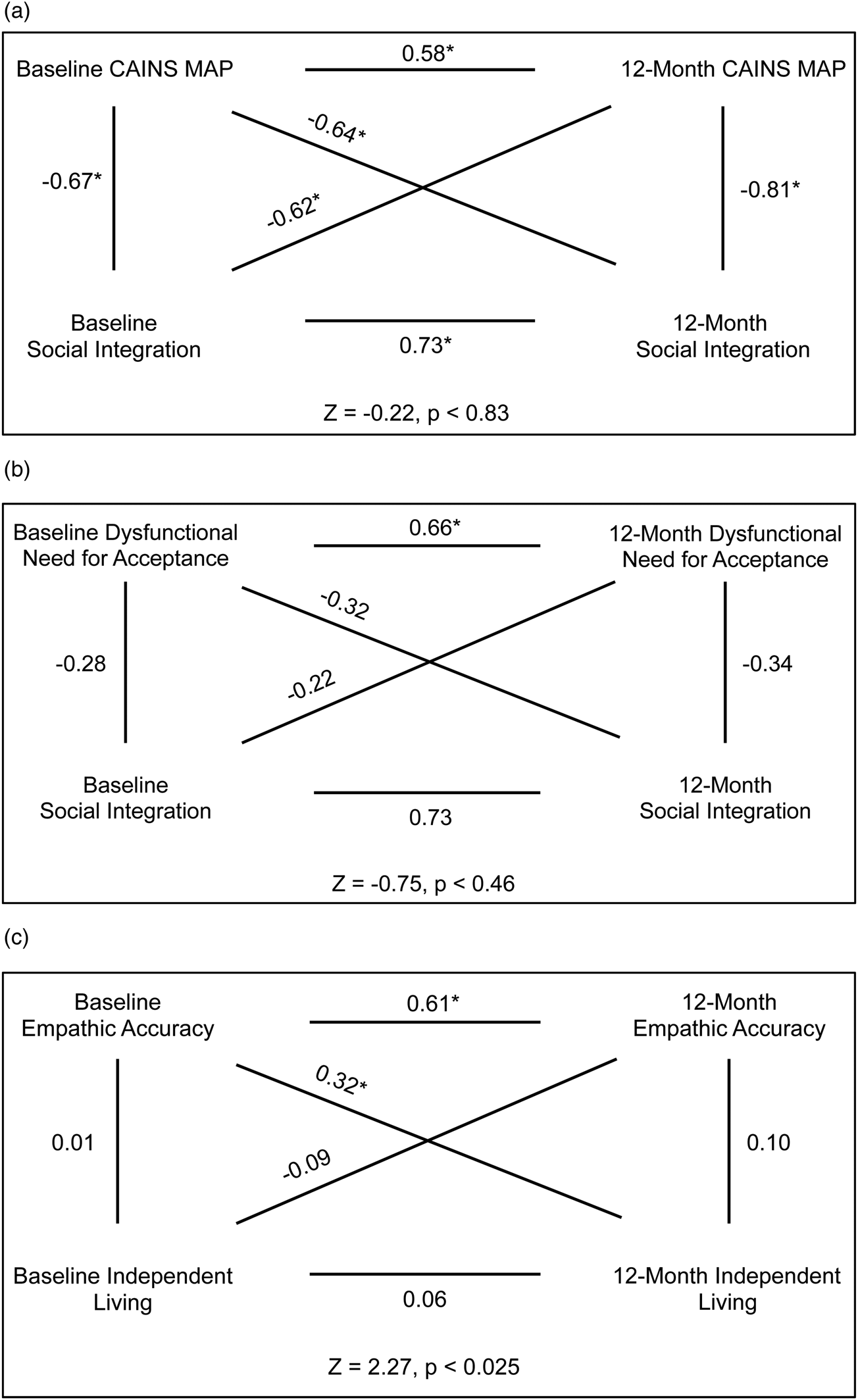
Significant correlations between longitudinal predictors and a 12-month functional outcome were further examined with cross-lagged panel analyses (Fig. 1). Social integration at baseline was associated with 12-month MAP, and MAP at baseline was associated with 12-month social integration (r's = −0.62 and −0.64, respectively), a nonsignificant difference between these cross-correlations (z = −0.22, p < 0.83). Thus, this analysis is not consistent with the causal influence of one variable on the other. Similarly, for the association between the DNAS and social integration, the cross-lags (r's = −0.32 v. −0.22) did not significantly differ from each other (z = −0.75, p < 0.46).
Cross-lagged panel analysis of the longitudinal association between (a) motivation and pleasure and social integration; (b) dysfunctional need for acceptance and social integration; and (c) empathic accuracy and independent living.

Empathic accuracy at baseline was significantly associated with independent living at 12 months, but the reverse association was not significant. The difference between the cross-correlations was significant (z = 2.27, p < 0.025), consistent with the idea that empathic accuracy may have a causal influence on independent living at 12 months.
Discussion
In this project, we evaluated perception, non-social cognition, social cognition, and motivation as correlates and predictors of community integration in homeless Veterans with a history of psychotic disorders. The baseline assessments occurred after the Veterans obtained vouchers for HUD-VASH housing, but before they used the vouchers to subsidize rental units. The strongest longitudinal association was between a baseline motivational measure, the MAP subscale from the CAINS, and social integration at 12 months. Two other longitudinal associations were significant but weaker: baseline DNAS and social integration at 12 months; and baseline empathic accuracy and independent living at 12 months. In addition to these longitudinal associations we observed cross-sectional associations at baseline between the MAP and all three of the community integration domains.
Overall, the correlations with motivational measures were stronger than those from other predictor domains. None of the associations for perception and non-social cognition was significant, and social cognition had one significant correlation with independent living at 12 months. While the associations with motivation and community integration were expected, the lack of associations for perception and non-social cognition was not. This relatively selective pattern of associations is different from what is typically seen in non-homeless psychotic disorders in which all of these domains are predictors of community integration. This difference in pattern might be attributable to the unique features of homeless Veterans with psychotic disorders. For example, Veterans are screened for psychiatric issues at the time of enlistment so Veteran samples with psychosis generally have few individuals with early age of onset and may have less illness severity. The sample also had a relatively high number of participants with unspecified schizophrenia spectrum and other psychotic disorder (n = 34). Also, Veterans in general (not only those with psychotic disorders) have access to a range of mental health and case management services that are not always available to non-Veterans. It is possible that cognitive and perceptual factors are more critical when individuals have fewer support services available to them.
The community integration variables did not change much from baseline to 12 months. Independent living improved with the provision of housing (largely by definition), but social integration did not change significantly, and work outcome improved, but to a very small degree. Our results are consistent with others (Mares & Rosenheck, Reference Mares and Rosenheck2010; Tsai et al., Reference Tsai, Mares and Rosenheck2012) that show providing housing to these individuals is an important first step, but it is insufficient to bring about meaningful improvement in community integration, particularly connections to friends and family.
We observed three longitudinal associations between baseline variables and 12-month community integration. Two of these associations did not have significant differences in the cross-lags. Hence, while these variables appear to be linked, one variable did not appear to be causing the other within the timeframe of this study. Findings from cross-lagged panel analyses are heavily dependent on when sampling occurs, in this case only at baseline and 12 months. It is possible that patterns consistent with causation would emerge with more frequent sampling or longer follow up period. A significant difference in the cross lags occurred for empathic accuracy, in which the pattern suggested baseline empathic accuracy was driving later independent living, as opposed to the reverse. Perhaps higher empathic accuracy at baseline indicates that participants are more skilled at navigating interpersonal interactions with landlords and neighbors, and thereby are more likely to be housed later.
We did not see many differences between those who returned at 12 months and those who did not. Among those who did not return, those who were discharged from HUD-VASH tended to have better scores on motivation, perception, and social cognitive measures. Veterans can be discharged from HUD-VASH because they are unable to meet the minimum requirements for continued involvement (e.g. requiring a higher level of care) or because they are making substantial progress and no longer need the support (e.g. getting a better job, being reunited with family members). Given the limited information provided by medical records, it was difficult to determine the specific reasons for HUD-VASH departures for most participants. The information that we found provided examples of both good and bad reasons for exit.
The CAINS provides two summary scores, one for motivation (i.e. MAP) and one for expressive negative symptoms. The expressive symptoms did not have any significant associations with any of the outcome variables at baseline or at 12 months (all r's <0.23). Hence, associations with community integration are specific to motivational features of psychosis, not negative symptoms globally.
This sample experienced both homelessness and psychotic diagnoses. Psychosis and homelessness can be mutually reinforcing in that psychotic symptoms can make it difficult to obtain and sustain independent living arrangements (Kuno, Rothbard, Averyt, & Culhane, Reference Kuno, Rothbard, Averyt and Culhane2000). Cognitive and motivational deficits associated with psychotic illnesses present obstacles for household tasks, interpersonal relationships, and activities of daily living. In addition, persons with SMI have increased vulnerability to eviction due to difficulties in managing routine landlord-tenant conflicts (Lamb & Bachrach, Reference Lamb and Bachrach2001). Hence, this subgroup of homeless individuals with psychotic disorders (about 12–15% of the homeless Veteran sample in Los Angeles) presents particular challenges for housing retention. The next paper will determine whether similar patterns exist in homeless individuals without these diagnoses.
The study had several limitations. First, it was a sample of homeless Veterans who had a history of psychosis. Hence, the findings might not generalize to homelessness in general or to non-Veterans with a history of psychosis. Second, the attrition over the course of 12 months was high, which was expected given the difficulty in engaging recently-housed Veterans in research activities that involve local travel. There were not prominent group differences at baseline in those who returned v. those who did not. The attrition clearly reduced the statistical power and may have led to Type 2 errors. Data from Study 2 will allow us to examine which findings replicate in an independent sample, which partly mitigates the reduced power in the current study. Third, substance use disorder might moderate the relationships observed in this sample, but we could not test that possibility because a large majority of the sample had a history of substance use prior to baseline. Fourth, we do not know exactly how many participants were housed at 12 months due to incomplete information in the records. We could confirm that 62% were housed at 12 months, though the actual number was likely much higher. Fifth, our assessments of functional outcome were not equally comprehensive; the assessment of social integration was more detailed than those for work and independent living. Sixth, our assessments were done in person and at long intervals. Novel approaches, such as smartphone-based assessments, could be conducted more frequently. Lastly, our study did not systematically examine environmental factors that might be relevant for community integration, such as type of housing placement or distance from the VA campus.
Despite these limitations, we observed interpretable cross-sectional and longitudinal associations with community integration. As expected, the provision of housing alone did very little to improve social integration at the group level. Correlations between motivational measures and community integration were generally stronger than those from other predictor domains. The strong association with motivational factors was notable but could be due to sample-specific factors. If these relationships are consistent across samples, it would suggest that motivational factors are generally important for recovery after homelessness and that they could be targeted in recovery-oriented interventions. The following paper (Study 2) (Wynn et al., Reference Wynn, Gabrielian, H, Horan, Kern, Lee and Greenthis issue) presents data from a sample of homeless Veterans that is diagnostically distinct from the current sample (those without a history of psychotic disorders) to evaluate whether the pattern of findings from this study holds up in an independent study.
Acknowledgement
This study was funded by Merit grant RX001116 from the Department of Veteran Affairs to Dr Green.
Conflict of interest
Dr Green has been a paid consultant for Biogen, Click Therapeutics, Lundbeck, and Roche, a member of the Scientific Board of Cadent. Dr Marder has been a paid consultant for Biogen, Lundbeck, Roche, Newron, Avanir, Allergan, and Sunovion. Dr Horan is an employee of VeriSci. The remaining authors have no disclosures.