“I told ‘em at the start that if they stuck together they would be able to get anything they wanted. But instead of that they're getting all split up.”
—U.S. Senator James McMillan (R-MI), speaking of Detroit's state legislative delegation.Footnote 1We seek to explain how state legislatures govern big cities. We build an account of such politics, one that is situated in a politics filled with legislators and institutions and one that rests on data covering a wide range of interactions between American states and cities over the last century. In so doing, we consider the two institutional arenas in which cities are governed in the details—cities and states—and in the process we propose a new research program for urban politics. Our move introduces new thinking about how urban representatives successfully and unsuccessfully manage the scope of conflict in urban governance.
We argue that the unity of urban delegations—or the lack thereof—provides essential cues to other members of the chamber. United urban delegations give legislators an immediate answer to the first question legislators contemplate when faced with a new issue: “Is it controversial?”Footnote 2 When urban delegations are united and can send a clear signal that the answer is no—irrespective of whether the bill is important or trivial—legislators from outside the city vote with the crowd. When members of urban delegations disagree with one another, those urban delegations invite suburban and out-state legislators to make choices for the city.
The city delegation, then, has tremendous power to manage the state's involvement in city affairs. Some delegations wield this power effectively. Some do not. And the recognition of this power changes our understanding of urban politics and pushes scholars to ask when state legislatures do and do not truly expand the scope of conflict on urban affairs, inviting new actors into urban politics.
Our approach brings the insights of legislative and historical scholars of state politics to bear on urban politics and gives literatures that have remained oddly disconnected a chance to learn from one another. We suggest that our understanding of the ways that states govern cities must fit with what we know about legislative politics in American states from the last 125 years—that is, legislative politics often dominated by amateur legislators working in nonprofessional legislatures, in bodies offering little routinization. Our analysis considers the consequences of such environments, which persist in many state legislatures today.
Our work draws building blocks from historical scholarship on urban treatment at the hands of state legislatures into the literature on urban politics. The most elaborate such treatment is that of Jon Teaford. He describes the treatment of nearly 400 big-city bills in select years in the late nineteenth century and makes clear that the legislatures in his sample almost always followed the urban delegation's wishes when deciding on big-city bills. In the rare instances where the legislature did not follow the delegation's guidance, there was often disagreement among the big city's representatives about the bill's merits.Footnote 3 Teaford concludes, “Legislatures of this period, for the most part, did not make policy or fashion the legal structure of municipal government. Instead, they more often simply responded to the demands of localities in accord with the cues given by the local delegation. … If the local delegation unanimously supported a local measure, then the legislature would typically follow suit.”Footnote 4 Teaford focuses exclusively on the era between 1870 and 1900. He offers a crucial descriptive account, one that we draw upon to start to build a dynamic account of urban treatment in state legislatures.Footnote 5
For us, the other important building block of an account of urban treatment in state legislatures comes from legislative scholars, from Kingdon's understanding of legislator decision making and from Hall's work on legislative participation. From Kingdon, we take a concern about how important controversy is in legislators’ decision-making processes. And, from Hall, we take the point that most legislative outcomes are decided before the final vote, and therefore, most legislative work happens before bills come to a vote. Studying urban treatment in state legislatures, then, means following bills from introduction to committee to vote. We suspect that, given the amateur status of most of the state legislatures we examine, these concerns with controversy and with the power exercised before a bill comes to a vote are perhaps even more important than they would otherwise be.
ALTERNATIVE ACCOUNTS
When scholars have focused on urban dependence, they've largely focused on economic and not politicaldependence and have missed these important contributions by Teaford and others. When scholars have taken up the question of state-level political treatment of cities, they have drawn data from city officials, who, perhaps not surprisingly, have a lot to say about state-level mistreatment.
For example, after returning from an official trip to several Midwestern cities, James A. Watson, president of the Boston City Council, rose in January 1922 to address his colleagues. “Boston is the city that I love, but it is being relegated to the rear because of the cold-blooded conservatism of those absent landlords who earn their money here and cut their coupons and pay their taxes in Brookline, Cambridge, Weston, Milton and other suburbs. They run our city down and belittle us red-blooded men, we who know the people's needs,” Watson declared.Footnote 6 “But in Chicago, thank God, and the same in Milwaukee, Buffalo and Columbus, absent landlordism in the management of public affairs of those cities is missing. They have home rule there.” In those cities—and in Detroit, which Watson visited near the end of his trip—mayors and city councils governed cities without the constant interference and superintendence of state legislatures, at least according to Watson. “They are not controlled from the State House of their state, as we are from Beacon Hill,” he claimed. But, he added, Boston's patient suffering would not continue indefinitely. “Boston, the great giant, has been sleeping, but she will wake, and my prediction is this, that in the coming year the Legislature of Massachusetts will not dare to handicap Boston in any particular,” Watson stated. “We are going to get a square deal from the Legislature. We demand it and the public will demand it, and we are going to get it.”
In some instances, such language was used by reformer scholars in the early part of the twentieth century and by the scholars who followed them as evidence of the ways the city was in “bondage” to the state in the early twentieth century. Goodnow analyzed “the absolute subjection of the city to the legislature.”Footnote 7 State interference occurred because purely local decisions required the consent of legislators with no knowledge of or interest in the local place. “Under the present system,” Parsons noted, “Buffalo and Albany have more to say as to what shall be done with Rochester telephones and gas pipes than Rochester herself.”Footnote 8 Motivated by greed, encouraged by business interests, and enraged by rural and suburban jealousies, state legislators were routinely portrayed as enemies of the metropolis. They justified their intervention by claiming that urban governments were corrupt and profligate. Enemies of the city, McBain wrote, devoted their time to finding ways to legislate “political spite” against city dwellers.Footnote 9
This complaint was centered in the big cities of the East and Midwest—and it was at its most intense in the late nineteenth and early twentieth century. Eastern state governments, according to Wiebe, “served as rural strongholds where the enemies of the city generally held sway.”Footnote 10 Kantor, drawing extensively on Gelfand, argues that state legislators intervened in local politics for two reasons: first, to extend and consolidate their state-level “power bases” by gaining control of urban “jobs and services,” and, second, to contain the threat posed by city growth to the electoral foundations of rural politicians.Footnote 11 Partisan animosity, as Bridges demonstrates, reinforced patterns of legislative hostility.Footnote 12 Erie suggests that cities encountered these various hostilities simultaneously, as Democratic cities like Boston were attacked by state-level alliances of rural Democrats and suburban and rural Republicans.Footnote 13 Especially in states like Massachusetts, New York, and Illinois, Griffith asserts, major cities faced “endemic hostility” from rural and suburban legislators.Footnote 14 “When they were of the same political party, the state politicians would often block incipient local reform,” Griffith writes. “When of the opposite political party, these same politicians would cloak themselves in the mantle of righteousness and proceed to ‘reform’ the city by transferring some control to themselves or their municipal cooperators, or they would ‘investigate’ corruption in a given city.”Footnote 15 As Nardulli argues, “For Chicagoans the state legislature became the chief symptom of a statewide political disease that sought to disfranchise and isolate Illinois' biggest city. …”Footnote 16 Wright and Schaffner observe the widespread presumption that regional hostility continues to shape state legislative decision making.Footnote 17
One implication of this literature is absolutely right: local politics is not self-contained. Politicians, reformers, and many scholars have long noted that state governments play significant roles in the affairs of cities, towns, and other local governments. Yet much modern scholarship on urban politics pays little attention to the role of state governments, while scholarship on state government generally neglects the role of local affairs. As Peterson suggests, many scholars have treated cities “as if they were nation-states,” as if they were tightly bounded, autonomous political units.Footnote 18 Thus Dahl studied New Haven without devoting any part of his book to the Connecticut legislature.Footnote 19 And Hunter and Stone wrote their influential studies of Atlanta politics with scant reference to Georgia state politics.Footnote 20 Peterson himself, though calling for an examination of the external forces that shape city politics, pays little attention to the role of state governments, emphasizing economic forces instead.
In this article we engage in a systematic examination of the legislative link between state politics and local government. What stands out is not interference or deference between two separate sets of political institutions, but rather the complete intertwining of state and local institutions around the issues of local politics. We contend that policy outcomes with respect to local places cannot be analyzed only as a function of locational advantages (per Peterson ) or local governing regimes, as Stone has argued. Rather, we argue that local policy outcomes often occur in the state legislature. As a consequence, understanding local politics requires a shift in focus to the two-level nature of local and state political arenas. The fact that the state can define the institutions of local politicsFootnote 21 and can make extensive policy decisions about local placesFootnote 22 means that we miss much of the fight—and possibly most of the fight about the parameters of local politics—when we arbitrarily limit our understanding of the causes of outcomes in local politics to forces inside the city or to the economic context in which the city operates.
The argument that the boundaries of local politics are porous is not new. Scholarship on development initiativesFootnote 23 and coalition-building and regime formationFootnote 24 stress the economic context in which urban politics takes place. Bridges and Erie demonstrate the role of partisan coalitions at the state level in machine politics, Mollenkopf examines the impact of national party politics on cities, and Teaford looks more generally at intergovernmental relations.Footnote 25 Yet we argue that existing scholarship still paints an incomplete and inaccurate picture of the political nature of the connections between state and local politics. We offer a more complete view, one that offers the ingredients for a dynamic account of such politics.
In historical accounts of the conditions under which local governments get—or fail to get—what they want from the state legislature, malapportionment is key. Rural and suburban legislators—perhaps of different partisan persuasions than urban interests—succeed in schemes to undermine the city politically by ensuring that big cities have small delegations, delegations that cannot carry nearly enough weight in the final votes to pass bills.Footnote 26 In present-day accounts, the implication is that the power of cities has been undermined by their declining share of seats in the legislature, the consequence of suburbanization in metro areas.Footnote 27 The assumption in standard accounts is that, in the end, what matters is the number of votes when the bill comes to the floor.
We challenge that focus on the number of seats and on the final vote. In its place, we suggest an alternative, and much more effective, perspective on the importance of the state in urban outcomes. We suggest that local unity, more than regional or partisan antagonism, shapes most outcomes on urban legislation. The unity or disunity of a city's delegation provides a powerful signal, one that works throughout the legislative process to shape the treatment of urban interests by other members of the legislature. City delegations, by this account, can wield tremendous power to manage the interaction between cities and states. Yet we also point out historical changes that challenge the unity of urban delegations, reshaping the relationship between states and cities, broadening the scope of conflict on urban issues. As Weir, Wolman, and Swanstrom make clear in their work on modern representation of urban interests at the state level, this broadened scope of conflict can undercut urban goals.Footnote 28
The account we offer can accommodate amateur state legislatures as well as the small number of contemporary state legislatures with an array of professional characteristics. Indeed, to ensure that we explain decision making about urban affairs in a range of environments, we analyze a vast set of bills about local places introduced into the legislatures of eight states—Alabama, California, Illinois, Michigan, Minnesota, Montana, New York, and Texas—from 1881 through 1997. We show that information cues from urban delegations matter greatly, and party and regional divides matter rarely. Furthermore, we show that these results persist across states and over time.
We begin our analysis by evaluating state legislative contexts, building our argument about the valuable cues found in urban unity. We then examine the conditions under which local delegations act cohesively and are able to capture the advantages that the process affords them. Next, we demonstrate how legislators have dealt with local affairs, with an eye to the special powers that big cities hold in these legislative processes. We conclude with a discussion of the broader implications of our results, paying special attention to the ways that the separation of powers in urban governance can matter. In the end, we offer two key contributions. First, we embed urban politics in an account of state legislative politics, and, more broadly, we offer a model of when extra institutional layers actually change outcomes for cities. Second, we introduce extensive, systematic new data to assess these arguments.
DECISION-MAKING CUES IN STATE LEGISLATURES
The average legislator in the states we study lacks the expertise that comes from a long career in the legislature and lacks the decision-making cues that would ordinarily arise from partisan competition. Thus many leading theories of legislative action and institutional design can do little to account for their decision-making environment.Footnote 29 While it is tempting to think of amateur state legislatures as a thing of the past, these conditions persisted into recent decades in most states. Even as late as the 1980s and 1990s, only eight or so states had professional legislatures.Footnote 30 The few professional legislatures today are clustered in mid-Atlantic and Great Lakes states, and they are exceedingly rare in certain regions: there seems to be broad consensus that California is the only professional legislature in the West; and there is some debate over whether the number of professional legislatures in the South is zero or one (Florida).Footnote 31 Of course, by and large, these legislatures did not look the same in the later part of our period of study as they did in the 1880s—legislators, especially in the most professional legislatures, more recently serve longer terms and have more of the accoutrements of professional life.Footnote 32 For the median state, however, these changes have been rather modest.Footnote 33 Nevertheless, as late as 1961, in even the most professional legislatures of Michigan and New York, nearly a fifth of the legislatures' members were first-timers. And even today, about half of state legislators have no personal staff to help with their work.Footnote 34
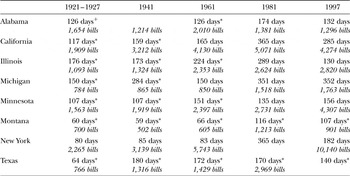
State legislatures have often coupled members' inexperience with exceedingly high workloads, making it nearly impossible for members to have an informed view of many bills, especially of bills affecting districts other than their own. As can be seen in Table 1, legislatures were often restricted to short sessions, in which members could have one thousand or more bills to consider. While the sessions gradually lengthened in many states, by 1995, only the legislatures in California and Michigan met for most of the year.
Length of Legislative Sessions and Number of Bills Introduced into the State Legislature's Lower Chamber

* Legislature met every other year.
+ Legislature met every four years.
Note: For 1921–27, we report bill introductions for 1921 and session lengths for 1926–27. For Alabama, whose legislature did not meet in 1921 or 1941, we report figures for 1919 and 1939.
Source: Numbers of bills are counted from the bill indexes of house journals for each state, with the number including all house bills as well as those senate bills that were introduced into the house. Session lengths come from the Book of the States, where length represents the amount of time elapsing on the calendar between the beginning and end of the session.
LEGISLATOR DECISION MAKING
As state politics scholars have made clear, this world filled with overburdened amateur legislators is different from the careerist, professional U.S. Congress upon which scholars have focused their theoretical attention. Observing the amateur phenomenon broadly, Jewell concluded that state legislators have “little incentive to learn the rules and techniques of the legislative game well enough to become professionals.”Footnote 35 Decision making in such an environment could descend easily into chaos. As Jewell, Greene, and Grant put it, “Most state legislators and most legislative committees today lack the time, the information, and the staff assistance to make careful, independent judgments about the bills” and so they “must follow the lead of someone else.”Footnote 36
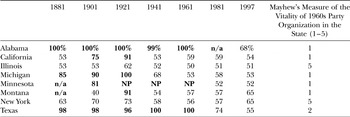
In some nineteenth-century legislatures, party sometimes offered a cue for finding a way through too many bills in too short a time,Footnote 37 but high levels of “party voting occurred selectively on contested issues.”Footnote 38 Party has continued in recent years to help structure decision making on the floor, at least in some places,Footnote 39 and decision making in committees.Footnote 40 In most of our sample, however, legislators would have had trouble relying on this obvious organizational tool: state legislators have often served in chambers thoroughly dominated by one party or the other. Of course, where one-party or no-party rule exists, legislators cannot easily use party as the deciding factor.Footnote 41 As we show in Table 2, about half of the legislatures described in this paper are essentially one-party or no-party legislatures, with 75 percent or more of the legislators from the same party. In most states, it was hard, too, for party to offer much in the way of incentives for loyalty. Mayhew's assessment of the vitality of state party organizations in the late 1960s concluded that most states (thirty of them, to be exact) had no effective party organization.Footnote 42 In many of these legislatures, then, it would be very hard for members to rely on party for much. A few states—Illinois and New York in particular—appear to have particularly strong party organizations and intense party competition. They are notable exceptions.
Percent of Lower-House Seats Controlled by the Majority Party

Note: Bold type indicates 75 percent or more of the seats held by the same party or nonpartisan legislature. Mayhew's scale runs from 1 (lowest level of organization) to 5 (highest level of organization).
NP = Nonpartisan legislature.
DECISION-MAKING CUES ON LOCAL BILLS
Even in unstructured environments—without the expertise that comes from long service in the legislature and without partisan cues—there is one available cue for legislators making decisions on how states should govern cities: the behavior of the local delegation promoting a bill. When the local delegation is unified in support of an urban bill, we suspect that bill is especially likely to progress through the legislative process and, ultimately, pass. In the information environment we have described—with weak partisan competition and little careerism—we can only imagine that rural and suburban legislators are trying very hard to figure out how to act on urban issues in ways that will be acceptable to their friends and neighbors and, more importantly, will enable their own bills to pass without trouble. These legislators want to enact a few bills their districts will notice. They are not seeking to make other legislators angry. In fact, they need other legislators because they want their few bills to make it through the legislature.
Why is unity important? Unity works in two ways to give urban delegations power. In Southern Politics, V.O. Key crafted an account of the power of “cohesive and determined minorities.” In his account, amateurs at the state level and professionals at the national level were able to translate their minority status into political power when they were unified.Footnote 43 Such unity enabled Black-Belt whites to win in state legislatures and national ones.Footnote 44 Dahl believed the power of cohesion to be more general: political effectiveness comes, he thought, to minorities with “a high potential for unity.”Footnote 45 For Key and Dahl, unity implied determination to shape or obstruct agendas. While there is some of that in our story, in our account, the predominant role of unity comes from the information it offers to other legislators. Unity suggests that the local bill is not a product of one or another special interest in the city, that there is broad local agreement on the goals outlined in the bill. Unity keeps the level of state scrutiny low by letting out-state and suburban legislators comfortably believe that the bill is not controversial. The slightest hint of urban discord is enough to change the politics. In the end, such unity could serve as a source not only of concerted action—as Key and Dahl suggest—but also as a source of expertise on the value of the bill to the city. In this scenario, urban delegations—more than partisan or rural interests—hold the keys to state governance of cities.
What results, in short, is conditional, constrained logrolling. Faced with any new urban bill, rural and suburban legislators are willing to defer to urban representatives. But when disagreement arises within the urban delegation, members from elsewhere back away from the exchange. Furthermore, the more unstructured the legislative setting, the more sensitive members are to even faint disagreement within the urban delegation. Where the mechanisms to enforce coordination are weaker, the defection of just one urban member can be a portent to suburban and rural legislators that trouble is brewing. The implication is that minority interests in city politics can have special kinds of power on issues the city is constitutionally required to take to the legislature.
DATA
To offer systematic scrutiny of our ideas, we draw data from the bills introduced into the lower houses of eight state legislatures from 1881 through 1997: Alabama, California, Illinois, Michigan, Minnesota, Montana, New York, and Texas. We selected these states because they vary on a range of crucial dimensions: the length of legislative careers, the nature and timing of urban economic development, racial and ethnic diversity, and nature of partisan organization. They include the dominant cases used in much of the urban politics literature (Chicago and New York). And they incorporate regional diversity. We collected random samples of sixty bills affecting local government introduced into each of these legislatures in 1881, 1901, 1921, 1941, 1961, 1981, and 1997 (or, in the case of Alabama, the legislative session closest to these years).Footnote 46 We regarded bills as local bills if they met any of these criteria: (1) reference to sub-state political units in general (counties, cities, municipalities, school districts, special districts); (2) explicit reference to a local place (a particular county or city); (3) reference to issues that were of primary concern to local or sub-state government. Some of these bills dealt with big cities, but of course not all of them did. To ensure that we had a sufficient number of observations of big-city bills, we drew additional random over-samples of ten bills about the largest city in the state in each of our state years. We collected information on these bills as they traveled through the institution, following the bills from each state through bill introduction and the rest through the entire legislative process, and tracking the specifics of each bill's treatment along the way.Footnote 47
We focus here primarily on legislation about big cities, although we consider general bills about local places at times for the sake of comparison or as a robustness check. Our central interests are in distinguishing urban bills from one another, and in understanding the range of supportive and opposing coalitions these bills generated. We examine the treatment of the bills about the largest city in each state. These largest cities are Mobile, Alabama (1880, 1900); Birmingham, Alabama (for the other years in the sample); San Francisco, California (1881, 1901); Los Angeles, California (for the other years in the sample); Chicago, Illinois; Detroit, Michigan; Minneapolis, Minnesota; Helena, Montana (1881); Butte, Montana (1901, 1941); Great Falls, Montana (1921, 1961); Billings, Montana (1981, 1997); New York, New York; San Antonio, Texas (1881 through 1921); and Houston, Texas (1941 through 1997).Footnote 48
These data give us systematic leverage on our central question: the power of unity to shape urban outcomes at the state level in these relatively disorganized, inexperienced legislatures. We explicitly test our account in the face of the two major alternative accounts: that urban politics in state legislatures is governed by partisan and/or out-state hostility. To isolate the role of unified urban delegations, we use a fully specified model, one that incorporates the main features in narrative accounts of urban politics—parties, politicians, race and ethnicity, and economics. These dimensions of politics are implicit rationales for out-state hostility or the lack thereof in existing accounts of urban politics. Also, we include features of state legislative institutions that may shape how the state body responds to urban interests.
We begin with a basic look at the frequency of urban–out-state conflict. Next, we examine whether the legislative agenda is centered around bills that are beneficial or pernicious to cities. We then ask what gives rise to urban cohesion: are there conditions under which we should expect urban delegations to be able to act together? Next, we examine the power of cohesion to shape the legislative process prior to the vote. And, finally, we test our ideas about the power of cohesion to provide voting cues.
TREATMENT OF URBAN BILLS
Our data show just how infrequently urban interests were at the center of legislative feuds. We find that, among bills that came to a vote, only 2 percent of the big-city bills in our sample had less than 50 percent support. Just 7 percent had less than 70 percent support, and 17 percent had less than 90 percent support. The same pattern holds for general bills about localities: just 3 percent had less than 50 percent support, 10 percent had less than 70 percent support, and 24 percent had less than 90 percent support in the floor vote. Among those bills coming up for a floor vote, then, big-city bills fared better than general bills dealing with local affairs.
Despite the rarity of legislative contention, we looked hard for evidence of urban mistreatment. We searched for two situations, in particular: 1) the passage of bills about the big city over the unified objection of the city's own legislative delegation, and 2) the rejection of bills with the unified support of the local delegation. While we did find cases where legislative support for a measure that the delegation supported unanimously was not overwhelming, and where support and opposition fell along partisan or urban-rural lines, we did not find any cases that fit either of the two situations that we would consider unmistakable urban mistreatment.Footnote 49 Rather, we found that every failure of bills pertaining to the cities was accompanied by disagreement among the local delegation or their unified opposition to the bills. This evidence, we believe, is more consistent with a story of local incentives to claim interference by the state, rather than with the story of actual interference. Interference is conjured when local delegates fail—whether strategically or accidentally—to coordinate in the interest of passing legislation about the city.
Consider the case of Detroit at the turn of the twentieth century.Footnote 50 Detroit's politicians and journalists were passionate about the problem of state interference. The problem of interference, as Detroit's politicians and journalists saw it, was two-fold—a problem of state party machine or corporate influence and a problem of paternalism. In 1901, this rhetoric arose around two main issues under consideration in the state legislature: a bill to convert some of Detroit's local boards into “one-man” units, and a bill to extend the term of the city's mayor. A close look, however, reveals both that citizens and journalists actually saw more nuance in the state legislature's dealings with the city, and that the rhetoric of interference followed conflicts that originated in local politics.
The problem of state political machines imposing their will on Detroit was a central element in both the public rhetoric of city officials and in the press. In his 1902 protest against the actions of Michigan's legislature, Mayor William Maybury of Detroit argued that legislation affecting Detroit was passed without “appeal to popular sentiment.” Addressing the Common Council, he stated, “No consideration of this radical change was submitted to your honorable body. The people and press were ignored. In the space of a few hours laws that have been in existence for yours have been revoked and new enactments made at the dictation of individuals.”Footnote 51 Newspaper accounts were perhaps more insistent. “Two or three men have the power some way or other to rush out to Lansing and within a few hours secure the passage of an act, good or bad, without the people of the city of Detroit—the people most interested—having a chance to protest,” the Free Press stated.Footnote 52 “That is highway legislation.” The Free Press singled out the “all-powerful” machine for attack. “The crack of the McMillan whip resounded through the house this morning and encircled in its long coil fifty-four members,” resulting in the passage of the “McMillan grabber bill.”Footnote 53 The Evening News reported the blatant disregard of local sentiment on the part of one member of Detroit's delegation, who declared, “This legislature will not bow to the common council of Detroit. … The aldermen have their duties to perform and we have ours, and I guess we know what to do.”Footnote 54
Yet if we look carefully at the issue of the state legislature's consideration of the establishment of “one-man boards” in Detroit, an important pattern emerges. We notice that while a rhetoric of outrage over state interference was given emphasis, the politics was, in fact, nuanced. We find that the claims of state interference followed fighting of local politicians on the issue.
Looking at press coverage of the one-man board bills, we find that the frame and the emphasis offered by the paper—following city politicians—highlighted scheming Republican politicians interested in building a Republican machine in the state. Among the prominent Detroit citizens whose comments on the issue were captured, however, there was far more variation and nuance. Thus, on the first page of the Detroit Evening News, the inch-high headline read, “Gov. Bliss Hasn't Signed Ripper Bills,” and the paper posed the question, “As a public spirited citizen, do you indorse the ripper bills, so-called, recently passed by the legislature without giving the people of Detroit an opportunity to be heard?”Footnote 55 Dr. C.L. Arnold, a member of Detroit's St. Peter's Episcopal Church, offered the emphasized rhetoric of outrage, arguing that “[t]he omnipotent new boss who has usurped without announcement the absolute control of political affairs in the state of Michigan, has at once snatched from the citizens of the commonwealth every vestige of their liberties. The riotous subjects of the czar are as free to accomplish their will in civil affairs as are we citizens of Michigan.”Footnote 56 Prominent attorney Horace H. Rackham, however, claimed that he believed “in a one-man head, but these bills are wrong in the foundation and principle.”Footnote 57 And trolley magnate S. F. Angus offered an account that voiced approval of the state action: “I think this ripper legislation is all right. The one-man board is a business proposition.”Footnote 58 These nuances appear on the third page of the newspaper, to be caught only by the attentive reader.
Examination of city council minutes reveals that the one-man board bills were a source of controversy and extended partisan fighting within the body. The Democrats on Detroit's Common Council had supported a mayoral appointment to the board of public works; Republicans had been less sure of the appointment. Democrats won easily at the local level, as the Democratic mayor had the right to make the appointment. One-man board bills were a way for the Republican councilors to challenge this outcome; the new laws would postpone the mayor's right to make appointment to public works and other boards for several months, while Republicans appointed by the governor would serve as one-man boards. In the end, the local Republican majority won—quite predictably—by escalating the conflict to the state level. And, rather than admitting to losing a political fight at the local level that spilled into the state arena, the Democrats used the rhetoric of outrage to create months of headlines about these bills. Despite the local origins of the conflict, the issue, the Democrats claimed, was one of state interference.
Our broader examinations of newspaper coverage of interactions between the city and the state and city councilors' discussions of issues before the state legislature reflect the same patterns we observed on the issue of the one-man board bills. Politicians and journalists noticed plenty of mundane or beneficial interactions between the city and the state—they simply chose not to emphasize those in their rhetoric.
On the patterns of journalistic coverage, the Detroit Free Press offers a striking case in point. Repeatedly, front-page headlines screamed about the malicious treatment Detroit was receiving at the hands of the state, while the interior pages noted that Detroit bills were doing quite well in the legislature. So, for example, while the Free Press front-page headlines argued that “Citizens of Detroit [Were] Given No Opportunity to Consider This Bold Slap at Home Rule,” a page-three story calmly discussed a bill to build a new bridge in Detroit.Footnote 59 The next day's editorial cartoon showed Republican operatives and the governor lording over Mayor Maybury; the caption read, “The Municipal Government of Detroit Since Yesterday.”Footnote 60 On March 14, the Free Press reported that the Detroit delegation needed to avoid “the impression that they are always acting under orders” from the Republican machine. On the March 15, the newspaper reported that the house passed four important amendments to Detroit's charter, amendments proposed by the Detroit City Council. Journalists certainly noticed that routine deliverance of beneficial—or at least mundane—outcomes for Detroit was happening in the state legislature; they simply chose to emphasize the extraordinary things in their rhetoric. The general framework offered for understanding the relationship between cities and states ignored the majority of the interactions between the cities and the states. And the resultant account of city interests in state politics was one-sided, simplifying the complex issues involved in the interactions between so many politicians working within and between so many institutions. That account constituted the rhetoric of outrage.
In our reading of Detroit's City Council minutes from this same time period, we found that most issues before the state legislature did not encourage politicians to employ the rhetoric of outrage. Members of the Detroit Common Council expressed overwhelming unanimity on issues they considered taking to the state. Among the scores of interactions reported in the Council minutes, only a tiny handful of issues were controversial. Bills that did excite controversy in the city council chambers reflected how local battles were being fought in the state arena. Sometimes these bills were ways to overturn outcomes at the local level, outcomes that seemed, to some, settled until a state-level bill offered a way out of a losing battle. Sometimes the bills offered an outcome that would have been different had the constitution said that the battle could have been fought at home. And, sometimes, the rhetorical possibilities surrounding these bills offered losing players the hope that they could turn the tables, even when the objective chances of their winning in either the state legislature or the city council were slim in the short run; the losing players turned to public opinion in hopes of redemption. The rare rhetoric of outrage centers on this class of bills. In 1901, specifically, only the one-man board bills and a bill to extend the mayor's term emerged in the council minutes as controversial actions by the state legislature. And both issues reflected local conflict that had escalated to the state arena and was then painted as state interference.
On the bill to extend the mayor's term, the Republican majority thought the claim of intrusion was overstated, while the Democratic minority wanted to push for a full challenge of the law at the earliest possible moment. Each time the council revisited the issue, the vote split on party lines, which advantaged the Republican majority. Democrats and many journalists claimed that the Republicans wanted to extend the Democratic mayor's term in office in order to forestall the election of a fellow Republican, Hazen Pingree, to the office of mayor. Pingree, they thought, would limit the political power of the state's McMillanite Republicans. The fight was an internal one, about who would be Detroit's mayor. The McMillanite Republicans were losing at the local level—the Democratic mayor seemed popular enough, and his potential Republican opponent in the fall elections had already demonstrated his power with Detroit's electorate. The state-level change, some argued, gave the McMillanites an opening, a chance to capture the mayor's office. And the Democrats were not pleased.
The losers in these escalated local fights had every incentive to frame these issues as ones of state interference, conjuring principles of liberty and self-government. They did this despite the fact that the only actors in the state legislative drama were legislators from Detroit, to whom the rest of the legislators paid deference.Footnote 61 The Democrats would lose in the short run in local politics in Detroit, in these specific fights. But the Democratic mayor held office through 1904. And the terms of the debate were altered. When politicians considered the interactions between Michigan and Detroit, the metaphor of interference was now readily available. In the end, their rhetoric of outrage was successful.
The notion of state interference implies that state legislators acted on their own, for their own aggrandizement, and not at the behest and urging of local officials. Perhaps more importantly, it implies that state legislators acted illegitimately. The real story is quite different. The evidence suggests that the normal relationship was cooperative, and that deviations reflected efforts by city leaders, who were members of a losing faction at the local level, to expand the scope of conflict on these issues. This model is consistent with arguments made by McGoldrick and Schiesl. “The minority party in the city may be more alert to seek the aid of their clansmen in the legislature in their local contests,” McGoldrick suggested. “Local good government groups may find themselves frequently in alliance with the dominant state party in their efforts to combat the local ‘machine.’”Footnote 62
THE AGENDA OF URBAN POLITICS IN STATE LEGISLATURES
If they were so motivated, of course, out-state legislators or partisan opponents could theoretically make trouble for cities at every stage of the legislative process. Urban opponents might influence the agenda of which urban issues get consideration early in the legislative process. Or they might exercise anti-urban political will by voting down bills desired by urban interests in the last stage of the legislative game. Indeed, anti-urban treatment might accumulate over the entire legislative process. Thus we consider the place of urban legislators in managing urban outcomes in the state legislature, beginning with bill introduction and ending with floor votes.
Our first question, then, is whether the agenda crafted by rural or suburban interests is stacked against cities in the first place? Looking to patterns of bill introduction and committee referral does not suggest so. Urban legislators are largely responsible for introducing big-city bills and for deliberating on these bills in committee. Eighty-seven percent of the bills about the big city—including bills involving the big city and other jurisdictions—were introduced by members from the big city.Footnote 63 Sixty-three percent of the time, these bills were referred to committees with urban majorities. Fifty-nine percent of the time, they were referred to committees with urban chairs. At least with these basic measures, then, cities do not seem especially disadvantaged. In fact, in most instances, cities seem to control the agenda.
Scrutiny of the content of these bills can also help us tell just how disadvantaged cities are by the agenda they confront in the legislature. We classified big-city bills into five categories: 1) bills that transferred resources to localities, 2) bills that transferred power to localities, 3) bills that transferred resources to the state, 4) bills that transferred power to the state, and 5) bills that adjudicated interactions between localities.Footnote 64 If cities routinely face legislation that would entail a loss of power or resources to the state, that might be suggestive of an anti-urban agenda. In fact, bills proposing transfers of power to the state are the most common type of legislation about big cities, comprising just over 50 percent of our sample. Yet, perhaps surprisingly, the exercise of state power in a city does not necessarily, nor even most commonly, entail an undesirable encroachment. Rather, these bills commonly deal with restructuring local government institutions, a task which is often brought to the legislature by the city's representatives because constitutionally it cannot be accomplished at the local level. Additionally, these bills sometimes involve regulation of some nongovernmental entity within the big city, such as state-imposed limitations on railroad companies in the early years of our sample and management of state schools located in the cities in the later years of our sample.
Bills that transfer power to localities—often designed to give the city increased authority previously denied to it by its state-sanctioned charter or other state law—are also quite common. In our sample we found nearly 25 percent of the bills aimed to empower cities in this way, granting cities increased taxation and regulatory powers and otherwise enhancing cities' abilities to deliver services. Cities also regularly seek legislation that will endow them with resources from the state; such bills account for about 20 percent of our sample. Quite notably, bills that conversely expropriate resources from the city to the state are exceedingly rare; none of the bills in our sample involves direct usurpation of city resources. Just 1 percent of our sample—a few bills that deal generally with a change in the use of state land that is not expected to be necessarily beneficial to the city—could be classified as bills that move resources from the city to the state. Legislation to adjudicate cities' relations with other local governments—including the resolution of disputes or the ratification of friendly agreements—is also relatively infrequent. Just 8 percent of our sample represented such state intervention, which included dealing with matters of annexation and the division of power and resources between local authorities.Footnote 65 In the end, cities do not seem to be especially disadvantaged by the urban agenda in these state legislatures; for the most part, cities themselves—and not out-state or partisan opponents—author their own agendas. We turn next to the question of how urban delegations influence decision making on these big-city bills.
BUILDING A UNIFIED LEGISLATIVE SIGNAL
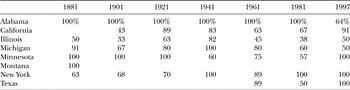
Our claim is that cities can manage the legislative process for bills about the big city if they can signal a united urban interest, that is, if they can use the tools they have readily available to them to persuade others that urban bills are uncontroversial. We evaluate that claim by tracking big-city bills in later sections of this paper, but first we need to account for when and how urban delegates manage to present a united front in the legislature. Looking to urban delegations' votes on final passage suggests such unity is exceedingly common, although certainly not uniform. Table 3 shows the degree of this unity across time and place.
Percentage of Big-City Bills on Which the Urban Delegation Was United

Note: Some state years are blank because no big-city bills came to a floor vote that year. In most cases, this was because special legislation was quite rarely used in that time and place. Instead, these state legislatures decided most local matters through general legislation. California in 1881 is the notable exception, where a number of big-city bills were introduced, but none made it to a floor vote.
The least-unified delegation in our sample is the Chicago delegation. The reason for this is that, from 1870 to 1982, the Illinois General Assembly differed from most other state legislatures in one important respect: cumulative voting. Under this system, the state was divided into legislative districts that were each represented by three members. In the voting booth, constituents had three votes. Voters could split their votes evenly among three candidates, or they could give multiple votes to any candidate. In 98.4 percent of elections from 1902 to 1960, cumulative voting meant that each district in Illinois sent to Springfield two members from its majority party and one member from its minority party.Footnote 66 As Hyneman and Morgan put it, “less noble elements of the community are able to pool their votes on the least respectable of the candidates and assure his election to the Assembly.”Footnote 67 Cumulative voting, by guaranteeing partisan division in the Chicago delegation, resulted in frequent disagreement within the Chicago delegation. Furthermore, cumulative voting increased heterogeneity within the parties. The Illinois Democratic Party was marked by conflicts between the Chicago machine and downstate interests in the 1950s. Absent cumulative voting, downstate Democrats would have been but a negligible portion of the state Democratic Party.Footnote 68
While the power of the Chicago political machine is well documented, the results in Table 3 suggest that its impacts on state legislation were rather poor. Such an outcome is perplexing, until we consider that the Cook County Democratic Party held sway over a subset of the local delegation and a subset of Illinois Democrats. Derge relayed this story of the power of the Daley machine on legislative affairs: “As one Chicago House Democrat put it to the writer in 1957: ‘a telephone call from Mayor Daley can control 40 of the 42 Chicago Democratic votes in the House.’” In his view, “the city administration with no control over city legislators was in a weak position to further metropolitan legislative interests” (emphasis added).Footnote 69
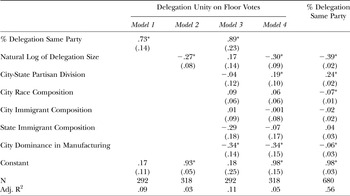
Considering the most divided case suggests that we should expect to find unified delegations when there is little internal party division in the delegation. We expect two other conditions to lead to greater urban unity: when delegations are small, and when there are sharp differences between the interests of the city and state. The expected effects of delegation party composition and size have obvious rationales.Footnote 70 We think of the third condition in the way that scholars have long thought about party cohesion in state legislatures: the more competitive the environment, the more unified the party.Footnote 71 So we include a measure of the extent to which the city's partisanship is different from that of the rest of the state, measured by the absolute value of the difference between the support of the Republican candidate for president in the city and in the state.Footnote 72
Extending this logic to race, we expect cities with racial compositions different than those of the state to be more unified than cities without such differences.Footnote 73 These racial interests are represented by variables indicating whether the city is relatively homogeneous with respect to race and immigrant make-up, along with a measure of the state's immigrant composition.Footnote 74 We look, as well, at whether economic differences between the city and the state have the same consequence. Throughout this period, economic development meant manufacturing, and so we center our attention there, capturing economic difference by calculating the city's manufacturing payroll divided by the average county's manufacturing payroll.
Table 4 shows the results of our analysis of factors contributing to delegation unity. First, when more of the delegation comes from the same party, the delegation is more likely to be unified. Second, in the second, third, and fourth columns of the table, it becomes clear that larger delegations and delegations with greater party division have identical—and substitutable—effects. It is harder to unify a large delegation, in large part because larger delegations are more apt to have partisan splits. Importantly, this result holds over time within each state, supporting the dynamic account in addition to the cross-sectional one: enlarging the delegation makes for less unity. Finally, the fifth column shows that among the number of factors shaping the possibility for partisan unity of the delegation—party differences, economic differences, and racial differences between the city and the state—the size of the delegation is the strongest predictor of a delegation with more members of the same party. These results foreshadow the difficulty cities will have after Baker v. Carr, when their delegations become larger and more diverse.Footnote 75
Predicting Delegation Unity

Note: Entries are OLS regression coefficients and standard errors.
*p < .05, two-tailed t-test.
MANAGING THE PROCESS: FIRST CONSEQUENCES OF COHESION
If urban delegates are to manage state-level involvement in local affairs, and, in so doing, manage the expansion of the scope of conflict of urban affairs, their control should start at the beginning of the legislative process. Here, we assess whether delegations with greater potential for unity can control the process of moving legislation out of the committee system, to a floor vote, and through to final passage.
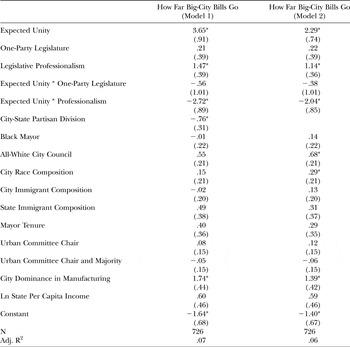
Accounting for the role of delegation unity in the legislative process before the vote, and using data from all the bills in our sample—not just those that actually survive until a vote on final passage—requires a measure of likely urban unity. In the analyses that follow, we rely on a measure of expected unity that is imputed from Model 4 in Table 4. Since some of these legislatures are nonpartisan, the other possible proxy for unity—the model including the delegation's partisan split—was not available for all of our cases.
We have proposed that a unified urban delegation tells other legislators how to treat big-city legislation, that the body is responsive to urban preferences when those preferences are made clear by agreement among the city's delegates. We have also argued that this responsiveness might be especially likely in amateur and/or one-party dominant legislative environments, where cues might be more crucial to members' decisions on how to act on bills. To test this hypothesis, we introduce measures of both of these legislative environments and then interact those measures with our expected unity signal. Our measure of the absence of party cues in the legislature is whether more than 75 percent of the members of the body are of the same party. Following Carey, Niemi, and Powell, we focus on legislative pay to gauge legislative professionalism. We use a measure intended to capture whether the job of a legislator paid enough to provide a comfortable living: whether legislator pay is at least twice the state's per capita income.Footnote 76
We explicitly consider the two major alternative explanations of outcomes on urban bills: partisan and out-state hostility. To ensure that we are actually isolating the role of delegation unity, we include a series of controls for explanations derived from narrative accounts of urban politics and previous studies of legislative decision making. Legislators, of course, might be responding not to the politics of urban delegates, but rather to urban attributes when making their decisions about big-city bills. Therefore, we include measures of potential politically salient differences between the city and the rest of the state. We again use the measures of partisan, racial, ethnic, and economic differences we employed in the previous section's analysis of delegation unity, but make some important additions. On the dimension of race, we add two variables to capture the effect of the political empowerment of racial minorities: we identify places without political empowerment of racial minorities with an indicator for cities with all-white city councils, and places where racial minorities exercise significant political power with an indicator of cities with black mayors.Footnote 77 On the economic dimension we make one addition. While our manufacturing measure is used to account for the possibility that states might feed their engines of economic development, and turn their backs on cities in decline,Footnote 78 we measure the state's wealth with per capita income to control for the ways in which the state's resource base would condition what policies could be funded by the state.
We also recognize that urban management of the process may derive from power or political skill exercised by urban politicians both inside and outside the legislature. To account for the influence of skillful city politicians, we include the length of time the mayor is in office: long-time mayors may very well have coalition-building skills that change legislative outcomes. In addition, given that we know already that urban representatives play a role in setting the agenda of urban politics in state legislatures through bill introduction, we want to account for the possibility that they use their positions on committees to enhance this agenda-setting power. We therefore include a measure of whether the big-city bill was reported by a committee chaired by an urban representative, and a measure to test whether the influence of that chair is greater when urban members dominate the chair's committee.
In Table 5, we examine the progression of big-city bills through the legislative process. Our dependent variable is a scale that runs from 0 through 3 to indicate how far each bill progressed through the legislature. The scale captures whether or not the bill was reported out of committee favorably, whether it was voted on by the full body, and whether it passed. As we rescaled all of our explanatory variables to run from 0 to 1, the coefficients in the table represent the maximum impact of the explanatory variable on the dependent variable.
Managing the Legislative Process

Note: Entries are OLS regression coefficients and standard errors.
*p < .05, two-tailed t-test.
If partisan differences governed the process here, we would expect to see city and partisan division mattering, and it does. Big-city bills do not go as far when there are partisan differences between city and state. If out-state rivalry mattered, we would expect to see evidence in the race and immigrant variables here (though we have more explicit analyses to come). Race does matter some, and it appears to account for some of the partisan effect.
Both partisan and out-state effects are swamped by three other variables. First, cities with economic dominance do better at getting their bills through the legislative process. Second, professional legislatures get more work done than do amateur ones. And, third, all of these effects—especially those centered on race and party—are overwhelmed by the effect of a united urban delegation.
Expected delegation unity indeed has a significant effect on the progression of big-city bills through the legislative process—and this unity matters much more in nonprofessional than in professional legislatures. The coefficient on expected unity reveals that where legislators face big-city delegations that tend to present a united front, bills about the big city go twice as far, on average. Yet the coefficient on the interaction between expected unity and legislative professionalism indicates that the effect of expected unity is much smaller in more institutionally developed legislative environments. Amateur legislators—those facing huge workloads in short sessions, likely concerned with passing their own few bills in that session, and unconcerned with reelection—seem particularly likely to allow big-city delegates to manage their own affairs.
MANAGING THE VOTE: FURTHER CONSEQUENCES OF COHESION
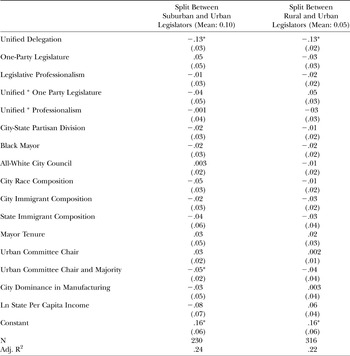
Our final look at the question of whether local cohesion shapes state decisions centers explicitly on out-state hostility, on whether unity draws urban and rural legislators, and urban and suburban legislators, together on votes. If urban unity makes it hard to tell an urban from a rural legislator, and an urban from a suburban legislator, then it does its work to shape urban outcomes in state legislatures. To tell whether delegation unity changes legislator behavior by shrinking urban-rural and urban-suburban divides on urban bills, we estimate two separate regression models that include a measure of whether the big-city delegation was unified. Of course, as we have argued, the information value of unity may be even greater to amateur legislators and in situations where there can be no party cues. So we again include the measure of urban unity in interaction with our indicators of one-party dominance and legislative professionalism. Does the difference between urban and rural, and between urban and suburban, legislators shrink in the face of urban unity? And do these differences shrink even more in legislatures filled with amateurs and/or without party cues?
In Table 6, we report the results of our analyses.Footnote 79 What shapes voting differences between legislators from cities and rural areas, and between legislators from cities and suburban areas? Our two dependent variables are the absolute value of the difference between the percent of urban support and the percent of either rural or suburban support for a bill. When these dependent variables have large values, urban and out-state legislators are voting differently. When these variables are near zero, the two groups are voting in nearly identical ways.
Managing the Vote

Note: Entries are OLS regression coefficients and standard errors.
*p < .05, two-tailed t-test.
The overwhelming story in these regressions supports our central argument: unified big-city delegations make for smaller vote differentials between urban and out-state representatives. And although we hypothesized that the information value of the unity cue could be greater in legislatures lacking simple party cues or full of amateurs, the cue seems valuable in shaping voting behavior regardless of the legislative environment. Unity matters for both sorts of vote splits—urban-rural and urban-suburban.Footnote 80 This unity drives the support the bill gets in all of these legislatures; the correlation between the extent of unity in the delegation and the extent of support in the legislature is huge: 0.58. Furthermore, it is rare to find striking urban-rural and urban-suburban divides on these bills. Overwhelmingly positive votes predominate in these legislatures, as we noted earlier. Fifty-nine percent of the votes on big-city bills are unanimous.Footnote 81
The evidence in Table 6 suggests that united delegations can manage the legislative process for big-city bills. Can they also manage the votes on general bills? One might hypothesize that rural and suburban legislators undermine urban interests not by sabotaging big-city bills, but with general legislation that harms urban interests and that is passed over the objections of the urban delegation. We considered this possibility by looking at general bills in the presence of delegations that were more likely to be unified and delegations that were less likely to be unified. In both instances, urban-rural and urban-suburban differences on these bills are statistically significantly smaller in the face of potentially unified delegations. Urban-rural voting differences on general bills about local issues average 7 percent when the big-city delegation is less likely to be unified, and 4 percent when the delegation is more likely to be unified. The urban-suburban splits show a similar change, from 9 percent to 6 percent.Footnote 82 Even when it comes to general bills— bills often involving explicit trade-offs—urban legislators have some ability to manage the legislative process.
We considered a long list of other explanations for the results in Table 6, but some very sensible alternate hypotheses do not bear out in subsequent tests. Results for the additional tests are discussed below, and the key tests are detailed further in appendix tables.Footnote 83
To address concerns about the temporal or spatial dependency of our account, we employed a number of other analyses. We controlled for states and years to ensure that our story is about our variables and not about some other feature of a particular state and year, and we found that they made little difference to the model. To address the possibility that the clustering of our sample by states and years affected the standard errors in the models we report, we reestimated a set of these models, adjusting the standard errors for the two forms of clustering in our data. This additional complication did not affect the results. In addition, we estimated these models for each year and then for each state to ensure that our central result holds across years and states; it does.
We introduced controls for other temporal variations as well. We included in the model a measure for whether a city had home rule yet; the results persist. This result is consistent with Allard, Burns, and Gamm's analysis of a subset of these data; they find that the treatment of urban interests by nonurban legislators did not change with the introduction of home rule.Footnote 84 Next, we consider whether there are particular features in the early and late years in the sample. Perhaps the time period up through the dawn of the twentieth century is particularly unique; perhaps legislatures were notably different after the 1970s due to reapportionment, growing legislative professionalization, and the Proposition 13 revolution. The effects from unity remain unchanged with all these additional tests. It would appear that baseline urban-rural conflict was higher in 1997, but unity remains a consistently powerful signal.
Although we found larger delegations less united than smaller ones, we still considered the possibility that the effect of unity we have found might be confounded by control over the legislature wielded by delegations that control larger shares of the seats. We included a measure for the percentage of seats held by the big city; that variable did not affect the coefficient on unity. Baseline urban-rural conflict appears to decrease as the big city's share of seats grows, but the power of unity persists.
We considered whether the degree of disunity matters. We estimated these models with a series of dummy variables indicating just how unified the delegation was on the bill. We found that even a small number of defectors in the delegation can disrupt the influence that the preponderance of the delegation seeks to achieve. It's not enough to be mostly unified; delegations see unique benefits from complete unity.Footnote 85
Our findings remained robust when we limited the model in ways to account for less-contentious bills. We controlled for procedural and symbolic legislation; the effects of unity remain unchanged. We split the sample to isolate the effects of unanimous and near-unanimous floor votes. When unanimous results are removed, more than half of the sample is eliminated from consideration. The effects of unity remain, but it is hardly surprising that the effects lapse out of significance as the sample size plummets.Footnote 86
To investigate this point in greater detail, we split the sample between bills that received above and below 90 percent support on the floor, so that we could line up next to one another relatively contentious and relatively uncontentious subsets. Here, our objective is to compare the estimated effects between the two models. Unity continues to shape the highly contentious votes as before, but, as we would expect from the very small sample size (with fewer than fifty cases), the effects are not significant. Rather, the important result is the comparison between the two samples. Unity plays a more powerful role in bringing together members from all regions on contentious bills than on uncontentious votes.Footnote 87 As a final check, we compared small subsamples of bills that might be considered especially important and especially trivial; we found that the treatment of these bills was remarkably similar.Footnote 88
In sum, our results—which hold in the face of a host of alternative accounts of state legislative politics—suggest that urban delegations have the power to manage urban affairs in these relatively disorganized legislatures. While there are conditions under which big cities may be somewhat disadvantaged in urban politics, those conditions can be easily overridden by urban unity. In our results, the city is powerful. This power comes when urban members are unified, when they can send a clear signal about the value of the bill to the city.
ILLUSTRATING UNITY'S POWER
Finally, we offer an example of the patterns we describe, one where we can trace out-state legislators' deference to unified urban delegations even in extreme circumstances. Here, we turn to a bill that provides a very tough test of our theory: where the city is on one side of an intense partisan divide, where the bill's implications spill beyond city limits, and where other cues might prompt nonurban legislators to sink the bill. The bill is uncommonly contentious—the final vote is 56-50. So the power of the city's delegation to signal that the bill is uncontroversial is not on offer here. Even in this extreme case, urban unity determines the outcome.
In 1981, Detroit waged what might seem to be a hopeless battle. To balance the city budget, Mayor Coleman Young wanted to increase the city's income tax on both resident and nonresident (that is, commuter) earnings in the city. This step required authorization from the legislature, and the suburban communities surrounding Detroit posed stiff opposition. Yet, in the end, the measure passed and won the signature of the state's Republican governor.
Detroit's success in this case illustrates the influence that a “determined and cohesive” minority can wield. Detroit built support for the tax increase in several ways. First, the city built a tight-knit urban coalition. The measure was endorsed unanimously by the Detroit city council, by the mayor, and by other prominent local leaders, including a former General Motors chairman and the president of the United Auto Workers.Footnote 89
The legislative record offers insight into the city's strategy for putting that unity to use. In floor debate, when State Representative Cushingberry from Detroit denounced a proposed amendment that would have crippled the legislation, he made a revealing comment. He remarked, “I hope my colleagues in rural Michigan understand what they will do to our budding urban agriculture alliance with the adoption of this amendment. It will be all but impossible to garner urban support for rural programs. Further our colleagues from out state jeopardize the fiscal integrity of this state by allowing this substitute to be adopted.”Footnote 90 Cushingberry made a threat and a claim that only a cohesive delegation can make. First, the threat: if rural interests betrayed Detroit on this bill, Detroit representatives would remember it when key rural bills came before them. Second, the claim: the bill's failure will bring about dire consequences for the city and for the state. Delegations in disarray simply do not have such sway: they cannot threaten coordinated retaliation, and they cannot make coherent claims about what a bill will do. Unity allowed Detroit to win in the face of very slim odds for success. If unity can matter in these circumstances, it has tremendous potential impact in less-contentious and less-organized settings, exactly as our statistical analyses suggest.
IMPLICATIONS
Urban delegations can manage the scope of conflict in state legislatures through unity. Furthermore, larger delegations have more trouble than smaller delegations accomplishing this unity. That observation is particularly jarring when placed next to the reapportionment revolution of the 1960s, next to the conviction that underrepresentation was the problem that big cities faced in legislatures in earlier decades. Better apportionment means larger delegations. Larger delegations make unity difficult to achieve and mean that the city loses control of the legislative process from start to finish. Writing in 1969, Malcolm Jewell forecasted exactly this outcome: redistricting and reapportionment would, he thought, “minimize the power of metropolitan legislators” by making “bloc voting” unlikely.Footnote 91 Writing just a few years before the reapportionment cases, Derge argued that “when legislative reapportionment is viewed in terms of this intra-metropolitan political struggle, it becomes doubtful whether correcting urban underrepresentation will necessarily make the city's lot in the state legislature an easier one.”Footnote 92 Derge worried as well about party division within urban delegations: “If metropolitan areas are to have party systems it is likely that metropolitan legislators will carry their political disputes with them to the state legislature where many metropolitan problems are agitated.”Footnote 93 Some of the urban resistance and anxiety about reapportionment has been characterized as based on the unwillingness of urban legislators “to share power and patronage with others.”Footnote 94
Of course, this caution applies only to bills immediately affecting the city's interest. On the broad range of issues that come before state legislatures not dealing with city governments, the apportionment revolution obviously strengthened the voice of city residents in statewide policymaking. Also, there are other reasons why larger urban delegations—despite the risks to unity—might be a good thing. In a legislature without staff, more people working on urban problems might be better: more expertise, more time to devote, more access points. And, of course, once in a great while, bills will arise where passage depends on the combination of unity and of brute force in the floor vote.
Ultimately, we suggest, the question is not whether urban interests are empowered, but rather which urban interests are empowered. In the end, whether this system of urban control is a good one is a complicated question. The most pronounced case of urban unity in our sample—in Alabama prior to the civil rights movement—makes us unsure that such an outcome is always desirable. Whites in Alabama were united, as V.O. Key reminds us, precisely because of their desire to disempower blacks. A larger, more diverse city delegation is less able to get anything done in the state legislature, but also it is less able to push through legislation that works against minority interests in the city. Instead, those minorities will have a seat in the chamber, and thus be able to voice opposition and in all likelihood kill legislation.
Ours is an account of a special kind of divided government, with two institutional arenas of urban government. An urban delegation's ability to speak with a unified voice will powerfully shape what it can accomplish in the chamber. Members of the legislative delegation have supreme power to kill local bills—through the signals they send when they are not unified, which shape the voting patterns of rural and suburban legislators. The areas where state action occurs will be constrained to matters where unanimous local support can be built. As long as everyone in power in the city agrees, the state legislature does not broaden the scope of conflict or add another set of institutions with any ability to shape urban outcomes. But when there is disagreement at the local level, the local place, for all intents and purposes, invites the state in. Local division means that both state and local institutions, both state and local political actors, matter. This system proliferates veto points and gives tremendous negative power to division.
Appendix Table A. Additional Controls on Vote Split between Urban and Suburban Legislators (Table 6)
Each model below includes all variables from Table 6. Each column represents the effects on vote splits from unified delegation, with a different control variable added to each. Entries are OLS regression coefficients and standard errors. *p < .05, two-tailed t-test

Appendix Table B: Additional Controls on Vote Split between Urban and Rural Legislators (Table 6)
Each model below includes all variables from Table 6. Each column represents the effects on vote splits from unified delegation, with a different control variable added to each. Entries are OLS regression coefficients and standard errors. *p < .05, two-tailed t-test.