Introduction
Story recall tests are administered to patients with memory complaints primarily because these tests are considered “ecologically valid,” in that the tests resemble the demands faced by patients in various real-life situations, such as listening to and remembering discourse from a conversation or from television and radio reports (Lezak et al., Reference Lezak, Howieson and Loring2004). The Logical Memory (LM) test from the Wechsler Memory Scale (WMS) (Wechsler, Reference Wechsler1997a) is one of the most frequently used story memory tests in clinical practice. This test was used in the original formulation of the diagnostic criteria for MCI (Petersen et al., Reference Petersen, Smith, Waring, Ivnik, Tangalos and Kokmen1999) and was recently recommended as a useful episodic memory test by the National Institute on Aging and the Alzheimer's Association (Albert et al., Reference Albert2011).
To date, few studies have investigated the domains that contribute to the immediate recall of story memory. Baddeley and Wilson (Reference Baddeley and Wilson2002) described two amnesic individuals with high premorbid intelligence who performed well on the immediate recall of a prose task but who were unable to retrieve any information after a 30-minute interval (Baddeley and Wilson, Reference Baddeley and Wilson2002). In this study, LM immediate recall was found to be positively correlated with fluid intelligence and executive functions, which suggests that the preservation of immediate recall could partially be explained by non-memory cognitive functions. The interaction between short-term and long-term memory, including semantic knowledge, has been suggested to be highly important for the immediate recall of story memory (Baddeley, Reference Baddeley2000). In particular, individuals with preserved intelligence and intact executive functions are able to retain information in their short-term memory while identifying certain patterns in the retained information and simultaneously accessing knowledge stored in their long-term memory to recode the information in a compressed representation that is less demanding on memory capacity (Baddeley and Wilson, Reference Baddeley and Wilson2002). This process has been called chunking and has been attributed to a slave system termed the “episodic buffer” (Baddeley and Wilson, Reference Baddeley and Wilson2002).
Controlled attentional resources have proven to be more important when learning unrelated sentences than on tests of LM (Jefferies et al., Reference Jefferies, Ralph and Baddeley2004). In contrast, a variety of linguistic codes can guide chunking in a more automatic way when handling logical material, such as in prose memory tests (Jefferies et al., Reference Jefferies, Ralph and Baddeley2004). Semantic memory has also been shown to be important in tests involving logical sentences (Larigauderie et al., Reference Larigauderie, Michaud and Vicente2011). However, the performance of tests that require the subject to learn unrelated words through repetition (such as the RAVLT) can rely on automatic phonological coding. Compared with the pattern in story memory tests, this pattern of learning appears to be less demanding of attentional resources (Jefferies et al., Reference Jefferies, Ralph and Baddeley2004).
Memory of words from the primacy region in word-recall tests (such as the RAVLT) has been shown to be particularly affected in AD because fewer words from this region are retained (La Rue et al., Reference La Rue, Hermann, Jones, Johnson, Asthana and Sager2008). Delayed recall in healthy individuals often reveals better retention of words from the primacy region, which suggests that the serial position of words on a word list corresponds to the various aspects of allocation and acquisition. The primacy region of word-list tests was positively correlated to the immediate recall of prose memory (Foldi, Reference Foldi2011).
The aims of the current paper are (1) to evaluate whether LM immediate recall can be used to distinguish control, MCI and AD subjects and (2) to identify which cognitive functions, including attention, executive functions, semantic memory, episodic memory, and current mental status, contribute to LM immediate recall. The tests selected for this study were the MMSE (Folstein, Reference Folstein, Folstein and McHugh1975), the Wechsler vocabulary subtest (Wechsler, Reference Wechsler1997b), the Trail Making Test B, parts of the RAVLT (Malloy-Diniz et al., Reference Malloy-Diniz, Lasmar, Gazinelli, Fuentes and Salgado2007) and controlled word association (semantic and orthographic). These issues are clinically relevant because story recall memory tests are considered as ecological and are likely to reflect the daily experiences that guided the subject or a relative to complain of memory deficits. Based on a literature review, we formed the following hypotheses: (1) the immediate recall of a story memory from LM is useful in discriminating AD from the other groups, but not in discriminating between MCI and controls, and (2) the immediate recall of a story memory from LM is associated with general knowledge, episodic memory and executive functions that depend on semantic abilities (i.e. semantic memory and premorbid skills).
Methods
In total, 73 consecutive volunteers (50 women and 23 men) aged 47–88 (mean age = 71.85 ± 9.41 years) participated in the experiment. The mean schooling level was 12.51 ± 4.09 years. All individuals were seeking specialized evaluation because of memory complaints. Most of them were referred by their physicians and came from diverse social settings. Overall, the individuals had a high schooling level, and most came from a high socioeconomic level. This study is part of a larger study on the pathophysiological, neuropsychological and morphological aspects of AD. We specifically recruited individuals who were 45 years of age or older and were seeking evaluation for memory complaints. Individuals from the control and MCI groups will be invited to enroll in annual evaluations. All participants provided written informed consent to participate in the study, which was approved by the local ethics committee.
Diagnoses were made by a senior board-certified psychiatrist (PM) in conjunction with clinical, neuropsychological and MRI assessments collected by a multidisciplinary team of neurologists, neuropsychologists, and speech-language therapists. Diagnoses of dementia due to AD were based on the DSM-IV (American Psychiatric Association, 2000) and NINCDS-ADRDA criteria (McKhann et al., Reference McKhann, Drachman, Folstein, Katzman, Price and Stadlan1984). MCI diagnoses followed the Winblad et al. (Reference Winblad2004) criteria but were restricted to the amnesic subtypes (single and multiple-domain) because we aimed to study individuals who were at a higher risk of developing AD. More specifically, we adopted the following criteria: memory complaints, preferentially corroborated by a close relative; quantitative evidence of age-inappropriate cognitive impairments that did not meet the criteria for dementia; cognitive decline; and essentially normal or only minimally impaired functional activities of daily living. The objective measure of memory impairment was defined as abnormal performance on the RAVLT (Malloy-Diniz et al., Reference Malloy-Diniz, Lasmar, Gazinelli, Fuentes and Salgado2007). Because all of the individuals had memory complaints, our clinical control group was composed of individuals with normal performance on the same memory test. A total of 26 individuals were classified as clinical controls; 27, as MCI patients; and 20, as having dementia due to AD. All individuals pertaining to the AD group had a CDR score ≤ 1. Below, we present clinical vignettes to illustrate each group.
Clinical control
MM was a 68-year-old woman with 12 years of schooling. She was looking for evaluation due to memory concerns. She was afraid of having AD because she had a daughter with mental disease who could not perform activities independently. MM was specifically worried because her memory was not working as well as it used to be. However, when asked, she could not give examples of situations in which her memory failed. Despite the memory complaints, she did not have significant depressive or anxiety symptoms. Additionally, she was not using medications. She scored 27 on the MMSE, and her performance in other domains was within normal ranges, including her performance on declarative memory (RAVLT), which showed an unimpaired ability to acquire and retain information. She also had completely preserved activities of daily living. Her CDR was 0.
Comment: This is a case of an old woman who, despite complaining about her memory, did not have evidence of cognitive decline. This case was a clinical control.
MCI
JS was a 76-year-old housewife with 9 years of schooling. She was referred to the researchers due to memory complaints that emerged two years before her enrollment in the research. She stated that during this period, she had been facing difficulties with certain services that she usually performed at home, such as remembering where she had stowed her personal objects or even items from her relatives. She was a widow and lived with her three adult daughters, who often told her that she was becoming forgetful. She had hypertension and hypercholesterolemia, and she was using losartan 75 mg, calcium 600 mg, and Sotacor 120 mg. She scored 26 on the MMSE and had normal performance on tests of working memory, visuoconstructional abilities and language; however, her performance on declarative memory (RAVLT) was inferior to that expected according to her age and educational level. She also reported no depressive symptoms. Despite her memory deficits, Mrs JS was still able to go to her aerobics class by herself (five times per week), and she was able to perform instrumental activities of daily living, as addressed by the Lawton Instrumental Activities of Daily Living Scale (Lawton IADL; Lawton and Brody, Reference Lawton and Brody1969), such as using a telephone to call someone, buy the items that she needed or preparing a meal. As described above, she was facing slight difficulties with certain activities but kept performing the activities independently. Her CDR was 0.5.
Comment: This is an example of an amnestic MCI individual who had memory complaints (as corroborated by her close relatives (daughters)), quantitative evidence of memory impairment without dementia, evidence of cognitive decline and minimal impairment of functional activities of daily living.
Dementia due to AD
HS was an 82-year-old woman with 9 years of schooling. She was referred to the researchers due to severe memory deficits. Her sister reported that Mrs HS started having memory problems over the past few years (there was no accurate information about the onset). HS was forgetting meetings that she scheduled with friends, losing personal objects, and not recognizing places that she had already visited. She had hypertension and no clinical diagnosis of depression, and she was using candesartan. She scored 22 on the MMSE and had preserved performance on visuoconstructional abilities and language, but her performance on working memory was below that expected for her age. Moreover, her performance on declarative memory (RAVLT) was below that expected for her age, showing significant impairment in retaining information over time (retention deficit). An evaluation using the Lawton IADL showed that Mrs HS could not independently perform certain activities of daily living, such taking care of her bills, taking her own medicines or even using the telephone. MRI was used to exclude the presence of other etiologies, such as vascular conditions. Her CDR was 0.5.
Comment: This is a case of probable dementia due to AD. Mrs HS’ sister could not state the exact period in which the memory problems had started, which likely suggests insidious onset of the symptoms. The course of the symptoms, associated with the magnitude of the memory deficits as well as a lack of independence to perform instrumental activities, did not permit a diagnosis of MCI. Additionally, the MRI did not suggest other etiologies for the cognitive deficits. The most probable diagnosis was dementia due to AD.
Neuropsychological measures
1. Logical memory (WMS-III) (Wechsler, Reference Wechsler1997a): immediate recall of the first LM story as a measure of prose memory recall; this test was the dependent measure and thus was not used as a diagnostic tool.
2. Visual reproduction immediate recall (WMS-III) (Wechsler, Reference Wechsler1997a): a measure of visual memory.
3. Vocabulary (WAIS-III) (Wechsler, Reference Wechsler1997b): a measure of expressive language and semantic memory (Strauss et al., Reference Strauss, Sherman and Spreen2006).
4. Trail Making Test B (Reitan et al., 1985): a measure of executive flexibility.
5. RAVLT (Malloy-Diniz et al., Reference Malloy-Diniz, Lasmar, Gazinelli, Fuentes and Salgado2007): a measure of verbal declarative memory, short-term memory and acquisition of the primacy effect.
6. Category fluency (Brucki and Rocha, Reference Brucki and Rocha2004) and controlled oral word association (Benton and Hamsher, Reference Benton and Hamsher1989): measures of verbal fluency and executive function, respectively.
7. MMSE (Castro-Costa et al., Reference Castro-Costa, Fuzikawa, Uchoa, Firmo and Lima-Costa2008): a measure of global cognitive status.
Statistical analysis
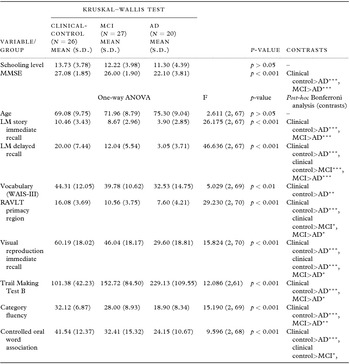
One-way analysis of variance (ANOVA) was performed to compare the performance of the three groups according to age, LM immediate recall and other neuropsychological measures. A Kruskal–Wallis test was used to compare education levels and MMSE scores, as both measures exhibited non-normal distributions. Moreover, post-hoc Bonferroni analysis was used to assess the significance of group differences. We also performed a stepwise multiple linear regression that considered the MMSE score, verbal fluency (semantic and orthographic), WAIS-III vocabulary, the primacy effect in RAVLT, the sum of repeated words across repetition blocks on the RAVLT, WMS-III visual reproduction immediate recall, and Trail B (two measures were considered: the time to complete Trail B and the time to complete Trail B minus the time to complete Trail A). LM immediate recall was used as the outcome measure. We further compared the performance of subjects in the MCI and clinical-control groups on immediate recall of the first LM story (dependent variable), with analysis of covariance (ANCOVA) controlling for the effects of the non-episodic memory tests, which was found to form the best model according to the regression analysis. A 0.5 two-tailed significance threshold (α) was adopted for all statistical tests, all of which were performed using SPSS Statistics 17.0.
Results
The groups did not significantly differ with respect to age or education (p > 0.05). LM immediate recall discriminated AD from the other groups (p < 0.05), but not MCI from the clinical controls (p = 0.118). The demographic and neuropsychological results are presented in Table 1.
Demographic and neuropsychological measures: comparisons between the three subject groups

Trail Making Test B scored as the time in seconds to complete the task; all other test results represented as raw scores.
*p < 0.05, **p < 0.01, ***p < 0.001.
To perform the regression analysis, we grouped all of the participants together. Stepwise multiple linear regression revealed a combination of the MMSE score, vocabulary and primacy on the RAVLT to be the best-fitting model (R = 0.787; R 2 = 0.619), explaining approximately 62% of the variance in the immediate recall of a story memory. Additionally, a combination of vocabulary and the MMSE score explained approximately 57% of the variance (R = 0.753; R 2 = 0.567). These results are described in Table 2.
Stepwise multiple linear regression analysis for the LM immediate recall task

We compared the performance of the MCI and clinical-control groups on LM immediate recall using ANCOVA to control for the effects of the non-episodic memory tests (i.e. vocabulary and the MMSE), which provided the best fit to the regression analysis model. The ANCOVA-corrected model showed significant differences between the MCI and the clinical-control groups in the performance of this task (p = 0.000) and showed that the performance of the MCI subjects was inferior to that of the controls.
Discussion
One aim of this study was to identify the combination of tests that best captured performance with respect to immediate recall of the first LM story. We also aimed to assess whether immediate recall of the first LM story could discriminate between the MCI, AD, and clinical-control groups. We hypothesized that general knowledge (i.e. semantic memory and premorbid skills), episodic memory and executive semantic abilities would provide the best model to explain prose memory immediate recall performance and that the MCI and clinical-control groups would exhibit similar performance on LM immediate recall. This study is clinically relevant because our dependent variable demonstrated ecological validity, and this variable is often used by clinicians and researchers. Our study was also developed to mimic everyday clinical practice, wherein individuals with and without cognitive decline seek evaluation for memory complaints. A closer evaluation of the use of LM in clinical samples will be important because the use of the original norms of the WMS-III (including LM) might lead clinicians to misclassify MCI cases (Brooks et al., Reference Brooks, Iverson, Holdnack and Feldman2008), reinforcing the necessity of understanding the differences and similarities among clinical groups.
As expected, the MCI and clinical-control groups exhibited similar performance on LM immediate recall; this finding will be discussed below. Stepwise linear regression revealed primacy on the RAVLT, vocabulary and the MMSE score to be the most important, predicting approximately 62% of the variance of the dependent variable. Contrary to our expectations, the MMSE score was one of the best predictors of LM immediate recall. In addition to primacy, as measured by the RAVLT, semantic knowledge has also been found to be important. This finding is in accordance with the findings of Larigauderie et al. (Reference Larigauderie, Michaud and Vicente2011), who showed that semantic memory is important for performance on logical sentence tests. We did not find any differences between the MCI and the control groups on the vocabulary test, which was expected, given that this test is a crystallized measure and an important tool for estimating premorbid skills (Stern et al., Reference Stern2005). Despite the importance of premorbid skills and semantic knowledge (measured by the vocabulary test), the current global cognitive status also exhibited significant importance, which is in agreement with the findings of Baddeley and Wilson (Reference Baddeley and Wilson2002), who showed that fluid intelligence is one of the most important aspects. The combination of vocabulary and the MMSE score explained approximately 57% of the LM immediate recall variance. The ability to chunk information has also been suggested to be less efficient in individuals who perform more poorly on the MMSE (Huntley et al., Reference Huntley, Bor, Hampshire, Owen and Howard2011). However, the sample used by Huntley et al. did not include individuals with MCI, and the sample comprised individuals without memory complaints and a separate group of individuals with AD. To the best of our knowledge, our study is the first to investigate this issue in a sample that mirrors the population encountered in routine clinical practice.
Delayed recall is a sensitive measure of AD. However, immediate story recall has been demonstrated to capture the transition from working memory slave systems to early storage and has been shown to have a positive correlation with words from the primacy region in a word-list test in a group of healthy individuals (Foldi, Reference Foldi2011). Despite examining MCI patients, AD patients, and clinical controls with memory complaints instead, our findings concur with those of Foldi (Reference Foldi2011). Word-list recall requires the participant to reproduce the target words, which is different from prose memory tests that demand retrieval of the same original meaning, even if the examinee does not use the same words (Lezak et al., Reference Lezak, Howieson and Loring2004). Retrieving the meaning does not necessarily requires that the participant memorizes the same words, and performance might rely on long-term (and semantic) memory; thus, it might be possible to understand the importance of a semantic memory for story memory performance.
We performed ANCOVA to assess whether the absence of differences between the clinical-control and the MCI groups on story memory immediate recall was related to vocabulary and the MMSE score, which were similar between the two groups. When controlling for non-memory influences, the clinical-control group's performance was significantly superior to that of the MCI group. This last finding might corroborate the hypothesis that LM immediate recall exceeds short-term memory capacity (Baddeley, Reference Baddeley2000). Furthermore, other studies have suggested that the hippocampus has special importance during the encoding of new material (Baddeley et al., Reference Baddeley, Jarrold and Vargha-Khadem2011). The absence of differences between the two groups might have been due to the preservation of vocabulary and the MMSE score (Table 1), as we were studying amnesic MCI individuals. When considering only the influences on memory, it is clear that the MCI group performed more poorly.
The finding that story memory immediate recall is explained by an episodic memory measure plus semantic memory and global cognition is clinically relevant because it highlights that a memory complaint and/or weak performance during a qualitative (or even quantitative) evaluation by clinicians might be secondary to other non-memory cognitive deficits. Thus, individuals with semantic memory deficits, such as semantic dementia, and individuals with a low premorbid level might perform poorly in the immediate recall of LM, despite theoretically being able to retain the information after a delay (Greenberg and Verfaellie, Reference Greenberg and Verfaellie2010). Moreover, our results add to the body of knowledge on cognitive rehabilitation by suggesting that reinforcing semantic knowledge can have therapeutic value.
There are certain limitations to this study. The small sample did not allow us to identify the various influences on the MCI, clinical-control, and AD groups. It could be argued that studies with larger samples would increase the power of the statistical tests, thus showing significant differences between the MCI and the clinical-control groups in the immediate recall of LM. Thus, it is possible that the lack of differences between these groups was due to the small sample size. Additionally, the contribution of the MMSE score might not be that unexpected, given that the entire group was included in the regression analysis and that the MMSE tool is often used as a measure of global cognition. These features could potentially increase the likelihood of contribution by different domains, including LM immediate recall. In addition, the age range of the participants limited the generalizability of the findings. Although our MCI sample comprised individuals of the amnesic subtype, several had impairments in non-memory domains. The prevalence of memory complaints in community studies varies from 25%–56% (Jonker et al., Reference Jonker, Geerlings and Schmand2000); such a complaint is a very common reason for referral and might represent a preclinical stage of AD and might also in part reflect associated psychopathology, such as depression (Reisberg and Gauthier, Reference Reisberg and Gauthier2008). In fact, certain studies have suggested that individuals with memory complaints could present gray-matter atrophy, similar to that observed in MCI groups (Saykin et al., Reference Saykin2006). Additionally, our control group was composed of individuals with subjective memory complaints, which, on the one hand, could limit the generalizability of our findings; on the other hand, however, their inclusion as controls had the advantage of more closely mimicking the actual type of patients who seek neuropsychological evaluation for memory complaints.
The morphological basis of the transference from working memory slave systems to early storage has seldom been investigated in MCI patients. Future studies might focus on the morphological basis of the immediate recall of prose memories while controlling for the MMSE score and vocabulary to identify the regions associated with the first steps in the reallocation of data from short-term to long-term memory. It is important to address this process in future studies because of the possibility that it predicts progression to dementia.
Conclusions
The immediate recall of prose is a poor predictor of MCI, supporting the view that non-memory cognitive functions exert a determining influence on prose recall. Story memory immediate recall may in part be explained by semantic and episodic memory and global cognition, thus highlighting the importance of overall cognition in chunking and in the use of general knowledge (semantic and long-term memory) to temporarily retain logical data. As the performance of patients with MCI is significantly abnormal when controlling for global cognition and semantic memory, the inability of immediate prose memory recall to differentiate individuals with MCI from controls may be explained by the preservation of global cognition and semantic memory in the MCI group.
Conflict of interest declaration
None.
Description of authors’ roles
Gabriel Coutinho and Cláudia Drummond performed the neuropsychological evaluations and wrote most of the manuscript. Ricardo de Oliveira-Souza, Jorge Moll and Fernanda Tovar-Moll developed the research methods and critically reviewed the manuscript. Gabriel Coutinho and Ricardo de Oliveira-Souza performed the statistical analyses. Paulo Mattos and Ricardo de Oliveira-Souza performed the medical evaluation of the patients, wrote part of the manuscript and critically reviewed the manuscript. All authors read and approved the final manuscript.
Acknowledgments
The project was supported by grants and fellowships provided by the Brazilian National Counsel of Technological and Scientific Development (CNPq), the Coordination for the Improvement of Higher Education Personnel (CAPES), and the Rio de Janeiro Foundation for the Support of Research (FAPERJ).