Bipolar disorder is characterized by the presence of manic episodes with changes in mood and energy levels (Goes, Reference Goes2016). These changes have negative consequences and decrease the quality of life of those patients (Jones et al., 2014). Worldwide, the incidence and prevalence of bipolar disorder are increasing (Serrano-Blanco et al., Reference Serrano-Blanco, Palao, Luciano, Pinto-Meza, Luján, Fernández and Haro2010); for instance, the prevalence for type I bipolar disorder is 0.6 to 1%, whereas that for type II is 0.6 to 3% among the world population (Akiskal et al., Reference Akiskal, Bourgeois, Angst, Post, Moller and Hirschfeld2000; Clemente et al., Reference Clemente, Diniz, Nicolato, Kapczinski, Soares, Firmo and Castro-Costa2015; Merikangas et al., Reference Merikangas, Akiskal, Angst, Greenberg, Hirschfeld, Petukhova and Kessler2007; Merikangas et al., Reference Merikangas, Jin, He, Kessler, Lee, Sampson and Karam2011). In the Mexican population, the prevalence is estimated in 3.3% (Kohn et al., Reference Kohn, Levav, de Almeida, Vicente, Andrade, Caraveo-Anduaga and Saraceno2005).
The self-recognition of hypomanic and manic episodes among the general population is low (Regeer, Kupka, Have, Vollebergh, & Nolen, Reference Regeer, Kupka, Have, Vollebergh and Nolen2015) and it is known that in the daily clinical practice, the number of undiagnosed patients with bipolar disorder is high (Zimmerman et al., Reference Zimmerman, Galione, Ruggero, Chelminski, Dalrymple and Young2011); in consequence, it is probable that these patients may be subject to incorrect treatment. The use of screening tools to help diagnose bipolar disorder is highly accepted (Kessler et al., Reference Kessler, Barker, Colpe, Epstein, Gfroerer, Hiripi and Walters2003; Kessler et al., Reference Kessler, Green, Gruber, Sampson, Bromet, Cuitan and Hu2010). The most frequently used are the Mood Disorders Questionnaire (Hirschfeld et al., Reference Hirschfeld, Williams, Spitzer, Calabrese, Flynn, Keck and Zajecka2000), Mood Swings Survey (Parker et al., Reference Parker, Fletcher, Barrett, Synnott, Breakspear, Hyett and Hadzi-Pavlovic2008), Hypomania Checklist (Angst et al., Reference Angst, Adolfsson, Benazzi, Gamma, Hantouche, Meyer and Scott2005) and the Bipolar Spectrum Diagnostic Scale (BSDS)(Nassir Ghaemi et al., Reference Nassir Ghaemi, Miller, Berv, Klugman, Rosenquist and Pies2005); this last one has been used and validated in many countries and languages (Hardoy et al., Reference Hardoy, Cadeddu, Murru, Dell’Osso, Carpiniello, Morosini and Carta2005, Morosini, Calabrese, Carta, & Hardoy; Chung, Tso, Cheung, & Wong, Reference Chung, Tso, Cheung and Wong2008; de Sousa Gurgel, Rebouças, de Matos, Carneiro, & e Souza, Reference de Sousa Gurgel, Rebouças, de Matos, Carneiro and e Souza2012; Lee et al., Reference Lee, Cha, Park, Kim, Lee and Lee2013; Nagata et al., Reference Nagata, Yamada, Teo, Yoshimura, Kodama and van Vliet2013; Otsubo et al., Reference Otsubo, Tanaka, Koda, Shinoda, Sano, Tanaka and Kamijima2005; Rouget et al., Reference Rouget, Gervasoni, Dubuis, Gex-Fabry, Bondolfi and Aubry2005; Sánchez-Moreno et al., Reference Sánchez-Moreno, Villagrán, Gutiérrez, Camacho, Ocio, Palao and Vieta2008; Zaratiegui et al., Reference Zaratiegui, Vázquez, Lorenzo, Marinelli, Aguayo, Strejilevich and Ghaemi2011). However, up to today, there are no valid versions of BSDS in Mexico. We hypothesized that BSDS could be a screening tool for bipolar disorder in Mexican population. To explore this possibility, the aim of this study was to examine the BSDS diagnostic capacity, and to obtain its criterion validity and internal consistency for its use in Mexican psychiatric patients.
Methods
Study Setting
The present study was undertaken in accordance with the Good Clinical Practices and approved by the Institutional Review Board of the Mental Health Specialized Hospital where the study was conducted. Prior to the assessment procedures, the study aims were fully explained to all participants, and after verbal acceptance they all signed a written informed consent.
Participants
Participants were consecutively recruited from the Mental Health Specialized Hospital dedicated to the research, training and treatment of psychiatric patients in Tabasco State, Mexico. As inclusion criteria we considered patients over 18 years of age, that met the DSM–IV criteria for major depression or bipolar disorder and were able to answer the BSDS. As exclusion criteria we considered patients with a concomitant medical or neurological illness or those who did not answer the BSDS in full. We excluded n = 12 participants.
A total of 200 patients with a mean age of 42.90 (SD = 15.31) years were included. Women accounted for 84% (n = 168) of the sample. Half of the patients (n = 100) were diagnosed with bipolar disorder and the remaining half, with major depression. The majority of participants showed low socioeconomic level (54%). The majority of participants were housewives (62.5%), whereas 18% were full time employees; and 5.5% were unemployed or students. Finally, years of schooling were Mean = 8.21 ± SD 2.98.
Assessment instrument and procedure
Psychiatric diagnoses were determined using the Structured Clinical Interview for DSM–IV Axis I Disorders (SCID–I) (First, Spitzer, Gibbon, & Williams, Reference First, Spitzer, Gibbon and Williams1996) and confirmed by consensus of two trained clinicians in the Hospital. The strength of agreement between clinicians regarding psychiatric diagnoses was evaluated using Kappa statistic, with Kappa values of 0.75. The reliability of SCID–I scores for bipolar disorder was previously reported elsewhere (Skre, Onstad, Torgersen, & Kringlen, Reference Skre, Onstad, Torgersen and Kringlen1991; Williams, Gibbon, First, & et al., 1992). After diagnoses were confirmed, an independent researcher blinded to the SCID–I diagnosis, gave the patients the BSDS to be answered.
The BSDS is a 20-item self-report narrative-based scale, developed for screening bipolar spectrum disorders accurately (Nassir Ghaemi et al., Reference Nassir Ghaemi, Miller, Berv, Klugman, Rosenquist and Pies2005). The first part of the instrument is a one-page story containing 19 sentences that describe some typical mood swing experiences. This part is written in third person and should be marked as “present” for each experience that the individual has lived. The second part is a simple 4-point Likert scale question, ranging from 0 (this story does not describe at all) to 6 (this story describes me very well or almost perfectly) using only pair numbers; it is designed to rate how well the story describes the individual. The score on the first part can range from 0 to 19 and on the second part from 0 to 6, with a total scoring ranging from 0 to 25. The validation study of the scale indicates that a total score equal or greater than 12 represents a positive screening for bipolar disorder. The sensitivity (0.76) and specificity (0.85) for BSDS have been previously described (Nassir Ghaemi et al., Reference Nassir Ghaemi, Miller, Berv, Klugman, Rosenquist and Pies2005).
The procedure for translating the BSDS into Spanish was based upon the American research teams recommendations (Pan & De La Puente, Reference Pan and De La Puente2005) and the International Test Commission Guidelines for test translation and adaptation (Muñiz, Elosua, & Hambleton, Reference Muñiz, Elosua and Hambleton2013). The BSDS was translated from English into Spanish by two independent translators; then, it was reviewed by one author (CATZ) and by two independent mental health professionals to identify discrepancies and to reach a final consensus for language adequacy of each sentence.
Statistical Analyses
The criterion validity of BSDS was evaluated by an independent t test model to compare the total BSDS scores between patients diagnosed with major depression and those diagnosed with bipolar disorder (discriminant validity). Effect size was computed for the significant results obtained of t-Tests (Cohen’s d). The reliability of the total scores was obtained using the alpha model Kuder Richardson (R–21) formula, as 19 of the 20 items of the instrument are categorical responses (absent/present). The last item of the instrument (the one of Likert response) was coded as “0 = absent” when total score was 0 or 2 (the story doesn’t describe the subject), or as “1 = present” when the total score was 4 or 6 (the story describes the subject’s experience).
The SCID–I diagnosis of bipolar disorder was used as the ‘gold standard’ to determine the diagnostic capacity of BSDS. At this point, a Receiver Operating Characteristic Curve (ROC) was plotted. The area under the ROC curve (AUC) was estimated and provided a summary measure to establish the statistical discrimination efficiency of BSDS total scores. Additionally, the optimal cut-off point with the most adequate sensitivity and specificity values were identified.
Results
Criterion validity and reliability of the scores of the BSDS
The total score of BSDS differed between diagnoses. Patients with bipolar disorder exhibited a higher mean BSDS score (16.12, SD = 5.14) than patients with depression (7.45, SD = 3.58; t(198) = 13.84, p < 0.001) with a large effect size of Cohen´s d 1.95. The internal consistency of BSDS total score according to the Kuder-Richardson (KR–21) formula was 0.85. The item-total correlation tests were from 0.20 to 0.62 for all items without a reliability improvement when one item was deleted at a time.
ROC curve and cut-off points of BSDS
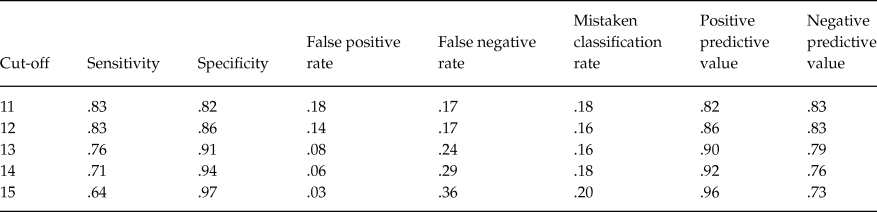
The area under ROC curve for the overall discriminability of BSDS against the criterion of SCID–I for bipolar disorder was 0.90 (Figure 1). Several cut-off points were tested to identify the most appropriate threshold for the correct screening for bipolar disorder diagnosis. The cut-off value of 12 reached the most stable sensitivity and specificity, with a predictive power higher than 0.80 (Table 1). The sensitivity and specificity effects in the BSDS positive and negative predictive power using the cut-off value of 12 are shown in Figure 2.
Receiver Operating Characteristic Curve of the BSDS Total Score.

Sensitivity and Specificity Indicators of BSDS Cut-Off Points

Effects of Sensitivity and Specificity in the OAS Predictive Power.

Discussion
In the present study we evaluated the Bipolar Spectrum Diagnostic Scale in Spanish version for Mexican population. First, we determined the validity and reliability of the scores and the internal consistency. Subsequently, we calculated the cut-off points of BSDS for its use in Mexican psychiatric patients. We recognized that there is previous validity study of BSDS in Spanish–speaking populations (Vázquez et al., Reference Vázquez, Romero, Fabregues, Pies, Ghaemi and Mota-Castillo2010); however, this was performed in Argentinians and they have linguistic and cultural characteristics that differ from the Mexican population; therefore, a valid and reliable BSDS in Mexicans is necessary.
First, we found that BSDS could discriminate between patients with bipolar disorder and depression using the gold standard SCID–I interview. These results were expected and are in accordance with previous reports in Chinese populations (Chu et al., Reference Chu, Lin, Chiang, Chen, Lu and Chou2010) and others (Smith et al., Reference Smith, Griffiths, Kelly, Hood, Craddock and Simpson2011; Zimmerman, Galione, Chelminski, Young, & Ruggero, Reference Zimmerman, Galione, Chelminski, Young and Ruggero2010). Secondly, we found that the most appropriate cut-off point in our study was 12, which is lower than what was observed in previous reports (including the original version) where 13 was the cut-off point (Nassir Ghaemi et al., Reference Nassir Ghaemi, Miller, Berv, Klugman, Rosenquist and Pies2005; Zaratiegui et al., Reference Zaratiegui, Vázquez, Lorenzo, Marinelli, Aguayo, Strejilevich and Ghaemi2011). However, our findings are similar to the Chinese version (Chu et al., Reference Chu, Lin, Chiang, Chen, Lu and Chou2010). It is import to take into consideration sensitivity and specificity (0.83 and 0.86 respectively) of the original version. In our study, when the cut-off was 13, we observed a sensibility of 0.76 and specificity of 0.91, that is higher than what was reported in other Spanish–speaking populations (Vázquez et al., Reference Vázquez, Romero, Fabregues, Pies, Ghaemi and Mota-Castillo2010; Zaratiegui et al., Reference Zaratiegui, Vázquez, Lorenzo, Marinelli, Aguayo, Strejilevich and Ghaemi2011). There are some possible explanations: a) these differences could be due to the linguistic and cultural variations among Spanish–speaking countries. b) Our study is not multicenter; the patients included came from only one Mental Health Specialized Hospital. For all the above, we suggest that BSDS could be used to help diagnose and discriminate patients with bipolar disorders.
Although adequate psychometric properties were obtained, our results should be replicated using patients from other regions in the country, because some cultural differences could impact our results, in particular those related to cut-off points.
Our study presents some limitations. The number of participants is the main one. During the study some patients did not attend to their appointments with their physician. Also, a considerable number of patients were illiterate and could not participate in the study. Another limitation is that our validation was performed in the south of Mexico. Therefore, caution must be taken when using BSDS in other Mexican regions.
In daily clinical practice, affective disorders are quite prevalent and they are frequently misdiagnosed. Self-report screening instruments in Mexico aiding bipolar disorder are scarce. The BSDS together with a clinical face-to-face interview with a mental health professional could be useful for detecting individuals with bipolar disorder, promoting early recognition and timely treatment in clinical settings.
All procedures involving human participants were performed in accordance with the ethical standards of the institutional and/or national research committee and with the 1964 Helsinki Declaration and its later amendments or comparable ethical standards.