Lichens produce a large variety of carbon based secondary compounds (CBSCs; Huneck & Yoshimura Reference Huneck and Yoshimura1996) and a number of biological roles for these have been proposed (e.g. Huneck Reference Huneck1999). For instance, strong experimental evidence confirms that several of these compounds, predominantly the ones situated in the medulla, deter lichenivores (e.g. Slansky Reference Slansky1979; Lawrey Reference Lawrey1980; Gauslaa Reference Gauslaa2005; Pöykkö et al. Reference Pöykkö, Hyvärinen and Bačkor2005). In a field transplantation experiment, Asplund & Gauslaa (Reference Asplund and Gauslaa2008) showed that thalli of Lobaria pulmonaria (L.) Hoffm. with artificially reduced levels of CBSCs were much more grazed than control thalli. Recently a number of quantitative studies on carbon-based secondary compounds in L. pulmonaria have been performed. According to these there are large variations in the concentration of CBSCs in Norwegian L. pulmonaria, ranging from 7 to 130 mg g−1. These variations seem to depend partly on soil pH and altitude (Vatne et al. Reference Vatne, Asplund and Gauslaa2011), as well as thallus age (Asplund & Gauslaa Reference Asplund and Gauslaa2007). However, exposure to solar radiation does not seem to affect these medullary compounds (McEvoy et al. Reference McEvoy, Gauslaa and Solhaug2007; Nybakken et al. Reference Nybakken, Asplund, Solhaug and Gauslaa2007), as opposed to many cortical compounds (reviewed by Gauslaa Reference Gauslaa2009). Two chemical races of L. pulmonaria var. pulmonaria are described in North America (Culberson Reference Culberson1969). Chemical race I has norstictic, stictic and constictic acids and two unknown substances; chemical race II has norstictic acid and one unknown substance. However, no quantitative data have been published on CBSCs in North American L. pulmonaria. In this study I aim to investigate whether the palatability to lichenivorous gastropods varies between the two chemical races. In addition, I want to confirm that the CBSCs in L. pulmonaria are unaffected by increased irradiance, even after 5 years at a forest edge.
The study area was located within the Fundy Model Forest on J. D. Irving Ltd. property south-east of the town Petitcodiac in south-eastern New Brunswick, Canada (45°54′N, 65°08′W, 100 m a.s.l.). The site was a mixed deciduous and coniferous stand, on moderately nutrient rich soils, dominated by Picea spp., Acer rubrum, Abies balsamea, Betula papyrifera and Populus tremuloides. Thalli of Lobaria pulmonaria were collected randomly from trunks of Populus tremuloides and Acer rubrum. Two trunks were standing at the forest edge facing a five year old clear-cut to the north. The remaining three trees were at least 20 m from the forest edge. Five to nine thalli with a size of approximately 20 cm2 were collected from each trunk. The maximum distance between sampled trees was 50 m. A number of thalli collected had grazing traces with patterns typical of gastropod grazing (see photograph in Gauslaa et al. Reference Gauslaa, Holien, Ohlson and Solhøy2006). The area grazed was estimated visually. Older thallus parts as well as parts with too many grazing traces were avoided in the analysis and feeding experiment.
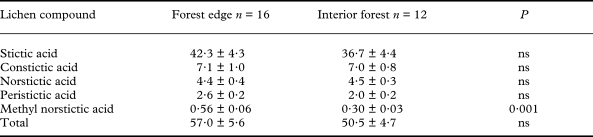
Lichen thalli were ground to powder in a ball mill and c. 60 mg powder, corresponding to c. 5 cm2, was extracted with 2 ml acetone four times for 15 minutes. The combined extracts were evaporated to dryness and dissolved in 3 ml acetone. The extracted compounds were quantified by HPLC using an ODS Hypersil column, 60 × 4·6 mm using 0·25% orthophosphoric acid and 1·5% tetrahydrofuran in Millipore (Millipore, Billerica, Massachusetts, USA) water (A) and 100% methanol (B) as mobile phases at 2 ml min−1, and UV detection at 245 nm. The run started with 30% B which was increased to 70% after 15 min. After a further 15 min 100% B was reached and held for 5 min, after which the amount decreased to 30% in 1 min. A 10 min post-run of 30% B was performed. Compound identification was based on retention times, online UV-spectra, co-chromatography of commercial standard norstictic acid (Gaia Chemical Corporation, Gaylordsville, CT, USA) and a stictic acid standard kindly given by Professor Harrie Sipman (Botanical Museum Berlin). The compounds were quantified against response curves of the above-mentioned standards. The constictic, peristictic and methyl stictic acids were quantified using the response curve of norstictic acid. Thalli of the chemical race II were excluded from the edge vs. interior forest analysis because this race only occurred in the interior forest and variations in total concentrations of CBSCs were considered to vary more between the chemical races than between environmental factors. Therefore, the sample size in Table 1 is different from the analysis in Figure 1.
Concentration (mg g−1 mean ± SE) of carbon based secondary compounds in Lobaria pulmonaria chemical race I growing at forest edges vs. interior forests. The significance from a t-test is given.

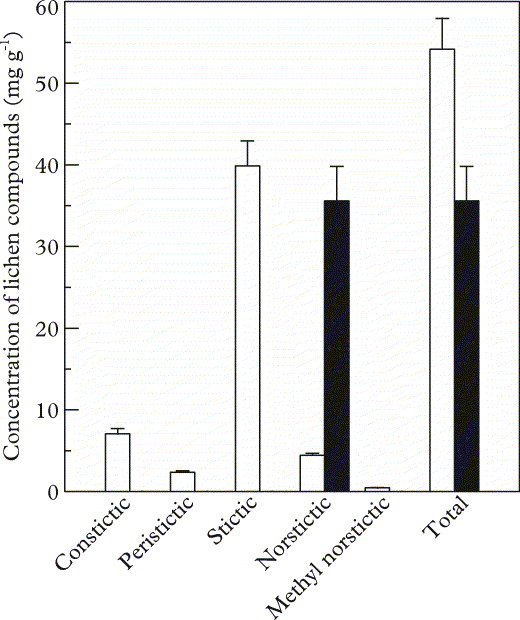
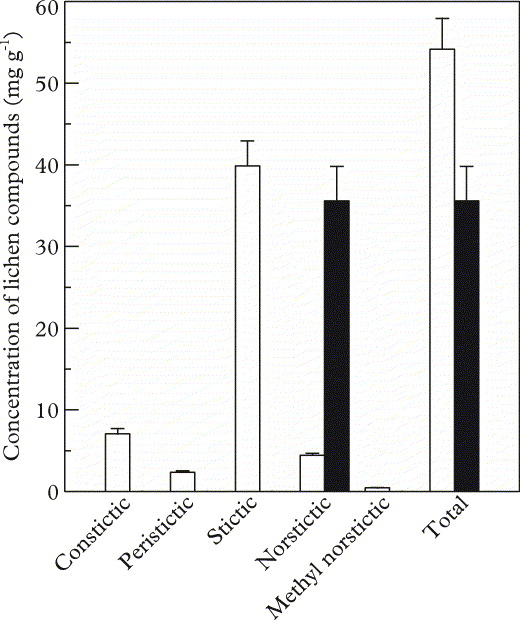
Concentration (mean ± SE) of carbon based secondary compounds in Lobaria pulmonaria chemical race I (white bars, n = 28) and race II (black bars, n = 11). All thalli of chemical race I were avoided by gastropods while all thalli but one of the chemical race II were grazed.
Ten thallus parts, approximately 8 cm2, of each chemical race were weighed air-dry (mean ± SE = 99·6 ± 4·8 mg). Thalli of both chemical races were put together in ten plastic boxes (measuring 7 × 9 cm) and three randomly picked snails (Helicigona lapicida) were placed in between the thalli. Three animals were used in order to reduce individual feeding variability (Hanley et al. Reference Hanley, Bulling and Fenner2003). The boxes were sprayed with water and closed with a perforated lid, allowing air circulation and preventing snails from escaping. The thalli were kept hydrated during the 6 h feeding experiment. Lichens were then rinsed from faeces and weighed when air-dry. Helicigona lapicida does not occur in the study area but in Europe it often climbs trees to feed on lichens and algae, including the study species. Relative consumption was used to quantify the preference. This was calculated by dividing the amount consumed of one food type (DMend – DMstart) by total box consumption.
Twenty eight of the 39 analyzed thalli belonged to chemical race I (Fig. 1). None of these were evidently grazed by gastropods. In contrast, all but one of the chemical race II thalli, which contained only norstictic acid, were more or less grazed (5 to >25 % of area). A majority (nine out of eleven) of these were found on one single tree. These thalli contained 25–36 mg g−1 norstictic acid while the other two contained 53·2 and 70·2 mg g−1. The concentration of norstictic acid was on average eight times higher in the thalli that only contained this compound (Fig. 1). Chemical race II is known to produce larger amounts of norstictic acid than race I (Jordan Reference Jordan1973). Gastropods exhibit a patchy small-scale distribution, depending on the spatial distribution of microclimatic factors and the availability of suitable shelter sites (e.g. Ledergerber et al. Reference Ledergerber, Baminger, Bisenberger, Kleewein, Stattmann and Baur1997; Kleewein Reference Kleewein1999). Even though the study area was very homogeneous in terms of suitable shelter sites, one cannot rule out that the observed grazing pattern was in fact due to varying densities of gastropods. However, the laboratory feeding experiment, in which H. lapicida snails were given the choice between thalli of race I and race II, confirmed the observed pattern from the field. 81·8 ± 5·3 % (mean± SE) of the total consumption per box were on Type II thalli while only 18·2 ± 5·3 % of the grazing was on race I thalli (t = 8·57, df = 18, P<0·001, t-test). On average the snails consumed 21·7 ± 2·3 mg lichen material in each box during the six hour feeding experiment.
It is not obvious if the observed discrimination between the two chemical races is due to differences in total concentrations of the compounds, or if there is a discrimination between specific compounds. The total concentration of CBSCs was on average higher in race I (Fig. 1), which was avoided. On the other hand, there were large variations in total concentration in race I thalli (ranging from 19·7–92·9 mg g−1) but still all of them were avoided. Furthermore, on one tree the severely grazed race II thallus had higher amounts of CBSCs than all the avoided race I thalli (total concentration: 53·2 compared with 37·3 ± 4·5, n = 5). This suggests that norstictic acid alone might be less efficient in deterring grazers. However, in order to test this properly one needs to compare race I and II thalli containing equal concentrations of CBSCs in a controlled laboratory feeding experiment, or one could apply pure compounds of norstictic acid and the substances in race I in equal amount to filter papers and let gastropods choose between the two.
No gastropods were observed on the sampled trees, probably due to the unfavourable sunny weather. However, the snail Anguispira alternata (Asplund Reference Asplund2010) and the slug Arion subfuscus were observed feeding on L. pulmonaria in nearby stands on rainy days. No other climbing snails were observed during two weeks of field studies in a very similar forest type c. 200 m away from the present study area. Grazing by the non-native A. subfuscus poses locally a serious threat to the world-wide critically endangered Erioderma pedicellatum (Cameron Reference Cameron2010). Apart from E. pedicellatum, Cameron (Reference Cameron2010) also observed grazing damage on L. pulmonaria as well as on Parmelia squarrosa, P. sulcata and Platismatia glauca in Nova Scotia. Gastropods have been shown to limit the early development of L. pulmonaria in broad-leaved deciduous forests (Asplund & Gauslaa Reference Asplund and Gauslaa2008). However, both L. scrobiculata and L. amplissima are more favoured by gastropods and these lichenivores can even shape the vertical distribution of Lobaria spp. (Asplund et al. Reference Asplund, Larsson, Vatne and Gauslaa2010). Lobaria quercizans, closely related to L. amplissima but with a different secondary chemistry, was the only additional Lobaria species in the study area. This species appeared to be preferred over L. pulmonaria, but this was not systematically studied.
The thalli close to the edge of the forest were brown, apparently due to production of photoprotective melanic compounds. However, the thalli from the interior of the forest showed no such pigmentation, indicating that the forest edge thalli receive more light since such compounds are highly responsive to increased irradiance (McEvoy et al. Reference McEvoy, Gauslaa and Solhaug2007; Nybakken et al. Reference Nybakken, Asplund, Solhaug and Gauslaa2007). Conversely, the concentrations of the major medullary compounds in L. pulmonaria were not significantly different between thalli at the forest edge and in the interior forest (Table 1). However, the concentration of the minor compound methyl norstictic acid did respond positively to the increased irradiance. Previous studies have shown that medullary compounds in this species are not affected by increased irradiance (McEvoy et al. Reference McEvoy, Gauslaa and Solhaug2007; Nybakken et al. Reference Nybakken, Asplund, Solhaug and Gauslaa2007). These studies were both short term (three month) transplantation experiments and longer times may be needed for a response to occur. However, the present study shows that this is not the case. Even after 5 years at the forest edge, I could not find any differences in CBSCs between the different levels of solar radiation, apart from methyl norstictic acid. Lichens growing on south-facing forest edges receive much more direct radiation compared to lichens at north-facing edges. However, the heavy brown-pigmentation in the lichens at the north-facing forest edge indicates that the enhanced solar radiation is high enough to induce changes in secondary compounds, provided that such compounds do respond to solar radiation. However, no such induction occurred.
With this study I have shown that lichenivorous gastropods discriminate between the two chemical races of L. pulmonaria. Chemical race II, with fewer secondary substances and a lower total concentration of them, was favoured by gastropods. Whether this reflects the distribution of these two races is not known. However, chemical race II is probably less likely to occur at sites with a high abundance of lichenivores.
I thank J. D. Irving Limited for use of study sites in the company's forest land. I also thank Dr Kate Frego for practical and financial support during field work and Dr Ulrika Jansson for field assistance. Dr Lars Fröberg, Dr James Lawrey and one anonymous reviewer are thanked for constructive comments on an earlier version of this manuscript.