


Introduction
Therapist drift
One factor which could contribute to improving therapy outcomes is ‘therapist drift’, defined as therapists not adequately delivering the evidence-based treatment in which they have been trained (Waller and Turner, Reference Waller and Turner2016), i.e. therapists not being adherent. This approach acknowledges the limitations of cognitive behavioural therapy (CBT) and the services in which it is delivered (Waller, Reference Waller2009), but focuses on addressing therapist factors as there is evidence for these and their deleterious effects on outcome (Waller and Turner, Reference Waller and Turner2016). A therapist factor particularly relevant to therapist drift is ‘therapist beliefs’.
The impact of therapist beliefs
Therapist beliefs have been shown to have an impact on therapist self-efficacy (Lent et al., Reference Lent, Cinamon, Bryan, Jezzi, Martin and Lim2009), views on homework non-compliance (Haarhoff and Kazantzis, Reference Haarhoff and Kazantzis2007), attitudes towards the CBT model (Parker and Waller, Reference Parker and Waller2017), and the use of exposure techniques (Deacon et al., Reference Deacon, Farrell, Kemp, Dixon, Sy, Zhang and McGrath2013). Lowered self-confidence and avoidance of specific interventions has been linked to beliefs relating to self-efficacy in CBT trainees (Bennett-Levy and Beedie, Reference Bennett-Levy and Beedie2007). Negative attitudes towards CBT have been found to be associated with decreased use of CBT techniques (Parker and Waller, Reference Parker and Waller2019). Other negative consequences of endorsing specific beliefs about the nature of therapeutic work, such as vicarious traumatisation (McLean et al., Reference McLean, Wade and Encel2003) and burn-out (Emery et al., Reference Emery, Wade and McLean2009), have also been reported. These findings support the need for understanding, measuring and addressing therapist beliefs.
Reflective practice
Evidence suggests that engaging in reflective practice assists with the identification of therapist beliefs, particularly those that affect the therapeutic relationship and treatment outcomes (Bennett-Levy et al., Reference Bennett-Levy, Thwaites, Chaddock, Davis, Stedmon and Dallos2009; Haarhoff and Thwaites, Reference Haarhoff, Thwaites, Haarhoff and Thwaites2015b). Beliefs focused on in reflective practice guides include those about both the ‘personal self’ (beliefs about personal identity, history and experiences, relating to personal skills and attributes) and the ‘therapist self’ (beliefs about self as a therapist, clients and the course of therapy, as well as conceptual and technical skills; Bennett-Levy, Reference Bennett-Levy2019). Trainees who engage in self-reflection demonstrate increased empathy, better coping mechanisms and better management of their therapeutic relationships (Laireiter and Willutzki, Reference Laireiter and Willutzki2003). Self-practice/self-reflection (SP/SR) has also been shown to benefit technical skill and interpersonal therapeutic skill in experienced CBT therapists (Davis et al., Reference Davis, Thwaites, Freeston and Bennett-Levy2015), and work-related skill and behaviour change, particularly when working with more complex patients, in experienced psychological wellbeing practitioners (Thwaites et al., Reference Thwaites, Haarhoff, Haarhoff and Thwaites2015). Self-reflection in CBT has long been recommended, and the latest systematic review of 10 articles found that this practice is reported to increase therapist empathy, confidence, competence and meta-competence (Gale and Schroder, Reference Gale and Schroder2014). Subsequent research suggests that it can also benefit conceptual, technical and interpersonal skills, primarily via strengthening therapist interpersonal skills resulting in a more nuanced approach to therapy (Freeston et al., Reference Freeston, Thwaites and Bennett-Levy2019). However, despite the evidence for identifying and addressing therapist beliefs, the beliefs addressed do not necessarily explicitly pertain to therapist adherence and thus therapist drift.
Measuring therapist beliefs
Research into the effects of therapist beliefs has identified that these beliefs and their links to adherent practice need further elaboration to optimise delivery of therapy, including measuring the outcome of addressing such beliefs (Parker and Waller, Reference Parker and Waller2019). However, there is currently no standardised measure of therapist beliefs. A standardised measure could support and enable reflective practice within CBT, providing a means of systematically responding to variations in patient outcome (Waller and Turner, Reference Waller and Turner2016). It could further be used as a training and supervision tool to screen for negative therapist beliefs that might be influencing the practice and outcome of therapy (Haarhoff, Reference Haarhoff2006).
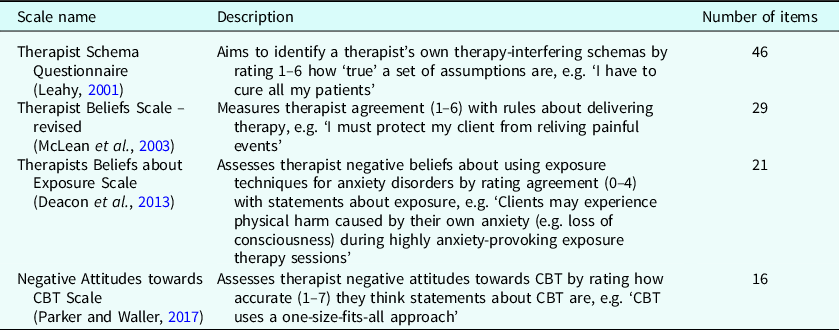
A limited number of CBT-specific scales have been developed (Table 1), but these vary in how theoretically informed and empirically derived they are. With the exception of the Negative Attitudes Towards CBT Scale (Parker and Waller, Reference Parker and Waller2017), none appear to have been developed in the UK; it is possible that therapists from different backgrounds, with different professional training, working in different countries and services, might experience different cognitions. Furthermore, reflective practice in CBT appears to have focused on the therapeutic relationship and development of CBT skills (e.g. Haarhoff et al., Reference Haarhoff, Gibson and Flett2011) rather than therapy-interfering cognitions that could be used to address adherence.Footnote 1 Current scales focus on beliefs, schemas and attitudes rather than thoughts specifically. There also appears to be no research on the experience of using a scale in this manner.
Scales measuring therapist beliefs in CBT

Therefore, this research was carried out to explore how to best conceptualise a scale’s content and use (measuring cognitions affecting therapist adherence to CBT), based on clinicians’ experiences of, and responses to, current scales. The research aimed to stimulate and prepare for further research into scale development and conceptualising and addressing such therapist cognitions. It is believed that doing this may help to reduce therapist drift and thus enhance therapy outcomes.
Method
Participants
All qualified and trainee therapists at a specialist anxiety service were invited via email to take part in focus groups exploring their thoughts on scales measuring therapist beliefs. Participants did not receive payment for their involvement.
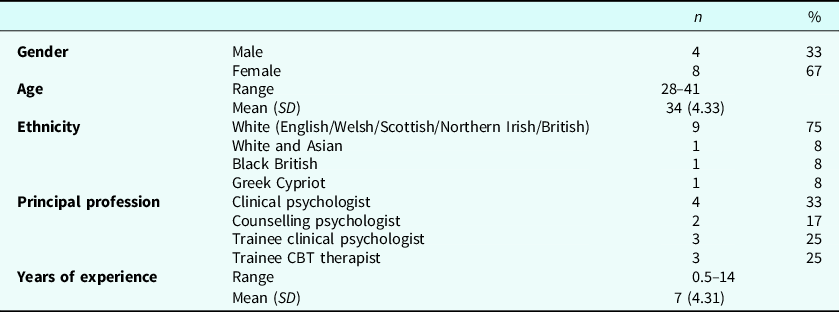
Fifteen people responded out of the 27 contacted (56% response rate), although only 12 participants attended the focus groups (44% completion rate). Qualified staff who participated (n = 6) had all been trained as CBT therapists, were BABCP-accredited, solely delivered CBT, and their experience ranged from 5 to 14 years. Trainees (n = 6) were currently undertaking the IAPT CBT Diploma, and had 3 to 7 years of prior mental health work experience (being 7 months into the course). Focus groups were conducted between April 2018 and June 2018 with each group lasting one hour. The therapists in the focus group would have been known in a professional context to the third author. See Table 2 for demographic details.
Demographic and professional information of focus group participants

Ethical considerations
The focus groups involved low risk of potential harm or distress. Participants were fully informed about the study and limits of confidentiality. Consent was obtained, and participants were given the option to withdraw prior to analysis. Approval was granted by the NHS Trust’s Clinical Academic Group.
Procedure
Participants were emailed 85 items selected from current scales (Table 1), which were also brought to the focus groups. These items also included 41 suggestions derived from the first author’s 15-minute interviews with seven qualified staff at the clinic, which asked them to identify therapist cognitions from their and their supervisees’ practice (see Supporting Information). (Only one interview participant also participated in the focus groups.) Interview items were amalgamated with those from pre-existing measures to form a list of 368 items. The first author, third author, and an external specialist, Stirling Moorey, met to review the items to identify general trends. Items that did not align with the aim of the scale were discarded, resulting in a preliminary scale of 85 items and eight broad sections: therapist competence, delivery of therapy, the therapeutic relationship, complexity, the CBT model, CBT in-session interventions, homework, and therapist reservations. Scale items were not presented if they did not reflect cognitions that could interfere with the delivery of evidence-based, anxiety disorder-specific CBT.
The focus group guide was developed by the first and third authors. Questions in the guide explored whether participants could identify the items as presenting in their or their supervisees’ practice, how these might be addressed, how the scale might be used, and any other items they would like to add. Groups were audio recorded and subsequently transcribed with all identifiable information removed. This data collection method was selected as focus groups are considered appropriate as a first step in developing questionnaire items, as well as allowing for exploration of perceptions of questionnaire content and usage because they give participants the opportunity to generate ideas in dialogue, allowing for a multiplicity of views to be explored (Millward, Reference Millward, Breakwell, Smith and Wright2012).
Analysis
In order to gain rich insight into participants’ experiences and beliefs, thematic analysis was used (Braun and Clarke, Reference Braun and Clarke2006). A key component of thematic analysis is the acknowledgement of the epistemology underlying data collection and analysis. Our view is that our reality of the participants’ experiences should be viewed in the context of this study and the authors’ role in generating themes, i.e. critical realist. The analysis was carried out by observing surface-level communications and by using inductive reasoning. This was important for this study because we wanted to capture participants’ reported views without imposing pre-existing ideas, whilst maintaining some reflexivity. Using a focus group and thematic analysis method has been used to explore clinician experience of using reflective blogs for CBT practice (Farrand et al., Reference Farrand, Perry and Linsley2010).
In order to increase the trustworthiness of the analysis (Lincoln and Guba, 1985; cited in Nowell et al., Reference Nowell, Norris, White and Moules2017), we include the following details. The first author analysed the data by making the transcripts, re-reading the transcripts, coding the data, grouping codes together, and attaching labels to potential themes (Green and Thorogood, Reference Green and Thorogood2014). Themes were identified by their occurrence across multiple participants. The themes were reviewed against the data set. The third author gave feedback on this process of analysis and draft iteration of themes by email and in a 1.5-hour meeting. The second and third authors subsequently refined the analysis by examining the transcripts, codes and themes individually, and then reviewing them together in a 1-hour meeting. The third author then checked the themes against the transcripts again. The final themes were agreed (by email) by the three authors. The Results section was shared with focus group participants for their comments; only seven of the 12 focus group attendees could be contacted, as five had left the Trust or were on maternity leave. Six participants responded, and they indicated that the analysis was credible and useful. Following some of the latest thinking on member checking, we have included participant reflections in the results below (Birt et al., Reference Birt, Scott, Cavers, Campbell and Walter2016).
As per Braun and Clarke (Reference Braun and Clarke2019a), this member checking is carried out to support the trustworthiness and transparency of the analysis by making the methods used clear, not to ‘validate’ the themes via consensus, because in this method of thematic analysis, themes are generated by the researcher (they do not reside in the data waiting to be discovered). The reader must therefore rely on the transparency of the researchers in order to assess how trustworthy their analysis is, hence the amount of information provided about the method of data collection and analysis. Discussion of this issue is beyond the scope of this paper and we refer the interested reader to Braun and Clarke (Reference Braun and Clarke2019b). From the same critical realist researcher position, we have chosen not to report frequency counts of how many participants contributed to each theme, because this gives a false appearance of quantitative certainty to qualitative results. ‘Whether something is insightful or important for elucidating our research questions is not necessarily determined by whether large numbers of people said it.’ (Braun and Clarke, Reference Braun and Clarke2013; p. 261).
The focus groups were conducted by the first author (who was completing an MSc at a local university with links to the clinic). She is very interested in the therapeutic relationship, critical of the role of this in CBT, and is now training as a counselling psychologist. The second author professionally identifies as an assistant psychologist who works at the clinic where the research was conducted. He is positive about the use of CBT and the importance of reflective practice within mental health services. The third author is a clinical psychologist and BABCP-accredited CBT therapist who works in the service where the research took place. He identifies as positive towards CBT and the use of self-reflection techniques by trainees and experienced therapists, with an emphasis on improving the quality of therapy.
Results
Thematic analysis
Four main themes were generated: (1) The Awareness and Importance of Cognitions, (2) Factors Fuelling Therapist Cognitions, (3) Addressing Therapist Cognitions, and (4) Using the Scale. Below, the main themes and their sub-themes are described, and illustrated with participant quotations. They are divided into two categories: Cognitions and Scale.
Cognitions
These themes relate to therapist cognitions in general.
1. The awareness and importance of cognitions
There was a sense amongst participants that it was important to access their own cognitions and be alert to the role they can play during therapy. Automatic thoughts were identified as easier to access than underlying beliefs, and were deemed more useful for reflective practice. However, there was variation in how aware participants reported being of their own cognitions.
Accessing and differentiating between different types of cognition
Participants recognised how scale items resembled varying levels of cognition:
I’m thinking whether these are beliefs like in the sense that they are something stable and across clients, or whether it could be more with certain clients, or it could be like automatic thoughts you have during sessions but not necessarily beliefs? … there are like different levels of it. (Participant 8)
Participants felt they were able to relate to automatic thoughts more readily than beliefs:
I think it’s the cognitions, because like I said, with the rules, like when you spell them out as a rule, I’m like ‘yeah, I can see that that’s not really true’, but I know that I definitely have that cognition you know all the time sort of thing. (Participant 12)
This had implications for which level of cognition it felt best to address using a scale:
If the scale is to measure cognitions that are maladaptive and are interfering with therapist’s performance and wellbeing, raw automatic thoughts may be better placed to measure that. (Participant 1)
Which kind of reflects the CBT model in general in that we’re much more conscious of our automatic thoughts, but we’re not really conscious of what the rule is. (Participant 12)
Participants identified that it is not just easier to access cognitions, but also that therapists are likely to intellectually deny they hold a rule, perhaps influenced by their training:
Problem is with the rules is if they’re too black and white ‘I must’ or ‘I should always’, someone might think… look at that and think… I kind of know that I shouldn’t have to do that all the time. (Participant 4)
The need to be alert to cognitions
Participants acknowledged that they had found it helpful to look at their own belief systems and how these might interact with the therapeutic process:
If you think these things, that’s gonna make you avoidant of certain techniques. (Participant 7)
I was sort of thinking, you know, are these beliefs somehow playing in here? How do they, you know, impact on them? I thought that was quite useful for me to kinda look at my own beliefs in therapy and in supervision. (Participant 4)
Relevance of the cognitions on the scale
However, there was variation as to whether participants identified with cognitions themselves or located them in others:
some of them were very relevant and others I didn’t feel like apply to me at all, but I’ve heard them from colleagues and peers, so I could still recognise them as thoughts that others experience. (Participant 8)
This was reflected in discussions around whether training and experience ‘dealt with’ therapist cognitions:
these sorts of things people in training regularly come up with … whereas I think that post-training and from experience, you would kind of have already thought about all this. (Participant 1)
I don’t think there’s really a distinction between therapist beliefs when you’re training and when you’re … just because you’re qualified, doesn’t mean you’re a perfect human being. (Participant 7)
2. Factors fuelling therapist cognitions
Participants identified that therapist cognitions were not static or necessarily primarily due to the individual therapist.
Cognitions are not just a product of the individual
Participants explored how their cognitions are not just an intrapersonal product, but are influenced by external factors. Examples included the level and type of training they have had:
if somebody has done other therapy through a more kind of counselling psychology background or done a lot of psychodynamic work or something in the past, then that could potentially make some more of these being endorsed. (Participant 5)
and service setting and current caseload. These interact with the therapist’s personality, style and other characteristics:
I feel that sometimes that was so out of my style before starting this purist CBT training, but I did kind of feel this is affecting my ability to be a person and actually be empathetic, but I think the more you kind of do it, the more maybe natural it becomes. (Participant 7)
For example, in therapists working in Improving Access to Psychological Therapies (IAPT) services, cognitions may represent themes of pressure due to the services’ protocols and targets, and this would be reflective of working in that particular setting and not necessarily transferrable to other services:
The high standards I can imagine perhaps cropping up in pressurised IAPT services where you’ve got to see somebody for 8–12 sessions and the hope is that they might recover in that period of time. (Participant 5)
Participants also acknowledged how beliefs may be shaped by individual clients:
I think for me these thoughts seem to be more dependent on maybe a patient more. (Participant 9)
Standards and a sense of competence
A recurrent example of beliefs that could influence thoughts were those around competence and high standards. Participants related to items reflecting their competence as a therapist, and recognised how their own high standards can influence therapy:
it’s the kind of work where perfectionism can really influence. (Participant 5)
There was a sense that holding these high standards could introduce a rigidity and pressure to be perfect for their patients:
I became so robotic and I wasn’t working with my patients, because in my head I was thinking ‘I need to get this perfect and on the ball so they know what I’m bloody talking about’. (Participant 11)
Therapists’ thoughts about their own competence and whether they can effectively execute an intervention may also impact on the therapy:
if you’re having one of these thoughts, you might be doing quite a lot of safety behaviours in terms of preparation or avoidance that might hurt the therapy. (Participant 6)
This can also make therapists feel less competent, or frustrated:
I do think I’ve got a lot of quite, not just high standards of myself, but probably too high standards of patients, and so sometimes I think ‘well, why don’t they get it?’. (Participant 12)
The counter-productive effects of these excessive attempts to be adherent were highlighted by participants who commented on the analysis.
Scale
Themes relating to participants’ views on using a scale are detailed below.
3. Addressing therapist cognitions
Participants articulated how a tool that identifies and measures therapy-interfering cognitions could serve to increase awareness of, and normalise, therapist cognitions: an area they felt is often neglected. It could also make addressing them a more routine part of practice.
Facilitating self-reflection
Therapists thought the scale could be useful as a self-reflection tool to identify problematic cognitions that emerge during therapeutic work:
sometimes you’re not really aware of that feeling when you’re focusing on so many things working with someone, that actually how you’re feeling and how that might be interacting with the therapy … I think it is a really helpful tool to just get you practising thinking a little bit more about what’s going on. (Participant 7)
The emphasis here, as in other themes, was on not ‘therapising’ the individual therapist, or locating problematic cognitions in them, but rather acknowledging them as they occur in relation to particular clients and pieces of work.
Normalising therapist cognitions
Participants discussed how a scale could be useful in normalising experiences of both holding and addressing negative therapist cognitions:
would be more normalising because it would be like ‘this is obviously just not me, this is a recognised belief that people have’, rather than me admitting some kind of like secret anxiety and issue, so I think it would be really good. (Participant 12)
Facilitating supervision
Participants concurred that the scale would be helpful for encouraging both supervisor and supervisee to gain a shared understanding of the supervisee’s cognitions. This would allow for areas that interfere with therapy to be identified and used to enhance treatment delivery:
I think [addressing the role of therapist cognitions and feelings] just … doesn’t get prioritised. (Participant 7)
I think having a measure might encourage supervisors and people to take on board. (Participant 6)
4. Using the scale
Participants identified that, in addition to the ways the scale could be facilitative of reflective practice, it could also be used to improve and measure their own professional development. However, it was acknowledged that this might encounter resistance from therapists.
Prompting action
Participants recognised that whilst identifying maladaptive cognitions is useful, further action would be required to make the scale meaningful in clinical practice; for example, using a Cognitive Interpersonal Cycle (Moorey, Reference Moorey, Whittington and Grey2014) or linking the item responses to the Cognitive Therapy Scale-Revised (CTS-R; Blackburn et al., Reference Blackburn, James, Milne, Baker, Standart, Garland and Reichelt2001). This could help to reduce the impact of maladaptive thinking/cognitions on therapy delivery:
I think like a scale with then like a worksheet that comes with it, like what do you do next? (Participant 1)
It might be quite interesting to sort of link it to the CTS-R. (Participant 3)
This was highlighted as important by participants who gave feedback on the analysis.
Measuring progress
Participants recognised how their cognitions changed over time and felt the scale could be employed to review cognitions at different stages of their training to demonstrate therapists’ development:
it’s useful to use it as a tool to see how far you’ve come … how have my beliefs changed and what that’s done to my practice. (Participant 7)
Therapist reservations about disclosing cognitions
Participants suspected endorsement of some items might affect how they are perceived by colleagues, and thus make people reluctant to use it:
some of them are like things that reflect badly on the therapist. (Participant 1)
I feel like not many people would admit that. (Participant 7)
This can be contributed to by concerns about what endorsing cognitions might be perceived to say about the person of the therapist:
It’s kind of almost, I guess, because this is an anxiety disorders clinic, it’s almost like, I guess, a bit stigmatising as a therapist if it’s like ‘oh, you’re quite anxious yourself’ sort of thing. (Participant 12)
Discussion
This study used thematic analysis of three focus groups to explore 12 therapists’ beliefs about, and experience of, using scales to identify their cognitions related to the practice of CBT. We identified that participants thought it important to be aware of and address therapist automatic thoughts (not underlying beliefs) because of their impact on therapy and the therapist. Therapy-interfering cognitions were reported to include ones about excessive attempts to remain adherent. However, participants emphasised that therapist cognitions are not just products of the individual, but are influenced by factors such as the service context, level of training, and individual clients. There were also tensions about whether participants identified these cognitions in themselves or only in others. Participants thought a scale could usefully enable therapists to become better practitioners through reflective practice in supervision, which was identified as a normal need, as long as the scale was used not just to identify cognitions but also to support changes in therapist behaviour. A scale could also meet a perceived need for normalising the influence of therapist beliefs and making it a part of routine practice. However, participants discussed how therapists might have reservations about disclosing cognitions in this way.
Thoughts not beliefs
Participants identified automatic thoughts as preferable for reflective practice as they are more quickly identified and addressed than rules or beliefs; they are the focus of CBT for similar reasons (Kennerley et al., Reference Kennerley, Kirk and Westbrook2017). It also potentially helps address the issue around reservations about disclosing cognitions, as these are seen as more transient than rules or beliefs that say something about the person of the therapist. The preference for automatic thoughts challenges Leahy’s and others’ approaches which focus on schemas (Leahy, Reference Leahy2001; Haarhoff et al., Reference Haarhoff, Gibson and Flett2011), and has been suggested in guides to reflective practice in CBT (Haarhoff and Thwaites, Reference Haarhoff, Thwaites, Haarhoff and Thwaites2015a). Given the importance of persuading clinicians to be adherent (Waller and Turner, Reference Waller and Turner2016), a scale centred on professional cognitions might be more accessible than those looking at their personal schemas. Our findings, taken together with others (Schneider and Rees, Reference Schneider and Rees2012), indicate therapists can find it challenging to address beliefs and rules (whether personal or professional). However, that does not mean that they should not be encouraged to do so – empirical questions remain as to which level of cognition most therapists prefer to work at (and whether these are personal or professional), and whether working with their preference to address those cognitions would benefit therapeutic practice.
Cognitions are not just the product of the individual
An important point for the conceptualisation of therapist cognitions within CBT seems to be that they are not just a result of intrapsychic processes but can occur as an interaction between training experience, the service therapists are in (and its demands), and individual clients. Whilst supporting the finding that cognitions influence behaviours in therapists (Bennett-Levy and Beedie, Reference Bennett-Levy and Beedie2007), the wider context needs to be considered when viewing therapy-interfering cognitions. This has been acknowledged in the work on conceptualising therapist drift, but not necessarily in addressing it (Waller, Reference Waller2009; Waller and Turner, Reference Waller and Turner2016). Using automatic thoughts to consider this arguably make this process easier within supervision, which could be of particular benefit to those new to reflective practice. This acknowledgement of the role of the environment could also contribute to keeping the boundary of reflective practice remaining professionally focused and not becoming personal therapy (Bennett-Levy and Lee, Reference Bennett-Levy. and Lee2014; Bennett-Levy, Reference Bennett-Levy2019).
Demanding standards
Notions of competence appeared dominant throughout therapists’ thinking, supporting similar findings reported in trainees (Haarhoff, Reference Haarhoff2006). The current research suggests that therapy-interfering cognitions might relate not only to avoidance of adherence, but also trying too hard to be adherent – a useful scale could attempt to assess both, subject to further research which illuminates the extent to which this is more of a problem for trainees.
Purpose of the scale: to enable therapists to provide better therapy, which is a normal need
Considering the growing complexity of client presentations and therapy (Haarhoff and Thwaites, Reference Haarhoff, Thwaites, Haarhoff and Thwaites2015a), a scale may facilitate necessary self-reflection skills and ensure best practice in supervision and therapy. The emphasis on not just identifying cognitions but also doing active work to address them is supported by the literature on CBT supervision, which shows that CBT supervision should use active methods, including setting supervisees ‘homework’ (Grey et al., Reference Grey, Deale, Byrne, Liness, Whittington and Grey2014). This could include using methods to address therapy-interfering cognitions, whether using cognitive strategies or behavioural experiments. Systematic normalisation of this may be facilitated by using scales.
Work on therapist drift has recommended using outcome measures and disorder-specific competence scales to monitor adherence (Waller and Turner, Reference Waller and Turner2016); our research suggests that monitoring therapist cognitions directly and systematically could also be used to achieve this aim. This could be explored through a mediational study. This may also increase the focus on improving technical adherence, as SP/SR tends to concentrate on improving interpersonal aspects of the delivery of therapy (Freeston et al., Reference Freeston, Thwaites and Bennett-Levy2019).
However, whilst scales were seen as useful tools, there might be some resistance towards using them for reflective practice. Therapists might be aware of cognitions they are experiencing but not willing to disclose or work on these; or they might think they are ‘immune’ to such things, and that only others experience them (Branch, Reference Branch, Dryden and Branch2012). Previous research has found that therapists might fear personal disclosure (Bennett-Levy and Lee, Reference Bennett-Levy. and Lee2014): this study adds to that, and explores how disclosure of cognitions may lead to fears of experiencing judgement from others about professional vulnerabilities, particularly in group or individual supervision discussions where interpersonal processes can come into play. This novel finding is strengthened and perhaps contributed to by the fact that this research was carried out by researchers not connected to the development of a SP/SR programme, unlike the majority of research to date (Gale and Schroder, Reference Gale and Schroder2014). Whilst some distress may be necessary for self-reflection (Schneider and Rees, Reference Schneider and Rees2012), the existence of a validated scale might help to normalise therapist cognitions, increase therapist self-awareness, and reduce resistance, distress and self-censorship by therapists, which have been identified as important needs (Farrand et al., Reference Farrand, Perry and Linsley2010; Freeston et al., Reference Freeston, Thwaites and Bennett-Levy2019).
Strengths and limitations
This study adds new information regarding conceptualising and addressing therapist cognitions, how there can be reluctance to disclose these, and how a scale could support reflective practice within supervision. The participants were experts in CBT and anxiety disorders (or being supervised by the same). The materials for the study were not limited to one scale, and included potential ‘items’ suggested by participants. The analysis was carried out rigorously, and reported in detail, and is enriched by being contributed to by psychologists at different stages in their careers.
However, the views of participants may not be representative of the wider workforce who are not as expert in CBT. Saturation, although considered the ‘gold standard’ by some for qualitative research (Saunders et al., Reference Saunders, Sim., Kingstone, Baker, Waterfield, Bartlam, Burroughs and Jinks2018), is not a requirement of qualitative research or considered appropriate for every epistemology or methodology (Braun and Clarke, Reference Braun and Clarke2019a,b). Saturation was not sought in this study for pragmatic reasons (a convenience sample was used), and because it did not fit with the aims of the study (an initial exploration of scale conceptualisation and usage) or data collection method. Nonetheless, the sample size and amount of CBT experience of the participants may limit the depth and breadth of the themes identified, particularly related to the experience of using scales. Furthermore, experiences and perceptions of scales were discussed abstractly; a ‘live’ data collection method, such as a diary (Hyers, Reference Hyers2018), could be used to capture and explore experiences of scales in more depth. As a piece of qualitative research, this study cannot demonstrate causal relationships or the effect of addressing therapist cognitions on adherence. Because of the mixed sample and the design of the study, this paper also does not disentangle different factors that could be contributing to the therapist cognitions identified, such as concerns about being scrutinised as a trainee which may dissipate when qualified, or complacency that could set in when qualified.
Clinical implications
Practising CBT interventions complements self-reflection to enhance intrapersonal and interpersonal awareness (Haarhoff et al., Reference Haarhoff, Thwaites and Bennett-Levy2015). Supervision is usually where reflective practice takes place and would be ideal to identify maladaptive cognitions often missed in self-supervision (Thwaites and Haarhoff, Reference Thwaites, Cairns, Bennett-Levy, Johnston, Lowrie, Robinson, Turner, Haarhoff and Perry2015). Questionnaires appear to receive little attention in the current literature on reflective practice in CBT, and are mentioned only for use at the start of the supervision process to identify therapist schemas (Bennett-Levy et al., Reference Bennett-Levy, Thwaites, Chaddock, Davis, Stedmon and Dallos2009). The current paper suggests that scales can be used to promote the systematic use of self-reflection across supervision sessions that could benefit clinicians and therapy outcomes. Although a scale specifically focused on therapist drift has not yet been developed, supervisors could use one of the pre-existing scales when exploring work with a supervisee that is not proceeding as expected. For example, the Negative Attitudes towards CBT Scale (Parker and Waller, Reference Parker and Waller2017) would allow the supervisor and supervisee to identify beliefs about CBT overall that may be affecting the implementation of recommended CBT techniques. However, as participants in this study reported that they might not endorse statements as broad and not sanctioned by CBT training such as ‘CBT is too stressful for clients’, supervisors may need to explore further whether such an attitude is playing out in the form of a thought, perhaps influenced by the client, e.g. ‘Doing a behavioural experiment would be too stressful for the client’ or the service in which the therapist is working, e.g. ‘Doing this behavioural experiment will worsen the client’s self-report scores’. Even if not using a scale, supervisors may benefit from considering this study’s findings when working to address the contribution of therapist cognitions to therapist drift (Box 1). However (as discussed below), the benefits of so doing need to be empirically established.
Recommendations for supervisory practice
Supervisees may have a preference to work on thoughts rather than deeper beliefs
Address cognitions that affect therapy-related behaviours (which may be about the therapeutic relationship, therapy techniques, the client, the therapist’s standards or something else)
Acknowledge that cognitions are influenced by the context in which the therapist is working
Be alert to potential resistance to addressing cognitions (and use the above recommendations to reduce this)
Link identifying cognitions to actions to improve practice:
Using a scale as a supervision/self-reflection tool
Identify therapist safety behaviours or avoidance, and set behavioural experiments to address these
Use another tool such as Moorey’s Cognitive Interpersonal Cycle, or the CTS-R to assess desired therapist behaviours
Future research
Further studies exploring therapist cognitions and the experience of scales measuring these in different settings and with different professionals would help reveal whether the general understanding of therapy-interfering cognitions and the experience of reflective practice in CBT is similar in non-specialist clinics. Developing a scale based on these findings could be used to measure the impact of interventions designed to reduce therapist drift by addressing therapist cognitions, which has been recommended (Waller and Turner, Reference Waller and Turner2016).
The next step in this process would be to produce a theoretically driven and empirically derived scale; the current study provides some initial guidance about the form this could take. Although it is common for scale items to be generated by the experience of the authors and then factor-analysed, guidelines on improving the quality of psychological tests recommend thoroughly conceptualising the theoretical basis of the test in order to improve content validity (Clark and Watson, Reference Clark and Watson1995). The current paper contributes to that conceptualisation of therapist beliefs contributing to therapist drift.
Future research could also address other empirical questions raised by this paper. For example, is the preference for working on thoughts expressed in this paper adaptive, or would clinicians’ work be improved more by working on rules and beliefs? What is the relationship between concerns about competence and perfectionism and level of training? Do cognitions endorsed differ between service or client group? Do methods such as SP/SR facilitate addressing cognitions and overcoming resistance to doing so? Does using scales normalise addressing therapist cognitions in supervision, and does this improve therapy outcomes? These questions can be answered using a variety of methods such as cross-sectional surveys, longitudinal designs, single case experimental designs (SCED), or experimental allocation to different groups.
Conclusions
The preference in this study for identification of thoughts over beliefs, the significance of cognitions concerning competence and perfectionism, the influence of present context on cognitions, the need for a scale to be linked to action, and the potential resistance to using scales can be said to be particularly notable findings. Based on this study, scales may offer several benefits, including normalising therapist cognitions, increasing the ease with which therapist cognitions are identified, and providing a systematic way for clinicians to monitor their reflective practice. These findings require further research to permit generalisation and test causal relationships with therapy outcomes. Nonetheless, they augment research on therapist cognitions and reflective practice, and provide insight into how therapists may be able to change their cognitions’ influence from being ‘therapy-interfering’ to ‘therapy-enabling’ in order to optimise the delivery of effective, evidence-based CBT.
Acknowledgements
Thanks to Dr Stirling Moorey for his consultation during the conduct of this research.
Financial support
This research received no specific grant from any funding agency, commercial or not-for-profit sectors.
Conflicts of interest
Authors have no conflicts of interest with respect to this publication.
Ethical statements
Authors have abided by the Ethical Principles of Psychologists and Code of Conduct as set out by the BPS. Approval was granted by the Psychological Medicine and Integrated Care Clinical Academic Group, South London and Maudsley NHS Trust, 9 January 2018.
Supplementary material
To view supplementary material for this article, please visit: https://doi.org/10.1017/S1754470X21000039
Key practice points
(1) Be alert to the potential contribution of therapist cognitions, in oneself or others, to therapist drift.
(2) Address thoughts (rather than beliefs) that affect therapy-related behaviours, but consider that rules may need to be addressed.
(3) Normalise the presence of these, including by acknowledging the contribution of the context to cognitions.
(4) Consider using scales to measure therapist cognitions as part of supervision or self-reflective practice.




Comments
No Comments have been published for this article.