The importance of social skills for personal development is currently a well-known fact. This repertoire of skills is considered as important as knowledge and cognitive skills throughout different periods of life. There are, however, specific social demands that characterize each stage of development, making it necessary to consider the special features of social behavior at each age, as each period of life implies different social challenges and settings.
The study of Social Skills (SS) in professional and academic settings is still awakening the attention of researchers and practitioners interested in developing interventions aimed at training these skills, given their importance in different fields, such as health care (Marin Sánchez & León Rubio, Reference Marin Sanchez and Leon Rubio2001), economy and business (Donohue et al., Reference Donohue, Conway, Berserker, Murphy, Farley, Waite and Shorty2005), workplace and education (Manfredin Vila, Reference Manfredin Vila2005, Salvador, De la Fuente, & Alvarez, Reference Salvador, De la Fuente and Alvarez2009) and higher education (Hochwarter, Witt, Treadway, & Ferris, Reference Hochwarter, Witt, Treadway and Ferris2006). While the significance of the study of social skills in college students as future professionals is undeniable (Del Prette, Del Prette, & Barreto, Reference Del Prette, Del Prette and Barreto1998; Del Prette & Del Prette, Reference Del Prette and Del Prette2003; Lopes, Gerolamo, Del Prette, Musetti, & Del Prette, Reference Lopes, Gerolamo, Del Prette, Musetti and Del Prette2015), this area of research is growing at a slower pace in comparison with other areas of psychology.
The transition between university and professional life implies high levels of demands for a young person, in an environment where it is necessary to employ theoretical knowledge as well as an elaborate repertoire of interpersonal skills to be successful in the current workplace. According to Del Prette and Del Prette (Reference Del Prette and Del Prette2003), both university students and professionals may require intervention and training processes to cope with the increasing interpersonal difficulties that are observed in the transition from university to workplace. However, higher education institutions in Argentina do not include SS assessment tools and training programs in their academic curricula. Therefore, students do not have opportunities to develop new social behavior patterns, and this may be a reason for the serious social skills deficits that we found in another study (Herrera Lestussi, Freytes, Lopez, & Olaz, Reference Herrera Lestussi, Freytes, López and Olaz2012).
The behavioral repertoire that allows people to develop social competence has been denominated Social Skills (SS), and the study and training of these skills have been of special interest in psychological research. There are many definitions of SS, and the complexity of the phenomena is reflected on the lack of a unified theory that integrates different behaviors identified as part of the concept (Del Prette & Del Prette, Reference Del Prette and Del Prette2012).
While many authors use the terms SS and social competence interchangeably, others differentiate them, emphasizing the functional aspect of the second term. For instance, Del Prette and Del Prette (Reference Del Prette and Del Prette2008, Reference Del Prette and Del Prette2012) defined social competence as the capacity people have to organize thoughts, emotions, and actions in line with personal goals and the specific demands of the situation, while generating positive consequences for themselves, for their interlocutors and for their social group. For these authors, SS referring to the skills required in interpersonal tasks or situations of social demands. On the other hand, social competence describes the functionality of the performance, that is to say, the ability to articulate these skills in line with interpersonal demands, social situations and cultural contexts producing immediate and delayed positive consequences. In this way, social skills are necessary but not sufficient for a socially competent behavior. Thus, a person may have some SS but still not be competent, whereas a socially competent person in a specific domain necessarily needs to have all the required skills for that situation (Olaz, Reference Olaz2012).
Another conceptual controversy in the SS framework is related to the lack of consensus concerning the categorization of the molar classes of responses that represent the concept. Considering the amount of classification systems in this area, we can observe that some of them are based on the skills’ content and others on their function.
Perhaps the most usual approach has consisted in grouping social behaviors into molar classes based on a common content (e.g., to initiate conversations, or to express discomfort). This is probably the reason for the proliferation of categorization systems that identified different number of classes, as well as different levels of molarity.
The second approach consists in identifying classes according to the function or the goals of the behaviors. The utility of such categorization is based on the fact that many topographically differentiated behaviors can be included in the same molar class, defined by its function and the goal of the social situation (McFall, Reference McFall1982).
Based on these considerations, we can conclude that researchers do not agree on the existence of a unified theory gathering different social behaviors in coherent classes. In addition, it is important to consider that most of the existing social skills systems are based on psychometric studies carried out using exploratory factor analysis, whereas the use of confirmatory factor analysis is not frequent in these studies. Therefore, the different social skills systems are based on biased decisions, which are always present in the exploratory factor analysis process. Moreover, in these cases it is difficult to determine if the obtained factors are based on their content or their functionality, especially when these two aspects are not considered in the construction of items.
Del Prette and Del Prette (Reference Del Prette and Del Prette2008) pointed out that this lack of agreement is due to the complexity of human relationships, since the same social molecular behavior can be part of different molar classes. In this way, a molecular behavior such as “asking open questions” can be included in the “Conversational Skills” molar class, and also in the “Social Skills for Affective and Sexual Settings” molar class.
We understand that, in order to build evaluation tools for the assessment of social skills, it is essential to have a previous comprehensive and simple typology that allows us to classify different molecular behaviors into molar classes, considering the functions of the SS. In this sense, the system proposed by Kelly (Reference Kelly2002) is an interesting alternative for the evaluation of college students’ social skills, as it is based on a solid theory and conceptual terms. This author proposed five molar classes (Conversational, Heterosocial, Refusal Assertiveness, Commendatory Assertiveness, and Job Interview Skills) that have been confirmed by exploratory and confirmatory factor analysis carried out in the development of local instruments (EAS-U, Olaz, 2012).
Standardized inventories are one of the most common tools used to evaluate SS, because they can be used in a wide number of individuals; their items include several situations and behaviors; they involve lower costs, and they allow us to evaluate covert behavior such as thoughts and emotions (Caballo, Reference Caballo2007). Even though there are adaptations of instruments built in North America, like Matson`s Evaluation of Social Skills with Youngsters (MESSY, Matson, Rotatori, & Helsel, 1983) and the Social Skills Rating System (SSRS, Gresham & Elliott, Reference Gresham and Elliott1990), Latin America does not have a significant local production of instruments to assess SS in college students (Morán & Olaz, Reference Morán and Olaz2014). This lack of local instruments has urged us to develop our own methods that take into account the special characteristics of our college students’ social behavior.
Del Prette and Del Prette (Reference Del Prette and Del Prette2001, Reference Del Prette and Del Prette2006) developed the Social Skills Inventory (SSI-Del-Prette) Footnote 1 to assess the SS repertoire in college students from Brazil. The instrument was designed from a research carried out by these authors, with college students from different academic areas and courses (Del Prette & Del Prette, Reference Del Prette and Del Prette1983; Del Prette, Del Prette, & Barreto, Reference Del Prette, Del Prette and Barreto1999; Del Prette, Del Prette, & Branco, Reference Del Prette, Del Prette and Branco1992). Subsequently, as psychometric properties obtained in different studies were appropriate, the instrument application spread to different populations and ages, and it has been largely used in Brazil (Del Prette & Del Prette, Reference Del Prette and Del Prette2013).
In its original version, the inventory was composed of 38 items that represent several interlocutors, contexts and interpersonal demands. The results obtained from psychometric studies developed in Brazil allowed the authors to conclude that the test is valid and reliable. Namely, the obtained evidence of validity based on internal structure allowed them to identify the following five-factor structure: “Coping and self-assertion with risk,” “Assertive expression of positive feelings,” “Conversation and social development,” “Self-exposure to strangers and new situations,” and “Self-control of aggressiveness.”
Considering the fact that in Argentina there is a lack of social skills assessment instruments for college students, Olaz et al. (Reference Olaz, Medrano, Greco and Del Prette2009) carried out a local adaptation of the SSI-Del-Prette, which is, to date, the only available SS tool with local psychometric studies. From the results obtained by the exploratory factor analysis, the authors identified five factors denominated: “Conversation and social development,” “Empathic skills and expression of positive feelings,” “Self-exposure to strangers and new situations,” “Coping with risk,” and “Social Skills for academic and workplace settings.” However, the identified structure just explained a low percentage of variance (26.5%), which could be a consequence of the low collinearity between items. Furthermore, the alpha coefficients of reliability were also low (in many cases below the cut point of .70). Taken the results together, we can conclude that this instrument had several limitations, and that it was important to develop a local instrument for Argentinean college students.
Based on these considerations, our goal in the current research was to construct the Social Skills Questionnaire for Argentinean College Students (SSQ-U), carrying out the studies recommended by the American Educational Research Association, the American Psychological Association, and the National Council on Measurement in Education (1999). This research could facilitate the possibility to count on a local instrument with adequate psychometric properties. This is necessary to enhance the quality of research on interpersonal behavior, and to evaluate the efficacy of the social skills interventions developed for Argentinean college students.
Method
We performed four studies in order to construct the instrument. Firstly, we wrote the items and provided evidence of validity based on test content. In the second and third studies, we performed exploratory and confirmatory factor analyses respectively, in order to provide evidence for the internal structure of the instrument, and assess the reliability of the factors. Finally, in a fourth study, we provided convergent and discriminant evidence validity using the Multi-trait multi-method procedure.
Participants
We used different samples of individuals for each study. All the participants were interviewed during the academic year, from March to September of 2013. In all the studies, using accidental sampling, we selected participants aged between 18 and 25, who attended 56 different programs of studies from five colleges in Córdoba, Argentina. Initially, the students were informed about the main objective of the research and they were told that their participation was anonymous and voluntary. We recruited 1075 students (61 % women, 39 % men, age M = 21. 03, SD = 2.07) for the study so as to provide evidence of validity based on internal structure using Exploratory Factor Analysis (EFA). In order to carry out Confirmatory Factor Analysis (CFA), we recruited 661 college students (58.9 % women, 41.1 % men) with the same age rank as the former study (M = 21,6 SD = 2,59). Finally, for the study of convergent and discriminant validity, we recruited 450 college students (59.7 % women, 40. 3 % men, age M = 20.6, SD = 1.85).
Instruments
Social Skills Inventory (Argentinean adaptation, Olaz et al., Reference Olaz, Medrano, Greco and Del Prette2009).
It is an instrument composed of 26 items that describe situations of interpersonal demands and possible reactions to those situations. Participants have to estimate the frequency in which they would take action according to the social skill represented in the item, using a five-point Likert scale ranging from 1 (never or once in a while) to 5 (always or almost always). The items are grouped in five factors identified by EFA: “Conversation and social development (α = .66),” “Empathic skills and expression of positive feelings (α = .60),” “Self-exposure to strangers and new situations (α = .70),” “Coping with risk (α = .52),” and “Social skills for academic and workplace settings (α = .64),” as reported by Olaz et al. (Reference Olaz, Medrano, Greco and Del Prette2009).
Social Self-Efficacy Scale for college students (SSE-CS, Olaz, Reference Olaz2012).
It is an instrument composed of 22 items that evaluate self-efficacy beliefs about interpersonal abilities in college students. In each item, participants have to estimate the confidence they have to properly perform certain behaviors linked to specific social demands, using a ten-point likert scale ranging from 1 (I cannot do it) to 10 (I am sure I can do it).
The items are grouped in five factors identified by EFA and CFA. Each of these factors constitutes a subscale of the instrument, so the person obtains five scores that represent the following dimensions: Self-Efficacy for affective and sexual approach (α = .84.), Conversational Self-Efficacy (α = .82), Self-Efficacy for Academic Skills (α =.87), Self-Efficacy for Refusal Assertiveness (α = .81) and Self-Efficacy for Commendatory Assertiveness (α = .79), as reported by Olaz (Reference Olaz2012). These factors are based on the five dimensions proposed by Kelly (Reference Kelly2002).
Procedure
Four studies were performed in order to develop the questionnaire. For the first study, we carried out a review of available social skills instruments for college students. We wrote the preliminary items for each of the factors identified in the study by Olaz et al. (Reference Olaz, Medrano, Greco and Del Prette2009), taking into consideration variables that could influence the social interaction, such as number of participants in the interaction, and levels of intimacy. This process was supervised by the authors of the SSI-Del-Prette. The approximate number of items to be designed was established using the Spearman-Brown formula, which allowed us to find out the effect on reliability indexes when increasing the number of items (Aiken, Reference Aiken2003). As a result, we designed 139 initial items that included the 26 items of the adapted version of the SSI-Del-Prette (Olaz et al., Reference Olaz, Medrano, Greco and Del Prette2009).
These items were revised by five expert judges in psychometrics and SS measurement. We sent them a structured form to assess the quality of the items. In this form, experts assessed each item in terms of quality of drafting, and adequacy for the evaluation of the concept in the target population. After evaluating the item, experts were able to recommend the inclusion of the item in the inventory using a dichotomist format of response YES/NO, and to estimate the general quality of the item using a Likert scale of five points (1 poor quality and 5 excellent quality). They also had the possibility of including some suggestions to improve the quality of the items. Furthermore, we asked the experts to classify each item under one of the five factors of SS identified in the former study by Olaz et al. (Reference Olaz, Medrano, Greco and Del Prette2009). Once we received the forms, we analyzed the observations and suggestions about the items, and we calculated the percentage of inter-rater agreement on the inclusion of each item. Furthermore, we computed the means for each of the items in order to estimate their quality. Finally, we used the Kappa concordance coefficient for multiple raters (Fleiss modification) in order to determine the conceptual clarity of the factors (Olaz et al., Reference Olaz, Medrano, Greco and Del Prette2009).
In a second study, exploratory factor analysis of the items was carried out in order to provide validity evidence based on internal structure. Firstly, we examined missing values, univariate, and multivariate outliers to determine the quality of the data. As a result of these initial analyses, we eliminated eight cases, obtaining a database of 1067 participants. Then, we assessed the adjustment between the item distributions and the multivariate assumptions. We analyzed the items with exploratory factor analysis, using Principal Components Analysis (PCA) at an initial stage to identify the number of factors (as suggested by Tabachnick & Fidell, Reference Tabachnick and Fidell2007), and then we used maximum likelihood as the extraction method. Finally, we estimated the internal consistency of each factor using the Cronbach alpha coefficient (α). For this procedure, we used the SPSS 20 software.
In a third study, we performed the confirmatory factor analysis. At a previous stage, we made a multicollinearity diagnosis among the items. Hence, we analyzed correlation matrix of the items, tolerance, and conditioning indexes for each of them (following the criteria proposed by Belsely, Kuh, & Welsch, 1980, in Tabachnick & Fidell, Reference Tabachnick and Fidell2007). In all of the cases, the obtained results were satisfactory. Consequently, we proceeded to perform the CFA.
The first step for the CFA was the model specification from the proposed theoretical structure. Secondly, we continued with model identification. In accordance to the criteria proposed by Uriel and Aldás (Reference Uriel and Aldas2005), we concluded that the model was overidentified, since we observed that the number of estimable parameters was less than the number of data points. To identify the model, we established some constraints: a) we fixed the regression coefficient of one of the variables to 1 in order to determine the metric scale for the common factor and to avoid the indetermination between variance and factor loading problem, and b) we fixed regression coefficients of the errors to 1.
Taking into account the results obtained in previous studies, we specified a five-factor model and we analyzed this model with CFA. Since the model was overidentified and we observed sufficient degrees of freedom (424 df), we proceeded to contrast the model. In order to do this, we used the AMOS 18 software with a procedure of direct estimation using maximum likelihood as an estimation method. We considered multiple statistic indicators to evaluate the goodness of fit of the model: chi- square (X2), the comparative fit index (CFI), the goodness of fit index (GFI), and the root mean square error of approximation (RMSEA). In order to evaluate the obtained index values, we followed the recommendations of Hu and Bentler (Reference Hu and Bentler1998), and Hair, Anderson, Tatham, and Black (Reference Hair, Anderson, Tatham and Black1999). Finally, we estimated the composite reliability for each of the factors, using the criteria proposed by Hair et al. (Reference Hair, Anderson, Tatham and Black1999) for the interpretation.
Lastly, a study of convergent and discriminant validity was carried out by means of the multrait- multimethod matrix, proposed by Campbell and Fiske (Reference Campbell and Fiske1959). We administrated the SSQ-U and the SSE-CS to the sample individuals. As a result of the analysis carried out to determine the quality of the database, we obtained a final sample of 388 participants. We evaluated the fit between the distribution of each item and the assumptions of multivariate analysis, obtaining satisfactory results.
Results
Study 1: Item design and evidence of validity based on test content.
Based on the expert recommendations, the means indicating the quality of the item (taking a mean of 3 as a cut point), and the percentage of agreement on the inclusion of the item (taking 80 % as a cut point), we decided to discard 17 items.
In the study of concordance between examiners, we observed high values in all the cases, with the exception of the factor “Conversational Skills,” where the value was moderate. We observed the higher concordance coefficient in the “Refusal Assertiveness” factor, observing a Kappa value of .76. Based on the suggestions provided by the experts and the literature review, we decided to change the name of the factors taking into consideration the classification proposed by Kelly (Reference Kelly2002), the content of the items, and the factor names from the SSE-CS (Olaz, Reference Olaz2012). The factors were finally named as follows: “Social Skills for Academic and Workplace Settings,” “Refusal Assertiveness,” “Commendatory Assertiveness,” “Social Skills for Affective and Sexual Settings,” and “Conversational Skills.”
Study 2: Exploratory factor analysis and internal consistency.
As a result of the analysis of adjustment between the item distributions and the multivariate assumptions, we discarded eight more items as we observed that the assumption of normality was not reached. The 114 items of the instrument were analyzed using PCA as extraction method. Tabachnick and Fidell (Reference Tabachnick and Fidell2007) suggested using this method as an EFA previous step, because of its characteristics and utility to provide information about the maximum number of factors to extract. We obtained a KMO (Kaiser-Meyer-Olkin) measure of sampling adequacy of .89, and the Bartlett’s test of sphericity was significant with p < .001. Using the Kaiser-Gutman rule (K1 rule), we identified an initial solution of 31 factors with eigenvalues greater than 1, which explained 57.4 % of the total variance of the items. As another criteria for the estimation of the factor number, we used the scree test (Catell, Reference Catell1966) and Horn’s Parallel Analysis (HPA, Horn, Reference Horn1965). The results obtained from the scree test allowed us to identify six factors, but HPA presented a maximum of 12 factors.
Based on these results, we decided to analyze data asking different solutions among five and twelve factors, using maximum likelihood as the extraction method with Promax rotation (this decision was based on the fact that we observed correlation greater than .30 in the factor correlation matrix). The observed results allowed us to identify a final structure of five factors.
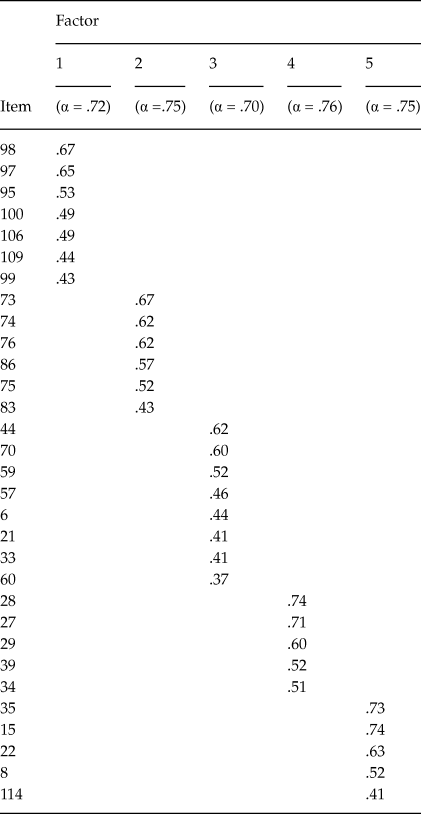
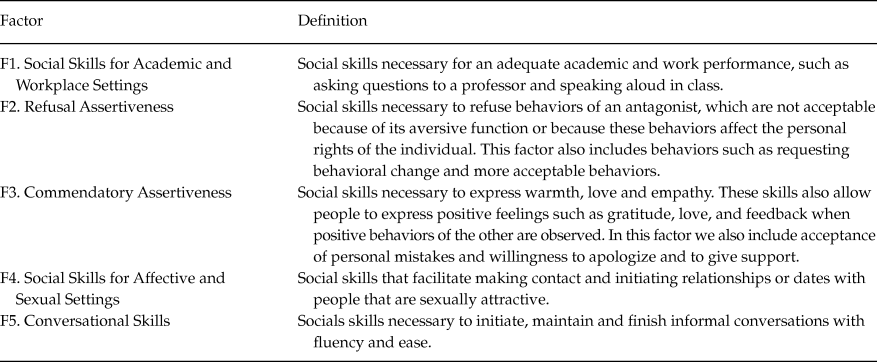
From the inspection of the pattern matrix we discarded items with pattern coefficient lower than .40 and items with pattern coefficient greater than .30 in more than one factor. We only maintained one item with a pattern coefficient lower than .40, as its correlation was close to the cut point (.37) and we considered it as a conceptually important indicator. In this way, we obtained a final simple structure of five factors and 31 items that explained 34 % of the variance of the test. Each factor included more than five items with pattern coefficients near to .50, as recommended by Costello and Osbourne (Reference Costello and Osborne2005). We present the results in Table 1. On the basis of the analysis of the content of the items related to each factor, we interpreted the factor as shown in Table 2.
Pattern matrix of the final 31 items obtained in the EFA of the Social Skills Questionnaire (SSQ-U)

Conceptual content of the obtained factors are presented

Study 3: Confirmatory factor analysis and composite reliability.
We carried out a CFA of a five-factor model taking into consideration the solution obtained from the EFA. This model obtained a significant X 2 statistic (1446.042, p = .001) and, even though the goodness of fit indexes did not reach adequate values (considering criteria proposed by Hu & Bentler, Reference Hu and Bentler1998), we obtained very approximate values (CFI = .84, GFI = .86, RMSEA = .061).
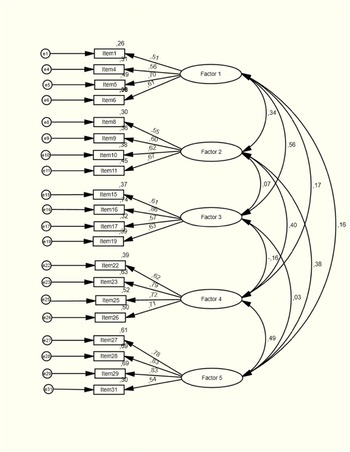
Taking these results into consideration, we proceeded to re-specify the model. In order to do this, we discarded items that presented high standardized residual covariances (greater than 2.58, according to Hair et al., Reference Hair, Anderson, Tatham and Black1999) also considering the Modification Indexes and the conceptual relevance of the item. The final model is presented in Figure 1.
Final model sowing the five-factor structure of the SSQ-U and the standardized regression coefficients.

We obtained a final structure of 20 items with standardized regression weights (p ≤ .001) between .51 and .61 in the first factor; .55 and .67 in the second; .57 and .86 in the third; .62 and .79 in the fourth; and .54 and .83 in the fifth. With regard to the goodness of fit indexes, even though we obtained a significant X2 statistic (476.2, p = .001), its value decreased considerably. On the other hand, the other indexes were adequate, following the criteria proposed by Hu and Bentler (Reference Hu and Bentler1998) (CFI = .92, GFI = .93, RMSEA = .056).
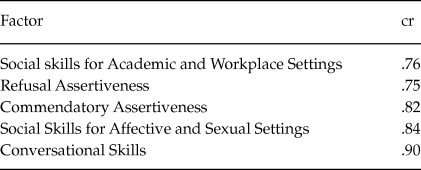
As a final step, we calculated the composite reliability of each factor using the formula suggested by Hair et al. (Reference Hair, Anderson, Tatham and Black1999). We obtained adequate values for all the latent constructs, with good and very good values. We present the results in Table 3.
Composite reliability (cr) of the five factors in the SSQ-U

Study 4: Convergent and discriminant evidence validity. Multi-trait multi-method matrix.
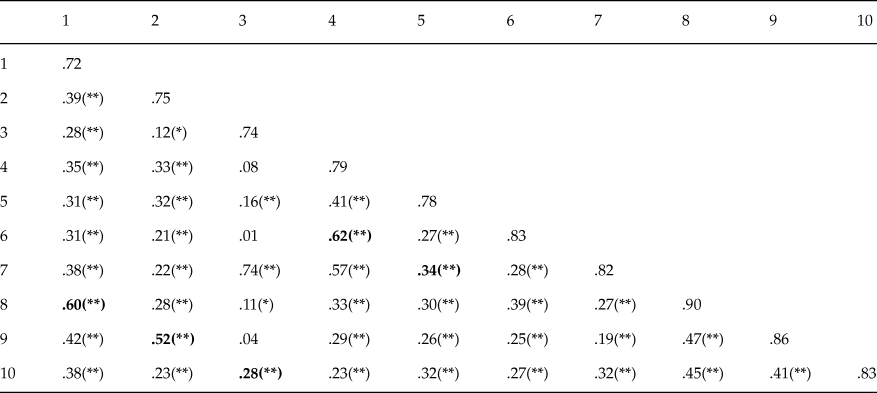
As we can see in the Table 4, the values of the alpha coefficients located in the diagonal of the matrix are appropriate in all the cases (above .70), and they are the highest values of the array. Secondly, the coefficients of convergence (monotrait- heteromethod, in bold letter), located in the square at the bottom of the table, are high and significant in all cases. Although we obtained low effect sizes in the convergence values between the subscale Commendatory Assertiveness of the SSQ-U, and the subscale Self Efficacy for Empathic Behavior and Expression of Positive Feelings SSE-CS, the effect sizes were appropriate based on the results obtained in studies with other similar scales (Pearson`s coefficients between .23 and .62).
Correlations between different factors of SSQ-U and SSE-CS

Note: *p ≤.05. **p ≤.01 (bilateral significance). 1 = Factor 1 SSQ-U. Social Skills for Academic and Workplace Settings. 2 = Factor 2 SSQ-U. Refusal Assertiveness. 3 = Factor 3 SSQ-U. Commendatory Assertiveness. 4 = Factor 4 SSQ-U. Social Skills for Affective and Sexual Settings. 5 =. Factor 5 SSQ-U. Conversational Skills. 6 = Factor 1 SSE-CS. Self-Efficacy for Affective and Sexual Approach. 7 = Factor 2 SSE-CS. Conversational Self Efficacy. 8 = Factor 3 SSE-CS. Self-Efficacy for Academic Skills. 9 = Factor 4 SSE-CS. Self-Efficacy for Refusal Assertiveness. 10 = Factor 5 SSE-CS. Self-Efficacy for Commendatory Assertiveness Behavior and Expression of Positive Feelings. On the diagonal we can see the coefficients of internal consistency of the subscales. The triangles represent the heterotrait- monomethod block. While the quadrate represents the heteromethod block. The coefficients of convergence are in bold type.
In addition, we observed that the values of the coefficients of convergence were higher than the values in the same column or row in the heteromethod block (represented as a square). However, this was not observed in the correlations of the subscales that evaluate Conversational Skills and Social Skills for Affective and Sexual Settings. Furthermore, it was observed that convergence validity coefficients were, in general, higher than the coefficients observed in the heterotrait monomethod triangles. Finally, we observed a pattern of correlations monotrait heteromethod similar in both instruments and the lower correlations of the matrix corresponded to the heterotrait heteromethod values.
Discussion
In this paper, we presented the psychometric studies that we carried out to construct the Social Skills Questionnaire for Argentinean College Students (SSQ-U), an instrument developed to evaluate the social skills repertoire in college students from Argentina. This was created taking into account a previous study carried out by Olaz et al. (Reference Olaz, Medrano, Greco and Del Prette2009).
We conducted a literature review about social skills instruments and we drafted new items that were added to the items obtained in the adaptation of the SSI-Del Prette to Argentina (Olaz et al., Reference Olaz, Medrano, Greco and Del Prette2009). The new items were written based on the five factors obtained at the study mentioned above, considering different social situations, number of participants, and level of intimacy.
Secondly, we carried out a study to provide evidence based on test content through experts’ judgments. As part of this study, we also required the experts to classify the items on the factors to determine their conceptual clarity, and we estimated concordance between examiners, for the same purpose. We obtained adequate values in all the categories (Landis & Koch, Reference Landis and Koch1977) observing higher values in the “Refusal Assertiveness” category. Olaz (Reference Olaz2012) stated that this class of behavior is one of the most studied in the SS framework, and it is present in the majority of the social skills assessment instruments. Additionally, Del Prette and Del Prette (Reference Del Prette and Del Prette2008) stated that empathy and assertiveness are two of the most important behavioral classes of SS, leading some authors to consider the study of these classes (assertiveness in particular) as an independent field of research, as it was originally conceived in the United States.
Following the suggestions of the experts, we decided to name the factors using the classification proposed by Kelly (Reference Kelly2002), and the results obtained from previous studies (Olaz, Reference Olaz2012). We made some changes to Kelly`s original classification in two factors according to theoretical considerations: “Heterosocial Skills,” and “Job Interview Skills.”
In the first factor, we considered that the term “Heterosocial” could imply a gender bias, so we decided to name the factor “Social Skills for Affective and Sexual Settings.” We also changed the category named “Job Interview Skills” to a broader class named “Social Skills for Academic and Workplace Settings” in order to include SS that are necessary in the academic environment.
From this analysis we obtained a preliminary sample of items whose internal structure was analyzed using EFA. The results of this analysis allowed us to identify a five-factor structure of 31 items that explained 34 % of the variance of the test (“Social Skills for Academic and Workplace Settings,” “Refusal Assertiveness,” “Commendatory Assertiveness,” “Social Skills for Affective and Sexual Settings,” “Conversational Skills.”) We observed adequate internal consistency for all the factors, following the criteria proposed by the specialized literature (Nunnally & Berstein, 1955). It is important to state that the obtained factor structure was also identified by Olaz (Reference Olaz2012) in the Social Self Efficacy Scale for College Students, so we could conclude that we have preliminary evidence of the proposed structure.
We carried out a CFA to provide more evidence for the obtained structure. We obtained a final structure of 20 items with adequate goodness of fit indexes (CFI = .92, GFI = .93, RMSEA = .056) and adequate values of reliability in all the factors. Although the final version of the scale has fewer items, as Uriel and Aldás (Reference Uriel and Aldas2005) stated, in those cases where discarding items can improve the model adjustment and the decisions are conceptually-based, item elimination can be desirable in terms of parsimony. Moreover, the number of items per factor does not exceed the cut point of seven items proposed by Hair et al. (Reference Hair, Anderson, Tatham and Black1999).
It is important to point out that in the CFA we carried out, we used a model development strategy (Hair et al., Reference Hair, Anderson, Tatham and Black1999), which has been criticized by Pedhazur (Reference Pedhazur1982) and Sörbom (Reference Sörbom1989). However, Hatcher (Reference Hatcher1994) stated that this strategy could be used as long as the modification of the model is guided by theoretical considerations, which was the case in our research. However, it is recommendable to develop further research in order to test the obtained structure in new samples of individuals.
Finally, we carried out a convergent and discriminant evidence of validity study, obtaining results that allowed us to conclude that the instrument is theoretically sound, as the observed correlations between the sub scales of the SSQ-U and the SSE-CS were in the direction we hypothesized.
There are some important aspects to be considered in relation to some limitations of the current study. First, the different studies were performed using accidental sampling, which limits the generalizatibility of the observed results. Second, we only included college students aged between 18 and 25 years old, whereas older people usually attend to university in our country as well; therefore, it is advisable to develop another version of the instrument to include these students.
We also consider that further research is needed in order to provide new evidence of validity and reliability of the instrument, before using this instrument in clinical and other applied settings. In this sense, it would be important to investigate the temporal stability of the scores of the instrument and to provide evidence based on relation to other conceptually relevant variables, such as social performance in real life situations and social anxiety. In relation to the last variable, we are currently constructing a path model of social anxiety in college students that includes social skills measured by the SSQ-U as a predictor variable, among other variables.
We also consider it is important to analyze the structural invariance between gender and age to provide more evidence based on the internal structure. Finally, it is advisable to conduct a research on the experimental sensitivity of the SSQ-U, by means of a study that investigates whether the scores of the instrument improve as a result of social skills trainings.
Thus, based on the reported results, we can conclude that the SSQ-U is a valid and reliable instrument to measure social skills. In the light of Bryant and Trower`s classical studies (1974), we recognized the importance of the assessment of the different variables associated with social problems in college students (Del Prette & Del Prette, Reference Del Prette and Del Prette2003). This is highlighted by the large number of reported investigations about the importance of SS in relation to college students' academic achievement and performance (García Nuñez del Arco, Reference García Nuñez del Arco2005; Oyarzún Iturra, Estrada Goic, Pino Astete, & Oyarzún Jara, Reference Oyarzún Iturra, Estrada Goic, Pino Astete and Oyarzún Jara2012), and psychological wellbeing (Velásquez et al., Reference Velásquez, Montgomery, Montero, Pomalaya, Dioses, Velásquez and Reynoso2008). Other studies also demonstrate the importance of SS as a protective factor against depression (Pardo, Sandoval, & Umbarila, Reference Pardo, Sandoval and Umbarila2004; Segrin, Reference Segrin2000), anxiety (Amezcua Membrilla & Pichardo Martínez, Reference Amezcua Membrilla and Pichardo Martínez2002), stress (Sousa Furtado, Oliveira Falcone, & Clark, Reference Sousa Furtado, Oliveira Falcone and Clark2003), addictive behaviors (Anguiano Serrano, Vega Valero, Nava Quiroz, & Soria Trujano, 2010; Cáceres, Salazar, Varela, & Tovar, Reference Cáceres, Salazar, Varela and Tovar2006), aggressiveness and antisocial behavior (Redondo Illescas, Sánchez-Meca, & Garrido Genovés, Reference Redondo Illescas, Sánchez-Meca and Garrido Genovés2002), eating disorders (Hinrichsen, Wright, Waller, & Meyer, Reference Hinrichsen, Wright, Waller and Meyer2003), among others. On the other hand, Lopes et al. (Reference Lopes, Gerolamo, Del Prette, Musetti and Del Prette2015) recognized the relevance of this repertoire for the future professional success of college students.
Despite the undeniable value of SS research, we concur with Stravinsky and Amado (2001 in Vertue, Reference Vertue2003) that there is a lack of valid and reliable instruments of SS for College students. In Argentina, this lack of social skills instruments is even more noticeable, and the SSQ-U is the first local instrument to assess SS in college students in a valid and reliable way. Bearing the observed limitations of this research in mind, and based on the reported results, we can conclude that the SSQ-U is an innovative instrument to be used in clinical research and treatment, academic settings, and in program planning to train social skills in college students in our country.
This research was partially supported by grants from the Ministerio de Ciencia y Tecnología de Córdoba, Argentina.