Experimental
Plant material
Billbergia zebrina (Herbert) Lindley (Supplementary Fig. S1, available online only at http://journals.cambridge.org) is a bromeliad native to the Atlantic Rain Forest, classified as vulnerable in the List of Threatened Species of the Rio Grande do Sul State, Brazil (FZB-RS, 2003). Aiming to evaluate the polymorphism of amplified fragment length polymorphism (AFLP) markers to assess the genetic diversity and to establish conservation strategies for this species, nodular cultures (NCs) and adult plants were genotyped and their relationship evaluated. DNA was extracted from 36 samples of NCs randomly collected among 12 treatments of micropropagation experiments (Dal Vesco et al., Reference Dal Vesco, Stefenon, Welter, Scherer and Guerra2011), comprising three samples per treatment. NCs were generated from a mix of mature capsules collected from two plants maintained in the bromeliad collection of the Federal University of Santa Catarina, Brazil. Leaf samples of three adult plants (Bz1, Bz2 and Bz3) were included, in order to determine the capacity of the AFLPs in discriminating among related and non-related individuals. Sample Bz1 corresponds to a wild individual non-related to other plants, while samples Bz2 and Bz3 are open-pollinated mother-plants of the seeds which originated the NCs. DNA was extracted as described by Stefenon et al. (Reference Stefenon, Nodari and Reis2003) from leaf samples of the adult plants and from about 0.85 g of each NC.
Molecular analysis
The AFLP fingerprint was performed as described by Stefenon et al. (Reference Stefenon, Gailing and Finkeldey2007), using the EcoRI and MseI restriction enzymes and its correspondent adapters and primers. The selective amplification was performed using six primer combinations: Eco-AAT+Mse-CAA, CTG, CTC, CAG, CTT and CAT. All PCR reactions were carried out in a C1000™ Thermal Cycler (Bio-Rad). PCR products (1.0 μl) were combined with the internal size standard ET-ROX-500 (Applied Biosystems) and electrophoretically separated on a capillary genotyping platform MegaBACE-1000 (GE Healthcare). Fragments were scored and transformed into a binary matrix using Fragment Profiler Software version 1.2. Just fragments between 50 and 600 bp (>100 rescaled peak height) consistent through two runs were selected.
Data analysis

Assuming that natural populations of B. zebrina are in Hardy-Weinberg equilibrium, allelic frequencies p and q were computed from the frequency of the presence/absence of the peaks, assuming  2, where q 2 is the frequency of band absence and p = 1 − q. Heterozygosity was assessed as H e = 2n/2n-1(1 − ∑ip i2), where n denotes the number of individuals and p i is the frequency of alleles p and q (Nei, Reference Nei1987). Phenotypic diversity of presence/absence of the peaks was estimated using the Shannon's index of diversity, computed as H S = − ∑p ilog2p i (Lewontin, Reference Lewontin1972), where p i is the frequency of presence/absence of the peak. The correlation among number of polymorphic fragments, heterozygosity and Shannon's index was evaluated through the Spearman's rank correlation coefficient (r s).
The relationship among genotypes was assessed using the software PAUP 4.0 (Swofford, Reference Swofford2003) based on Nei and Li genetic distance (Nei and Li, Reference Nei and Li1979), through a clustering analysis (Neighbour-joining algorithm). Statistical support was assessed through 1000 bootstrap replicates.
Results and discussion
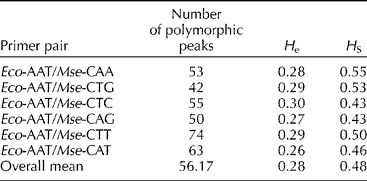
Using six primer pairs, a total of 337 reliable AFLP fragments were scored. The mean number of polymorphic loci was 56.17, the mean heterozigosity was H e = 0.28 and the mean Shannon's index of diversity equalled H S = 0.48 (Table 1). Weak non-significant correlation was found between the number of polymorphic fragments and the levels of genetic diversity (r s=0.014, P>0.05 for H e and r s= − 0.13, P>0.05 for H S) and between H e and H S (r s=0.03, P>0.05).
Measures of genetic diversity of Billbergia zebrina, estimated over all loci and for each amplified fragment length polymorphism primer pair used

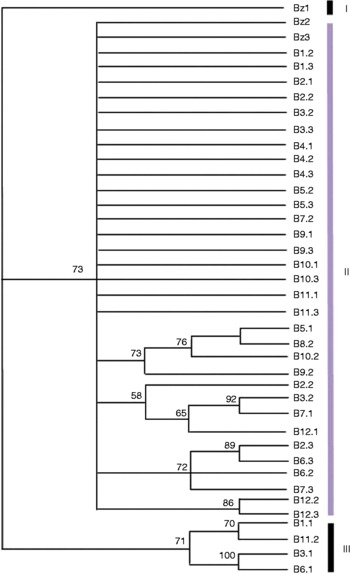
The clustering analysis (Fig. 1) revealed three main groups: group I, formed by the non-related adult plant Bz1; group II, comprised of the two mother-plants and 34 NCs, forming a large polytomy; and group III, formed by four NCs.
Neighbour-joining dendrogram of all 39 plants, based on Nei and Li genetic distance. Number at the nodes is the bootstrap support after 1000 replications (a colour version of this figure can be found online at journals.cambridge.org/pgr).

Micropropagation protocols for B. zebrina were recently developed (Dal Vesco et al., Reference Dal Vesco, Stefenon, Welter, Scherer and Guerra2011) and recognized as an attractive alternative towards species conservation. Nevertheless, the selection of populations for conservation has to be based on sound scientific knowledge, particularly about the genetic variability of the species.
Levels of genetic diversity estimated from co-dominant allozyme and microsatellite markers in natural populations of bromeliads reveal from low to high variability, depending on the marker system and species analyzed (Supplementary Table S1, available online only at http://journals.cambridge.org)Footnote 1. The levels of AFLP polymorphism and genetic diversity observed in B. zebrina can be considered moderate to high, when compared to other studies using dominant markers in plants (Supplementary Table S1, available online only at http://journals.cambridge.org). Analyzing the genetic relationships among 77 individuals from 18 species of the genus Fosterella (Pitcairnioideae) with 13 AFLP primer pairs, Rex et al. (Reference Rex, Patzolt, Schulte, Zizka, Vásquez, Ibisch and Weising2007) observed between 30 and 52 polymorphic fragments. In Puya raimondii (Pitcairnioideae), Sgorbati et al. (Reference Sgorbati, Labra, Grugni, Barcaccia, Galasso, Boni, Mucciarelli, Citterio, Iramategui, Gonzales and Scannerini2004) found only five polymorphic AFLP fragments out of 217 loci. In B. zebrina, the number of polymorphic fragments ranged from 42 to 74. Similarly, the estimation of gene diversity achieved for B. zebrina is higher than the values of H e obtained from dominant markers in plant species sharing similar life history traits (Supplementary Table S1, available online only at http://journals.cambridge.org).
The moderate-to-high level of genetic diversity detected at AFLP markers in the present study suggests that natural populations of B. zebrina present high genetic diversity. Maintenance of such diversity has to be the focus of programmes of species conservation; and AFLP markers proved to be a very useful tool in assessing the genetic diversity of these populations.
The capability of the AFLP technique in assessing the genetic diversity in populations of B. zebrina is also demonstrated by its discriminatory potential, revealed by the higher differentiation of the non-related adult plant Bz1 in relation to the other genotypes and by the large polytomy, which represents the high similarity among 35 NCs propagated from two mother-plants that also grouped within this group. On the other hand, the low similarity revealed by four NCs in the clustering analysis may be the effect of somaclonal variation that occurred during the micropropagation process.
The molecular genetic analysis performed in the present study shows the high polymorphism of the AFLP markers and its usefulness for studies of genetic diversity in B. zebrina. In addition, the in vitro regenerative system based on NCs of B. zebrina allows the mass propagation of this bromeliad, presenting the high potential to be employed in conservation programmes.
Acknowledgements
The authors thank CAPES, CNPq, FINEP and FAPESC for fellowship, research grants and financial support for the development of this study.