Introduction
Cognitive impairment in patients with eating disorders (EDs) has been reported by the majority of studies addressing this issue. However, heterogeneous patterns of cognitive dysfunctions have been found and, in a minority of studies, no dysfunction was observed [see Zakzanis et al. (Reference Zakzanis, Campbell and Polsinelli2010) for a meta-analysis and Appendix 1 (available online) for a detailed description of literature data]. The heterogeneity of findings might be due to the use of different neuropsychological tests, exploring different subdomains of complex cognitive functions. This is particularly true for memory and executive functions, the two most investigated cognitive domains in the literature on EDs.
Studies investigating memory dysfunction in EDs have reported either no impairment or deficits in different memory subdomains, such as short-term verbal or visuospatial memory, secondary verbal and/or visuospatial memory and verbal learning (see Appendix 1). In particular, of eight studies exploring memory in patients with bulimia nervosa (BN), three found no impairment, one found impaired short-term and working memory only in subjects with co-morbidity, and four investigated verbal memory and reported impaired learning, secondary memory or short-term memory (see Appendix 1); three out of these four also included a test for secondary visuospatial memory, but only two reported a deficit in this subdomain. None of the studies carried out in BN patients explored recognition versus free recall to rule out the possibility that the observed memory impairment is due to an executive dysfunction, that is a deficit in the ability to initiate a suitable strategy for successful recall.
Findings relevant to executive functions in EDs were also heterogeneous, showing an impaired set shifting, deficits of problem solving or working memory, and also no impairment of the same subdomains (see Appendix 1). Set shifting was most often explored by means of the Wisconsin Card Sorting Test (WCST) and the Trail Making Test Part B (TMT-B). An impairment on these tests might result from visuospatial deficit, a factor not always controlled for. Furthermore, the TMT-B index (time to complete the test) can be affected by slowness on test execution. In patients with BN impaired processing speed has been reported (Ferraro et al. Reference Ferraro, Wonderlich and Jocic1997; Lauer et al. Reference Lauer, Gorzewski, Gerlinghoff, Backmund and Zihl1999), which makes it difficult to rule out the possibility that the impaired set shifting reported by all studies using TMT-B, but not by those using the WCST (Appendix 1), is simply due to slowness. Apart from the confounding role of visuospatial deficits and psychomotor speed, it is also worth noting that different mechanisms may underlie the impairment of set shifting. Indeed, perseveration may be due to either a deficit in the ability to shift from a previously attended perceptual category to a new one (i.e. attentional set shifting deficit due to perseveration), as observed in patients with frontal lobe lesions, or an inability to focus on the new stimulus dimension because it was previously learned as irrelevant (deficit in inhibiting a reinforced action), as observed in patients with Parkinson's disease (Owen et al. Reference Owen, Roberts, Hodges, Summers, Polkey and Robbins1993). Investigations aimed to disentangle these mechanisms were not carried out in patients with BN.
Other methodological factors may account for discrepancies in neuropsychological findings in EDs: (1) small sample sizes; (2) insufficient clinical characterization of experimental samples; (3) use of different control groups (healthy subjects, patients with other psychiatric diagnosis, or normative data); and (4) lack of control for confounding variables, such as education, general cognitive abilities, drug status and starvation, in addition to the presence of depressive, anxious or obsessive–compulsive symptomatology, which might have an impact on task performance, especially when speed and accuracy are not evaluated separately. In addition, personality traits, such as perfectionism and harm avoidance, are often reported in these patients (Halmi et al. Reference Halmi, Sunday, Strober, Kaplan, Woodside, Fichter, Treasure, Berrettini and Kaye2000; Fassino et al. Reference Fassino, Amianto, Gramaglia, Facchini and Abbate Daga2004) and might influence neuropsychological performance (Strupp et al. Reference Strupp, Weingartner, Kaye and Gwirtsman1986; Tchanturia et al. Reference Tchanturia, Morris, Surguladze and Treasure2002), and are not generally controlled for. Moreover, other than malnutrition with metabolic imbalance and structural brain abnormalities, it has been hypothesized that neuroendocrine dysfunctions may influence cognitive deficits observed in patients with EDs. It is well known that cognitive functions are influenced by steroid hormones (Squire, Reference Squire1992; Lupien et al. Reference Lupien, Lecours, Lussier, Schwartz, Nair and Meaney1994, Reference Lupien, de Leon, de Santi, Convit, Tarshish, Nair, Thakur, McEwen, Hauger and Meaney1998; van Niekerk et al. Reference van Niekerk, Huppert and Herbert2001; Blair et al. Reference Blair, Granger and Peters Razza2005; Alhaj et al. Reference Alhaj, Massey and McAllister-Williams2006; Li et al. Reference Li, Cherrier, Tsuang, Petrie, Colasurdo, Craft, Schellenberg, Peskind, Raskind and Wilkinson2006), and indeed steroid abnormalities have been reported in subjects with EDs (Zumoff et al. Reference Zumoff, Walsh, Katz, Levin, Rosenfeld, Kream and Weiner1983; Winterer et al. Reference Winterer, Gwirtsman, George, Kaye, Loriaux and Cutler1985; Hotta et al. Reference Hotta, Shibasaki, Masuda, Imaki, Demura, Ling and Shizume1986; Fichter et al. Reference Fichter, Pirke, Pöllinger, Wolfram and Brunner1990; Monteleone et al. Reference Monteleone, Luisi, Colurcio, Casarosa, Monteleone, Ioime, Genazzani and Maj2001, Reference Monteleone, Luisi, Martiadis, Serritella, Longobardi, Casarosa, Genazzani and Maj2006; Klein et al. Reference Klein, Mayer, Schebendach and Walsh2007). Studies investigating the influence of steroid hormones on neurocognitive performance in patients with ED have reported conflicting results (Laessle et al. Reference Laessle, Fischer, Fichter, Pirke and Krieg1992; Seed et al. Reference Seed, Dixon, McCluskey and Young2000; Galderisi et al. Reference Galderisi, Mucci, Monteleone, Sorrentino, Piegari and Maj2003), probably because of the diagnostic heterogeneity of experimental samples among different studies (patients with BN or with anorexia nervosa, AN).
The present study aimed to define the pattern of neurocognitive impairment in a large group of untreated patients with BN, by tapping several domains of cognition previously investigated in these patients with conflicting results. To disentangle the relative contribution of the verbal versus the visuospatial domain and of processing speed versus accuracy, we chose a comprehensive neuropsychological battery, in which each test has subtests for visuospatial and verbal materials, matched for task difficulties and providing separate indices for speed and accuracy. The battery assesses (a) attention/immediate memory (Block Span and Digit Span), (b) implicit learning of supraspan sequences [learning tests independent of executive functions; the Corsi Block Tapping Task (CBTT) and Hebb's Digit Recurring Sequences (HDRS)], (c) conditional learning, a form of learning dependent on executive functions, assessing the ability to learn, by using an external reinforcing feedback, correct associations between pairs of stimuli [the Spatial (SCAL) and Non-Spatial Conditional Associative Learning Tasks (NSCAL)], and (d) perseveration independent of inhibition of a previously reinforced action [the Self-Ordered Pointing Tasks for Words (SOPT-W) and for Drawings (SOPT-D)].
The WCST was included to assess set shifting, independently of speed, and it was therefore preferred to the TMT-B. It involves the ability to focus on a new stimulus category previously learned as irrelevant, by inhibiting a previously reinforced action. The Wechsler Adult Intelligence Scale – Revised (WAIS-R) was used to assess cognitive general abilities.
The study was also designed to demonstrate that neuroendocrine, personality and clinical characteristics influence neurocognitive performance in BN.
Method
Subjects
Patients were recruited among those attending the out-patient and in-patient units of the Eating Disorder Centers of the University Psychiatric Departments of Naples, Milan, Padua and Pisa. Before entering the study, patients participated in a 1-h clinical interview to verify their conformity to the following inclusion criteria: (a) DSM-IV diagnosis of BN, confirmed by the Structured Clinical Interview for DSM-IV (SCID-I; First et al. Reference First, Spitzer, Gibbon and Williams2002); (b) female sex; (c) age >16 years; (d) informed consent to participate in all the experimental procedures; (e) absence of drug treatment for ⩾4 weeks (6 weeks in the case of fluoxetine treatment); and (f) absence of both cerebral or somatic diseases not related to the aberrant eating pattern.
Healthy controls (HC), matched with patients for age (±3 years), were selected on the basis of the above criteria from (b) to (e) plus the absence of both previous or current physical and mental disorders, as assessed by means of the Mini-International Neuropsychiatric Interview (MINI; Sheehan et al. Reference Sheehan, Lecrubier, Janavs, Knapp, Weiller, Bonora, Amorim, Lepine, Sheehan, Baker and Sheehan1994) and physical examination.
Psychopathological evaluation
Patients' psychopathological state was evaluated by using the following instruments: the Bulimic Investigation Test Edinburgh (BITE; Henderson & Freeman, Reference Henderson and Freeman1987) to assess eating-related psychopathology, and the MADRS (Montgomery & Asberg, Reference Montgomery and Asberg1979) to evaluate depressive symptoms.
The presence of co-morbidity for other psychiatric disorders was assessed by using SCID-I. For all these instruments, the inter-rater reliability was formally evaluated: the κ value for the principal diagnosis of SCID-I was 0.89, whereas for co-morbid diagnoses it was between 0.86 and 0.89; the κ value for the MADRS total score was 0.88. The inter-rater reliability was not evaluated for the BITE, which is a self-rating scale.
Personality characteristics were assessed by means of Cloninger's Temperament and Character Inventory – Revised (TCI-R; Cloninger, Reference Cloninger1999). Height and body weight were measured and the body mass index (BMI) was calculated for each subject.
Neuropsychological assessment
Each test included in the battery provides separate indices for accuracy and speed of execution and includes a verbal and a non-verbal version matched for task requirements, thus enabling an accurate evaluation of both verbal and visuospatial abilities. The only exception is the WCST, widely used to investigate set shifting, which was added mainly for comparison with previous literature findings. Finally, cognitive general abilities were assessed so as to control for their influence on neuropsychological performance.
The following neurocognitive domains were assessed: (a) attention/immediate memory, (b) implicit learning, (c) conditional learning, (d) perseveration, (e) set shifting and (f) cognitive general abilities.
Attention/immediate memory was assessed by the Block Span and the Digit Span. Implicit learning was evaluated by the CBTT and the HDRS, which assess the ability to learn a supraspan spatial or non-spatial sequence that, unknown to the subject, recurs every third sequence, and whose memory trace is expected to be reinforced more than those of the non-recurring sequences (Milner, Reference Milner, Buser and Rougeul-Buser1978).
Conditional learning, dependent on executive control, was assessed by the SCAL and the NSCAL, which evaluate the ability to learn, by trial and error, the correct association between pairs of stimuli (Petrides, Reference Petrides1985).
Perseveration was evaluated by the SOPT-W and SOPT-D, which explore the ability to initiate, organize and monitor a sequence of self-generated responses, and to carry them out while constantly monitoring their execution (Petrides & Milner, Reference Petrides and Milner1982); no external feedback is provided to subjects during task execution, thus preventing establishing reinforced associations and learned irrelevance, so that perseveration on this test is independent of inhibition of previously reinforced associations. All set sizes included in the SOPT (6, 8, 10 and 12 items) were administered and both time and speed indices were calculated as an average across them.
Set shifting was assessed by the WCST. This complex test explores categorization abilities, the presence of perseveration and the ability to maintain the cognitive set, and also set shifting. As a measure of set shifting, it entails the ability to focus on a new stimulus category previously learned as irrelevant, by inhibiting a previously reinforced action.
Cognitive general abilities were evaluated by the WAIS-R, which estimates the Full Scale, Performance and Verbal Intelligence Quotient (FSIQ, PIQ and VIQ). For further details on the test procedures see Galderisi et al. (Reference Galderisi, Mucci, Catapano, Colucci D'Amato and Maj1995, Reference Galderisi, Mucci, Mignone, Bucci and Maj1999) .
To reduce the number of statistical comparisons, we selected two outcome measures for each test. For the WCST, we chose the number of perseverative errors, which is the most commonly used measure and therefore meets our need of comparison with previous literature findings, and the number of correct responses, which was preferred as an accuracy index to the number of categories as it is a continuous measure. For all the other tests two summary indices were chosen, one for speed of execution and one for accuracy, as they were deemed more robust than partial measures (for the SOPT, for instance, the average accuracy was used instead of the accuracy for each set size). The summary indices included: for SOPT-W and SOPT-D, the total mean time to complete the test and the average number of repeated items; for SCAL and NSCAL, the mean time per trial and the total number of errors; for CBTT and HDRS, the mean time ratio (mean time on recurring sequences/mean time on non-recurring sequences) and the accuracy ratio (ratio between the percentage of correct recurring and non-recurring sequences).
All tests except the WCST and the WAIS-R were administered in a single session lasting 2 h and in the same order (SCAL, NSCAL, SOPT-D, SOPT-W, CBTT, HDRS). The WAIS-R and the WCST were administered in a separate session, starting with the WAIS-R for all subjects. In each centre, all tests were administered by the same examiner, who had received an ad-hoc training organized by the coordinating center.
Biochemical analyses
Cortisol and 17β-estradiol plasma levels were assessed according to the following procedure: after an overnight fast, each subject underwent a blood sample collection between 0800 and 0900 hours, when a butterfly needle was inserted into a forearm vein and kept patent by a saline infusion; after 30 min resting, blood was collected in tubes with lithium heparin as anticoagulant; plasma was separated and stored at –20°C. Menstruating women underwent blood sample collection in the follicular phase of their menstrual cycle (day 5–8 from menses). Plasma cortisol concentrations were determined by a double-antibody radioimmunoassay (RIA) method, using a commercially available kit (Biochem Immunosystems, Milan, Italy); intra- and interassay coefficients of variation (CVs) were <5% and <8% respectively. Plasma 17β-estradiol levels were determined by an immunometric method (MAIA clone), using a commercially available kit (Biochem Immunosystems); intra- and interassay CVs were 4.3% and 3.2%, respectively.
Data analysis
To meet the criteria of normality and homogeneity of variance, the speed indices of neuropsychological tests and also the total number of errors on SCAL and NSCAL and plasma levels of 17β-estradiol were log transformed. Outliers (subjects whose scores exceeded the 75th or the 25th percentile by 1.5 times the interquartile range) were excluded from the analysis (Rothamsted et al. Reference Rothamsted, Barnett and Lewis1994).
For each neuropsychological index, z scores were calculated from the mean value of the HC group. A sign inversion was applied to those neuropsychological indices for which a lower number indicates a worse performance (e.g. the number of correct responses at WCST) so as to homologate for all indices the direction indicating impairment (the higher the index, the greater the impairment).
For all the variables considered, missing data were substituted with the mean value of the group.
Independent one-way analyses of variance (ANOVAs) were used to test for group differences on demographic variables, WAIS-R Full Scale IQ, BMI and neuroendocrine indices. In the case of group differences on these indices, group comparisons on neuropsychological variables were performed by entering them as covariates. To test for group differences on neuropsychological performance, separate multivariate ANOVAs (MANOVAs) were run for accuracy and speed indices using multivariate and repeated-measure designs. Tukey's Honestly Significantly Different (HSD) procedure was used for post-hoc comparisons only when a significant main effect or interaction had been found in the multivariate analyses. The statistical power was 0.94 and 0.87 for the MANOVA on accuracy and speed indices respectively, for the interaction between the group factor (with two levels) and the neuropsychological domains factor (with eight and six levels for accuracy and speed indices respectively), considering a mean difference of ¼; s.d. between the two groups. All group comparisons were also carried out after the exclusion of patients with co-morbidity for depressive disorders to control for the influence of a significant burden of depression on the results. To check for site differences, this variable was added as a categorical predictor in all group comparisons. To clarify the simultaneous effect of several confounding variables on patients' neuropsychological performance, multiple regression analyses were carried out, in which neuropsychological variables were entered as dependent variables, and independent variables included education, BITE total score, duration of illness, MADRS total score, previous history of AN, neuroendocrine indices (cortisol and 17β-estradiol), and TCI-R dimensions (Novelty seeking, Harm avoidance, Reward dependence, Persistence, Self-directedness, Cooperativeness, Self-transcendence).
Correlation analyses were carried out by means of Pearson's test.
Results
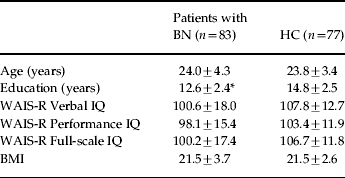
A total of 83 female patients with BN and 77 HC were included in the study. No difference was observed between the two groups on BMI, IQ and demographic variables, with the exception of education, which was significantly lower in the patient group (Table 1). Seventeen BN patients showed co-morbidity for current depressive disorder (11 major depressive disorder, single episode, four major depressive disorder, recurrent, two dysthymic disorder), with a mean total score of 22.8 (s.d.=11.2) on the MADRS. Twenty-two BN patients had a previous history of AN, remitted for at least 1 year for all of them. These patients did not differ from those without previous history of AN for any neuroendocrine or neuropsychological variable, with the exception of the speed index of the HDRS, which was higher in the latter group. Five patients were amenorrheic, and 18 were oligomenorrheic. None of the subjects included in the study were using hormonal contraceptives.
Demographic characteristics, intellectual quotient (IQ) and body mass index (BMI) of the experimental sample

BN, Bulimia nervosa; HC, healthy controls; WAIS-R, Wechsler Adult Intelligence Scale – Revised.
* Significant difference between the two groups: p<0.00005.
A significant main effect of site was observed for both neuroendocrine and neuropsychological indices; however, the interaction with diagnosis was not statistically significant. Group comparison on neuroendocrine indices showed significantly higher values of cortisol plasma levels in patients with BN than in HC [mean±s.d.=162.7±50.4 and 142.3±45.5 respectively, F(1, 158)=7.20, p=0.008], but no significant group difference on plasma levels of 17β-estradiol was found. Similar results were found when comparing BN patients with HC after the exclusion of patients with co-morbidity for depressive disorder [mean±s.d.=164.9±52.6 and 142.3±45.5 respectively, F(1, 141)=7.58, p=0.007 for group comparison on cortisol plasma levels]. In the light of these results, all comparisons between patients and controls were carried out using education and cortisol plasma levels as covariates.
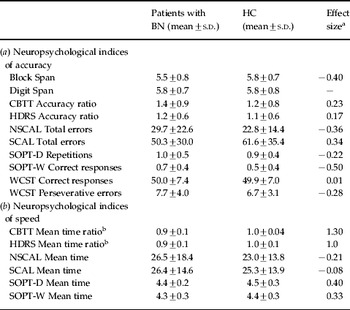
In the whole experimental sample, no significant group difference was found for neurocognitive test accuracy indices. Raw data and the effect size for these variables are shown in Table 2 a. After excluding patients with co-morbidity for depressive disorders, the MANCOVA for the accuracy indices showed a significant main effect of diagnosis [Hotelling T 2=0.15, F(10, 130)=2.01, p=0.04] and a significant diagnosis×neuropsychological index interaction [Hotelling T 2=0.15, F(9, 131)=2.13, p=0.03]. Follow-up ANOVAs showed that the effect of diagnosis was due to better performance on the accuracy indices of CBTT and SCAL in BN patients compared to HC (p=0.04 and p=0.02 respectively).
Raw data for the neuropsychological indices of (a) accuracy and (b) speed

BN, Bulimia nervosa; HC, healthy controls; s.d., standard deviation; CBTT, Corsi's Block Tapping Task; HDRS, Hebb's Digit Recurring Sequences; NSCAL, Non-Spatial Conditional Associative Learning Task; SCAL, Spatial Conditional Associative Learning Task; SOPT-D, Self-Ordered Pointing Tasks for Drawing; SOPT-W, Self-Ordered Pointing Tasks for Words; WCST, Wisconsin Card Sorting Test.
a A negative sign indicates a worse performance in BN v. HC.
b Mean time ratio=mean time on recurring sequences/mean time on non-recurring sequences.
In the whole experimental sample, the MANCOVA for the speed indices also showed a significant main effect of diagnosis [Hotelling T 2=0.09, F(6, 151)=2.32, p=0.04] and a significant diagnosis×neuropsychological index interaction [Hotelling T 2=0.09, F(5, 152)=2.67, p=0.02]. Post-hoc analyses revealed that the interaction was due to a faster performance on the CBTT in patients with BN compared to HC (p=0.02). A significant main effect of the covariate cortisol was also observed [Hotelling T 2=0.10, F(6, 151)=2.42, p=0.03], revealing an association between this index and the neuropsychological performance. We explored this association by means of correlation analyses, which showed a weak negative association between cortisol plasma levels and mean time on the SCAL (r=−0.17, p=0.03) and the NSCAL (r=−0.18, p=0.02), indicating that the higher the cortisol plasma levels, the faster the performance on tests exploring conditional learning. Raw data and effect size for neuropsychological speed indices are shown in Table 2 b. After excluding patients with co-morbidity for depressive disorders, no significant group difference was found for the speed indices.
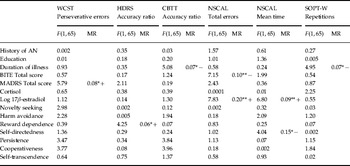
The results of multiple regression analyses are reported in Table 3. The MADRS total score was associated with the number of perseverative errors on the WCST (the worse the depressive symptomatology, the poorer the performance on the WCST). The dimension ‘Reward dependence’ of the TCI-R was associated with the accuracy index of the HDRS (the higher the score on ‘Reward dependence’, the worse the performance on the verbal subtest exploring implicit learning). The dimension ‘Self-directedness’ of the TCI-R was associated negatively with the speed index of the NSCAL (the lower the score on this dimension, the slower the performance on the NSCAL). The 17β-estradiol was associated with both the accuracy and speed indices of the NSCAL (the higher the plasma levels of this neuroendocrine index, the less accurate and the slower the NSCAL performance). The BITE total score was associated negatively with the accuracy index of the NSCAL (the higher the bulimic symptomatology, the better the performance of the non-spatial subtest exploring conditional learning). The duration of illness was associated negatively with the accuracy indices of the CBTT and the SOPT-W (the longer the duration of illness, the better the performance on the two tests).
Results of multiple regression analyses on neuropsychological indices

WCST, Wisconsin Card Sorting Test; HDRS, Hebb's Digit Recurring Sequences; CBTT, Corsi's Block Tapping Task; NSCAL, Non-Spatial Conditional Associative Learning Task; SOPT-W, Self-Ordered Pointing Tasks for Words; MR, multiple regression; AN, anorexia nervosa; BITE, Bulimic Investigation Test Edinburgh; MADRS, Montgomery–Asberg Depression Rating Scale.
* p⩽0.05, ** p⩽0.01; +, positive association; −, negative association.
Discussion
According to our findings, patients with BN have no impairment in the domains of attention/immediate memory, implicit learning and different aspects of executive functions, including conditional associative learning, set shifting and perseveration independent of ‘learned irrelevance’ and inhibition of previously reinforced associations. In particular, group comparison on accuracy indices in the whole experimental sample did not reveal any significant group difference. After excluding patients with co-morbidity for depressive disorders, neurocognitive performance was even better in patients with BN than in HC on the CBTT and SCAL, two tests exploring non-verbal implicit and conditional learning respectively. This suggests a negative influence of depression on these two tests. With regard to the speed indices, the only group difference in the whole experimental sample was a faster performance in patients with BN than in HC on the CBTT, the test exploring non-verbal implicit learning, whereas no difference was observed after excluding patients with co-morbidity for depressive disorders. This might be explained by the smaller size of the sample when excluding patients with depression; however, even though slowness has been widely reported in depression, in a study investigating reaction time in depressed patients and healthy controls during the execution of tasks requiring either effortful information processing or automatic information processing (Hammar, Reference Hammar2003), patients were slower only on tasks requiring effortful information processing.
In a previous study by our group (Galderisi et al. Reference Galderisi, Mucci, Monteleone, Sorrentino, Piegari and Maj2003), ED patients were slower than controls on implicit learning and more accurate on a spatial executive task, showing a cognitive pattern similar to that observed under conditions of heightened arousal, which impairs implicit learning and enhances effortful processing. The discrepancy between this cognitive profile and that observed in the present study might be due to the difference in the characteristics of the experimental samples (in the previous study patients with AN were included) and to the failure to take into account confounding variables. In line with our previous findings, no impairment was found in executive functions, including set shifting abilities, whose impairment in EDs has been reported in several studies (Fassino et al. Reference Fassino, Pierò, Daga, Leombruni, Mortara and Rovera2002; Tchanturia et al. Reference Tchanturia, Morris, Surguladze and Treasure2002, Reference Tchanturia, Anderluh, Morris, Rabe-Hesketh, Collier, Sanchez and Treasure2004, Reference Tchanturia, Davies and Campbell2007; Holliday et al. Reference Holliday, Tchanturia, Landau, Collier and Treasure2005; Steinglass et al. Reference Steinglass, Walsh and Stern2006; Brand & Franke-Sievert, Reference Brand and Franke-Sievert2007) and has been proposed as a trait marker of AN (Tchanturia et al. Reference Tchanturia, Morris, Surguladze and Treasure2002; Holliday et al. Reference Holliday, Tchanturia, Landau, Collier and Treasure2005). However, in accordance with our findings, no impairment of mental flexibility (explored with WCST) was reported in patients with BN with respect to HC in a recent study (Mobbs et al. Reference Mobbs, Van der Linden, d'Acremont and Perroud2008). Impairment of set shifting might be limited to patients with AN; indeed, among the above-mentioned studies reporting such an impairment, only two included patients with BN (Tchanturia et al. Reference Tchanturia, Anderluh, Morris, Rabe-Hesketh, Collier, Sanchez and Treasure2004; Brand & Franke-Sievert, Reference Brand and Franke-Sievert2007) and none of them used the WCST.
The absence of cognitive impairment observed in our experimental sample is only partially discrepant with findings reported by the few neuropsychological studies carried out in patients with BN. Jones et al. (Reference Jones, Duncan, Brouwers and Mirsky1991), in a paper investigating several cognitive domains, found a slight impairment of attention and executive functions. Lauer et al. (Reference Lauer, Gorzewski, Gerlinghoff, Backmund and Zihl1999) reported, in a group of BN patients during the acute phase of their illness with respect to normative data (no control group), no impairment of memory and an impairment of attention and executive functions that improved after 7 months of treatment. In the paper by Ferraro et al. (Reference Ferraro, Wonderlich and Jocic1997), impairment of attention, executive functions, visuospatial ability and memory was reported in patients with BN with respect to HC, and also a higher variability of the performance on tests exploring attention and executive functions, which suggests that the impairment of some cognitive domains reported in patients with BN might be present in only some of them. Finally, in a study by McKay et al. (Reference McKay, Humphries, Allen and Clawson1986), the only difference observed between BN patients and HC on the Luria–Nebraska Neuropsychological Battery was a slower performance in the group of patients while drawing geometric figures, one of the factors of the Motor scale, whereas the remaining 13 clinical scales were within the normal range. The main causes of the discrepancies between our findings and those reported in the above-mentioned studies include the heterogeneity of tests used to investigate the same neuropsychological domain and the lack of control for confounding variables such as the presence of depressive symptomatology, TCI-R dimensions or neuroendocrine indices in some studies.
With regard to the neuroendocrine indices, in line with previous findings (Monteleone et al. Reference Monteleone, Maes, Fabrazzo, Tortorella, Lin, Bosmans, Kenis and Maj1999, Reference Monteleone, Luisi, Colurcio, Casarosa, Monteleone, Ioime, Genazzani and Maj2001), we found higher plasma levels of cortisol but not of 17β-estradiol in BN patients versus HC. Moreover, the MANCOVA for the speed indices in the whole experimental sample showed a significant main effect of cortisol. Correlation analyses showed that cortisol had a favorable, though weak, effect on the speed of execution of both tests exploring conditional learning, whereas multiple regression analyses showed a negative effect of 17β-estradiol on the accuracy and speed indices of the non-spatial version of the same tests. The finding of a positive effect of cortisol on some neuropsychological indices, also observed in our previous study (Galderisi et al. Reference Galderisi, Mucci, Monteleone, Sorrentino, Piegari and Maj2003), is in contrast with the hypothesis that stress, through an increase in glucocorticoid levels, induces neurotoxic effects, and with evidence that elevated glucocorticoid levels are associated with memory impairment and hippocampal atrophy (Squire, Reference Squire1992; Lupien et al. Reference Lupien, Lecours, Lussier, Schwartz, Nair and Meaney1994, Reference Lupien, de Leon, de Santi, Convit, Tarshish, Nair, Thakur, McEwen, Hauger and Meaney1998; Sapolsky, Reference Sapolsky1996; León-Carrión et al. Reference León-Carrión, Atutxa, Mangas, Soto-Moreno, Pumar, Leon-Justel, Martín-Rodriguez, Venegas, Domínguez-Morales and Leal-Cerro2009). It is our hypothesis that, in patients with EDs, steroid abnormalities, such as the increase in cortisol, might reflect a mild and prolonged stress reaction producing an adaptive facilitation of cognitive processes, instead of a disruptive neurotoxic effect (Galderisi et al. Reference Galderisi, Mucci, Monteleone, Sorrentino, Piegari and Maj2003). This hypothesis would be in line with the observation that many subjects with EDs, despite malnutrition, metabolic alterations and brain pseudo-atrophy, only present mild cognitive alterations and are often high achievers at school or at work. The finding of a negative association between 17β-estradiol and performance on a test exploring conditional learning falls within the complex picture of the effects of this hormone on cognitive functions. It is possible that estrogens influence only some cognitive domains and that the effects on these domains depend on their plasma levels (according to some studies, an optimal range of estrogens plasma levels may exist for some cognitive domains; Barrett-Connor et al. Reference Barrett-Connor, Goodman-Gruen and Patay1999; LeBlanc et al. Reference LeBlanc, Janowsky, Chan and Nelson2001) and/or plasma levels of other hormones, such as progestins, which might attenuate the cognitive effects of estrogens (Duff & Hampson, Reference Duff and Hampson2000).
According to our findings, the presence of a previous history of AN has no significant influence on either the neurocognitive profile or the neuroendocrine indices.
Multiple regression analyses in our study showed that not only neuroendocrine indices but also psychopathological and temperamental variables are associated with cognitive functioning. In particular, we observed that depressive symptomatology was associated with a worse performance on the WCST. This finding is in line with other studies reporting an association between depression and poor performance on tests exploring executive functions (Cullen et al. Reference Cullen, Coen, Lynch, Cunningham, Coakley, Robertson and Lawlor2005; Erberk-Ozen et al. Reference Erberk-Ozen, Birol, Boratav and Kocak2006; Must et al. Reference Must, Szabó, Bódi, Szász, Janka and Kéri2006; Gruber et al. Reference Gruber, Rathgeber, Bräunig and Gauggel2007). Moreover, the TCI-R dimension ‘Reward dependence’, which reflects sensitivity to social approval, was associated with a worse performance on the verbal subtest exploring implicit learning. In support of the hypothesis formulated in our previous study (Galderisi et al. Reference Galderisi, Mucci, Monteleone, Sorrentino, Piegari and Maj2003), this association suggests that, in patients with EDs, personality traits characterized by the tendency to obtain the highest possible standards of behavior and external approval (Halmi et al. Reference Halmi, Sunday, Strober, Kaplan, Woodside, Fichter, Treasure, Berrettini and Kaye2000) might promote a focused style of processing, which enhances executive control and impairs implicit learning (Strupp et al. Reference Strupp, Weingartner, Kaye and Gwirtsman1986). Finally, the TCI-R dimension ‘Self-directedness’ was associated negatively with the performance on a test exploring verbal conditional learning, again revealing the importance of personality traits as mediating variables.
Bulimic symptomatology was associated with a better performance on the NSCAL, and duration of illness with a better performance on the CBTT and SOPT-W. These data are in line with the hypothesis that cognitive impairment does not represent a core feature of BN.
In conclusion, according to our findings, patients with BN have no neurocognitive abnormality in the domains of attention/immediate memory, set shifting, perseveration, conditional and implicit learning. An influence of steroid levels, depressive symptomatology and personality traits on neurocognitive performance was found, which underscores the need to control for these variables in studies investigating neurocognitive functioning in patients with EDs.
Note
Supplementary material accompanies this paper on the Journal's website (http://journals.cambridge.org/psm).
Acknowledgments
This work was supported by grant MM06493915 from the Italian Ministry of University and Scientific Research.
Declaration of Interest
None.