Introduction
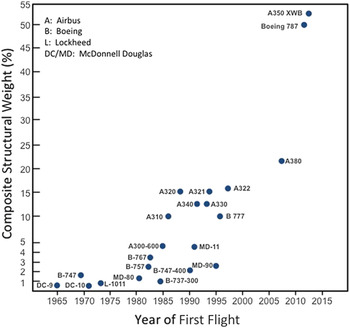
Carbon-fiber-reinforced polymer (CFRP) composites are the state-of-the-art material systems for lightweight aerospace structures. Because of their mass advantage over metallic material alternatives, their use in commercial aircraft has increased steadily over the past 50 years, as shown in Figure 1.Reference Harris, Starnes and Shuart1–3 The increasing weight fraction of CFRPs in commercial aircraft is consistent with the S-curve pattern associated with technology maturation, where the use of technologies reaches a plateau following a rapid rise in adoption.Reference Fenn and Raskino4 Just as the development of carbon fibers was spurred by the need for strong, lightweight materials in aerospace applications,Reference Endo, Saito, Dresselhaus, Dresselhaus and Ebbesen5 projections of carbon nanotubes (CNTs) being a game-changing structural material were based on their superior mechanical properties enabling the next generation of lightweight, efficient aerospace vehicles.Reference Harris, Shuart and Gray6
Increasing carbon-fiber composite content in commercial aircraft.Reference Harris, Starnes and Shuart1–3

The promise of CNTs being a revolutionary material was triggered by Iijima’s seminal paper,Reference Iijima7 which captured the imagination of the research community. In the United States, research was fueled by focused funding infused by the National Nanotechnology Initiative.Reference Roco8 Today, a cursory search for publications associated with CNTs results in over 100,000 publications, attesting to the scale of investment in CNT-related research.
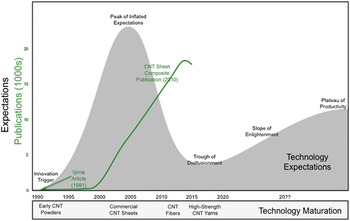
The attention garnered by these reports kindled a surge in expectations that this unique material would have an imminent impact. The interest in CNTs follows the generic technology life-cycle phases depicted by Gartner, Inc. as the Gartner Hype Cycle.Reference Fenn and Raskino4 In Figure 2, a publications plot is overlaid on the Gartner Hype Cycle, annotated with some key CNT events relevant to the advancement of CNTs toward structural applications. With what appears to be the beginnings of the “trough of disillusionment” on the Gartner Hype Cycle being coincident with the greater commercial availability of bulk formats of CNTs, the time is right for a perspective on the realistic impact CNTs can have.
Overlay of Gartner Hype CycleReference Fenn and Raskino4 with the number of publications related to carbon nanotube research.

The purpose of this article is to examine how close CNTs have come to fulfilling expectations for lightweight aerospace structures in the 24 years since Iijima’s reportReference Iijima7 stimulated intense interest in this material and to propose areas of study to bridge knowledge gaps that can realize the potential for this material to be part of the lightweight structures technology suite. This review is limited to CNT composites and hybrid composites of CNT and CFRPs having engineering polymeric matrixes such as epoxies, bismaleimides, and polyimides.
Carbon nanotubes
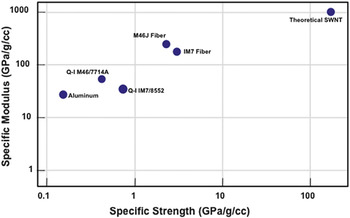
CNTs are high-aspect-ratio cylinders of graphene sheets.Reference Dresselhaus, Dresselhaus, Saito, Endo, Iijima and Dresselhaus9Figure 3 shows that, at the nanoscale, the specific strength of CNTs is 10 times greater than that of Hexcel’s polyacrylonitrile- (PAN-) based IM7 carbon fiber, and their specific modulus is five-fold higher. At the time this assessment was conducted,Reference Harris, Shuart and Gray6 the promise of structural CNTs was based on theoretical calculations for single-walled nanotubes. Experimental validation of the material’s potential was only possible later, as sufficient material became available to produce coupons of composite specimens large enough to obtain statistically reliable data on their mechanical performance.
Mechanical properties of aerospace structural materials where IM7 and M46J are carbon fibers and Q-I IM7/8552 and Q-I M46/7714A are quasi-isotropic composites of these fibers, respectively. Note: SWNT, single-wall carbon nanotube.Reference Harris, Shuart and Gray6

CNT composites
Low-loading CNT composites
Early assessments of the structural performance of single-walled CNT composites were predicated on composite mechanical properties estimated using the rule of mixtures, where a specific modulus of 1 TPa and a specific strength of 100 GPa suggested that simply doping engineering matrixes with small quantities of this reinforcement would yield structural materials that could outperform CFRPs. However, the large surface-to-volume ratio of CNTs leads to significant agglomeration, which reduces the ability of this nanoscale reinforcement to transfer stress.Reference Thostenson, Ren and Chou10,Reference Odegard, Gates, Wise, Park and Siochi11 A significant body of work in the literature has thus been devoted to understanding how dispersion can be maximized to prevent agglomeration of these nanofillers in order to take advantage of the predicted load-carrying capability.Reference Thostenson, Ren and Chou10,Reference Park, Ounaies, Watson, Crooks, Smith, Lowther, Connell, Siochi, Harrison and St. Clair12–Reference Jen and Huang28
Lightly doped CNT composites consist of 0.5–5% CNT powder mixed in a polymer matrix. Approaches to aid the dispersion of the nanofiller CNTs include in situ polymerization with sonicationReference Park, Ounaies, Watson, Crooks, Smith, Lowther, Connell, Siochi, Harrison and St. Clair12,Reference Jia, Zhang, Zhao, Xu, Huang, Qian, Lu and Wei25 and chemical functionalization of the nanotubes.Reference Gu, Liang, Liang and Ni19–Reference Ma, Siddiqui, Marom and Kim21 Because engineering polymer matrixes have inherently high tensile properties in pristine form, addition of nanofillers yields nanocomposites with mechanical properties enhanced to a significantly lesser extent than those noted for lower-stiffness matrix materials.Reference Bai and Ci17 These enhanced mechanical properties were often touted to be multiple times better than the matrix material properties. Although such a difference represents a significant increase over the unfilled baseline material, when compared to the mechanical properties of state-of-the-art structural composites, these improvements are insufficient for lightly doped CNT composites to be a serious contender as a material for highly loaded structural components.
High-volume-fraction CNT composites
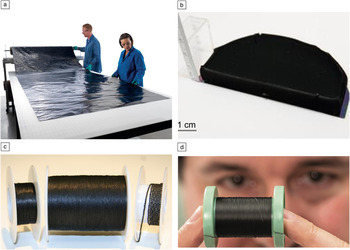
Although a significant portion of the published literature is devoted to the study of lightly loaded CNT composites, state-of-the-art CFRPs used in aerospace applications are predominantly composed of carbon-fiber reinforcement, typically containing ∼60% fiber bound by ∼40% resin. As CNTs became available in larger quantities, much higher concentrations of CNTs in composites became more accessible. In addition to the more pervasive powder form of CNTs, these materials are now also obtainable as sheetsReference Gurau29 or buckypaper,Reference Mora, Vilatela and Windle30 vertical arrays,31–Reference Cho, Schulz and Shanov33 fiber,Reference Behabtu, Young, Tsentalovich, Kleinerman, Wang, Ma, Bengio, ter Waarbeek, de Jong, Hoogerwerf, Fairchild, Ferguson, Maruyama, Kono, Talmon, Cohen, Otto and Pasquali34 and yarn,Reference Gurau29 as shown in Figure 4. Composites fabricated from these formats are discussed in the following sections.
Available carbon nanotube formats: (a) sheets,Reference Gurau29 (b) vertical arrays,Reference Cho, Schulz and Shanov33 (c) yarns,Reference Gurau29 and (d) fibers.Reference Behabtu, Young, Tsentalovich, Kleinerman, Wang, Ma, Bengio, ter Waarbeek, de Jong, Hoogerwerf, Fairchild, Ferguson, Maruyama, Kono, Talmon, Cohen, Otto and Pasquali34 (a, c) Courtesy of Nanocomp Technologies, Inc. (b) Reprinted with permission from Reference Reference Cho, Schulz and Shanov33. © 2014 Elsevier. (d) Photo credit Jeff Fitlow, Rice University.

Buckypaper
Randomly aligned buckypapers, or flat mats of CNTs, can be made by filtering a high-concentration suspension of dispersed CNTs and drying the dense mat collected on the filter paper.Reference Wang, Liang, Wang, Zhang and Kramer35,Reference Jakubinek, Ashrafi, Guan, Johnson, White and Simard36 They are also available in large sheets produced using a gas-phase catalytic growth process.Reference De Volder, Tawfick, Baughman and Hart37 Regardless of the fabrication approach, this format offers a route for making high-quality composites containing more than 50% CNTs, without having to overcome the challenge of homogeneously blending a highly viscous solution of the matrix material with a large amount of CNT powder. The resulting composite has a CNT/matrix ratio more consistent with those typically encountered in aerospace CFRPs.
As-received CNT sheets obtained from the gas-phase process have specific tensile strengths ranging from 100 MPa/(g/cm3) to 250 MPa/(g/cm3) and specific tensile modulus of ∼5 GPa/(g/cm3).Reference Lin, Kim, Connell, Lebrón-Colón and Siochi38–Reference Cano, Grimsley, Czabaj, Hull and Siochi41 Composites fabricated from these randomly aligned CNT mats have specific strengths of over 300 MPa/(g/cm3) and specific moduli of ∼25 GPa/(g/cm3).Reference Kim, Siochi, Carpena-Núñez, Wise, Connell, Lin and Wincheski39–Reference Downes, Wang, Haldane, Moench and Liang43 Although these mechanical properties are multiple times higher than those of the unfilled resin, they are still far below those of typical CFRPs (∼3 GPa/[g/cm3] and ∼170 GPa/[g/cm3], respectively).Reference Harris, Shuart and Gray6
Functionalization and cross-linking of unaligned CNT sheets can enhance interbundle and nanotube/matrix interactions. The mechanical properties of the composites derived from these modified buckypapers indicate that these interactions were not sufficient to achieve high tensile properties.Reference Jakubinek, Ashrafi, Guan, Johnson, White and Simard36 In contrast, dramatic improvements in CNT composites were noted when the nonwoven CNT mats were mechanically stretched to align and densify the CNT network.Reference Kim, Siochi, Carpena-Núñez, Wise, Connell, Lin and Wincheski39–Reference Downes, Wang, Haldane, Moench and Liang43 Condensing the CNTs in this manner and improving the CNT/matrix interface either by functionalization,Reference Cheng, Wang, Zhang and Liang44 or by lowering the viscosity of the resin during infiltration,Reference Kim, Sauti, Siochi, Smith, Wincheski, Cano, Connell and Wise40 yielded a specific tensile modulus of more than 80 GPa/(g/cm3), close to those measured for unidirectional CFRP laminates, (i.e., with carbon fibers aligned in one direction).45 It is notable, however, that although the stiffness of the composite approaches that of unidirectional CFRPs, the specific strength remains approximately 55% of CFRP specific strengths.Reference Harris, Shuart and Gray6,Reference Kim, Sauti, Siochi, Smith, Wincheski, Cano, Connell and Wise40–Reference Cheng, Wang, Zhang and Liang44
Vertical arrays
Vertical arrays or forests of CNTs grown on a substrate by chemical vapor deposition (CVD) represent another format of highly aligned, uniform-length CNTs.31 Highly loaded CNT composites were fabricated by mechanically compressing the CNT forest detached from the substrate and then dipping the reinforcement in a resin pool, relying on capillary wetting to infuse the densified assembly with a thermosetting resin.Reference Wardle, Saito, Garcia, Hart, de Villoria and Verploegen46,Reference Cebeci, de Villoria, Hart and Wardle47 CNT contents of up to 20 vol% were achieved. The modulus measured from the highly loaded composite was less than 10% of the predicted value of 100 GPa based on rule of mixtures. The severe decrease of the measured modulus was attributed to the inherent waviness of the CNTs used in this study,Reference Wardle, Saito, Garcia, Hart, de Villoria and Verploegen46 suggesting that, in addition to requiring highly densified aligned CNTs as illustrated in the buckypaper embodiment, load transfer is more effective when the CNT network comprises straight nanotubes.
High-strength fibers
CNTs have been used to create high-strength fibers in two ways. First, a very low concentration (up to 1 wt%) of highly pure CNTs dispersed in high-molecular-weight PAN served as a nucleating agent for the crystallization of PAN domains and improved orientation and graphitization of the fibers. Carbon fibers templated with CNTs resulted in 64% and 49% improvements in fiber tensile strength and modulus, respectively, compared to undoped PAN fibers.Reference Sahin, Fasanella, Chasiotis, Lions, Newcomb, Kamath, Chae and Kumar48,Reference Liu and Kumar49
Second, CNT fibers have also been produced by dissolving CNTs having very low defect contents in chlorosulfonic acid, and then extruding through spinnerets and coagulating the resulting fiber.Reference Behabtu, Young, Tsentalovich, Kleinerman, Wang, Ma, Bengio, ter Waarbeek, de Jong, Hoogerwerf, Fairchild, Ferguson, Maruyama, Kono, Talmon, Cohen, Otto and Pasquali34 The extrusion process induced alignment of the CNTs and, together with the use of high-purity starting materials, yielded fibers with very good tensile properties. The average specific strength and specific modulus reported were 0.77 GPa/(g/cm3) and 92 GPa/(g/cm3), respectively. This combination of properties warrants evaluation of such fibers as reinforcements for high-strength composites in aerospace applications. Moreover, because most structural fibers currently used in composites are manufactured by solution spinning,Reference Liu and Kumar49 CNT fibers produced in this way might be readily scalable and adopted by industry.
High-strength yarn
CNT yarns are very similar in form to high-strength carbon fibers. They are produced by several approaches. Specific strengths of about 10 GPa/(g/cm3) were reported for yarn produced by spinning from an aerogel, (i.e., a web of CNTs produced by CVD),Reference Koziol, Vilatela, Moisala, Motta, Cunniff, Sennett and Windle50 although these values were obtained using a short (1 mm) gauge length. Measurements conducted with a 20 mm gauge length yielded specific strengths on the order of 1 GPa/(g/cm3). High volume fraction (>25%) epoxy composites fabricated from these yarns were shown to achieve 90% of the predicted ultimate strength determined by simple rule of mixtures. The CNT fibers enhanced compressive properties as well.Reference Mora, Vilatela and Windle30 CNT yarns made using the floating catalyst CVD approach are now available in commercial quantities with specific strengths approaching those of Kevlar. The quoted CNT yarn specific strength of 1.8 GPa/(g/cm3)Reference Gurau29 is about one-half that of carbon fiber.Reference Harris, Shuart and Gray6 However, carbon-fiber properties are typically decreased in composites fabricated from these fibers.Reference Harris, Shuart and Gray6 In contrast, CNT composite properties tend to be higher than those of the CNT reinforcement from which the composite is derived;Reference Kim, Siochi, Carpena-Núñez, Wise, Connell, Lin and Wincheski39–Reference Cheng, Wang, Zhang and Liang44 therefore, it is anticipated that CNT composites fabricated from this type of high-strength yarn will yield properties comparable to those of unidirectional IM7/epoxy composites.45
Yarns have been dry spun from vertical CNT arrays by drawing CNTs from the forest of vertical arrays.Reference Jiang, Li and Fan51,Reference Zhang, Atkinson and Baughman52 High specific strengths of the yarn ranging from 0.310 GPa/(g/cm3) to 0.575 GPa/(g/cm3) were reported.Reference Zhang, Atkinson and Baughman52 A recent report emphasized advances toward more practical commercial production rates of fibers from this format of CNTs.Reference Alvarez, Miller, Haase, Kienzle, Zhang, Schulz and Shanov53 Tensile properties of the high-throughput yarn have not been reported. The ability to spin catalyst-free yarn using this process offers a potential advantage of environmental durability for composites fabricated from this material in applications where long-term environmental stability is important.
The advent of CNT yarns represents a step in the direction of advancing CNTs as a component of high-strength, lightweight structures. Attractive mechanical properties measured at gauge lengths used in ASTM (American Society for Testing and Materials; organization that sets international standards) methods result from densified, highly aligned CNTs with low defect contents. The commercial availability of large quantities of these materials having such good fiber characteristics opens the way to assessing the mechanical properties of composites derived from this CNT format. Excellent composite properties are likely to require composite processing methods that promote excellent CNT/matrix interfaces to maximize stress transfer across the discontinuous, densely packed high-strength nanotubes.
Hybrid CNT/carbon-fiber composites
Another approach for taking advantage of CNTs in structural composites is to integrate them into CFRPs to yield hybrid composites with mechanical properties superior to those of CFRPs, whose utility is limited by failure due to poor interlaminar properties. Several studies have explored various ways in which the different formats of CNTs described in the preceding section can be hybridized with CFRPs to enhance the interlaminar properties of these composites. In one approach, an unaligned CNT mat was sandwiched between two layers of woven carbon-fiber sheets and co-cured. The in-plane shear strength of this type of hybrid composite increased by about 50% relative to that of CFRPs that did not contain the CNT sheet.Reference Kim54
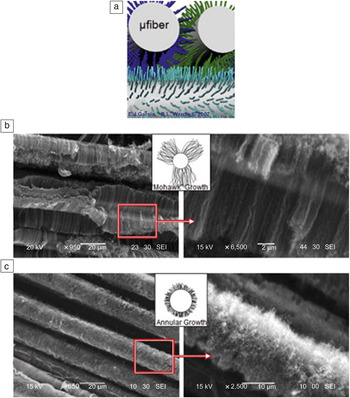
Different approaches proposed for enhancing interlaminar properties without decreasing in-plane properties are based on using vertical CNTs to bridge across laminates. For example, hybrid composites produced with fuzzy fibers, fibers with radially grown CNTs as shown in Figure 5,Reference Wicks, Wang, Williams and Wardle55 were designed to yield composites with better interlaminar properties based on a mechanism involving load transfer across laminates through CNTs grown radially around the fiber reinforcement.Reference Wicks, Wang, Williams and Wardle55–Reference Steiner, Li and Wardle57 Interlaminar shear strength was shown to improve by more than 60% relative to that of composites produced with bare fibers. Alternatively, vertical arrays of aligned CNT were transferred to the CFRP prepreg, which is a resin-infused carbon-fiber fabric or tape, while maintaining their orientation perpendicular to the carbon-fiber laminates.Reference Garcia, Wardle and Hart58 Modest improvements in mode I (where a crack propagates due to tensile stress normal to the crack plane) and mode II (where a crack propagates due to shear stress) toughness were noted. However, when CNTs were directly grown on woven carbon-fiber fabrics, the resulting hybrid composite exhibited ∼50% greater fracture toughness.Reference Kepple, Sangorn, Lacasse, Gruenberg and Ready59
Examples of architectures for carbon nanotubes (CNTs) grown radially around a fiber. Reprinted with permission from Reference Reference Wicks, Wang, Williams and Wardle55. © 2014 Elsevier.

Finally, the use of a combination of these nanocomposite concepts at the interface between carbon-fiber laminates yielded positive results as well. The highest enhancement was 50% improvement in mode II fracture toughness when an aligned CNT sheet was used in conjunction with a toughened interlayer region.Reference Nguyen, Tun, Haro, Yoshioka, Hirano and Ovalle-Robles60,Reference Tun, Yoshioka and Nguyen61
Lessons from aerospace carbon-fiber composites
Early insertion of CFRPs into commercial vehicles consisted of testing lightly loaded secondary structures such as fairing panels (used to bridge gaps between aircraft parts in order to produce a smooth surface and reduce drag), spoilers, and upper aft rudders. Subsequently, test elements progressed to increasingly heavily loaded components such as ailerons,Reference Harris, Starnes and Shuart62 elevators, and horizontal and vertical stabilizers.Reference Cho, Schulz and Shanov33 The objective of flight testing these composite structures was to validate ground-test data with actual flight information. Consistency between performance in flight and predictions based on ground tests contributed to confidence in the use of CFRPs in aircraft components.Reference Harris, Starnes and Shuart1
Lessons learned from failure analysis of the composite components also advanced understanding of the differences in failure characteristics of metals, for which there were established models, and composites, a new material for which such models were absent.Reference Harris, Starnes and Shuart1 Just as decades of design knowledge gained from metallic structures cannot be directly transferred to composite structures that fail in a different manner, the same consideration must be afforded to the design of CNT structures, where the larger surface areas in nanostructures, combined with excellent mechanical properties, albeit with noncontinuous elements, offer a breadth of possibilities that is not yet fully understood. Starting points for understanding mechanisms in CNT structures that can support structural applications can be gleaned from the extensive studies done on CFRP structures and compiled by the CFRP community in publications documenting the results of the worldwide failure exercises, where subject matter experts in composites convened to discuss failure of CFRPs.Reference Hinton and Soden63–Reference Hinton and Kaddour65
Industry practice involves the use of a building-block approach, where component design relies on an understanding of the load environment for specific elements. The development process encompasses definition of the manufacturing method to achieve the required structural performance. This established practice relies on building a database of mechanical properties from numerous test coupons, elements, and subcomponents to assure safety and reliability of the structure.Reference Harris, Starnes and Shuart1 Development work as exemplified by the Advanced Subsonic Technology Composite Wing ProgramReference Karal66 spans durability and damage-tolerance studies, manufacturing studies, large-component fabrication, and testing. This rigorous process is necessary to ensure safety and reliability of a structural material; the nature of the process requires the availability of large quantities of materials with reliably consistent properties.
Technology maturation and insertion of CNTs in aerospace structures
Highlights of technology maturation for structural CNTs are captured in Figure 2, which illustrates the application of the Gartner Hype Cycle to CNT development. Iijima’s workReference Iijima7 triggered significant interest in this material. The surge in publications fueled expectations about the potential for CNTs to be game-changing. Initial expectations of immediate payoff in structural benefits from the extremely high tensile properties reported for CNTs have been tempered by more than 15 years of research largely yielding disappointing results for strong nanocomposites. However, as shown in this review of high-volume-fraction CNT composites, significant progress has been made in the past few years to advance this technology toward realistic use in structural components. This was achieved through focused efforts to work toward proofs of concept that mechanical properties comparable to those of CFRPs can be achieved with high volume concentrations of aligned, densified CNT networks. These advancements, along with the increasing commercial availability of CNT formats more amenable to processing with methods developed for carbon-fiber composites, might be signaling a tipping point for this technology. The increase in publications studying this material for the purpose of insertion into aerospace applications might be the beginning of the “slope of enlightenment” (see Figure 2).
Scale-up of commercially available nanomaterials has progressed significantly in the past couple of years. High-strength nanocomposite articles are beginning to be produced in larger scales with properties that are competitive with those of CFRPs at the macroscale.Reference Siochi, Kim, Sauti, Cano, Wincheski, Ragcliffe, Czabaj, Jensen and Wise67 Although this constitutes considerable technical progress, actual use in aerospace structures will not become common until a better understanding of how to design and use these materials can be developed. Among other things, this requires an understanding of how stress transfer occurs across the length scales spanning from nanotubes to networks of tube bundles. This requires characterization of the local behavior of CNT elements, as well as their multiscale interactions in the network of reinforcement that constitutes macroscale composites. An understanding of these mechanisms can be aided by developing computational tools to model behavior at the mesoscale where these critical interactions occur.
The range of problems that need to be overcome requires multidisciplinary collaborations so the problems can be addressed in parallel to advance understanding and technology maturation. Coupling experimentation with modeling in the following areas can contribute to accelerate development:
• improving nanotube structural perfection at high manufacturing rates;
• developing an understanding of the load-transfer mechanism across length scales to retain excellent nanoscale properties at the macroscale;
• developing nanocomposite processing methods to enhance interfacial interaction between the matrix resin and the nanofillers, including the design and synthesis of matrix resin compositions tailored for CNTs; and
• understanding the failure mechanism in high-strength composites sufficient to develop modeling tools to support structural design.
Given the breadth of possible applications and understandable risk aversion in aerospace applications, the community can benefit from a systems analysis study that identifies areas of near-term payoffs. This exercise would permit the definition of some demonstration articles to focus attention on issues specific to this high payoff technology. Some near-term use opportunities can be employed as vehicles to generate the relevant body of information necessary to inspire confidence in structure designers as to the utility of nanomaterials in realistic applications. Such a benefits analysis study could also be used to map the mid- and far-term benefits of structural nanomaterials. In addition, this exercise could yield concrete research objectives that can focus the community on making real progress toward a demonstrable application, which would move this technology onto the so-called “slope of enlightenment” (see Figure 2) and, thereafter, to productive use.
Acknowledgments
We acknowledge Drs. Kristopher Wise, Stephen Scotti, James Ratcliffe, and Richard Wahls for insightful discussions that helped inform the content of this article.