THE VARIABLE, DATA, AND METHODS
No other morphological variable except the copula has played as prominent a role in sociolinguistics and creole studies as the variation between inflected and unmarked past-temporal reference verbs. Several studies have examined the use of past marking by second-language speakers of English (e.g., Adamson et al., Reference Adamson, Fonseca-Greber, Kataoka, Scardino and Takano1996, on Spanish learners; Bayley, Reference Bayley1996, on Chinese learners; and Wolfram & Hatfield, Reference Wolfram and Hatfield1984, on Vietnamese learners) and in varieties of English around the world (e.g., Schreier, Reference Schreier2003, on Tristan da Cunha); the focus, however, has been on variable past inflection in African American Vernacular English (AAVE) and the English-based creoles of the Caribbean (CECs). Part of this interest is probably due to the variable's central position in the enduring debate about the origins of the former. Whereas the absence of a morphological mark on consonant-final regular verbs (e.g., work) was first construed as the result of syllable-final consonant cluster reduction (Fasold, Reference Fasold1972; Labov et al., Reference Labov, Cohen, Robins and Lewis1968; Wolfram, Reference Wolfram1969) and subsequently interpreted as an argument against the creolist position of an underlying zero past, Bickerton (Reference Bickerton1975:159) proposed that, were the AAVE data reanalyzed taking into account distinctions such as stativity, a creole pattern would emerge.
This controversy already illustrates one of the problems involved in the analysis of past inflection: its location “at the intersection of variable processes” (Patrick, Reference Patrick1991:171). On the one hand, there is the phonological process of syllable-final consonant cluster reduction, which affects syllables that end in a stop that shares voicing with the immediately preceding consonant. In such cases, syllable-final /t/ or /d/ (as well as other stops) may be deleted. This happens not only in bimorphemic clusters, that is, past forms such as missed, but also in monomorphemic ones such as mist. On the other hand, lexical and grammatical factors, such as verb type or aspect, as well as sociolinguistic variables such as age, sex, or class have also been shown to influence the presence or absence of a morphological mark on past-reference verbs. Consequently, analyses of past inflection in AAVE and CECs “have gained steadily in sophistication and breadth” (Poplack & Tagliamonte, Reference Poplack and Tagliamonte2001:103); they now generally make fine distinctions along all of these lines.
Yet, in spite of this progress, and after more than 30 years of research, no consensus seems to have been reached with regard to the most fundamental problem affecting quantitative linguistic analysis: the definition of the scope and relevant contexts of the variable (ed). Even though most studies now include a more or less detailed section concerning the circumscription of the variable context, the theoretical grounds on which specific forms are included or excluded are seldom explicitly spelled out. This not only makes the actual counting and coding process difficult; it also hampers the drawing of conclusions based on cross-variety comparisons, as the results obtained in one study may not be generalizable to the next.
According to Milroy (Reference Milroy1987:114), one reason for the infrequency of explicit discussion concerning the constitution and extension of linguistic variables is that “elements of English which vary in a socially patterned manner are often very salient and sometimes rather general throughout the English-speaking world.” Moreover, there are apparently clear guidelines set up by the pioneer of the quantitative approach, William Labov. The “principle of accountability” (Labov, Reference Labov, Lehmann and Malkiel1982:30) simply and concisely states that “for the section of speech being examined, all occurrences of a given variant are noted, and where it has been possible to define the variable as a closed set of variants, all non-occurrences of the variant in the relevant environments.” The identification of variants is guided by the idea of identity in meaning, that is, variants must be “alternate, semantically equivalent ways of saying ‘the same thing’” (1982:18). However, Labov has also pointed out that “even the simplest type of counting raises a number of subtle and difficult problems. The final decision as to what to count is actually the solution to the problem in hand” (1968:14, quoted in Wolfram, Reference Wolfram1969:47).
At first sight, the analysis of the variation between inflected and unmarked past-reference verbs does not appear unduly complex. After all, if auxiliary structures and preverbal particles are disregarded, as is usually the case (see below), the variation does not exceed the single-word domain, the variable processes being suffixation, vowel change, or suppletion, and its semantic dimension appears easy enough to formulate: “the variable is […] defined by its meaning and function: past-reference” (Patrick, Reference Patrick1999:223). Yet, apart from the fact that defining the envelope of variation always requires care, as the inclusion or exclusion of tokens may impose a model on the data, which, in turn, may influence the results obtained (cf. Poplack & Tagliamonte, Reference Poplack and Tagliamonte2001:114), there are at least two reasons why accurate determination of the variable context for past inflection may be more complex than it initially appears. First, in all varieties of English, the marking of temporal distinctions is characterized by a considerable lack of correspondence between form and function. According to Biber et al. (Reference Biber, Johansson, Leech, Conrad and Finegan1999:452), this is particularly true of tense marking. One form, such as the Simple Present, may function in a number of contexts, such as present habituality, future time, and past (in the case of the historical present); conversely, one meaning, such as future temporal reference, may be expressed via a variety of forms, such as the Simple Present, going to, and will.
Second, the semantic area of past-temporal reference involves a host of subdistinctions that constitute potential complications for the establishment of semantic equivalence. There is not only tense, which locates a situation in time, but also aspect, which makes reference to the internal temporal structure of the situation. A final distinction can be made in terms of orientation (Kortmann, Reference Kortmann1991:24), a term which is not generally accepted in linguistics but is useful for characterizing the PERFECT,Footnote 1 which is often treated as an aspect but is best thought of as a separate cross-linguistic category (cf. Dahl, Reference Dahl1985:129). According to Kortmann (Reference Kortmann1991:18), orientation, just like tense, relates to situation-external time but “indicates no more than the anteriority of some situation relative to some reference time which may or may not be identical with coding time”—an idea that can also be captured with Reichenbach's model of temporal reference (1947), which will be discussed shortly.
Such problems are compounded by the fact that AAVE and CECs exist in “divergent dialect situations” (Winford, Reference Winford1993a:141) in which standard English (StE) and nonstandard varieties and/or creoles interact with each other. For variable linguistic processes, such as past inflection, this means that identical surface variants may result from structurally different grammars. As Poplack and Tagliamonte (Reference Poplack and Tagliamonte2001:5) point out, the absence of inflection, for example, “may be the creole mark for a non-stative verb with simple past reference […] or result from removal of an English past-tense suffix.” How is semantic equivalence to be established in such cases? According to Winford (Reference Winford1993a:142), “great care” is necessary, but “there is no reason, in principle, why it cannot be done.” His own work on perfect have in Trinidadian English (Winford, Reference Winford1993a), which presents a detailed discussion of the decisions that were made in delimiting the variable, constitutes an example. Extended discussion of “count” and “don't count” cases in copula analyses is presented in Blake (Reference Blake1997b). My article aims to contribute to variation analysis in the spirit of these studies.
In the following, I first review the delimitation of the envelope of variation in previous studies of past inflection in AAVE and CECs. I then discuss the meanings and uses of the English Simple Past and those of the creole unmarked verb and outline their temporal-aspectual dimensions. Next, I look at the categorization of individual lexical items and morphological verb classes and consider the effects of such categorization on the results of analyses of variable past inflection. Throughout the article, I draw on data from Bahamian Creole English (BahCE), a CEC whose closest historical and linguistic links are with Gullah (cf. Hackert and Huber, Reference Hackert and Huber2007) but which also shows similarities to AAVE, Trinidadian Creole, and Barbadian.
The present-day Bahamas represent an example of the “divergent dialect situation” sketched previously. According to Holm and Shilling (Reference Holm and Shilling1982:ix), there exists
a continuum of overlapping varieties of English, ranging from a creole retaining the most influence of the grammar of African and other languages (the basilect) to a variety of English whose grammatical differences from the standard English spoken elsewhere are negligible (the acrolect).
In the Bahamas, as well as in other Caribbean speech communities, negative attitudes toward the vernacular are frequent. The “dialect” (as speakers of BahCE call it) is often viewed as “bad” or “broken” English and opposed to “proper,” that is, standard, English. It is associated with backwardness and a lack of education and is seen as an obstacle to the country's modernization and integration into the global economy. In spite of these negative associations, most Bahamians are unwilling to abandon their dialect. They feel that it is appropriate in private and/or informal situations or when humor or social authenticity are to be conveyed, but in public and/or formal situations or when “serious” topics are at hand, StE is the form of speech called for.
This means that StE is an important part of the Bahamian sociolinguistic situation, and variation in language use generally involves standard forms on the one hand and nonstandard or creole ones on the other. It does not mean that linguistic variation is exclusively unidirectional in that all creole speakers are automatically driven by the societywide prestige target; on the contrary, a close examination of speaker attitudes reveals a variety and complexity of evaluative norms that are difficult to account for within a “consensus” or “concord” model of the speech community (cf. Rickford, Reference Rickford1986b). The situation just described also means that, in discussing the linguistic variable past inflection, we need to refer not only to creole grammar but also to StE grammar. This in no way implies that I advocate using StE as a model for CECs or that we should do “typology-by-translation”;Footnote 2 it simply means that, in describing the linguistic variation extant in urban BahCE, we need to take into account both creole and standard forms.
My data stem from sociolinguistic interviews with 20 speakers—10 male and 10 female—between the ages of 25 and 80 that I conducted in the Bahamian capital, Nassau, in 1997 and 1998. All speakers came from working-class areas of Nassau; some had moved from there to more middle-class residential areas. The interviews centered on topics such as work, traditional crafts, family life, life on the Out Islands of earlier times, individual episodes in Bahamian history or the speaker's own life, and folklore; they yielded more than 8000 tokens of (ed).
To obtain explicit information on the meanings and uses of particular verb forms as well as negative evidence on their employment in discourse (i.e., information on what cannot be used in what contexts), I also administered Dahl's tense-aspect questionnaire (1985:198–206) to five highly educated bilingual speakers of BahCE. The questionnaire consists of a number of sentences as well as a series of short texts to be translated from standard English. All sentences are placed in a specific context; verbs are given in the infinitive and capitalized in the text to minimize influence from English in the translation:
[Talking of what happened yesterday] While my brother WRITE the letter, I WAIT in the garden.
For more information on the data, see Hackert (Reference Hackert2004:17–30).
THE TEMPORAL-ASPECTUAL PROPERTIES OF (ED): ABSOLUTE PAST, PERFECT, HABITUAL
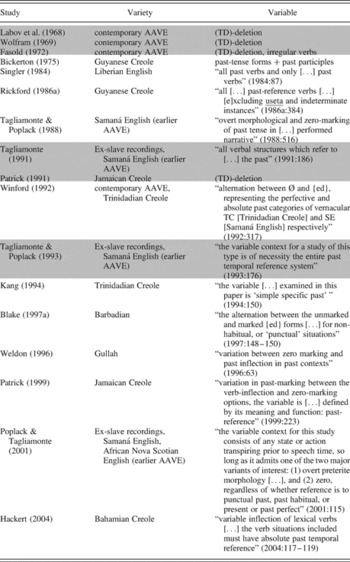
Table 1 presents an overview of extant studies of past marking in AAVE and CECs.Footnote 3 Even at the most general level, there are great differences in the aims and databases of the various investigations. The earliest analyses of past marking in AAVE (i.e., Fasold, Reference Fasold1972; Labov et al., Reference Labov, Cohen, Robins and Lewis1968; Wolfram, Reference Wolfram1969) as well as Patrick's (1991) article on Jamaican Creole (all shaded lightly) were primarily interested in syllable-final consonant cluster reduction and, therefore, included not only verbs but also words of other classes to which this process applies. By contrast, Tagliamonte (Reference Tagliamonte1991) and Tagliamonte and Poplack (Reference Tagliamonte and Poplack1993) investigate “the entire past temporal reference system” of earlier AAVE, as represented in a Samaná corpus and the ex-slave recordings (cf. Bailey et al., Reference Bailey, Maynor and Cukor-Avila1991), in order to uncover this system's “underlying grammatical structure” (Tagliamonte, Reference Tagliamonte1991:10) and thus the (creole or English) origins of the variety. As a result of this diversity in interests, there are great differences in the delimitation of the variable context, as the final column of Table 1 shows.
Studies of past marking in AAVE and CECs

Most studies of past marking in AAVE and CECs (unshaded in Table 1) focus on the variation between inflected and uninflected forms. Inflection in this context refers to three morphological processes: suffixation, vowel change, and suppletion. This excludes periphrastic forms containing preverbal markers and/or auxiliaries, even though the term “inflection” is sometimes used in a wider sense to refer to all forms of a single lexical item as required by its various grammatical roles in particular sentences (cf. Trask, Reference Trask1993:142). The variable (ed), that is, variable past inflection, is thus usually understood to include variants such as play and played, give and gave, or go and went, but not usually did go, have played, or used to give.
It is important to note in this context that, as Poplack and Tagliamonte (Reference Poplack and Tagliamonte2001:90) point out, “circumscribing the variable context may take either form or function as the point of departure, depending on the goals of the analysis.” If we analyze variable past inflection in the sense just defined, we define our variable by formal means. What needs to be done then is to specify semantically equivalent contexts of occurrence and provide linguistic argumentation for the inclusion or exclusion of particular tokens. The circumscription of the scope and content of the variable may also proceed from the semantic to the formal. Poplack and Tagliamonte (Reference Poplack and Tagliamonte2001:90), for example, “begin with the temporal reference point (past and future, respectively), and consider all of the variants selected to express it.” The variable context thus comprises a single function, such as past, and a number of forms, such as inflection, preverbal markers, and auxiliary structures.
In what follows, I will restrict my attention to past inflection in the narrower sense, which means that, like the majority of studies listed in Table 1, I take the form of the variable as the point of departure. Thus, if I refer to “past inflection” or “past marking,” what is meant is always synthetic forms such as played or gave and not analytic constructions such as used to give, even though, they also indicate past-temporal reference. Even if we restrict our attention to studies of past inflection “proper,” however, there is still considerable potential for disagreement over the envelope of variation. The sources for such disagreement reside, first, in the temporal-aspectual properties of the variable and, second, in the functions and marking behavior of individual lexical items.
So what are the temporal-aspectual characteristics of (ed)? According to Patrick (Reference Patrick1999:224), the semantic scope of variable past inflection is “general past-reference”; others, such as Winford (Reference Winford1992:317) or Blake (Reference Blake1997a:150), restrict their analyses to specific or “punctual” pasts. To appreciate in what way an unmarked verb can be considered a “way of saying the same thing” as an inflected one, it is necessary first to look at the meanings and uses of unmarked verbs in creoles and past-inflected ones in English and then to determine areas of overlap. This undertaking is complicated by the “polyvalence” of creole unmarked verbs (Mufwene, Reference Mufwene1984:216; cf. also Sankoff, Reference Sankoff1990), that is, the fact that such forms have an extremely wide range of readings. Thus, apart from past-reference contexts, BahCE regularly employs bare verb stems to refer to present statives, as in
(1) Jesus love me (Sharon, 14:1).Footnote 4
habituals, as in
(2) They does steal away, when they get in the job, they steal away, especially—if they—have–a big position, and they handling the money, they take so much—out, they go for big, big, big, big money (George, 25:28–30).
generic sentences, as in
(3) [Q: What kind of sound do cats make?] They MEOW
A: They go “meow”
D: They meow
and in proverbs, as in
(4) Fish'man never call his own fish stink (Glinton-Meicholas, Reference Glinton-Meicholas1995:115).
Of course, as these contexts all have nonpast reference, they must be excluded from analyses of variable past inflection, even if they contain one of the variants of (ed), that is, the uninflected verb.
Interestingly, the wide range of readings of creole unmarked verbs is paralleled by that of past-inflected ones in English. The Simple Past also occurs in nonpast contexts; this happens in indirect speech or thought, as in
(5) How did you know that I was Max Wilson?
in hypothetical constructions, such as
(6) If you really worked hard, you would soon get promoted.
and in contexts in which a tentative attitude is to be conveyed, as in
(7) Did you want to see me now? (all examples from Quirk et al., Reference Quirk, Greenbaum, Leech and Svartvik1985:188–189).
Obviously, such constructions must also be excluded. To sum up, even if unmarked and past-inflected verbs occur in a wide range of contexts, some of them with nonpast reference, the variable's semantic scope must be restricted to the past. However, can we be more specific?
Perfective and habitual verb situations
According to Quirk et al. (Reference Quirk, Greenbaum, Leech and Svartvik1985:183), an important feature of the English Simple Past is that the state or event it denotes “must have taken place in the past, with a gap between its completion and the present moment”; Biber et al. (Reference Biber, Johansson, Leech, Conrad and Finegan1999:454) state that the Past “most commonly refers to past time via some past point of reference.” The implications for an analysis of variable past inflection are straightforward. The verb situations included must have absolute past-temporal reference, which—in terms of Reichenbach's (Reference Reichenbach1947) three-point framework, which builds on the distinction between a point of the eventFootnote 5 (E), a point of reference (R), and a point of speech (S)—means that reference time must be identical with a past event time, or E, R—S.Footnote 6
Just as English employs the Simple Past to render absolute past situations, CECs use the unmarked verb, which the boldfaced forms in the following extract illustrate.
(8) I—I been in a—a—in—in a—in a—plane crash before.
[No way!]
Yeah, that's 15 years ago when my daddy die. I was in Miami, and I had to leave—out of Miami about—7:30 that night. And catch a private plane out for Crooked Island, Sunday morning for the funeral. And when we got—when we got in Crooked Island, before we—just before we land, the pilot said—tell us to be prepare, ‘cause the gear stuck, the landing gear stuck. But, you see, Crooked Island is a place like this, where the e—where—where the runway is—both side is sandy ground, and the plane—when it hit—when it hit the runway, it run off the—the runway. And she hit and she run until she bog in the sand—just about—just about the top of the plane was in the sand. But other places wouldn'ta had that opportunity, ‘cause ‘e ain't much places in the Bahamas where the runway is sandy. And that what save us (Sidney, 6:4–20).
In Bickerton's description of the “typical” creole tense-mood-aspect (TMA) system (1981:58), the interpretation of the unmarked verb is dependent on the situation's aspectual characteristics: whereas unmarked statives express the present, unmarked nonstatives receive a past interpretation. This description has often been taken to imply that creoles possess “special” TMA systems, different from those of any other language. A look at the typological literature, however, reveals striking similarities with noncreole languages (cf. Velupillai, Reference Velupillai2003). Thus, the unmarked verb frequently appears as an instantiation of the PERFECTIVE (PFV) cross-linguistically (Bybee et al., Reference Bybee, Perkins and Pagliuca1994:90–91); perfective verb situations constitute its most important use in BahCE as well.
In both Dahl's (1985) typological and Smith's (1997) universal grammar perspective, boundedness is the critical feature characterizing the PFV. Boundedness, in turn, implies past reference, as unbounded situations by necessity include the present. According to Dahl (Reference Dahl1985:78), the “prototypical” PFV can be characterized as follows:
A PFV verb will typically denote a single event, seen as an unanalyzed whole, with a well-defined result or end-state, located in the past.
Here is an example from my tense-aspect interviews:
(9) [Q: How long did it take for your brother to finish the letter?] He WRITE the letter in an hour.
A: He write it in ‘bout an hour.
C: He take a hour to write the letter.
D: He finish in an hour.
J: How long it take him to write the letter? Take him a hour.
V: He write that in about a hour.
What has been said so far seems to suggest that the PFV is incompatible with stative verb situations, because these situations are defined by their lack of endpoints (Smith, Reference Smith1997:32). As Bybee et al. (Reference Bybee, Perkins and Pagliuca1994:92) point out, “when perfectives do apply to stative predicates, the effect is usually to signal a present state, not a past one, despite the fact that perfectives are usually past”—a description that recalls Bickerton's description of “typical” creole TMA systems.
However, CECs unmarked statives can also have past reference, which the following example illustrates.
(10) So, C… and some other guys got into a fight through the corner, ‘cause you know this the same corner where R… live. And he took off his jewelry, and he hand them to R…, ‘cause R… was the only person nearby that he knew. So he gave R… the—the jewelry. So apparently the little guy came, right, so C… was thanking R… for the jewelry, and the little guy already know that R… is so, ‘cause R… don't really hide it (Jeanne, 6:2–5).
If we analyze the BahCE unmarked verb as an instantiation of the PFV, such uses do not present a problem. The PFV is an aspectual category that is neutral with regard to temporal reference. Because of the boundedness constraint, its default reading is past for nonstatives and present for statives, but the presence of temporal indicators in the form of adverbials or other contextual information may override this interpretation, causing statives to assume past-temporal reference (cf. Smith, Reference Smith1997:69–70).
How do the Simple Past and the PFV go together? After all, one is a tense category, the other an aspectual one, but we are still assuming past-inflected and unmarked verb forms to constitute a single variable, (ed), in varieties such as AAVE and CECs. Cross-linguistically, aspect falls into perfective and imperfective categories. English possesses progressive and simple forms; whereas, the Progressive marks situations as ongoing and thus unbounded, the Simple Past “applies only to completed happenings,” and “an episode [is] seen as a total entity” (Leech, Reference Leech1987:13). This obviates the distinction between stative and nonstative verb situations, or, as Leech puts it, “whole lifetimes or even whole eras of civilization may, in historical retrospect, appear as complete, unitary happenings” (1987:13). What this means is that, whereas the Progressive may be seen as an instantiation of the IMPERFECTIVE, the Simple Past is actually usually perfective in meaning.Footnote 7 Thus, even though we are dealing with the interplay between a tense and an aspectual category, their common core of meaning allows us to identify them as “ways of saying the same thing,” that is, both refer to situations that happened at a definite past time and are seen as excluding the present moment.
Perfective verb situations are not the only area of overlap between past-inflected and unmarked verbs; both forms can also be employed in past habitual situations, as the following examples show.
English:
(11) In those days we used to live/lived in the country (Quirk et al., Reference Quirk, Greenbaum, Leech and Svartvik1985:187).
BahCE:
(12) [The boy used to receive a sum of money now and then] When the boy GET the money, he BUY a present for the girl.
A: Every time he daddy gi’ him money, he buy a present for the girl.
J: His daddy used to send him a lot of money one time ago, and man, whenever he get that money, first thing he do is go buy a present for that girl.
V: Almost every time he get that money, he used to go buy her one present.
In such situations, there is variation between a number of other forms; whereas in English, would and used to alternate with the past-inflected verb (with slight differences in meaning; cf. Quirk et al., Reference Quirk, Greenbaum, Leech and Svartvik1985:228–229), BahCE features an even wider range of forms, as the following examples show.
(13) I remember my grandmother, he had a—he—she had a cousin, and he was a—preacher, he was a minister, went to the Se—to the Seven Days Church, only Saturday church. And he was the only person on this Island was—belong to this church. The other settlement had people. And my grandmother would send me to him every Saturday, too, when she make bread in the oven. We used to make bread in the oven—uh—with wood and things and—and fish and what not like that. She'll send me to carry his dinner. And he'll be meditating, and I would go in the house quietly and put his stuff down. And then I would leave (Mrs. Miller, 4/16/97, 5:39–44).
(14) I used to come down the road, I used to get beaten. I's—like—let me show you. Let me show you what I used to do. I used to come, and I used to go by him, and I talk, if I get send to the shop, I is forget, I talk until I—my grammy used to be looking for me, and I used to get a beating for that (Shanae, 5:17–20).
Many studies of past inflection in AAVE and CECs exclude past habitual situations from their analyses. Winford (Reference Winford1992:317–318), for example, writes: “We are concerned here only with alternation between Ø and {ed}, representing […] specific events or situations seen as past in relation to the moment of speaking,” and Blake (Reference Blake1997a:149–150) “focuses on mesolectal perfective marking/unmarking for non-habitual, or ‘punctual’ situations (e.g., After that, I come home).” Tagliamonte and Poplack (Reference Tagliamonte and Poplack1988) investigate only data from narratives of personal experience (cf. Labov & Waletzky, Reference Labov, Waletzky and Helm1967). Even though their background (or orientation) sections may contain habitual verb situations, the defining characteristic of such narratives is their specificity; we can thus assume that if habitual tokens entered into the calculations of Tagliamonte and Poplack (Reference Tagliamonte and Poplack1988) at all, their share in the data can be no more than marginal.
It can well be argued, however, that instances of unmarked or inflected past-reference habituals should be included in a quantitative analysis: not only is the Simple Past a viable alternative to used to or would for past habitual situations in StE (Quirk et al., Reference Quirk, Greenbaum, Leech and Svartvik1985:187, 228–229); but Winford (Reference Winford1992:335) also indicates that the distinction between verbs referring to specific past situations and those referring to habitual ones is an important one for the alternation between unmarked and inflected verbs in AAVE, a finding that is confirmed by Poplack and Tagliamonte (Reference Poplack and Tagliamonte2001:127). It also holds for various CECs, such as Trinidadian Creole (Winford, Reference Winford1992) and BahCE (Hackert, Reference Hackert2004:166–172).Footnote 8 Most importantly, however, the semantic properties of past habitual situations permit their inclusion in analyses of (ed).
As already outlined, an important requirement for the use of past inflection is that the situation referred to has absolute past reference, that is, it lies entirely in the past, “with a gap between its completion and the present moment” (Quirk et al., Reference Quirk, Greenbaum, Leech and Svartvik1985:183). This requirement is satisfied by past habituals; they “invite […] a contrastive interpretation” (Smith, Reference Smith1997:183), suggesting that something that was the case in the past no longer pertains. It is true that habituality describes only situations that are “characteristic of an extended period of time” (Comrie, Reference Comrie1976:27–28), which seems to run counter to intuitive notions of the PAST as having a very similar semantic content to the PFV. As Bybee et al. point out, however, past markers “express only the notion that the situation occurred prior to the moment of speech” (1994:82); they may therefore easily combine with a habitual interpretation (1994:81, 85). What this means is that, if we assume an absolute-past meaning as the basic semantic content of the variable (ed), habitual verb situations arguably form a part of the envelope of variation. Because they carry an additional semantic feature, that is, [+habitual], in contrast to perfective situations, which are marked [−habitual], however, they must be separated from the latter via a grammatical aspect factor group.
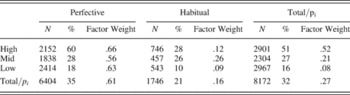
The inclusion or exclusion of habitual tokens has noticeable consequences for overall marking rates. As Table 2Footnote 9 shows, in urban BahCE, past inflection is much less likely when habituals are included in the calculations than when only perfectives are considered. The consequence for cross-variety comparisons is clear. If habitual tokens are counted, this will lower overall rates of past inflection, thus making the variety in question appear more “creole-like”;Footnote 10 conversely, if the envelope of variation is restricted to perfective verb situations, marking rates will be higher, and the variety will appear more “English-like.” To sum up, whether habitual verb situations are included in an analysis of variable past inflection or not has important implications for the conclusions drawn from the analysis, whether they pertain to clines of “creoleness” among similar or related varieties or the putative creole origins of any particular variety.
Past inflection in BahCE by grammatical aspect and speaker subgroup

Perfect and past-before-past situations
The definition of the temporal-aspectual dimensions of the variable (ed) outlined previously has excluded verb situations in which the “point of the event” is not equal to the point of reference. There are two such situation types:
1. Past situations that are anchored to the moment of speech, or—in Reichenbach's (Reference Reichenbach1947) terms—E—R, S, as in (15).
2. Situations that necessitate a past-before-past interpretation, or E—R—S, as in (16).Footnote 11
Whereas StE employs the Present Perfect in the first and the Past Perfect in the second case, both unmarked and inflected verbs surface in such environments in BahCE:
(15) The sun come back out—you see that? (Shanae, 26:14).
My complaint is high blood […] I had that from I was in my thirties. (Mrs. King, 13:28)
(16) When I went there, he was in the water—they throw him overboard. (Sharon, 2:4)
I was in a place—well, the Victoria Gardens, waiting on somebody who went there to carry something. (Mrs. Smith, 10:35)
Just like habitual pasts, perfect meanings may be seen to constitute a separate area of variability in CECs (Winford, Reference Winford1993a). What distinguishes these areas and warrants inclusion in the case of habituality but exclusion in the case of perfects is the absolute-past requirement. Past habitual situations may be seen as satisfying this requirement; perfect ones, on the contrary, are defined by their orientation toward the present or moment of speech. Moreover, at least in StE, the Simple Past is restricted to perfectives and past habituals; with few exceptions, to be discussed, perfect meanings invariably necessitate the have plus past participle construction.
Unlike StE, CECs do not possess a single perfect category. Depending on the meaning to be expressed, various options are available in BahCE: unmarked or inflected verbs, done, and constructions involving been or was. Among more acrolectal speakers, auxiliary have also occurs (cf. Winford, Reference Winford1993a:176). Cross-linguistically, the PERFECT is associated with four different uses. These are context-dependent and include the “perfect of result”; the “experiential” perfect; the “perfect of persistent situation”; and the “perfect of recent past” (Dahl, Reference Dahl1985:132).
In the perfect of result, “a present state is referred to as being the result of some past situation” (Comrie, Reference Comrie1976:56). Most speakers of BahCE employ done in this case:
(17) [A: It seems that your brother never finishes books. B:] (That is not quite true.) He READ this book (= all of it).
C: He done read all of this book.
J: Yeah, he's read them straight through, and he done read this one to the end.
V: He done read that whole thing—he done read that whole book, I see that!
The experiential perfect refers to a situation that has been obtained at least once in a period of time leading up to the present. Here, BahCE speakers show variation between unmarked and past-inflected verbs, with unmarked forms occurring far more frequently:
(18) [Q:] You MEET my brother (at any time in your life until now)?
A: This my brother—you met him before? You know him?
C: You meet my brother before?
D: You ever meet him?
J: You ever meet Charlie?
V: You ever met my brother before?
A special case of experiential is constituted by situations involving movement to and from a location. Almost invariably, these take the form of been plus locative complement:
(19) I never been Chicago, I never been—never been Chicago, I never been in New York, I never been New York, I never been Minnesota. It's couple of state I never been. Yeah. Think—I think I been in North Carolina. Yeah, I been (Henry, 4/15/97, 1:36–38).
The perfect of persistent situation presents a wide spectrum of forms in BahCE. Referring to a situation that has begun in the past but still obtains in the present, it always involves semantically stative predicates, usually containing a past form of be, that is, been or was. Following been or was may be verbs in the Progressive as well as noun phrases, adjective, or locative complements. Unmarked verbs, either stative or habitual (and thus semantically stative; cf. Smith, Reference Smith1997:50–51), can also occur in a perfect of persistent situation. It is generally accompanied by an adverbial naming a backward time span, such as (for) three weeks or since last week, as in the following example:
(20) [(Of a coughing child:) For how long has your son been coughing?] He COUGH for an hour.
A: How long he been coughing? He been coughing a hour.
J: How long he been coughing? He been coughing all day.
V: How long he had this cough? He been coughing for about a hour.
The perfect of recent past, also referred to as the “hot news” perfect (Dahl, Reference Dahl1985:132), finally, involves unmarked verbs again:
(21) [The speaker has just seen the king arrive (no one had expected this event)] (Have you heard the news?) The king ARRIVE
A: You hear the news? The king just reach.
C: The king reach.
D: The king come.
Whereas all of these situations would have to be discounted in an analysis of variable past inflection, especially with adverbs such as ever, never, or always, “Past and Present Perfect are largely interchangeable” in English (Leech, Reference Leech1987:46). This also holds for already, yet, and just. If these adverbs are used with the Present Perfect, their reading is either experiential (ever, never, always) or resultative (already, yet, just). Both of these uses, however, focus not upon a situation that began in the past and persists into the present but upon a situation that is seen as having taken place entirely in the past, either “once or repeatedly before the present” or with “some present result or state” (Winford, Reference Winford1993a:147). This secondary focus explains why the Simple Past in English and unmarked or inflected verbs in CECs are marking options. Examples such as the following could therefore plausibly be included:
(22) [You ever cured anyone with bush medicine? … ]
I never cure none, but I could give advice what kind of bush to get, yeah (Mrs. King, 12:40–41).
In a related vein, some cases in which English generally uses the Past Perfect represent potential sites for variable past inflection in CECs. This is the case, for example, in constructions with after that have “sequential meaning” and thus make the Past Perfect redundant (Quirk et al., Reference Quirk, Greenbaum, Leech and Svartvik1985:196, 1085). Arguably, structures such as the following can therefore be included as well:
(23) Well, my husband had me on couple drive […], and after I see he ain't had no patience no more, I ain't bother gone no more (Carol, 6/4/97, 15:31–32).
Cases in which after has recapitulative function, that is, where the verb structure introduced by after disrupts the normal, sequential ordering of events, however, must be excluded.
(24) The ambulance took me to the hospital—after they took me to hospital—uh—I was into Outpatient (Carol, 4/15/97, 12:18–19).
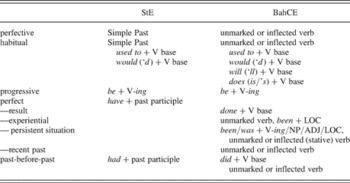
Table 3 summarizes possible past meanings and their formal realizations in StE and BahCE. Bold print indicates meanings that conform to the absolute-past requirement; they may be seen to constitute the temporal-aspectual extension of the variable (ed) for quantitative analyses of past inflection.
Possible past meanings and their formal realizations in StE and BahCE

FUNCTIONAL VERB CLASSES, MORPHOLOGICAL VERB CATEGORIES, AND LEXICAL IDENTITY
Having delimited the temporal-aspectual scope of the variable (ed), we can now turn to functionally, morphologically, and lexically determined “count” and “don't count” cases.
Functional verb classes
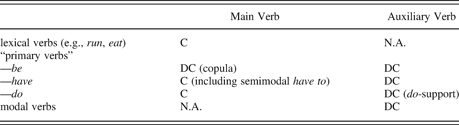
Even though this is not always spelled out (but cf. Poplack & Tagliamonte, Reference Poplack and Tagliamonte2001:115), analysts seem to agree that the study of variable past inflection must be confined to main verbs. This basically restricts it to one of the three functional classes outlined by Quirk et al. (Reference Quirk, Greenbaum, Leech and Svartvik1985:96): the lexical verbs. Only two of the “primary” verbs are usually counted: have, either as a main verb only or including the semimodal have to,Footnote 12 and do in main-verbal use, which excludes all cases of do-support, that is, negative and interrogative constructions as well as uses of did as a “‘stranded’ operator” with “quasi-ellipsis” of the predication (Quirk et al., Reference Quirk, Greenbaum, Leech and Svartvik1985:905), as in the following example.
(25) [So that's what happened to you, you think?]
It does—yes, it did, uh-huh (Sister Brown, 6:34–35).
As for be, it is widely agreed that the variable occurrence of this verb in both copula and auxiliary use constitutes a field of investigation separate from the present one. Modals, finally, are generally excluded from overall counts of past inflection in AAVE or CECs, as they function only as auxiliary verbs.Footnote 13Table 4 summarizes.
“Count” or “don't count”? Functional verb classes
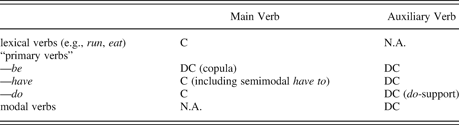
Note: C = “count”; DC = “don't count”; N.A. = does not occur.
Morphological verb categories
One of the best-known results from the study of past inflection in AAVE and CECs is that membership in a particular morphological category has an effect on the marking behavior of individual verbs. However, morphological categories have not only repeatedly been found to be the “strongest and most significant of all linguistic factors in structuring the variation between inflection and non-marking” (Patrick, Reference Patrick1999:226), they have also played a crucial role as a variable that may be diagnostic of the putative creole origins of AAVE. In his detailed comparison of mesolectal Trinidadian Creole with working-class black speech from Washington, DC, Winford (Reference Winford1992:324) suggests that “the present pattern of past marking in BEV [i.e., Black English Vernacular] may well have come about as the result of a process of language shift similar to that evidenced in the TE [i.e., Trinidadian English] continuum” (1992:325).
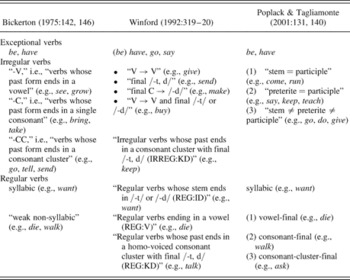
Later cross-variety comparisons of hierarchies of past inflection according to morphological category include Blake (Reference Blake1997a:158), Patrick (Reference Patrick1999:246), Poplack and Tagliamonte (Reference Poplack and Tagliamonte2001:121), and Hackert (Reference Hackert2004:159). Whereas Blake (Reference Blake1997a) and Hackert (Reference Hackert2004) have followed (and modified) Winford's categorization of verbs (1992), which, in turn, is based on Fasold (Reference Fasold1972), Patrick (Reference Patrick1999) is based on Patrick (Reference Patrick1992). As Table 5 shows, however, there are other models as well. Poplack and Tagliamonte (Reference Poplack and Tagliamonte2001), for example, aim to trace the historical precedents of verb stem usage in earlier AAVE; they follow Christian et al. (Reference Christian, Wolfram and Dube1988). This variety of categorizations produces inconsistencies, which, as Winford (Reference Winford1992:320) already pointed out, “pose somewhat of a problem for comparability of past tense marking in BEV and other varieties.”
Morphological verb categories across studies of AAVE and CECs

With regard to regular verbs, there now seems to be agreement that the three subclasses listed by Winford (Reference Winford1992:320) must be distinguished, as verbs ending in /t/ or /d/ pattern differently from those ending in a vowel. Verbs ending in a consonant other than /t/ or /d/, finally, are potentially subject to syllable-final consonant cluster reduction. Even though Bickerton viewed phonological factors as subordinate to grammatical ones, such as stativity and anteriority (1975:159), and consequently distinguished only [+syllabic] from [−syllabic] regular verbs (1975:104–105), the importance of phonological constraints on regular past inflection, first asserted by Labov et al. (Reference Labov, Cohen, Robins and Lewis1968), has repeatedly been reaffirmed (e.g., Hackert, Reference Hackert2004:152–153; Patrick, Reference Patrick1999:240; Poplack and Tagliamonte, Reference Poplack and Tagliamonte2001:125).
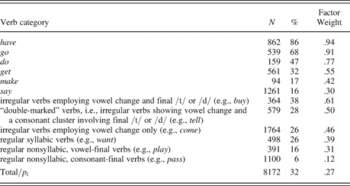
The picture becomes more complex once we move on to the irregular verbs. How many subcategories of irregular verbs are there? Which individual lexical items must be discounted or at least analyzed separately? It has long been recognized that particular high-frequency verbs must be separated from their respective morphological category to avoid skewed results. Thus, have and go, which both tend to appear in inflected form in both AAVE and CECs, as well as say, which shows a preference for unmarking,Footnote 14 are usually listed separately or even excluded, as in Winford's (1992) categorization. Patrick (Reference Patrick1999:226) also excludes do. What about make? As Fasold (Reference Fasold1972:38) already noted, make patterns strictly only with have in morphological terms: both verbs do not show a vowel change but replace a single final consonant by /d/. This suggests that make should be analyzed in conjunction with have, but, as Table 6Footnote 15 shows, at least in BahCE, make shows a marking pattern that is diametrically opposed to that of have, that is, it shows a trend toward unmarking.Footnote 16 If both were assigned to the same morphological category, the marking propensities of make could not be recovered, and the marking rate of have would be artificially lowered. Therefore, it can be argued that make should be assigned a category of its own as well. Table 6 includes another lexical category that is not commonly listed separately in studies of past inflection in AAVE and CECs: get. The verb get is a particularly versatile verb. A fundamental divide, however, runs along the stative/nonstative distinction and determines separation of the various structures into “count” and “don't count” cases. On the one hand, there is nonstative and variably past-inflected get in passive constructions or as a “resulting copula” (Quirk et al., Reference Quirk, Greenbaum, Leech and Svartvik1985:161), as in the following examples.
(26) I live—uh—by—uh—one man what get kill with one truck (George, 5/8/97, 1:23).
He working over there, he get straight, he get straight over there, he working over there now (George, 30:13).
On the other hand, there is stative get, which usually occurs in its inflected form got and is either possessive or existential in meaning or part of the “modal idiom” (Quirk et al., Reference Quirk, Greenbaum, Leech and Svartvik1985:141–142) got to, gotta, or gotty.
(27) Good water, sometime, in like—when we go in the farm, my grandparents, they ha—we got some hole they call cistern—cestern (Mrs. Miller, 4/16/97, 5:28–29).
And the student-them saying that—that—they—don't like to walk down that way late in the night. So now—they gotty have school there in the day—no school there in the night (George, 29:10–12).
This use of get must be discounted, as it is not generally amenable to past inflection, even if it occurs in past contexts. It might be hypothesized, however, that stative got, through its evident relation to nonstative get, nevertheless has an elevating effect on the past-marking frequency of the latter. In fact, even though the absolute rate of past inflection for get is not that much higher than that of the other vowel-change-only verbs in BahCE (32% versus 26%; cf. Table 6), with which it morphologically belongs, a chi-square test indicates that this difference is statistically significant at p = .011. Moreover, owing to its syntactic multifunctionality, get is one of the most frequent individual lexical items, which means that, if it is left with its morphological verb category, this category's rate of past inflection is artificially inflated.Footnote 17
Past inflection in BahCE by verb category

What Table 6 excludes is the class of “devoicing” verbs, for example, send. These are listed separately in Winford's classification (1992:319–320); however, a number of studies (e.g., Blake, Reference Blake1997a:153; Hackert, Reference Hackert2004:141; Patrick, Reference Patrick1999:141–142) have excluded them from their calculations because they evidence categorical consonant cluster reduction and are few in number. In sum, Table 6 basically reflects Winford's categorization with the addition of a number of lexically determined classes.
Idiosyncratic marking preferences of individual verbs also underlie the apparently deviant behavior of entire categories. Even though the “double-marked” verbs are usually treated as a separate category because they are often investigated in conjunction with consonant cluster reduction (e.g., Patrick, Reference Patrick1991), all three groups of vowel-change verbs (i.e., the buy, tell, and come groups) actually fall under a single morphological rule, if—as is commonly the case—the occurrence of the vowel change alone is regarded as sufficient to indicate overt past marking (cf. Winford, Reference Winford1992:320). One might therefore expect rates of past inflection to be similar across the three groups, but Table 6 shows that, at least in BahCE, verbs employing vowel change and /t/ or /d/ evidence a marking rate that, at 38%, is considerably higher than those of the other two groups, which are past-inflected at 28% and 26%, respectively. However, this elevated past inflection rate is actually an artifact of the behavior of a single verb: think. Think is not only rather frequent (its 54 tokens account for 15% of all verbs of its morphological category) but, at 78%, also past-inflected exceedingly frequently. If it is removed from the analysis, the past-inflection rate of the verbs employing vowel change and /t/ or /d/ drops to 31%—a frequency that more closely resembles that of the other vowel-change verbs.
What do we make of all of this? It might well be that the factor of the morphological verb category, whose importance has consistently been affirmed in studies of variable past inflection in AAVE and CECs, actually masks another, related factor: lexical identity. Poplack and Tagliamonte (Reference Poplack and Tagliamonte2001:14), in fact, come to exactly this conclusion. Even though their categorization of verbs is fairly different from the categorizations based on Winford's (1992) model (see Table 5), their breakdown of past inflection by individual lexical item and text frequency shows that
the division into verb classes […] is not particularly explanatory of the behavior of the verbs within them. Instead, the apparent effect of verb class reflects the varying lexical tendencies of its members, some of which favor the stem form and others the marked variant, and these are compounded by their differential representation in the data (Poplack & Tagliamonte, Reference Poplack and Tagliamonte2001:141).
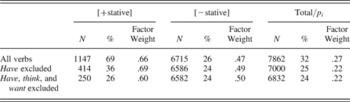
Another piece of evidence for the lexical identity hypothesis comes from the investigation of a different factor that is also commonly assumed to be diagnostic of creole status or heritage: stativity. In the “typical” creole TMA system outlined by Bickerton (Reference Bickerton1981:58), past-reference statives must be preceded by the “anterior” marker, whereas past-reference nonstatives are unmarked. Bickerton (Reference Bickerton1975:158) also asserts that “even […] late in the decreolisation process, grammatical constraints can exercise […] powerful effects”; this has usually been taken to imply that if any system of past temporal reference follows creole constraints, statives should be past-inflected at substantially higher rates than nonstatives. As in other CECs, stative verb situations are indeed much more likely to be past-marked than nonstatives in BahCE—69% versus 26% is an impressive difference in absolute frequency. When have, however, which accounts for over 60% of all stative verb situations and is past-marked near categorically (cf. Hackert, Reference Hackert2004:164), is removed, this rate drops to 36%. When, additionally, think and want are discounted, which are also rather frequent and marked at rates that exceed those of their respective morphological category, the marking rates of the two kinds of verb situations approximate. Table 7 summarizes.
Past inflection and stativity in BahCE

Lexical identity thus underlies not only the inflectional behavior of particular morphological verb categories but also the effect that stativity has on past marking. As for have, its influence on the high marking rates observed for statives has been noted for a number of creoles and related varieties, among them Jamaican Creole (Patrick, Reference Patrick1999:256–269), early St. Kitts Creole (Tagliamonte, Reference Tagliamonte, Baker and Bruyn1999:225), and earlier AAVE (Poplack & Tagliamonte, Reference Poplack and Tagliamonte2001:142). Patrick (Reference Patrick1999:259) even maintains, “studies of stativity which do not pay close attention to such a common and exceptional verb may be suspect.”
What should be compared across varieties in addition to overall frequencies of past inflection and marking rates according to verb category, thus, is the marking behavior of individual lexical items. This is not meant to suggest that “every word has its own pattern,” as the fact that most verbs can actually be subsumed under overarching morphological categories shows; nevertheless, such a comparison should yield interesting results. Whereas in Guyanese Creole (Bickerton, Reference Bickerton1975:147), get, for example, is past-inflected at a rate “only marginally higher than that of say,” in BahCE its rate of past inflection resembles that of other vowel-change verbs, and in earlier AAVE, get shows a strong preference for marking. Want, on the other hand, tends to be marked in BahCE; whereas in earlier AAVE, it “shows a clear preference for verb stem usage” (Poplack & Tagliamonte, Reference Poplack and Tagliamonte2001:142). Individual lexical marking preferences, finally, are not specific to AAVE or CECs; as Poplack and Tagliamonte (Reference Poplack and Tagliamonte2001:138–141) have shown, they have robust antecedents in the history of English. With the help of historical sociolinguistic data, such as that assembled in the Ottawa Grammar Resource on Early Variability in English, 1577–1898 (cf. Poplack & Tagliamonte, Reference Poplack and Tagliamonte2001:86), such preferences might eventually be correlated with particular geographical, social, and/or chronological trends in the history of English. These correlations would shed more light on the ultimate origins of AAVE or CECs than have synchronic comparisons according to complex and somewhat controversial factor groups, such as morphological verb category or stativity.
To return to the issue of delimiting the envelope of variation for a quantitative analysis of past inflection, the preceding suggests that more individual lexical items than previously thought should be considered and tested against morphological categories. A helpful resource for decisions about which verbs to analyze separately might be found in Biber et al. (Reference Biber, Johansson, Leech, Conrad and Finegan1999), a corpus-based, usage-oriented grammar of English. Biber et al.'s list of the 12 most common lexical verbs in English (1999:373) includes not only all those verbs about which there is general agreement as to their exclusion or separate treatment (e.g., say, go), but also a number of those whose exceptional status is not as obvious but has already been discussed (e.g., get, think, want, make). According to Biber et al., any of these 12 verbs occurs at a rate of over a thousand times per million words; their frequency is particularly high in conversation, where they account for nearly 45% of all lexical verbs—their role in sociolinguistic interviews, which are the usual way of obtaining data for quantitative analyses of variable linguistic features, should be very similar.
Another way of obtaining information as to the statistical distribution of lexical items is the use of electronic resources such as the International Corpus of English, which shares Biber et al.'s focus on StE. A useful first step in analyzing nonstandard or creole varieties such as AAVE or CECs would therefore be the setting up of word lists and/or concordances for each corpus, which would then permit the introduction of a separate category for high-frequency items or the restriction of the number of those items included in a sample. Such tools would also allow for the precise testing of frequency effects and the subsequent (re)assignment of particular lexical items to morphological categories. Finally, if performed for a number of CECs, they would constitute a first step in establishing frequency data for those varieties, which are still lacking, thus hampering not only variety-specific descriptions but also cross-variety comparisons.Footnote 18
CONCLUSION
Even though past inflection has been one of the most frequently researched variables in the study of AAVE and CECs, the delimitation of the envelope of variation—one of the fundamental tasks in quantitative analyses—has not received much detailed discussion. This article has summarized the literature to date on this topic and presented linguistic arguments and quantitative data in an attempt to provide an explicit base for the delimitation of the scope and relevant contexts of (ed). The discussion was restricted to an approach taking the variable's form as the point of departure; the basic question was in what way an unmarked verb might be a “way of saying the same thing” as a form marked via suffixation, vowel change, or suppletion.
I first looked at the temporal-aspectual dimensions of the variable, arguing that the inclusion of perfect situations can result in a “categorial and semantic mismatch” (Winford, Reference Winford1993a:141), as such situations constitute a variable context of their own, where unmarked and past-inflected verbs are but two minor forms encoding some of the meanings associated with the English Present Perfect. Habitual verb situations, on the other hand, may be argued to form part of the envelope of variation if they are clearly marked via a grammatical aspect factor group.
A second focus was on the inclusion or exclusion of “problematic” verbs and their assignment to morphological categories. In addition to be or have, which are generally either excluded or treated separately, there are numerous other high-frequency verbs, such as get, think, or want, which behave idiosyncratically in different varieties and may thus skew the marking properties of their morphological verb categories and hamper cross-variety comparisons.
Obviously, the alternation between unmarked and inflected past-reference verbs can be examined with different research aims in mind, which will then necessitate different delimitations of the variable context. If the focus is on the phonological process of syllable-final consonant cluster reduction, only two of the morphological verb categories discussed will be selected—in addition to words from other classes subject to the process. If the aim is to describe the grammar of past temporal reference of a single variety, the structures excluded here, that is, auxiliary constructions and preverbal past markers, will have to be included. Although such discrepancies hamper cross-variety comparisons and the conclusions drawn from them, they need not obviate them entirely. What is important is that sufficient methodological information be provided for the findings from one study to be replicated by another. Clearly, there is much more work to be done in the area of tense marking in AAVE and CECs; it is hoped that this article will contribute to the establishment of a sound methodological basis for this work.