INTRODUCTION
Early breast cancer constitutes about 30% of the breast cancer load in India as compared to 60–70% in the western world. Results from the west cannot be always applied to Indian patients because of social, economic and availability of standard of care (surgical skill and adjuvant treatment facilities). The data on early breast cancer are sparse from India as only few studies are published.1–3 With in this subset, patients with early breast cancer, the long-term risk of locoregional recurrence (LRR) after mastectomy and radiotherapy is <15%. However, patients with extracapsular extension (ECE), or patients with <10 lymph nodes recovered at axillary dissection have been demonstrated to have substantially higher rates of LRR. Results from the Early Breast Cancer Trialist's Cooperative Group metaanalysis and the most recent trials that investigated the benefits of postmastectomy radiotherapy (PMRT) suggested that all patients with lymph node–positive disease benefitted from this adjuvant treatment.4–6 Studies from United States in which patients with 1–3 positive lymph nodes were treated with mastectomy and standard axillary level I–II lymph-node dissection followed by systemic therapy reported 10-year LRR <15%.7–9 On the other hand, randomised trials from Europe and Canada in which less extensive surgery was performed reported an LRR of ≥30% for such patients.5,6 Few data are available to demonstrate factors predictive of LRR for patients with T1–T2 tumours who receive PMRT. Such data might be useful for determining subsets of patients for whom different locoregional treatment strategies should be considered. Very little is found in the literature about the role of PMRT for low-risk node-negative breast cancer patients. We undertook this study to analyse clinicopathologic predictors for LRR and to see the outcome of patients with T1–T2 breast cancer treated with surgery and radiotherapy in a regional cancer center from north India.
METHODOLOGY
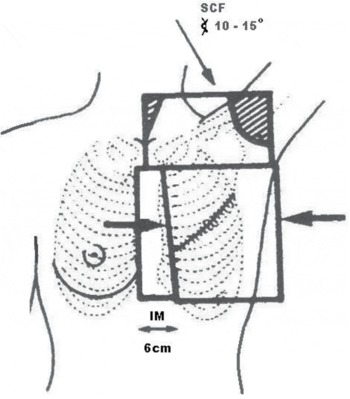
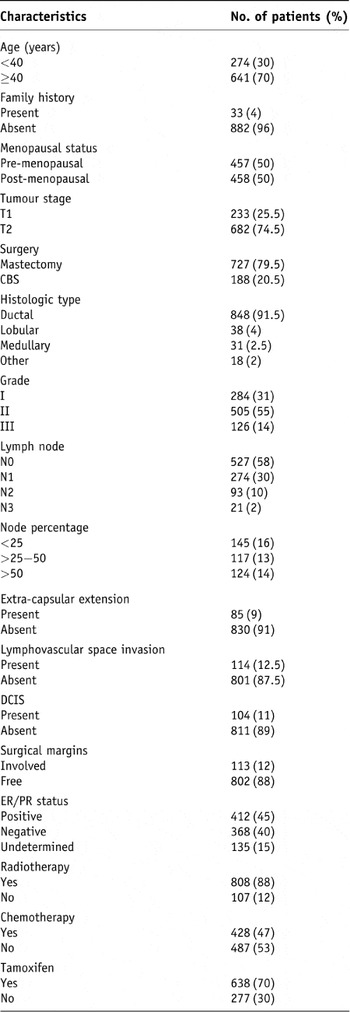
From 1990 to 2000, 915 patients with T1–T2 breast tumours, who underwent mastectomy or conservative breast surgery (CBS) with or without radiotherapy, were analysed retrospectively. In all the patients, a detailed analysis was carried out with respect to age, disease stage, radiation therapy technique, dose, the use of chemotherapy or hormonal therapy, and other clinical and/or pathologic characteristics as shown in Table 1. All parameters were entered into a computerised database. Majority of patients 671 (70%) were ≥40 years of age. T1 tumour was seen in 233 (25.5%) patients and 682 (74.5%) had T2 tumour. Lymph nodes were infiltrated in 388 (42%) patients. Hormonal receptors (ER/PR) were found to be positive in 412 (45%) patients. Mastectomy was done in 727 (89.5%) patients and 188 (20.5%) patients underwent CBS (Table 1). Post-operative radiation was given to 808 (88%) patients. We follow Manchester shorter fractionation schedule10 35 Gy to chest wall and 40 Gy to axilla and supraclavicular region given in 15 fractions over 3 weeks. Patients with CBS were given 40 Gy/16#/3 weeks. Doses were prescribed at the mid-point of the central axis. Patients were given radiation to axilla and supraclavicular region when axillary nodes were positive, when axillary status was unknown or when there was incomplete axillary dissection and in patients where axillary dissection was not done. Anterior photon field was used to deliver radiation to supraclavicular, infraclavicular, axillary and internal mammary (IMN) nodes. Two tangential opposed fields were used to irradiate chest wall. The borders for chest wall radiotherapy were the anterior midline (medial), the mid-axillary line (laterally), the inframammary fold (inferior) and the bottom of the head of the clavicle (superior) as shown in Figure 1. The supraclavicular, infraclavicular and high axillary lymph nodes were treated with an anterior photon field; the inferior portion of this field was matched to the superior edge of the tangent fields. The head of the humerus was also shielded from the radiation beam. IMN nodes were irradiated with a separate 12 × 6 cm field in 95 (10%) patients. Medial border of IMN was midline; lateral border 5–6 cm lateral to midline; superior border abuts the inferior border of the supraclavicular field; and the inferior border was above the xiphoid. Dose delivered was 40 Gy/15#/3 weeks calculated at a point 4–5 cm beneath the skin surface. Treatment was given using 60Co units or 4MV linear accelerator.
Chest wall, supraclavicular and internal mammary field marking for PMRT.

Patient and treatment characteristics

CBS, conservative breast surgery; DCIS, ductal carcinoma insitu.
Two chemotherapy regimes used were FAC (5-FU: 600 mg/m2, adriamycin: 50 mg/m2 and cyclophosphamide: 600 mg/m2) in 117 (12%) and CMF (cyclophosphamide: 600 mg/m2, methotrexate: 40 mg/m2 and 5-FU: 600 mg/m2) in 311 (35%) patients. Tamoxifen was given to 638 (70%) patients irrespective of ER/PR status; dose was 20 mg daily for 5 years. The patients were followed at regular intervals (every 3 months till 1 year, 4 months till 3 years, 6 months till 5 years and yearly there after) and further tested only if they had symptoms or evidence of recurrent disease, or metastatic disease.
Locoregional control and survival curves were generated by the Kaplan–Meier method. Locoregional control was defined as any recurrence in the skin or soft tissue over chest wall or a recurrence in the regional lymphatic sites (axilla, IMN, infraclavicular and supraclavicular). Univariate analysis was done using the log-rank test. Multivariate analysis was done using the Cox proportional hazards model for age, menopausal status, tumour stage, surgery, histological grade, nodal status (absolute number of nodes involved and percentage of nodes involved), deep resection plane, ECE, lymphovascular invasion (LVI), ductal carcinoma in situ (DCIS) ER/PR status, radiotherapy given, chemotherapy and hormones. The outcome studied were LRR, distant failure, locoregional recurrence-free survival (LRRFS) and overall survival (OS) using univariate and multivariate analyses.
All statistical tests were two-tailed and differences were considered to be statistically significant if p ≤ 0.05. Statistical analysis was performed using SPSS software version 12.0 (Statistical Package of Social Science, Chicago, IL). Local ethical committee had approved the treatment standard during the study.
RESULTS
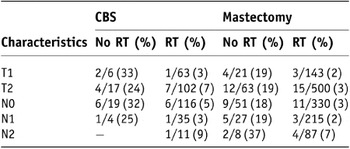
Mean age was 47 years (range 20–80 years). At a median follow up of 74 months LRR was 5.3% and distant metastases rate was 19%. Overall LRR in patients with CBS was 8% as compared to 4.6% in patients with mastectomy. LRR in patients with CBS followed with radiation was 3% as compared to 33% with out radiation (Table 2). LRR in patients with PMRT was 2% as compared to 19% with out radiation. LRR reduction rate with radiation was 30% in patients with CBS as compared to 17% for those with PMRT. Even in patients with N0 nodes over all LRR was 4% with radiation and 20% without radiation. LRR reduction rate was 16%. Worst case was in patients with CBS-N0 who were not given radiation. LRR in these patients was 32% as compared to 5% in those who were given radiation post-CBS. In patients with mastectomy with N0 status, LRR was 3% with radiation as compared to 18% without radiation. LRR reduction rate was 15 % (Table 2). Higher LRR in these patients (N0 nodes) with out radiation may be due to larger tumour size. Median tumour size was 4 cm in these patients and many (41%) of these patients had not received any systemic treatment.
LRR according to type surgery with and with out radiation

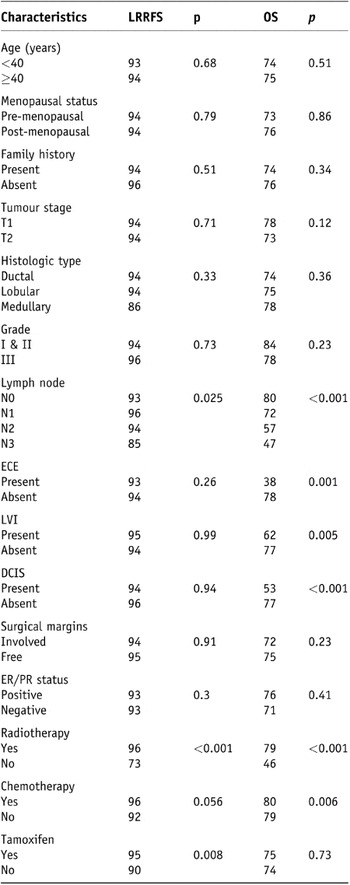
Disease-free survival (DFS) and OS at 10 year was 72% and 76%, respectively. On univariate analysis (Table 3) factors affecting LRRFS were type of surgery (p = 0.048), nodal involvement (p = 0.025), node percentage (p = 0.047), radiotherapy (p = <0.001) and hormonal therapy (p = 0.008). Factors affecting OS were nodal involvement (p ≤ 0.001), LVI (p = 0.005), DCIS (p ≤ 0.001), node percentage (p ≤ 0.001), ECE (p = 0.001), chemotherapy (p = 0.006) and radiotherapy (p ≤ 0.001).
Prognostic factors for LRRFS & OS at 10 years: univariate analysis

ECE, extracapsular extension; LVI, lymphovascular invasion; DCIS, ductal carcinoma insitu
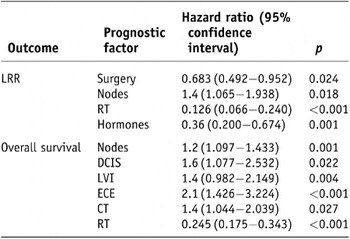
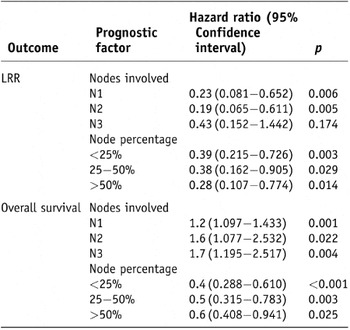
On multivariate analysis (Table 4) factors affecting LRRFS were type of surgery (HR 0.68, 95%CI 0.492–0.952), nodal involvement (HR 1.3, 95%CI 1.042–1.869), node percentage (HR 1.4, 95%CI 1.065–1.938), radiotherapy (HR 0.126, 95%CI 0.066–0.240) and hormonal therapy (HR 0.36, 95%CI 0.200–0.674). Similarly factors affecting OS were nodal involvement (HR 1.4, 95%CI 1.220–1.730), node percentage (HR 1.2, 95%CI 1.097–1.433), LVI (HR 1.4, 95%CI 0.982–2.149), DCIS (HR 1.6, 95%CI 1.077–2.532), ECE (HR 2.1, 95%CI 1.426–3.224), chemotherapy (HR 1.4, 95%CI 1.044–2.039) and radiotherapy (HR 0.245, 95%CI 0.175–0.343). In the Cox regression model, nodal ratio was a stronger prognostic factor for LRR as well as OS compared with absolute number of positive nodes (Table 5).
Significant adverse prognostic factors for various outcomes: multivariate analysis

Nodal involvement as significant prognostic factors for LRR and OS

DISCUSSION
Breast cancer accounts for 19–34% of all cancer cases among women in India.11–13 Advances in locoregional and systemic therapies in the past two decades have revolutionised breast cancer management but still CBS rate remains low in India. CBS was done only in 20.5% of patients in the present study. The CBS rate has almost doubled as compared to a study reported by Raina et al.2 during the same duration, but still it is too low as compared to that in the western world where 60–70% of patients go for CBS. The reasons for this low CBS rate could be patient's fear of the cancer as they just want to get rid of the organ which has developed such a dreadful disease (patient preference/fear), inadequate surgical skills, poor cosmetic outcome and lack of radiotherapy facility in many hospitals. Currently the trend is changing particularly in urban areas where women with breast cancer are opting for CBS.
CBS, increased percentage of positive nodes, no radiotherapy and no hormonal therapy were significant predictors of LRR among patients with T1–T2 breast tumour. In a study by Cheng et al.14 they developed a model to predict LRR and the impact of PMRT on survival. In addition to axillary nodal status, ER/PR status, LVI, and age at diagnosis were all found to be significant. Even a population-based analysis from British Colombia of 821 women with T1–T2 breast cancer with 1–3 positive nodes reported that nodal ratio >0.25, age <45 years, medial tumour location, and estrogen receptor–negative status were individual factors associated with post-mastectomy LRR risk of >20% and that combination of these factors were associated with even greater LRR risk.15
The results from the present analysis strongly indicate that the benefit of post-operative radiotherapy is equally pronounced in patients with 1–3 positive nodes and in patients with ≥4 positive nodes. LRR in patients with 1–3 positive lymph nodes was 2% with radiation and 19% without radiation. LRR reduction rate was 17% (Table 2). This is comparable to that reported by Woodward et al.16 where they have reported 3% and 13% LRR in patients with 1–3 positive lymph nodes with and without radiation, respectively. A recent analysis of 1152 patients from Danish Breast Cancer Cooperative Group 82 b & c trials with a more axillary dissection showed that radiotherapy resulted in a substantial reduction in the 15-year LRR rate from 51% to 10% (p < 0.001) in ≥4 positive node patients and from 27% to 4% (p < 0.001) in patients with 1–3 positive nodes, respectively. In contrast, the 15-year survival benefit after RT was equally pronounced in patients with 1–3 positive nodes (57% vs. 48%, p = 0.03) and in patients with ≥4 positive nodes (21% vs. 12%, p = 0.03).17 In the present study, LRR was 8% and 33% in patients with ≥4 positive lymph nodes with and without radiation, respectively. LRR reduction rate was 25%. In an analysis of 2016 patients treated with mastectomy and chemotherapy on Eastern Cooperative Group Trials, Recht et al.8 reported 10-year LRR of 28.7% for patients with ≥4 positive lymph nodes, and 12.9% for patients with 1–3 positive lymph nodes. Similarly Katz et al.7 suggested a 10-year total LRR of 25–34% for patients with ≥4 positive nodes, and 13% 10-year total LRR for patients with 1–3 positive nodes. LRR reported by Raina et al.2 is comparable to our study but with a lesser follow up (48 months). Percentage of nodes involved was a stronger prognostic factor for both LRR as well as OS as compared with absolute number of positive nodes (Table 5). The nodal ratio may be a more comprehensive approach to estimate LRR because it takes into account the number of excised nodes and may accordingly adjust for differences in axillary surgical staging. This finding is consistent with results from other outcome analyses.18–21
According to tumour stage, in T1 tumour LRR post-CBS irradiation was 3% as compared to 33% with out radiation. After PMRT in patients with T1 tumour, LRR was 2% as compared to 19% with out radiation. In patients with T2 tumours LRR post-CBS irradiation was 7% as compared to 24% without radiation. LRR was 3% and 19%, respectively, with and without PMRT (Table 2). LRR reduction rate was 16% for T1–T2 tumours with PMRT. So our observations confirm the findings of Truong et al.13 that patients with LRR estimate of <10% constitute a low-risk subgroup that may be spared of PMRT and that patients with LRR risk of >30% constitute a high-risk subgroup, justifying PMRT recommendations since a two-thirds relative reduction (absolute 20%) may translate to 10-year survival improvements of 4–5%. A 15–20% LRR may arguably be a reasonable threshold at which PMRT should be considered and discussed, with careful balancing of the benefits and risks and attentions to patient's goals and preferences. The present study also demonstrates a 16–20% risk of LRR in post-mastectomy patients with out radiotherapy in early stage breast cancer.
In the present study, anthracyclin-based adjuvant chemotherapy was given to only 27% patients as compared to 73% patients with treated with CMF regimen, so it may be difficult to compare with other studies where majority of patients were treated with anthracyclins based chemotherapy, but this chemotherapy regimen does not obviate the need for PMRT.4, 14 Still the LRR and OS results are better. Similarly Pisansky et al.22 reported on 342 women with T1–T2 tumour and 1–3 positive nodes treated with non-anthracyclin-based chemotherapy with or without tamoxifen. With a median follow-up of 9.3 years, the risk of LRR was 17%.
Our results are consistent with those of the Danish pre- and post-menopausal trials23, 24 where survival benefit of radiation therapy was confirmed in patients treated with adjuvant chemotherapy, and also with the meta-analysis of all adjuvant trials where radiation therapy given in conjunction with chemotherapy was compared with the same chemotherapy alone, confirming statistically significant reduction of over all mortality associated with radiation therapy.25 Analysis at 20 years from the British Columbia randomised trial has also shown significant benefit of PMRT for DFS and OS.5
The primary advantage of study population is big single institution group, coming from one geographical area, and thus sharing the same social, economic, ethnic and environmental parameters. Among 15 prognostic variables analysed in this study the adjuvant radiation was the strongest independent factor for LRR as well as OS. Limitation of the study is that it is a retrospective data. Therefore, decisions concerning the choice of mastectomy or CBS and use of radiation therapy for patients included in this study were made by treating physicians and patients, which introduce biases. Decisions to use PMRT have been primarily based on tumour stage and the absolute number of positive nodes.6,26,27 Other aggressive disease features such as LVI, ECE and positive surgical margins should also be considered while making such decisions. These decision-making processes require not only clinical judgement and skills in estimating risks, but also effective communication and careful consideration of patient's values and preferences.
The present study suggests that radiation use may offer a therapeutic advantage for all patients with T1–T2 breast cancer. Radiation post-CBS should be a standard practice. Most interesting finding of this analysis is the demonstration that PMRT reduced the risk of LRR in all categories of patients with lymph node positive as well as lymph node–negative disease.
Although this is not a randomised trial, this is high time to think about radiation therapy to patients with 1–3 positive lymph nodes because PMRT in low-risk breast cancer patients may reduce the overall mortality. Ongoing European trials such as the Selective Use of Post-operative Radiotherapy After Mastectomy trial as well as biologic predictors may resolve some of the issues raised here, but will require an additional 5–10 years before mature results become available. Until further data are available, however, we believe the great majority of patients with any involved axillary lymph nodes should be strongly considered for PMRT.