Introduction
Proper rearing management plays an important role in developing a healthy flock (Wattanachant et al., Reference WATTANACHANT, SUWANAPUGDEE, SUKSATHIT and MONGKOL2002; Od-Ton et al., Reference OD-TON, WATTANACHANT and WATTANASIT2004; Wattanachant and Wattanachant, Reference WATTANACHANT and WATTANACHANT2007).
The influence of light parameters such as intensity, Reference ANDREWS and ZIMMERMANphotoperiod and wavelength on bird physiology and immunity has been widely investigated (Lewis and Morris, Reference LEWIS and MORRIS1998; Morris, Reference MORRIS2004; Olanrewaju et al., Reference OLANREWAJU, THAXTON, DOZIER, PURSWELL, ROUSH and BRANTON2006) alongside other performance parameters (Barrott and Pringle, Reference BARROTT and PRINGLE1951; Cherry and Barwick, Reference CHERRY and BARWICK1962; Classen and Riddell, Reference CLASSEN and RIDDELL1989; Buyse et al., Reference BUYSE, KUHN and DECUYPERE1996; Manser, Reference MANSER1996). Correct lighting enhances the immune response of the bird and plays a vital role in alleviating the stress response in chickens (Xie et al., Reference XIE, WANG, DONG, CAO, WANG, CHEN and CHEN2008). The use of LEDs has more recently been introduced in modern poultry rearing systems. Blue, green or blue-green mixed monochromatic LEDs have a stimulating effect on total muscle weight of growing broilers (Rozenboim et al., Reference ROZENBOIM, BIRAN, UNI, ROBINZON and HALVEY1999a; Reference ROZENBOIM, ROBINZON and ROSENSTRAUCH1999b; Reference ROZENBOIM, BIRAN, CHAISEHA, YAHAV, ROSENSTRAUCH, SKLAN and HALEVY2004, Karakaya et al., Reference KARAKAYA, PARLAT, YILMAZ, YILDIRIM and OZALP2009).
This review focuses on information related to the effects of light, particularly LEDs and its role on immune response and meat quality parameters in poultry.
LEDs and immunity
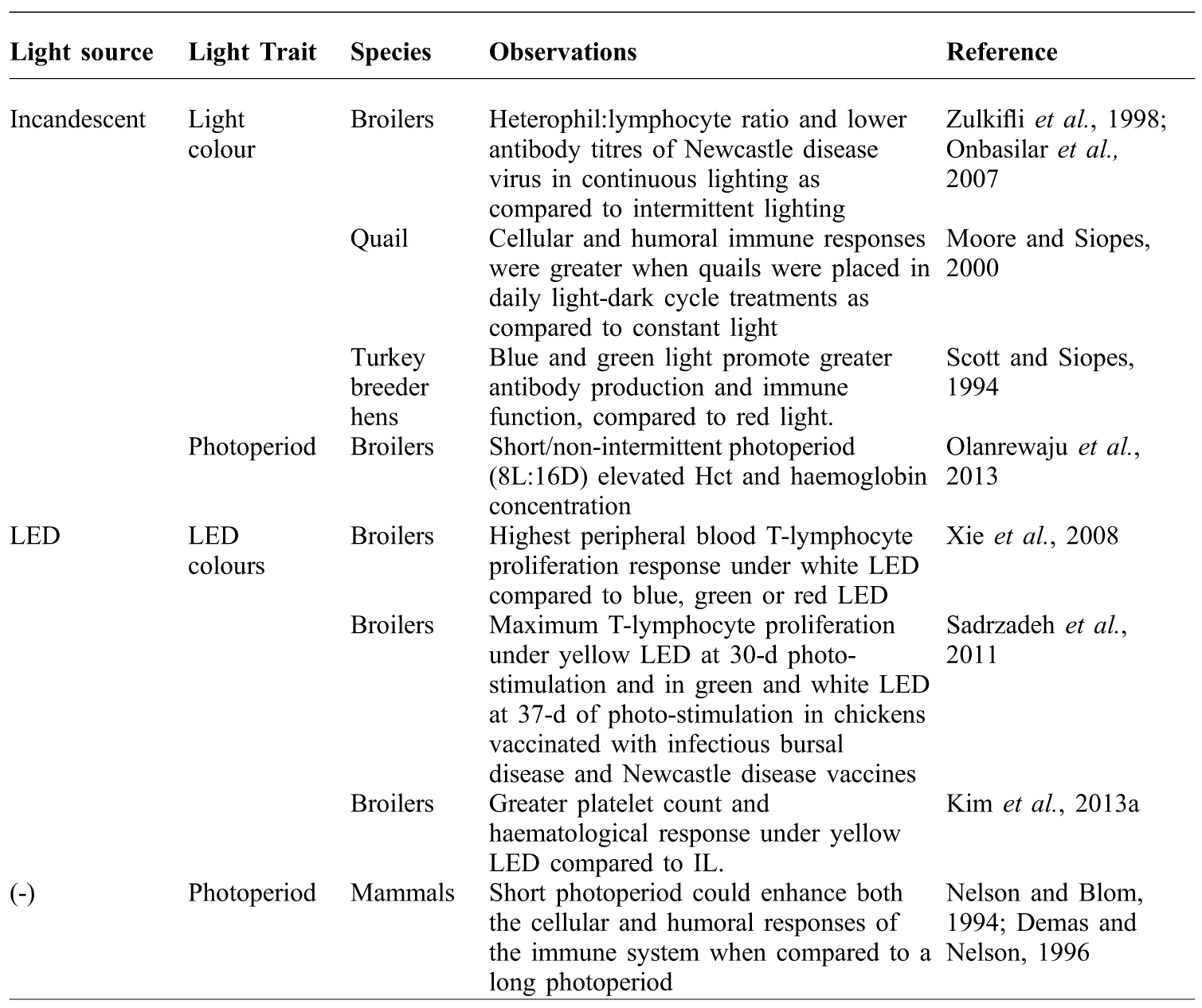
The practice of light stimulation to compensate or improve genetic potential may actually impair immuno-competence and negatively impact FCR. Theoretically, an increase in the number of erythrocytes of the same volume (MCV) always leads to the increase in haematocrit value (Hct). It has been found that chickens characterised by a greater number of erythrocytes (and hence higher Hct) could have erythrocytes of lower haemoglobin content (Nowaczewski and Kontecka, Reference NOWACZEWSKI and KONTECKA2012). A recent study by Olanrewaju et al. (Reference OLANREWAJU, PURSWELL, COLLIER and BRANTON2013) indicated that a short/non-intermittent photoperiod (8L:16D) elevated Hct and haemoglobin concentrations in broilers. In mammals, a short photoperiod can enhance both the cellular and humoral responses of the immune system when compared to a long photoperiod (Nelson and Blom, Reference NELSON and BLOM1994; Demas and Nelson, Reference DEMAS and NELSON1996). In birds, it has been shown that immune function can be suppressed in adult starlings photo stimulated with long daylengths (18L:6D). Both the cellular and humoral immune responses were greater when birds were placed in daily light/dark cycle treatments as compared to constant light (Moore and Siopes, Reference MOORE and SIOPES2000). Broilers had a higher heterophil:lymphocyte ratio and lower antibody titres to challenge with Newcastle disease virus in continuous lighting as compared to intermittent lighting (Zulkifli et al., Reference ZULKIFLI, SAYAADAH and MORMA1998; Onbasilar et al., Reference ONBASILAR, EROL, CANTEKIN and KAYA2007).
Any infection in the body can activate the granulocytes circulation in the blood when a chemical signal from infection or inflammation is received or via other cells of the immune system. Studies on different aspects of immunity showed that hormonal (endocrine), neural and immune functions correspond closely and interact within the immuno-neuro-endocrine network. Melatonin is important in enhancing not only circulating WBC but also the activities of B and T lymphocytes of immature male chickens without adversely affecting BW (Brennan et al., Reference BRENNAN, HENDRICKS, EL-SHEIKH and MASHALY2002). In addition, Gilbert (Reference GILBERT1963) and Sturkie (Reference STURKIE1951) have previously demonstrated an erythropoitic effect of thyroxin which can be stimulated by normal photoperiods (Blair et al., Reference BLAIR, NEWBERRY and GARDINER2000; Olanrewaju et al., Reference OLANREWAJU, PURSWELL, COLLIER and BRANTON2013).
Apart from photoperiods, the impact of light colours on immunity has been studied in poultry. In an experiment by Scott and Siopes (Reference SCOTT and SIOPES1994) on turkey breeder hens challenged with a phytohaemagglutinin-induced dermal injection (cutaneous basophilic hypersensitivity) found a greater response under red light than in green and blue light after 15 weeks of photo-stimulation. In these birds, blue and green light helped to promote greater antibody production and immune function, compared to red light. Xie et al. (Reference XIE, WANG, DONG, CAO, WANG, CHEN and CHEN2008) conducted a study using blue, green and red LEDs on the immune response of broilers and found that those reared under white LEDs had the highest peripheral blood T-lymphocyte proliferation responses compared to blue, green or red LEDs. In contrast, chickens vaccinated with infectious bursal disease and Newcastle disease vaccines had maximum T-lymphocyte proliferation when reared under yellow LEDs at 30-d photo-stimulation and in green and white LEDs at 37-d of photo-stimulation (Sadrzadeh et al., 2011). Kim et al. (Reference KIM, PARVIN, MUSHTAQ, HWANGBO, KIM, NA, KIM, KANG, KIM, YANG and CHOI2013a) observed better platelet counts and haematological responses in broilers reared under yellow LEDs compared to IL, which positively influenced growth performance. Table 1 summarises the trial result on effects of LEDs on immunity.
Impact of different light sources on immunity.

LEDs and meat quality
Poultry meat quality is an important factor and is gaining importance with rising awareness in a health-conscious society. Meat quality includes physical, chemical, morphological, biochemical, microbial, sensory, technological, hygienic, nutritional and culinary properties (Ingr, Reference INGR1989). Furthermore, quantifiable properties of meat such as water holding capacity, shear force, drip loss, cook loss, pH, shelf life, collagen content, protein solubility, cohesiveness and fat binding capacity are important for processors involved in the manufacture of value added meat products (Allen et al., Reference ALLEN, FLETCHER, NORTHCUTT and RUSSELL1998).
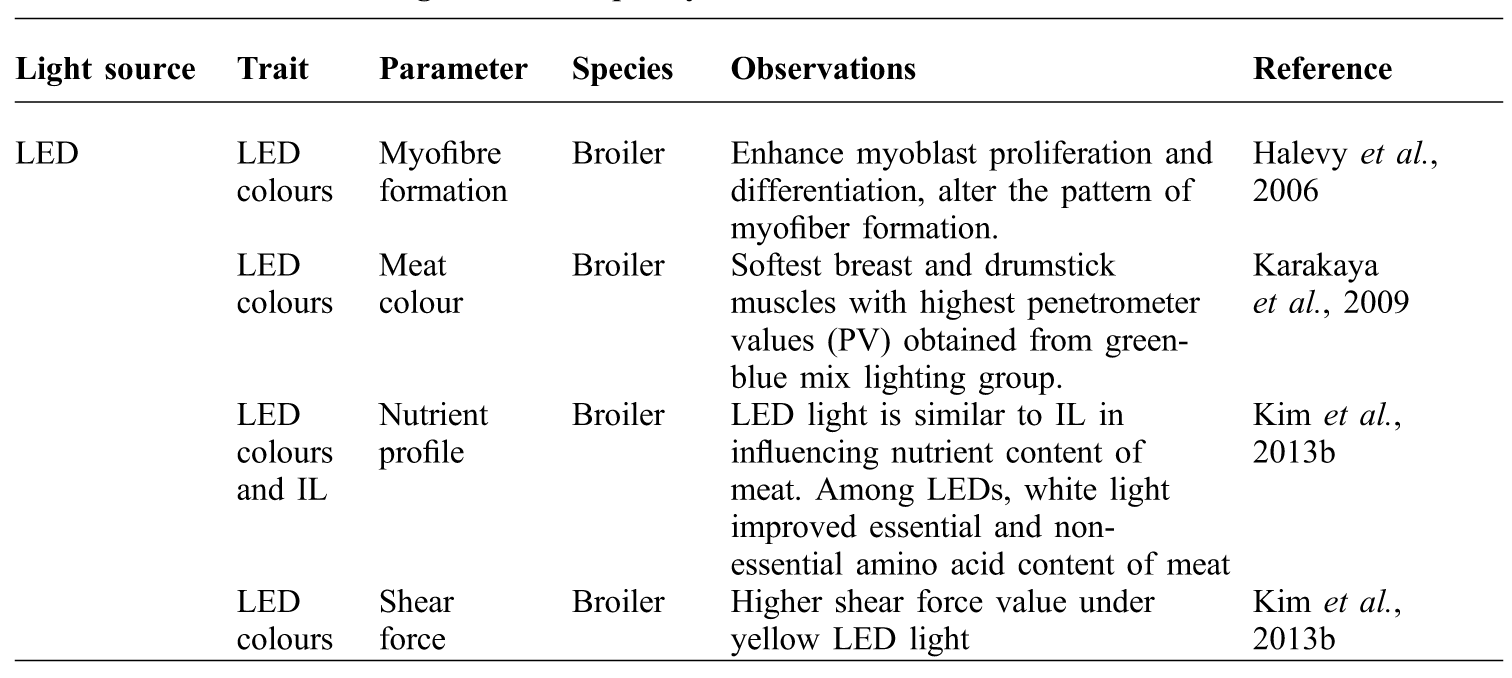
The effect of rearing systems on the protein and fat content of breast and leg muscles was reported by Bogosavljević-Bošković et al. (Reference BOGOSAVLJEVIC-BOSKOVIC, KURCUBIC, PETROVIC and DOSKOVIC2006). Access to the natural environment (including sunlight) resulted in differences in terms of the structural manifestations of tissues and organs, as well as in terms of the biochemical processes involved in metabolism. The influence of light wavelengths on muscle development during rearing is known, which in turn directly influences growth and meat yield. Halevy et al. (Reference HALEVY, PIESTUN, ROZENBOIM and YABLONKA-REUVENI2006) suggested that LEDs have stimulatory effects specific to adult myoblasts, enhancing their proliferation and differentiation, and consequently altering the pattern of myofibre formations. During embryogenesis, monochromatic green light penetrates the eggshell and has a direct effect on muscles in the embryo. Shorter wavelengths have been found to be effective at the dermal level, whilst blue light penetrates the abdominal wall of rats to a depth of 2 mm (Sisson and Wickler, Reference SISSON and WICKLER1974).
In an experiment by Karakaya et al. (Reference KARAKAYA, PARLAT, YILMAZ, YILDIRIM and OZALP2009), it was found that the breast and drumstick muscles obtained from poultry reared under green-blue mixed lighting group had the highest penetrometer values (PV), which indicated softer meat structure. Further trials (Kim et al., Reference KIM, PARVIN, MUSHTAQ, HWANGBO, KIM, NA, KIM, KANG, KIM, CHO, YANG and CHOI2013b) found higher shear force value in broilers reared under yellow light. Birds raised under red LED had high fat contents whereas white LED had least fat percentage in breast meat. Prayitno et al. (Reference PRAYITNO, PHILLIPS and STOKES1997) stated that low fat content in muscles could be related to activity in the white LED group that can affect their behaviour and thus the composition of the meat. It has been noted that LED light is similar to IL in influencing the nutrient content of breast meat. Among LEDs, white light improves the essential and non-essential amino acid content of breast meat (Kim et al., Reference KIM, PARVIN, MUSHTAQ, HWANGBO, KIM, NA, KIM, KANG, KIM, CHO, YANG and CHOI2013b). Table 2 summarises the current findings on light and meat quality.
Influence of LED light on meat quality.
Conclusions
LEDs have been introduced as a light source in poultry housing and are preferred over conventional light sources due to its various benefits. With shorter wavelengths such as yellow, blue and green or their combinations, LEDs can improve muscle and immune responses in broilers, and white LEDs has been shown to improve meat quality in broilers. The use of LEDs in poultry houses can improve meat yield, quality and bird immunity, while lowering energy costs over conventional light sources.